

Watching your grandchildren grow up from miles away can tug at your heartstrings. Fortunately, modern technology and intentional habits make long-distance grandparenting more rewarding and accessible than ever before.
You do not need an endless travel budget or daily phone calls to stay relevant in their busy lives. A steady presence, small rituals, and creative bonding ideas bridge hundreds of miles with ease.
This practical guide reveals actionable ways to strengthen your relationship, avoid common mistakes, and maximize your financial legacy for your family.
At a Glance: The Essentials of Long-Distance Grandparenting
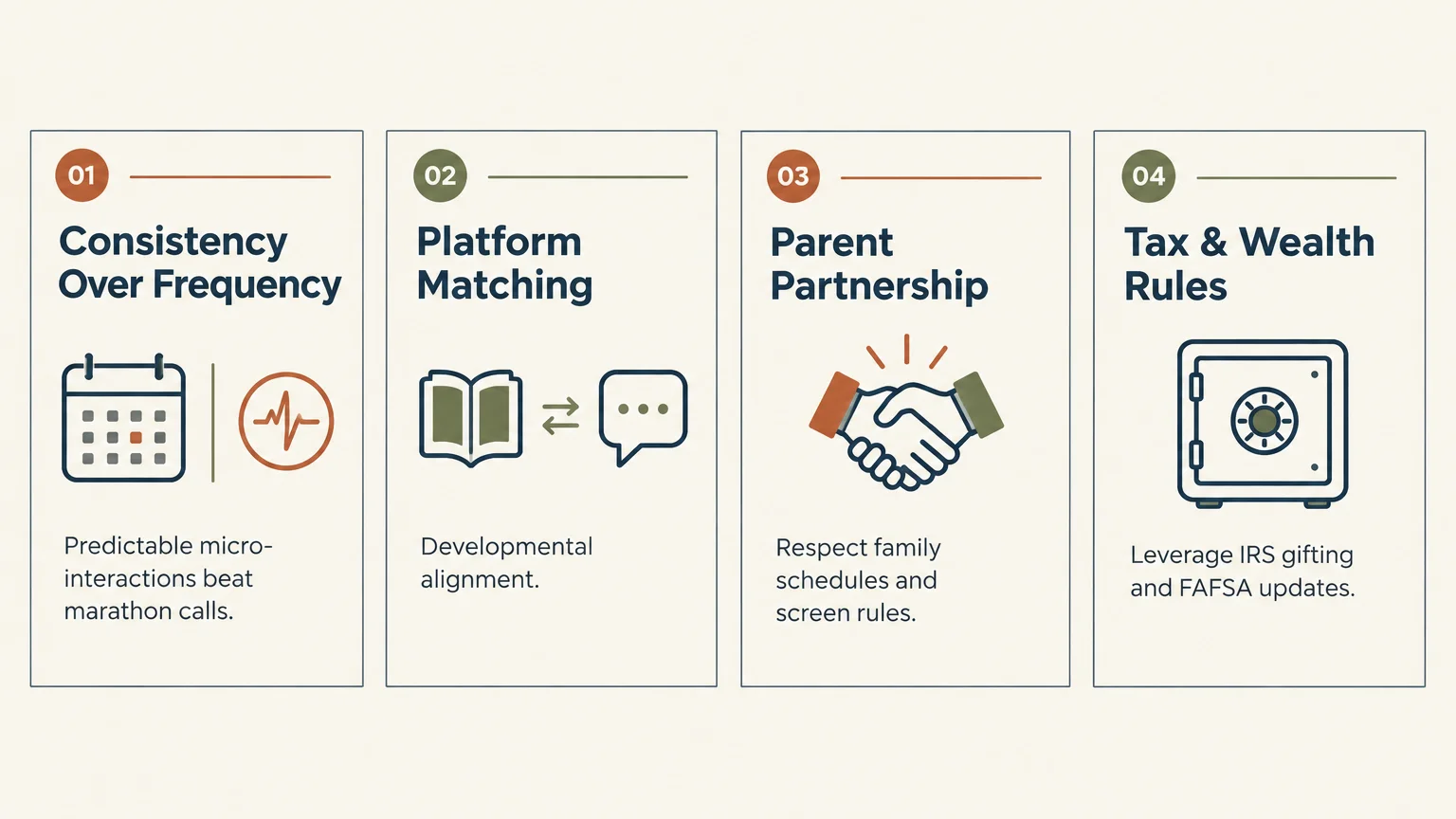
- Consistency beats frequency: Predictable, micro-interactions build stronger bonds than marathon phone calls every few months.
- Meet them on their platform: Match your communication style to their developmental stage, from picture books over video chat to casual texting.
- Coordinate with parents: Always partner with the parents first to align with family schedules, house rules, and digital screen boundaries.
- Leverage favorable tax updates: Current IRS rules and FAFSA changes allow you to gift money and fund college plans with unprecedented tax advantages.
Understanding the Modern Distance Barrier
Physical separation represents one of the most common hurdles modern families face. You are certainly not the only grandparent navigating this emotional challenge.
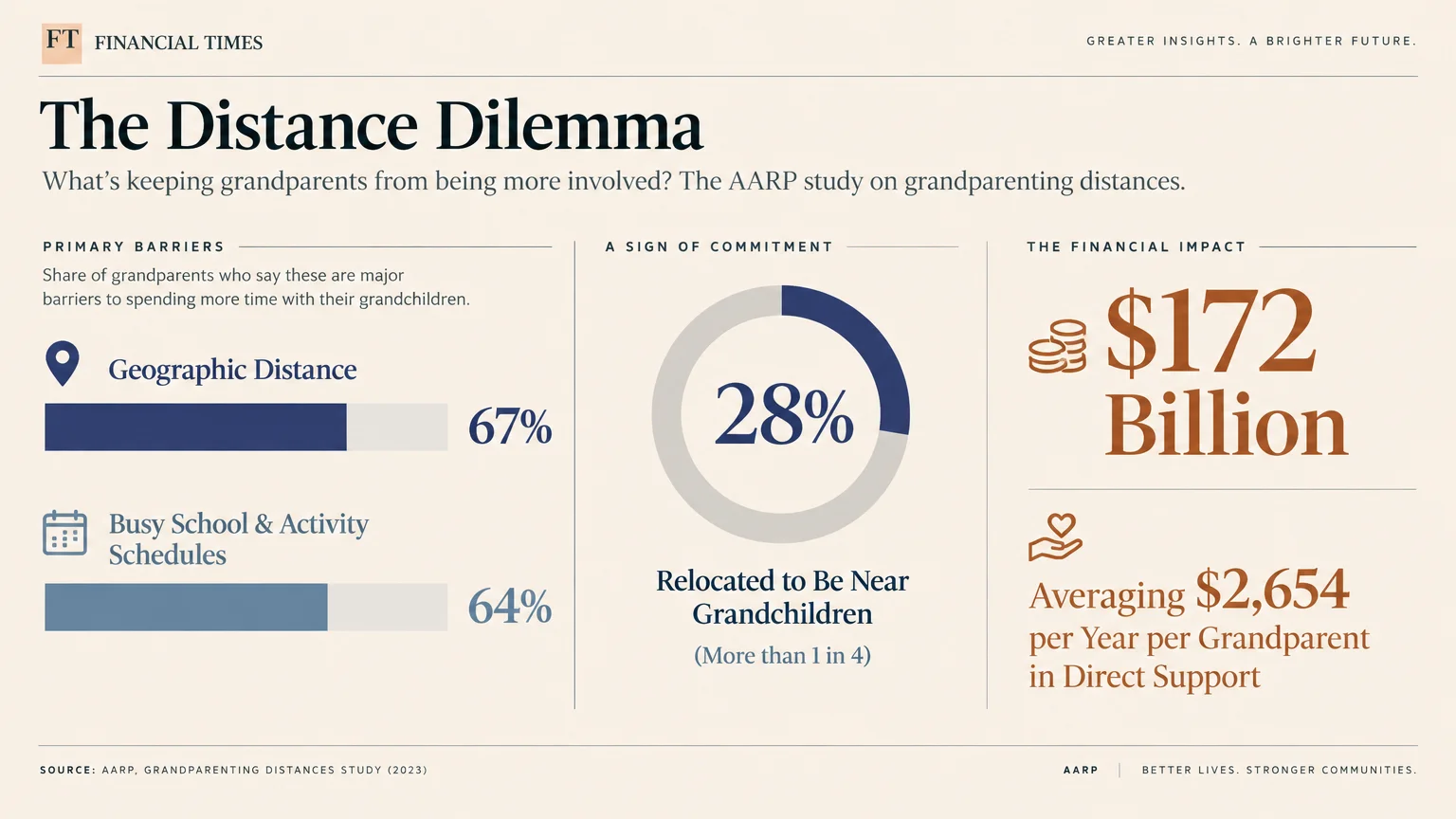
According to research from AARP, 67% of grandparents who do not see their grandchildren as often as they wish cite geographic distance as their leading obstacle. Busy school and extracurricular schedules rank second at 64%.
Family dynamics continue to shift as adult children relocate for career opportunities and affordable housing. In response, more than 1 in 4 grandparents (28%) have relocated to a new community or shared home specifically to be closer to their grandchildren.
Moving across the country is not feasible or desirable for every retiree. Your established community, healthcare providers, and housing budget often keep you rooted in place.
Grandparents also invest immense financial resources into their extended families. AARP’s Powering Families study reports that U.S. grandparents spend over $172 billion annually in direct support, averaging $2,654 per year across all grandchildren.
Directing both your time and financial gifts strategically ensures your investments create genuine, lasting closeness.

Age-Specific Grandparent Bonding Ideas
A five-year-old child and a sixteen-year-old high schooler relate to the world in fundamentally different ways. Tailoring your approach to their developmental stage prevents awkward calls and keeps interactions fun.
Engaging Toddlers and Preschoolers (Ages 2 to 5)
Young children have short attention spans and thrive on physical visuals. Staring at a static face on a screen rarely holds their attention for more than two minutes.
Keep video sessions brief and activity-centered. Read an illustrated picture book together by holding identical physical copies on both sides of the screen.
You can also sing familiar nursery rhymes, play peekaboo, or show them your pets. Young kids love visual tours of your garden, kitchen, or neighborhood birds.
Physical mail creates massive excitement for this age group. Sending a colorful postcard or sticker sheet gives them a tangible reminder that you adore them.
Connecting With Elementary Schoolers (Ages 6 to 11)
Elementary-age children develop distinct hobbies, humor, and reading skills. This stage offers rich opportunities for shared projects and cooperative games.
Set up an ongoing game of Battleship, checkers, or chess using duplicate boards at each home. You move the pieces on your end while they replicate the moves on theirs.
Establish a two-person book club with your grandchild. Read one chapter per week independently, then schedule a dedicated call to discuss the plot twists.
Try sending coded letters through the postal service. Include an alphabet cipher key so they can spend twenty minutes excitedly decoding your secret message.
Staying Relevant to Tweens and Teens (Ages 12 to 18)
Teenagers lead whirlwind lives packed with homework, sports, friends, and shifting emotions. Demanding a scheduled thirty-minute phone call often leads to monosyllabic answers.
Shift your strategy toward low-pressure, asynchronous communication. A funny meme, a quick text asking about their track meet, or a sports clip requires zero social pressure.
Show genuine curiosity about their digital interests. If they enjoy a specific mobile game, download it yourself and ask them to give you beginner tips.
Send occasional digital gift cards for a favorite smoothie shop or fast-food spot. Add a simple note saying: “Grab a drink on me between study sessions.”

Digital Tools That Bridge the Miles Without Breaking the Bank
Technology should simplify your relationships rather than complicate them. Several straightforward digital tools allow you to stay present without learning complex systems.
One exceptional tool for busy families is Marco Polo. This video walkie-talkie app lets you send short video messages that the recipient can watch and answer whenever convenient.
Parents and teenagers love this app because it eliminates phone tag. The core app remains completely free, while Marco Polo Plus costs $59.99 annually ($9.99 monthly) for expanded cloud storage.
For capturing family history, Storyworth offers an unmatched structured format. The platform emails you one thought-provoking question every week about your life, childhood, and life lessons.
You simply reply via email, and Storyworth automatically archives your reflections. At the end of one year, they bind your written memories and uploaded photos into a beautiful hardcover keepsake book for $99.
Standard platforms like FaceTime, Zoom, and WhatsApp also offer free screen-sharing features. You can watch educational videos, browse family photo albums, or solve digital jigsaw puzzles together in real time.

Financial Gifting Strategies: Building Grandchild Wealth Wisely
Many grandparents express love through financial gifts, college funding, and milestone contributions. Structuring these gifts properly protects your tax liability and maximizes every dollar.
Navigating the IRS Annual Gift Tax Exclusion
You can transfer meaningful financial gifts to your grandchildren each year without paying federal gift taxes or filing paperwork. The Internal Revenue Service (IRS) sets an annual exclusion limit per recipient.
For calendar year 2024, you can gift up to $18,000 per grandchild without filing IRS Form 709. For 2025 and 2026, the annual exclusion increases to $19,000 per recipient.
Married couples who agree to split gifts can combine their allowances. That means a married couple can gift up to $38,000 per grandchild in 2025 and 2026 entirely tax-free.
These gifts do not count as taxable income to your grandchildren. They also reduce the taxable value of your estate over time.
Grandparent 529 Plans Under the FAFSA Simplification Act
Historically, grandparents faced a major penalty when paying for college from a 529 account. Previous financial aid rules treated grandparent distributions as untaxed student income, reducing need-based aid by up to 50%.
That frustrating penalty no longer exists. Under the FAFSA Simplification Act, fully implemented for the 2024–2025 academic year, the FAFSA no longer requires students to report gifts or distributions from grandparent-owned 529 accounts.
Your grandchild can now utilize your 529 funds for qualified tuition, housing, and books without reducing their federal financial aid eligibility. This change makes grandparent-owned 529 plans one of the most effective ways to contribute to higher education.
You can learn more about managing long-term education investments at Investor.gov, managed by the U.S. Securities and Exchange Commission.
Unlocking SECURE 2.0 Rollovers to Roth IRAs
Grandparents often worry about overfunding a 529 plan if their grandchild chooses not to attend college or receives a scholarship. Thanks to the SECURE 2.0 Act, you have an incredible fallback option.
Starting in 2024, unused 529 plan funds can be rolled over directly into a Roth IRA in the grandchild’s name without penalties or taxes. This rollover carries a lifetime ceiling of $35,000 per beneficiary.
To qualify, the 529 plan must have been open for at least 15 years. Rollovers remain subject to annual Roth IRA contribution limits, and the grandchild must have earned income matching the transferred amount.
This provision lets you jumpstart your grandchild’s retirement savings decades early. A $35,000 Roth IRA funded in a young adult’s early twenties can easily grow into hundreds of thousands of tax-free dollars by retirement.

Comparing Long-Distance Connection and Support Methods
Balancing your time, emotional energy, and financial resources requires intentional planning. The following table highlights popular connection strategies and their associated commitments.
| Connection Strategy | Best Age Group | Financial Cost | Time Commitment | Primary Relationship Benefit |
|---|---|---|---|---|
| Marco Polo Video Messages | Tweens & Teens (12–18) | Free (or $59.99/yr) | 5–10 minutes weekly | Low-pressure, asynchronous updates that fit busy teen schedules. |
| Snail Mail & Activity Packets | Young Kids (3–10) | $5–$15 per month | 30 minutes monthly | Tangible excitement from receiving physical letters and puzzles. |
| Storyworth Keepsake Project | All Ages (Family Heirloom) | $99 standard fee | 15–30 minutes weekly | Preserves generational wisdom and personal family history in print. |
| Grandparent-Owned 529 Plan | Infants to College Age | Flexible contributions | 1 hour annual review | Compounds education wealth without damaging FAFSA aid eligibility. |
| Virtual Book Club or Co-Gaming | School Age (6–12) | Free to minimal | 30–45 minutes weekly | Creates shared experiences and mutual conversational topics. |
What Can Go Wrong: 4 Costly Long-Distance Mistakes
Even the most loving grandparents can inadvertently trigger friction when trying to connect across the miles. Steering clear of these four common missteps protects your relationships and finances.
1. Overstepping parental boundaries. Always consult the parents before scheduling calls, shipping large toys, or introducing digital apps. Contradicting house rules or bedtime routines breeds resentment with your adult children, who hold the keys to communication.
2. Guilt-tripping over missed calls. Children and teenagers frequently forget to return calls or seem distracted on camera. Expressing disappointment or saying “you never call me” turns calls into a chore rather than a joy.
3. Jeopardizing your own retirement budget. Spending thousands of dollars on frequent cross-country flights or extravagant gifts can strain a fixed income. You can consult tools on the Consumer Financial Protection Bureau (CFPB) website to maintain a balanced household budget.
4. Gifting cash without tax coordination. Handing large sums of cash or writing checks directly to college financial aid offices without understanding tax rules can trigger paperwork headaches. Structure your financial gifts alongside your broader estate plan to maximize family benefits.

Expert Wisdom on Family and Legacy
Maintaining financial clarity while supporting the next generation remains vital for every retiree. Generosity must always align with personal stability.
“True generosity is giving what you can afford, not what puts your own financial security at risk.” — Suze Orman, Personal Finance Author and Host
Your grandchildren need your presence, emotional wisdom, and encouragement far more than they need expensive items. Preserving your financial independence protects both your dignity and your family’s future.
Frequently Asked Questions
How often should I reach out to my long-distance grandkids?
Aim for consistent micro-interactions once or twice a week rather than exhausting monthly calls. Quick texts, postcards, or short video messages maintain steady connection without overwhelming their schedule.
Do grandparent-owned 529 plans hurt financial aid in 2026?
No, they do not. Thanks to the FAFSA Simplification Act, distributions from grandparent-owned 529 accounts no longer count as untaxed student income on the federal financial aid application.
What is the IRS annual gift exclusion limit for 2025 and 2026?
The annual gift tax exclusion is $19,000 per recipient for 2025 and 2026. A married couple splitting gifts can give up to $38,000 per grandchild without filing IRS Form 709.
How can I connect with teenage grandchildren who dislike phone calls?
Meet them where they communicate by using brief text messages, photo shares, or asynchronous apps like Marco Polo. Ask about their hobbies, send funny memes, and avoid lecturing them about call frequency.
Simple Steps to Deepen Your Connection Today
Staying close to your grandchildren does not require elaborate travel plans or dramatic gestures. It begins with small, repeatable actions that show you care about their day-to-day lives.
Pick one idea from this guide to put into practice this week. Whether you drop a fun postcard in the mail, download Marco Polo, or review your 529 college savings strategy, your initiative makes a lasting impact.
This is educational content based on general financial principles for seniors. Individual results vary based on your situation. Always verify current benefit amounts, tax rules, and program eligibility with official government sources.
Last updated: February 2026. Benefit amounts, tax rules, and program details change annually—verify current figures with official government sources.

Leave a Reply