

You can boost your retirement savings or launch a lucrative encore career without spending four years earning an expensive college degree. Many overlooked roles across healthcare, infrastructure, and skilled services pay far above the national median wage.
Whether you want full-time earnings or flexible semi-retirement income, these surprisingly high paying jobs offer steady demand and strong financial stability. You might already possess the foundational skills needed to step into one of them today.
Here is a detailed guide to 15 well paying jobs that outperform expectations, complete with current earnings data and practical entry paths.
Why Certain Underrated Careers Pay Substantially More
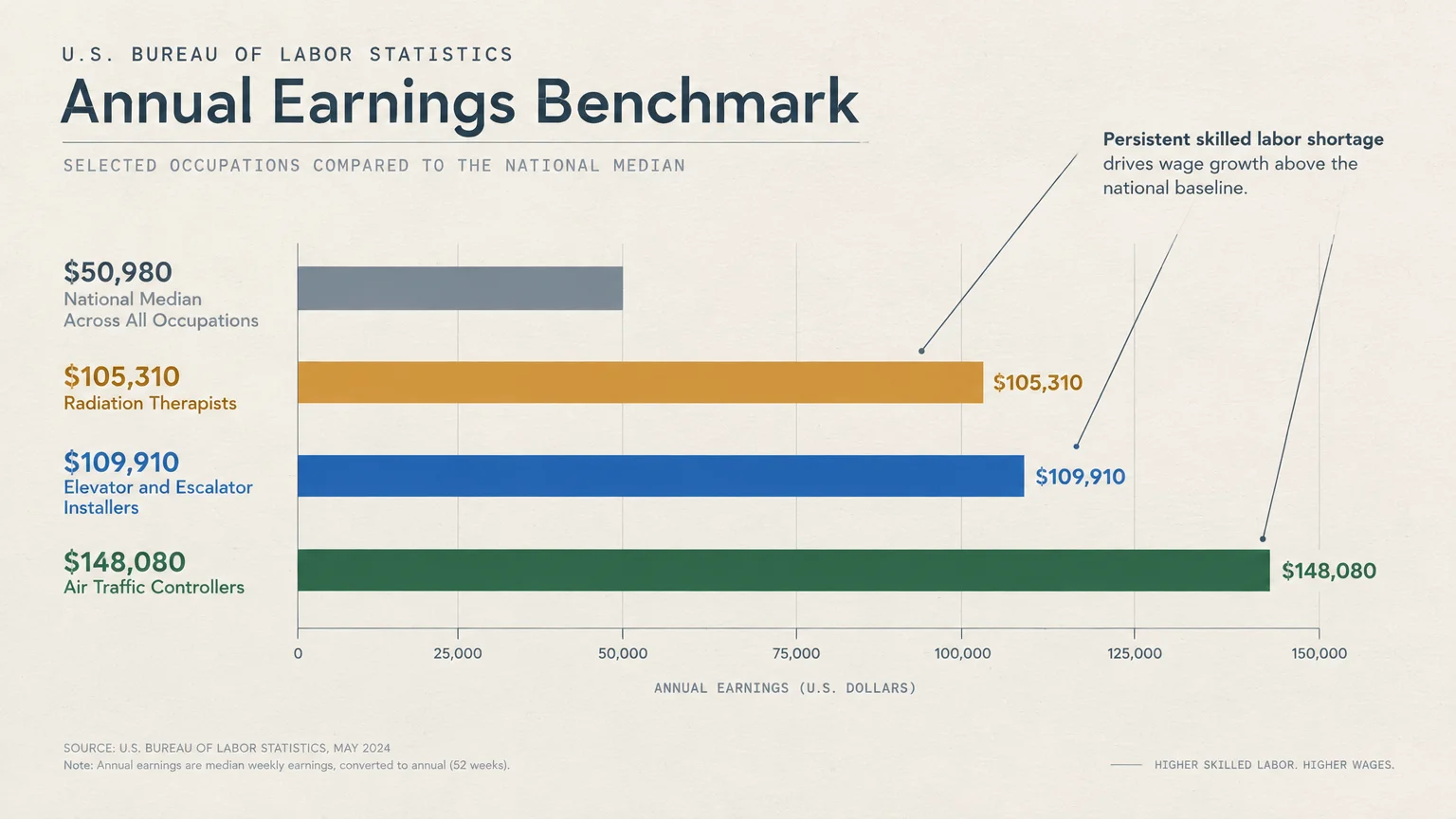
Most people assume that high salaries belong exclusively to corporate executives, physicians, and software engineers. However, the U.S. Bureau of Labor Statistics reports a national median annual wage of $50,980 across all occupations.
Dozens of specialized professions pay well beyond that baseline; many exceed six figures. These high salary jobs thrive because they solve critical technical challenges, manage regulatory requirements, or provide direct clinical support.
A persistent shortage of skilled labor drives wages upward in these fields. As veteran specialists retire, employers must offer competitive compensation packages to attract reliable talent.
For older workers, these careers offer tremendous leverage. Your work ethic, communication skills, and reliability make you an outstanding candidate for roles that value diligence over credentials.
“The best investment you can make is an investment in yourself. The more you learn, the more you’ll earn.” — Warren Buffett, Chairman and CEO of Berkshire Hathaway
15 Surprisingly High Paying Jobs to Consider
The following careers showcase unexpected earning potential across multiple industries. Each profile details current median pay, required credentials, and practical insights for older job seekers.
1. Air Traffic Controllers
Air traffic controllers manage the safe movement of aircraft across national airspace and airport runways. The Bureau of Labor Statistics reports a median annual wage of $148,080, which translates to roughly $71.19 per hour.
The role requires specialized training, an associate degree, and exceptional spatial awareness. While the Federal Aviation Administration maintains an age limit of 30 for new civilian hires, contract flight facilities and military-experienced controllers operate under different hiring rules.
Experienced aviation specialists frequently transition into private airfield coordination or simulation training instruction. These auxiliary positions preserve high earning potential without the extreme pressure of major commercial hub towers.
2. Elevator and Escalator Installers and Repairers
Elevator technicians assemble, maintain, and repair complex mechanical lifts and moving walkways. This essential infrastructure role commands a median annual pay of $109,910.
You do not need a college degree to enter the field; a high school diploma and a formal apprenticeship provide complete preparation. The industry projects a 6% employment growth through 2035.
Senior mechanics often shift toward diagnostic inspection, maintenance scheduling, and project consulting. This shift minimizes heavy manual lifting while retaining top-tier union wages and comprehensive healthcare benefits.
3. Radiation Therapists
Radiation therapists administer targeted radiation treatments to oncology patients under the supervision of medical physicists and oncologists. The median annual wage for this clinical specialty sits at $105,310.
You can qualify for state licensing by completing a focused two-year associate degree program. The profession offers structured, predictable daytime schedules without the overnight shifts common in general hospital nursing.
Older adults excel in this field because mature professionals bring emotional composure and empathy to the treatment room. Patients appreciate receiving care from compassionate specialists who understand healthcare challenges.
4. Power Plant Operators, Distributors, and Dispatchers
Power plant operators and energy dispatchers control the systems that generate and distribute electricity across municipal power grids. This technical profession yields an overall median salary of $105,080.
Nuclear power reactor operators earn even more, boasting a median wage of $122,890, while power dispatchers earn $106,730. Entry requires a high school diploma combined with extensive on-the-job technical training.
Much of the work involves monitoring control boards, adjusting voltage outputs, and responding to system diagnostics from comfortable stations. It rewards methodical thinkers who stay calm under emergency operating conditions.
5. Nuclear Medicine Technologists
Nuclear medicine technologists prepare and administer radiopharmaceuticals for diagnostic imaging and targeted medical therapies. The median annual pay for these healthcare specialists is $101,370.
Outpatient care clinics offer even higher earning potential, with median salaries reaching $171,170. Most employers require an accredited associate degree alongside standard clinical certification.
The physical demands remain far lighter than general bedside care. Technologists spend their hours calibrating sensitive instruments, reviewing scan results, and guiding patients through safe imaging procedures.
6. Dental Hygienists
Dental hygienists examine oral health, clean teeth, and educate patients on preventative oral care. They earn a median annual income of $98,100.
Licensing requires an accredited associate degree in dental hygiene, which typically takes two academic years to complete. The role represents one of the most adaptable encore careers in modern healthcare.
Dental practices routinely hire hygienists for two or three days each week. This flexible structure lets you collect substantial hourly wages while preserving plenty of personal time for your retirement lifestyle.
7. Diagnostic Medical Sonographers
Diagnostic medical sonographers use ultrasound equipment to capture internal body images for medical assessments. The Bureau of Labor Statistics reports a median annual wage of $96,590 for this specialty.
You can launch this career through an associate degree or a focused postsecondary certificate program. The non-invasive nature of ultrasound technology makes it an appealing healthcare path.
Hospitals, diagnostic laboratories, and private medical practices maintain constant demand for certified technicians. You can choose full-time positions, evening shifts, or per-diem assignment contracts that match your schedule.
8. Technical Writers
Technical writers translate complex technical processes, engineering data, and medical guidelines into readable instructional manuals. This communication discipline commands a median annual wage of $90,390.
While many practitioners hold bachelor’s degrees, relevant industry experience often carries equal weight with corporate hiring managers. Professionals with background knowledge in defense, finance, or technology transition smoothly into these assignments.
Technical writing is uniquely suited for remote work and independent consulting. You can take on lucrative corporate contracts from home without enduring daily highway commutes.
“Working even a few years longer changes the entire retirement math. It allows your investments to grow while cutting down the years you need to fund.” — Jean Chatzky, Financial Journalist and Author
9. Insurance Claims Adjusters and Damage Appraisers
Insurance claims adjusters inspect damaged property, evaluate accident liability, and calculate appropriate claim payouts. Auto damage insurance appraisers earn a median annual income of $78,240.
Most states require a high school diploma, basic insurance licensing coursework, and passing a state licensing exam. No multi-year academic degree is necessary to establish an independent appraisal practice.
Experienced professionals can work as independent desk adjusters, reviewing damage photographs and policy documents from a home office. Catastrophe claims adjusters can also travel temporarily to disaster areas for premium pay.
10. Construction and Building Inspectors
Building inspectors examine residential and commercial structures to verify compliance with local building codes and safety zoning regulations. The median annual pay stands at $74,690, with top earners collecting over $112,320.
Most jurisdictions require a high school diploma, practical trade experience, and state-issued inspection licenses. The Bureau of Labor Statistics projects 14,800 open inspection positions every year through 2035.
This occupation lets seasoned tradespeople monetize their practical construction knowledge without swinging hammers or hauling heavy materials. Municipal agencies provide steady weekday hours, defined pensions, and excellent health benefits.
11. Court Reporters and Simultaneous Captioners
Court reporters transcribe spoken courtroom proceedings, legal depositions, and live broadcast captioning word for word. These precise transcription specialists earn a median annual salary of $72,420.
Qualification requires a postsecondary nondegree award or community college certificate in machine shorthand or voice writing. Roughly 1,800 positions open annually across state courts and private reporting agencies.
Modern captioning technology enables many reporters to transcribe legal depositions remotely. You can operate as an independent contractor, accepting only the transcript assignments that fit your lifestyle.
12. Occupational Therapy Assistants
Occupational therapy assistants (OTAs) guide patients through rehabilitative exercises to rebuild physical coordination and motor skills. They earn a median annual wage of $72,300.
Entering this profession requires completing a two-year accredited associate degree and passing a national certification exam. Employment is projected to surge 20% through 2035, far outstripping average job growth rates.
OTAs work in rehabilitation hospitals, senior living centers, and outpatient orthopedic clinics. The role delivers immense emotional satisfaction as you help patients regain their personal independence.
13. Lodging Managers
Lodging managers oversee operations, guest services, housekeeping standards, and budgeting at hotels, resorts, and country inns. The median pay is $69,250 annually, which equals roughly $33.29 per hour.
Practical hospitality experience counts far more than academic credentials, with 5,500 annual openings nationwide. Many boutique bed-and-breakfasts and resort communities actively seek mature, customer-focused managers.
Some hospitality positions provide complimentary on-site apartments and utilities as part of the compensation plan. That unique arrangement can eliminate your housing overhead while bolstering your monthly savings.
14. Property Appraisers and Assessors of Real Estate
Real estate appraisers calculate property values for mortgage lending, tax assessments, and estate settlements. The median annual wage is $67,960, rising to $83,630 within financial institutions, while top appraisers exceed $122,660.
Licensing requires state-approved coursework, a period of supervised apprentice training, and passing a national examination. Many successful appraisers build independent practices that let them choose their daily volume.
The profession blends solitary research with on-site home visits. You can inspect a property in the morning and complete your comparable-sales report at your desk during the afternoon.
15. Hearing Aid Specialists
Hearing aid specialists conduct auditory tests, select appropriate amplification instruments, and fit custom hearing devices. They earn a median annual wage of $65,160, with the top 10% making over $94,020.
Most states require only a high school diploma, an apprenticeship period, and a state licensing examination. The field is projected to expand by 19.4% between 2025 and 2035 as the senior population grows.
Older workers bring empathy and personal rapport to this retail-health environment. Patients often feel more comfortable discussing hearing challenges with a mature practitioner who understands age-related sensory changes.
Compensation at a Glance: High Paying Careers Compared
The following table summarizes the median pay, entry training, and core lifestyle advantages of these 15 underrated careers. Use it to compare roles that fit your background and personal earnings goals.
| Career Field | Median Pay (BLS 2025) | Typical Entry Education | Key Advantage for Seniors |
|---|---|---|---|
| Air Traffic Controllers | $148,080 / year | Associate Degree | Lucrative private aviation consulting |
| Elevator Installers & Repairers | $109,910 / year | High School + Apprenticeship | Transition to safety and code inspection |
| Radiation Therapists | $105,310 / year | Associate Degree | Predictable daytime medical clinic hours |
| Power Plant Operators | $105,080 / year | High School + On-the-job Training | Control room oversight with minimal physical strain |
| Nuclear Medicine Technologists | $101,370 / year | Associate Degree | High hourly earnings in outpatient centers |
| Dental Hygienists | $98,100 / year | Associate Degree | Outstanding part-time and per-diem flexibility |
| Diagnostic Medical Sonographers | $96,590 / year | Associate Degree / Certificate | Clean, non-invasive diagnostic work |
| Technical Writers | $90,390 / year | Bachelor’s Degree or Experience | Excellent remote and freelance contract potential |
| Insurance Claims Adjusters | $78,240 / year | High School / State License | Independent desk claims adjusting from home |
| Building Inspectors | $74,690 / year | High School + Certification | Monetizes construction expertise safely |
| Court Reporters & Captioners | $72,420 / year | Postsecondary Certificate | Remote deposition transcription opportunities |
| Occupational Therapy Assistants | $72,300 / year | Associate Degree | Rapid 20% industry job growth |
| Lodging Managers | $69,250 / year | High School + Experience | Potential on-site housing benefits included |
| Real Estate Appraisers | $67,960 / year | Licensing Coursework + Trainee Hours | Autonomous schedule with self-employment control |
| Hearing Aid Specialists | $65,160 / year | High School + State License | Growing senior demand and peer connection |

How Working Affects Your Social Security Benefits
Earning an income in your 50s, 60s, or 70s strengthens your personal wealth, but you must monitor federal earnings regulations. Your Full Retirement Age (FRA) determines how employment affects your monthly benefit check.
According to the Social Security Administration, full retirement age is 67 for anyone born in 1960 or later. If you have already attained your FRA, you can earn unlimited wages without any benefit withholding.
If you claim Social Security early and continue working, an earnings test applies. In 2026, the annual exempt earnings limit for beneficiaries under FRA all year is $24,480 ($2,040 monthly).
The agency withholds $1 in benefits for every $2 you earn above that $24,480 threshold. For workers reaching FRA during 2026, the limit rises to $65,160 ($5,430 monthly) for the months before reaching full retirement age.
In that transition year, the agency withholds $1 for every $3 earned above the limit. Looking ahead, the exempt threshold rises to $25,560 for beneficiaries under FRA all year and $67,920 for those reaching FRA in 2027.
Withheld Social Security benefits are never permanently lost. Once you reach full retirement age, the government recalculates your monthly payment upward to credit you for the withheld amounts.
What Can Go Wrong: Common Pitfalls for Second-Career Seniors
Embarking on a new career path late in life delivers great rewards, but careless planning can cause expensive setbacks. Keep these common traps on your radar before accepting a new position.
Triggering Unexpected Tax Brackets
Adding wages on top of retirement distributions can push your adjusted gross income into a significantly higher bracket. Furthermore, extra income can cause up to 85% of your Social Security benefits to become taxable.
Check the latest brackets with the Internal Revenue Service before accepting a high-paying offer. You may need to adjust your tax withholding to prevent an unwelcome tax bill in April.
Mishandling Medicare Enrollment Rules
Many workers assume employer coverage always replaces Medicare, but business size dictates the rules. If your new employer has fewer than 20 employees, Medicare remains your primary payer at age 65.
Failing to enroll in Medicare Part B on time can result in permanent lifetime late-enrollment penalties. Review coordination guidelines on Medicare.gov before waiving any coverage.
Underestimating Physical Requirements
Certain technical occupations require standing for long stretches, carrying gear, or bending into tight mechanical spaces. Always assess the physical demands of job training programs before paying tuition.
If stamina is a concern, select roles with low physical exertion, such as technical writing or desk claims adjusting. These paths preserve your joints while delivering excellent hourly compensation.
Ignoring Licensing Timelines
Many high-paying roles require passing state examinations and completing supervised apprenticeship hours. Underestimating these requirements can leave you without income for several months.
Research your state licensing board requirements well before you plan to transition. Preparing study materials in advance ensures a smooth entry into your chosen field.

When to Consult a Professional
A career shift later in life touches every corner of your personal balance sheet. Scheduling a consultation with an accountant or fee-only financial planner helps you navigate these four scenarios:
- Coordinating Benefit Withholdings: A certified financial planner can calculate how your anticipated wages interact with early Social Security claims and pension payouts.
- Navigating Employer Health Plans: A health insurance counselor can confirm whether your employer health plan qualifies as creditable coverage under Medicare rules.
- Managing Tax Bracket Creep: A tax professional can recommend pre-tax retirement plan contributions to shelter fresh employment earnings from high tax brackets.
- Protecting Consumer Credit: The Consumer Financial Protection Bureau encourages reviewing debt obligations before financing late-career vocational training.
Frequently Asked Questions
Can I work full-time after reaching Full Retirement Age?
Yes, you can work as many hours as you choose once you reach Full Retirement Age. The Social Security Administration places no cap on earnings for beneficiaries at or above FRA.
Your monthly check will never be reduced regardless of how much you earn. In fact, substantial current earnings can replace lower-earning past years and raise your baseline benefit.
Do I have to go back to college for four years to earn a high salary?
No, most of the careers listed in this guide require only an associate degree, trade certification, or on-the-job training. Many professionals transition into these fields within 12 to 24 months.
Your previous professional background often shortens the learning curve. Transferable skills like organization, customer relations, and problem solving give you an immediate edge.
How does earning more income impact my Medicare Part B premiums?
High earned income can trigger the Income-Related Monthly Adjustment Amount, commonly known as IRMAA. This surcharge raises your monthly Medicare Part B and Part D premiums.
The government calculates IRMAA using your tax return from two years prior. Consulting an accountant helps you monitor whether your new wages will trigger these surcharges.
Where can older adults find job placement resources?
The AARP Job Board connects workers age 50 and older with employers who have signed an age-diversity pledge. These organizations value the experience that mature employees offer.
Local community colleges and workforce development boards also sponsor discounted vocational training for seniors. Many states subsidize certifications in high-demand fields like healthcare and infrastructure inspection.
Taking Your Next Career Step
Pursuing an underrated, well-paying career can revitalize your daily routine and restore financial resilience. Whether you choose part-time dental hygiene, technical writing, or building inspection, substantial earnings remain within reach.
Review the licensing requirements in your home state, evaluate your personal financial goals, and select a path that aligns with your passions. A rewarding second chapter is waiting for you.
This is educational content based on general financial principles for seniors. Individual results vary based on your situation. Always verify current benefit amounts, tax rules, and program eligibility with official government sources.
Last updated: November 2026. Benefit amounts, tax rules, and program details change annually—verify current figures with official government sources.









Leave a Reply