

If your monthly Social Security check tops $2,095, you receive more money than the typical American retiree. That monthly payment climbs to $2,170 in January 2027, placing you well above the national median.
Many retirees assume most seniors collect the maximum payout, but actual numbers tell a very different story. Knowing where your check stands helps you make smarter choices about withdrawals, taxes, and daily spending.
This retirement income benchmark reveals how your benefits compare across the country. Understanding these numbers empowers you to protect your purchasing power and optimize your overall retirement plan.
The Real Benchmark: Average Social Security Benefit Amounts
Many pre-retirees imagine that a standard Social Security check reaches $3,000 or $4,000 every month. Official data from the Social Security Administration shows a far more modest reality.
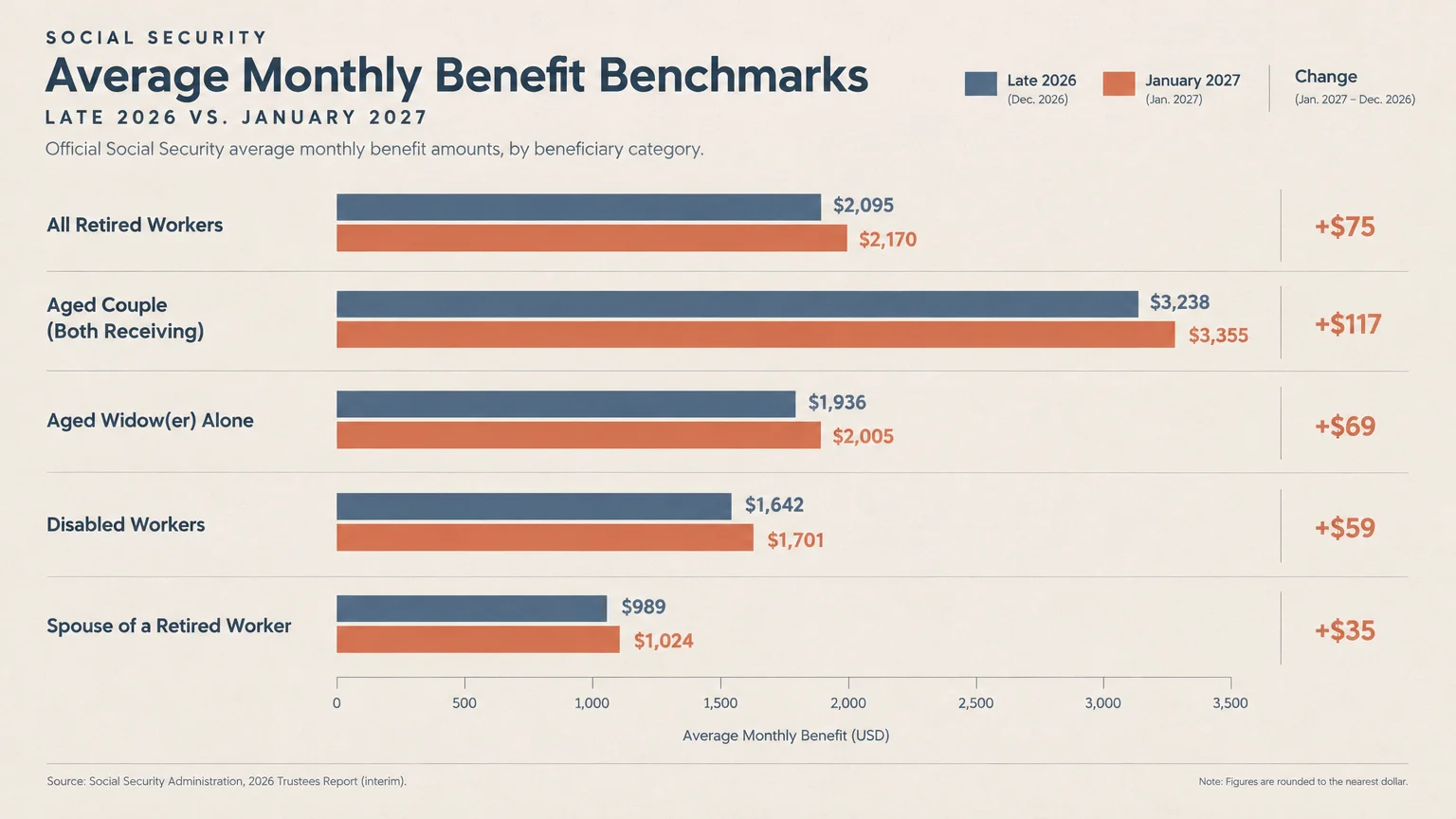
In late 2026, the estimated average monthly benefit for all retired workers stands at $2,095. That translates to roughly $25,140 per year in guaranteed baseline income.
Starting with payments delivered in January 2027, that national average increases by $75 to reach $2,170 per month. On an annualized basis, an average recipient collects approximately $26,040.
If your current monthly benefit exceeds these figures, you receive an above average Social Security payout. You have outpaced the baseline earnings record of most retired American workers.
Your social security check amount reflects your highest 35 years of indexed earnings. Earning more than the national benchmark indicates that your career earnings remained consistently strong over several decades.
Benchmark numbers also vary significantly depending on household filing status. A single retiree faces a different income baseline than a married couple sharing two separate benefit checks.
Tracking this retirement income benchmark gives you an objective baseline. You can gauge whether your guaranteed income covers essential living expenses before you touch your investment portfolio.
Benchmark Comparison: Where Your Check Ranks
Evaluating your Social Security comparison requires looking beyond single retired workers. The Social Security Administration tracks payout levels across several beneficiary categories.
Couples, surviving spouses, and individuals receiving disability benefits each have unique national benchmarks. The table below outlines official average benefit levels across late 2026 and January 2027.
| Beneficiary Category | Late 2026 Average Monthly Benefit | January 2027 Average Monthly Benefit | Monthly Dollar Change |
|---|---|---|---|
| All Retired Workers | $2,095 | $2,170 | +$75 |
| Aged Couple (Both Receiving Benefits) | $3,238 | $3,355 | +$117 |
| Aged Widow(er) Alone | $1,936 | $2,005 | +$69 |
| Spouse of a Retired Worker | $989 | $1,024 | +$35 |
| Disabled Workers | $1,642 | $1,701 | +$59 |
For an aged couple where both partners collect benefits, the joint average reaches $3,238 in late 2026. In January 2027, that joint payment rises to $3,355 per month.
Surviving spouses face unique economic hurdles after losing a partner. The average monthly benefit for an aged widow or widower living alone rises from $1,936 in late 2026 to $2,005 in 2027.
Spousal benefits provide crucial supplemental income for households with one primary earner. A spouse claiming on a retired worker’s record receives an average of $989 in late 2026, climbing to $1,024 in 2027.
Disabled workers receive an average monthly payment of $1,642 in late 2026. Their average benefit increases to $1,701 per month under the 2027 adjustment.
Reviewing these averages shows where your household stands. If your household benefit surpasses $3,355 per month, your combined Social Security income outranks most American retiree couples.

How Retirees Build an Above-Average Benefit
Securing an above average Social Security check does not happen by accident. The program uses a strict mathematical formula based on earnings history, career duration, and claiming age.
The Social Security Administration calculates your primary insurance amount using your highest 35 years of earnings. The agency adjusts those wages for historical wage inflation.
If you worked fewer than 35 years, the agency enters zeros into the formula for the missing years. Those zero-income years drag down your lifetime average and reduce your ultimate monthly check.
High earners who pay the maximum payroll tax each year achieve substantially higher payments. The wage cap limits how much annual income faces the 6.2% Social Security payroll tax.
In 2026, the taxable maximum wage cap is $184,500. For 2027, that taxable wage limit increases to $192,300, requiring high earners to pay taxes on more income.
Your claiming age serves as the final lever determining whether your check lands above or below average. Claiming before your Full Retirement Age triggers a permanent reduction in monthly income.
Workers born in 1959 reach Full Retirement Age at 66 years and 10 months. Anyone born in 1960 or later faces a Full Retirement Age of 67.
If you file for benefits at age 62, your monthly check drops permanently by up to 30%. In 2026, the absolute maximum payment for an early filer at age 62 is $2,969.
Retirees who wait until Full Retirement Age secure much higher ceilings. The maximum benefit at Full Retirement Age is $4,152 per month in 2026, increasing to $4,188 per month in 2027.
Delaying claims past Full Retirement Age provides the biggest boost. You earn delayed retirement credits worth 8% per year for every year you wait up to age 70.
A top earner who delays benefits until age 70 qualifies for a maximum check of $5,181 per month in 2026. In 2027, that maximum monthly payout climbs to $5,358.
“Delaying your claim is the single best investment return you can guarantee in retirement.” — Suze Orman, Personal Finance Author and Host
Few Americans achieve the absolute maximum check because it requires 35 years of earnings at or above the wage cap. Anyone beating the $2,095 or $2,170 benchmark remains well ahead of the pack.
The 2027 COLA: How Inflation Adjustments Expand Your Lead
Annual cost-of-living adjustments protect your benefits from persistent consumer price inflation. On October 14, 2026, the Social Security Administration announced a 3.6% COLA for 2027.
This 3.6% boost represents a noticeable step up from the 2.8% adjustment implemented for 2026. The increase applies to nearly 72 million beneficiaries nationwide.
Higher starting checks produce larger absolute dollar gains under percentage adjustments. A 3.6% increase on a below-average check of $1,500 adds $54 each month.
If your monthly check already sits above average at $2,500, a 3.6% COLA adds $90 per month. Over a full calendar year, that difference delivers $1,080 in extra cash flow.
Beneficiaries receiving Supplemental Security Income see their higher payments first. Increased checks for roughly 7.3 million SSI recipients arrive on December 31, 2026.
All other Social Security recipients receive their higher payments beginning in January 2027. Your payment date follows your standard monthly distribution schedule based on your birth date.
You can check your personalized benefit change before paper statements arrive. Beneficiaries who set up paperless notices in their online account by November 18, 2026, view notices online in late November.
The agency mails paper notices throughout the month of December to beneficiaries who prefer physical mail. Checking your statement early allows you to build an accurate household budget for the upcoming year.
Working While Collecting: The Retirement Earnings Test Explained
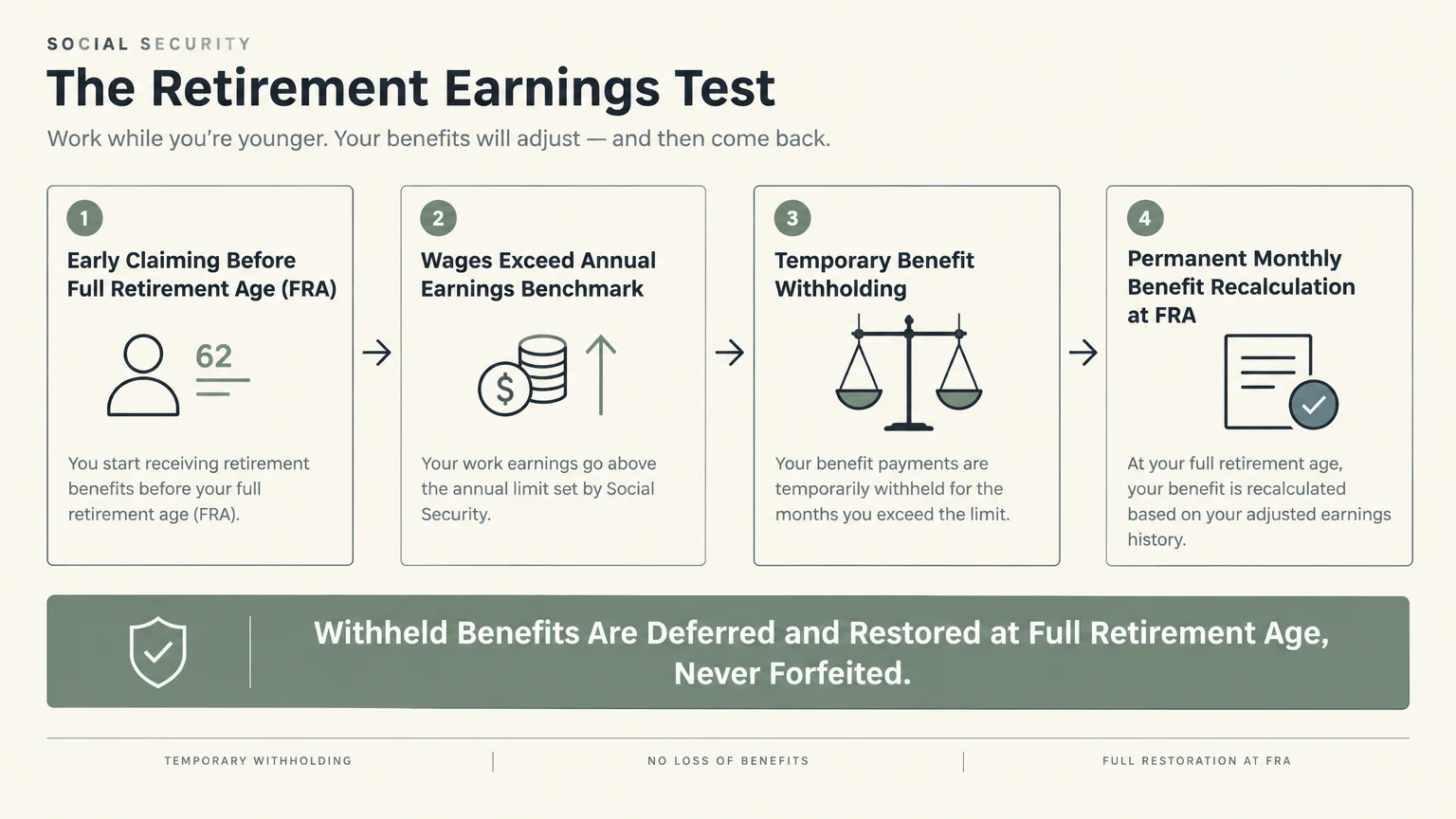
Many seniors choose to work part-time or consult while receiving Social Security benefits. If you claim benefits before reaching Full Retirement Age, the government limits your earned income.
The Retirement Earnings Test temporarily withholds benefits if your wages surpass annual statutory limits. The Consumer Financial Protection Bureau highlights that this rule only applies before Full Retirement Age.
In 2026, the earnings limit for workers under Full Retirement Age is $24,480 per year, or $2,040 per month. That limit increases to $25,560 per year, or $2,130 per month, in 2027.
If you earn more than the limit, the agency withholds $1 in benefits for every $2 earned above the threshold. Earning $4,000 above the limit results in $2,000 in withheld benefits.
A more generous limit applies during the calendar year you reach Full Retirement Age. In that specific year, the limit covers only the months before your actual birthday month.
The earnings limit in the year you reach Full Retirement Age is $65,160 per year ($5,430 monthly) in 2026. That limit rises to $67,920 per year ($5,660 monthly) in 2027.
In the year you reach Full Retirement Age, the agency withholds $1 for every $3 earned over the cap. Once you reach your exact Full Retirement Age, all earnings limits disappear entirely.
Withheld benefits do not disappear permanently. The Social Security Administration recalculates your monthly benefit at Full Retirement Age to credit you for every withheld month.
That recalculation permanently increases your subsequent monthly checks. Working while collecting may temporarily delay payments, but it does not forfeit your earned lifetime benefits.
Taxes on Social Security: The Hidden Cost of an Above-Average Check
Collecting an above-average Social Security check offers clear financial advantages, but it also increases your tax exposure. Many retirees do not realize that federal taxes apply to Social Security benefits.
The Internal Revenue Service uses a calculation called combined income to determine whether your benefits face taxation. Combined income includes adjusted gross income, nontaxable interest, and half your Social Security benefit.
Single filers with combined income between $25,000 and $34,000 pay federal income tax on up to 50% of their benefits. If combined income exceeds $34,000, up to 85% becomes taxable.
For married couples filing jointly, the lower threshold sits between $32,000 and $44,000 for the 50% tax bracket. Combined income above $44,000 subjects up to 85% of benefits to income taxes.
Congress established these income thresholds in 1983 and never indexed them for inflation. Because benefit checks have grown over four decades, most above-average recipients now trigger these taxes.
If your annual benefit reaches $26,040, half of that total represents $13,020 toward your combined income. A modest pension or retirement account distribution quickly pushes you past the $32,000 or $44,000 marks.
This dynamic often creates the retirement tax torpedo, where each extra dollar of IRA income exposes more Social Security to taxation. Coordinating your withdrawals helps you avoid unexpected spikes in your effective tax bracket.

Common Mistakes to Avoid
Managing an above-average benefit requires vigilance to avoid costly filing errors and tax penalties. Many retirees forfeit thousands of dollars simply because they misunderstand program rules.
- Claiming Early Without Running the Lifetime Math: Taking benefits at age 62 locks in a permanent 30% reduction. Unless you face urgent health concerns or cash shortages, claiming early permanently diminishes your lifetime guaranteed income.
- Triggering Unnecessary Taxes on Benefits: Taking large, irregular distributions from traditional IRAs pushes your combined income into the 85% taxation zone. Spreading withdrawals evenly across multiple years keeps your taxable income predictable.
- Overlooking Spousal and Survivor Protections: When the higher earner claims early, they permanently diminish the future survivor benefit for their spouse. Delaying the primary earner’s claim protects the surviving partner’s lifelong financial security.
- Ignoring Administrative Online Account Updates: Failing to verify your earnings record on your personal account allows wage reporting errors to stand. Correcting these errors promptly ensures you receive every dollar you earned over your career.
Avoiding these common missteps allows you to preserve your above-average status throughout your retirement years. Proactive planning keeps more money in your bank account.
Smart Strategies to Protect and Enhance Household Benefits
Whether you already collect benefits or plan to claim soon, specific strategies optimize your household income. You can implement several practical adjustments to protect your purchasing power.
If you reach Full Retirement Age and regret claiming early, you can voluntarily suspend your benefit payments. Suspending benefits allows your checks to accrue delayed retirement credits at 8% per year until age 70.
Continuing to work during retirement can also raise your monthly check. If your current earnings exceed one of your earlier 35 indexed years, the agency automatically recalculates your benefit upward.
Married couples should coordinate their claiming timelines strategically. Having the lower-earning spouse claim earlier while the higher earner delays until age 70 maximizes both current income and future survivor benefits.
You can also access supportive community resources through the Administration for Community Living. These programs help older adults navigate local tax relief, utility assistance, and healthcare cost management.

Finding the Right Advisor
Managing substantial Social Security benefits alongside investment portfolios often requires qualified professional guidance. A certified financial planner helps you align your guaranteed income with your tax strategy.
Consider consulting an independent, fee-only fiduciary advisor if you identify with any of the following scenarios:
- You Balance Large Traditional 401(k) or IRA Balances: An advisor calculates the exact withdrawal order to minimize the tax torpedo on your Social Security benefits.
- You Face Complex Marital or Survivor Decisions: If you qualify for divorced spousal benefits or survivor benefits, professional planning prevents you from leaving money on the table.
- You Plan to Work Past Age 62 While Claiming: A planner helps you model the Retirement Earnings Test so you do not encounter surprises with benefit withholding.
- You Want to Coordinate Delayed Credits With Portfolio Longevity: An advisor evaluates whether spending down taxable assets while delaying Social Security to age 70 improves your long-term wealth.
The right professional focuses on your comprehensive financial picture rather than selling proprietary financial products. Seek credentials like Certified Financial Planner (CFP) to ensure high fiduciary standards.
Frequently Asked Questions
What is the average Social Security benefit in 2026 and 2027?
The estimated average monthly benefit for retired workers is $2,095 in late 2026. In January 2027, that national average increases by $75 to reach $2,170 per month.
What is the maximum Social Security check possible?
In 2026, the maximum check is $2,969 at age 62, $4,152 at Full Retirement Age, and $5,181 at age 70. In 2027, the maximum at age 70 reaches $5,358 per month.
How does the 2027 COLA affect my monthly payment?
The 3.6% COLA announced on October 14, 2026, increases all benefits starting with January 2027 payments. An average check of $2,095 increases by roughly $75 each month.
Can I collect an above-average benefit and still work?
Yes, but if you are under Full Retirement Age, earnings above $24,480 in 2026 ($25,560 in 2027) trigger benefit withholding. Once you reach Full Retirement Age, all earnings limits vanish.
Will my above-average Social Security check be taxed?
Yes, if your combined income exceeds $25,000 for single filers or $32,000 for married couples filing jointly. Up to 85% of your benefits may face federal income taxation.
Making the Most of Your Retirement Benchmark
Earning an above-average Social Security benefit provides a sturdy foundation for your retirement years. It delivers reliable, inflation-adjusted income that continues regardless of market volatility.
Review your personal statement annually to confirm that your earnings records remain accurate and your tax strategy remains sound. Taking deliberate steps today ensures your hard-earned benefits support your lifestyle for decades to come.
The information in this guide is meant for educational purposes. Your specific circumstances—including income, benefits, tax situation, and health needs—may require different approaches. When in doubt, consult a licensed financial advisor or tax professional.
Last updated: November 2026. Benefit amounts, tax rules, and program details change annually—verify current figures with official government sources.









Leave a Reply