

You can boost your monthly cash flow this weekend without committing to rigid corporate schedules. Flexible side gigs let you monetize your existing skills, life experience, and neighborhood connections immediately.
A well-planned side business provides cushion against inflation, funds leisure travel, and protects your primary retirement nest egg. Better yet, several lucrative options require zero upfront capital and minimal technical setup.
The right venture respects your physical energy, preserves your personal freedom, and protects your Social Security benefits. Here are seven practical weekend businesses you can launch before Monday morning arrives.

1. In-Home Pet Sitting and Dog Walking
Pet care remains one of the most rewarding and accessible side businesses for active retirees. Many pet owners actively avoid crowded commercial boarding kennels and prefer trusted, mature adults to watch their companions.
You can offer drop-in visits, daytime dog walking, or overnight boarding directly in your own home. This flexibility allows you to accept clients only when your personal calendar permits.
Getting started takes minimal effort. You can create a profile on platforms like Rover or simply announce your services on local neighborhood message boards.
Your Weekend Launch Checklist:
- Download a dedicated pet-sitting app or create a simple promotional flyer.
- Take two clear, cheerful photos of yourself interacting with friendly animals.
- Define your boundaries, such as accepting only hypoallergenic dogs or small breeds.
- Post your availability on local neighborhood forums like Nextdoor.
Dog walkers typically earn between $20 and $35 for a 30-minute neighborhood walk. In-home overnight boarding often commands $50 to $85 per night per animal.
If you drive to client homes, track every single trip on your odometer. The Internal Revenue Service standard business mileage rate is 76 cents per mile for the second half of 2026.

2. Freelance Proofreading and Document Review
If you possess sharp grammar skills and a keen eye for detail, proofreading offers an ideal home-based business. You can complete assignments from your favorite armchair with just a laptop and an internet connection.
Small business owners, real estate agents, graduate students, and independent authors constantly produce written materials that require careful review. They value reliability and precision far more than formal editorial degrees.
Unlike copy editing, proofreading focuses strictly on catching spelling errors, punctuation mistakes, formatting inconsistencies, and broken hyperlinks. The work carries low stress and requires zero phone calls or customer confrontations.
Your Weekend Launch Checklist:
- Review the free digital style guides for Associated Press (AP) or Chicago Manual style.
- Draft a clean one-page summary highlighting your professional background and attention to detail.
- Set up a free profile on freelance marketplaces such as Upwork or Fiverr.
- Email three local real estate agents or small business owners offering to polish their marketing newsletters.
Beginning proofreaders generally charge between $25 and $45 per hour, or roughly two to four cents per word. Reviewing a 10-page business proposal can easily earn you $75 in an afternoon.
Best of all, you choose your own workload. You can accept a single project on a quiet Saturday or take on steady weekly assignments.

3. Local Neighborhood and Historic Walking Tours
Longtime residents possess an intimate understanding of their community that tourists and newcomers find fascinating. Organizing small, curated walking tours allows you to share historic lore, architectural highlights, or scenic park trails.
Walking tours require almost zero startup overhead. You simply design an enjoyable 60-to-90-minute walking route that avoids steep hills, heavy traffic, and uneven pavement.
You can tailor your tour around specific themes, such as local architecture, culinary gems, historic landmarks, or ghost stories. Your personal storytelling turns ordinary sidewalks into an engaging historical journey.
Your Weekend Launch Checklist:
- Map out an easy 1-mile walking loop featuring four to six interesting stops.
- Time your walk at a relaxed pace to ensure proper pacing for participants.
- Draft a short narrative with memorable anecdotes for each designated stop.
- Publish your experience on platforms like Airbnb Experiences or local community event boards.
Tour hosts frequently charge $20 to $35 per attendee. Hosting a group of six guests on a Saturday morning can net you over $150 before lunch.
This side venture also delivers great physical and social benefits. You stay physically active, meet interesting travelers, and showcase your civic pride.

4. Senior Downsizing and Home Organization Consulting
Millions of older adults want to downsize into smaller homes or retirement communities but feel paralyzed by decades of accumulated possessions. Busy adult children often live too far away to provide hands-on packing and sorting assistance.
As a peer, you bring patience, empathy, and organizational structure that younger organizers rarely possess. You can guide clients through sentimental sorting decisions without making them feel rushed or judged.
Your job is not heavy furniture moving. Instead, you serve as a compassionate project manager who categorizes items into keepsakes, family gifts, donations, and garage sale inventory.
Your Weekend Launch Checklist:
- Write down a step-by-step room assessment checklist for sorting closets and garages.
- Compile a direct contact sheet of reputable local charities that offer free donation pickups.
- Print basic business cards or create a simple one-page informational sheet.
- Introduce yourself to local senior centers, estate sale managers, and independent living coordinators.
Downsizing consultants typically charge $40 to $70 per hour for hands-on sorting sessions. Booking two four-hour sessions over a weekend can produce upwards of $400 in direct earnings.
Word-of-mouth spreads rapidly in this field. A single successful organizing project frequently leads to multiple client referrals across the same neighborhood.

5. Online Reselling of Curated Books and Vintage Goods
You do not need an antique storefront to run a profitable resale business. High-demand collectibles, vintage housewares, and out-of-print books can all be sold online directly from your kitchen table.
Most retirees can launch this business immediately without spending a penny on new inventory. You can start by sorting through your own storage closets, garage shelves, and spare bedrooms.
Specialty categories such as vintage board games, vintage audio equipment, quality kitchen cast iron, and regional history books sell remarkably well. Dedicated buyers search platforms like eBay, Poshmark, and AbeBooks daily for specific treasures.
Your Weekend Launch Checklist:
- Identify five desirable items in your home that you no longer use or need.
- Clean each item and take clear, well-lit photos against a plain, neutral background.
- Search completed listings on eBay to determine recent realistic selling prices.
- Create your free seller account and list your first three items with accurate descriptions.
Resale margins vary, but it is common to find secondhand books or items for $2 at thrift stores and resell them for $25 to $50 online. Packing orders on Sunday evenings creates a productive and low-stress routine.
Keep organized digital or paper receipts for every purchase and shipping label. Business expenses reduce your taxable net profit when tax season arrives.

6. Private Academic Tutoring and Conversational Language Coaching
Your lifetime of career experience and professional communication skills makes you an exceptional mentor. Tutoring offers high hourly compensation without requiring physical exertion or inventory management.
You can assist elementary students with foundational reading, guide high schoolers through history, or coach foreign professionals in conversational English. Many international adults seek native English speakers simply to practice natural dialogue online.
Platforms like Cambly let you connect with adult language learners across the globe without preparing formal lesson plans. Alternatively, local parents gladly pay top dollar for dependable, patient in-person homework coaches.
Your Weekend Launch Checklist:
- Select two specific subjects where your knowledge and confidence are highest.
- Sign up for a remote conversation platform or write a brief local tutor announcement.
- Determine whether you prefer meeting students via Zoom or at the public library.
- Share your availability with friends, former colleagues, and neighborhood community groups.
Private academic tutors earn between $35 and $60 per hour depending on the subject complexity. Remote conversational English sessions generally pay $12 to $20 per hour for informal, friendly chats.
Teaching two sessions every Saturday morning can produce a consistent $300 to $450 in extra monthly income. It also provides meaningful intellectual engagement and connects you with ambitious learners.

7. Mobile Notary Public and Document Signer
Every community requires certified individuals to verify identities on critical legal documents. Notaries stamp power of attorney paperwork, deeds, medical directives, and real estate closing contracts.
While receiving your official commission stamp takes a couple of weeks, you can start the application process this weekend. Most state governments offer straightforward online applications, background checks, and open-book study modules.
Mobile notaries travel to client homes, hospitals, and title offices to witness signatures. Because you bring convenience directly to the client, you can charge travel and convenience fees on top of standard state notarization fees.
Your Weekend Launch Checklist:
- Check your state secretary of state website for notary commission requirements.
- Complete the online application form and pay the required state filing fee.
- Order the recommended self-study guide or take the free state-sponsored tutorial.
- Research local mobile notary rates and loan signing agent certification programs.
Standard notary stamps usually cost between $5 and $15 per signature by state law. However, mobile travel fees often add $40 to $75 per appointment.
Certified loan signing agents who handle mortgage closings can earn $100 to $200 for a single appointment. This work fits seamlessly into flexible retirement schedules.
“Retirement is not the end of the road. It is the beginning of the open highway, where you decide how fast you want to drive and what you want to explore.” — Jean Chatzky, Financial Journalist and Author
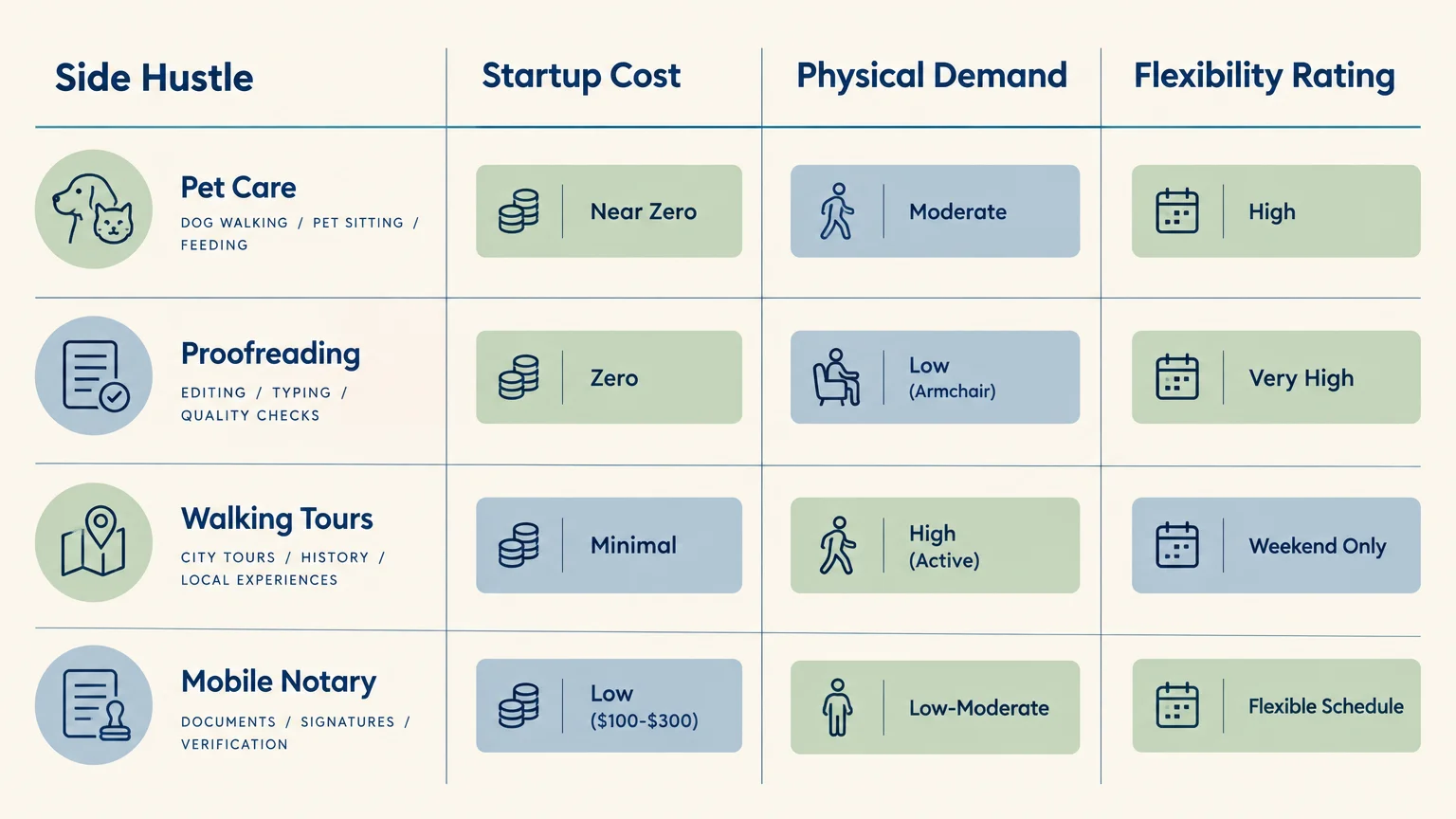
Side Hustle Comparison for Retirees
Selecting the best venture depends on your physical mobility, personal preferences, and financial targets. Review the side-by-side comparison below to decide which path matches your lifestyle.
| Side Hustle | Startup Cost | Typical Earnings | Physical Demand | Ideal Personality |
|---|---|---|---|---|
| Pet Sitting & Walking | Under $20 | $20–$35/walk; $50–$85/night | Moderate to High | Animal lovers who enjoy daily outdoor walks |
| Proofreading | $0 | $25–$45/hour | Very Low | Detail-oriented readers who enjoy quiet focus |
| Neighborhood Tours | Under $25 | $20–$35/person | Moderate | Outgoing storytellers passionate about local history |
| Downsizing Consultant | Under $50 | $40–$70/hour | Low to Moderate | Empathetic, organized communicators |
| Online Reselling | $0 (using home items) | $20–$50/item profit | Low | Bargain hunters who enjoy sorting and packaging |
| Private Tutoring | $0 | $30–$60/hour | Very Low | Patient mentors and lifelong educators |
| Mobile Notary | $100–$250 | $50–$150/signing trip | Low | Punctual, organized professionals with reliable vehicles |
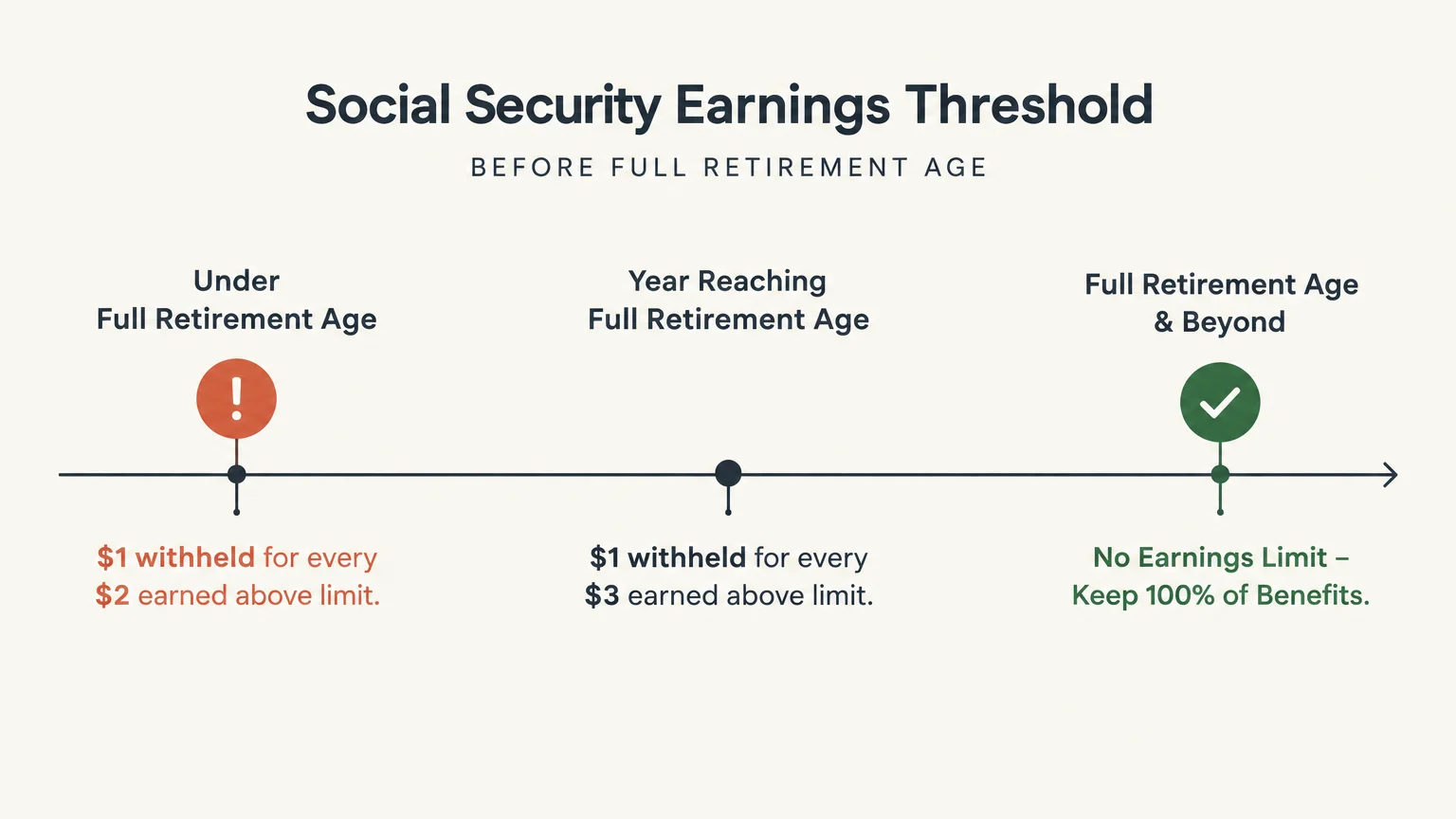
Social Security Earnings Limits to Know Before You Start
You can work and earn side income while collecting benefits, but specific limits apply if you have not reached Full Retirement Age. The Social Security Administration enforces annual earnings thresholds that you must track carefully.
For individuals born in 1960 or later, Full Retirement Age is 67. Once you reach that milestone, you can earn unlimited income from any source without losing a single dollar of benefits.
If you are younger than your Full Retirement Age for the entire year, the earnings limit in 2026 is $24,480. The Social Security Administration withholds $1 in benefits for every $2 you earn above this threshold.
In 2027, this annual limit increases to $25,560, allowing you to earn slightly more before any benefit withholding occurs. These limits apply strictly to earned wages and net self-employment earnings, not passive investment income or pensions.
A higher limit applies during the calendar year you reach your Full Retirement Age. In 2026, the limit is $65,160 for the months preceding your birthday month, with $1 withheld for every $3 earned above the limit.
In 2027, the limit for the year you reach Full Retirement Age rises to $67,920. Withheld benefits are not lost forever; the administration recalculates your monthly benefit upward once you reach full age to credit withheld amounts.
Be aware of the special first-year retirement rule if you claim benefits mid-year. Under this rule, the administration checks whether you perform substantial services in self-employment, defined as working more than 45 hours monthly in your side business.
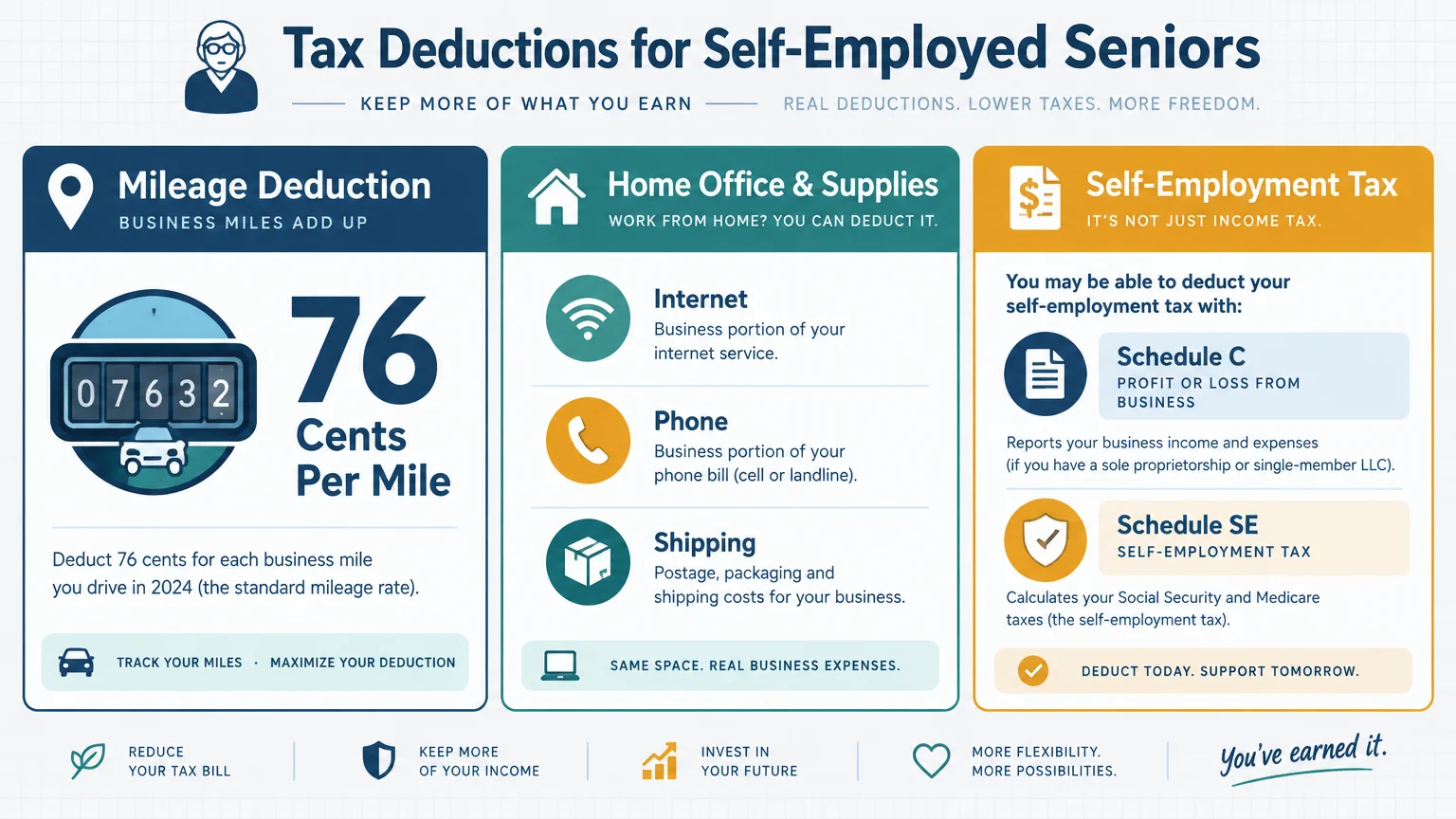
IRS Tax Rules for Senior Side Hustles
Every dollar you earn from a side business counts toward your overall taxable income. Understanding basic tax obligations prevents unpleasant surprises when you file your annual return.
If your net self-employment earnings reach $400 or more in a calendar year, you must file Schedule C with your Form 1040. You must also pay self-employment tax, which covers Medicare and Social Security contributions.
The self-employment tax rate is 15.3%, consisting of 12.4% for Social Security and 2.9% for Medicare. You must pay this tax even if you are currently enrolled in Medicare and collecting retirement benefits.
Fortunately, you only pay tax on your net profit, not your gross revenue. Legitimate business deductions reduce your taxable earnings dollar-for-dollar.
You can deduct business supplies, marketing costs, software subscriptions, and vehicle expenses. If you use your car for gig work, remember that the IRS standard mileage rate is 76 cents per mile for the second half of 2026.
Tax reporting rules have also seen practical adjustments under recent legislation. For the 2026 tax year, third-party payment platforms like Venmo, PayPal, and eBay issue Form 1099-K only if your gross transactions exceed $20,000 and 200 individual transactions.
Similarly, starting in 2026, clients must send Form 1099-NEC for independent contractor services only if payments total $2,000 or more annually. Regardless of whether you receive a 1099 form, the law requires you to report all business income accurately.
“Do not let fear stop you from creating extra financial security. When you generate income doing something you genuinely care about, work ceases to feel like an obligation.” — Suze Orman, Personal Finance Expert

Pitfalls to Watch For
Starting a side venture should enhance your retirement lifestyle, not burden it with unexpected complications. Avoiding these common traps keeps your venture enjoyable and financially productive.
1. Neglecting Self-Employment Tax Reserves
Unlike corporate employers, side gig clients do not withhold income or payroll taxes from your checks. If you spend every dollar you make, you could face an unwelcome balance due on April 15.
Set aside roughly 25% to 30% of your net profits into a separate savings account. Making quarterly estimated tax payments prevents IRS underpayment penalties.
2. Accidentally Exceeding Social Security Earnings Caps
Retirees under age 67 often get excited by business growth and unintentionally cross the $24,480 annual limit in 2026. This triggers benefit withholding letters from the government.
Monitor your net monthly earnings closely if you collect early retirement benefits. Keep your side gig hours capped so your net earnings remain safely below the annual threshold.
3. Mixing Personal and Business Finances
Using your personal checking account for side business expenses creates an administrative nightmare during tax season. Commingling funds makes it difficult to prove legitimate deductions during an audit.
Open a dedicated, no-fee checking account solely for your side venture revenue and expenses. Save digital copies of all receipts for business supplies, packaging materials, and client travel.
4. Underestimating Physical Fatigue and Burnout
You worked hard for decades to earn your retirement freedom. Taking on exhausting physical gigs or rigid customer deadlines can quickly drain your enthusiasm.
Prioritize projects that allow you to set your own boundaries and pace. Always protect your health, sleep schedule, and family commitments first.

Getting Expert Help
While many weekend side businesses remain simple, certain financial milestones call for professional oversight. Consulting a certified public accountant or licensed financial advisor makes sense in specific situations.
Higher Tax Brackets and IRMAA Surcharges
Earning extra side income could push your combined income into a higher tax bracket or trigger higher Medicare Part B premiums. If your income nears the Medicare Income-Related Monthly Adjustment Amount (IRMAA) limits, seek advice on timing your earnings.
Choosing a Legal Structure
Most retirees start as sole proprietors, but forming a limited liability company (LLC) provides added liability protection. An attorney or tax professional can help you decide whether your gig warrants a formal corporate entity.
Coordinating Required Minimum Distributions (RMDs)
If you are age 73 or older, you must balance side gig profits with mandatory retirement account withdrawals. A financial planner can structure your withdrawals and business write-offs to minimize total tax liability.
Frequently Asked Questions
Can I start a side hustle if I already receive Medicare?
Yes, you can operate a business while enrolled in Medicare. Your earnings do not affect your Medicare eligibility, though significant income increases could trigger higher Part B and Part D premiums under IRMAA rules two years later.
Do I need an official business license for a weekend side gig?
Requirements vary by municipality and industry. Simple home-based services like proofreading or pet sitting rarely need specialized licenses, but you should check with your city clerk regarding local zoning rules and basic permits.
Will side hustle income increase my future Social Security benefit?
It can. Because you pay the 12.4% Social Security payroll tax on your net self-employment earnings, the administration includes those earnings in your lifetime work record, which could increase your monthly benefit if it replaces a lower-earning year.
What is the simplest way to track business mileage?
You can use automated smartphone mileage apps like MileIQ or keep a paper logbook in your glove compartment. Record the date, total miles driven, destination, and business purpose for every qualifying trip.
How do payment apps report my gig income to the government?
For the 2026 tax year, third-party payment settlement platforms only issue Form 1099-K if your payments exceed $20,000 and 200 transactions. However, federal law requires you to report all net profit on your tax return regardless of whether you receive a form.
Your Next Step This Weekend
Building an extra revenue stream in retirement does not require complex business plans or substantial seed capital. It simply requires choosing a venture that matches your natural talents and taking a single decisive step forward.
Pick one idea from this guide today and dedicate two hours on Saturday morning to set up your profile or outline your services. You can enjoy newfound financial breathing room while maintaining full control over your calendar.
Review helpful consumer resources from the Consumer Financial Protection Bureau and retirement insights from AARP as you build your new enterprise. Take action now and turn your spare weekend hours into rewarding financial independence.
The information in this guide is meant for educational purposes. Your specific circumstances—including income, benefits, tax situation, and health needs—may require different approaches. When in doubt, consult a licensed financial advisor or tax professional.
Last updated: November 2026. Benefit amounts, tax rules, and program details change annually—verify current figures with official government sources.









Leave a Reply