

You do not have to sell your family home if your spouse enters a skilled nursing facility. Federal law provides specific legal shields that safeguard married couples from losing their primary residence to long-term care expenses.
Many seniors fear that catastrophic care costs will force the healthy partner out on the street. Fortunately, established rules guarantee that you can keep your home without fear of immediate loss or displacement.
Understanding these rights allows you to protect your life savings while securing top-tier medical assistance for your partner. Here is your roadmap to preserving your shelter, your independence, and your financial dignity.
Understanding Spousal Impoverishment Protection
Decades ago, nursing home bills regularly bankrupted couples, leaving the healthy partner without savings or shelter. Congress addressed this devastating dilemma by enacting spousal impoverishment protection rules.
These statutes establish clear boundaries between individual care expenses and basic family preservation. The legal system recognizes that one partner’s illness should never force the other into sudden poverty.
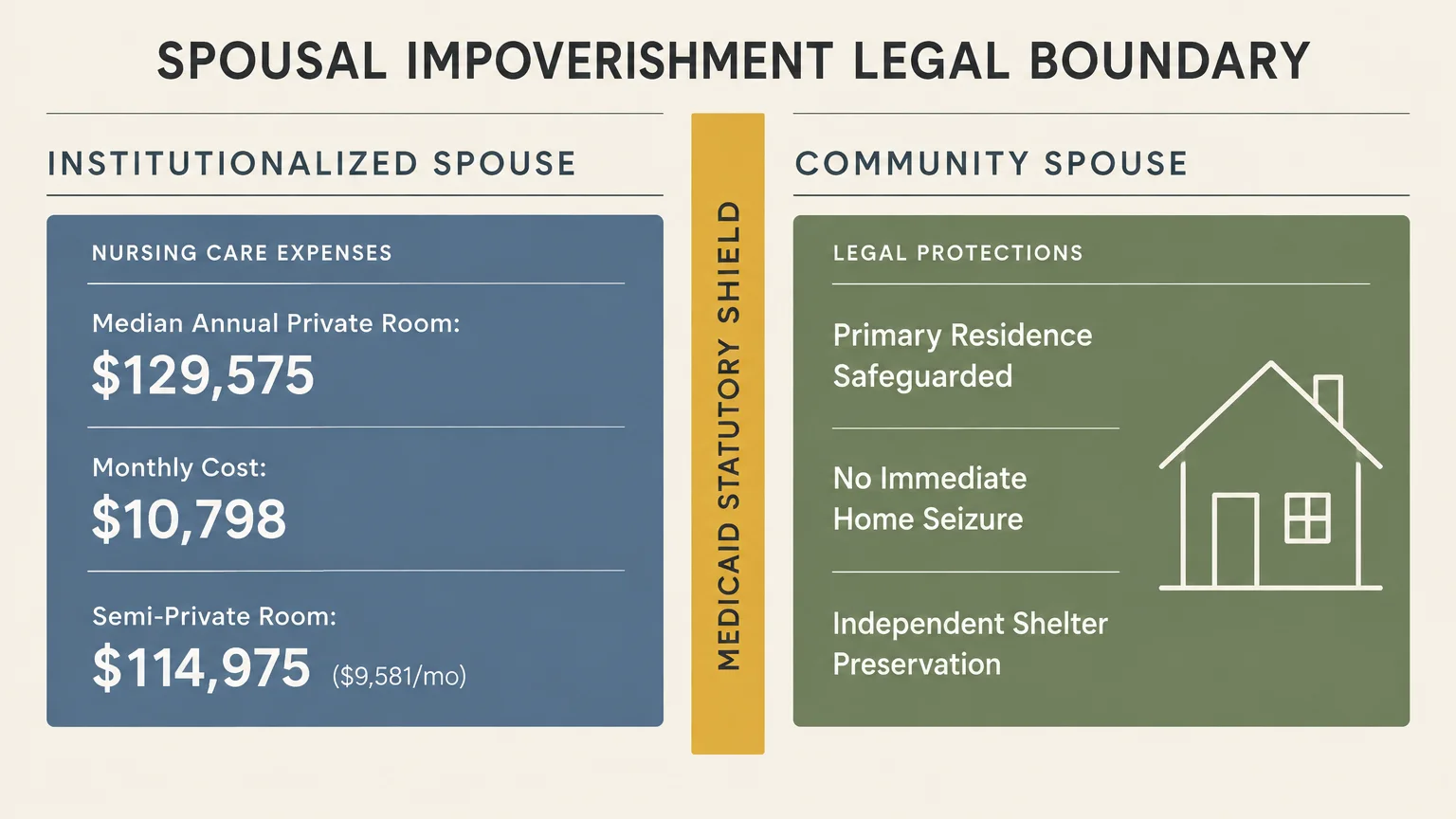
Under Medicaid terminology, the partner entering skilled care is known as the institutionalized spouse. Meanwhile, the partner who remains at home is designated as the community spouse.
This distinction triggers a separate set of financial calculations designed specifically to preserve your shelter. The regulations prevent states from seizing marital homes to cover immediate nursing care.
According to survey data from CareScout, the national median cost for a private nursing home room is $129,575 annually, or roughly $10,798 per month. A semi-private room averages $114,975 per year, which translates to $9,581 monthly.
Few households can sustain out-of-pocket costs approaching $10,000 every single month for very long. Spousal protection provisions provide the financial bridge that prevents total economic ruin.
“You cannot afford to ignore long-term care planning, because the greatest risk is leaving the healthy spouse with nothing.” — Suze Orman, Personal Finance Author and Host
The Primary Residence Medicaid Exemption Explained
Medicaid categorizes household possessions as either countable assets or non-countable exempt assets. Countable assets include checking accounts, mutual funds, stocks, and secondary real estate properties.
Your primary residence receives a special, non-countable designation when your spouse applies for institutional Medicaid. As long as you reside in the house, the government treats the property as entirely exempt.
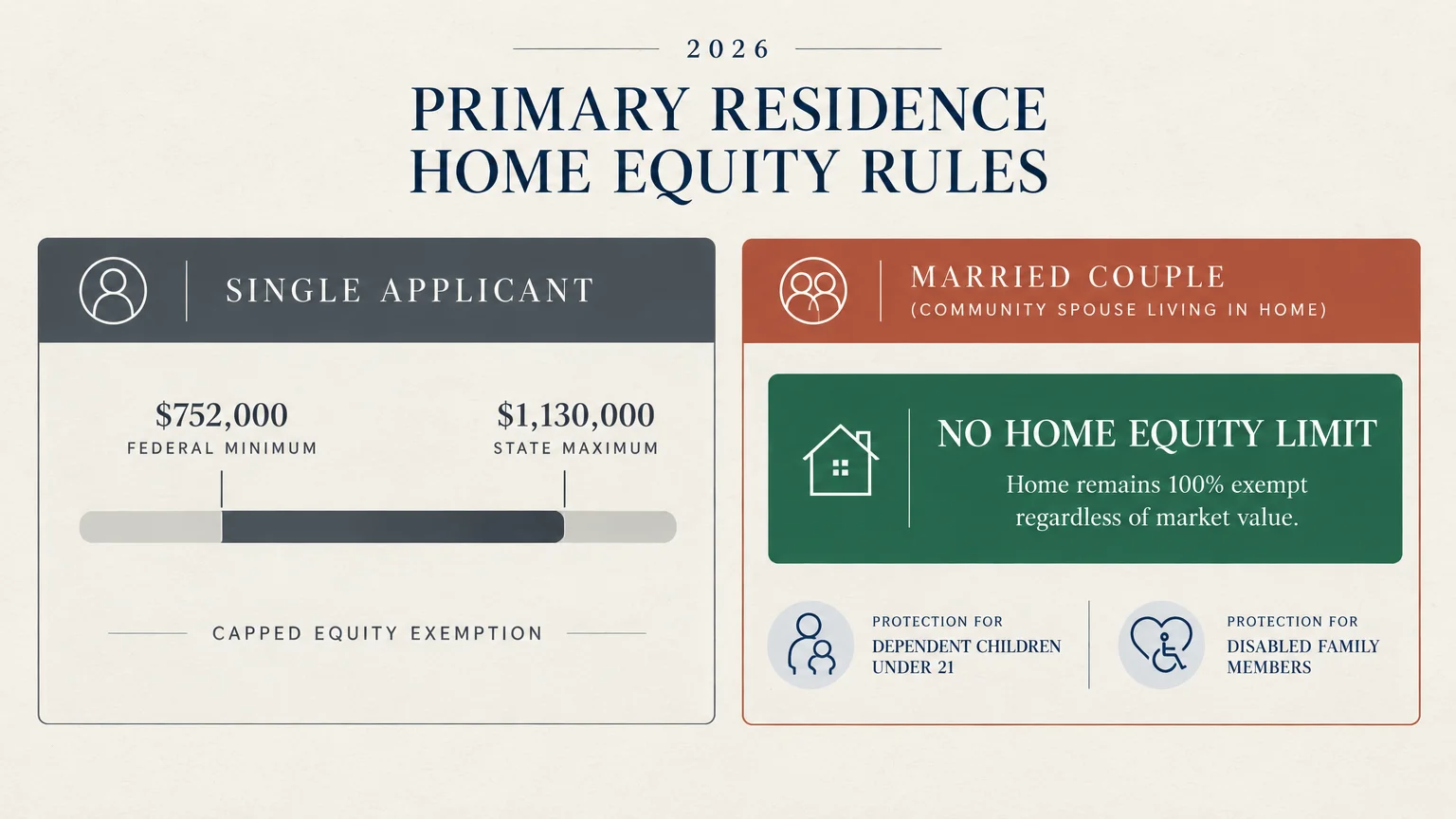
Single Medicaid applicants must comply with strict equity caps on their primary dwellings. In 2026, those individual limits range from a federal minimum of $752,000 to a state-level maximum of $1,130,000.
Married applicants face a completely different, far more generous rule. Under federal guidelines, there is no home equity limit whatsoever if the community spouse lives on the property.
Even if your house is worth several million dollars, its value cannot disqualify your spouse from Medicaid benefits. Your continued occupancy acts as an absolute shield against immediate asset disqualification.
This protection also applies if a dependent child under age 21 resides in the home. Similarly, a permanently disabled or blind child of any age living there preserves the exemption automatically.
You can learn more about federal assistance and health program rules directly through Benefits.gov.
2026 Medicaid Financial Limits for Married Couples
While your residence remains fully protected, you must also understand how liquid assets and incomes are divided. Medicaid evaluates married partners under specific income and resource guidelines.
The institutionalized spouse can typically hold no more than $2,000 in personal liquid reserves. Their monthly income is generally capped at $2,982 per month under standard 2026 income rules.
To keep the community spouse secure, the law establishes the Community Spouse Resource Allowance, often abbreviated as CSRA. This allowance sets aside a significant portion of joint wealth exclusively for the at-home partner.
In 2026, the federal minimum CSRA is $32,532, while the federal maximum allowance reaches $162,660. The exact amount you can retain depends entirely on your state’s specific formula.
In addition to assets, federal law protects your monthly cash flow through the Minimum Monthly Maintenance Needs Allowance, or MMMNA. If your personal income is modest, you can draw from your spouse’s income.
The federal standard minimum MMMNA is $2,705 monthly, effective through mid-2027. The maximum monthly maintenance allowance stands at $4,066.50 for the 2026 calendar year.
| Financial Metric | Institutionalized Spouse Limit | Community Spouse Allowance |
|---|---|---|
| Countable Liquid Assets | $2,000 maximum | $32,532 minimum to $162,660 maximum |
| Monthly Income Allowance | $2,982 monthly cap | $2,705 minimum to $4,066.50 maximum |
| Primary Residence Equity | Not applicable | Unlimited exemption (zero equity cap) |
| Personal Belongings & Vehicle | Strictly limited | One primary vehicle and household goods exempt |
If your personal income drops below your state’s threshold, your spouse’s pension or Social Security fills the gap. This monthly income diversion occurs before any payment is handed over to the nursing home.
How to Protect Your Home from Nursing Home Costs: Actionable Steps
Merely qualifying for Medicaid does not complete your long-term legal protection. You must take deliberate administrative measures to safeguard the property against subsequent legal entanglements.
Taking action early prevents clerical errors from turning into costly eligibility denials later. Follow these proven legal procedures to secure your deed and protect your equity.
Step 1: Retitle the Real Estate Solely in Your Name
Most married couples hold their home title jointly as tenants by the entirety or joint tenants with rights of survivorship. When one partner requires Medicaid, joint ownership creates unnecessary administrative vulnerabilities.
You should promptly transfer the property title entirely into the name of the community spouse. Removing the institutionalized spouse eliminates their ownership interest from public county records.
Federal law expressly permits deed transfers between spouses without triggering transfer penalties. Executing this spousal deed transfer insulates the home from immediate administrative complications.
Step 2: Update Your Will and Estate Planning Documents
Many seniors mistakenly leave outdated reciprocal wills intact after a spouse enters a care facility. A simple reciprocal will leaves all estate assets directly to the surviving spouse upon death.
If you pass away unexpectedly before your ill partner, your entire house would transfer back to them. That sudden inheritance would instantly disqualify them from Medicaid and expose the home to private billing rates.
Rewrite your estate plan to bypass your institutionalized spouse in the event of your prior death. Work with counsel to establish a testamentary trust that provides comfort without compromising state benefits.
Step 3: Secure Comprehensive Durable Power of Attorney
You cannot easily retitle real estate or restructure bank accounts if your partner has already lost cognitive capacity. A basic medical directive is entirely insufficient for complex property transfers.
Ensure that both partners execute comprehensive durable financial powers of attorney. These documents must contain explicit authority authorizing Medicaid planning, asset reorganization, and gifting between spouses.
If your spouse suffers from advanced dementia without these documents, you might face expensive guardianship proceedings. Securing legal authority in advance prevents costly court intervention during a health emergency.
Step 4: Investigate Protective Deed Transfers
Several states allow specialized deeds that transfer real estate outside of probate while retaining complete lifetime control. An enhanced life estate deed, frequently called a Lady Bird deed, represents one effective example.
A Lady Bird deed allows you to live in and sell the property freely during your lifetime. Upon your death, ownership transfers directly to designated beneficiaries without entering the probate system.
Because the real estate avoids probate court, it remains beyond the reach of traditional post-death reimbursement claims. Check local statutes to verify whether your state authorizes these specialized instruments.
“The time to plan for major health transitions is before the crisis hits, when all legal and asset transfer options remain fully open.” — Ed Slott, CPA and Retirement Distribution Specialist
Navigating the 60-Month Look-Back Period and Spousal Transfers
To discourage families from intentionally giving away money to obtain public benefits, Medicaid enforces a 60-month look-back period. Caseworkers examine all financial transactions, deed transfers, and asset sales made during the preceding five years.
Any gifts made to adult children or third parties for less than fair market value trigger severe penalty periods. A penalty period represents a span of months during which Medicaid refuses to pay nursing home costs.
Crucially, federal law contains a sweeping exception to the 60-month look-back rule: transfers between spouses are entirely exempt. You can transfer real estate, cash, or investments directly to your healthy spouse at any time.
This spousal transfer can occur before applying for assistance or even during the active application process. The state cannot assess a financial penalty or delay benefits due to transactions solely between husbands and wives.
However, you must never deed the house directly to your adult children as a quick fix. Gifting real estate to children inside the five-year window triggers an immediate penalty period and destroys the spousal exemption.
If you transfer your home to an adult child without compensation, Medicaid calculates the property value and suspends coverage. You would then be forced to pay full private nursing rates until that penalty period expires.
You can research public healthcare eligibility criteria and state guidelines at Medicare.gov.

State Rule Variations: New York and California
While federal statutes establish general guidelines, individual states administer their own Medicaid programs with differing standards. Keeping up with your state’s unique operational rules ensures you avoid catastrophic miscalculations.
New York maintains significantly higher liquid resource limits for individuals seeking long-term coverage. In 2026, New York permits an individual Medicaid applicant to retain $33,038 in countable assets, while a married couple applying jointly can hold $44,796.
California operates its own distinctive program known as Medi-Cal, which has undergone major structural shifts. California briefly removed its asset test before reinstating resource limits on January 1, 2026.
Under the reinstated guidelines, California caps countable resources at $130,000 for an individual, plus $65,000 for an additional household member. However, state legislation mandates that this asset limit drops sharply to $21,000 for individuals and $31,000 for couples on July 1, 2027.
These shifting standards highlight why localized legal advice is indispensable. What works seamlessly in Texas or Florida may fail completely under regulatory frameworks in New York or California.
The Threat of Medicaid Estate Recovery Program (MERP)
Keeping your home while your spouse is alive is straightforward, but the long-term risk emerges later. Federal law mandates that every state operate a Medicaid Estate Recovery Program, commonly referred to as MERP.
MERP tasks state agencies with recovering taxpayer funds spent on long-term care from the deceased recipient’s estate. The primary target for recovery claims is almost always the family residence.
Fortunately, federal statutes explicitly prohibit states from filing claims or liens against your house while you survive. As long as the community spouse remains alive, the state cannot seize the property or force a sale.
The danger arises after both spouses have passed away. If the property remains titled in the deceased Medicaid recipient’s name, the state can place an estate recovery claim against the proceeds.
Transferring the deed exclusively into your name during your lifetime removes the house from your spouse’s probate estate. Because your spouse holds no legal interest at death, MERP cannot attach a lien in standard probate states.
Some states employ expanded estate recovery laws that target non-probate property, including life estates and joint tenancies. Consulting a knowledgeable attorney ensures your title structure defeats both standard and expanded recovery efforts.
You can locate local caregiver support services and legal guidance tools through the Eldercare Locator, backed by the U.S. government.

Real-World Financial Scenarios
Examining practical examples shows how these statutory protections operate in everyday life. Reviewing specific household numbers clarifies how asset formulas shield your wealth.
Scenario A: Protecting High Real Estate Equity
Consider David and Sarah, a married couple who purchased their suburban home decades ago. The house has appreciated significantly and now holds a fair market value of $850,000 with no mortgage.
David suffers a severe stroke and requires continuous skilled nursing care at a regional facility. Sarah panics, believing she must sell the house to satisfy private nursing charges of $9,581 each month.
Because Sarah continues living on the property, the home equity is entirely exempt from Medicaid calculations. David qualifies for state healthcare support without touching the home’s equity.
Sarah retitles the property deed solely into her name and updates her will. Her home remains fully secure, and David receives necessary care paid through Medicaid benefits.
Scenario B: Protecting Modest Retirement Assets
Now consider Arthur and Linda, who hold $140,000 in joint savings alongside their fully paid $300,000 residence. Arthur must transition into a memory care center due to progressive Alzheimer’s disease.
Arthur’s individual asset ceiling is $2,000, but Linda benefits from the federal Community Spouse Resource Allowance. Under her state’s calculation, Linda retains the maximum allowable portion of their liquid wealth.
Because their total joint savings of $140,000 falls below the 2026 maximum CSRA threshold of $162,660, Linda keeps every penny. She also retains the house with zero required spend-down on her primary residence.
Linda then redirects a portion of Arthur’s pension to satisfy the Minimum Monthly Maintenance Needs Allowance. She stays in her neighborhood with stable monthly income and fully protected life savings.
Common Mistakes to Avoid
Families navigating healthcare emergencies frequently make catastrophic errors out of fear and misinformation. Avoiding these classic missteps will save your family tens of thousands of dollars.
- Selling the house to pay private bills: Many seniors liquidate real estate before seeking advice, burning through equity that was completely exempt. Never sell your primary residence without speaking to a long-term care specialist.
- Gifting the property directly to adult children: Deeding the house to your children triggers a severe penalty under the 60-month look-back rule. It also strips away valuable capital gains tax benefits, including the step-up in basis.
- Leaving your spouse on the property deed: Failing to remove the institutionalized spouse leaves the real estate vulnerable to estate recovery after their passing. Transfer ownership solely to the healthy spouse as soon as eligibility is confirmed.
- Ignoring spousal monthly income allowances: Many community spouses struggle financially because they never claim their rightful share of their partner’s monthly income. Always claim your maximum MMMNA allowance to maintain your household budget.
Each of these errors stems from a basic misunderstanding of federal protections. Taking measured, informed steps keeps your wealth where it belongs—supporting the healthy surviving partner.
You can find comprehensive guidance on healthy aging and benefit programs from the Administration for Community Living.

Finding the Right Advisor
Navigating Medicaid rules requires specialized knowledge that general practitioners rarely possess. Engaging an experienced elder law attorney or certified financial planner ensures that your paperwork satisfies strict state requirements.
Here are four specific scenarios where professional legal counsel is non-negotiable:
- Urgent crisis applications: If your spouse needs nursing placement within weeks, an elder law specialist can execute rapid asset transfers. They ensure you meet eligibility guidelines without triggering accidental gift penalties.
- Significant non-exempt savings: Couples with investment portfolios exceeding the $162,660 CSRA maximum require advanced spend-down strategies. Advisors can convert countable assets into exempt income streams using Medicaid-compliant annuities.
- Blended families and remarriages: If you or your spouse have children from prior marriages, simple spousal transfers can complicate inheritance plans. Counsel can draft specialized protective trusts that shield the home while respecting all family branches.
- Residences in expanded recovery states: If your state enforces aggressive estate recovery policies, simple deed transfers might not provide complete post-death protection. An attorney can prepare irrevocable trusts or Lady Bird deeds tailored to your jurisdiction.
When interviewing attorneys, verify that their practice focuses specifically on Medicaid planning and elder care. Inquire about their track record with your local Department of Social Services before signing an engagement agreement.
Senior advocacy groups like AARP provide extensive resources and directories to help families locate qualified legal experts.
Frequently Asked Questions
Can the nursing home force me to sell my house?
No, a nursing home cannot force you to sell your house. As long as you reside in the property, it remains completely exempt from Medicaid asset limits under federal law.
Does Medicare cover long-term nursing home stays?
Medicare does not cover custodial or long-term nursing home care. Medicare pays solely for short-term rehabilitative stays following a qualifying hospital admission, generally capping coverage at 100 days.
Will Medicaid put a lien on my house while I am living there?
No, federal law strictly forbids states from placing liens or recovering costs from your home while a surviving spouse lives there. Your occupancy prevents immediate state claims against the real estate.
Can I transfer the house to my children to keep it safe?
Transferring your house to adult children inside the 60-month window triggers severe Medicaid penalty periods. However, you can transfer the title directly to your healthy spouse with zero financial penalty.
What happens if the community spouse passes away first?
If the healthy spouse dies first with an outdated will, the house could transfer back to the institutionalized spouse. To avoid losing Medicaid, update your estate plan to direct the home into a protective trust.
Protecting Your Future and Next Steps
Navigating a partner’s transition into full-time nursing care is emotionally draining and physically exhausting. You should not have to carry the additional anxiety of losing your home or your economic independence.
Federal law firmly protects the community spouse, ensuring you retain both your roof and sufficient resources to live comfortably. Take immediate action by reviewing your deeds, updating your powers of attorney, and consulting a local elder care professional.
The information in this guide is meant for educational purposes. Your specific circumstances—including income, benefits, tax situation, and health needs—may require different approaches. When in doubt, consult a licensed financial advisor or tax professional.
Last updated: November 2026. Benefit amounts, tax rules, and program details change annually—verify current figures with official government sources.









Leave a Reply