

An annual Social Security cost-of-living adjustment (COLA) promises to boost your retirement income, but the extra money shown on your official notice rarely reflects what actually lands in your bank account. Hidden tax traps, rising healthcare premiums, and outdated program rules quietly siphon off those extra dollars before you can spend them. For instance, while the Social Security Administration announced a 2.8% COLA increase for 2026, automatic deductions and unindexed tax thresholds will force millions of seniors to give back a substantial portion of their raise. Understanding how these financial triggers work allows you to take proactive steps to protect your hard-earned benefits and keep more of your monthly income.
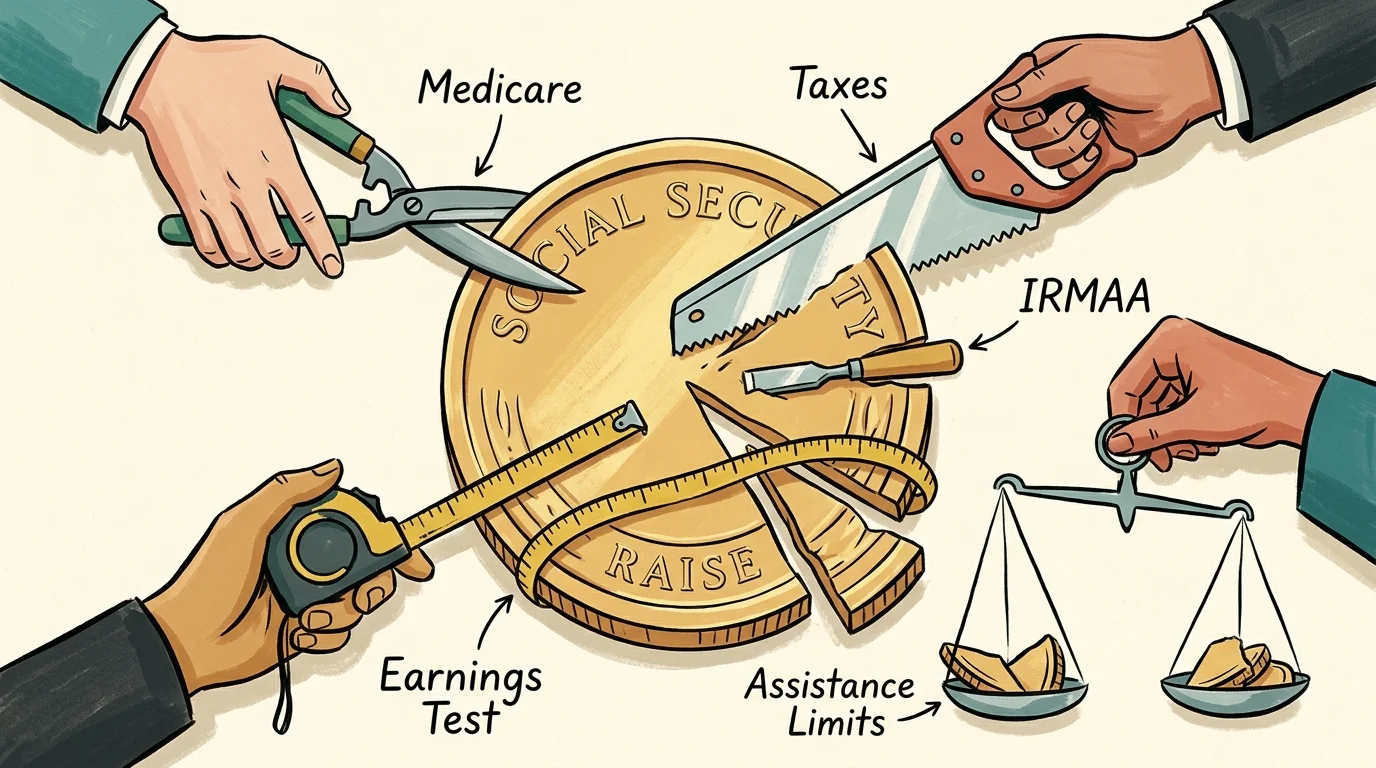
At a Glance: The Drains on Your Social Security Raise
While a cost-of-living adjustment officially increases your gross monthly benefit, several offset mechanisms reduce your take-home pay. Before examining each mechanism in detail, review these primary factors that erode your net payout:
- Medicare Part B Premium Hikes: Medicare automatically deducts premiums directly from your Social Security check, consuming a sizeable portion of any gross raise.
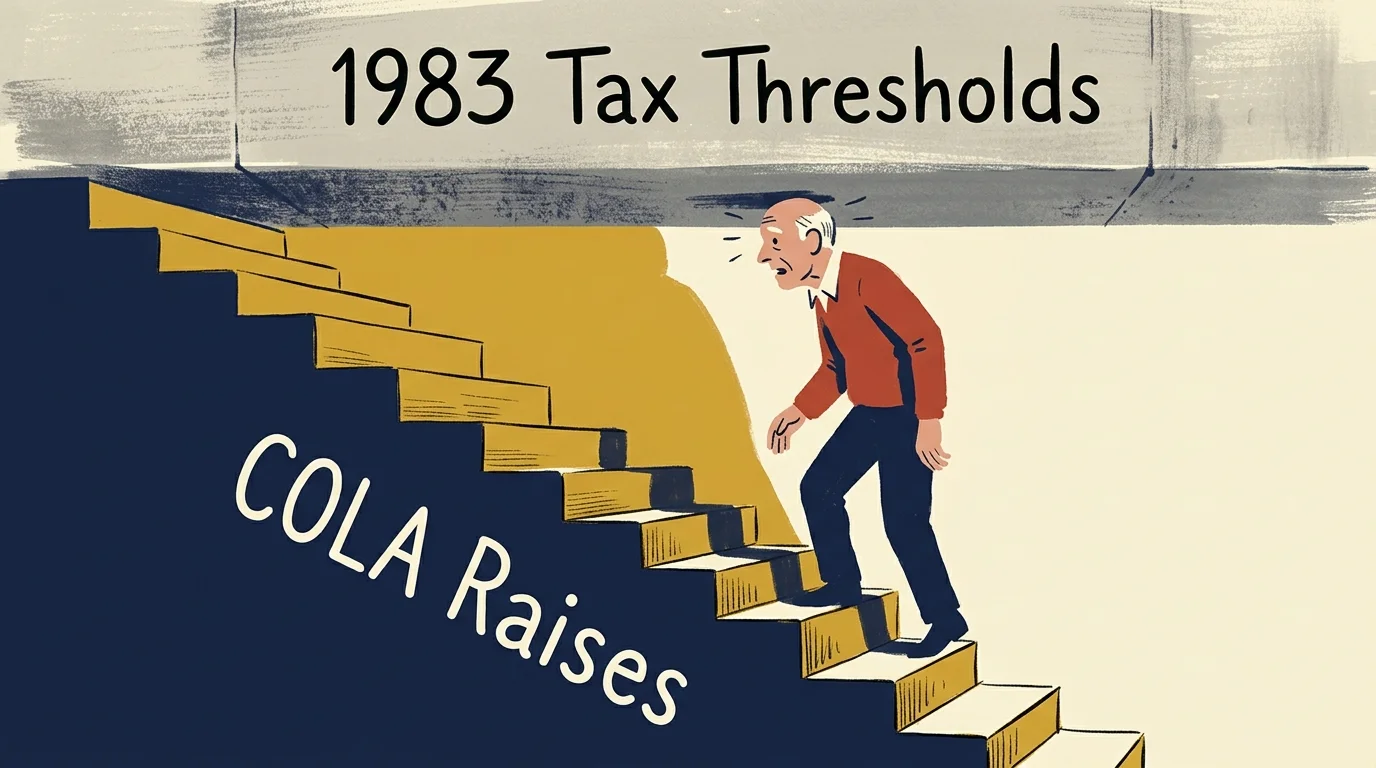
- Static Tax Thresholds (“Bracket Creep”): Federal tax limits on Social Security benefits have not adjusted for inflation since 1983; as a result, COLA increases push higher percentages of your benefit into taxable territory.
- IRMAA Surcharges: Exceeding strict income thresholds by even one dollar triggers steep Medicare surcharges that wipe out monthly benefit gains.
- The Retirement Earnings Test: Working while receiving benefits before reaching Full Retirement Age triggers mandatory benefit withholdings.
- Benefit Cliff Effects on Assistance: Higher gross Social Security payments can push vulnerable low-income seniors past strict income limits for vital state and federal assistance programs.

Trigger 1: Soaring Medicare Part B Premiums
The most direct drain on your annual COLA raise comes from Medicare Part B premiums. If you collect Social Security and enroll in Medicare Part B, the federal government automatically deducts your monthly premium directly from your benefit check. When Medicare costs increase, your net Social Security payment drops accordingly.
For context, beneficiaries received a 2.5% COLA raise in 2025, while standard Medicare Part B premiums rose to $185.00 per month. For 2026, the Social Security Administration announced a 2.8% COLA; however, according to the Centers for Medicare & Medicaid Services, the standard monthly Medicare Part B premium surged to $202.90 per month—a sharp $17.90 monthly increase (9.7%). Additionally, the annual Part B deductible increased to $283.
To see how this direct deduction shrinks your actual raise, consider a practical numeric calculation:
- Gross Monthly Benefit (2025): $1,900.00
- 2026 COLA Increase (2.8%): +$53.20 per month (raising gross benefit to $1,953.20)
- 2026 Medicare Part B Premium Hike: -$17.90 per month (increasing from $185.00 to $202.90)
- Actual Net Monthly Increase: $35.30 per month
In this typical scenario, higher healthcare costs immediately consume more than 33% of your monthly gross raise. While a statutory “Hold Harmless Rule” prevents Medicare from reducing your net check below the previous year’s dollar amount if your COLA raise is exceptionally small, it does not preserve the raise itself; it simply ensures your net deposit does not go backward.
Trigger 2: Static Tax Thresholds and “Tax Bracket Creep”
Federal tax law subjects up to 85% of your Social Security income to income tax depending on your overall earnings. However, unlike traditional income tax brackets—which the Internal Revenue Service adjusts annually for inflation—the statutory thresholds for taxing Social Security benefits have remained completely frozen since 1983 and 1993.
As COLA raises increase your gross benefit dollars over time, those same inflation adjustments continuously push you past unindexed income thresholds. Financial experts refer to this phenomenon as “tax bracket creep.”
The IRS calculates your tax liability using a specific formula called Combined Income:
Combined Income = Adjusted Gross Income (AGI) + Tax-Exempt Interest + 50% of Social Security Benefits
Depending on your filing status, your Combined Income triggers the following federal tax tiers:
- Single Filers:
- Combined income between $25,000 and $34,000: Up to 50% of benefits are taxable.
- Combined income above $34,000: Up to 85% of benefits are taxable.
- Married Filing Jointly:
- Combined income between $32,000 and $44,000: Up to 50% of benefits are taxable.
- Combined income above $44,000: Up to 85% of benefits are taxable.
When statutory thresholds remain fixed while benefits rise, routine COLA increases force moderate-income retirees to pay taxes on their benefits for the first time—or move into the 85% tax tier. Consequently, you hand a significant slice of your gross raise right back to the federal government when filing your return with the Internal Revenue Service.
“The biggest surprise for most retirees isn’t how much they make, but how little it takes for the IRS to start taxing their Social Security benefits.” — Ed Slott, IRA and Retirement Account Expert
Trigger 3: Income-Related Monthly Adjustment Amount (IRMAA) Cliffs
If you report higher income during retirement, you face an additional trigger: the Income-Related Monthly Adjustment Amount (IRMAA). IRMAA is a statutory surcharge added directly to your standard Medicare Part B and Part D premiums.
The Social Security Administration determines your IRMAA status using a two-year lookback rule based on your tax returns. For example, your 2026 Medicare premiums depend directly on the Modified Adjusted Gross Income (MAGI) reported on your 2024 tax return.
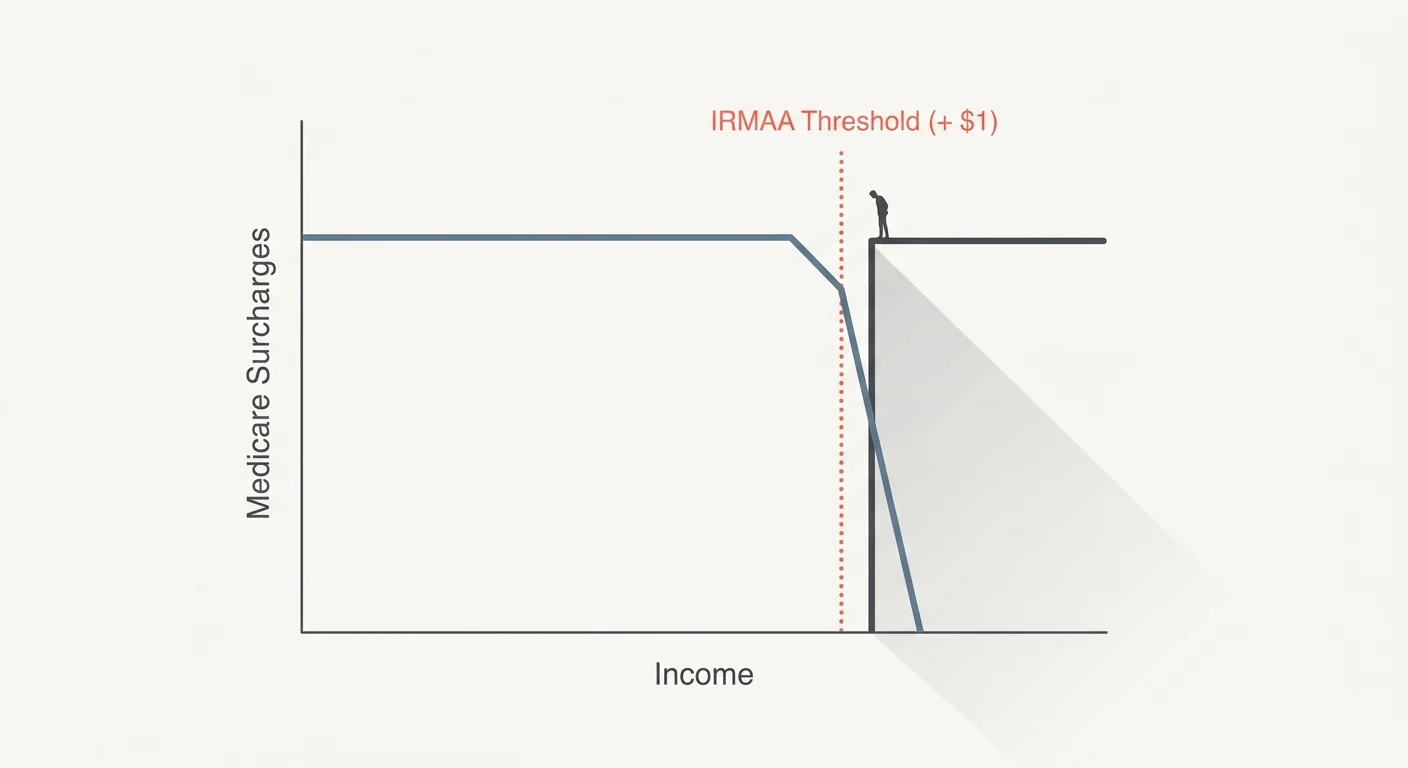
Unlike standard progressive tax brackets, IRMAA operates on rigid “cliff” thresholds. Crossing an IRMAA bracket limit by a single dollar subjects you to the full monthly surcharge tier for the entire calendar year. According to Medicare.gov, tier 1 IRMAA surcharges begin at the following MAGI limits:
- Single Filers: MAGI exceeding $109,000
- Married Filing Jointly: MAGI exceeding $218,000
If a required minimum distribution (RMD), property sale, or COLA-boosted income pushes your MAGI from $108,999 to $109,001, you cross the cliff. You will instantly owe tens or hundreds of dollars in additional monthly Medicare Part B and Part D surcharges. That single dollar over the threshold can easily wipe out your entire annual COLA raise and reduce your overall retirement cash flow.

Trigger 4: The Social Security Retirement Earnings Test
Many retirees choose to collect Social Security early while working part-time or full-time jobs. If you claim benefits prior to reaching your Full Retirement Age (FRA)—which ranges between age 66 and 67 depending on your birth year—the Retirement Earnings Test directly limits your monthly benefit check.
When your earned wages or self-employment income exceed annual statutory caps, the Social Security Administration withhold benefits according to fixed formulas:
- Under Full Retirement Age All Year: In 2026, the exempt earnings limit is $24,480. The Social Security Administration withholds $1 in benefits for every $2 you earn above $24,480.
- Year Reaching Full Retirement Age: In the year you reach FRA, a higher threshold applies ($62,160 in 2025). The agency withholds $1 in benefits for every $3 earned above that limit until the exact month you reach full retirement age.
For example, if you collect benefits early in 2026 and earn $30,480 from a job, you exceed the $24,480 limit by $6,000. The SSA will withhold $3,000 in benefit payments throughout the year. Although the Social Security Administration recalculates your benefit amount at FRA to credit those withheld payments back over your remaining lifetime, the immediate withholding eliminates your COLA gains for the year.
Trigger 5: Loss of Need-Based Assistance and State Taxes
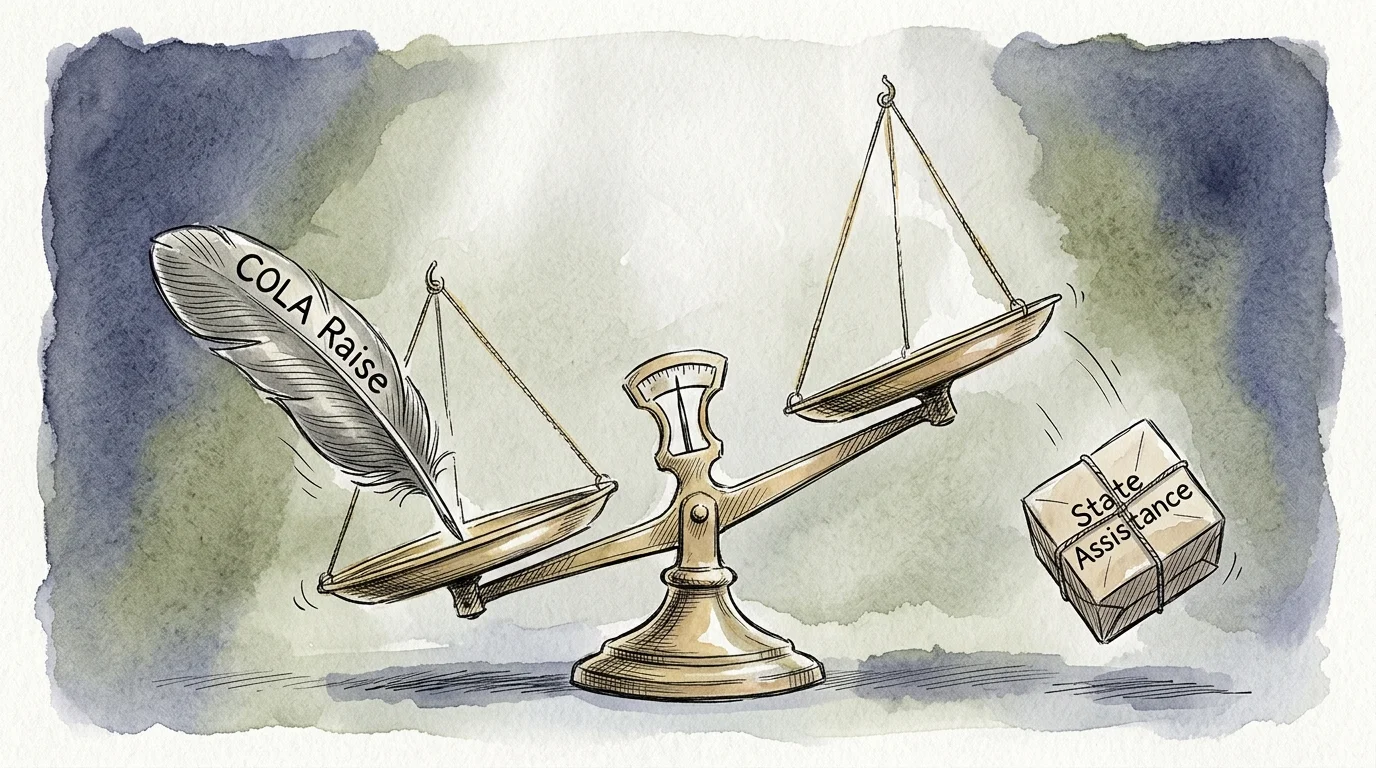
The fifth hidden trigger affects retirees who receive low-income assistance or reside in states that tax retirement benefits. A gross COLA raise can inadvertently spark severe secondary losses through benefit cliffs or local tax liabilities.
Low-income programs evaluate eligibility based on gross income limits rather than net take-home pay. Essential social safety-net programs—including Supplemental Nutrition Assistance Program (SNAP) food benefits, Low-Income Home Energy Assistance (LIHEAP), and state Medicare Savings Programs (MSPs)—maintain strict income limits. A monthly COLA raise of $40 or $50 can push you slightly above the eligibility limit for a Medicare Savings Program. If you lose MSP coverage, your state stops paying your monthly Medicare Part B premium ($202.90 in 2026), forcing that full expense back onto your shoulders and creating a massive net loss in monthly household income.
Furthermore, while most states exempt Social Security benefits from state income taxation, several states still tax a portion of your benefits based on income thresholds. You can explore income limits and assistance guidelines through Benefits.gov or your state’s department of revenue.
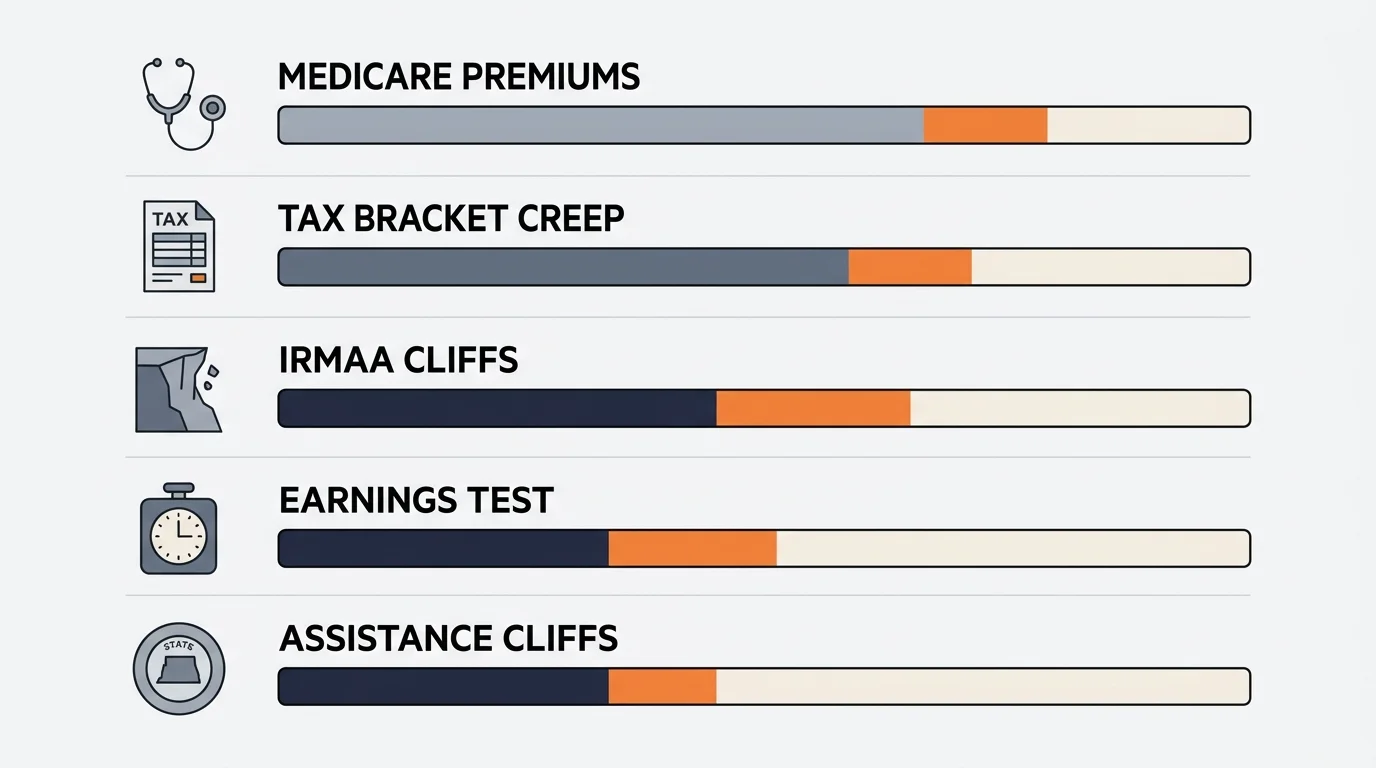
Comparing the 5 Hidden COLA Triggers
To evaluate how each trigger affects your monthly benefit check, review this detailed side-by-side summary:
| Hidden Trigger | Primary Mechanism | Impact on Net Check | Key Mitigation Strategy |
|---|---|---|---|
| Medicare Part B Hikes | Automatic deduction of monthly premiums from Social Security checks. | Directly reduces net monthly raise amount. | Verify Hold Harmless status; budget for annual CMS premium adjustments. |
| Tax Bracket Creep | Static, unindexed statutory thresholds ($25k single / $32k joint). | Exposes up to 85% of benefit payouts to federal income tax. | Manage withdrawals using Roth IRAs; adjust federal tax withholding via Form W-4V. |
| IRMAA Surcharges | Rigid income cliffs using a 2-year tax return lookback. | Triggers extra monthly Part B and Part D surcharges. | File Form SSA-44 after life-changing events; control annual MAGI. |
| Retirement Earnings Test | Mandatory withholding for earning income before reaching FRA. | Temporarily holds back $1 for every $2 earned over limits. | Limit earned wages under annual caps or delay claiming until reaching FRA. |
| Assistance & State Taxes | Gross income increases exceed program caps or state tax limits. | Disqualifies beneficiaries from subsidy programs like MSP or SNAP. | Consult local aging agencies before accepting voluntary income increases. |

What Can Go Wrong: Common Senior Mistakes
Failing to account for hidden financial triggers can lead to costly surprises during retirement. Navigating Social Security rules requires avoiding these frequent mistakes:
- Ignoring the 2-Year IRMAA Lookback: Taking a large traditional IRA distribution, selling taxable real estate, or realizing significant capital gains without factoring in the two-year lookback period often triggers unexpected IRMAA premium surcharges two years later.
- Failing to Appeal IRMAA After Life Changes: If your income drops significantly due to a qualifying life-changing event—such as marriage, divorce, retirement, or loss of income-producing property—you do not have to accept an IRMAA surcharge. Many seniors pay high surcharges unnecessarily because they fail to submit Form SSA-44 to request a redetermination.
- Neglecting Federal Tax Withholdings: Assuming the Social Security Administration automatically taxes your check causes many retirees to owe substantial sums at tax time. The SSA does not withhold taxes automatically; you must explicitly request withholding by filing IRS Form W-4V.
- Overlooking Secondary Benefit Thresholds: Low-income seniors often celebrate a gross COLA increase without realizing it might disqualify them from state Medicare Savings Programs, leading to sudden out-of-pocket medical expenses.
Actionable Strategies to Protect Your Net COLA Payout
You do not have to watch hidden financial triggers erode your benefit checks. Implementing smart, proactive financial strategies helps protect your gross raise and preserve your purchasing power:
- Execute Qualified Charitable Distributions (QCDs): If you are age 70½ or older, you can transfer up to $108,000 (indexed for inflation) directly from a traditional IRA to a qualified charity. QCDs count toward your Required Minimum Distributions (RMDs) without adding a single dollar to your Adjusted Gross Income, keeping your MAGI below IRMAA and benefit tax thresholds.
- Manage Retirement Account Withdrawals: Balance your withdrawals between taxable traditional IRAs, tax-free Roth IRAs, and taxable brokerage accounts. Drawing tax-free dollars from a Roth IRA allows you to meet monthly income needs without elevating your Combined Income.
- Submit Form SSA-44 for IRMAA Relief: If your current income is substantially lower than it was two years ago because you retired, stopped working, or lost a spouse, complete SSA Form SSA-44 (Medicare Income-Related Monthly Adjustment Amount – Life-Changing Event) to request a recalculation based on current income.
- File IRS Form W-4V: Prevent unexpected tax bills by requesting voluntary federal tax withholding directly from your monthly Social Security benefit. You can select standard withholding rates of 7%, 10%, 12%, or 22%.

When to Consult a Professional
Navigating the interplay between Social Security rules, tax legislation, and healthcare premiums requires personalized strategy. Consider scheduling a consultation with a qualified Certified Financial Planner (CFP) or Certified Public Accountant (CPA) in the following scenarios:
- Approaching Age 73 or 75 (RMD Age): When mandatory account distributions threaten to push you into higher tax brackets and trigger IRMAA surcharges.
- Experiencing Major Life Transitions: Following the death of a spouse, a divorce, or the sale of a primary residence or business.
- Planning Pre-FRA Employment: When you plan to earn income while receiving Social Security benefits prior to reaching Full Retirement Age.
- Navigating Multi-Year Roth Conversions: When evaluating how converting traditional IRA funds into Roth accounts will impact your Medicare premiums over a multi-year horizon.
Frequently Asked Questions
Does the Hold Harmless Rule protect my entire COLA raise from Medicare Part B increases?
No. The Hold Harmless Rule only prevents Medicare from reducing your net monthly check below what you received the previous year. If your gross COLA raise is $50 and Medicare Part B premiums rise by $17.90, Medicare deducts the full $17.90, leaving you with a net raise of $32.10. The rule only steps in if the premium hike exceeds your total gross dollar raise.
How do I appeal a Medicare IRMAA surcharge if my income dropped recently?
You can appeal an IRMAA surcharge by filing Form SSA-44 with the Social Security Administration. You must document a qualifying life-changing event—such as work reduction, work stoppage, divorce, or loss of income-producing property—and provide evidence of your lower current income, such as recent tax returns or pay stubs.
Will working after reaching Full Retirement Age trigger benefit withholdings?
No. The Social Security Retirement Earnings Test applies strictly to beneficiaries who have not yet reached their Full Retirement Age. Once you reach your exact FRA month, you can earn unlimited income from wages or self-employment without facing any Social Security benefit withholdings.
How do I determine if my Social Security COLA raise will be taxed?
Calculate your Combined Income by adding your Adjusted Gross Income, tax-exempt interest income, and 50% of your total Social Security benefits. If that total exceeds $25,000 for single filers or $32,000 for joint filers, up to 50% or 85% of your benefits will be subject to federal income tax.
Taking Control of Your Retirement Income
A Social Security cost-of-living adjustment represents an important boost to your retirement budget, but gross figures rarely tell the complete story. Automatic Medicare Part B deductions, outdated tax thresholds, IRMAA cliffs, and benefit withholdings quietly shrink your actual take-home pay each year. By understanding these five triggers, monitoring your income sources, and utilizing tools like Form SSA-44 or Roth withdrawals, you can safeguard your financial health and ensure your retirement income serves your actual needs.
This article provides general financial education and information only. Everyone’s financial situation is unique—what works for others may not work for you. For personalized advice tailored to your retirement needs, consider consulting a qualified financial professional such as a CFP or CPA.
Last updated: February 2026. Benefit amounts, tax rules, and program details change annually—verify current figures with official government sources.









Leave a Reply