

Managing your retirement withdrawals before 2027 can save you thousands of dollars in unnecessary income taxes and Medicare surcharges. Recent tax law updates have completely reshaped federal planning benchmarks for older adults.
While the IRS taxes standard income across seven familiar tiers, retirees face secondary brackets that directly threaten pensions and Social Security. Missing these thresholds can quietly push your household into higher tax territory without your knowledge.
Reviewing your numbers today gives you the power to shield your retirement nest egg from preventable financial hits. Here is your roadmap to the eight critical tax brackets that matter most before 2027.

The Changing Retirement Tax Landscape Through 2027
Retirement tax planning shifted dramatically when Congress enacted the One Big Beautiful Bill Act (OBBBA) in July 2025. This landmark legislation permanently extended the lower federal income tax rates originally introduced under the 2017 Tax Cuts and Jobs Act.
Without this action, individual income tax rates would have reverted to significantly higher pre-2018 levels at the start of 2026. You no longer have to fear an automatic return to the punitive 28% or 33% ordinary brackets.
However, permanent rate reductions do not mean your taxes will remain static. The Internal Revenue Service (IRS) adjusts tax bracket thresholds annually to account for inflation.
After a 2.7% inflation adjustment in 2026, economic projections from leading tax analysts show federal bracket thresholds will climb by approximately 3.2% for tax year 2027. These rising brackets give you fresh opportunities to harvest income at lower rates.
Retirees also navigate a multi-layered tax system where traditional income brackets intersect with stealth levies. Hidden surcharges on Medicare Part B and Part D premiums operate like secondary tax brackets with severe financial penalties.
Taking a proactive stance now lets you arrange your withdrawals, capital gains, and Roth conversions intelligently. Let us examine the eight critical tax brackets you should review before 2027 arrives.
1. The 0% “Zero Tax” Bracket: Enhanced Senior Deductions
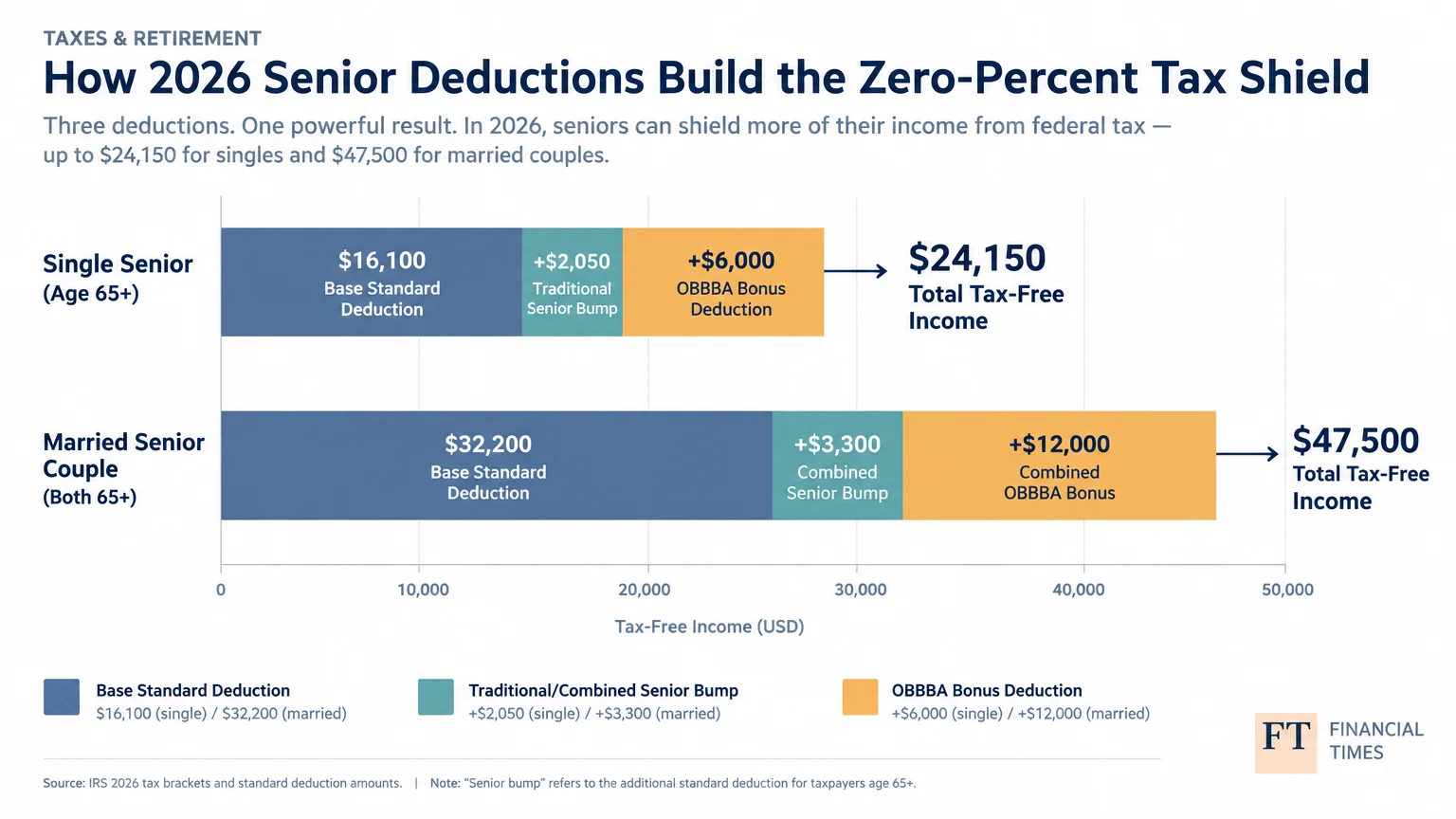
The single most powerful tax bracket in retirement is the zero-percent bracket created by the standard deduction. Every dollar of income that falls below this threshold remains completely free from federal income tax.
For tax year 2026, the basic standard deduction is $16,100 for single filers and $32,200 for married couples filing jointly. Projections indicate these base amounts will expand to $16,600 for singles and $33,200 for married couples in 2027.
Seniors age 65 and older receive an additional traditional standard deduction on top of the base amount. In 2026, this extra deduction adds $2,050 for single filers and $1,650 per qualifying spouse for married couples.
For 2027, the traditional senior bump will project to $2,100 for single taxpayers and $1,700 per qualifying spouse. Furthermore, recent legislation created an unprecedented tax shelter specifically for older Americans.
Under the OBBBA, an extra Senior Bonus Deduction provides $6,000 per person age 65 and older for tax years 2025 through 2028. Married couples where both spouses have reached age 65 can claim an extra $12,000 deduction.
This bonus deduction phases out at a 6% rate for Modified Adjusted Gross Income (MAGI) above $75,000 for single filers or $150,000 for married couples. You can claim this bonus whether you itemize or take the standard deduction.
When you combine these deductions in 2026, a single senior can shield up to $24,150 of income with zero federal tax liability. A married senior couple can shield up to $47,500 of retirement income entirely tax-free.
2. The 10% Federal Income Tax Bracket: Your Low-Cost Base
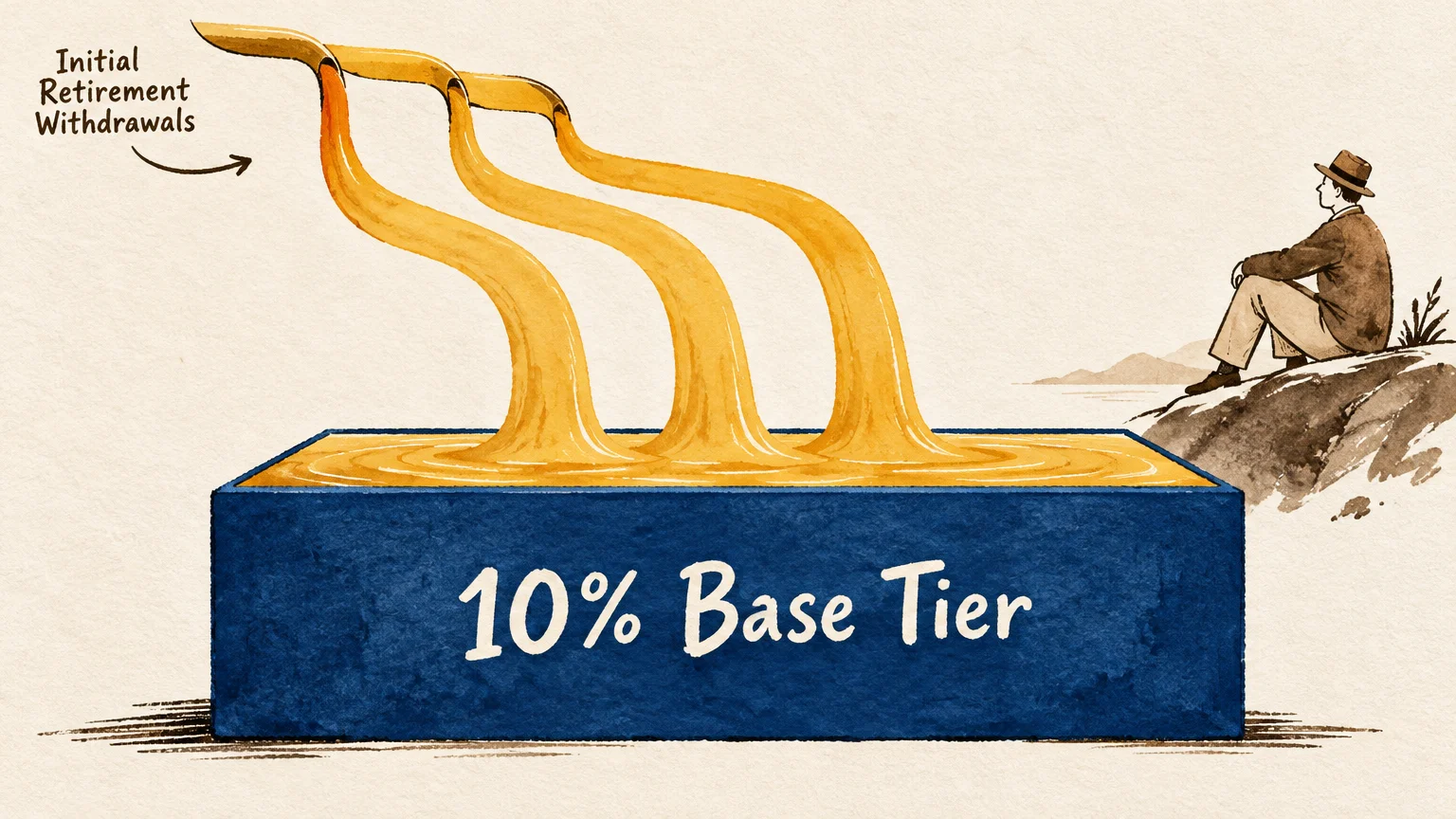
Once your income exceeds your standard deduction, your first taxable dollars enter the lowest federal rate tier: the 10% bracket. This bracket provides an exceptionally low tax rate for baseline retirement distributions.
For tax year 2026, the 10% bracket covers taxable ordinary income up to $12,400 for single filers and $24,800 for married couples filing jointly. For 2027, economic forecasts project these boundaries to widen to $12,800 for singles and $25,600 for joint filers.
Many retirees fail to utilize this ultra-low tier fully during their early retirement years. If you delay claiming Social Security until age 70, you may experience years with surprisingly low taxable income.
You can withdraw funds from traditional tax-deferred individual retirement accounts (IRAs) to absorb this entire 10% bucket. Paying a mere dime on the dollar to access your tax-deferred retirement savings represents an enormous long-term victory.
Failing to fill this bracket leaves inexpensive tax capacity on the table. You forfeit the chance to clear out future taxable distributions before mandatory distribution rules take control.
3. The 12% “Sweet Spot” Bracket: Prime Roth Conversion Runway
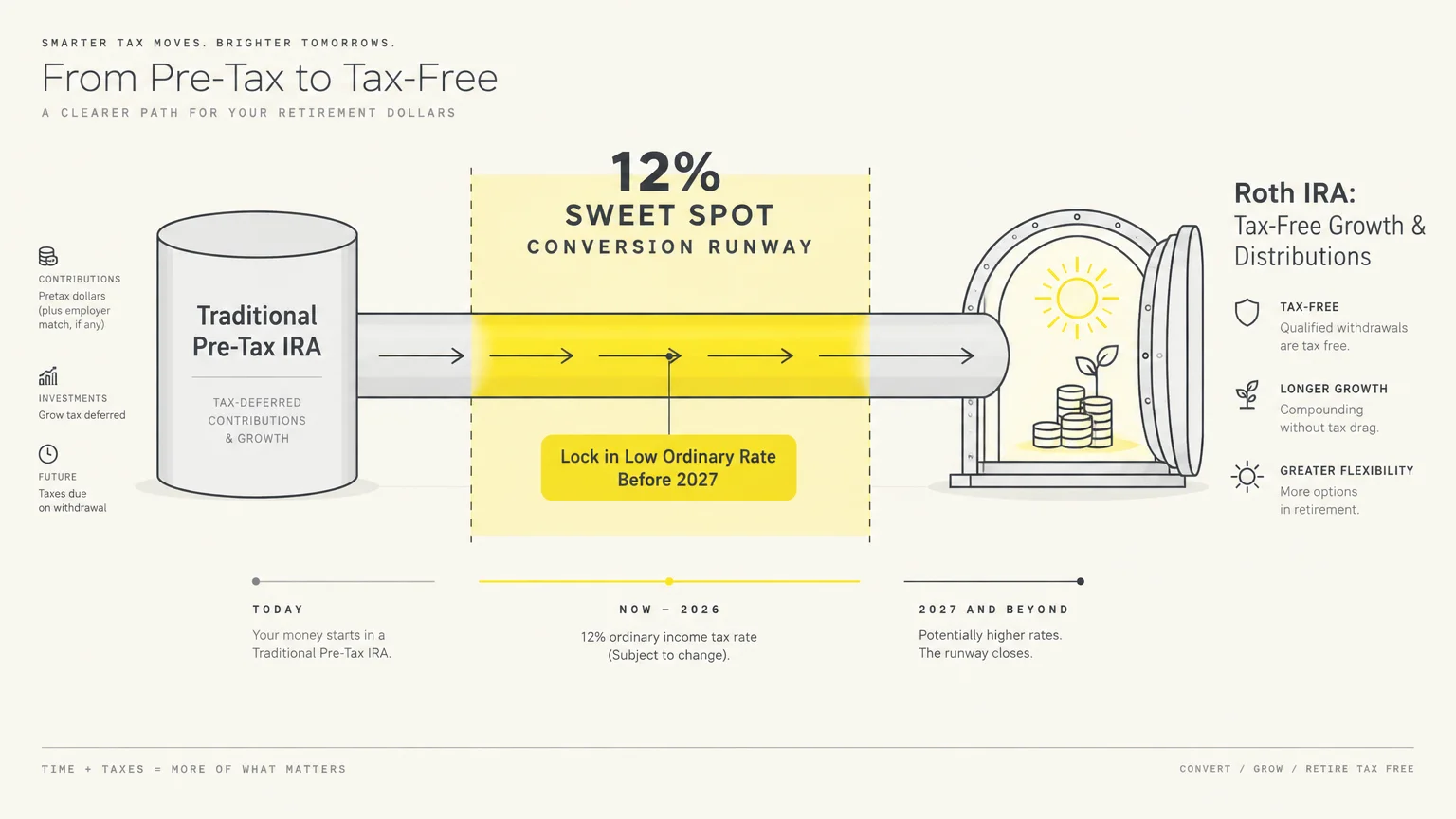
Financial planners widely consider the 12% ordinary income bracket the sweet spot of retirement tax planning. It gives you a remarkably broad runway to access retirement savings at a modest tax rate.
In 2026, the 12% bracket applies to taxable income between $12,401 and $50,400 for single filers. For married couples filing jointly, it covers taxable income between $24,801 and $100,800.
In 2027, projected adjustments expand this tier from $12,801 to $52,025 for singles, and from $25,601 to $104,050 for joint filers. Consider the total income a married senior couple can realize inside this bracket.
When you combine the projected 2027 joint standard deduction and senior bonuses with the 12% ceiling, a married couple can collect over $150,000 while paying no more than 12% on their top dollar.
This bracket offers an ideal window for execute strategic, partial Roth IRA conversions. You systematically withdraw money from tax-deferred accounts, pay a modest 12% tax, and move those dollars into a permanent tax-free environment.
“The single biggest threat to your retirement savings is taxes. You have to plan ahead and move your money from accounts that are ‘tax-deferred’ to accounts that are ‘tax-free’ while rates remain favorable.” — Ed Slott, CPA and Retirement Distribution Specialist

4. The 22% Bracket: The Steep Retirement Tax Cliff
The transition between the 12% and 22% brackets is the sharpest percentage jump in the federal income tax code. Exceeding the 12% threshold causes the tax rate on your next dollar of income to surge by ten full percentage points.
For 2026, the 22% bracket applies to taxable income from $50,401 to $105,700 for single taxpayers. For married couples filing jointly, the 22% rate spans from $100,801 to $211,400.
For tax year 2027, the 22% bracket is projected to cover $52,026 to $109,125 for singles and $104,051 to $218,250 for joint filers. Crossing into this bracket requires careful tactical evaluation.
Paying a 22% marginal rate may still prove advantageous if your required minimum distributions (RMDs) will later propel you into higher tax brackets. However, crossing this boundary accidentally can disrupt your annual budget.
Many retirees cross into the 22% bracket unintentionally when taking large one-time distributions for home renovations or medical emergencies. You should fund sudden capital needs from taxable savings or Roth accounts to preserve your 12% ceiling.
5. The 24% Upper-Middle Tier: A Viable Shelter for High Savers
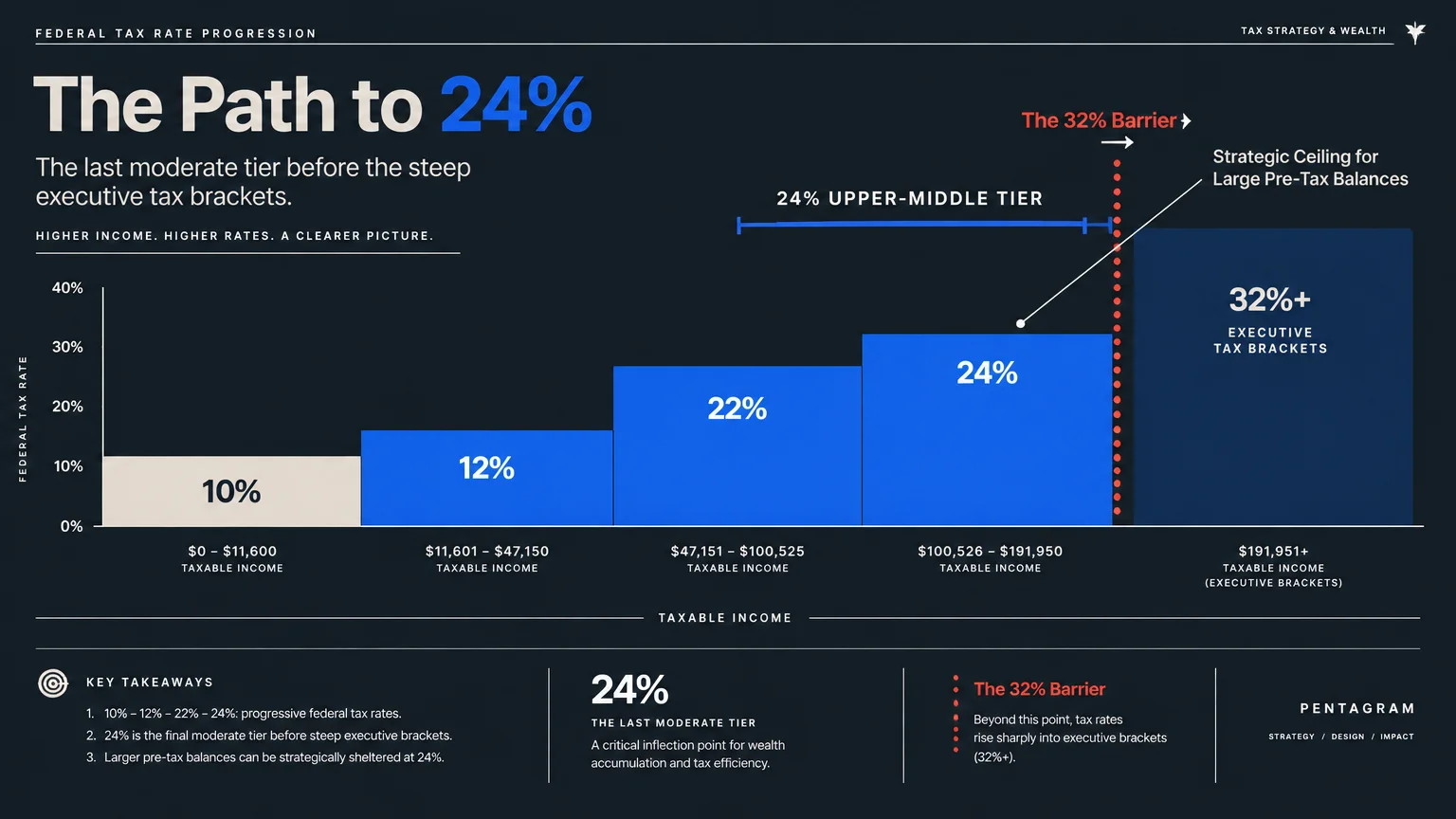
Unlike the sharp leap from 12% to 22%, the transition from the 22% bracket into the 24% tier is surprisingly gentle. Your marginal rate increases by just two percentage points.
In 2026, the 24% bracket spans from $105,701 to $201,775 for single filers, and from $211,401 to $403,550 for married couples. For 2027, projections place this bracket between $109,126 and $208,325 for singles, and $218,251 to $416,650 for married couples.
This bracket accommodates affluent retirees who possess significant traditional IRA balances or multiple defined-benefit pensions. The broad width of the 24% bracket allows you to absorb substantial income before facing the 32% bracket.
If you face large future RMDs, intentionally accelerating distributions through the top of the 24% bracket can be a brilliant defensive play. You prevent those mandatory distributions from pushing your balance into the 32% or 35% brackets later in life.

6. The 0% Long-Term Capital Gains Bracket
Not all retirement income is taxed at ordinary income rates; investments held in taxable brokerage accounts receive special treatment. Long-term capital gains and qualified dividends enjoy preferential rates, beginning at 0%.
In 2026, you pay a 0% capital gains rate if your total taxable income remains under $49,450 for single filers or $98,900 for married couples. In 2027, projections push these 0% caps up to $51,050 for singles and $102,100 for married joint filers.
Capital gains sit on top of your ordinary income when determining your bracket. If your ordinary income stays below the threshold, your investment gains can flow into your bank account completely tax-free.
This dynamic creates an exceptional opportunity known as tax-gain harvesting. You can intentionally sell appreciated stocks or mutual funds up to the cap and immediately buy them back, resetting your cost basis higher without paying any tax.
If your taxable income exceeds those thresholds, your capital gains trigger a 15% rate up to $545,500 for singles or $613,700 for joint filers in 2026 ($563,200 and $633,600 projected for 2027). Above those elevated marks, capital gains incur a 20% rate.
High-income retirees must also monitor the Net Investment Income Tax (NIIT). This 3.8% surcharge applies to investment gains once your MAGI exceeds $200,000 for single filers or $250,000 for married couples filing jointly.
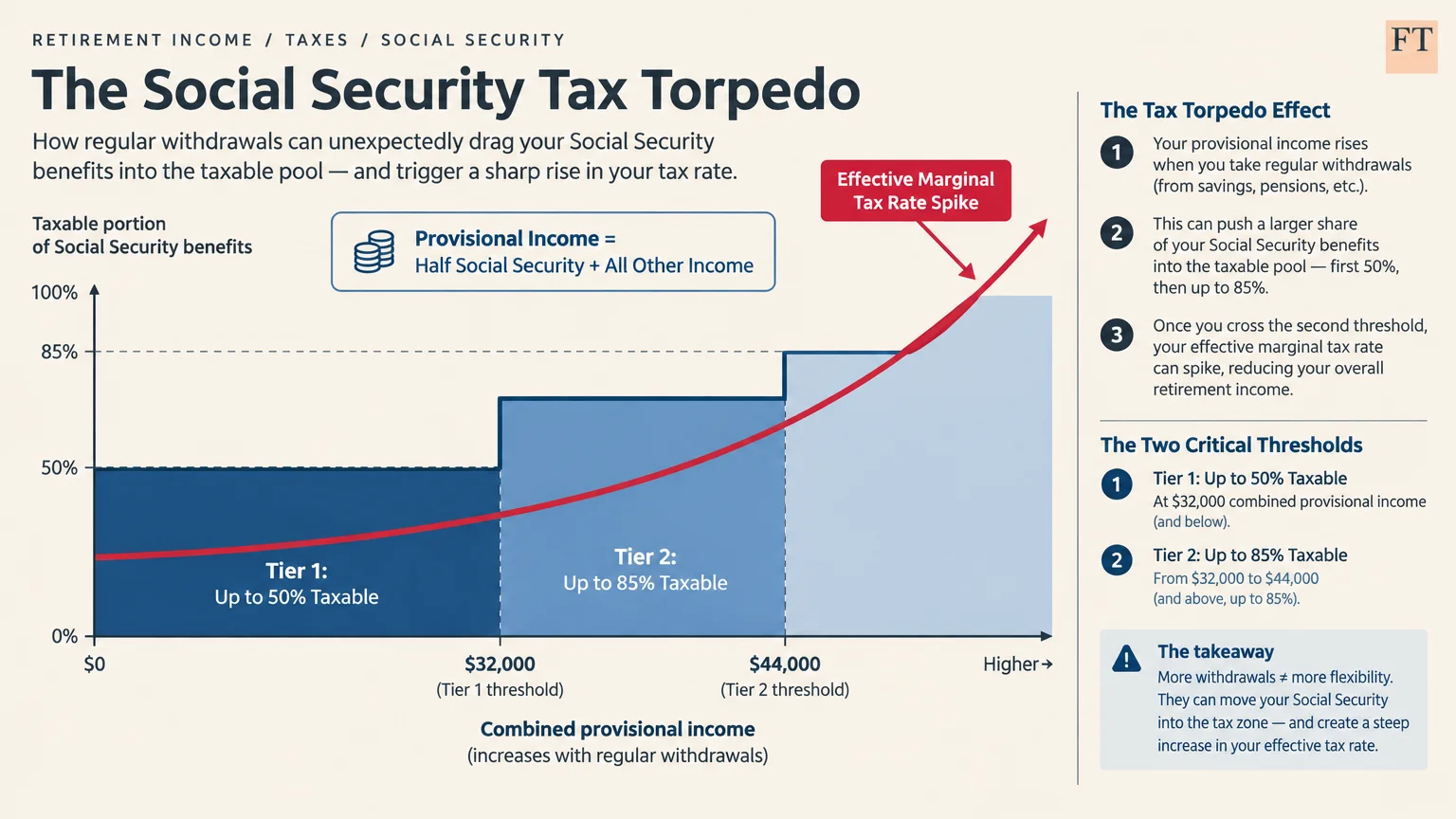
7. Social Security Provisional Income Brackets: The “Tax Torpedo”
Many seniors mistakenly believe their Social Security benefits are exempt from federal income taxation. In reality, your benefits face harsh taxation brackets governed by a formula known as provisional income.
Your provisional income equals your Modified Adjusted Gross Income plus non-taxable interest, plus exactly half of your gross annual Social Security benefits. The statutory thresholds governing Social Security have never been adjusted for inflation since their introduction in 1983.
The Social Security Administration (SSA) and the IRS apply two distinct taxation tiers based on this formula:
- Single Filers: Up to 50% of your benefits become taxable if provisional income sits between $25,000 and $34,000; up to 85% becomes taxable if your provisional income exceeds $34,000.
- Married Couples Filing Jointly: Up to 50% of benefits become taxable between $32,000 and $44,000; up to 85% becomes taxable once provisional income tops $44,000.
Because these thresholds remain completely frozen, standard Cost-of-Living Adjustments (COLA) push more retirees into these taxable tiers each year. Every dollar of outside income can cause eighty-five cents of your Social Security to become taxable.
This compounding effect creates what financial planners call the “tax torpedo.” It can drive your effective marginal tax rate far above your stated federal tax bracket.

8. Medicare IRMAA Surcharge Brackets: The Hidden Surcharge Cliff
Perhaps the most aggressive shadow tax brackets in retirement belong to Medicare. The Income-Related Monthly Adjustment Amount (IRMAA) slaps monthly surcharges onto your Part B medical and Part D prescription drug coverage.
IRMAA surcharges operate as rigid cliff brackets rather than progressive tiers. If your MAGI crosses an IRMAA threshold by even one single dollar, you owe the entire monthly surcharge for the full year.
The Centers for Medicare & Medicaid Services enforce a strict two-year lookback period. Your 2025 tax return dictates your Medicare premiums for 2027, and your 2026 tax return determines your 2028 premiums.
For 2026, initial IRMAA surcharges begin when MAGI exceeds $109,000 for single filers or $218,000 for married couples filing jointly. Official 2027 brackets will appear in late 2026 based on inflation data.
Failing to manage your income before 2027 can result in hundreds or thousands of dollars in added Medicare costs. You must evaluate your distributions carefully to avoid triggering these steep surcharge cliffs.
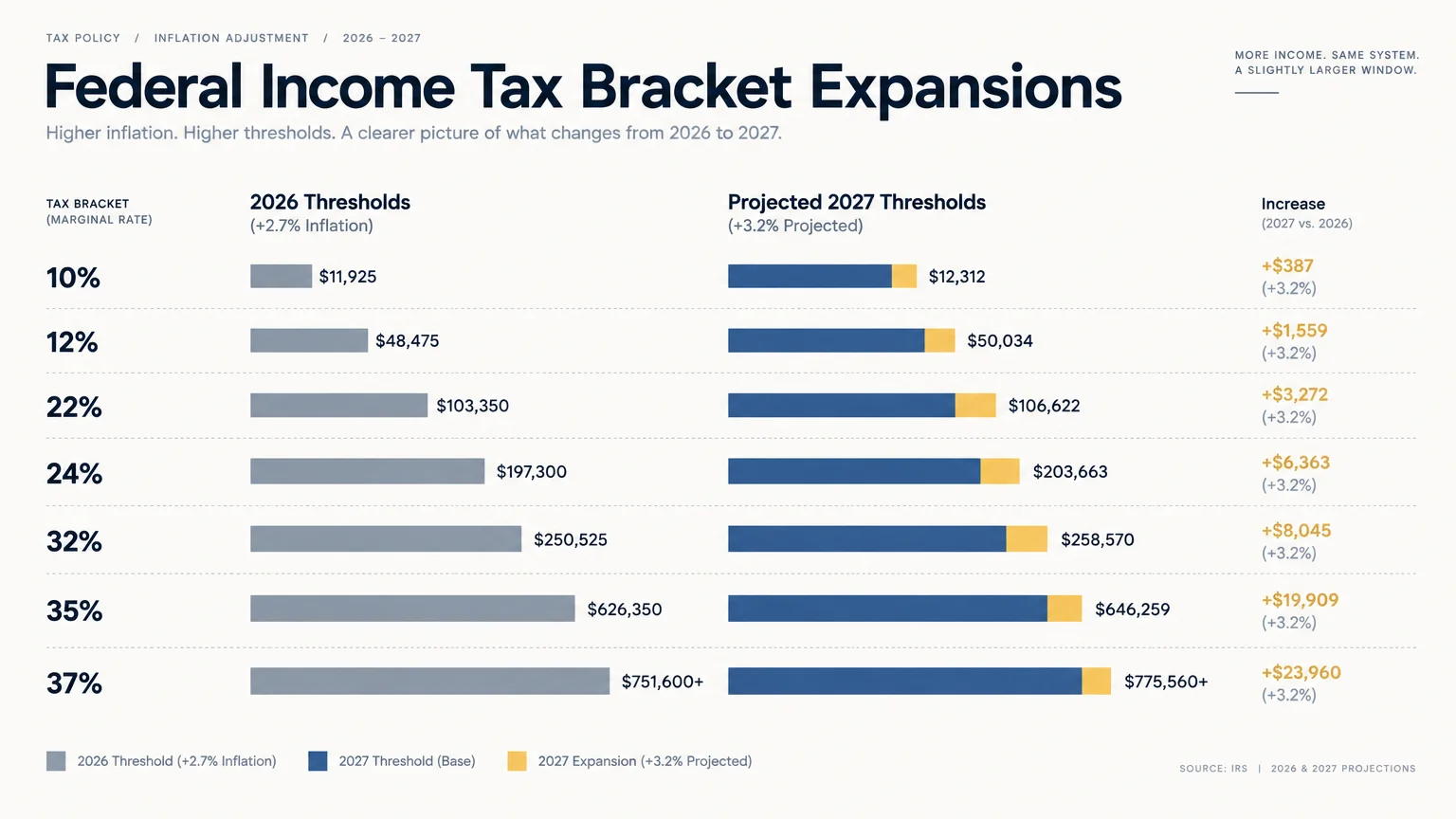
2026 vs. Projected 2027 Tax Brackets and Thresholds
The following comparison table shows the official 2026 IRS limits alongside projected 2027 thresholds for each essential retiree bracket. Use these numbers to guide your multi-year distribution plan.
| Tax Bracket / Category | 2026 Limits (Single / MFJ) | 2027 Projected (Single / MFJ) | Strategic Action for Retirees |
|---|---|---|---|
| 0% Standard Base | $16,100 / $32,200 | $16,600 / $33,200 | Foundation deduction; shields baseline retirement income. |
| Age 65+ Traditional Bump | +$2,050 / +$1,650 each | +$2,100 / +$1,700 each | Automatic deduction boost; claim as soon as you reach 65. |
| OBBBA Senior Bonus | +$6,000 / +$12,000 max | +$6,000 / +$12,000 max | Phases out over $75k single / $150k MFJ; keep income under cap. |
| 10% Ordinary Rate | Up to $12,400 / $24,800 | Up to $12,800 / $25,600 | Fill this low bracket with taxable IRA withdrawals annually. |
| 12% Ordinary Rate | $12,401–$50,400 / $24,801–$100,800 | $12,801–$52,025 / $25,601–$104,050 | Ideal sweet spot for executing ongoing partial Roth conversions. |
| 22% Ordinary Rate | $50,401–$105,700 / $100,801–$211,400 | $52,026–$109,125 / $104,051–$218,250 | Ten-point jump; avoid crossing this threshold unintentionally. |
| 24% Ordinary Rate | $105,701–$201,775 / $211,401–$403,550 | $109,126–$208,325 / $218,251–$416,650 | Modest 2% bump; useful runway to accelerate pre-RMD withdrawals. |
| 0% Capital Gains | Up to $49,450 / $98,900 | Up to $51,050 / $102,100 | Harvest gains in taxable accounts up to the threshold tax-free. |
| Social Security 50% Tier | $25,000–$34,000 / $32,000–$44,000 | Frozen (Unindexed) | Manage provisional income to avoid the tax torpedo. |
| Social Security 85% Tier | Over $34,000 / $44,000 | Frozen (Unindexed) | Plan around maximum benefit taxation once you cross this limit. |
| Medicare IRMAA Tier 1 | Over $109,000 / $218,000 | Subject to CMS late 2026 update | Mind the 2-year lookback; prevent a $1 overage cliff surcharge. |

Strategic Action Steps to Optimize Your Brackets Before 2027
Understanding these brackets is only valuable if you implement concrete financial steps. You must manage where your money comes from and when you withdraw it.
First, practice bracket topping each December. Calculate your expected income for the year, evaluate the remaining space inside your current bracket, and pull just enough from your traditional IRA to fill that tier.
Second, capitalize on Qualified Charitable Distributions (QCDs) if you are age 70½ or older. For 2026, the IRS allows you to donate up to $111,000 directly from your traditional IRA to an eligible 501(c)(3) charity tax-free.
A QCD satisfies your annual required minimum distribution without increasing your Adjusted Gross Income. This keeps your income below the phaseouts for senior bonuses, IRMAA surcharges, and Social Security taxation brackets.
Third, balance your withdrawal sequencing across tax-deferred, taxable, and tax-free accounts. Drawing from a Roth account creates zero taxable income, giving you absolute control over your bracket placement.
Fourth, maintain emergency cash reserves in high-yield savings accounts or short-term Treasury bills. Having accessible cash prevents you from making sudden, oversized IRA withdrawals that trigger unwanted tax penalties.

Costly Errors to Sidestep
Retirees often stumble into avoidable traps when navigating the interplay of federal brackets. Recognizing these missteps beforehand protects your income.
- Triggering an IRMAA Cliff by a Few Dollars: Selling an asset or completing a Roth conversion without checking IRMAA lines can cost thousands in extra Medicare premiums. Always track your MAGI against the $109,000 single or $218,000 joint benchmarks.
- Forfeiting the OBBBA Senior Bonus: Taking excessive distributions that push your MAGI over $75,000 as a single filer ($150,000 married) phases out your $6,000 or $12,000 bonus deduction. Keep your income under those phaseout lines when possible.
- Ignoring the Widow’s Tax Penalty: When one spouse passes away, the surviving spouse transitions from married filing jointly to single filing status. This cuts your tax brackets and deduction thresholds almost in half while your income often stays largely the same.
- Waiting Too Long to Begin Roth Conversions: Delaying traditional IRA distributions until required distribution ages force your hand can result in massive, uncontrollable RMDs. Execute planned conversions during your lower-income early retirement years.

When DIY Isn’t Enough
While many seniors handle basic tax filing independently, certain retirement scenarios demand professional expertise. Complex distribution logistics can easily overwhelm basic tax software.
You should consider partnering with a certified financial planner or tax professional if your combined traditional retirement assets exceed $1,500,000. Large account balances inevitably face substantial RMDs that require sophisticated multi-year modeling.
Professional guidance is also critical if you plan to sell appreciated real estate or a family business in retirement. A seasoned advisor can structure installment sales or 1031 exchanges to prevent you from shooting into top brackets.
Transitioning into surviving spouse status also warrants expert help. An advisor can evaluate whether accelerating distributions before filing as single provides substantial lifetime savings.
For independent verification of credentialed financial planners, you can consult public consumer resources provided by the Consumer Financial Protection Bureau (CFPB).
Frequently Asked Questions
Did the tax cuts expire at the end of 2025 as originally scheduled?
No, the lower individual income tax rates did not expire. Congress passed the One Big Beautiful Bill Act in July 2025, which permanently preserved the seven individual brackets established under the 2017 Tax Cuts and Jobs Act.
How does the new OBBBA Senior Bonus Deduction work?
The OBBBA provides an extra $6,000 deduction per person age 65 and older for tax years 2025 through 2028. This deduction begins to phase out at a 6% rate once MAGI exceeds $75,000 for single filers or $150,000 for married couples.
How does the Medicare IRMAA two-year lookback affect my 2027 planning?
Medicare bases your 2027 Part B and Part D premiums on the tax return you file for 2025. Any income generated in 2026 will dictate your 2028 Medicare premiums, making early planning essential.
Can completing a Roth conversion increase the taxes on my Social Security?
Yes, traditional IRA conversions count directly toward your provisional income. If your non-benefit income increases, it can cause up to 85% of your Social Security benefits to face federal income tax.
Taking Control of Your Retirement Brackets
Retirement tax planning is not a one-time event; it is an active, ongoing process that requires your attention each year. Knowing how the eight tax brackets interact gives you a profound advantage over retirees who simply react when tax season arrives.
Take the time this week to review your current tax return, evaluate your withdrawal strategy, and calculate where your income falls against these 2026 and 2027 thresholds. A few small adjustments today will keep more of your hard-earned money where it belongs: in your pocket.
The information in this guide is meant for educational purposes. Your specific circumstances—including income, benefits, tax situation, and health needs—may require different approaches. When in doubt, consult a licensed financial advisor or tax professional.
Last updated: February 2026. Benefit amounts, tax rules, and program details change annually—verify current figures with official government sources.









Leave a Reply