

Claiming Social Security before your Full Retirement Age does not mean you must stop building wealth. You can collect thousands of dollars in monthly cash flow without triggering any reduction in your retirement benefits.
The Social Security Administration evaluates only your earned wages from active work, leaving various passive revenue streams completely untouched. Learning which dollars are exempt allows you to optimize your retirement income without fear of sudden penalties.
This practical guide breaks down the six major payment types that protect your monthly benefit check.
Understanding the Social Security Retirement Earnings Test
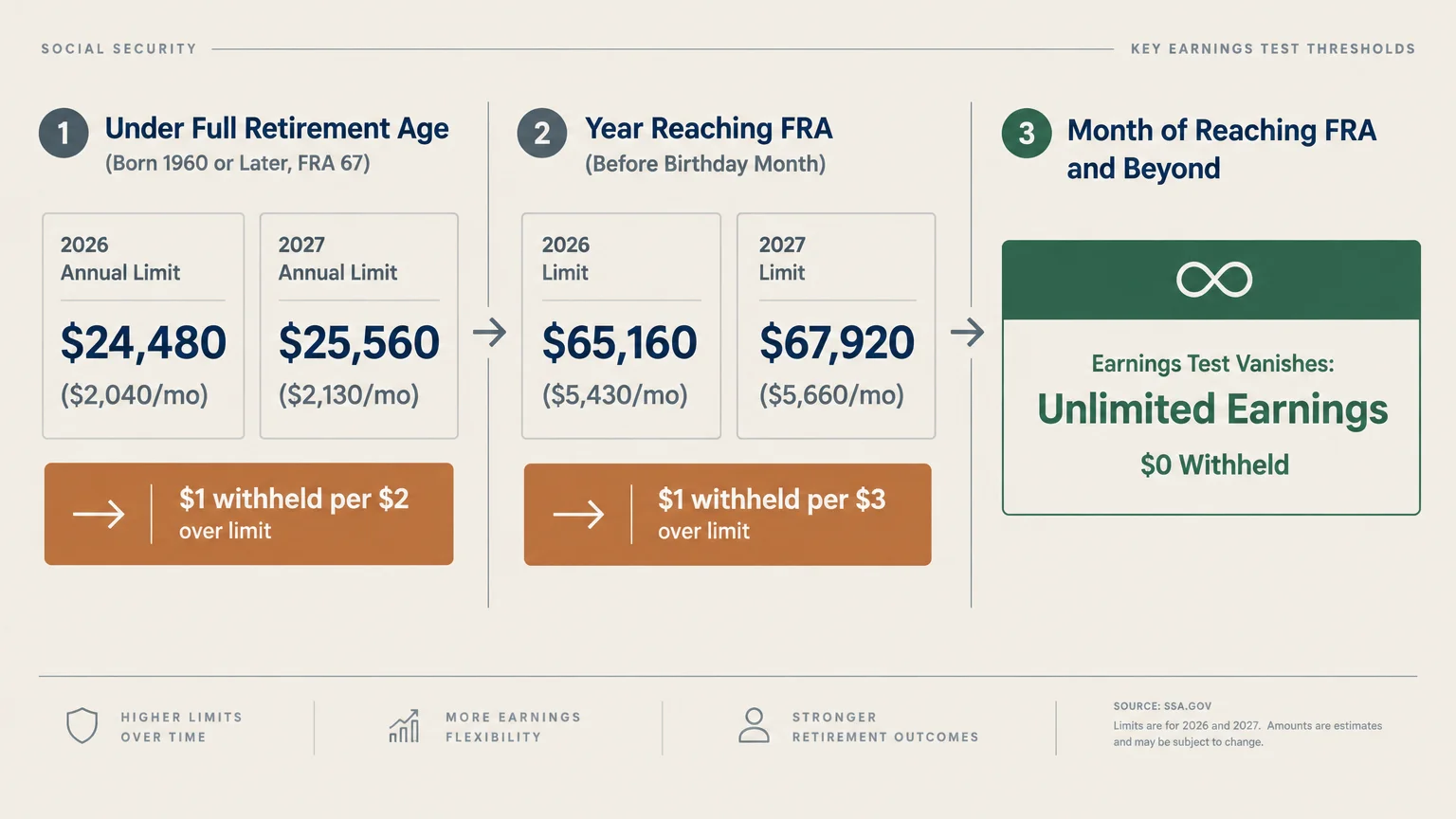
The Social Security Administration (SSA) applies an earnings test if you claim retirement benefits before reaching your Full Retirement Age (FRA). For anyone born in 1960 or later, Full Retirement Age is 67.
If you work while collecting early benefits, federal rules cap the amount of active wages you can bring home each year. Exceeding those statutory limits triggers temporary withholding of your monthly benefit checks.
For the year 2026, the annual exempt earnings limit is $24,480, which equals $2,040 per month. If you remain under Full Retirement Age for the entire calendar year, the SSA withholds $1 in benefits for every $2 you earn above $24,480.
For 2027, the exempt earnings threshold rises to $25,560, or $2,130 per month. The agency continues to apply the same $1 withholding for every $2 earned over this threshold.
A higher limit applies during the calendar year you reach your Full Retirement Age. In 2026, you can earn up to $65,160 ($5,430 per month) before reaching your birthday month without penalty.
For earnings above $65,160 in 2026, the agency withholds $1 for every $3 earned. In 2027, this higher threshold increases to $67,920, which breaks down to $5,660 per month.
Once you reach the exact month of your Full Retirement Age, the earnings test vanishes completely. You can earn an unlimited salary without sacrificing a single penny of your benefit.
Withheld benefits are never permanently lost. When you reach Full Retirement Age, the Social Security Administration recalculates your monthly payment to credit you for every month benefits were withheld.
A special monthly rule also protects you during your first year of retirement. This rule ensures you receive your full benefit for any month you earn $2,040 or less in 2026 ($2,130 in 2027), regardless of your total yearly earnings.
If you run an independent venture, the monthly rule requires you to spend fewer than 45 hours per month working on your business. For highly skilled occupations, spending between 15 and 45 hours can still count as substantial service.
Earned Income vs. Unearned Income: The Crucial Difference
The retirement earnings test hinges on a strict legal distinction between earned income and unearned income. Understanding this difference prevents costly surprises on your annual tax return.
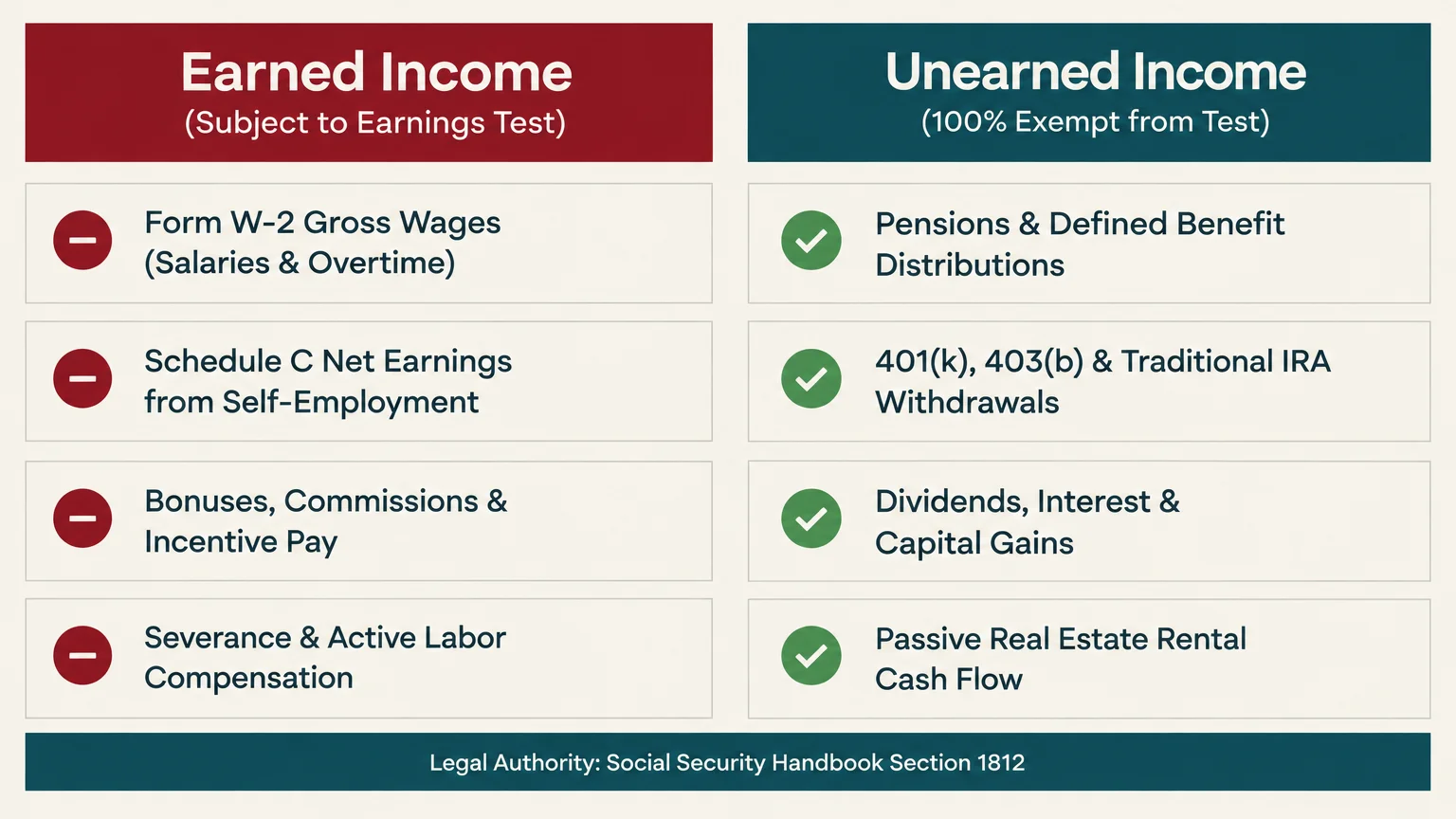
According to Section 1812 of the official Social Security Handbook, the earnings test applies exclusively to gross wages from employment and net earnings from self-employment. The government views earned income as direct compensation for your present labor.
Gross wages include salaries, overtime pay, bonuses, commissions, and severance pay. If an employer reports your compensation on a Form W-2, the SSA counts every dollar toward your annual limit.
Net earnings from self-employment include profits reported on Schedule C of your federal tax return. The agency tallies these amounts after allowable business deductions, regardless of when clients submit payment.
Unearned income represents financial gains that do not stem from your physical or mental labor during that tax year. These inflows stem from past investments, employer retirement packages, or government support programs.
The SSA excludes unearned income completely from the earnings test calculation. You can receive hundreds of thousands of dollars in unearned payments every year without losing any monthly Social Security checks.
| Income Category | Counted Toward Earnings Limit? | Impact on Benefits Under FRA |
|---|---|---|
| W-2 Wages and Salaries | Yes | Withholds $1 for every $2 over annual limit ($24,480 in 2026) |
| Net Self-Employment Earnings | Yes | Reduces benefits if business net profit exceeds annual limits |
| Employer Pension Plans | No | Zero reduction, regardless of total annual payout |
| Traditional and Roth IRA Withdrawals | No | Zero reduction; distributions do not count as active wages |
| Stock Dividends and Capital Gains | No | Zero reduction; growth reflects passive investment return |
| Passive Real Estate Rental Income | No | Zero reduction if you do not operate as a real estate dealer |
Knowing how your cash inflows are classified gives you greater control over your retirement timetable. Let us examine the six major income streams that leave your monthly benefit untouched.

1. Employer Pensions and Military Retirement Pay
Monthly pension checks from former employers represent deferred compensation for labor you completed in past decades. Because you are no longer actively working to generate those funds, the SSA considers them unearned income.
You can collect a corporate pension, a union benefit, or a private annuity without triggering any earnings test reduction. Even a six-figure annual pension distribution will not reduce your early Social Security retirement benefits.
Military retirement benefits follow identical exemption guidelines. Retired service members can draw full military retirement pay alongside early Social Security benefits without running afoul of the annual earnings cap.
Civil service pensions also qualify as unearned income under earnings test regulations. Whether you worked for a local municipality, a state agency, or the federal government, those pension distributions remain exempt.
Be aware of separate historical provisions that apply to pensions earned from jobs where you did not pay Social Security payroll taxes. The Windfall Elimination Provision and Government Pension Offset can modify benefit formulas for certain non-covered public workers.
Those specific provisions alter your baseline benefit formula rather than testing your current annual work earnings. If your pension comes from covered employment where FICA taxes were deducted, your checks face zero offsets.
2. Traditional 401(k), 403(b), and IRA Distributions
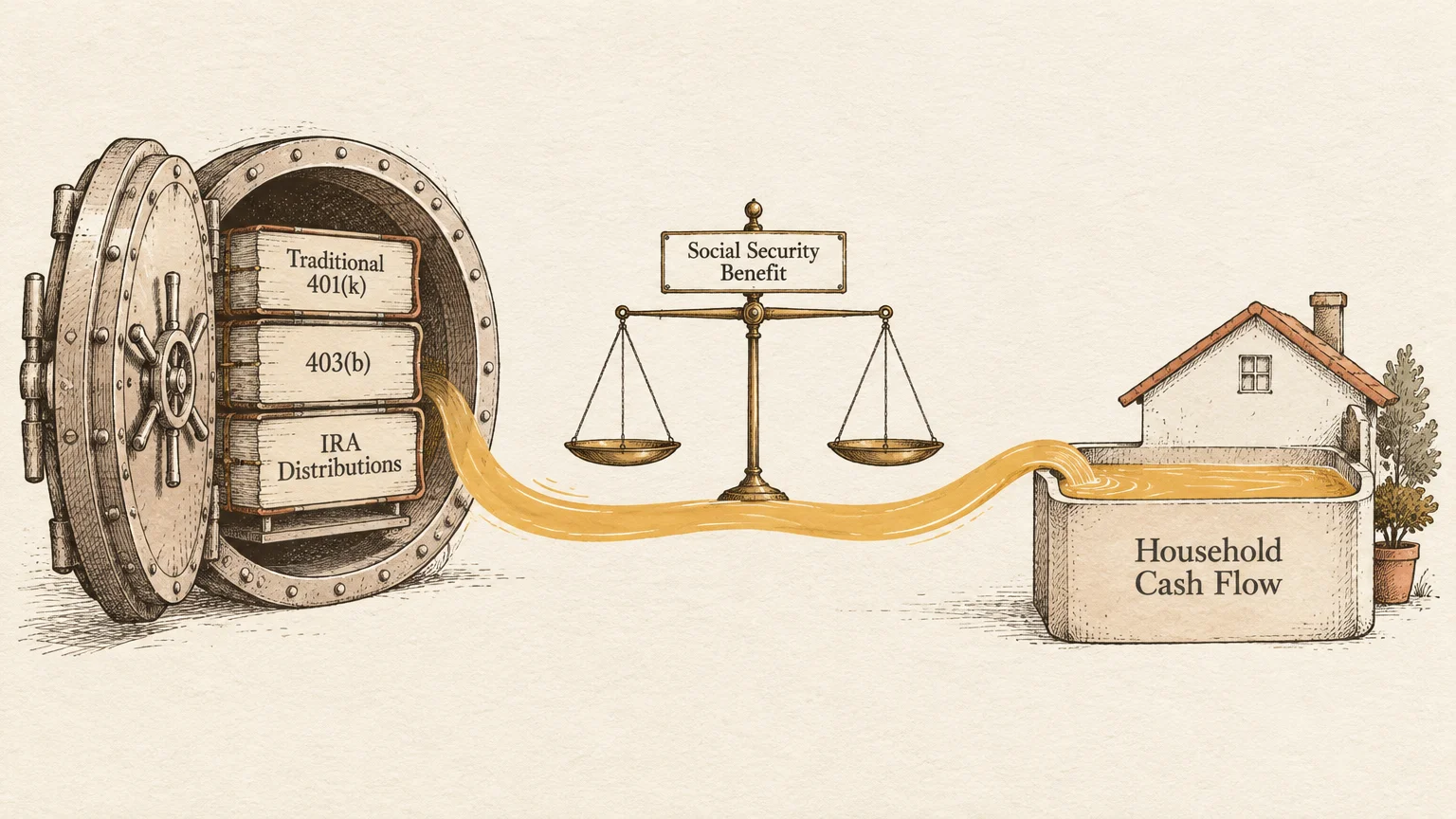
Distributions from qualified retirement accounts represent one of the most common income sources for American seniors. Fortunately, the SSA does not treat retirement account withdrawals as wages.
Money you pull from a traditional 401(k), 403(b), or 457(b) plan enters your bank account completely exempt from the earnings test. The same exemption applies to distributions from Traditional IRAs and SEP-IRAs.
Required Minimum Distributions (RMDs) mandated by the Internal Revenue Service also do not count. Even if an RMD forces you to withdraw tens of thousands of dollars, your Social Security benefit remains protected.
Roth IRA and Roth 401(k) distributions enjoy the exact same protection under federal rules. Because you funded these accounts with after-tax dollars, withdrawals do not reflect active employment earnings.
Private commercial annuities follow this exact blueprint. Annuity payouts purchased through insurance companies deliver reliable monthly cash flow without raising your counted earnings total by a single cent.
“The most important thing to understand about retirement accounts is that taxes will always be your single biggest expense.” — Ed Slott, CPA
As Ed Slott points out, while these withdrawals bypass the earnings test, they may still trigger income tax liabilities. Managing the timing of your account distributions keeps your overall tax burden manageable.
3. Investment Dividends, Interest, and Capital Gains
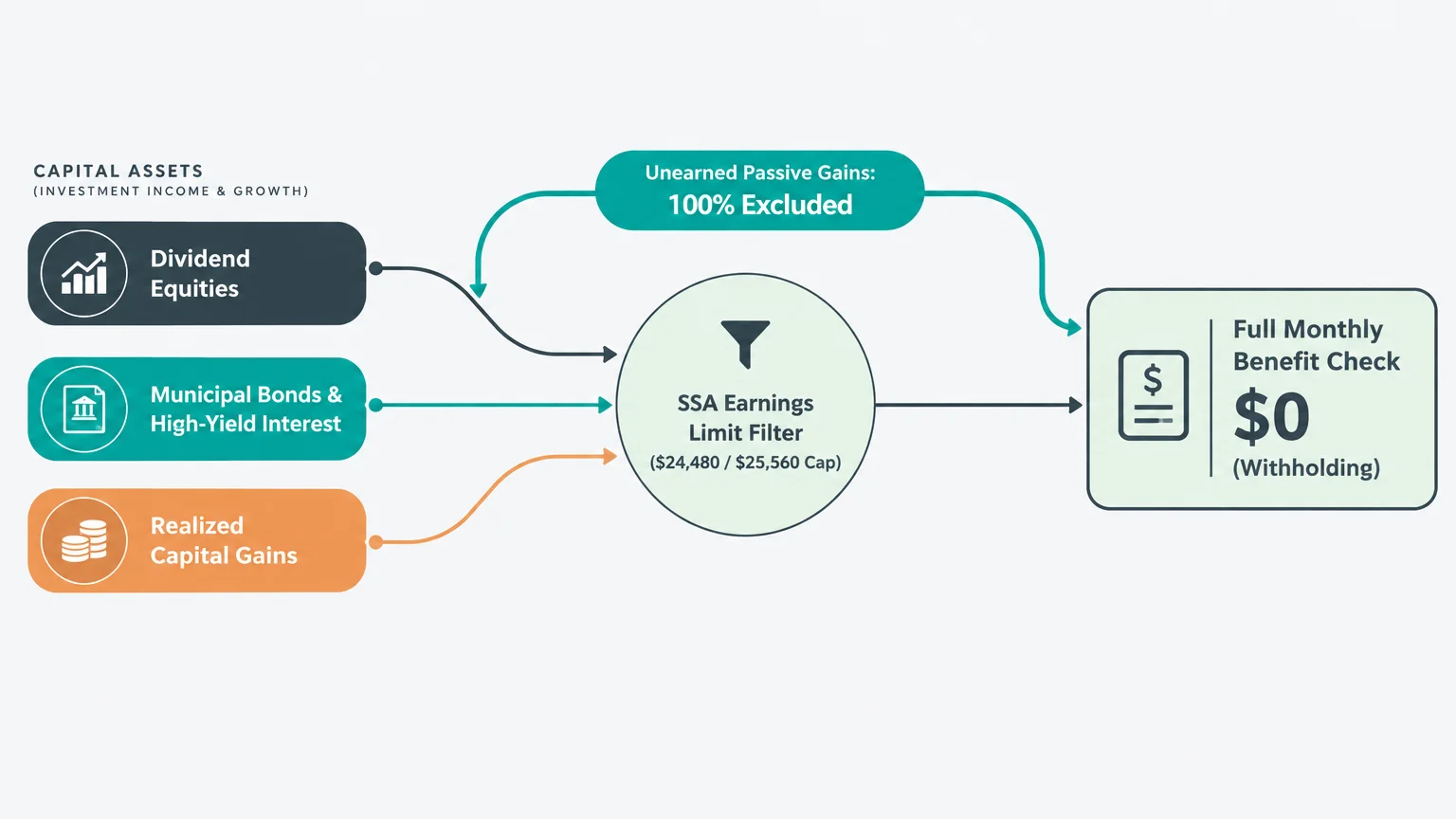
Investment portfolios generate income while you sleep, which is why federal regulations classify portfolio growth as purely passive. You can build substantial investment wealth without jeopardizing your Social Security checks.
Dividends paid by corporate stocks, mutual funds, and exchange-traded funds (ETFs) do not count toward the annual earnings ceiling. Whether you reinvest those dividends or deposit them into checking, the SSA ignores them entirely.
Interest payments generated by high-yield savings accounts, certificates of deposit (CDs), and Treasury bonds remain completely exempt. Municipal bond interest also bypasses the earnings test, even when it generates substantial cash flow.
Capital gains realized from selling assets represent investment appreciation rather than earned wages. If you sell appreciated shares of stock, mutual funds, or precious metals, that profit does not trigger benefit withholding.
Selling your personal residence or secondary property generates capital gains that remain exempt from the earnings limit. You can downsize your home, pocket significant equity, and continue collecting your normal monthly benefit check.
An exception exists only for licensed securities dealers who trade financial instruments as an active daily trade or business. For everyday individual investors managing personal savings, portfolio revenue remains entirely safe from benefit withholding.

4. Passive Real Estate Rental Income
Real estate investments can generate dependable monthly cash flow throughout your retirement years. The Social Security Administration explicitly categorizes rental income as unearned revenue under standard conditions.
If you own residential duplexes, condominiums, or single-family rental homes, your net rental profits do not count toward the earnings limit. You can collect rent payments each month while drawing early retirement benefits.
Commercial real estate holdings and industrial leases enjoy the exact same exemption under SSA guidelines. Returns generated through real estate syndications or Real Estate Investment Trusts (REITs) are similarly protected from the earnings cap.
To retain this complete exemption, your real estate activities must remain strictly passive under tax law definitions. You cannot operate as a licensed real estate dealer holding properties primarily for quick retail sale to customers.
If you provide substantial hotel-like services to tenants, the government may reclassify your rental revenue as active self-employment earnings. Providing regular maid service, catered meals, or guided tours turns rental profits into active earned income.
Standard landlord maintenance—such as fixing plumbing, painting walls, or collecting monthly rent—does not violate the passive income rule. As long as you maintain typical rental properties, your monthly benefit remains fully secure.

5. Government Benefits and Veterans Affairs (VA) Payments
Millions of seniors rely on government support programs and military service benefits to cover essential living expenses. The SSA never counts public support benefits toward your retirement earnings ceiling.
Disability compensation and pension payments issued by the U.S. Department of Veterans Affairs remain completely exempt. A veteran can receive maximum service-connected disability compensation while drawing early Social Security retirement benefits.
State unemployment insurance benefits also do not count as earned income under federal guidelines. If you lose an early retirement job and collect unemployment compensation, those state funds will not reduce your Social Security.
Workers’ compensation settlements and ongoing statutory disability benefits bypass the earnings test as well. Because these programs replace lost health or functional capacity rather than compensating current work, the SSA excludes them.
Do not confuse Social Security retirement rules with Supplemental Security Income (SSI) standards. SSI is a strict needs-based program that limits unearned income and caps countable resources at $2,000 for individuals and $3,000 for couples.
Social Security Disability Insurance (SSDI) also enforces different guidelines through Substantial Gainful Activity (SGA) caps. In 2026, the non-blind SGA limit is $1,690 per month, rising to $1,770 per month in 2027.

6. Inheritances, Cash Gifts, and Legal Settlements
Unexpected financial windfalls can significantly improve your retirement security without endangering your monthly Social Security checks. The Social Security Administration does not view gifts or inheritances as active labor compensation.
Cash inheritances, distributions from family trusts, and inherited personal property bypass the earnings limit entirely. You can inherit an estate valued at millions of dollars without sacrificing any of your monthly retirement payments.
Financial gifts from children, relatives, or friends follow identical exemption standards. Whether someone gifts you money to cover healthcare expenses or provides cash for a vacation, your benefits remain safe.
Compensatory damages received from personal injury court settlements or lawsuit judgments do not count as earned wages. The law treats these legal payouts as compensation for physical harm, emotional distress, or property damage.
Be careful if a legal settlement specifically designates an award as back pay or lost wages from employment. The SSA classifies back-pay settlements as earned wages, attributing those dollars to the tax years when you earned them.
Sick pay received more than six calendar months after the last month you worked is also exempt from the earnings test. Once you cross that six-month threshold, ongoing disability or sick payouts cease counting as active employment wages.
The Hidden Catch: Income Taxes on Social Security Benefits
While unearned income will not trigger the Social Security earnings test, it can still trigger significant federal income taxes. Many seniors mistakenly assume that earnings-test exempt means completely tax-free.
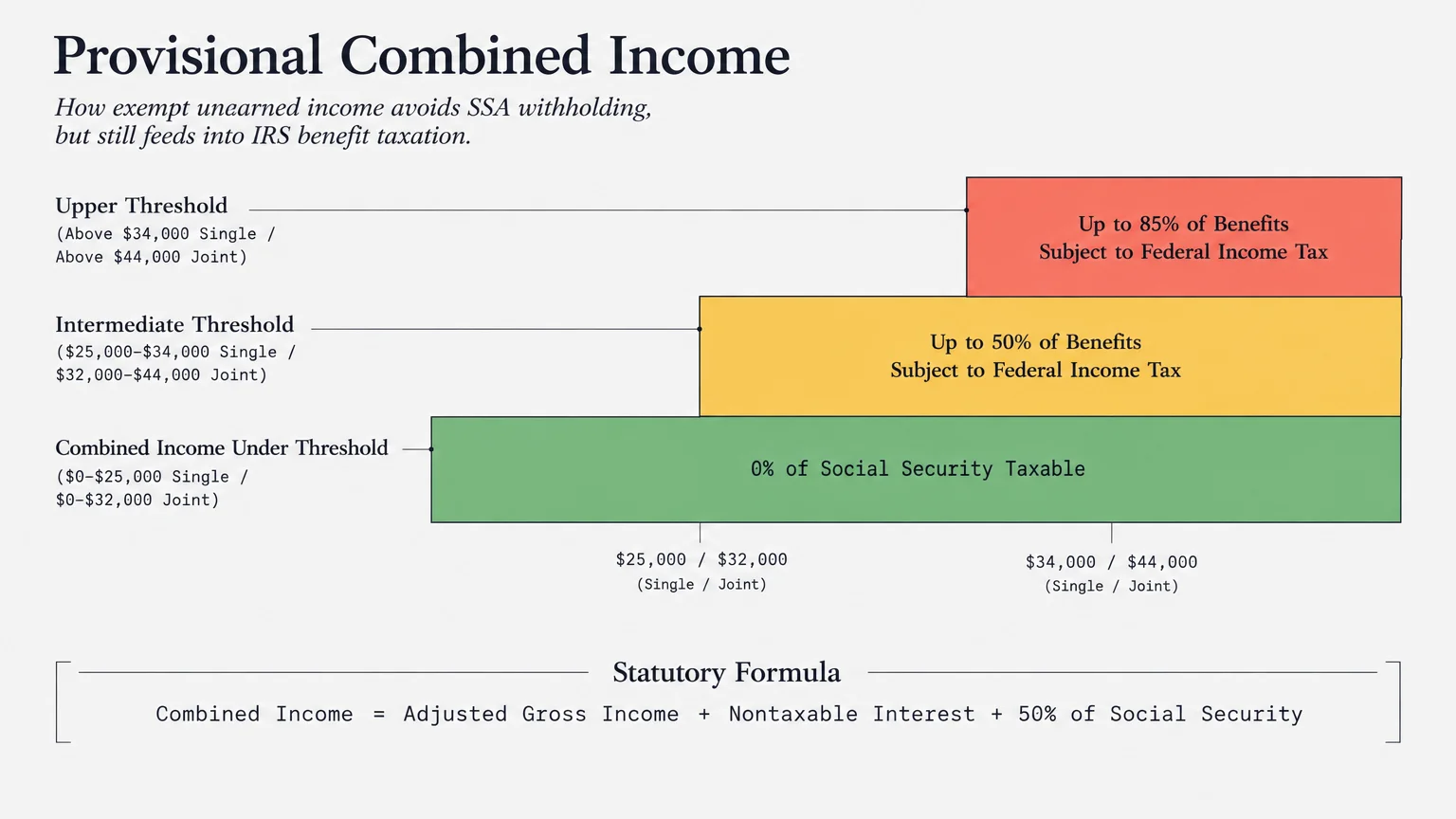
The IRS uses a specific formula called “combined income” or provisional income to decide whether your monthly benefits face federal taxes. Calculating your combined income requires simple addition across three specific financial categories.
Your combined income equals your Adjusted Gross Income (AGI), plus any nontaxable interest, plus exactly half of your total annual Social Security benefits. Unearned income streams like pensions, IRA withdrawals, and dividends increase your AGI directly.
If your combined income falls between $25,000 and $34,000 as an individual tax filer, up to 50% of your benefits become taxable. If your combined income surpasses $34,000, up to 85% of your benefits face federal income tax.
For married couples filing jointly, combined income between $32,000 and $44,000 exposes up to 50% of benefits to taxation. If a joint return reports combined income above $44,000, up to 85% of benefits become taxable.
Congress established these static tax thresholds in 1983 and has never indexed them for inflation. Because these thresholds remain fixed, standard investment growth and pension payouts push millions of beneficiaries into taxable brackets every year.
What Can Go Wrong: 4 Costly Mistakes Seniors Make
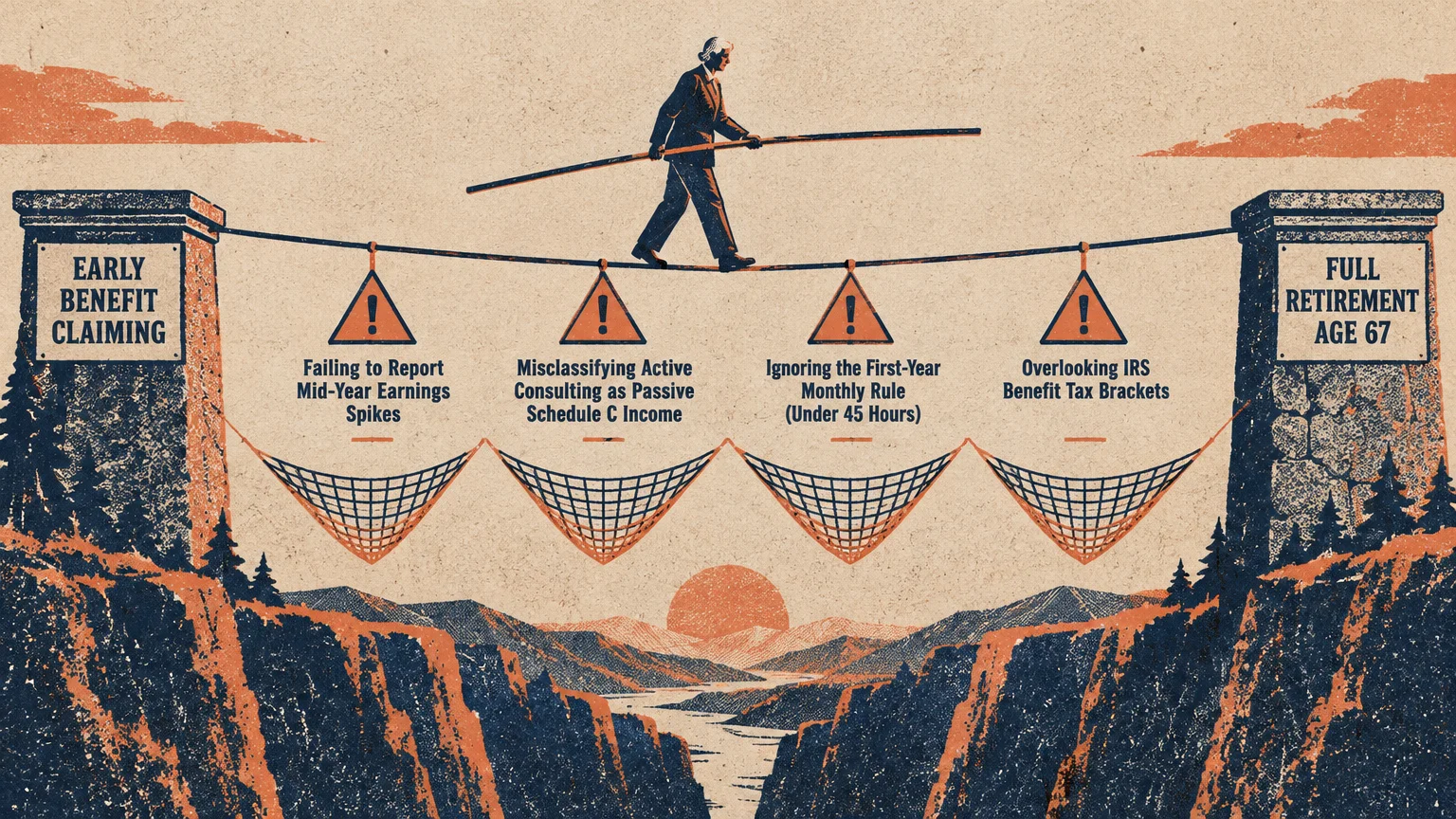
Navigating the intersection of early retirement benefits and ongoing income requires careful attention to detail. Making administrative mistakes can derail your monthly budget and trigger unexpected clawbacks from the government.
The first major error involves confusing deferred compensation payouts or vacation cash-outs with unearned pension money. Employers often distribute accumulated vacation pay or deferred bonuses months after you step away from your job.
The SSA counts accrued vacation pay and performance bonuses as earned income if you performed the work before retirement. If that payout arrives during a year you claim early benefits, it can push you past the annual limit.
The second mistake occurs when business owners attempt to disguise active consulting labor as passive corporate dividends. The SSA investigates small business owners who slash their W-2 salaries while taking massive dividend distributions from an S-Corporation.
If you actively perform consulting or executive services for your firm, the SSA can reclassify those corporate distributions as earned wages. That reclassification can trigger immediate withholding of your monthly retirement benefits.
The third error involves mismanaging the special first-year monthly retirement rule. Self-employed retirees often violate the rule by working more than 45 hours in a single month during their first retirement year.
Devoting more than 45 hours to your venture eliminates your monthly exemption, even if the business generated zero profit that month. Tracking your business hours meticulously ensures you preserve your full monthly checks.
The fourth common misstep is failing to withhold federal income taxes on early retirement distributions. Receiving large pension checks alongside Social Security can cause an unexpected tax bill on April 15.
You can submit IRS Form W-4V to request voluntary federal tax withholding directly from your monthly Social Security payments. Choosing voluntary withholding prevents underpayment penalties and smooths out your annual tax obligations.

When to Consult a Professional
While basic Social Security rules appear straightforward, personal financial circumstances often require custom strategic planning. Working with a qualified financial planner or certified public accountant protects your household wealth.
You should seek professional counsel if you plan to transition from an executive W-2 position into an independent consulting role. A tax specialist can help structure your business entity to separate active earnings from legitimate passive returns.
Schedule a planning session if you hold significant assets in traditional pre-tax retirement accounts like 401(k)s and traditional IRAs. An advisor can model systematic Roth conversions before Full Retirement Age to reduce future required distributions.
Professional guidance is critical if you negotiate a complex corporate severance agreement or deferred executive compensation package. An experienced CPA will verify which portions count as earned wages and help you time payments advantageously.
Consult a qualified tax advisor if your household income sits near the $25,000 or $32,000 provisional income thresholds. Precise management of capital gains and municipal bond interest can keep your Social Security benefits out of the 85% tax tier.
Frequently Asked Questions
Does rental income count toward the Social Security earnings limit?
No, standard rental income from investment properties does not count toward the Social Security earnings limit. The SSA considers rental profits unearned income, provided you do not operate as a licensed real estate dealer or provide hotel-style services.
What happens to Social Security benefits withheld due to excess earnings?
Withheld benefits are not permanently forfeited or lost. When you reach your Full Retirement Age, the SSA automatically recalculates your monthly benefit upward to credit you for every month benefits were withheld.
Can I draw a private annuity without reducing my Social Security checks?
Yes, payouts from private commercial annuities do not count toward the earnings limit. The government classifies annuity distributions as unearned income, allowing you to collect full payments regardless of your age.
How does the Social Security earnings test work if I retire mid-year?
A special monthly rule applies during your first calendar year of retirement. In 2026, you can receive your full Social Security check for any month you earn $2,040 or less, regardless of your earnings earlier that year.
Moving Forward With Confidence
Claiming early Social Security benefits does not force you to surrender alternative financial opportunities. By focusing your efforts on pensions, investment portfolios, rental properties, and retirement accounts, you can enjoy robust cash flow without benefit reductions.
Review your anticipated income streams each autumn to verify how the government categorizes every incoming dollar. Strategic planning today gives you the freedom to build lasting financial independence throughout your golden years.
The information in this guide is meant for educational purposes. Your specific circumstances—including income, benefits, tax situation, and health needs—may require different approaches. When in doubt, consult a licensed financial advisor or tax professional.
Last updated: November 2026. Benefit amounts, tax rules, and program details change annually—verify current figures with official government sources.









Leave a Reply