

Stepping away from bedside shifts does not mean leaving your clinical expertise behind. Across the country, remote nursing jobs let experienced clinicians trade twelve-hour hospital floors for flexible work from home.
Whether you want extra retirement income, mental engagement, or employer health coverage, telehealth, case management, and consulting roles put decades of judgment to work. You can choose part-time, contract, or full-time schedules tailored to your lifestyle.
Before sending out applications, however, you should check multistate licensing rules, certification timelines, and how extra earnings affect Social Security and Medicare.
Why Remote Nursing Jobs Fit Retirement So Well
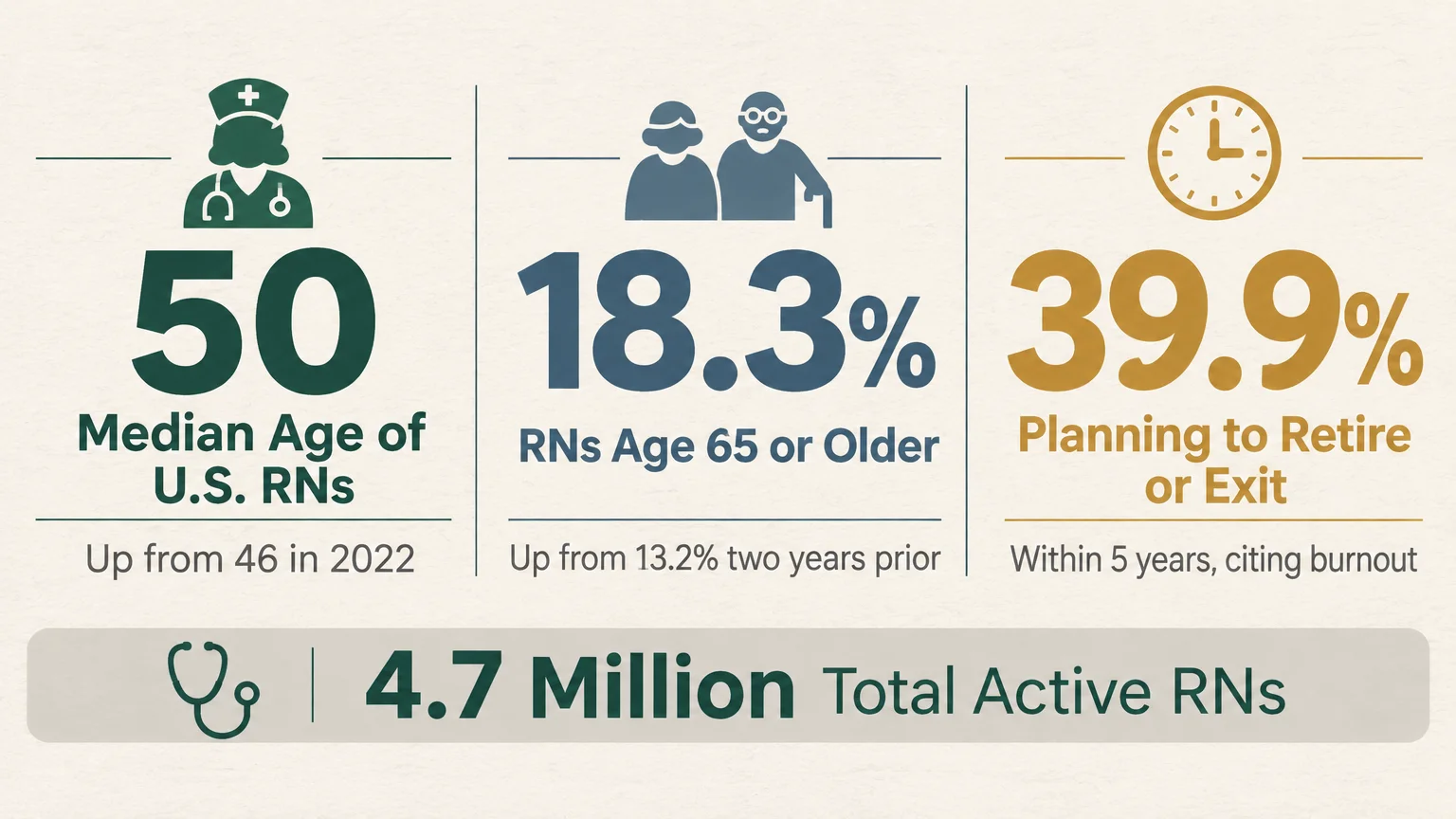
Experienced clinicians represent one of healthcare’s most valuable resources, and employers increasingly build virtual roles to retain that knowledge. According to the National Council of State Boards of Nursing (NCSBN) 2024 National Nursing Workforce Survey, published in April 2025, nearly 4.7 million registered nurses (RNs) live in the United States.
About 87.7% of those RNs remain actively employed in nursing, with nearly 69% working full-time. Yet the workforce is aging quickly, making flexible retired nurse jobs more common across insurers, hospital systems, and digital health companies.
The NCSBN survey found that the median age of U.S. RNs climbed to 50 in 2024, up from 46 in 2022. Meanwhile, 18.3% of RNs are now age 65 or older, up from 13.2% just two years earlier.
Burnout drives many nurses away from direct bedside care long before they want to stop earning. Roughly 39.9% of surveyed RNs plan to retire or leave nursing within five years, and 41.5% cite stress and burnout as key factors.
Between 2022 and 2024 alone, 138,000 nurses exited the workforce, and many remaining baby boomers are expected to reach retirement age in 2027. Work from home nurses bridge that gap by applying clinical triage, chart review, and patient education without physical strain.
Top Work From Home Roles for Retired Nurses
Not every virtual clinical position requires the same background, schedule commitment, or credentialing. Comparing your favorite parts of nursing—whether patient coaching, chart analysis, or teaching—helps you target the best fit.
Nurse Case Manager (Remote)
If you enjoyed discharge planning and guiding patients through complex recoveries, a nurse case manager remote role offers strong continuity. You coordinate care plans, arrange home health services, and check in with high-risk patients by phone or video.
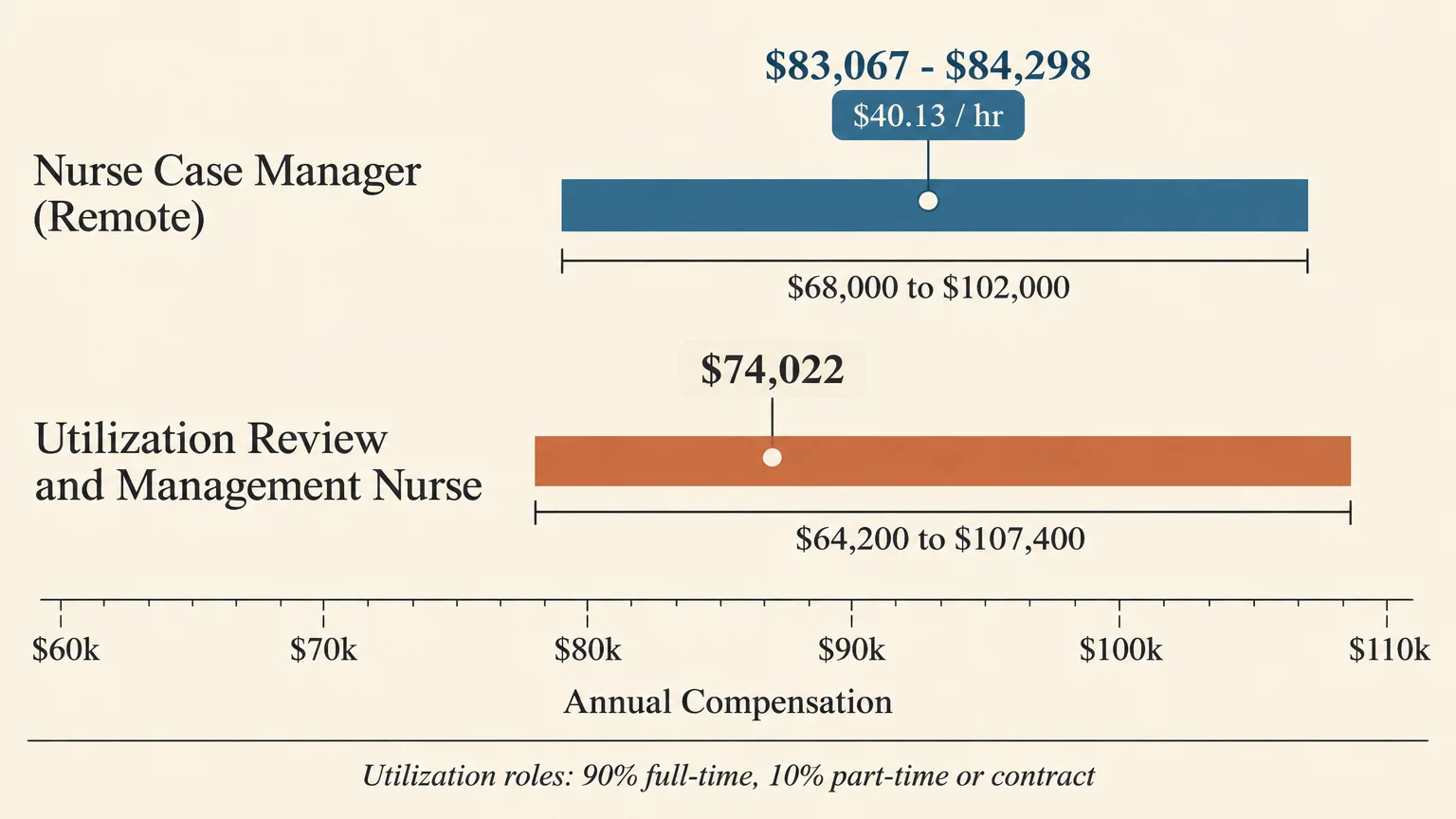
PayScale (October 2026) and Nurse.org report median to average annual compensation of roughly $83,067 to $84,298, or about $40.13 per hour. Most case managers earn between $68,000 and $102,000 per year depending on geography and specialty.
Utilization Review and Management Nurse
Utilization review nurses evaluate clinical documentation against insurance criteria to determine medical necessity for hospital stays, procedures, and rehab services. These desk-based positions rarely involve live patient triage, which appeals to retirees who prefer structured analysis.
Data from RemoteNursingJobs.com, updated November 2026 across 625 salary-bearing listings, shows typical advertised pay from $64,200 to $107,400 per year. Major employers include Centene, CVS Health, and Optum, with PayScale (April 2026) reporting early-career total pay averaging $74,022.
About 90% of utilization listings are full-time, while roughly 10% offer part-time, per diem, or contract hours. Starting part-time or contract can let you test remote workflows before committing to forty hours weekly.
Telehealth Triage and Remote Monitoring Nurse
Telehealth nursing jobs place you on the front lines of virtual care without leaving your home office. You assess symptoms over phone or video, direct callers to appropriate care levels, or track chronic-condition readings through Remote Physiologic Monitoring (RPM) and Remote Therapeutic Monitoring (RTM).
PayScale (October 2026) reports telehealth hourly rates between $26.00 and $42.98, averaging $35.95 early-career and $39.03 mid-career. Industry career guides commonly cite annual full-time salaries ranging from $70,000 to $90,000.
Retired Nurse Practitioners (NPs) can also deliver virtual primary or specialty care from home. U.S. Bureau of Labor Statistics (BLS) May 2025 data lists a median NP wage of $132,300 ($63.61 per hour), with 41% projected growth through 2035.
Legal Nurse Consultant
Attorneys, insurance carriers, and risk-management teams hire legal nurse consultants (LNCs) to review medical records, build chronologies, and identify standard-of-care issues. Because much of this work is project-based, you often control your own weekly caseload.
PayScale (September 2026) shows entry-to-early-career LNC hourly pay averaging $48.03 to $49.02. ZipRecruiter (October 2026) reports an average of $87,681 per year ($42.15 per hour) for work-from-home medical LNCs, with middle percentiles spanning $68,000 to $101,500.
Online Nursing Instructor and Adjunct Faculty
Colleges and universities rely on seasoned nurses to teach online courses, grade care plans, and mentor degree-completion students. If you hold a graduate nursing degree, academic calendar breaks make this option easy to pair with travel or family time.
According to BLS May 2025 wage data, nursing instructors and professors earn a median annual salary of $80,250, with a mean of $86,410. Postsecondary health specialties teachers earn a median of $107,310 alongside 18% projected growth between 2025 and 2035.
Clinical Documentation and Medical Coding Specialist
Licensed practical nurses (LPNs), vocational nurses (LVNs), and RNs who enjoy detail work often thrive in clinical documentation improvement, medical coding, or chart auditing. These roles translate bedside notes into accurate billing codes and quality-metric records.
BLS May 2025 figures show medical records specialists earn a median wage of $51,140 ($24.59 per hour), with 8% projected growth and roughly 14,000 openings annually through 2035. Coding credentials can open doors even if you prefer stepping back from clinical decision-making.
| Remote Role | Recent Pay Benchmark | Typical Credential | Common Schedule |
|---|---|---|---|
| Nurse Case Manager | $83,067–$84,298/yr median (2026) | Active RN; CCM helpful | Mostly full-time |
| Utilization Review Nurse | $64,200–$107,400/yr advertised (2026) | Active RN or LPN/LVN | 90% full-time, 10% part-time/PRN |
| Telehealth Triage Nurse | $26.00–$42.98/hr; $70,000–$90,000/yr | Active RN (compact often preferred) | Full-time, part-time, or shifts |
| Legal Nurse Consultant | $87,681/yr avg; $48.03–$49.02/hr entry | Active RN; LNCC optional | Contract or self-employed |
| Online Nursing Instructor | $80,250/yr median (BLS May 2025) | MSN or DNP; active RN | Part-time adjunct or semester |
| Medical Records Specialist | $51,140/yr median (BLS May 2025) | Coding certificate; RN/LVN helpful | Full-time or flexible shifts |
What Remote Nursing Pays Compared to Traditional Roles
Understanding broader federal wage benchmarks helps you evaluate whether a remote offer matches your experience. You can review official national occupation tables directly through the U.S. Bureau of Labor Statistics (BLS).
Per May 2025 BLS Occupational Employment and Wage Statistics, all U.S. RNs earn a median annual wage of $97,550 ($46.90 per hour) and a mean of $101,420. The 10th percentile sits at $68,940, while the 90th percentile reaches $137,470.
Those nursing earnings remain nearly double the $50,980 median wage across all U.S. occupations. RN employment is projected to grow 6% between 2025 and 2035—faster than the 3.5% all-occupation average—creating about 180,800 openings each year.
Other nursing tiers also command competitive pay when transitioning into remote or administrative tracks. May 2025 BLS data reports these median annual wages and outlooks:
- LPNs and LVNs: $64,400 median ($67,050 mean), reaching $83,440 at the 90th percentile.
- Medical and Health Services / Nurse Managers: $123,860 median ($140,970 mean), with 24% projected growth through 2035.
- Combined Nurse Practitioners, Nurse Midwives, and Nurse Anesthetists: $134,920 median, with 36% projected growth and roughly 29,400 annual openings for NPs alone.
Keep in mind that remote positions sometimes pay slightly less per hour than acute hospital night shifts with differentials. However, eliminating commuting costs, scrubs, parking fees, and physical exhaustion often leaves your net financial and personal return much higher.
Licensing Rules You Must Check Before Applying
Before updating your resume, verify your exact nursing license status and where you are legally permitted to practice. Remote employers filter applications immediately based on active state licensure.
The Nurse Licensure Compact and Patient-Location Rule
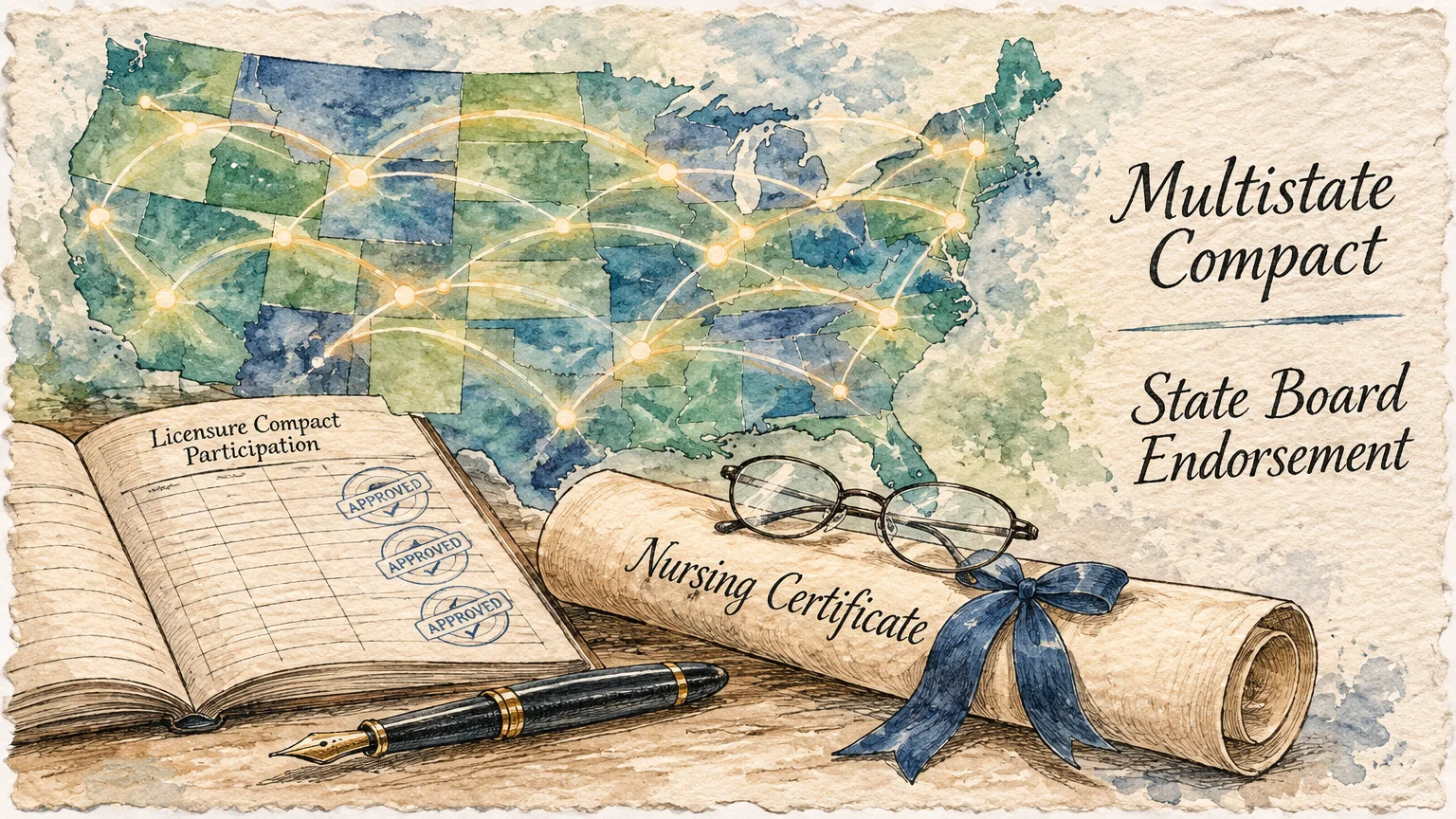
Under the Nurse Licensure Compact (NLC), eligible RNs and LPNs/LVNs hold one multistate license in their Primary State of Residence to practice across member jurisdictions. As of October 2026, 43 jurisdictions have enacted the NLC.
Forty states have fully implemented the compact, while Guam maintains partial implementation—meaning out-of-state compact nurses can practice there, though Guam does not issue multistate licenses yet. Massachusetts and the U.S. Virgin Islands have enacted the NLC and await full implementation.
Several large states remain outside the compact with no pending bills, including California, New York, Illinois, and Oregon. Legislation remains pending in Washington, D.C. and Michigan.
Under NLC Article III(e) and state nurse practice acts, telehealth legally occurs where the patient is physically located—not where the employer is headquartered. You must hold a single-state license or compact privilege covering every state where your assigned patients reside.
Exceptions for Federal Employers and APRNs
Federal nursing positions follow a helpful exception to state-by-state licensing hurdles. Nurses employed by the U.S. Department of Veterans Affairs (VA), military facilities, or Indian Health Services are exempt from state-of-practice licensure if they hold an active license in any U.S. state.
Advanced Practice Registered Nurses (APRNs), however, are not covered by the RN and LPN compact. A separate APRN Compact will only take effect once seven states enact it, so remote NPs generally need individual licenses in each patient state.
Reactivating a Retired Versus Lapsed License
State Boards of Nursing treat a voluntarily retired or inactive license very differently from an expired or lapsed one. If you requested inactive or retired status in good standing, reactivation typically requires an application, standard renewal fees, and catch-up continuing education (CE).
Allowing a license to lapse involuntarily adds extra hurdles before you can take work from home nurse roles. Reinstatement generally involves fees between $25 and $350, back fees, CE verification, and often a nurse refresher course with supervised clinical hours if lapsed roughly five or more years.
Completing a refresher program and board review usually takes three to nine months. Retaking the NCLEX is rarely required for ordinary lapses, though any NLC multistate privilege stops as soon as a license becomes inactive or lapsed.
Key Certifications and 2026–2027 Rule Changes
Adding a targeted credential helps retired clinicians stand out against younger applicants, especially when moving from bedside nursing into desk-based specialties. Several major certification and federal telehealth rules also shift between 2026 and 2028.
Specialty Credentials Worth Considering
For case management roles, the Certified Case Manager (CCM) credential is issued by The Commission, which renamed itself from CCMC on February 24, 2026. The exam costs $430 ($235 nonrefundable application fee plus $195 exam fee) and features 180 questions via Pearson VUE or remote proctoring.
Eligibility requires an active health license or degree plus 12 to 24 months of case management experience, with renewal every five years using 80 CE hours (including 8 in ethics). The Commission also offers a CCM-R retirement designation if you later step back permanently.
Watch an important deadline if you are eyeing the American Nurses Credentialing Center (ANCC) Nursing Case Management (CMGT-BC) exam instead. ANCC is retiring that credential, accepting applications only through December 31, 2026, with final testing running through December 31, 2027.
For legal consulting, the Legal Nurse Consultant Certified (LNCC) credential from ALNCCB/AALNC is accredited by ABSNC. It requires an active RN license, five years of RN practice, and 2,000 hours of legal consulting within the prior five years.
LNCC exam fees are $360 for AALNC members or $495 for non-members for a four-hour, 200-question test valid for five years (renewed with 60 contact hours). Non-ABSNC certificate programs, such as CLNC, generally require an active RN license, coursework, and a 100-question online test.
Medicare Telehealth and Remote Monitoring Updates
Recent federal legislation keeps demand strong for virtual care nurses over the next two years. The Consolidated Appropriations Act, 2026 (H.R. 7148), signed February 3, 2026, extended major Medicare telehealth flexibilities through December 31, 2027.
Those extensions cover care delivered in the home, lifted geographic restrictions, audio-only coverage for non-behavioral visits, and expanded practitioner eligibility. However, DEA flexibilities for tele-prescribing controlled medications are scheduled to expire December 31, 2026 unless replaced.
Meanwhile, the CY 2027 Medicare Physician Fee Schedule Final Rule, issued November 9, 2026, reshapes remote monitoring staffing rules. Starting January 1, 2027, RPM and RTM services require a face-to-face initiating visit and established-patient status.
Importantly for remote nurses working through staffing agencies, federal regulators delayed a rule requiring remote monitoring clinical staff to be direct W-2 employees until January 1, 2029. Third-party vendor staffing remains permitted through December 31, 2028.
How Working After Retirement Affects Social Security and Medicare
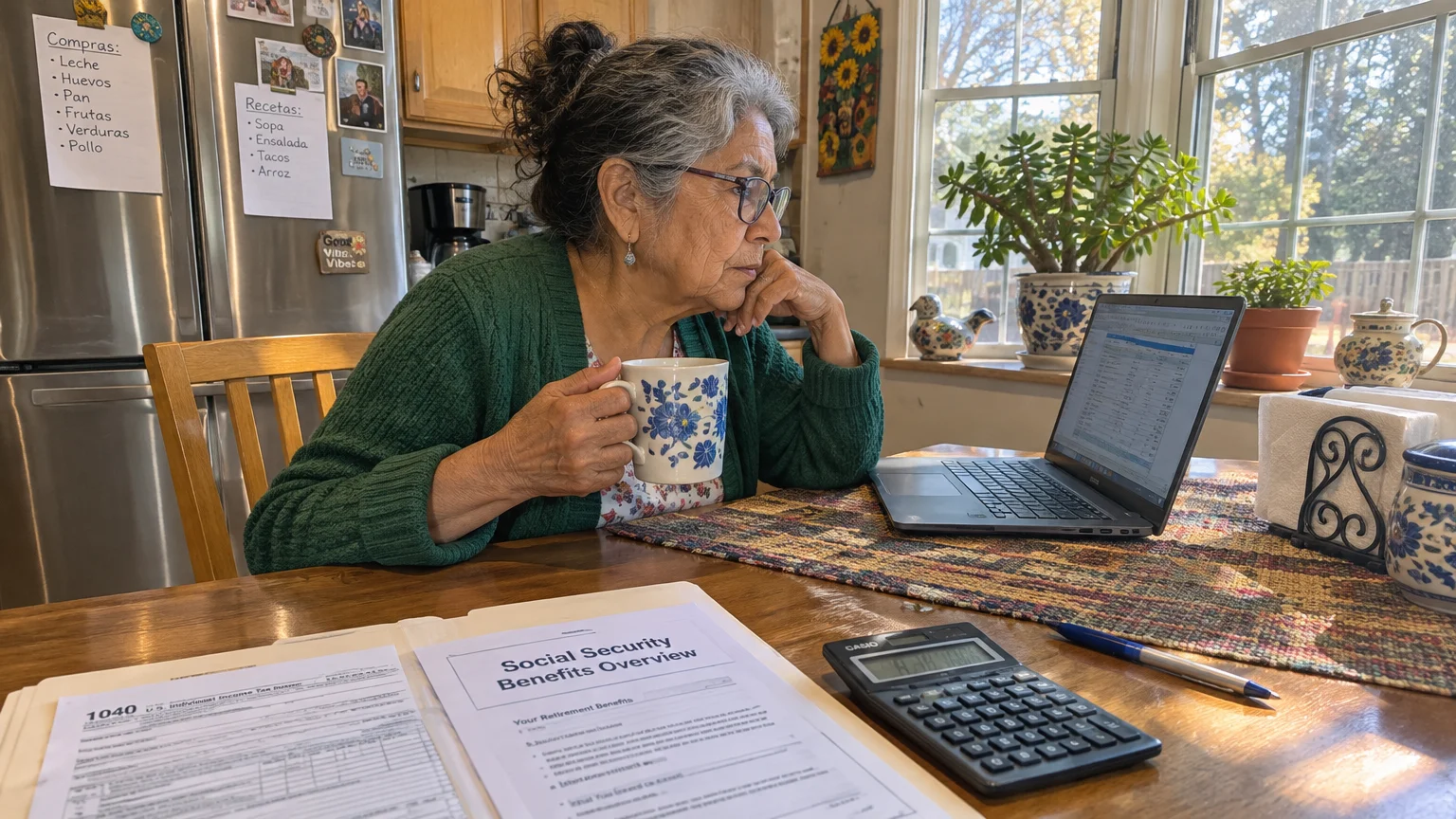
Earning a paycheck again feels great until unexpected benefit reductions or healthcare penalties catch you off guard. Before signing an offer letter, map how your projected wages and weekly hours interact with federal retirement programs.
Social Security Earnings Limits for 2026 and 2027
Under rules from the Social Security Administration (SSA), Full Retirement Age (FRA) is 67 for anyone born January 2, 1960 or later. Starting in the exact month you reach FRA, no earnings limit applies, and working never reduces your checks.
If you claim Social Security before FRA and stay under FRA all year, an annual earnings test applies. In 2026, that cap is $24,480 (or $2,040 per month under the first-year monthly rule), rising to $25,560 in 2027.
SSA withholds $1 in benefits for every $2 earned above the cap. For example, if you are under FRA all of 2026 and earn $30,480 in part-time telehealth ($6,000 above $24,480), SSA withholds $3,000 in benefits for the year.
During the calendar year you reach FRA, a much higher cap applies to months before your birthday month. That threshold is $65,160 ($5,430 per month) in 2026 and rises to $67,920 in 2027, with $1 withheld for every $3 over.
Withheld benefits are not lost forever. Once you reach FRA, SSA recalculates your monthly payment upward to credit the months in which benefits were withheld.
The Self-Employment Substantial-Services Trap
Freelance legal nurse consultants and independent contractors must watch a separate hour-based rule. Under the SSA monthly Special Earnings Limit Rule, self-employed workers are not considered retired in any month they devote more than 45 hours to their business.
Even more surprisingly, working 15 to 45 hours in a month can disqualify you from receiving that month’s check if your work qualifies as a highly skilled occupation—even when your pay stays below the monthly dollar limit. Track consulting hours carefully if using the monthly rule.
Medicare and the 20-Employee Rule
If you are age 65 or older and take a remote job offering group health insurance, employer size determines whether you can delay Medicare Part B. You can verify enrollment windows directly at Medicare.gov.
When an employer has 20 or more employees and provides active creditable group coverage, that employer plan pays primary, and you can delay Part B without penalty. Once active employment or group coverage ends—whichever comes first—you receive an eight-month Special Enrollment Period (SEP).
If your employer has fewer than 20 employees, Medicare pays primary at age 65. Delaying Part B in that situation can leave major medical claims unpaid by the small-group plan.
COBRA continuation coverage and retiree health plans never count as active employer coverage for delaying Medicare Part B, and missing your eight-month Special Enrollment Period triggers a permanent 10% late-enrollment penalty for every twelve-month period delayed.

Pitfalls to Watch For
Even careful nurses make costly mistakes when transitioning from bedside retirement back into virtual employment. Avoid these four common missteps as you plan your return:
- Ignoring patient-location licensing rules: Never assume your home-state license covers nationwide triage or case management; confirm whether your employer needs an NLC multistate license or extra single-state licenses where patients live.
- Letting a license lapse completely: Placing an unused license on formal inactive or retired status is far cheaper and faster to reverse than letting it expire for five years and needing a clinical refresher course.
- Overworking during your first retirement year: Independent LNCs who log 15 to 45 hours in a single month can lose that month’s Social Security check under substantial-services rules, even if invoices are paid later.
- Relying on small employers or COBRA for Medicare Part B: Always confirm in writing that a remote employer has 20 or more employees before dropping or delaying Part B, and enroll within eight months of leaving active coverage.
Getting Expert Help
Remote nursing touches state professional boards, federal retirement formulas, and healthcare enrollment timelines all at once. Reaching out to the right specialist in these four scenarios saves months of frustration:
- Reactivating an older license: Contact your State Board of Nursing before paying for private courses so you know exact CE hours, background checks, and whether a supervised clinical refresher is required.
- Combining Social Security with self-employed nursing: Speak with an SSA representative before launching a freelance LNC practice under FRA so you understand how monthly hour limits and net earnings affect your checks.
- Coordinating employer health coverage at age 65+: Use a free State Health Insurance Assistance Program (SHIP) counselor—accessible through the National Council on Aging (NCOA) or Medicare—to verify creditable coverage and SEP deadlines.
- Planning taxes and retirement withdrawals: Meet with a qualified financial advisor or tax professional when new remote wages push you into higher tax brackets or change your retirement distribution schedule.
Frequently Asked Questions
Can I work as a remote nurse if my license is retired or inactive?
No—you must hold an active nursing license before practicing, even in non-bedside telehealth or case management jobs. If you voluntarily placed your license on retired or inactive status, your State Board of Nursing typically lets you reactivate it with fees and catch-up continuing education.
Do I need a compact nursing license to get telehealth nursing jobs?
You do not strictly need a compact license, though holding an NLC multistate license makes you far more competitive for national employers. If you live in a non-compact state like California or New York, you can still work locally or obtain additional single-state licenses.
How much can a retired nurse earn without reducing Social Security?
Once you reach Full Retirement Age (67 for anyone born January 2, 1960 or later), you can earn any amount with zero reduction. Under FRA all year, the annual earnings cap is $24,480 in 2026 and $25,560 in 2027, with higher limits during your FRA year.
Will taking a remote nursing job affect my Medicare Part B coverage?
It depends on employer size and whether your coverage comes from active work. If your remote employer has 20 or more employees and offers creditable group health insurance, you can delay Part B penalty-free and use an eight-month Special Enrollment Period when active work or coverage ends.
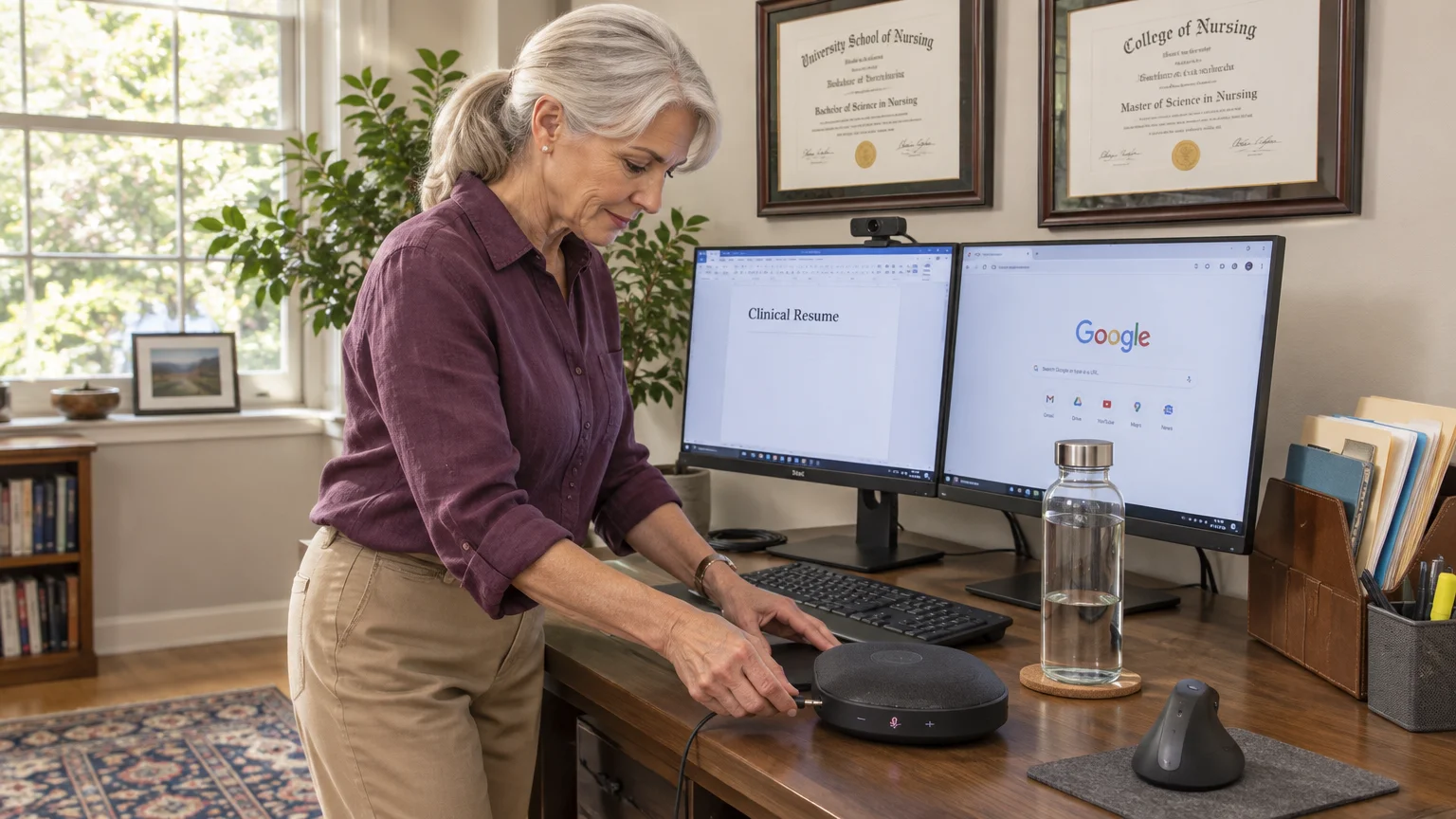
Next Steps for Your Remote Nursing Search
Start by checking your nursing license expiration status, picking one or two roles that fit your energy level, and confirming your Social Security and Medicare timelines. With your clinical judgment intact, a flexible home office can deliver steady income and purpose on your own terms.
This is educational content based on general financial principles for seniors. Individual results vary based on your situation.
Always verify current benefit amounts, tax rules, and program eligibility with official government sources.
Last updated: November 2026. Benefit amounts, tax rules, and program details change annually—verify current figures with official government sources.





Leave a Reply