

Claiming Social Security early does not always lock you into a smaller check forever. Once you reach full retirement age, you can pause your monthly payments and earn bigger checks later.
This strategy, known as voluntary suspension, adds 8% per year in delayed retirement credits up to age 70. You keep every dollar you already received without paying back prior benefits.
Still, pausing your checks affects spousal benefits, Medicare billing, and monthly cash flow. Understanding the exact rules helps you decide whether suspending fits your retirement plan.
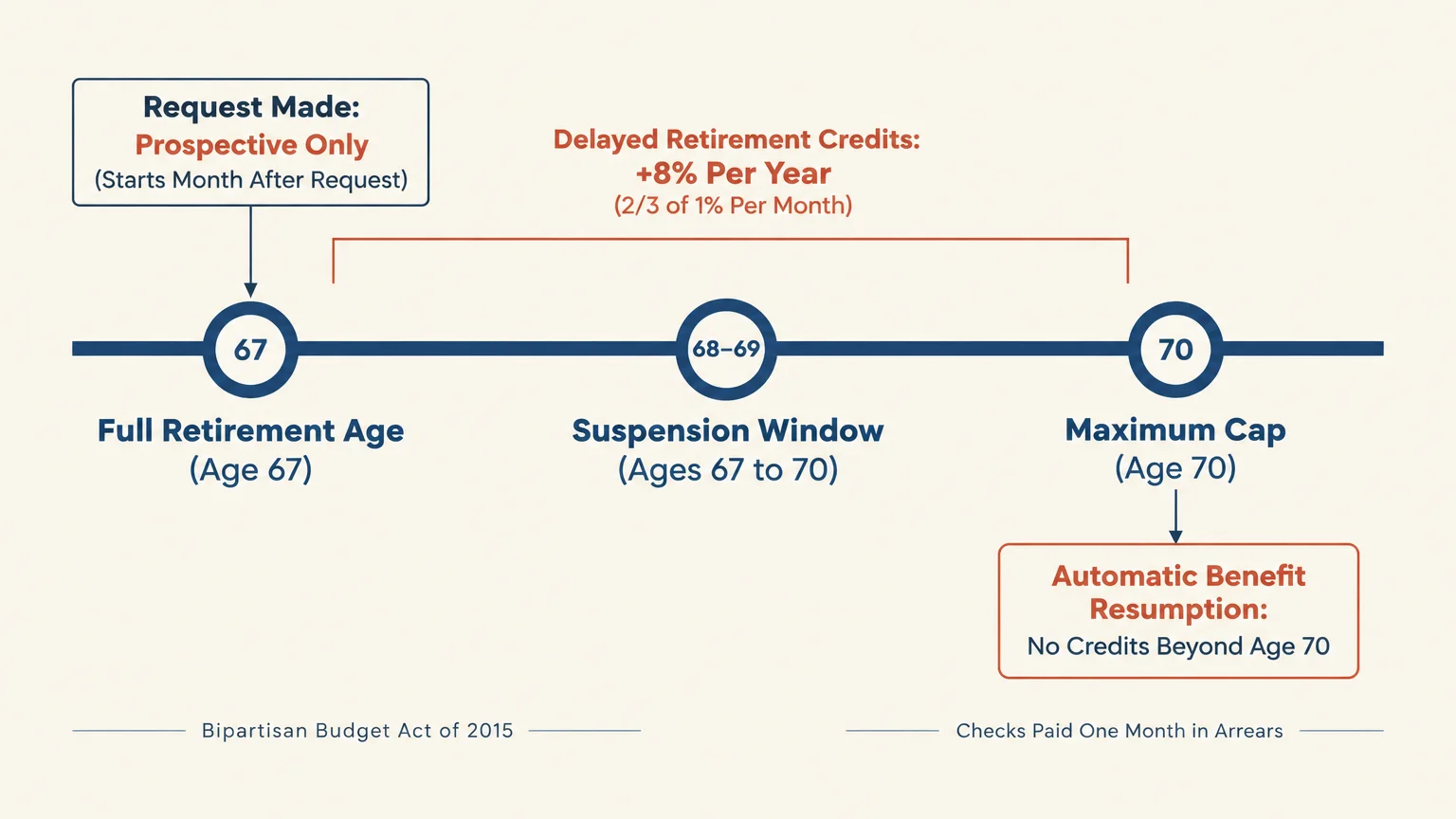
How Voluntary Suspension Works After Full Retirement Age
You can ask the Social Security Administration (SSA) to suspend your retirement benefits only after you reach your full retirement age (FRA). You must also already be entitled to benefits and be under age 70.
Your FRA depends on your birth year under current SSA rules. If you were born in 1959, your FRA is 66 years and 10 months.
If you were born in 1960 or later, your FRA is 67. Anyone born on January 1 is treated by SSA as born in the previous year.
To suspend Social Security, you do not need to fill out a complex paper form or provide a signature. You can make your request orally by phone or in person, or submit it in writing to SSA.
Under rules enacted by the Bipartisan Budget Act of 2015 and effective since April 30, 2016, every voluntary suspension is prospective only. Your suspension begins no earlier than the month after the month you make the request.
Social Security also pays benefits one month in arrears. If you call SSA in June to suspend your checks, you will still receive your June payment in July before payments stop.
Once suspended, your benefits remain paused until you either request to restart them or turn 70. SSA automatically resumes your checks in the month you reach age 70.
If you decide to restart payments before age 70, your checks resume the month after your reinstatement request. You cannot retroactively undo a suspension or claim lump-sum back payments for months you skipped.
Any delayed retirement credits you earn during a partial calendar year generally appear in your benefit starting the following January.
The Math Behind Delayed Retirement Credits and Early Filing
For anyone born in 1943 or later, delayed retirement credits accrue at two-thirds of 1% for every month your benefit stays suspended past FRA. That equals an 8% annual increase for each full year you wait, up to age 70.
Once you turn 70, delayed retirement credits stop accruing. Pausing past age 70 gives you no extra growth, which is why SSA restarts your checks automatically.
Consider how those credits work on an average check. SSA reports the average retired-worker benefit is $2,095 per month in 2026, rising to an estimated $2,170 per month in 2027.
If you receive $2,095 at FRA and suspend for one full year, your 8% credit adds $167.60 to your base check. That brings your monthly payment to $2,262.60 before annual Cost-of-Living Adjustments (COLAs).
For higher earners, the upside can be even larger in dollar terms. The maximum Social Security benefit for a worker retiring at FRA is $4,152 per month in 2026 and $4,188 per month in 2027.
However, early filers need to watch how SSA calculates those credits. Claiming at age 62 with an FRA of 67 reduces your monthly benefit by up to 30%.
SSA applies that early-filing penalty by cutting five-ninths of 1% per month for the first 36 months before FRA. For up to 24 additional early months, SSA cuts another five-twelfths of 1% per month.
If you claimed early and later suspend at FRA, your 8% annual credits apply to your reduced monthly benefit amount—not your full Primary Insurance Amount (PIA). Let us walk through a clear example.
- Full benefit baseline: Suppose your unreduced benefit at age 67 (your PIA) would have been $2,000 per month.
- After claiming at 62: A 30% early-filing reduction lowers your monthly check to $1,400.
- Suspending from 67 to 70: Three years of delayed retirement credits add 24% to your current $1,400 check, not to $2,000.
- Result at age 70: Your new base check becomes $1,736 per month ($1,400 multiplied by 1.24), plus any COLAs applied along the way.
Even though $1,736 remains lower than the $2,480 you would receive by waiting until 70 from the start, it is still $336 higher than $1,400. That permanent 24% boost lasts for the rest of your life.
Your underlying benefit also keeps receiving annual COLAs while suspended. On October 14, 2026, SSA announced a 3.6% COLA for 2027, following a 2.8% increase in 2026.
Because COLAs and delayed retirement credits compound on top of each other, your eventual check grows faster than 8% alone. You can check your exact earnings record and estimates anytime at SSA.gov.
Suspending your benefits is essentially buying inflation-protected, guaranteed lifetime income—but only if your household cash flow and spousal benefits can handle the pause.

When Suspending Social Security Makes Strong Financial Sense
Pausing your checks works best when your financial picture improves after you originally filed. Many retirees use voluntary suspension to repair an early claiming decision once new income or savings arrive.
Review these common situations where suspending Social Security can strengthen your long-term retirement security:
- You return to work after reaching FRA: Once you reach FRA, the Social Security earnings limit disappears completely. If a new paycheck covers your daily bills, pausing your benefit lets that unneeded check grow by 8% per year.
- You want to recover from pre-FRA earnings withholding: Before the year you reach FRA, SSA withholds $1 for every $2 earned above $24,480 in 2026 ($25,560 in 2027). In your FRA year, it withholds $1 for every $3 earned above $65,160 in 2026 ($67,920 in 2027).
- You receive a windfall or pension buyout: Inheriting money, selling a business, or downsizing your home can give you plenty of cash to cover living expenses between FRA and age 70.
- You want to protect a lower-earning spouse after your death: While your delayed retirement credits do not raise a living spouse’s benefit, they do permanently increase future widow or widower survivor benefits.
- You expect above-average longevity: If your family history and personal health point toward a long retirement, trading three years of checks for a permanently higher inflation-adjusted payment often pays off.
Timing your taxes is another reason to consider this Social Security strategy. Without Social Security checks hitting your bank account, your taxable income may drop temporarily during your late sixties.
That lower income window can give you room to draw down traditional retirement accounts or complete Roth conversions carefully. You can review current federal tax rules at IRS.gov before shifting how you draw income.
Remember also how SSA handles pre-FRA earnings test reductions. Any checks withheld before FRA due to high wages are not gone forever; SSA recalculates and increases your monthly benefit once you reach FRA.
From that point forward, choosing to suspend builds even more lifetime income on top of that recalculated base. You avoid paying taxes on benefits you do not currently need while locking in larger future checks.
When You Should Think Twice Before Suspending
Voluntary suspension carries real trade-offs that can hurt a household if you overlook the fine print. Before calling SSA, check how pausing your record affects everyone who relies on your earnings history.
Under rules effective since April 30, 2016, suspending your retirement benefit automatically suspends any auxiliary benefits paid on your record. That includes monthly payments going to your current spouse or eligible dependent children.
There is one notable exception to that family rule. Benefits paid to an independently entitled or divorced ex-spouse do not stop when you suspend your own retirement checks.
Keep in mind how spousal benefits work even when you stay suspended until 70. A living spouse’s benefit remains capped at 50% of your PIA and never grows from your delayed retirement credits.
However, if your current spouse claimed early and loses checks during your suspension, SSA gives them an Adjustment of Reduction Factor (ARF). That adjustment credits them for those unpaid months to reduce their early-filing penalty once they reach FRA.
Suspending your own benefit also blocks you from collecting auxiliary or survivor benefits on someone else’s record during the suspension. If you qualify for a widow or widower benefit elsewhere, pausing your record shuts off that option too.
You should also avoid voluntary suspension if you receive Supplemental Security Income (SSI). Voluntary suspension makes you ineligible for SSI payments during the suspended months.
Cash flow strain is another major warning sign. Never carry high-interest credit card debt or drain your emergency reserve just to chase an 8% Social Security boost.
For practical worksheets on managing household cash flow and debt in retirement, explore the consumer planning tools at the Consumer Financial Protection Bureau.
Finally, consider your health honestly before pausing checks. If serious medical issues shorten your life expectancy and no surviving spouse depends on your record, collecting steady checks now usually beats waiting until age 70.
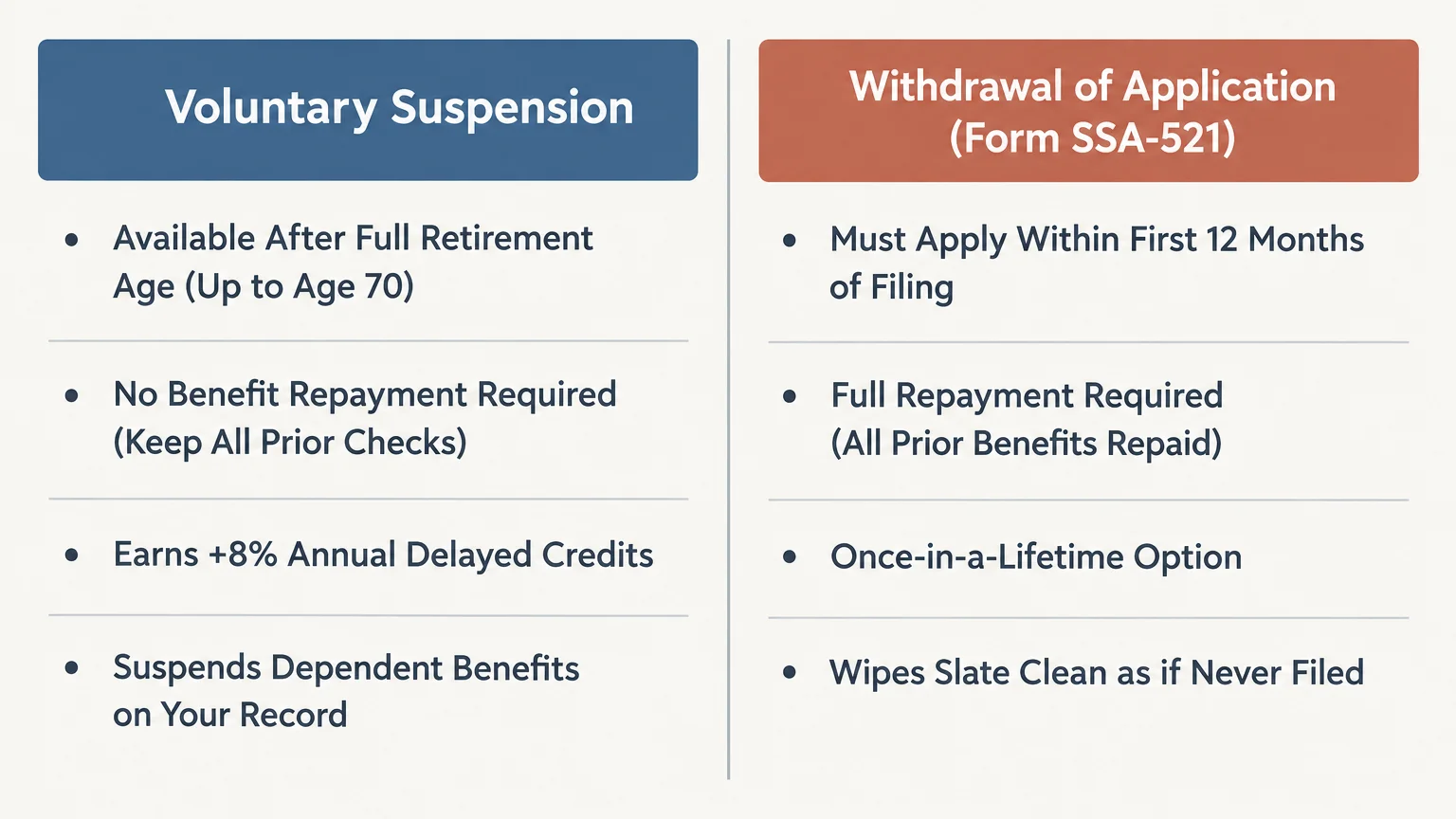
Voluntary Suspension vs. Withdrawing Your Application
Seniors often confuse suspending benefits with withdrawing a Social Security application altogether. Both strategies let you hit reset on your retirement timing, yet they follow completely different rules.
Withdrawing your application using Form SSA-521 wipes the slate clean as if you never filed. However, SSA allows a withdrawal only within 12 months of your first month of entitlement.
You are also limited to one approved withdrawal per lifetime. Worse, you must repay every dollar SSA paid to you and anyone else on your record.
That repayment bill includes any Medicare premiums withheld, medical expenses paid by Medicare on your behalf, and closed-year tax withholdings. You also need written consent from every other person receiving benefits on your record.
Compare both options side by side before deciding which path fits your timeline:
| Feature | Voluntary Suspension | Application Withdrawal (Form SSA-521) |
|---|---|---|
| Eligible age or window | From Full Retirement Age up to age 70 | Only within 12 months of first entitlement month |
| Repayment required | None; keep all benefits already received | Must repay 100% of benefits, Medicare expenses, and tax withholdings |
| Lifetime limit | No single-use cap between FRA and 70 | One approved withdrawal per lifetime |
| Consent from family | Not required, though family benefits on your record pause | Written consent required from anyone paid on your record |
| Effect on future benefit | Adds 8% per year in DRCs to your existing monthly amount | Resets your benefit calculation as if you had never claimed |
If you filed less than a year ago and can afford to return the cash, a withdrawal restores your full PIA. If more than 12 months have passed—or repaying benefits hurts your savings—waiting until FRA to suspend is your best tool.
Managing Medicare Part B Bills While Benefits Are Suspended
Many retirees forget that Social Security normally deducts Medicare Part B premiums straight from their monthly check. When you suspend Social Security, those automatic deductions stop immediately.
Instead, the Centers for Medicare & Medicaid Services (CMS) sends you a direct bill for Part B—typically on a quarterly schedule. Failing to pay those bills on time can cause you to lose your Part B medical coverage.
In 2026, the standard Medicare Part B premium is $202.90 per month, with a $283 annual deductible. On a quarterly billing cycle, that standard premium comes to $608.70 every three months.
Official 2027 Part B rates are expected later in November 2026. The 2026 Medicare Trustees Report projects a 2027 standard Part B premium of $209.50 per month and a $292 annual deductible.
High-income retirees also face Income-Related Monthly Adjustment Amounts (IRMAA) on both Part B and Part D. Under 2026 thresholds, single filers with modified adjusted gross income above $109,000—or joint filers above $218,000—pay extra surcharges.
Those 2026 surcharges add at least $81.20 per month to Part B and $14.50 per month to Part D. If you owe IRMAA on top of standard premiums, factor that full quarterly cost into your budget before suspending.
CMS offers four straightforward ways to keep your Medicare coverage current during a suspension:
- Medicare Easy Pay: Sign up for free automatic monthly deductions from your checking or savings account so you never miss a due date.
- Online card or bank payments: Log in directly to your secure account at Medicare.gov to pay invoices electronically.
- Bank bill pay: Schedule payments through your bank’s online bill-payment portal using your Medicare number.
- Mail: Send a check, money order, or credit card slip along with the payment coupon attached to your CMS bill.
Setting up Medicare Easy Pay right after you suspend removes the stress of tracking quarterly envelopes.
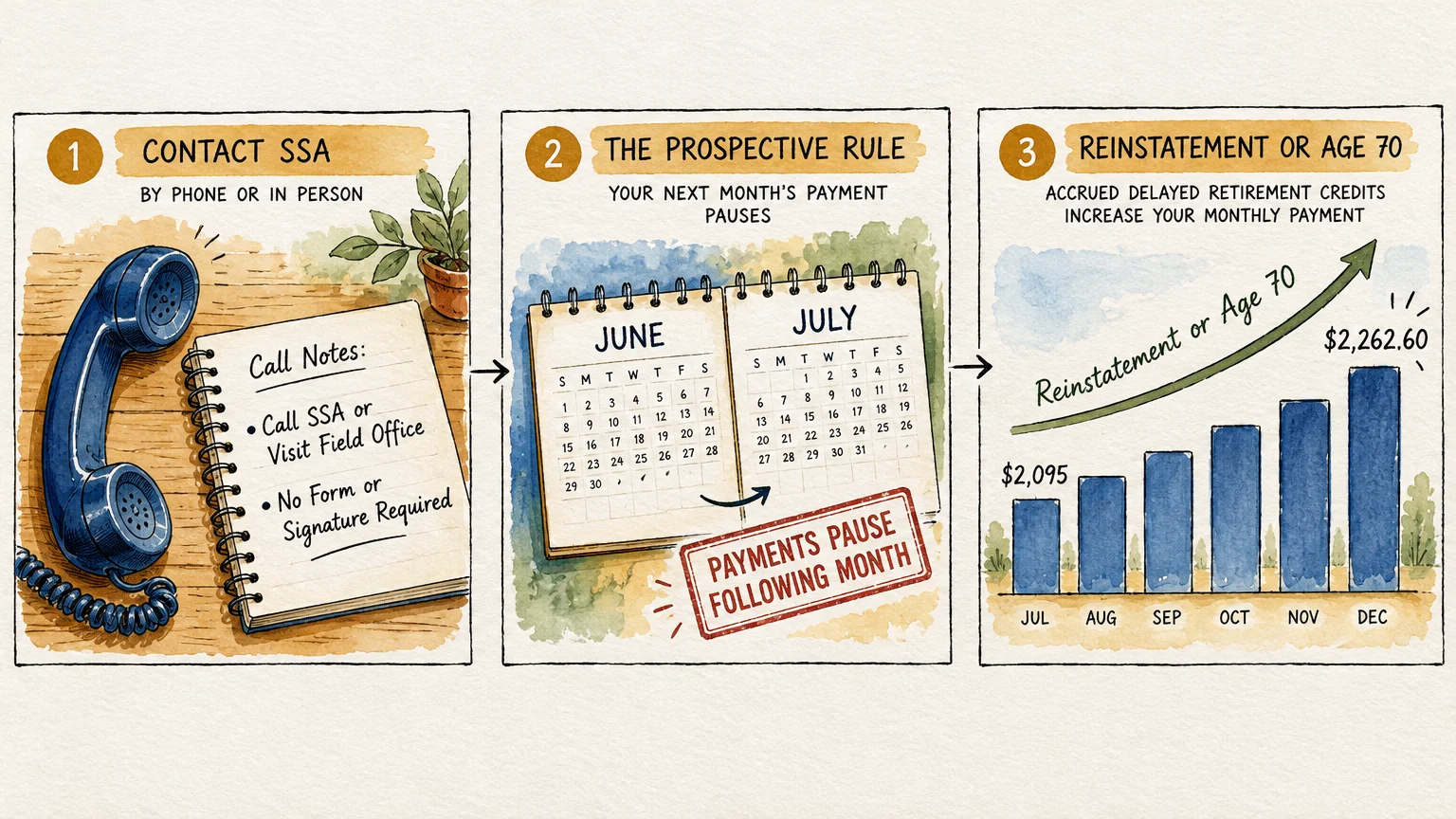
Step-by-Step Guide to Suspending and Restarting Benefits
Turning your Social Security pause into action takes careful sequencing rather than guesswork. Follow these six practical steps to execute a voluntary suspension smoothly:
- Verify your FRA and monthly benefit amount: Log in to your online SSA account to confirm the exact month you reach FRA and review your current benefit figure.
- Audit your household impact: Check whether a current spouse or child receives payments on your work record, and confirm that neither of you relies on SSI.
- Build a cash-flow and Medicare bridge: Set aside enough cash or steady non-Social Security income to cover living costs and direct CMS quarterly Part B bills.
- Submit your suspension request to SSA: Contact SSA by phone, in person, or in writing once you reach FRA, knowing the pause begins no earlier than the next month.
- Track your final arrears check and Medicare invoices: Watch for your last payment arriving one month behind, then enroll in Medicare Easy Pay as soon as your CMS bill arrives.
- Mark your calendar for age 70—or restart early if needed: Verify that payments resume automatically in your 70th birth month, or call SSA anytime earlier to restart checks the following month.
Keep written notes of the date you contacted SSA and the representative’s name or confirmation number. Clear records protect you if any billing or benefit timing question comes up later.
Pitfalls to Watch For
Even financially savvy retirees make avoidable errors when putting Social Security on hold. Watch out for these four common traps before locking in your decision:
- Expecting retroactive lump sums in an emergency: Under post-April 2016 rules, you cannot suspend at 66, run into unexpected expenses at 68, and ask SSA for two years of missed checks in one lump sum.
- Assuming credits erase early-filing cuts completely: Delayed retirement credits grow your reduced benefit amount, not your full PIA, so calculate your raise from your actual current check.
- Overlooking a spouse’s lost income: If your husband or wife receives spousal benefits on your record, suspending your check cuts off their check at the exact same time.
- Missing direct Medicare Part B payments: Ignoring or misplacing a quarterly CMS invoice while waiting for your checks to restart can trigger a dangerous lapse in health coverage.
Reviewing each pitfall alongside your household budget prevents costly surprises. A few minutes of verification up front keeps your retirement income steady and your health insurance intact.

Getting Expert Help
While straightforward cases are easy to handle directly with SSA, some retirement situations involve moving parts that reward personalized math. Consider working with a fee-only Certified Financial Planner (CFP) or Certified Public Accountant (CPA) in these scenarios:
- Coordinating dual-earner spousal and survivor plans: An advisor can model how pausing your benefit changes both household cash flow today and survivor protection for a younger or lower-earning spouse.
- Managing tax brackets and IRMAA cliffs: A CPA can help you draw from IRAs or execute Roth conversions during your suspension window without accidentally triggering higher Medicare surcharges.
- Deciding between withdrawal and suspension: If you are still within your 12-month entitlement window, a planner can compare the after-tax cost of repaying benefits against waiting until FRA to suspend.
- Sorting out complex benefit interactions: Divorced spouse exceptions, dependent child benefits, or transitioning from disability benefits all benefit from specialized guidance.
You can also browse plain-language retirement guides and calculators at AARP as you prepare questions for a consultation. Bringing clear figures to a meeting helps you get actionable answers faster.
Frequently Asked Questions About Suspending Social Security
Can I suspend my Social Security benefits if I already started claiming at 62?
Yes, as long as you have reached your full retirement age and are under age 70. Keep in mind that your 8% annual delayed retirement credits will grow your reduced monthly benefit amount rather than your original age-67 amount.
Will my Social Security suspension stop my spouse’s benefits too?
Yes, if your current spouse receives auxiliary benefits on your work record, those payments stop during your voluntary suspension. However, benefits paid to an independently entitled or divorced ex-spouse are not suspended.
How do I pay for Medicare Part B if I suspend my Social Security checks?
CMS bills you directly—usually every quarter—once deductions from Social Security pause. You can pay through Medicare Easy Pay automatic bank drafts, online at Medicare.gov, via your bank’s bill pay, or by mailing a check.
Do I still get Cost-of-Living Adjustments while my benefits are suspended?
Yes, annual COLAs still apply to your underlying benefit calculation while your payments are paused. For example, the 2.8% COLA in 2026 and the 3.6% COLA in 2027 factor into your restarted check alongside your earned delayed retirement credits.
Before calling SSA, pull your latest benefit statement, total your household monthly expenses, and confirm how you will pay quarterly Medicare bills. Taking those three steps ensures your decision is built on solid numbers rather than guesswork.
This article provides general financial education and information only. Everyone’s financial situation is unique—what works for others may not work for you. For personalized advice tailored to your retirement needs, consider consulting a qualified financial professional such as a CFP or CPA.
Last updated: November 2026. Benefit amounts, tax rules, and program details change annually—verify current figures with official government sources.





Leave a Reply