

Finding reliable cash flow in retirement takes more than parking money in a savings account. Quality healthcare dividend stocks can deliver regular quarterly checks while giving your income room to grow over time.
With consumer inflation running near 3.7% and ten-year Treasury yields topping 5%, fixed interest alone loses purchasing power. You need businesses selling essential treatments that raise shareholder payouts consistently.
Four major drugmakers stand out in late 2026 for retirees seeking steady payouts, resilient demand, and manageable risk. Here is how their yields, payout coverage, and tax rules stack up for your portfolio.
Why Healthcare Dividend Stocks Deserve a Spot in Your Income Plan
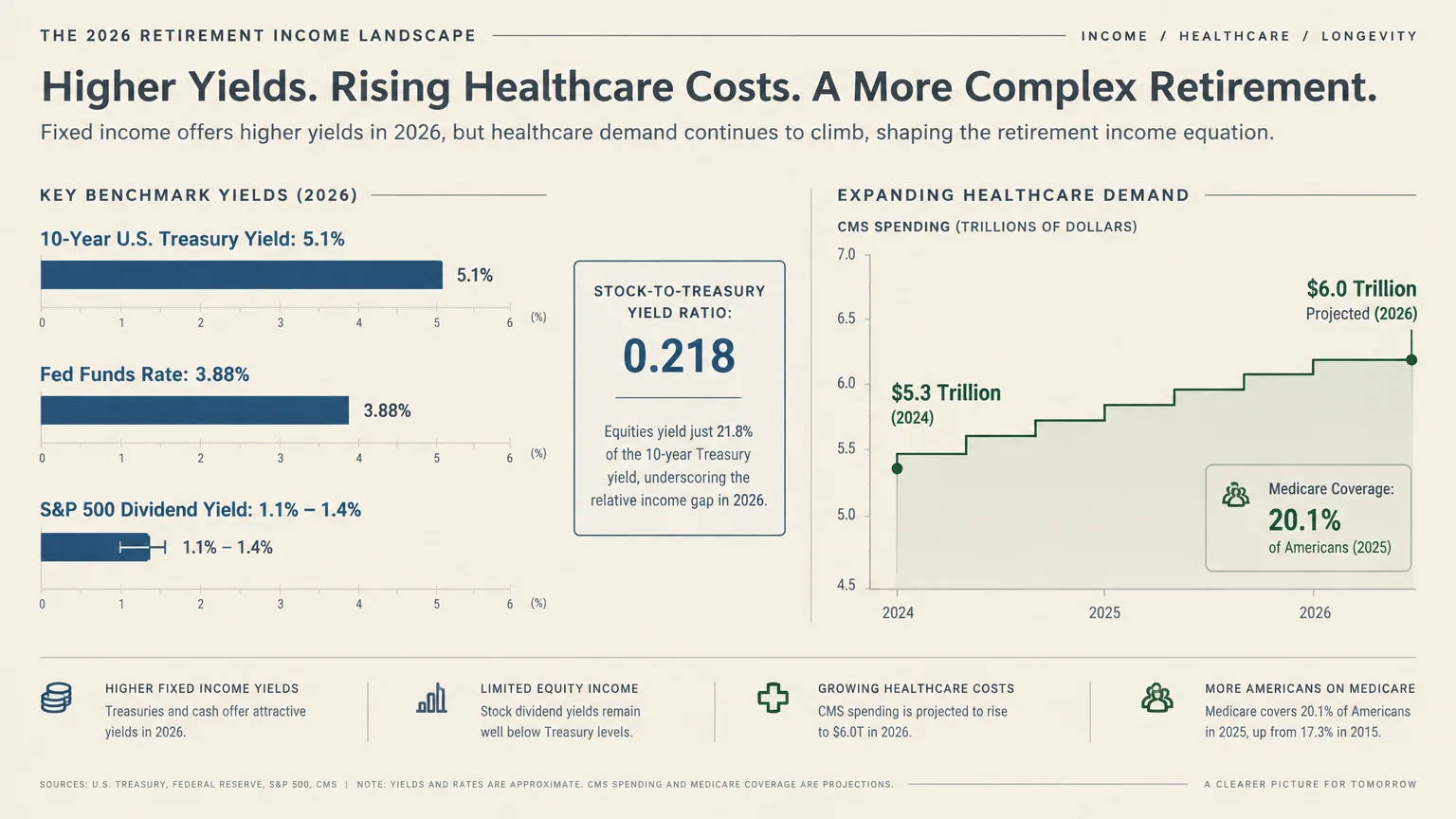
Many retirees compare stock dividends directly against government bond yields before deciding where to place cash. In mid-November 2026, the ten-year U.S. Treasury yield climbed to 5.1% following a 0.4% monthly jump in consumer prices reported by the Bureau of Labor Statistics.
Meanwhile, the Federal Reserve held its effective federal funds rate at 3.88% inside a 3.75% to 4.00% target range, per the Federal Reserve Board’s November 13, 2026 release. Safe cash accounts pay decent interest today, yet those rates can drop whenever central bankers cut later.
Broad stock indexes do not solve an income gap on their own either. Equity Research Service and Starman data show the S&P 500 dividend yield sat around 1.1% to 1.4% in late 2026, giving Seeking Alpha a stock-to-Treasury yield ratio of just 0.218.
That low market average explains why targeted dividend stocks for retirees remain so practical. Established pharmaceutical companies pay noticeably higher starting yields while maintaining the ability to raise payouts year after year.
Long-term healthcare demand backs up those cash distributions. According to the Centers for Medicare & Medicaid Services (CMS), U.S. national health spending grew 7.2% to $5.3 trillion in 2024 and is projected to hit $6.0 trillion in 2026.
Aging demographics drive much of that growth. U.S. Census Bureau figures show Medicare covered 20.1% of Americans in 2025, and CMS projects Medicare spending will rise 7.7% annually through 2034.
Your own household budget reflects these medical trends too. On Medicare.gov, the standard 2026 Medicare Part B premium sits at $202.90 per month.
CMS age data also show personal healthcare spending averaged $20,503 a year for adults ages 65 to 84 and $35,995 for those 85 and older. Owning profitable healthcare companies lets you collect income from the very industry taking a bigger bite out of retirement budgets.
Focus on whether a company can pay and raise its dividend from real free cash flow—not just whether today’s yield looks tempting on a stock screener.
Side-by-Side Comparison of Four Retirement Income Stocks
Each of these four drugmakers serves a different role inside a retirement portfolio. One delivers nearly 6% upfront yield, another mixes a 4% payout with strong cash coverage, and two emphasize steady annual raises.
Review the mid-November 2026 numbers below to see which combination of current income and payout growth fits your goals best.
| Company (Ticker) | Mid-Nov. 2026 Price | Annual Dividend | Approximate Yield | Dividend Increase Streak | Key Payout Ratio |
|---|---|---|---|---|---|
| Bristol-Myers Squibb (BMY) | $62.62–$63.13 | $2.52 ($0.63/qtr) | 3.98%–4.08% | 17 consecutive years | ~50% of 9M 2026 free cash flow |
| Pfizer (PFE) | $28.89 | $1.72 ($0.43/qtr) | ~5.9% | Flat at $0.43 since early 2025 | ~89% of free cash flow |
| AbbVie (ABBV) | $294.45–$295.03 | $7.28 ($1.82/qtr*) | 2.47%–2.50% | 53 consecutive years (incl. Abbott) | ~45.7% of cash flow |
| Johnson & Johnson (JNJ) | $280.00–$285.75 | $5.36 ($1.34/qtr) | 1.88%–1.95% | 64 consecutive years | ~79.0% of trailing GAAP earnings |
*AbbVie’s 5.2% raise to $1.82 per share quarterly takes effect with its February 16, 2027 payment.
Notice how yield and dividend growth move in opposite directions across this group. Balancing higher-yielding names with faster dividend growers helps protect both today’s bills and next decade’s groceries.
1. Bristol-Myers Squibb: Balancing Yield With Cash Flow Strength
If you want meaningful upfront income without sacrificing payout safety, the bristol myers squibb dividend deserves a close look. Shares traded between $62.62 and $63.13 in early-to-mid November 2026, up roughly 40.8% over the prior twelve months.
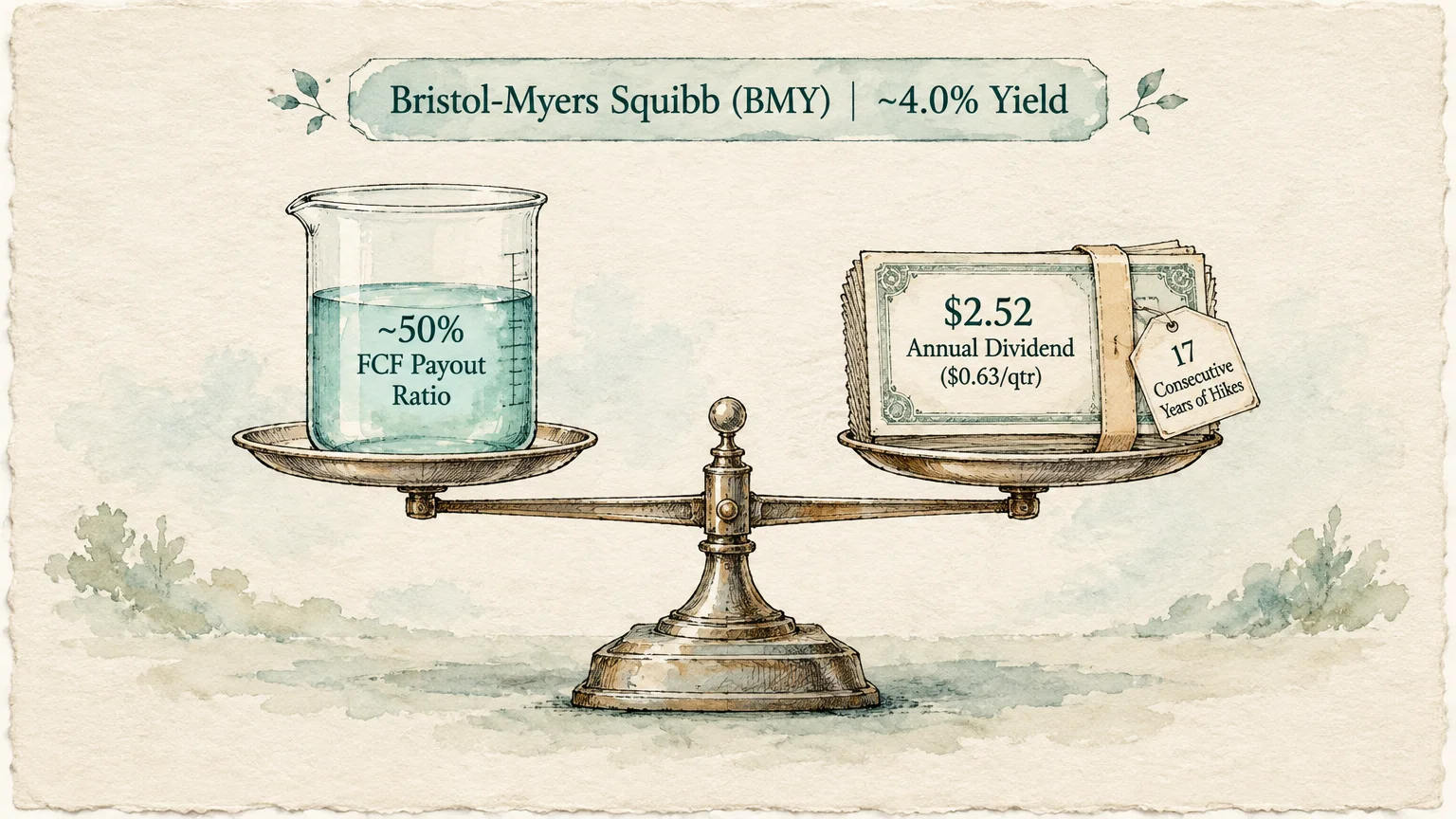
The company pays $0.63 per share each quarter, or $2.52 annually, generating a yield near 3.98% to 4.08%. Its most recent payment arrived on November 2, 2026, following an October 2 ex-dividend date.
To put that in dollar terms, holding 400 shares represents roughly $25,200 at $63 per share and pays you $252 every quarter. Over a full year, that single position adds $1,008 in cash flow to your retirement budget.
The Motley Fool and MarketBeat report that Bristol-Myers Squibb has paid dividends for 94 straight years and raised them for 17 consecutive years. Its five-year annual dividend growth rate sits near 5.15%, helping payouts keep pace with everyday living costs.
Cash coverage looks healthy as well. The annual payout uses about 38% to 40% of 2026 non-GAAP earnings guidance ($6.35 to $6.55 per share) and roughly 50% of free cash flow through the first nine months of 2026.
Retirees also benefit from relatively calm price swings, as the stock carries a low beta of 0.186. At the same time, management trimmed total debt from $51 billion to $47 billion during 2025, strengthening its balance sheet.
You should watch one clear policy headwind before buying, though. Co-marketed blood thinner Eliquis took a 56% Medicare negotiated discount starting January 1, 2026, dropping its 30-day price from $521 to $231 (and $237.25 in 2027).
Analysts expect a $1.5 billion to $2 billion step-down in Eliquis revenue during 2027. Because the payout consumes only about half of free cash flow, the dividend still holds a solid buffer while newer treatments scale up.
2. Pfizer: High Current Yield With a Tighter Safety Cushion
Retirees hunting for high yield dividend stocks often land on Pfizer first. Shares closed at $28.89 on November 13, 2026—up 15.8% for the year, though still down 35.4% over the past five years.
Pfizer pays $0.43 per share every quarter, or $1.72 a year, putting its yield near 5.9%. Owning 1,000 shares at $28.89 costs $28,890 and delivers $430 per quarter, or $1,720 annually.
That yield easily beats both the broader stock market and ten-year Treasury notes. Its fourth-quarter payment arrives December 7, 2026, marking Pfizer’s 352nd consecutive quarterly dividend.
Still, a higher yield comes with clear trade-offs you should weigh carefully. Pfizer has kept its quarterly payout flat at $0.43 since early 2025, meaning your income is not growing right now.
Coverage also requires closer monitoring than at peers. Acquisition-related charges pushed Pfizer’s GAAP earnings payout ratio near 246%, though The Motley Fool noted on November 14, 2026, that its free cash flow payout ratio sits near 89%.
An 89% free cash flow payout leaves little margin for surprises if profits stumble. That is why Pfizer’s operational turnaround matters so much to income investors.
Management raised full-year 2026 revenue guidance to between $62 billion and $64 billion as non-COVID drugs gained traction. In the third quarter of 2026, non-COVID revenue climbed 7% operationally, led by a 55% surge in cancer therapy Padcev and 25% growth in Eliquis.
Those gains helped offset sharp declines in COVID-19 products, with Paxlovid down 63% and Comirnaty falling 29%. Treat Pfizer as an income booster rather than your primary dividend grower, and watch free cash flow trends each quarter.
3. AbbVie: Dividend Growth Driven by Newer Therapies
While Pfizer maximizes cash today, AbbVie shines when you want retirement income stocks that raise your paycheck meaningfully each year. Shares traded between $294.45 and $295.03 on November 12 and 13, 2026.
In late October 2026, AbbVie boosted its quarterly dividend by 5.2%, lifting it from $1.73 to $1.82 per share ($7.28 annualized). That increase takes effect with the February 16, 2027 payout for shareholders on record by January 15, 2027.
At roughly $295 per share, the raised payout yields around 2.47% to 2.50%. Holding 100 shares—about a $29,500 investment—generates $182 per quarter, or $728 a year starting in 2027.
AbbVie’s dividend pedigree ranks among the strongest in healthcare. Counting its pre-spinoff history with Abbott Laboratories, the company has raised its dividend for 53 consecutive years and boosted its payout more than 330% since becoming independent in 2013.
Strong cash generation supports those ongoing raises. The dividend takes up roughly 45.7% of cash flow and about 52% of 2026 non-GAAP earnings guidance ($13.95 to $13.99 per share).
Even better, AbbVie proved it can move past a major patent cliff. Third-quarter 2026 revenue jumped 10.3% year-over-year to $17.404 billion, prompting management to raise its 2026 revenue outlook to $67.8 billion.
Immunology blockbusters Skyrizi ($5.776 billion, up 22.7%) and Rinvoq ($2.706 billion, up 23.9%) powered that expansion. Their growth easily cushioned falling sales from Humira (down 31.2% to $683 million) and blood cancer drug Imbruvica (down 26.1% to $522 million amid a 38% Medicare discount).
Because the stock trades near $295 per share, fractional-share investing through your brokerage makes building a position much easier. AbbVie fits retirees who want steady annual raises to fight long-term inflation.
4. Johnson & Johnson: Six Decades of Steady Payout Raises
Conservative retirees often value predictability above everything else, and Johnson & Johnson delivers a rare record of consistency. Shares traded near $280.00 to $285.75 in mid-November 2026.
The company pays $1.34 per share quarterly, or $5.36 annually, for a current yield near 1.88% to 1.95%. Its next dividend pays out on December 8, 2026, with an ex-dividend date of November 24, 2026.
Holding 100 shares near $283 (roughly $28,300) sends you $134 every quarter, totaling $536 a year. That starting yield trails Treasury notes significantly, so Johnson & Johnson works best as a low-drama anchor rather than a high-income workhorse.
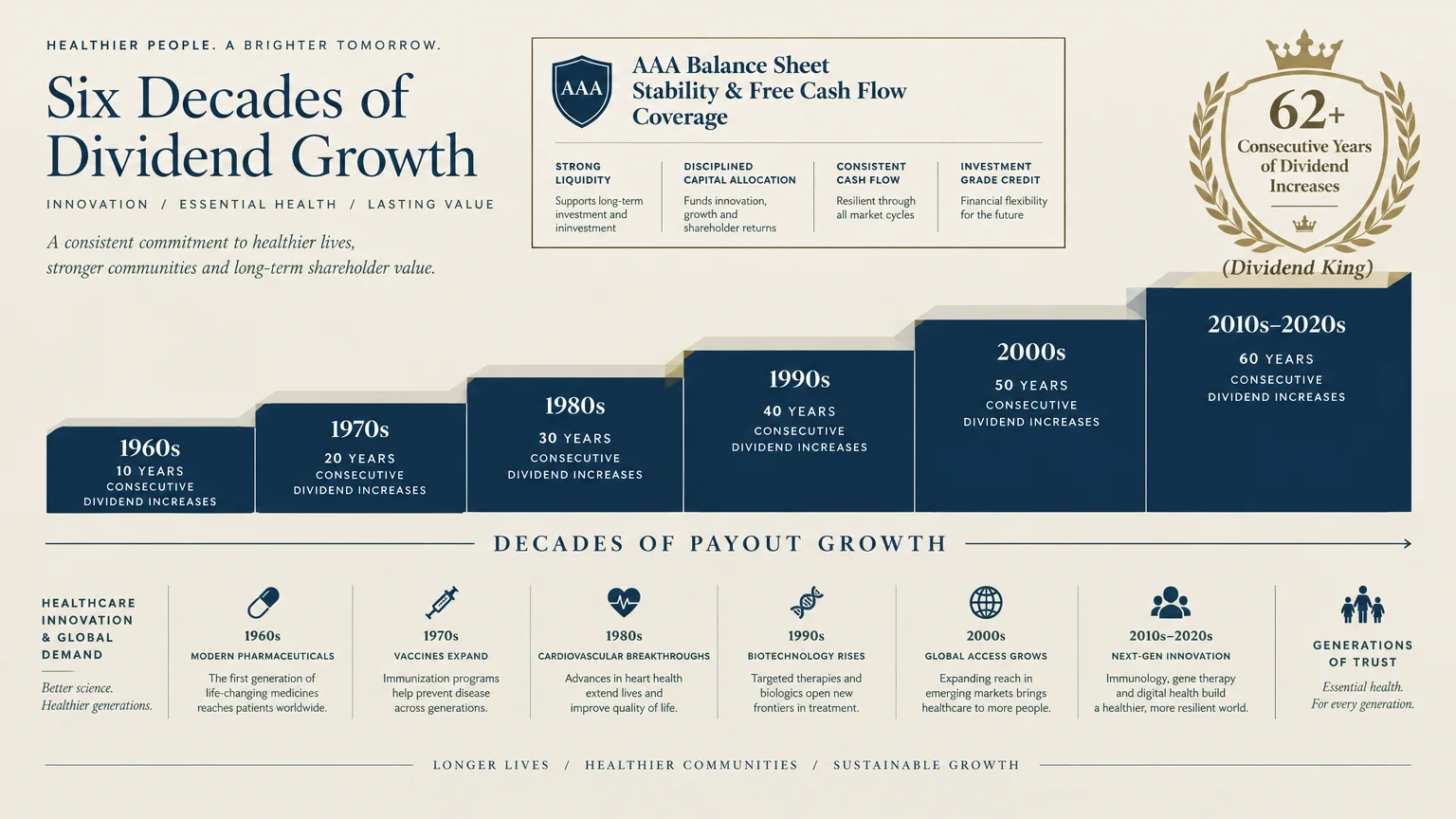
Per Johnson & Johnson’s April 14, 2026 announcement, management raised the dividend 3.1%, marking its 64th consecutive year of annual increases. Over the past five years, its dividend growth has averaged roughly 4.98% annually.
Its trailing twelve-month GAAP payout ratio sits near 79.0%, higher than AbbVie or Bristol-Myers Squibb on an adjusted basis. Even so, its diversified business across Innovative Medicine and MedTech—following the 2023 Kenvue consumer health spinoff—helps smooth out single-product bumps.
Policy shifts are creating mixed effects for the company heading into 2027. Immunology drug Stelara faced a 66% Medicare discount in 2026, yet CMS confirmed Stelara will leave the negotiated price list on January 1, 2027 due to biosimilar competition.
Meanwhile, blood thinner Xarelto remains subject to a 62% Medicare discount. Pairing Johnson & Johnson’s durability with a higher-yielding stock like Bristol-Myers Squibb lets you blend stability with stronger current cash flow.
How Medicare Drug Price Rules Shape Pharma Dividends
Federal drug pricing rules changed permanently when Medicare began negotiating prices directly with manufacturers under the Inflation Reduction Act. Understanding how this schedule unfolds helps you avoid surprises in your portfolio.
The first round of negotiated Maximum Fair Prices for 10 major Medicare Part D drugs took effect on January 1, 2026, at 38% to 79% below 2023 list prices. CMS estimates those cuts save Medicare $6 billion annually and trim out-of-pocket bills by $1.5 billion for nearly 9 million enrollees.
More rounds are already queued up, creating recurring checkpoints for investors:
- January 1, 2026: Round 1 prices started affecting major drugs including Eliquis (56% discount), Imbruvica (38%), Stelara (66%), and Xarelto (62%).
- November 30, 2026: CMS is scheduled to release Round 3 negotiated prices for 15 additional drugs, expanding for the first time into Medicare Part B treatments given in clinics.
- January 1, 2027: Round 2 negotiated prices for 15 drugs take effect, while Stelara exits the negotiated list due to biosimilar competition.
When reviewing any pharmaceutical stock, check what share of company revenue comes from older drugs facing Medicare price cuts or upcoming patent expirations. Companies with broad pipelines and low payout ratios handle these transitions far better than firms leaning heavily on one aging medicine.
You can review unbiased investor checklists on Investor.gov and FINRA.org before committing retirement savings to individual equities.
Taxes, Deductions, and Account Placement in 2026
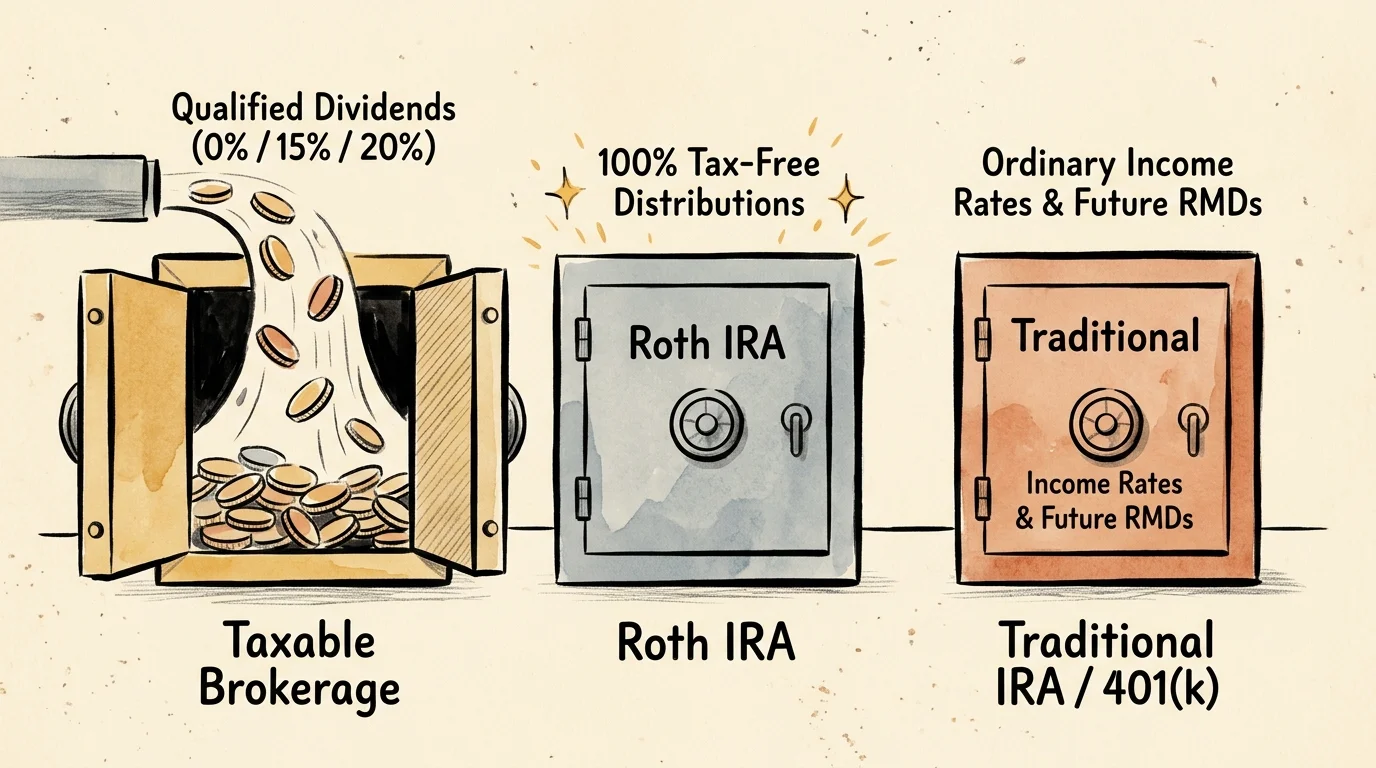
Keeping more of your dividend check matters just as much as picking strong companies. Under IRS Revenue Procedure 2025-32 and Publication 550, dividends from these U.S. corporations generally count as qualified dividends, which receive lower tax rates than ordinary income.
For the 2026 tax year, qualified dividend brackets depend on your taxable income and filing status:
- 0% tax rate: Taxable income up to $49,450 for single filers, $98,900 for married couples filing jointly, or $66,200 for heads of household.
- 15% tax rate: Taxable income from $49,451 to $545,500 (single) or $98,901 to $613,700 (married filing jointly).
- 20% tax rate: Taxable income above $545,500 (single) or $613,700 (married filing jointly).
To lock in those favorable rates, you must satisfy the IRS holding-period rule in Publication 550. Generally, you need to hold the stock for more than 60 days during the 121-day period starting 60 days before the ex-dividend date.
Be mindful of extra surtaxes and reinvestment rules as well. If your modified adjusted gross income tops $200,000 (single) or $250,000 (joint), the 3.8% Net Investment Income Tax applies to your dividends—and those thresholds do not adjust for inflation.
Automatic dividend reinvestment plans (DRIPs) also trigger current taxes when held in a standard brokerage account. Even if your cash buys extra shares immediately instead of hitting your bank account, the IRS taxes those reinvested dividends in the year paid.
Senior tax breaks in 2026 give many retirees extra room inside the 0% or 15% brackets. Taxpayers age 65 and older receive an additional standard deduction of $2,050 (single) or $1,650 per qualifying joint spouse.
Per the Tax Foundation, 2026 filers age 65+ also qualify for a separate $6,000 senior deduction under the One Big Beautiful Bill Act, phasing out at 6% above $75,000 single or $150,000 joint income. You can verify current forms and brackets directly on IRS.gov.
Where you hold your shares shapes your tax bill over time too. Traditional IRAs and 401(k)s shelter dividends until withdrawal, though required minimum distributions (RMDs) generally begin at age 73 and are taxed as ordinary income.
Roth IRAs eliminate lifetime RMDs for original owners and keep qualified withdrawals tax-free. Taxable brokerage accounts work well if your income fits inside the 0% qualified dividend bracket, letting you spend quarterly checks without touching retirement accounts.
Costly Errors to Sidestep
Even experienced savers occasionally make avoidable mistakes when building an income portfolio from healthcare stocks. Watch out for these four traps as you allocate your retirement savings:
- Chasing high yield without checking free cash flow: A 5.9% yield like Pfizer’s looks thrilling on paper, yet its 89% free cash flow payout ratio leaves less breathing room than AbbVie’s 45.7% or Bristol-Myers Squibb’s 50%. Always inspect cash flow coverage before buying.
- Missing the 60-day holding window: Buying shares right before an ex-dividend date and selling too soon forces the IRS to tax your payout at ordinary rates (10% to 37%) instead of qualified rates. Plan trades carefully around ex-dividend calendars.
- Putting too much money into one sector: Owning all four stocks as your entire income plan concentrates your retirement on pharmaceutical regulation and patent timelines. Pair healthcare holdings with other income sources such as Treasuries, utilities, or broad dividend funds.
- Forgetting DRIP tax bills in taxable accounts: Reinvesting dividends automatically compounds share count smoothly, yet you still owe taxes on every dollar declared that year. Keep enough cash on hand each April or direct payouts to a money market sweep fund if you spend them.

When DIY Isn’t Enough
Selecting four blue-chip healthcare stocks is straightforward, yet coordinating dividends with taxes and benefits gets tricky fast. Consider consulting a Certified Financial Planner or CPA if you encounter any of these situations:
- Coordinating RMDs at age 73: You want to blend traditional IRA withdrawals, Social Security benefits, and brokerage dividends without accidentally jumping into a higher tax bracket or raising your Medicare Part B premium. You can check benefit timing rules on SSA.gov as part of that planning.
- Nearing key 2026 tax phase-outs: Your modified adjusted gross income sits close to the $75,000 single or $150,000 joint phase-out for the $6,000 senior deduction, or near the $200,000/$250,000 Net Investment Income Tax triggers.
- Rebalancing stocks with large capital gains: You hold older healthcare shares with big embedded profits in a taxable account and need a tax-smart plan to trim concentration risk.
- Structuring survivor income: You are deciding whether to place higher-yielding stocks in a Roth IRA or taxable account so a surviving spouse keeps steady income under single-filer tax brackets later.
Frequently Asked Questions About Healthcare Dividend Stocks
Are healthcare dividend stocks safe for retirees in 2026?
No stock is risk-free, because share prices fluctuate and drugmakers face patent cliffs and Medicare price negotiations. However, large profitable drugmakers with conservative payout ratios and steady demand historically offer smoother rides than cyclical sectors.
How are qualified dividends from these stocks taxed in retirement?
If you meet the IRS 60-day holding rule, qualified dividends are taxed at 0%, 15%, or 20% depending on your 2026 taxable income. Single filers up to $49,450 and joint filers up to $98,900 pay 0% federal tax on qualified dividends.
Should I hold dividend stocks in a Roth IRA or a taxable brokerage account?
If you sit in the 0% qualified dividend bracket and spend your checks today, a taxable account works nicely. If you want tax-free compounding with no lifetime required minimum distributions, a Roth IRA offers greater long-term flexibility.
How can I spot a dividend that might be at risk of a cut?
Look first at the free cash flow payout ratio and the company’s debt load rather than headline yield alone. When a firm pays out nearly all its free cash flow—or carries flat dividends while earnings slide—its safety cushion is thinning.
Putting Your Healthcare Income Plan Into Action
Start by matching each stock to a clear job: Bristol-Myers Squibb for balanced yield and coverage, Pfizer for maximum current payout, and AbbVie or Johnson & Johnson for dependable annual raises. Check ex-dividend dates, confirm your account placement, and spread purchases across sectors so no single policy shift disrupts your monthly budget.
This article provides general financial education and information only. Everyone’s financial situation is unique—what works for others may not work for you. For personalized advice tailored to your retirement needs, consider consulting a qualified financial professional such as a CFP or CPA.
Last updated: November 2026. Benefit amounts, tax rules, and program details change annually—verify current figures with official government sources.








Leave a Reply