

Missing the wrong payment on a fixed income can wipe out your healthcare, trigger foreclosure, or cause irreversible insurance cancellations. When your monthly budget tightens, knowing which bills demand immediate attention protects your independence and safety.
Some late bills merely trigger modest administrative fees, while others result in sudden service shutoffs or devastating legal consequences. Ranking your obligations strategically ensures that temporary cash shortages never spiral into life-altering personal crises.
Here is your guide to the fifteen critical expenses you must prioritize during lean months, along with actionable steps to protect your household.
Understanding the Bill Triage Strategy
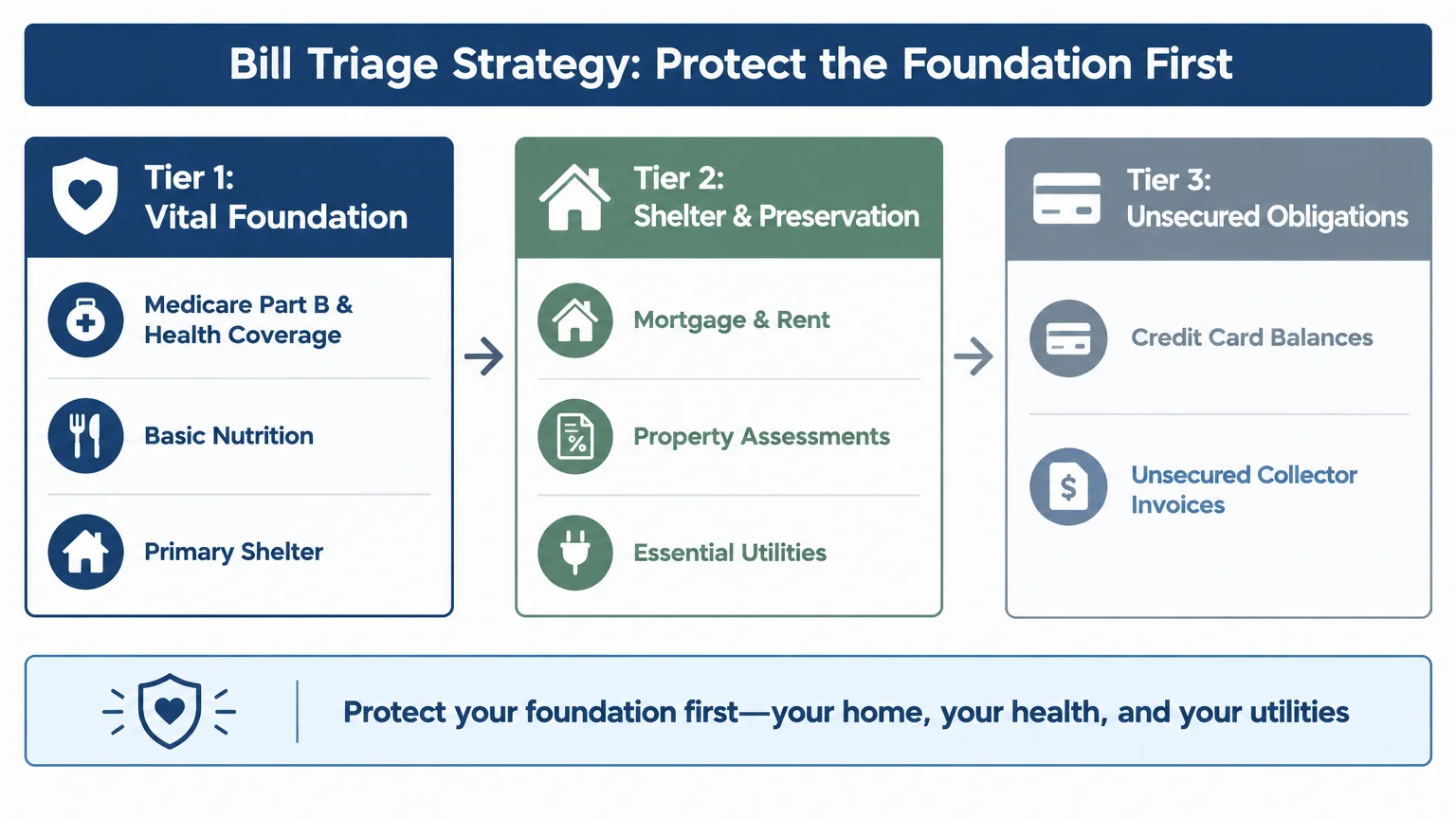
Managing monthly expenses in retirement requires a deliberate defense system. You cannot treat every invoice that arrives in your mailbox with equal urgency.
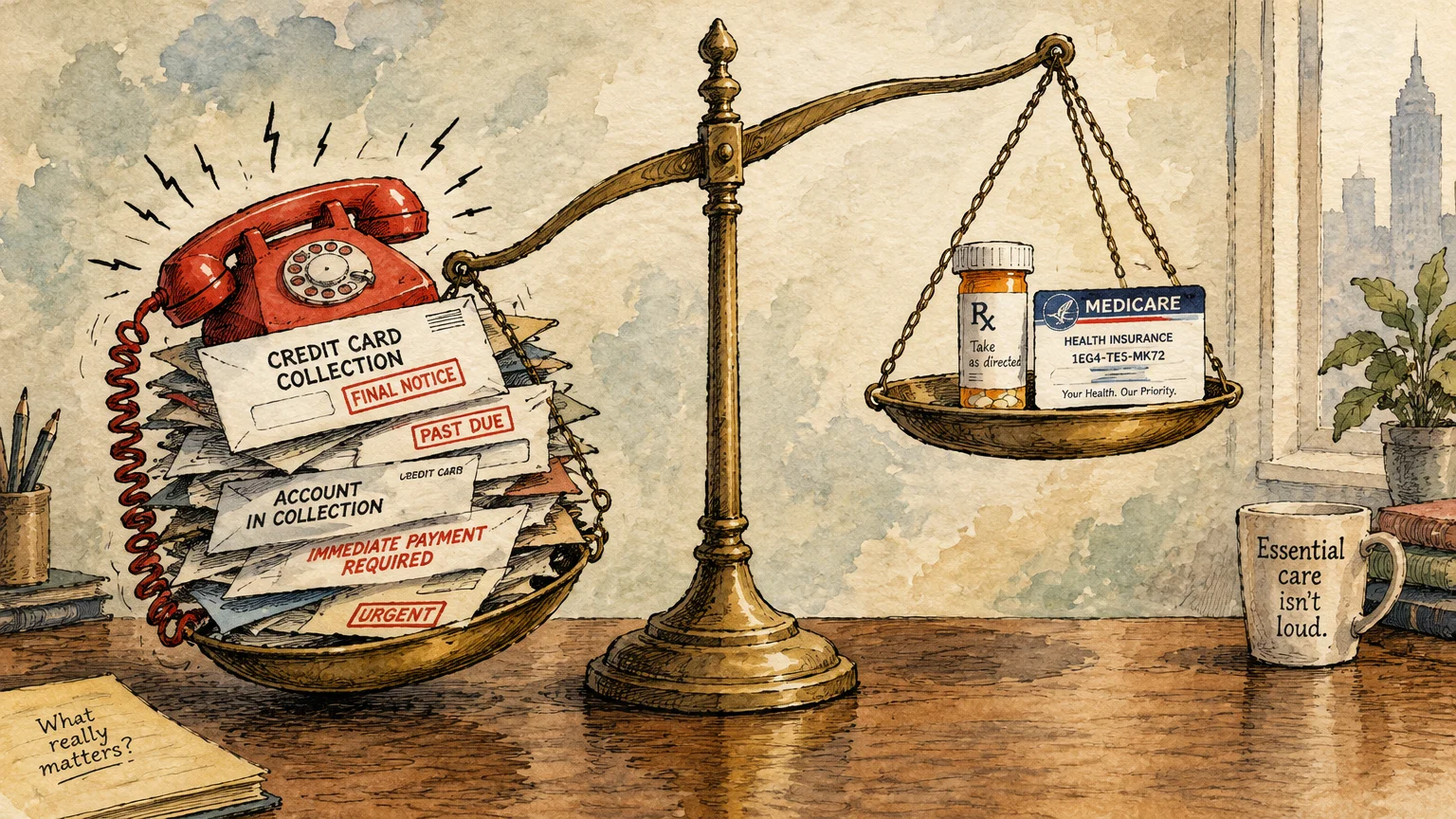
Creditors with the loudest collection departments often hold unsecured debt that carries minimal immediate danger to your day-to-day survival. By contrast, quiet bills like insurance premiums and local property assessments carry catastrophic penalties if you miss them.
Applying triage means funding your basic survival, personal safety, and legal health coverage before spending a single dollar elsewhere. This structured approach preserves your credit standing where it matters most and keeps a roof over your head.
“You must protect your foundation first—your home, your health, and your utilities—before sending a single extra penny to unsecured creditors.” — Suze Orman, Personal Finance Author
Tier 1: Healthcare and Essential Coverage You Cannot Replace
Healthcare expenses represent your most sensitive financial vulnerability in retirement. Losing coverage leaves you exposed to medical bills capable of wiping out a lifetime of savings within days.
1. Medicare Part B Premiums
The standard monthly Medicare Part B premium is $202.90. If you receive Social Security benefits, the government deducts this payment automatically from your monthly check.
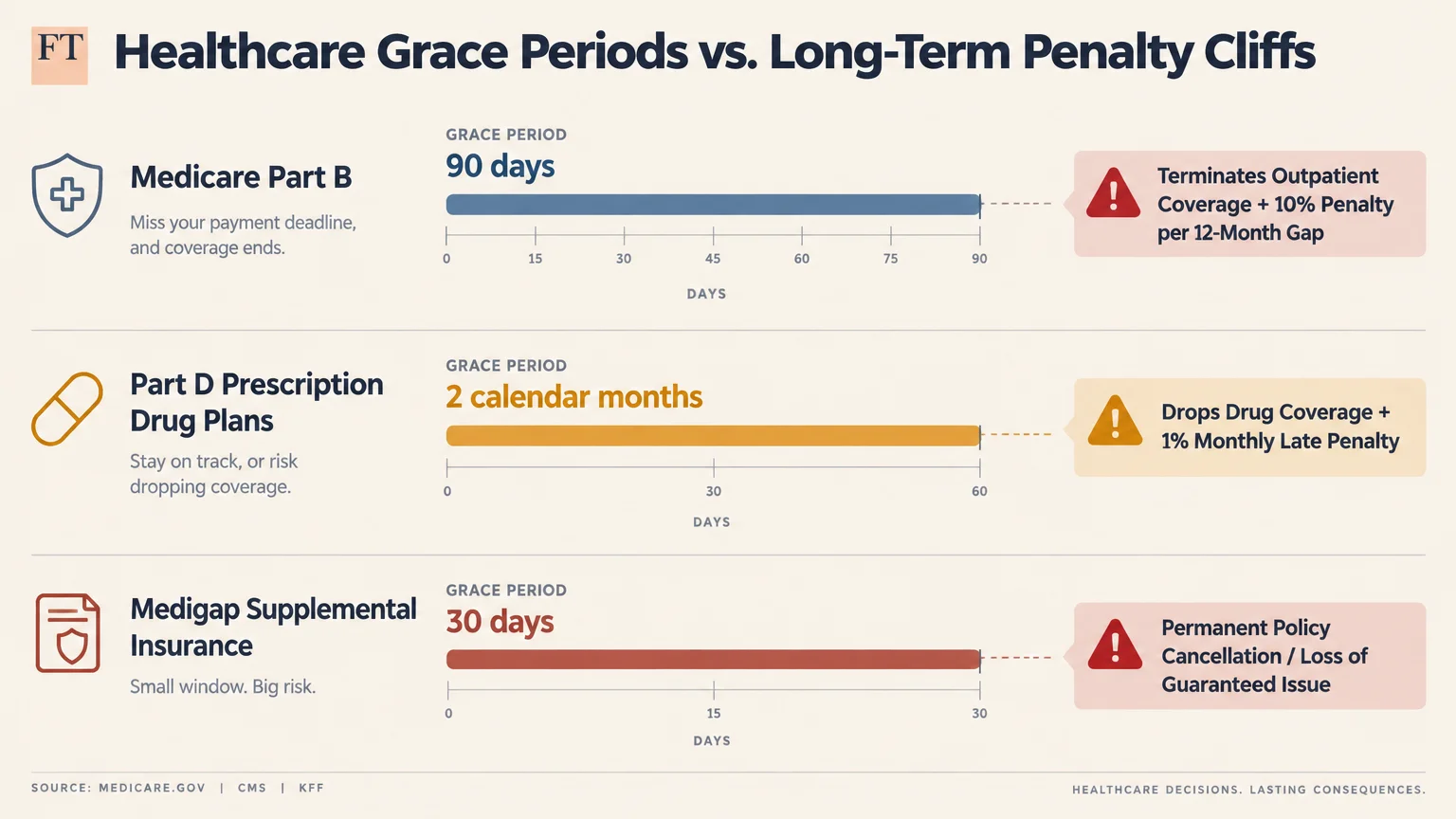
If you pay Medicare directly through quarterly invoices, you face severe risks by falling behind. Direct-billed Part B coverage includes a strict 90-day grace period before coverage terminates permanently.
Losing Part B leaves you without outpatient doctor visits, diagnostic tests, and preventive screenings. Re-enrollment is restricted to the General Enrollment Period each winter, leaving you uncovered for months.
Even worse, you face a permanent 10% late enrollment penalty for every 12-month period you were eligible but uninsured. Pay your Part B invoice promptly through Medicare.gov to avoid lifetime coverage loss.
2. Medicare Advantage and Part D Prescription Drug Plans
Private insurers delivering Medicare Advantage and Part D drug plans maintain strict nonpayment rules regulated by federal guidelines. Unpaid plan premiums carry a required grace period of at least two calendar months before disenrollment occurs.
If an insurer drops you for nonpayment, you lose coverage for routine appointments and vital maintenance prescriptions. You are thrust back into fee-for-service Medicare without drug coverage until the next annual open enrollment period.
Going without creditable prescription coverage also triggers a permanent Part D late enrollment penalty of 1% per month. Keep these premiums current to maintain continuous access to your daily medications.
3. Supplemental Health Insurance (Medigap)
Medigap plans pay the deductible and 20% coinsurance gaps that Original Medicare leaves behind. These policies are governed by private contracts and strict state insurance regulations.
If you fail to pay your Medigap premium within the standard 30-day grace period, the carrier will cancel your policy. Once cancelled, you rarely have a legal right to buy that policy back.
In most states, insurers require complete medical underwriting outside your initial enrollment window. A single preexisting health condition could result in total denial, leaving you with unlimited out-of-pocket medical liability.
4. Long-Term Care Insurance
Long-term care insurance policies purchased years ago are virtually impossible to replace at reasonable rates today. Most carriers enforce a rigid 30-day or 60-day grace period before terminating lapsed policies.
Letting an old policy lapse forfeits every dollar in premiums you invested over decades. Purchasing an equivalent policy in your sixties or seventies costs significantly more and requires passing stringent health underwriting.
Protect this asset by establishing an automatic bank draft. Most states also permit you to designate a trusted secondary contact who receives notification before any policy cancellation takes effect.

Tier 2: Shelter and Property Preservation
Securing your living space forms the cornerstone of financial stability. Housing disruptions create overwhelming stress and trigger costly legal battles that strain limited budgets.
5. Mortgage or Reverse Mortgage Obligations
Most traditional mortgage contracts provide a 15-day grace period before assessing a late fee of 4% to 5% on overdue balances. However, allowing missed payments to accumulate puts your homeownership in immediate peril.
Under federal regulations enforced by the Consumer Financial Protection Bureau, mortgage servicers cannot file a legal foreclosure action until you are more than 120 days delinquent. That timeline passes quickly when compound interest and late fees pile up.
Borrowers with Home Equity Conversion Mortgages (reverse mortgages) must remain vigilant as well. While you make no monthly mortgage payments, failing to pay required property charges can trigger immediate technical default and foreclosure.
6. Property Taxes
Municipal tax collectors possess exceptional legal authority to seize real property for unpaid balances. Local governments rarely compromise on overdue property taxes, and administrative penalties accrue rapidly at punitive interest rates.
Unpaid property taxes result in municipal tax liens placed directly against your deed. In many jurisdictions, the local government can auction these tax certificates to private investors, initiating foreclosure proceedings.
If your taxes are not escrowed inside a monthly mortgage payment, you must budget for them proactively. Contact your county assessor immediately to explore senior homestead exemptions and property tax deferral programs.
7. Homeowners and Renters Insurance
Carrying active hazard and liability insurance protects you against catastrophic natural disasters and personal injury lawsuits. If you miss a premium payment, your insurer can terminate your coverage after a brief grace period.
If you hold a traditional mortgage, a lapsed policy causes your lender to purchase force-placed insurance on your behalf. Force-placed policies cost double or triple standard market rates while covering only the lender’s loan balance.
For renters, losing liability coverage violates most standard residential lease agreements. Maintain uninterrupted premium payments so a fire, plumbing disaster, or storm cannot wipe out your personal belongings.
Tier 3: Critical Utilities and Lifeline Services
Utility shutoffs threaten your physical health, your ability to store medication safely, and your continued independence at home.
8. Essential Electric and Heating Utilities
Utility delinquency represents a growing national crisis for older Americans living on fixed incomes. Data from the National Energy Assistance Directors Association indicates roughly 21.5 million households are behind on energy bills, driven by rising electric and gas costs.
Utility companies issue shutoff notices quickly when balances age past 30 days. Reconnection requires paying the past-due balance alongside steep administrative fees and mandatory security deposits.
Federal rules through the Low-Income Home Energy Assistance Program (LIHEAP) help roughly 2.4 million older adults each year. LIHEAP crisis interventions must act within 48 hours—or 18 hours in life-threatening conditions—to restore power or prevent imminent disconnection.
Check state-level policies as well, since 35 states enforce winter shutoff moratoriums or temperature-triggered bans that shield older households from loss of heat during freezing conditions. Explore application details through Benefits.gov before emergency shutoffs occur.
9. Water and Sewer Services
Unlike heating and electric utilities, municipal water departments rarely operate under seasonal winter shutoff moratoriums. A missing water payment can lead to rapid service disconnection at your street meter.
Living without running water creates severe hygiene hazards and renders a residential property legally uninhabitable under local health codes. In extreme cases, code enforcement officers can condemn your home until services are restored.
Unpaid municipal utility balances frequently convert into direct liens attached to your real estate deed. Prioritize your monthly water bill alongside basic food purchases to keep your residence safe and legally compliant.
10. Phone and Internet Services
Modern medical care and family safety rely heavily on consistent communication channels. Telehealth appointments, patient portal updates, and electronic banking access all require continuous phone and home broadband service.
Telecommunications carriers enforce automated disconnection policies when accounts become 30 to 60 days overdue. Reconnecting services triggers activation penalties and security deposits that needlessly inflate your monthly overhead.
Reliable phone access also safeguards your connection to 911 dispatchers and emergency monitoring systems. If your budget is tight, ask your telecom carrier about discounted senior connectivity tiers.

Tier 4: Transportation, Mobility, and Prescription Access
Preserving your physical mobility and access to prescription therapies ensures you can attend specialist consultations and maintain your health independently.
11. Auto Insurance
Operating a motor vehicle without continuous liability insurance is illegal across nearly every state jurisdiction. Insurers provide minimal leeway for missed payments, frequently cancelling policies after a brief 10-day notice.
A policy cancellation leaves you personally vulnerable to catastrophic financial judgments if you cause a traffic collision. State motor vehicle departments track insurance lapses electronically, resulting in automatic driver’s license suspensions and registration revocations.
Once you develop a gap in coverage, insurers place you in high-risk categories that dramatically raise your future premiums. Never skip an auto insurance bill if you intend to keep your car on the road.
12. Primary Vehicle Loan or Lease
Defaulting on an automobile loan carries swift physical consequences that happen far faster than residential foreclosures. In many states, lenders can legally dispatch repossession agents the moment a loan enters formal default.
Losing your personal vehicle disrupts your ability to visit doctors, purchase groceries, and remain active in your community. Public transit is often unavailable or impractical for older adults with limited mobility.
If you anticipate missing an auto loan payment, contact your lender before the due date arrives. Lenders frequently grant temporary loan extensions or payment deferrals to avoid the high administrative cost of vehicle repossession.
13. Pharmacy Accounts and Ongoing Prescription Copays
Missing payments on pharmacy store credit accounts or copayment balances can lead pharmacies to freeze non-emergency medication orders. You cannot maintain your health if administrative billing holds block your prescription refills.
Skipping maintenance medications for cardiovascular disease, diabetes, or hypertension leads to emergency hospitalizations and irreversible declines in physical health. The cost of an inpatient hospital stay far outweighs the copayment you were attempting to delay.
Speak candidly with your pharmacist if you encounter difficulty paying for required medications. They can often suggest low-cost therapeutic generics, manufacturer copay assistance cards, or charitable foundations that cover out-of-pocket costs.
Tier 5: Government and Unsecured Debts
Government obligations possess unique collection powers, while unsecured debts require careful management to minimize long-term financial fallout.
14. Federal Income Taxes
The Internal Revenue Service maintains potent collection mechanisms that far exceed the reach of standard private collection agencies. The IRS can issue tax levies against personal bank accounts and garnish a portion of your Social Security payments.
The standard IRS failure-to-pay penalty is 0.5% of the unpaid balance per month, capping at 25%. However, failing to file your tax return triggers a severe 5% monthly penalty, alongside underpayment interest set at 7% compounded daily.
In July 2026, the IRS launched the Automatic Exemption from Penalty program, replacing the older First Time Abate process. This automated system waives failure-to-file and failure-to-pay penalties for taxpayers who maintained clean filing and payment compliance for the prior three years.
Always file your tax return by the annual deadline, even if you lack the funds to pay the balance due. File on time and establish an approved monthly installment agreement directly through the Internal Revenue Service to reduce monthly penalty rates to 0.25%.
15. Credit Card Minimum Payments
Unsecured credit card balances carry the lowest legal priority for basic survival, but ignoring minimum due dates carries expensive consequences. On April 15, 2025, a federal court vacated the proposed CFPB rule that would have capped credit card late fees at $8.
As a result, standard safe harbor limits remain active under Regulation Z. Card issuers can legally charge up to $30 for a first late payment and $41 for subsequent missed payments within six billing cycles.
Federal Reserve data shows the average credit card interest rate stands at 21.19% across all accounts, rising to 22.36% for accounts assessed interest. Missing your payment date also triggers penalty interest rates that can exceed 29%, rapidly accelerating your total balance.
While card issuers report delinquent accounts to credit bureaus only after 30 days past due, internal late fees apply immediately. Pay at least the minimum due to keep your account in good standing and avoid penalty rates.
Comparing Grace Periods and Consequences
The table below highlights how key bills differ regarding grace periods, penalties, and long-term consequences so you can prioritize your payments effectively.
| Bill Category | Standard Grace Period | Immediate Consequence | Long-Term Impact |
|---|---|---|---|
| Medicare Part B | 90 days | Delinquency warning notice | Loss of outpatient care; lifetime 10% annual late penalties |
| Medicare Advantage / Part D | 2 calendar months | Notice of intent to cancel | Loss of prescription drug coverage; lifelong Part D penalties |
| Medigap Supplemental | 30 days | Policy cancellation notice | Permanent loss of guaranteed coverage; medical underwriting |
| Mortgage Payments | 15 days | Late fee assessed (4% to 5%) | Foreclosure process initiated after 120 days delinquent |
| Property Taxes | Varies by county (0–30 days) | High interest and statutory fees | Municipal tax lien auction; eventual property foreclosure |
| Heating & Electric | 15 to 30 days | Late fees and shutoff warnings | Physical disconnection; steep reconnection fees and deposits |
| Auto Insurance | 10 to 30 days | Policy lapse notice | License suspension; vehicle impoundment; expensive high-risk rates |
| Federal Taxes (IRS) | None (due on filing date) | 0.5% failure-to-pay penalty plus 7% interest | Federal tax liens; bank levies; Social Security garnishment |
| Credit Card Minimums | 21 to 25 days (billing cycle) | Late fee up to $30 to $41; penalty APR | Credit score damage after 30 days; aggressive third-party collections |
How to Triage Your Expenses When Money Runs Tight
When unexpected repairs or healthcare emergencies exhaust your available cash, you must take immediate control of your cash flow. Follow this step-by-step strategy to protect your financial security.
- Protect your physical foundation first. Pay your housing, heating, power, water, and vital medications before distributing remaining funds elsewhere.
- Audit your direct debits. Review your automated bank deductions to stop automatic payments for low-priority subscriptions or nonessential credit accounts.
- Communicate with creditors early. Contact utility customer service departments, auto lenders, and mortgage servicers before missing a due date to request hardship plans.
- Leverage senior assistance programs. Explore local and federal support programs for utility subsidies, prescription discounts, and property tax deferrals through organizations like the National Council on Aging.
- Use credit card grace periods defensively. If you cannot pay all obligations, remember that credit card companies do not report missed payments to credit bureaus until your account is 30 days past due.
Common Mistakes to Avoid
Navigating financial distress requires avoiding common pitfalls that can worsen your economic standing. Steer clear of these four critical errors when money gets tight.
Paying unsecured creditors before essential shelter. Aggressive collection callers often convince seniors to empty bank accounts for unsecured credit cards. Remember that credit card companies cannot seize your home or disconnect your heat without lengthy legal proceedings.
Ignoring bills completely instead of asking for help. Creditors are far more willing to offer temporary repayment plans, interest rate reductions, or grace extensions when you reach out before the bill becomes severely delinquent.
Failing to file your tax return because you owe money. The IRS penalty for failing to file is ten times larger than the penalty for paying late. Always submit your tax paperwork on time to limit statutory penalties.
Assuming medical bills will instantly destroy your credit. Major credit reporting agencies exclude unpaid medical debts under $500 entirely and enforce a mandatory 365-day waiting period before reporting larger medical debts. Use this one-year window to negotiate hospital financial hardship relief rather than neglecting your rent or utility bills.
Frequently Asked Questions
Which bill should I pay first if my monthly income falls short?
Always pay your primary shelter costs, essential utilities, and irreplaceable health insurance premiums first. These expenses preserve your physical safety, maintain your independence, and prevent life-threatening coverage lapses.
Can unpaid medical bills ruin my credit score immediately?
No. The three nationwide credit bureaus voluntarily exclude unpaid medical collections under $500, remove paid medical debt entirely, and enforce a 365-day waiting period for larger medical bills. More than 15 states maintain even stricter protections against medical debt reporting.
How long can I be delinquent on my mortgage before facing foreclosure?
Under federal CFPB mortgage servicing rules, a loan servicer cannot legally initiate formal foreclosure proceedings until your mortgage payment is more than 120 days delinquent. This rule applies equally to traditional mortgages and reverse mortgages facing property charge defaults.
What can I do if I cannot afford my heating or electric bills this winter?
Apply immediately for the Low-Income Home Energy Assistance Program (LIHEAP), which prioritizes older adults and delivers emergency crisis grants within 48 hours. Additionally, check whether your state enforces one of the 35 state-mandated winter shutoff moratoriums that prevent power disconnections during cold weather.
Protecting Your Financial Well-Being
Facing a temporary income squeeze can feel overwhelming, but prioritizing your expenses systematically restores control over your daily life. Focus on keeping your living space secure, your utilities connected, and your medical coverage active.
Remember that unsecured debts and nonessential services can always wait while you stabilize your personal foundation. Taking deliberate action today keeps short-term cash flow challenges from threatening your long-term independence.
This article provides general financial education and information only. Everyone’s financial situation is unique—what works for others may not work for you. For personalized advice tailored to your retirement needs, consider consulting a qualified financial professional such as a CFP or CPA.
Last updated: November 2026. Benefit amounts, tax rules, and program details change annually—verify current figures with official government sources.









Leave a Reply