

Every Veterans Day, retail chains advertise free meals and store discounts, yet thousands of military retirees overlook permanent government programs worth tens of thousands of dollars each year. Claiming these earned benefits can dramatically lower your out-of-pocket medical bills and protect your household nest egg.
Many aging veterans mistakenly believe that valuable federal assistance requires a combat record or a thirty-year active-duty career. In reality, basic wartime service or a minor service-connected rating unlocks substantial tax-free monthly stipends, housing upgrades, and healthcare allowances.
Reviewing these twelve overlooked benefits helps you capture every financial resource you earned through your honorable service.
1. VA Aid and Attendance for In-Home Care and Assisted Living
Long-term custodial care ranks among the largest threats to a stable senior retirement. The VA Aid and Attendance benefit provides tax-free monthly cash directly to wartime veterans and surviving spouses who need daily assistance.
You can use these funds to cover in-home caregivers, adult day health centers, or residential assisted living communities. The program operates as an enhanced tier on top of the standard wartime pension.
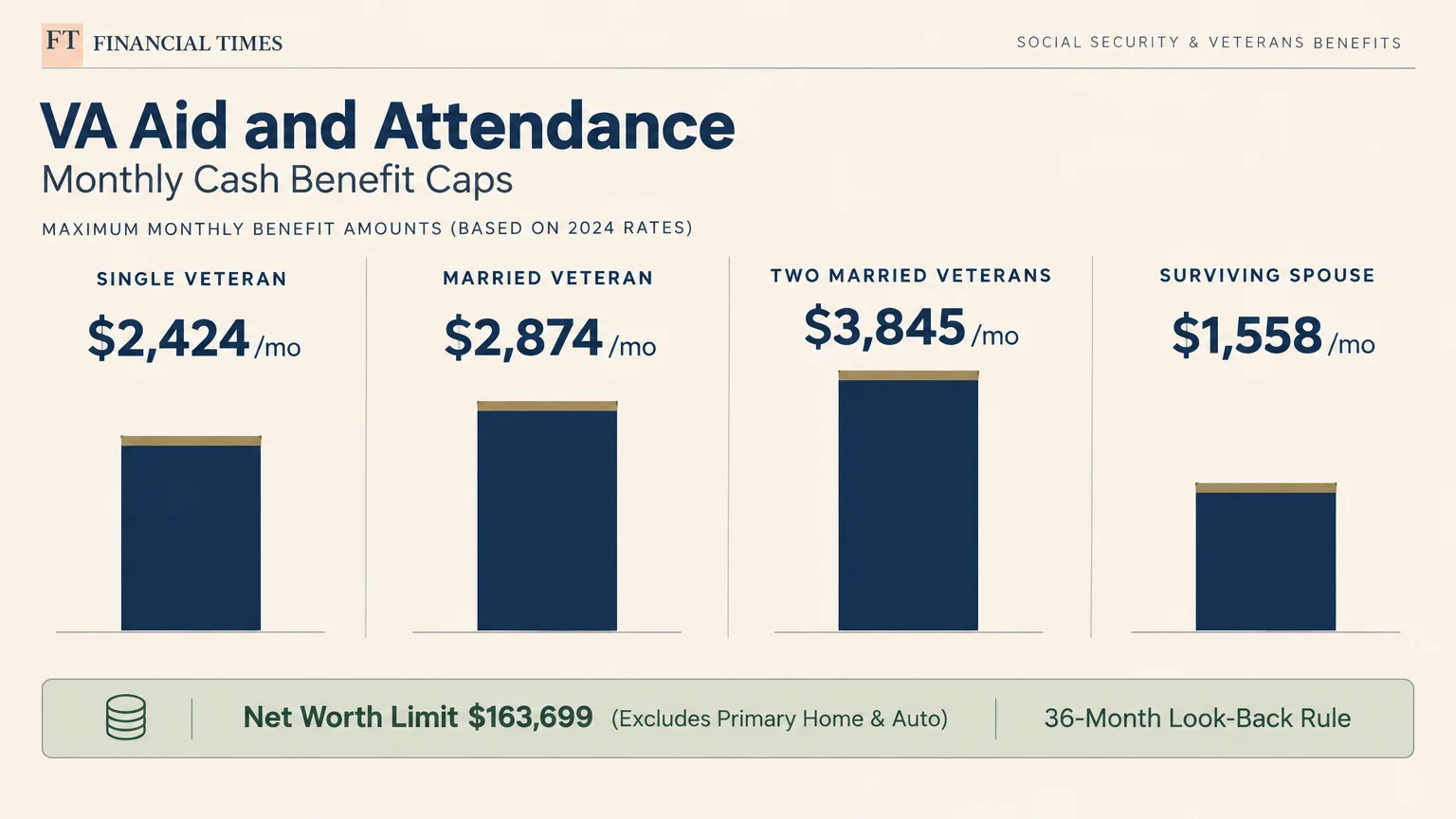
Eligible single veterans can receive up to $2,424 per month to offset daily care costs. Married veterans qualify for up to $2,874 per month, while two married veterans can collect up to $3,845 monthly.
Surviving spouses of wartime veterans can also receive up to $1,558 per month in direct assistance. These payments arrive tax-free and do not reduce your standard Social Security retirement income.
Qualifying requires active wartime service, medical verification that you need help with activities of daily living, and adherence to net worth caps. The VA enforces a net worth limit of $163,699, which excludes your primary residence and personal vehicle.
Be aware that the VA examines asset transfers under a 36-month look-back rule. Giving away assets to qualify triggers penalty periods up to five years, calculated using a $2,874 monthly divisor.

2. The Spousal Aid and Attendance Add-On
Many disabled veterans receive monthly disability compensation but remain unaware that their spouse’s declining health can unlock additional cash. The VA provides a supplemental allowance specifically for veterans whose spouses require custodial care.
To qualify, you must carry a combined service-connected disability rating of 30% or higher. Your spouse must also demonstrate a medical need for regular assistance with basic personal needs like dressing or mobility.
This spousal add-on pays between $61 and $201.41 per month on top of your normal dependent payment. The exact amount depends directly on your established disability rating percentage.
The money deposits automatically into your monthly compensation without restrictions on how you spend it. You can channel this extra cash toward home health aides, medical transportation, or specialized therapies.
3. Home Accessibility Grants for Aging in Place
Modifying a home for wheelchair access or fall prevention often costs thousands of dollars. The Department of Veterans Affairs operates multiple grant programs designed to help senior veterans age safely in their own houses.
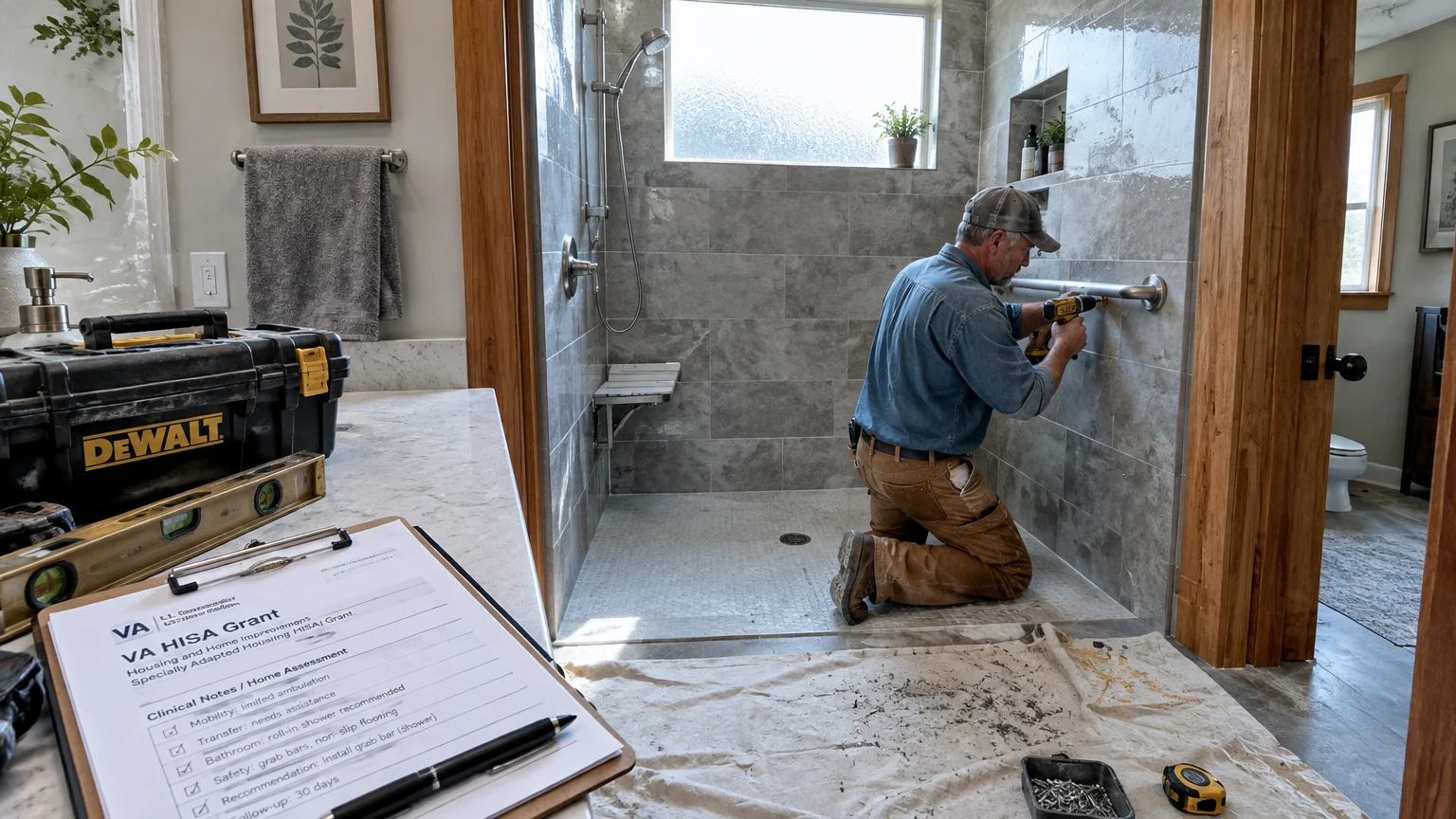
The Home Improvements and Structural Alterations (HISA) grant offers a lifetime benefit of up to $6,800 for service-connected conditions. Veterans with non-service-connected disabilities can still receive up to $2,000 for essential home accessibility projects.
HISA funds cover roll-in showers, widened interior doorways, exterior ramps, and heavy-duty grab bars. You must enroll in VA health care and obtain a clinical prescription from a VA physician to apply.
Veterans facing severe service-connected mobility impairments can explore larger structural programs. The Specially Adapted Housing (SAH) grant provides up to $126,526 across up to six separate uses over your lifetime.
The Special Home Adaptation (SHA) grant delivers up to $25,350 to improve mobility and sight accommodations. If you temporarily live with family, the Temporary Residence Adaptation (TRA) grant offers up to $50,961 for necessary renovations.
Keep in mind that current statutory authority for the TRA grant program expires after December 11, 2026, unless extended by Congress. Review your home improvement needs through the official VA portal to start your paperwork promptly.

4. Monthly Caregiver Stipends Under the PCAFC Program
Caring for an aging veteran often forces adult children or spouses to cut back on working hours. The Program of Comprehensive Assistance for Family Caregivers (PCAFC) compensates dedicated family members for their daily caregiving labor.
To participate, the veteran must hold a combined service-connected disability rating of 70% or higher. The veteran must also require continuous in-person care for at least six consecutive months.
Approved primary family caregivers receive a monthly non-taxable stipend based directly on local federal pay scales. In the standard Rest of U.S. locality tier, the stipend delivers $1,896.30 per month at Level 1.
Caregivers managing higher-level continuous assistance receive $3,034.08 per month at Level 2. In designated high-cost metropolitan areas, these monthly caregiving payments reach as high as $3,793.
The program also grants caregivers at least 30 days of annual respite care to prevent physical exhaustion. Uninsured primary caregivers receive comprehensive health insurance coverage through the civilian CHAMPVA program.
“A big part of financial freedom is having your heart and mind free from worry about the what-ifs of life.” — Suze Orman, Personal Finance Author and Host
5. Disability Compensation Upgrades and Annual COLA Increases
Many military retirees never request a rating increase after leaving active duty decades ago. However, service-connected joint injuries, respiratory conditions, and nerve damage frequently worsen as your body ages.
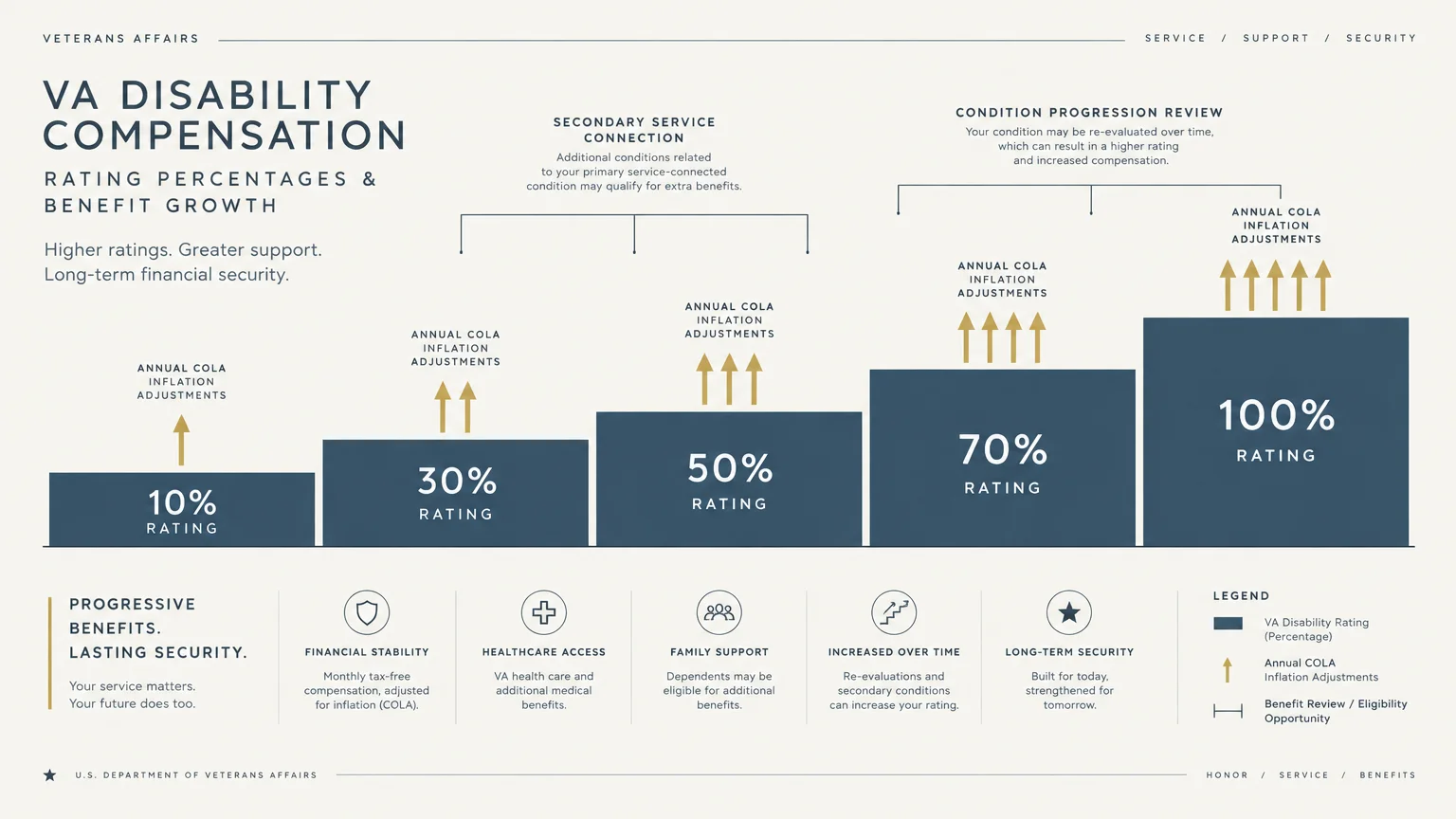
Filing for an increased rating can elevate your monthly tax-free cash flow substantially. Monthly base compensation ranges from $180.42 for a 10% rating up to $3,938.58 for a 100% rating with no dependents.
Congress indexes these disability rates to inflation through annual Cost-of-Living Adjustments. Benefits received a 2.8% COLA increase for 2026, which took effect on December 1, 2025.
The Social Security Administration announced an additional 3.6% COLA increase for 2027, which raises VA compensation payments starting December 1, 2026. This adjustment pushes the single 100% disability payout to approximately $4,080.37 per month.
VA disability compensation remains entirely exempt from state and federal income taxes. Exploring eligibility through Benefits.gov helps you evaluate potential rating increases without jeopardizing your existing benefits.

6. Complete Exemption from VA Home Loan Funding Fees
Retirees who downsize or relocate often finance their new properties with government-backed mortgages. VA loans eliminate down payments and mortgage insurance, but they typically charge a mandatory administrative funding fee.
This fee generally ranges between 1.4% and 3.6% of your entire mortgage amount. Borrowers without an exemption must either pay this balance in cash at closing or finance it into their debt.
The VA completely waives this funding fee for any veteran receiving service-connected disability compensation. You only need a verified disability rating of 10% or higher to claim the waiver.
On a $350,000 retirement home purchase, dodging a 2.15% first-time funding fee saves you $7,525 immediately. Surviving spouses receiving Dependency and Indemnity Compensation also qualify for this complete fee waiver.

7. Digital Lifetime National Parks and Federal Recreation Pass
Staying active in retirement promotes cardiovascular health and mental vitality. All honorably discharged military veterans and Gold Star Families qualify for the America the Beautiful Military Lifetime Pass at zero charge.
This permanent entitlement grants free entrance to more than 2,000 national parks, wildlife refuges, and national forests. It permanently eliminates the standard $80 annual fee that civilians must pay.
Under the federal EXPLORE Act effective January 1, 2026, you can claim and store a fully digital version on your smartphone. You no longer need to wait for a physical plastic card to ship through the postal mail.
A single digital pass covers entry fees for the veteran and all passengers in a single private vehicle. The pass also covers entry for up to two registered motorcycles traveling together.

8. In-Person and Online Commissary and Exchange Privileges
Inflation on everyday groceries and consumer goods strains fixed retirement budgets. Expanded Department of Defense regulations grant retail shopping privileges to all veterans with any service-connected disability rating.
Purple Heart recipients, former prisoners of war, and registered family caregivers also receive full installation access. You can shop at base commissaries, military exchanges, and authorized morale, welfare, and recreation facilities.
Commissary products sell at cost plus a standard 5% surcharge, delivering average grocery savings between 20% and 25%. Military exchange goods are completely exempt from local and state retail sales taxes.
You can also use these privileges online through military exchange websites without leaving home. You simply register your veteran status using your Veteran Health Identification Card or DoD credentials.
9. Premium Hearing Aids and Audiology Care
Age-related hearing loss combined with military noise exposure creates significant communication challenges. Standard Medicare does not cover routine hearing exams or prescription hearing devices, leaving seniors with hefty medical bills.
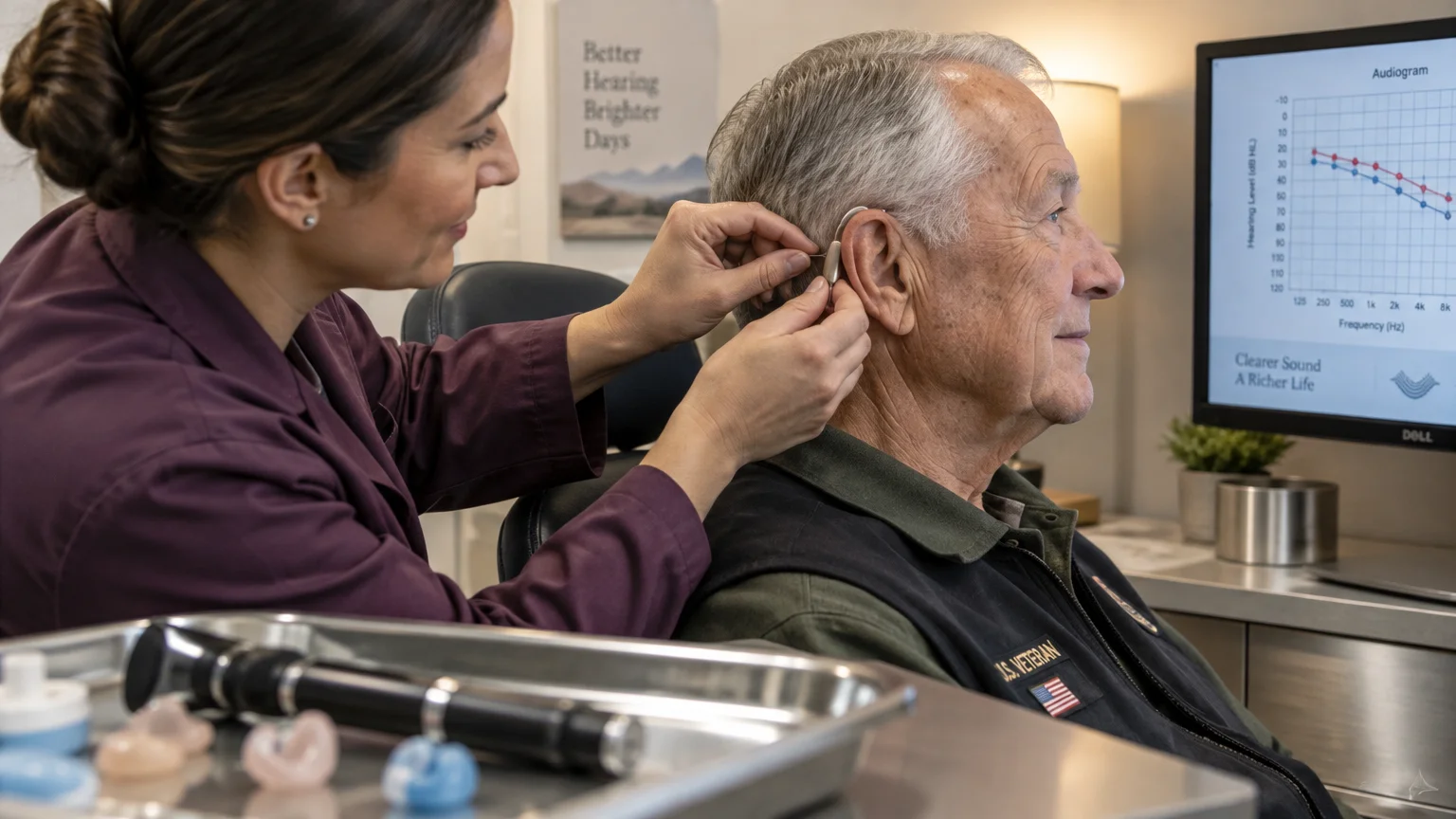
Enrolling in VA health care provides comprehensive diagnostic audiology services at no out-of-pocket cost. If an audiologist prescribes hearing devices, the VA dispenses top-tier digital models from leading manufacturers.
Private commercial hearing aids routinely cost between $3,000 and $7,000 per pair. The VA covers the initial fitting, follow-up tuning appointments, and custom ear molds entirely.
The agency also mails free replacement batteries, wax guards, and cleaning supplies directly to your doorstep upon request. You can request these audiology supplies online or through automated telephone ordering systems.
“Retirement security is about maximizing every guaranteed income stream available to you.” — Jean Chatzky, Financial Journalist and Author

10. VA Burial Allowances and Memorial Honors
Planning end-of-life arrangements relieves an immense emotional and financial burden from surviving children and spouses. The VA guarantees free memorial services for eligible honorably discharged veterans across 157 national cemeteries.
The burial benefit covers the opening and closing of the grave, perpetual site care, and a government headstone. Surviving family members also receive a ceremonial United States burial flag and a Presidential Memorial Certificate.
Families can also access direct cash reimbursement allowances to offset private burial or cremation costs. For deaths occurring on or after October 1, 2026, the non-service-connected burial allowance pays up to $1,032.
The VA also provides up to $1,032 for an associated cemetery plot allowance. If the death stems from a verified service-connected condition, the VA pays a burial allowance up to $2,000.
Families have a strict two-year window from the burial date to submit claims for non-service-connected allowances. Service-connected burial claims have no filing deadline, but acting early prevents lost records and administrative delays.
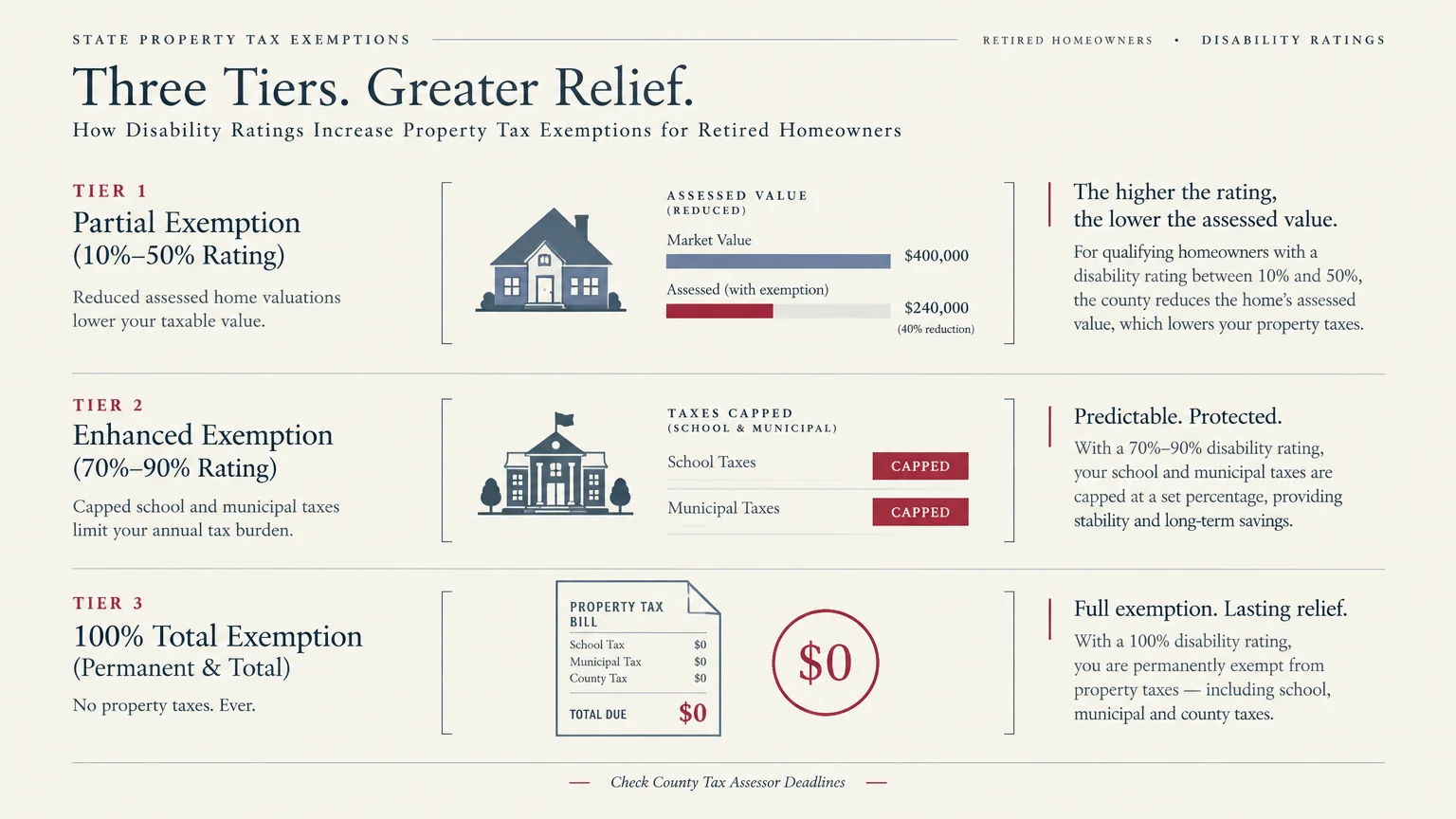
11. State-Level Property Tax Exemptions
County property taxes represent an escalating housing expense for seniors living on fixed retirement pensions. Nearly every state offers specialized homestead exemptions or tax credits for former military personnel.
Many states grant complete 100% property tax exemptions to veterans deemed totally and permanently disabled. Other states offer sliding-scale assessed value reductions starting at 10% disability ratings.
Some jurisdictions provide property tax exemptions for all seniors age 65 or older with honorable wartime service. These state-level breaks can reduce annual tax liabilities by hundreds or even thousands of dollars.
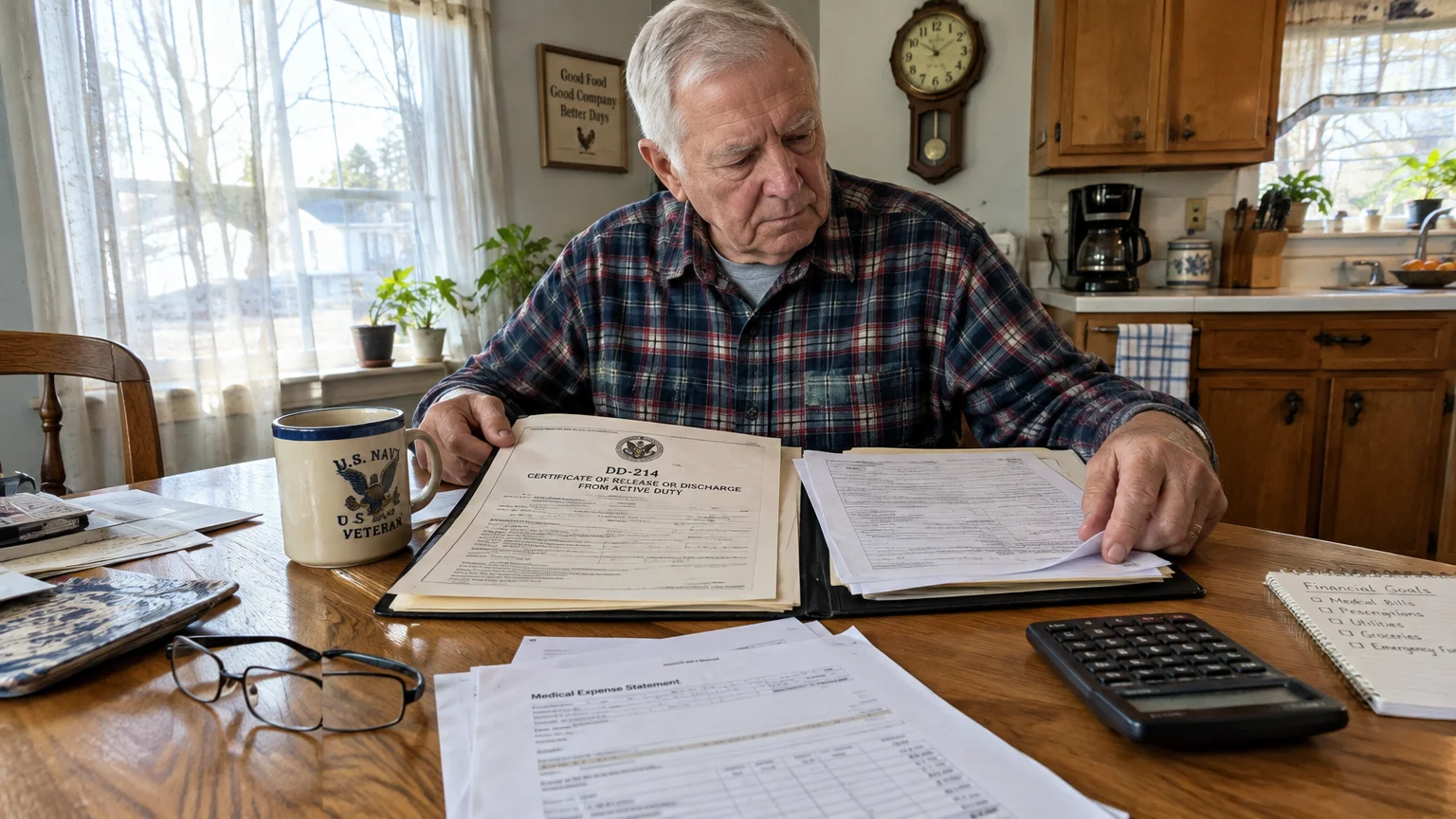
Because these rules operate under state law rather than federal jurisdiction, eligibility requirements vary widely. Visit your county tax assessor’s office with your DD-214 discharge paperwork to file before annual deadlines.
12. Basic Non-Service-Connected Veterans Pension
Low-income wartime veterans aged 65 and older can qualify for monthly pension payments even without a disability. This supplemental safety-net program provides dependable income to seniors facing rising everyday living costs.
The Maximum Annual Pension Rate (MAPR) for a single veteran without dependents stands at $17,441. For a veteran supporting one dependent spouse or child, the MAPR increases to $22,839.
Surviving spouses without dependents can receive an annual baseline rate of up to $11,699. The VA calculates your monthly check by subtracting your countable household income from your established MAPR limit.
Out-of-pocket medical expenses that exceed 5% of your MAPR reduce your countable income dollar-for-dollar. This deduction formula allows seniors with heavy medical bills to qualify for higher monthly pension deposits.
Applicants must meet the standard net worth ceiling of $163,699, which excludes your primary home on up to two acres. Consult senior guidance from AARP to coordinate pension claims alongside other retirement assets.
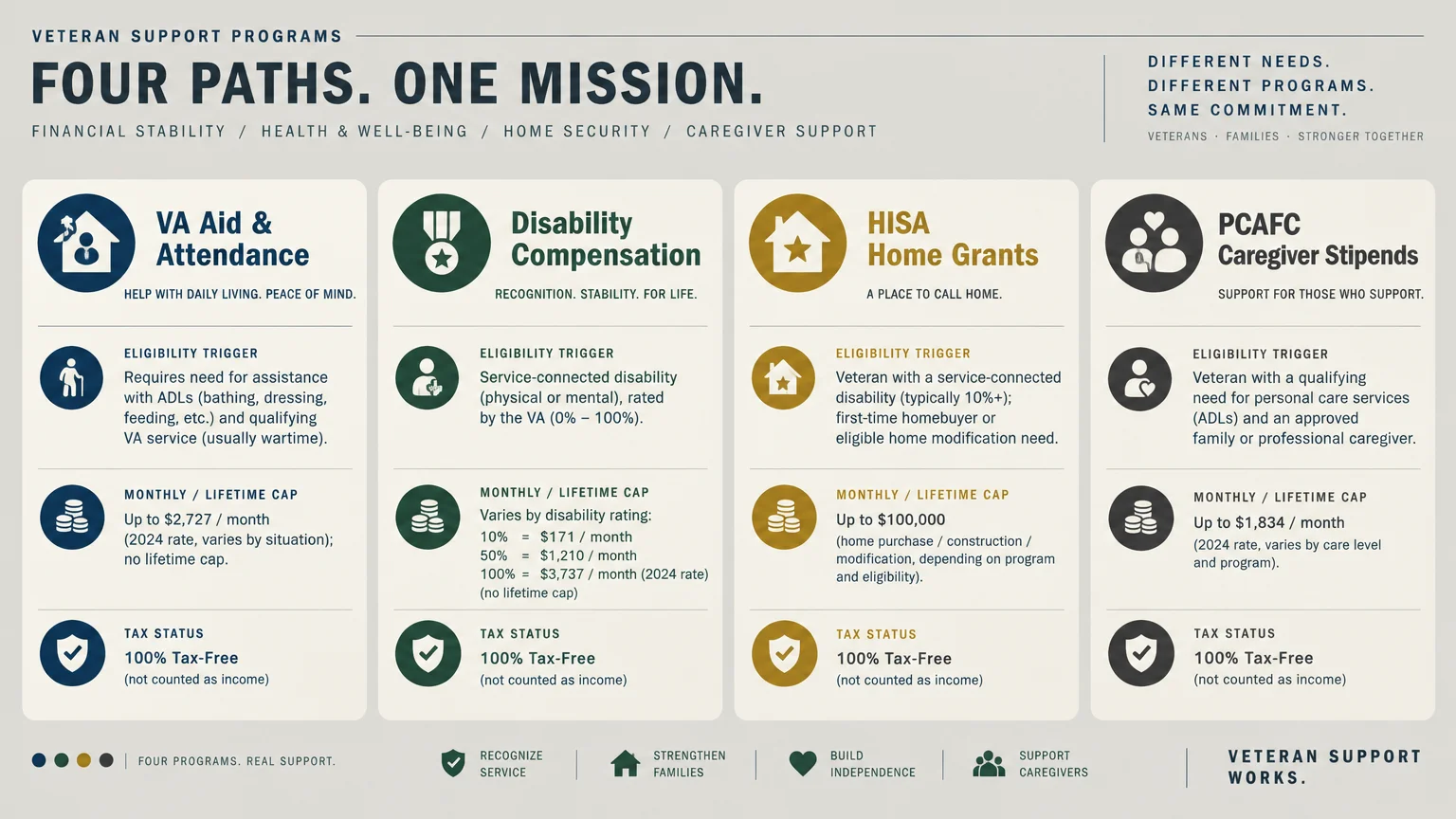
Comparing Essential Veteran Support Programs
Understanding which program best suits your current financial and physical needs helps you prioritize your claims. The following comparison highlights key financial benefits, qualifying criteria, and maximum payouts.
| Benefit Program | Primary Eligibility Factor | Maximum Current Benefit | Key Requirement |
|---|---|---|---|
| Aid and Attendance | Wartime service & daily care need | $2,424 to $3,845 / month | Net worth under $163,699 |
| Spousal Care Add-On | Veteran rated 30%+ disability | Up to $201.41 / month | Spouse needs personal care |
| HISA Housing Grant | Medical necessity for access | $2,000 to $6,800 lifetime | Prescription from VA physician |
| PCAFC Caregiver Stipend | Veteran rated 70%+ disability | $1,896.30 to $3,793 / month | 6+ months continuous care need |
| Home Loan Fee Waiver | Veteran rated 10%+ disability | Waives 1.4% to 3.6% fee | Active disability compensation |
| Non-Service Burial Allowance | Qualifying wartime/pension service | $1,032 burial + $1,032 plot | Must file within 2 years |

Common Mistakes to Avoid
Navigating government bureaucracies often leads to frustrating delays and missed payments. Avoiding these common missteps protects your financial security and expedites your claim approvals.
Assuming non-combat service disqualifies you. Many retirees assume that pension or healthcare benefits require frontline combat deployments. Most programs require only active wartime service dates or a direct service connection.
Violating the 36-month look-back window. Gifting savings or transferring real estate to children to qualify for wartime pensions triggers severe penalties. The VA assesses disqualification periods up to five years based on a $2,874 monthly divisor.
Missing the two-year burial deadline. Families frequently delay submitting receipts for non-service-connected burial and plot allowances. Claims submitted past the strict two-year deadline face mandatory administrative denial.
Paying unaccredited claim representatives. Federal law prohibits individuals from charging fees to prepare initial VA benefit applications. Always partner with accredited Veterans Service Officers from established chartered organizations.
Frequently Asked Questions
Can I receive VA disability compensation and Social Security retirement benefits simultaneously?
Yes, you can collect full VA disability compensation alongside standard Social Security retirement benefits. VA disability compensation is non-taxable and never reduces your earned monthly Social Security payments.
Does my primary residence count toward the VA pension net worth limit?
No, your primary residence does not count against the $163,699 net worth ceiling. The residential exclusion applies to your home and residential lot sizes up to two acres.
How do I obtain the digital National Parks military pass?
You can create a free profile on Recreation.gov to verify your military status. Under the EXPLORE Act, you can download the digital pass directly to your mobile wallet.
Are VA pension and Aid and Attendance checks considered taxable income?
No, the IRS does not tax VA pension payments or Aid and Attendance allowances. You do not report these benefit payments on your federal income tax return.
Taking Action on Your Earned Benefits
Filing for earned benefits restores financial control and shields your retirement assets against unforeseen caregiving costs. Start by gathering your DD-214 discharge paperwork, relevant civilian medical files, and personal financial records.
Connect with an accredited Veterans Service Officer (VSO) through organizations like the VFW, DAV, or American Legion. These trained professionals provide free assistance to file claims accurately and avoid administrative rejections.
The information in this guide is meant for educational purposes. Your specific circumstances—including income, benefits, tax situation, and health needs—may require different approaches. When in doubt, consult a licensed financial advisor or tax professional.
Last updated: October 2026. Benefit amounts, tax rules, and program details change annually—verify current figures with official government sources.









Leave a Reply