

Major Social Security updates take effect in January 2027, and several key deadlines arrive before 2026 ends. Knowing what is changing now helps you protect your monthly check and avoid costly surprises.
Your 2027 benefits bring a 3.6% cost-of-living boost, higher earnings limits for working retirees, and a milestone shift in Full Retirement Age. Pending Medicare deductions and a December open enrollment cutoff will also shape your net deposit.
Use this guide to review every verified number, mark the critical November and December dates on your calendar, and prepare your budget with confidence.
At a Glance: Five Key Changes Heading Into 2027
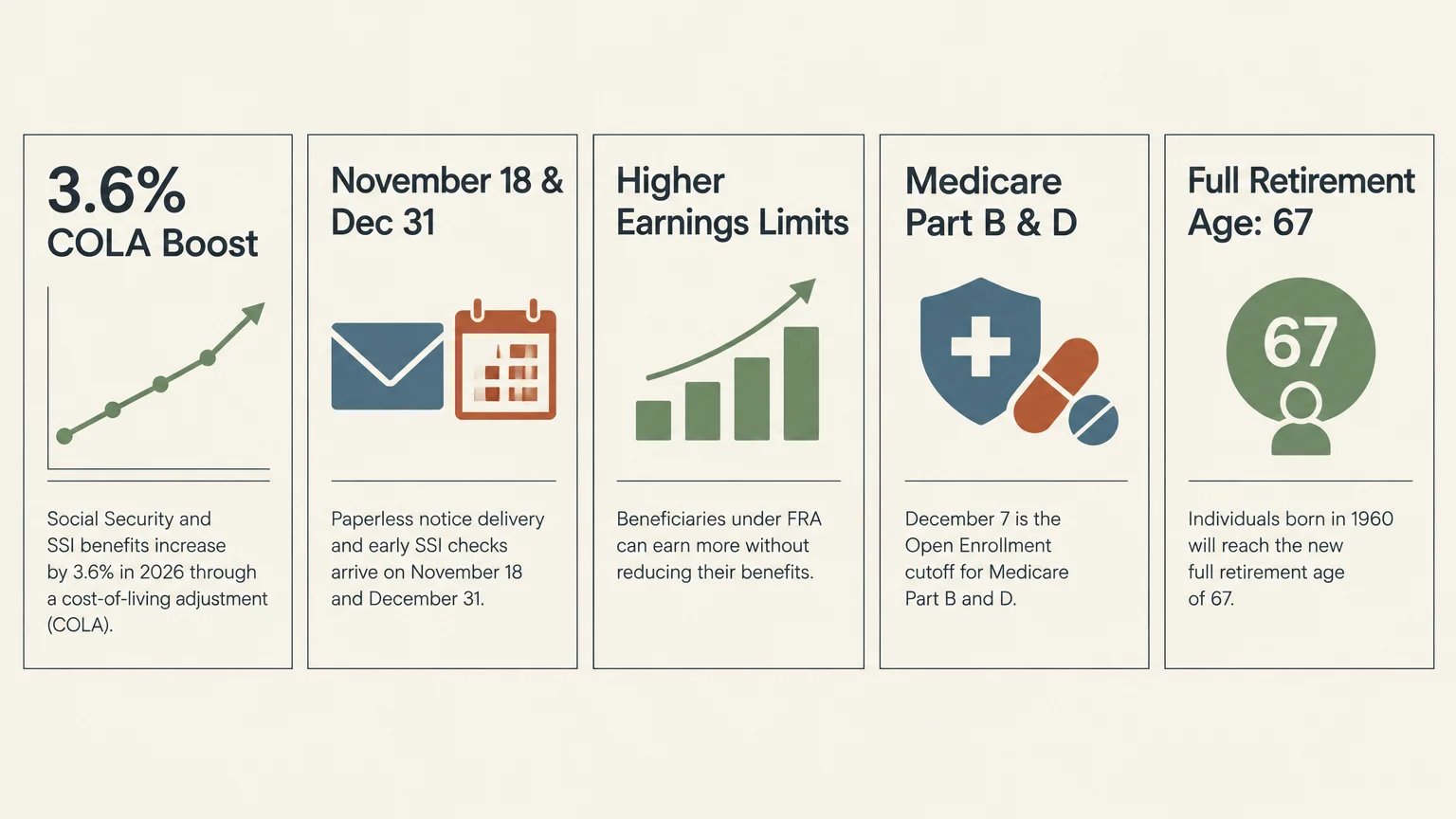
Before diving into the details, review these five shifts affecting retirees, workers, and disability beneficiaries before January:
- A 3.6% COLA boost: Monthly Social Security and Supplemental Security Income (SSI) checks rise by 3.6%—the largest increase since 2023.
- Pre-January notice and payment dates: You must opt into paperless delivery by November 18, 2026, to see your notice early, and some January checks arrive on December 31, 2026.
- Higher 2027 earnings limits: Working beneficiaries under Full Retirement Age can earn more in 2027 before benefits are temporarily withheld.
- Medicare Part B and Part D shifts: Standard 2027 Part B premiums remain pending while Open Enrollment closes December 7, 2026, alongside confirmed Part D caps.
- Full Retirement Age hits 67: People born in 1960 reach a new 67-year benchmark as Congress moves to clarify claiming-age labels.
1. Your 2027 COLA Increase and Higher Monthly Benefit Checks
On October 14, 2026, the Social Security Administration (SSA) announced a 3.6% cost-of-living adjustment for 2027. That 2027 COLA—up from 2.8% in 2026—reflects inflation measured from the third quarter of 2025 through the third quarter of 2026.
Roughly 76 million Americans will receive higher payments through this adjustment. Nearly 72 million Social Security beneficiaries see the increase in January 2027, while about 7.3 million SSI recipients get their boost on December 31, 2026.
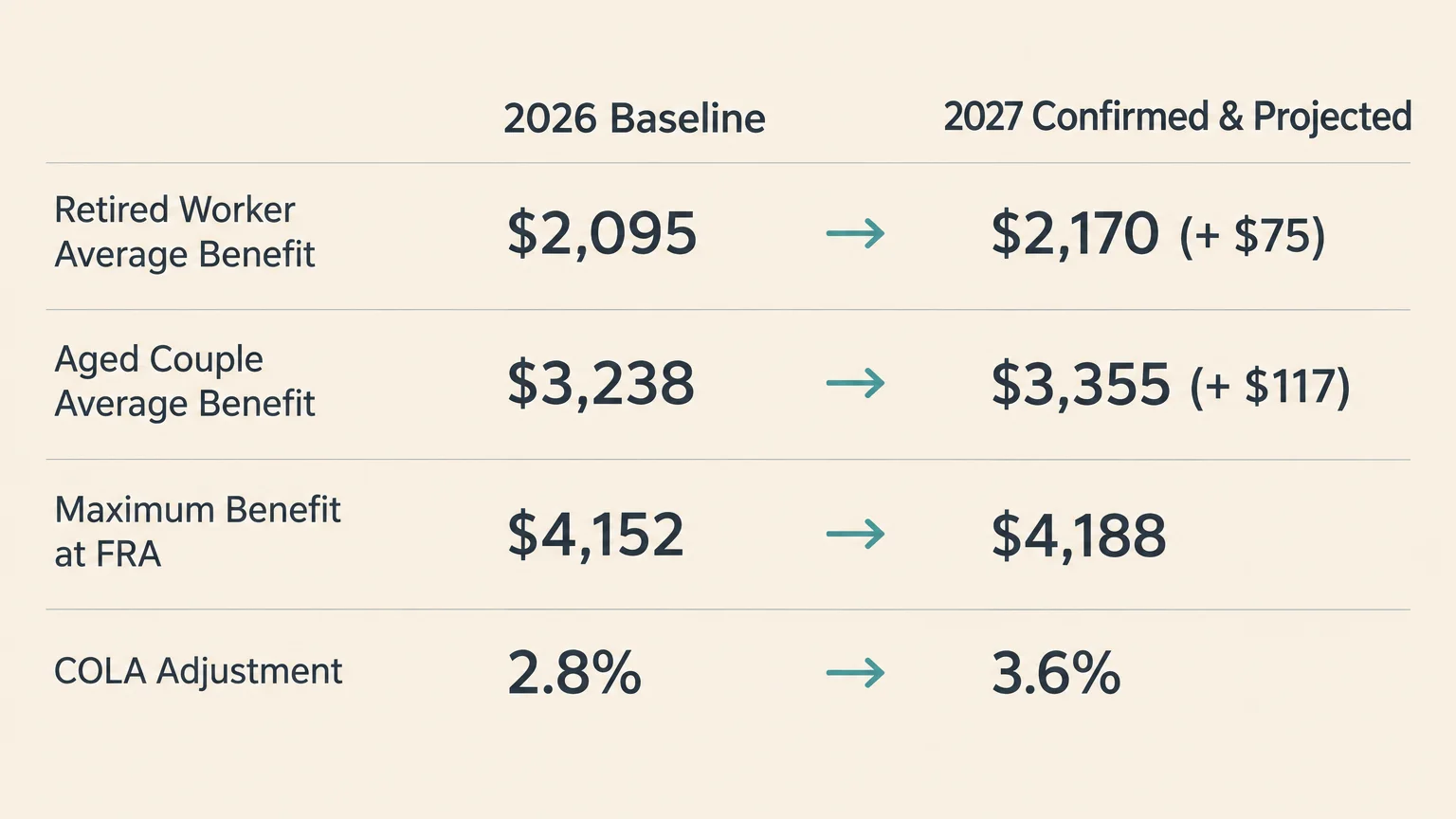
For the average retired worker, the 3.6% raise adds about $75 per month, lifting the typical check from $2,095 to $2,170. An aged couple both receiving benefits sees their combined average climb from $3,238 to $3,355, adding $117 each month.
Other beneficiary groups see meaningful increases under the SSA 2027 COLA Fact Sheet as well:
- Aged widow or widower living alone: Rises from $1,936 to $2,005 per month on average.
- Widowed mother with two children: Increases from $3,932 to $4,074 per month.
- All disabled workers: Grows from $1,642 to $1,701 per month.
- Disabled worker with a spouse and child: Moves from $2,970 to $3,077 per month.
- Maximum benefit at Full Retirement Age: Edges up from $4,152 in 2026 to $4,188 per month in 2027.
You can calculate a quick estimate of your own gross increase right now. Multiply your current 2026 gross monthly benefit—before Medicare deductions—by 1.036 to preview your new pre-deduction amount.
For example, if your 2026 gross benefit is $1,800 per month, a 3.6% increase adds $64.80, bringing your gross check to $1,864.80. Keep in mind that your actual deposit depends on any Medicare premiums or tax withholding taken from your check.
If you receive SSI, federal payment standards also rise with the 3.6% adjustment. Maximum monthly federal SSI payments increase from $994 to $1,029 for an eligible individual and from $1,491 to $1,544 for an eligible couple.
One critical rule has not changed for SSI recipients going into January. Federal SSI resource limits remain frozen at $2,000 for an individual and $3,000 for a couple, so watch your bank balances around year-end.

2. Pre-January COLA Notice Deadlines and Early Payment Dates
Many retirees wait until January to check their new deposit amount, only to be caught off guard by deductions. Taking action in November and December puts your official numbers in your hands weeks ahead of schedule.
The SSA sets November 18, 2026, as the cutoff to sign up for an online my Social Security account and choose paperless notices. Meeting that deadline lets you view your 2027 COLA notice online in late November—up to three weeks before paper letters arrive.
If you prefer paper mail or miss the November 18 cutoff, the SSA mails simplified, one-page COLA notices throughout December 2026. These letters clearly list your exact 2027 benefit amount, payment dates, and Medicare deductions.
Wait until January before contacting the SSA if your mailed letter has not arrived by late December. Phone lines spike in December, and most missing notices simply experience routine holiday mail delays.
Follow these steps before the end of November to stay ahead of your 2027 paperwork:
- Visit the official SSA portal to open or verify your personal online account before November 18, 2026.
- Update your communication preferences to paperless delivery so your 2027 COLA notice appears in your message center in late November.
- Double-check your current bank routing number and mailing address inside your profile to prevent payment delays.
- Download or print your notice once it posts so you can verify your January budget and tax withholding.
Also pay close attention to the calendar at the very end of 2026. Because January 1, 2027, is a federal holiday, the SSA shifts certain January payments into December.
Recipients of SSI only, dual SSI and Social Security beneficiaries, and people who started Social Security before May 1997 receive their January 2027 payment on Thursday, December 31, 2026. Standard Social Security retirement and disability payments continue on the second, third, or fourth Wednesday based on your birth date.
Seeing two deposits in December does not mean you received a bonus check. That December 31 deposit is your January 2027 payment arriving one day early, so budget it to cover your January bills.
3. Higher 2027 Social Security Earnings Limits and Work Rules
Working during retirement remains popular, whether for extra income or personal fulfillment. If you collect benefits before reaching Full Retirement Age, the Social Security earnings limit 2027 rules determine how much you can earn without temporary withholding.
In 2027, the SSA raises both annual exempt thresholds to keep pace with wage growth. Knowing which tier applies to your birth year prevents an unexpected pause in your monthly checks.
- Under Full Retirement Age all of 2027: Your annual exempt limit rises from $24,480 ($2,040 per month) in 2026 to $25,560 ($2,130 per month) in 2027. The SSA withholds $1 in benefits for every $2 you earn above $25,560.
- Reaching Full Retirement Age during 2027: Your exempt limit jumps from $65,160 ($5,430 per month) in 2026 to $67,920 ($5,660 per month) in 2027. Only earnings from months before your birthday month count, and the SSA withholds $1 for every $3 over the limit.
- At or above Full Retirement Age: Starting the exact month you reach Full Retirement Age, the earnings test disappears completely. You can earn any salary without reducing your Social Security check.
Consider how the math works if you stay under Full Retirement Age throughout 2027 and earn $31,560 from a part-time job. That exceeds the $25,560 limit by $6,000, so the SSA withholds $3,000 in benefits for the year.
Withheld benefits are not lost forever, though the temporary cash-flow hit can sting. Once you reach Full Retirement Age, the SSA recalculates your monthly check upward to credit you for the months benefits were withheld.
If you plan to keep working in 2027—even without claiming benefits yet—several other SSA wage thresholds also increase in January:
- Work credits: The earnings needed for one quarter of coverage rise from $1,890 in 2026 to $1,970 in 2027. Earning $7,880 in 2027 secures all four annual credits.
- Payroll tax cap: Maximum taxable earnings subject to the 6.2% Social Security tax climb from $184,500 to $192,300. Employees pay up to $11,922.60 in Social Security tax, while self-employed workers pay up to $23,845.20.
- Medicare payroll taxes: The 1.45% Medicare tax still applies to all earned income with no cap, plus a 0.9% surtax above $200,000 ($250,000 for married joint filers).
- Disability (SSDI) work thresholds: Substantial Gainful Activity limits rise from $1,690 to $1,770 per month (non-blind) and from $2,830 to $2,950 per month (blind). The Trial Work Period threshold rises from $1,210 to $1,270 per month.
If you know your 2027 wages will top the earnings limit, report your estimate to the SSA before January. Reporting early lets the agency withhold whole checks right away instead of sending an overpayment notice next year.
4. Medicare 2027 Deductions, Pending Part B Rates, and Open Enrollment
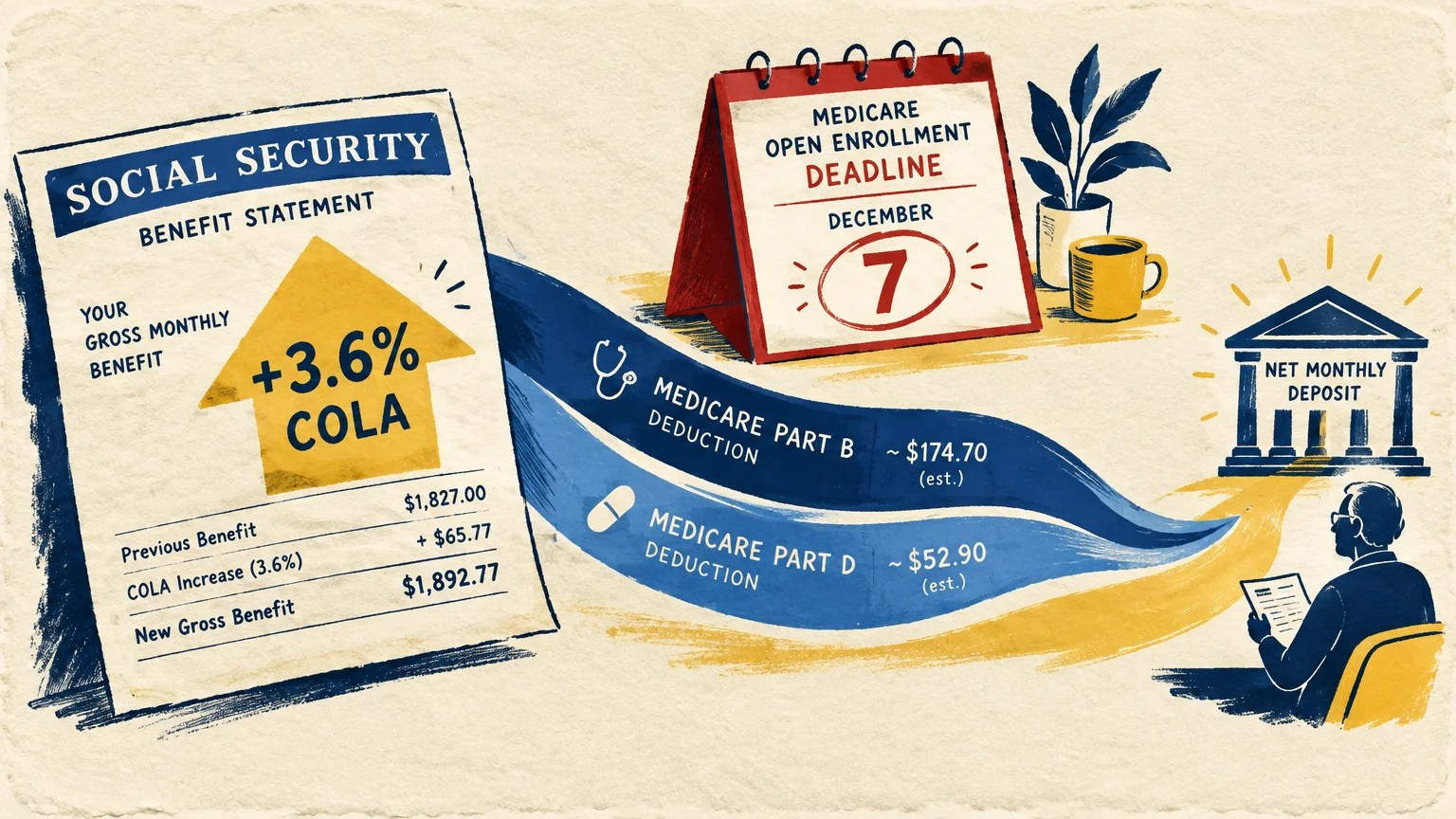
Your gross COLA only tells half the story, because Medicare premiums come straight out of most Social Security checks. That makes tracking Medicare Part B 2027 updates essential before December ends.
As of mid-November 2026, the Centers for Medicare & Medicaid Services (CMS) has not yet published official 2027 Part B premiums, deductibles, or income-related IRMAA brackets. Those final 2027 surcharges will use your 2025 modified adjusted gross income.
While awaiting the official CMS release, you can compare current 2026 figures against official projections from the 2026 Medicare Trustees Report. In 2026, the standard Part B premium is $202.90 per month and the annual deductible is $283.
The June 2026 Trustees Report projects the standard Part B premium will rise by $6.60, or 3.25%, to $209.50 per month in 2027. Under those same projections, the Part B annual deductible reaches $292, and the Part A inpatient hospital deductible moves from $1,736 to $1,788.
Even when Part B costs rise, the statutory hold harmless rule protects most Social Security recipients from seeing a smaller net deposit than the prior year. With a 3.6% COLA adding roughly $75 to an average check, a projected $6.60 Part B increase still leaves most retirees well ahead.
However, the hold harmless rule does not shield everyone from higher deductions. Higher-income retirees paying IRMAA surcharges, first-time Part B enrollees, and dual-eligible beneficiaries whose premiums are paid by Medicaid fall outside that protection.
Meanwhile, Medicare has already confirmed several major Part D prescription drug updates taking effect January 1, 2027:
- Part D out-of-pocket cap: Your annual cap on covered prescription drug spending increases from $2,100 in 2026 to $2,400 in 2027.
- Maximum standard deductible: Prescription drug plans can charge an annual deductible up to $700 in 2027, up from $615 in 2026.
- Base beneficiary premium: The national base premium rises from $38.99 to $41.33 per month, though CMS projects average stand-alone Part D premiums will rise under $1—from $35.09 to roughly $36.
- Medicare Advantage and negotiated drugs: CMS expects weighted average Medicare Advantage premiums to drop over 16%, while negotiated prices for 15 additional Part D drugs begin January 1, 2027.
Medicare Open Enrollment runs from October 15 through December 7, 2026, for coverage starting January 1, 2027. Compare your drug list and local plans on Medicare.gov before December 7 so higher deductibles or formulary shifts do not drain your COLA raise.
5. Full Retirement Age Hits 67 and Congress Targets Claiming-Age Clarity
Among all Social Security changes 2027 brings, one milestone has been decades in the making. People born in 1960 turn 67 starting in 2027, becoming the first group whose Full Retirement Age is permanently 67.
That completes the gradual phase-in from the 1983 Social Security reforms. Keep one quirky calendar rule in mind if your birthday falls on New Year’s Day: SSA regulations treat people born on January 1, 1960, as born in 1959, giving them a Full Retirement Age of 66 and 10 months.
With Full Retirement Age set at 67, claiming early carries a steeper lifetime trade-off. Starting benefits at age 62 locks in a permanent 30% reduction compared to waiting until age 67.
On the other hand, waiting past your Full Retirement Age earns delayed retirement credits worth 8% per year—about 0.66% per month—until age 70. For someone with a standard benefit of $2,000 at 67, claiming at 62 yields $1,400, while delaying to 70 lifts the check to $2,480 before COLAs.
To help future retirees understand those trade-offs, Congress passed the Claiming Age Clarity Act (H.R. 5284) in October 2026 and sent it to the President. Without changing benefit amounts or eligibility, the bill directs the SSA to replace confusing claiming labels by the later of January 1, 2027, or 12 months after enactment.
- Age 62: Changes from early eligibility age to minimum monthly benefit age.
- Full Retirement Age: Changes from full or normal retirement age to standard monthly benefit age.
- Age 70: Changes from delayed retirement credit age to maximum monthly benefit age.
Before choosing your claiming date, consider your health, marital status, and long-term income needs.
You may also hear headlines about Social Security’s long-term finances as 2027 approaches. The 2026 Social Security Trustees Report projects that retirement trust fund reserves could be depleted in late 2032, after which ongoing payroll taxes would still cover a substantial share of scheduled benefits.
That long-term outlook should encourage thoughtful planning rather than panic claiming. Claiming early solely out of fear locks in a 30% cut right away, whereas coordinating benefits with your broader savings gives you stronger lifetime security.
2026 vs. 2027 Social Security and Medicare Quick Reference
Use this side-by-side table to compare confirmed 2026 rules against verified 2027 figures and official projections.
| Benefit or Threshold | 2026 Amount | 2027 Amount or Status |
|---|---|---|
| Cost-of-Living Adjustment (COLA) | 2.8% | 3.6% (confirmed) |
| Average Retired Worker Benefit | $2,095/month | $2,170/month (estimated average) |
| Max Benefit at Full Retirement Age | $4,152/month | $4,188/month |
| SSI Max Federal Payment (Individual / Couple) | $994 / $1,491 | $1,029 / $1,544 |
| Earnings Limit (Under FRA All Year) | $24,480/year ($2,040/mo) | $25,560/year ($2,130/mo) |
| Earnings Limit (Reaching FRA During Year) | $65,160/year ($5,430/mo) | $67,920/year ($5,660/mo) |
| Maximum Taxable Wage Cap | $184,500 | $192,300 |
| Quarter of Coverage (Work Credit) | $1,890 | $1,970 |
| Medicare Part B Standard Premium | $202.90/month | Pending CMS ($209.50 projected) |
| Medicare Part B Deductible | $283/year | Pending CMS ($292 projected) |
| Medicare Part D Out-of-Pocket Cap | $2,100/year | $2,400/year (confirmed) |
What Can Go Wrong Before January
Even straightforward annual Social Security updates can trip up careful planners when deadlines overlap during the busy holiday season. Watch out for these four common mistakes before January arrives:
- Missing the December 7 Medicare cutoff: Assuming your Part D plan works the same in 2027 can cost hundreds when the out-of-pocket cap jumps to $2,400 and deductibles rise to $700. Review your 2027 Annual Notice of Change and compare plans before December 7, 2026.
- Falling for COLA scams or calling too early: Scammers often text or call claiming you must confirm personal details to unlock your 3.6% COLA. Your raise is automatic, and the Consumer Financial Protection Bureau warns older adults never to share banking or Social Security numbers with unsolicited callers.
- Letting December 31 deposits break your budget: Dual SSI and Social Security recipients—plus pre-May 1997 filers—receive January’s payment on December 31, 2026. Spending that check in December leaves a gap for January rent and groceries, and excess balances can push SSI recipients over the $2,000 resource cap.
- Ignoring how 2025 income affects 2027 Part B: Selling property or taking a large retirement account distribution in 2025 can trigger 2027 Medicare IRMAA surcharges. Because IRMAA payers do not get hold harmless protection, watch for your official CMS notice before spending your full COLA boost.

When to Consult a Professional
Most retirees can handle annual COLA reviews and Medicare comparisons using official government calculators on SSA.gov and local counseling from groups like the National Council on Aging. Still, certain transitions warrant personalized guidance from a Certified Financial Planner or CPA:
- Working while claiming before Full Retirement Age: If your 2027 earnings may cross $25,560—or $67,920 in your FRA year—a planner can help you time bonuses or pause benefits to avoid unexpected withholding.
- Navigating higher income and IRMAA brackets: If your 2025 income spiked due to a home sale, Roth conversion, or required distribution, a CPA can check whether you qualify for an IRMAA life-changing event appeal.
- Deciding between claiming at 62, 67, or 70: Coordinating spousal benefits, survivor protection, and portfolio withdrawals around the 1960 Full Retirement Age milestone often pays for professional advice many times over.
- Protecting SSI or Medicaid eligibility: When a small COLA or early December 31 deposit risks pushing you past strict $2,000 or $3,000 asset rules, a benefits counselor or elder law attorney can help you remain compliant.
Frequently Asked Questions
When will I find out my exact 2027 Social Security payment?
If you set up a paperless my Social Security account by November 18, 2026, you can view your 2027 COLA notice online in late November. Otherwise, expect a simplified one-page letter in the mail during December 2026, and wait until January before calling if it is late.
Will the 2027 Medicare Part B increase wipe out my 3.6% COLA?
For most retirees, no—the 3.6% COLA adds an average of $75 per month to retired worker checks, while Trustees project the standard Part B premium will rise by roughly $6.60 to $209.50. Wait for CMS to release official 2027 Part B and IRMAA rates to see your exact net figure.
What happens if I earn over the 2027 Social Security earnings limit?
If you are under Full Retirement Age all of 2027, the SSA withholds $1 for every $2 earned above $25,560. Once you reach Full Retirement Age, the limit ends permanently and the SSA increases your monthly benefit to credit back previously withheld months.
When do January 2027 Social Security and SSI checks arrive?
SSI recipients, dual SSI and Social Security beneficiaries, and people who started Social Security before May 1997 receive their January 2027 payment on Thursday, December 31, 2026. Everyone else receives January payments on their normal second, third, or fourth Wednesday schedule.
Does the Claiming Age Clarity Act change my benefit amount or retirement age?
No—H.R. 5284 only updates terminology in SSA educational materials without altering benefit formulas or eligibility rules. Your Full Retirement Age remains 67 if you were born in 1960 or later, aside from the January 1 birthday rule.
Take Three Simple Steps Before December Ends
Start this week by logging into your online Social Security account before November 18, 2026, so your 2027 COLA notice arrives online first. Next, review your Medicare Part D or Medicare Advantage plan before Open Enrollment closes on December 7, 2026.
Finally, adjust your 2027 household budget once your December notice shows both your 3.6% raise and final Medicare deductions. Taking these small steps now gives you clear numbers and steadier peace of mind heading into January.
This article provides general financial education and information only. Everyone’s financial situation is unique—what works for others may not work for you.
For personalized advice tailored to your retirement needs, consider consulting a qualified financial professional such as a CFP or CPA.
Last updated: November 2026. Benefit amounts, tax rules, and program details change annually—verify current figures with official government sources.





Leave a Reply