

Retirement confidence just hit a multi-year low. According to the 2026 Retirement Confidence Survey from the Employee Benefit Research Institute and Greenwald Research, worker confidence dropped to 61%, its lowest mark since 2017.
Retiree confidence fell five percentage points to 73%, the lowest level since 2015. Everyday living costs, rising medical bills, and lingering debt are forcing Americans 55 and older to rewrite their plans.
Fresh 2026 data points to seven major retirement trends reshaping how people save, work, and claim benefits—along with practical steps you can take right now.
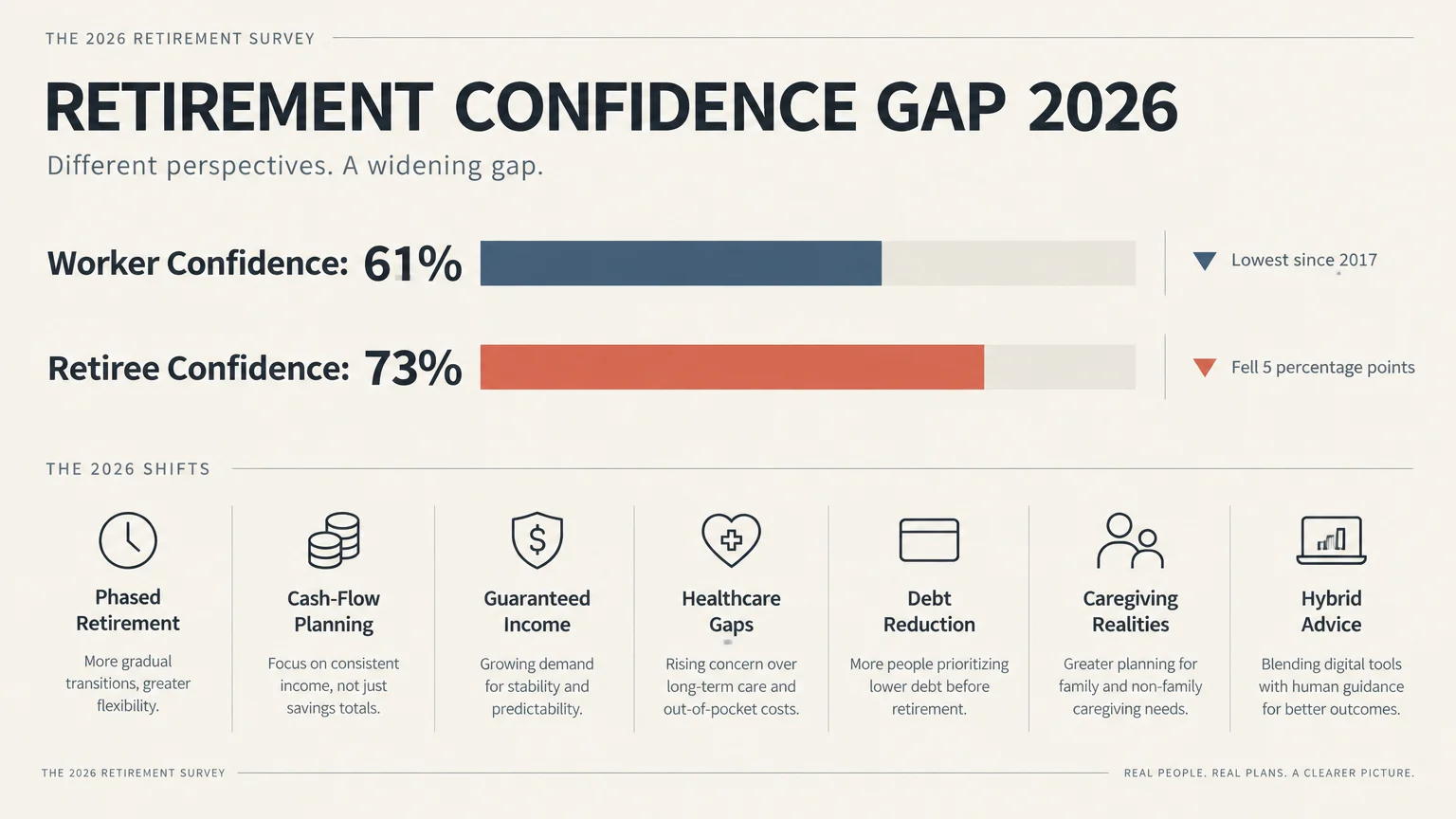
At a Glance: Why Americans Are Rethinking Retirement in 2026
Across major retirement survey 2026 reports, a clear pattern stands out. Older workers and current retirees are moving away from rigid exit dates and one-size-fits-all savings rules.
Instead, households are building flexible income plans that blend part-time pay, updated IRS catch-up limits, and smarter Medicare choices. Here are the seven biggest ways people are rethinking retirement:
- Phasing out of work slowly: More people plan to work past 65, even as health and layoffs force earlier exits.
- Moving past a single magic number: Savers are shifting from arbitrary million-dollar targets to realistic monthly cash-flow plans.
- Prioritizing guaranteed lifetime income: Outliving savings ranks ahead of almost every other retirement fear.
- Budgeting directly for healthcare gaps: Rising Medicare deductibles and drug caps demand dedicated after-tax savings.
- Clearing debt before leaving a paycheck: Borrowing now pressures both workers and retirees at higher rates than a year ago.
- Accounting for family caregiving: Unpaid caregiving often delays retirement and reduces emergency reserves.
- Combining human advice with digital tools: Savers want automated tracking alongside personalized tax and claiming guidance.
1. Embracing Phased Retirement and Working Longer—With a Backup Plan
Working in retirement has become one of the defining retirement trends of 2026. In the EBRI/Greenwald survey, 74% of workers say they plan to work for pay in retirement.
Yet reality looks very different from those plans. Only 31% of current retirees actually work for pay, and those who do cite staying active (91%) and enjoying work (85%) as their main reasons.
A wide timing gap separates expectations from real life as well. Workers expect to retire at a median age of 65, while retirees actually stepped away at a median age of 62.
Nearly four in ten workers—39%—expect to work until age 70 or older, or never retire at all. In practice, only 10% of retirees worked that long, while 29% stopped before age 60.
Nearly half of retirees (46%) left the workforce earlier than planned, according to EBRI/Greenwald. Health problems or disabilities drove 41% of early exits, and unexpected company changes accounted for another 35%.
Other 2026 surveys echo both the desire to keep working and the hurdles involved. The 26th Annual Transamerica Retirement Survey reports that 51% of workers plan to work in retirement, split between 36% part-time and 15% full-time.
Encouragingly, 83% of employers in the Transamerica study say they support working past age 65. Still, age bias and job-search delays remain real risks if you lose a position in your 60s.
An AARP survey reported in February 2026 found that 7% of retirees reentered the labor force over the prior six months, with 48% returning because they needed money. Separate AARP data shows adults 65 and older average 39 weeks of unemployment, and 91% view age discrimination as common.
How to Put This Trend to Work
Treat working past 65 as a welcome bonus rather than the foundation of your financial plan. Test whether your budget still holds up if you have to stop working at 62.
If you plan to work while collecting Social Security before your Full Retirement Age (age 67 for anyone born January 2, 1960, or later), check the Retirement Earnings Test rules at the Social Security Administration.
- Under Full Retirement Age all year: Social Security withholds $1 in benefits for every $2 you earn above $24,480 in 2026 ($25,560 in 2027).
- During the year you reach Full Retirement Age: Social Security withholds $1 for every $3 earned above $65,160 in 2026 ($67,920 in 2027), counting only months before your birthday month.
- Starting the month you reach Full Retirement Age: There is no earnings limit, and Social Security recalculates your monthly check upward to credit any previously withheld amounts.
For example, suppose you are 64 in 2026 and earn $34,480 from part-time consulting. That puts you $10,000 above the $24,480 threshold, meaning $5,000 in benefits would be temporarily withheld during the year.
2. Recalculating the Savings Target Beyond a Single Magic Number
The Northwestern Mutual 2026 Planning & Progress Study reveals a sharp jump in what Americans think retirement costs. Respondents say they need an average magic number of $1.46 million to retire comfortably—up $200,000 from $1.26 million in 2025.
High-net-worth households estimate needing $2.67 million, while everyone else puts the target at $1.35 million. Even so, 44% of Americans admit they do not know how much they have saved, and 23% hold one year or less of annual income.
The Transamerica survey highlights a similar divide between goals and balances. Workers estimate a median need of $650,000, yet median household retirement savings across all workers stand at just $78,000.
High prices are squeezing daily budgets, too. Transamerica found that 78% of workers say the high cost of living makes it harder to save, and 65% worry they could work until retirement and still fall short.
Focus less on matching a national headline figure and more on closing the gap between your monthly bills and your dependable income sources.
Actionable Ways to Catch Up in 2026 and 2027
If you are 55 or older, updated IRS contribution limits give you a powerful window to boost savings quickly. Under IRS Notice 2026-66, released in November 2026, workplace limits rise meaningfully for 2027.
- 401(k), 403(b), governmental 457(b), and TSP base limit: $24,500 in 2026, increasing to $25,500 in 2027.
- Standard age 50 and older catch-up: $8,000 in 2026 ($32,500 total), increasing to $8,500 in 2027 ($34,000 total).
- Ages 60 to 63 super catch-up under SECURE 2.0: $11,250 in 2026 ($35,750 total), increasing to $11,750 in 2027 ($37,250 total).
- Traditional and Roth IRA limits: $7,500 in both 2026 and 2027, plus a $1,100 catch-up at age 50 and older ($8,600 total).
Watch one critical SECURE 2.0 tax rule if you are still earning strong wages. Starting in 2026, workers age 50 and older whose prior-year FICA wages with their employer topped $150,000 must put 401(k) catch-up dollars into an after-tax Roth account.
That prior-year FICA wage threshold rises to $155,000 for 2027 catch-up contributions, per the Internal Revenue Service. Planning for Roth catch-ups ahead of time prevents an unexpected bump in your current-year tax bill.

3. Turning Nest Eggs Into Guaranteed Lifetime Income
Fear of running out of money is reshaping retirement planning changes across every age group. In Allianz Life’s 2026 Retirement Study, 67% of respondents say they fear outliving their money more than dying.
Northwestern Mutual found that 48% of Americans worry they will outlive their savings, and 41% in Transamerica’s survey rank it among their top fears. Meanwhile, BlackRock’s 2026 Read on Retirement report uncovered a dangerous blind spot.
While 68% of workplace savers believe they are on track, projected workplace balances will replace only 50% to 60% of the income they expect to need. No wonder 92% of surveyed retirees told BlackRock that guaranteed income made a bigger difference than expected.
Nine in ten savers in the BlackRock study also expressed interest in guaranteed lifetime income options. For most seniors, Social Security remains the cornerstone of that steady paycheck.
However, Transamerica reports that 73% of workers worry Social Security will not be there for them, even though nearly one in three expect it to be their primary retirement income. Understanding the 2026 Social Security Trustees Report helps replace fear with facts.
The Trustees project that retirement trust fund reserves could be depleted in late 2032. Even if Congress takes no action before then, ongoing payroll taxes would still fund a substantial share of scheduled benefits.
For current and upcoming retirees, the 2027 cost-of-living adjustment (COLA) provides a meaningful boost. Social Security and SSI benefits for 76 million Americans will rise 3.6% in 2027, taking effect in January 2027 for Social Security and December 31, 2026, for SSI.
Why Claiming Age Changes Your Lifelong Floor
Under Social Security rules, your Full Retirement Age is 67 if you were born on or after January 2, 1960. Claiming as soon as you turn 62 permanently reduces your monthly check by up to 30%.
Waiting past 67 increases your benefit every month up to age 70, locking in larger inflation adjustments for life. Consider a simple example based on a $2,000 full monthly benefit at age 67.
Claiming at 62 drops that starting payment by 30% to $1,400 per month. On a $2,000 check, a 3.6% COLA adds $72 each month, while the same 3.6% increase adds $50.40 on a $1,400 check.
Higher earners who wait until Full Retirement Age can collect a maximum monthly benefit of $4,152 in 2026 and $4,188 in 2027. Note that wages subject to the 6.2% Social Security payroll tax also climb from $184,500 in 2026 to $192,300 in 2027.
4. Confronting Healthcare Costs and Medicare Surprises Head-On
Medical bills rank among the biggest threats to retirement budgets in 2026. In the EBRI/Greenwald survey, 58% of workers and 40% of retirees cite high healthcare costs as a barrier to living comfortably.
Fidelity Investments’ 25th Annual Retiree Health Care Cost Estimate, released in July 2026, puts a clear price tag on that pressure. A 65-year-old retiring in 2026 will need an average of $185,500 in after-tax savings for healthcare throughout retirement.
For a couple, that average reaches roughly $371,000—up 7.5% from $172,500 per person in 2025. Yet Fidelity found that 54% of pre-retirees mistakenly believe Medicare covers all of their healthcare expenses.
Fidelity’s figure includes Original Medicare premiums (45%), cost-sharing (48%), and out-of-pocket prescription drugs (7%). Crucially, it excludes long-term care, most dental services, and over-the-counter medications.
Key 2026 and 2027 Medicare Figures to Budget Around
Planning accurately means knowing the confirmed costs on Medicare.gov and watching upcoming 2027 changes. Here is where the numbers stand as of mid-November 2026:
- Medicare Part B (2026 confirmed): The standard monthly premium is $202.90 (up from $185.00 in 2025), and the annual deductible is $283.
- Medicare Part B (2027 projected): Official rates have not yet been released, though the 2026 Medicare Trustees Report projects a $209.50 monthly premium and $292 deductible.
- Medicare Part A (2026 confirmed): The inpatient hospital deductible is $1,736 per benefit period.
- IRMAA income surcharges (2026): Higher premiums begin when your 2024 modified adjusted gross income (MAGI) exceeds $109,000 for single filers or $218,000 for joint filers.
- Medicare Part D drug caps: The maximum Part D deductible rises from $615 in 2026 to $700 in 2027, while the annual out-of-pocket drug cap increases from $2,100 to $2,400.
Two major Medicare shifts take effect on January 1, 2027, that deserve your immediate attention. First, Medicare-negotiated prices begin for 15 additional prescription drugs, including Ozempic, Wegovy, and Trelegy Ellipta.
Second, an estimated 3 million Medicare Advantage enrollees will have to choose a new plan as insurers exit local markets. Average plan choices with drug coverage are falling from 32 to 28, making a careful plan check vital.
If you are still working and have not yet enrolled in Medicare, consider maximizing a Health Savings Account (HSA) alongside a qualifying high-deductible health plan. Contribution limits are $4,400 for self-only coverage and $8,750 for families in 2026, rising to $4,500 and $9,000 in 2027, plus a $1,000 catch-up at age 55 and older.

5. Tackling Debt Before Stepping Away From Work
Carrying balances into retirement is no longer rare—and it is hurting financial security faster than many people realize. According to EBRI/Greenwald, 58% of workers say debt hurts their ability to save, up sharply from 49% in 2025.
Even more striking, 29% of retirees report that debt hurts their ability to live comfortably, a 10-percentage-point jump in a single year. High borrowing costs eat directly into fixed Social Security and pension checks.
If retirement sits two to five years away, prioritize paying off high-interest credit cards and auto loans before your final paycheck arrives. Avoid tapping a traditional 401(k) or IRA early just to wipe out debt, though.
Large pre-tax withdrawals count as taxable income and can accidentally push your MAGI over the $109,000 or $218,000 IRMAA cliffs two years later. For unbiased steps on organizing payoff priorities, review the budgeting and debt-reduction guides at the Consumer Financial Protection Bureau.
6. Factoring Caregiving Into Your Retirement Timeline
Unpaid family caregiving quietly disrupts thousands of retirement timelines every year. The 2026 EBRI/Greenwald survey shows 44% of unpaid caregiving workers expect to retire at age 70 or older or never retire, compared with 37% of non-caregivers.
More than half of caregiving workers report immediate financial strain right now. Specifically, 56% say caregiving hurt their ability to build emergency savings, and 54% say it forced them to cut back their work hours.
Reduced hours do more than shrink your current paycheck. They can also lower employer retirement matches and reduce the 35 highest-earning years used to calculate your Social Security benefit.
If you are caring for a spouse, parent, or grandchild, start by separating caregiving expenses from your core retirement accounts. Look into respite services, caregiver tax credits, and local support programs through the National Council on Aging before cutting your hours or leaving a job.
7. Pairing Human Advice With New Financial Technology
One of the most hopeful shifts in 2026 research involves how people make financial decisions. In Northwestern Mutual’s 2026 study, 74% of Americans who work with a financial advisor feel confident about retirement readiness, compared with just 43% without one.
At the same time, attitudes toward artificial intelligence are nuanced. Northwestern Mutual found that 33% of Americans feel pessimistic about AI’s impact on their careers, yet EBRI/Greenwald reports that 50% expect technology and AI to help manage their finances as they age.
You do not have to choose between an advisor and modern tools. Digital apps work well for tracking monthly spending, flagging unusual account charges, and reminding you of Required Minimum Distributions (RMDs), which start at age 73 under SECURE 2.0 before rising to age 75 in 2033.
Reserve complex choices—such as coordinating Roth conversions, timing Social Security, and avoiding IRMAA surcharges—for a qualified human fiduciary. That combination gives you daily clarity alongside customized long-term strategy.
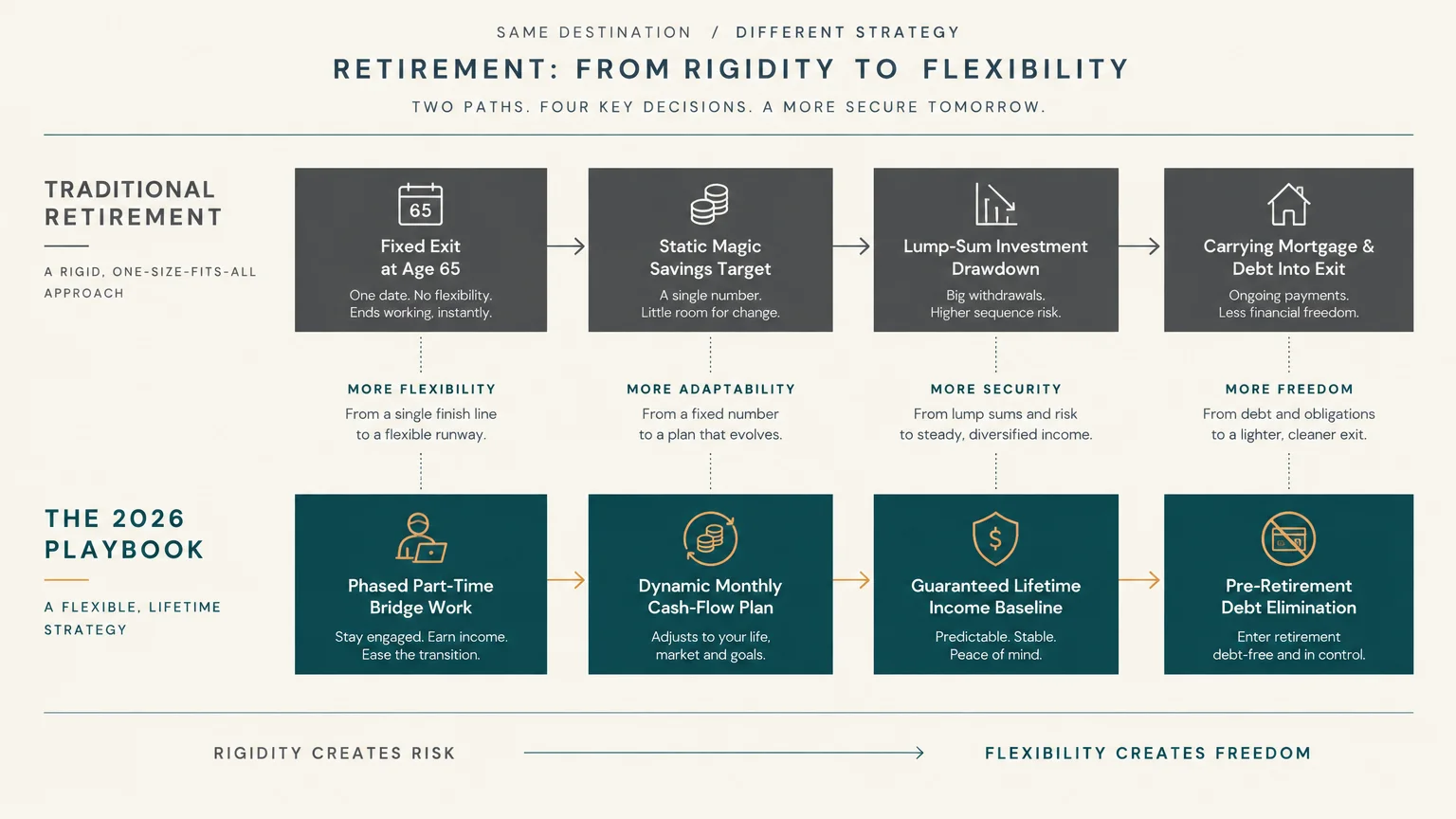
Comparison: Traditional Retirement vs. The 2026 Retirement Playbook
Seeing old assumptions side by side with 2026 reality makes it easier to spot where your own plan needs an update. Use this comparison table to audit your strategy before making big moves.
| Planning Area | Old Assumption | 2026 Reality & Action Plan |
|---|---|---|
| Exit Age & Work | Stop working completely on a set date at 65 | Retirees’ median retirement age is 62; plan for phased work but verify your budget works if health or layoffs force an early exit |
| Savings Target | Aim for one headline dollar figure | Workers’ median household savings is $78,000 vs. $1.46M expectations; calculate your monthly income gap and use 2026/2027 catch-up limits |
| Income Strategy | Rely mostly on portfolio withdrawals | Workplace plans replace 50%–60% of income; coordinate Social Security timing to strengthen guaranteed lifetime income |
| Healthcare Costs | Assume Medicare pays almost everything | 54% hold this myth; budget toward $185,500 per person ($371,000/couple), Part B premiums, and rising Part D caps |
| Debt & Caregiving | Expect expenses to drop cleanly at retirement | 29% of retirees struggle with debt and caregiving cuts work hours; clear high-interest balances and tap community respite early |
| Catch-Up Taxes | Put all extra 401(k) dollars into pre-tax accounts | Prior-year FICA wages over $150,000 ($155,000 for 2027) require after-tax Roth 401(k) catch-up contributions |
What Can Go Wrong: 4 Common Mistakes When Rethinking Retirement
Updating your retirement plan is smart, yet rushed adjustments can backfire. Watch out for these four costly mistakes as you apply 2026 retirement planning changes.
- Counting on work until 70 without a contingency: Because 46% of retirees stop working earlier than planned—often due to health or company changes—assuming eight more years of full pay leaves your household exposed if work ends at 62.
- Triggering the Social Security Earnings Test unexpectedly: Claiming Social Security at 62 or 64 while continuing a part-time job paying over $24,480 in 2026 ($25,560 in 2027) temporarily reduces your monthly checks.
- Missing the SECURE 2.0 Roth catch-up shift or RMD deadline: High-earning workers over 50 who fail to account for mandatory Roth catch-ups, or retirees who miss their first RMD at age 73, face avoidable tax headaches.
- Ignoring your 2027 Medicare Advantage or Part D notices: With 3 million Medicare Advantage members needing new plans for 2027 and Part D deductibles rising to $700, letting coverage auto-renew without review can raise your out-of-pocket bills.

When to Consult a Professional
Self-education takes you far, especially when paired with government calculators and digital budgeting tools. Still, certain crossroads carry six-figure tax or benefit consequences where a fee-only Certified Financial Planner or CPA earns their keep.
Consider scheduling a professional review if you face any of these four situations:
- Coordinating Social Security and part-time work: A planner can model whether delaying benefits to age 67 or 70 while drawing modestly from savings boosts your lifetime after-tax income.
- Managing Roth conversions near IRMAA cliffs: Because Medicare surcharges look back two years at MAGI above $109,000 (single) or $218,000 (joint), careful tax bracket management saves thousands in premiums.
- Navigating an unexpected layoff or health exit: If you leave work before 65, an advisor can help bridge health coverage before Medicare and evaluate severance or pension payout choices.
- Planning around long-term care or caregiving: Because Fidelity’s $185,500 healthcare estimate excludes long-term care, a specialist can help protect a healthy spouse’s income and assets.
Frequently Asked Questions About 2026 Retirement Trends
What is the Full Retirement Age, and how does working affect Social Security?
Your Full Retirement Age is 67 if you were born on or after January 2, 1960. Once you reach the month of your Full Retirement Age, you can earn any amount from work without reducing your Social Security check.
If you claim earlier and earn above $24,480 in 2026 ($25,560 in 2027), Social Security withholds $1 for every $2 above the limit. Withheld dollars are not lost forever, because Social Security recalculates your benefit higher once you reach Full Retirement Age.
How much can people 50 and older contribute to retirement accounts in 2026 and 2027?
In 2026, workers 50 and older can put $24,500 into a 401(k), 403(b), or TSP plus an $8,000 catch-up ($32,500 total), rising to $25,500 plus $8,500 in 2027 ($34,000 total). Workers ages 60 to 63 qualify for a higher super catch-up of $11,250 in 2026 and $11,750 in 2027.
Traditional and Roth IRA limits stay at $7,500 for both 2026 and 2027, plus a $1,100 catch-up for savers 50 and older. Remember that catch-ups must go into a Roth 401(k) if your prior-year FICA wages exceeded $150,000 for 2026 ($155,000 for 2027).
Does Medicare cover all healthcare costs in retirement?
No—and 54% of pre-retirees misunderstand this gap, according to Fidelity. Original Medicare requires monthly Part B premiums ($202.90 in 2026), annual deductibles ($283 for Part B and $1,736 per benefit period for Part A), and cost-sharing on services.
Medicare also excludes most dental care, over-the-counter items, and long-term custodial care. Fidelity estimates a 65-year-old retiring in 2026 needs $185,500 in after-tax savings just to cover Medicare premiums, cost-sharing, and prescriptions over retirement.
How do Social Security trust fund projections affect current and near retirees?
The 2026 Social Security Trustees Report estimates retirement trust fund reserves could be depleted in late 2032. That does not mean benefits disappear—ongoing payroll taxes would still pay a substantial share of scheduled benefits even without new legislation.
For 2027, Social Security and SSI benefits remain fully scheduled to rise by a 3.6% COLA. Still, stress-testing your personal budget for modest benefit adjustments gives you valuable peace of mind.
Your Next Practical Steps
You do not have to overhaul your entire financial life overnight to respond to these 2026 retirement trends. Start this week by checking your personalized benefit estimate at SSA.gov, reviewing your 2027 Medicare plan options, and confirming whether your employer offers the 2026/2027 catch-up or super catch-up contributions.
Small, steady adjustments now protect your choices later—whether you work part-time by choice, retire at 62, or delay benefits to 70. This is educational content based on general financial principles for seniors. Individual results vary based on your situation. Always verify current benefit amounts, tax rules, and program eligibility with official government sources.
Last updated: November 2026. Benefit amounts, tax rules, and program details change annually—verify current figures with official government sources.




Leave a Reply