

High fund fees and unpredictable stock pickers can quietly erode the nest egg you spent decades building. Low-cost index funds solve both problems by giving you broad market exposure, steady dividends, and minimal fees in a single holding.
Retirees face a 3.7% annual inflation rate as of September 2026 and shifting interest rates, making portfolio simplicity more valuable than ever. Financial advisors routinely point to seven proven index funds that can anchor your retirement portfolio for life.
Below, you will find each fund’s current cost, yield, and exact role—plus how to pair them with Social Security, Medicare brackets, and required minimum distributions.
Why Lifelong Index Funds Beat High-Fee Stock Picking
Every dollar you pay in fund management fees leaves your portfolio permanently. Because index funds simply track an established market benchmark instead of paying teams of analysts, their costs stay near zero.
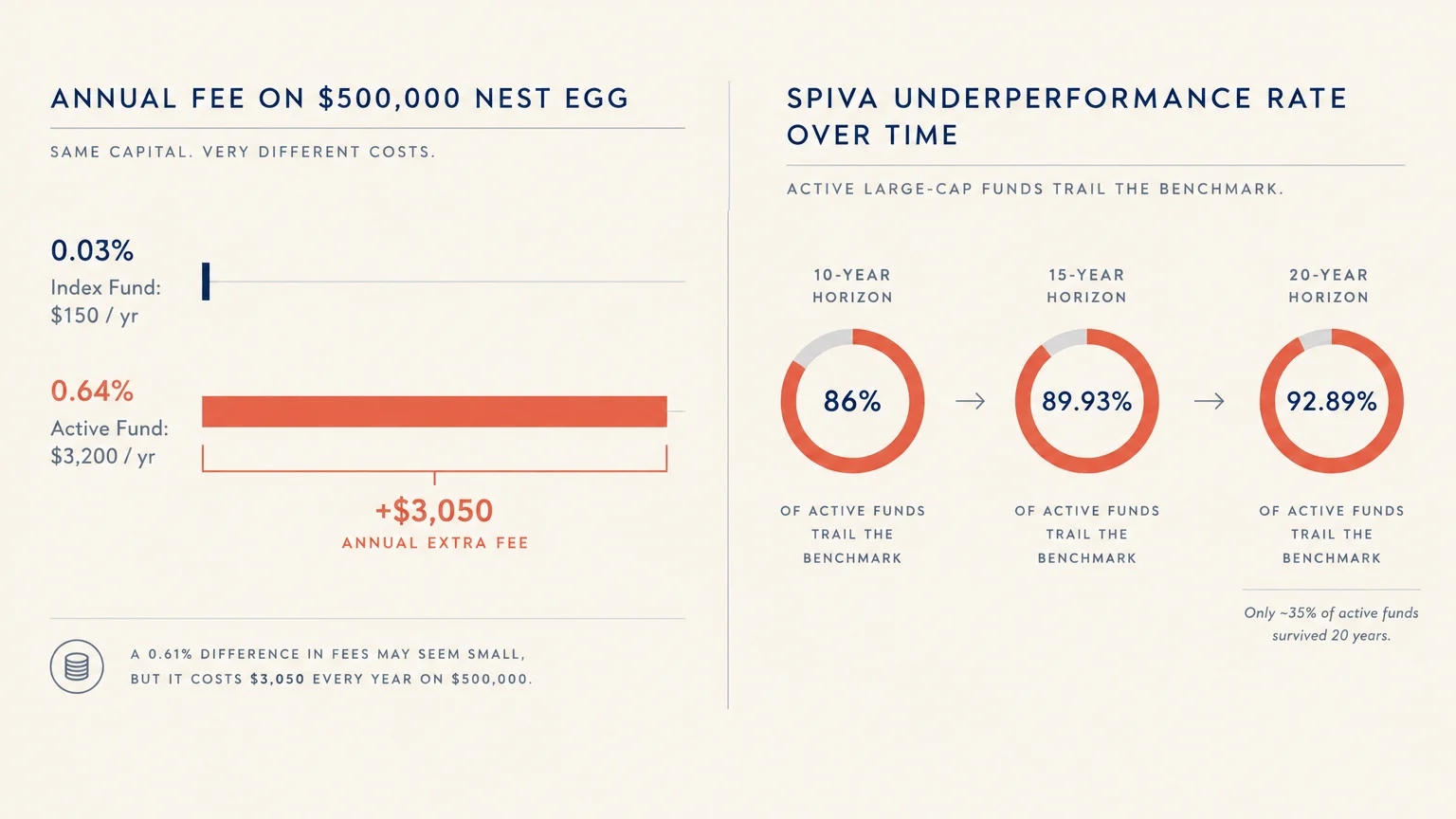
According to the Investment Company Institute’s 2025 fee report published in March 2026, asset-weighted average expense ratios were just 0.05% for index equity mutual funds and 0.14% for index equity ETFs. Actively managed equity mutual funds charged an average of 0.64%, while the average across all equity mutual funds stood at 0.40%.
Consider how that fee gap hits a $500,000 retirement nest egg. A 0.03% index fund costs $150 per year, whereas a 0.64% active fund extracts $3,200 annually—costing you $3,050 extra every single year before investment growth even begins.
Higher fees rarely buy better results over a multi-decade retirement. Data from S&P Dow Jones Indices’ SPIVA U.S. Year-End 2025 Scorecard shows 78.78% of actively managed U.S. large-cap equity funds trailed the S&P 500 in 2025.
Longer timelines look even starker for active stock pickers through the end of 2025:
- 10-year horizon: Roughly 86% of active U.S. large-cap funds trailed the S&P 500.
- 15-year horizon: Exactly 89.93% underperformed the benchmark.
- 20-year horizon: Fully 92.89% trailed the index, and only about 35% of those active funds even survived the 20-year span.
Short-term market swings did not rescue active managers either. In the first half of 2026, 67% of active U.S. large-cap funds trailed the S&P 500, according to the SPIVA U.S. Mid-Year 2026 Scorecard.
Broader fund survival numbers tell the same story across categories. Only 25% of active funds survived and outperformed their passive peers over the 10-year period ending June 30, 2026, according to the Morningstar US Active/Passive Barometer.
Choosing best index funds eliminates manager risk and keeps your strategy easy for a spouse or adult child to manage later. You own the whole market at rock-bottom cost, freeing your time for the retirement you worked to enjoy.
The 7 Index Funds Retirees Can Hold for Life
A resilient retirement portfolio balances three jobs: long-term growth to outpace inflation, dependable income for monthly bills, and stability when stock markets drop. No single fund handles all three tasks well on its own.
The seven low cost index funds below cover every core pillar of long term investing in retirement. Each fund carries an expense ratio between 0.015% and 0.06%, leaving nearly all market returns in your account.
| Fund (Ticker) | Asset Focus | Expense Ratio | Recent Yield / Key Metric | Primary Retirement Role |
|---|---|---|---|---|
| Vanguard Total Stock Market ETF (VTI) | Entire U.S. Stock Market | 0.03% | 1.02% 30-day SEC yield | Broad U.S. growth engine |
| Vanguard S&P 500 ETF (VOO) | 500 Largest U.S. Companies | 0.03% (0.015%–0.02% peers) | Tracks S&P 500 Index | Blue-chip core equity anchor |
| Schwab U.S. Dividend Equity ETF (SCHD) | High-Quality Dividend Stocks | 0.06% | 3.07% 30-day SEC yield | Steady quarterly income stream |
| Vanguard Dividend Appreciation ETF (VIG) | Dividend-Growing Companies | 0.04% | Focuses on rising payouts | Inflation-fighting dividend growth |
| Schwab U.S. Aggregate Bond ETF (SCHZ) | U.S. Investment-Grade Bonds | 0.03% (AGG/SPAB also 0.03%) | 4.99% 30-day SEC yield | Core fixed-income stability |
| Vanguard Short-Term TIPS ETF (VTIP) | Short-Term Inflation Bonds | 0.03% | 2.34% 30-day SEC yield; 2.4-yr duration | Direct purchasing-power shield |
| Vanguard 0-3 Month Treasury Bill ETF (VBIL) | Ultra-Short U.S. Treasuries | 0.06% | 3.89% 30-day SEC yield | Liquid cash-bucket reserve |
1. Vanguard Total Stock Market ETF (VTI)
Vanguard Total Stock Market ETF (VTI) gives you instant ownership across large, mid-sized, and small U.S. companies in a single trade. It tracks the Morningstar US Total Market Index and charges a tiny 0.03% expense ratio as of April 2026.
Because VTI spreads your money across thousands of businesses rather than just household giants, you capture growth wherever it appears in the domestic economy. As of October 31, 2026, VTI carried a 1.02% 30-day SEC yield alongside its capital growth potential.
Retirees often use VTI as their primary long-term growth sleeve inside either an IRA or a taxable brokerage account. Keep in mind that VTI moves up and down with the broader stock market, so pair it with bonds and cash before drawing monthly income.
2. Vanguard S&P 500 ETF (VOO) — Plus Mutual Fund Peers
If you prefer owning strictly the largest, most established American corporations, an S&P 500 index fund remains a staple for lifelong investors. Vanguard S&P 500 ETF (VOO) charges 0.03% per year, while traditional mutual fund counterparts cost even less at major brokerages.
According to 2026 fund disclosures, Schwab S&P 500 Index Fund (SWPPX) charges just 0.02%, and Fidelity 500 Index Fund (FXAIX) charges 0.015%. Choosing the fund offered natively at your brokerage keeps trading friction near zero.
You generally do not need both VTI and VOO in the same account because their largest holdings overlap heavily. Pick VTI if you want small- and mid-cap exposure included automatically, or choose VOO, SWPPX, or FXAIX for pure blue-chip simplicity.
3. Schwab U.S. Dividend Equity ETF (SCHD)
Many retirees want meaningful cash flow from their stocks without selling shares during a market slump. Schwab U.S. Dividend Equity ETF (SCHD) tracks the Dow Jones U.S. Dividend 100 Index for an expense ratio of 0.06%.
This index screens for financially healthy companies with strong cash flow and sustainable payouts rather than blindly chasing risky yields. According to Charles Schwab, SCHD delivered a 3.07% 30-day SEC yield as of November 12, 2026, and a 2.95% trailing 12-month distribution yield as of October 31, 2026.
That higher dividend stream can cover utility bills or property taxes while leaving your principal shares untouched. Just remember that SCHD concentrates in dividend-paying sectors like financials, energy, and consumer staples, so it works best alongside a broad fund like VTI or VOO.
4. Vanguard Dividend Appreciation ETF (VIG)
While SCHD emphasizes higher current income today, Vanguard Dividend Appreciation ETF (VIG) focuses on companies with a proven record of raising their dividends year after year. It carries an ultra-low 0.04% expense ratio as of November 12, 2026.
Businesses that consistently hike payouts tend to carry durable balance sheets and strong pricing power during inflationary periods. As a result, VIG often experiences milder price swings than the overall stock market when growth stocks stumble.
Pairing VIG with VTI or SCHD gives your retirement portfolio a built-in raise mechanism over a 20- or 30-year horizon. Because VIG’s starting yield is typically lower than SCHD’s, view it as a steady compounder rather than an immediate high-yield paycheck.
5. Schwab U.S. Aggregate Bond ETF (SCHZ) — Plus AGG and SPAB
Bonds exist in a retirement portfolio to cushion stock market drops and pay reliable interest. Schwab U.S. Aggregate Bond ETF (SCHZ) holds a broad mix of U.S. Treasuries, investment-grade corporate bonds, and mortgage-backed securities for just 0.03%.
If you shop at another brokerage, iShares Core U.S. Aggregate Bond ETF (AGG) and SPDR Portfolio Aggregate Bond ETF (SPAB) also charge 0.03%. With the 10-year U.S. Treasury yield trading near 5.0% to 5.2% in autumn 2026, core bonds finally pay attractive income again.
As of November 12, 2026, SCHZ reported a 4.99% 30-day SEC yield and a weighted average maturity of 8.20 years. Expect modest price fluctuations when interest rates move, yet that near-5% yield creates a strong buffer against temporary bond-price dips.
6. Vanguard Short-Term Inflation-Protected Securities ETF (VTIP)
Rising living costs pose one of the biggest silent threats to a fixed retirement budget. U.S. Bureau of Labor Statistics data released November 10, 2026 showed the Consumer Price Index rose 0.4% in October after climbing 0.6% in September, with annual inflation sitting at 3.7% through September 2026.
Vanguard Short-Term Inflation-Protected Securities ETF (VTIP) shields your savings by holding U.S. Treasury bonds whose principal adjusts upward with inflation. VTIP charges just 0.03% as of January 2026—a fraction of its 0.633% Lipper peer average.
As of November 12, 2026, VTIP offered a 2.34% 30-day SEC yield alongside a short average duration of 2.4 years. Keeping duration short prevents the sharp bond-price drops that hurt long-term inflation funds when the Federal Reserve raises rates.
7. Vanguard 0-3 Month Treasury Bill ETF (VBIL)
Every retiree needs a safe, liquid cash bucket so you never have to sell stocks during a downturn. Vanguard 0-3 Month Treasury Bill ETF (VBIL) holds ultra-short U.S. government bills backed by the full faith and credit of the United States.
Following the Federal Reserve’s rate moves putting the federal funds target range at 3.75% to 4.00% in late 2026, short-term bills pay solid yields without locking up your money. VBIL carries a 0.06% expense ratio and yielded 3.89% as of November 12, 2026.
Unlike certificates of deposit with early-withdrawal penalties, VBIL trades daily on the market and preserves near-stable principal. Holding one to two years of living expenses in VBIL lets you sleep soundly through stock market volatility.
Optional Global Diversifiers: VT and BNDX
If you want exposure outside the United States, two companion funds fit seamlessly into a lifelong portfolio. Vanguard Total World Stock ETF (VT) blends U.S. and international stocks in one fund for a 0.07% expense ratio.
On the fixed-income side, Vanguard Total International Bond ETF (BNDX) holds hedged foreign investment-grade bonds for 0.07%, yielding roughly 4.85% in October 2026. Adding a 10% to 20% slice of international holdings reduces reliance on any single country’s market cycle.
How to Blend These Funds Into a Safe Retirement Paycheck
Knowing which index funds for retirees to buy is half the battle; deciding how much to withdraw each year completes the plan. For a 30-year retirement starting in 2026, Morningstar’s State of Retirement Income report estimates a 3.9% starting safe withdrawal rate with a 90% probability of success.
That 3.9% benchmark sits slightly below the classic 4% rule, though it improved from 3.7% in 2024. Put into concrete dollars, a $600,000 portfolio supports $23,400 in year-one withdrawals—or $1,950 per month—adjusted upward for inflation thereafter.
Build your portfolio around a dependable cash and bond floor first, then let low-cost stock index funds quietly fund your later retirement decades.
Your portfolio withdrawals then stack on top of guaranteed Social Security checks. Social Security benefits received a 2.8% cost-of-living adjustment (COLA) in 2026 and will gain a 3.6% COLA in 2027, according to the Social Security Administration.
That 2027 COLA lifts the estimated average monthly retired-worker check by $75—from $2,095 to $2,170—starting in January 2027. Combined with $1,950 from a $600,000 portfolio, an average retiree generates $4,120 per month before taxes and Medicare premiums.
If you still work part-time before reaching full retirement age, watch the Social Security earnings test carefully. You can earn up to $24,480 per year ($2,040 monthly) in 2026 and $25,560 per year ($2,130 monthly) in 2027 before $1 in benefits is withheld for every $2 earned above the cap.
A practical way to structure these seven funds is the three-bucket approach:
- Near-term spending bucket (1–2 years of withdrawals): Hold VBIL for steady 3.89% Treasury income and instant liquidity when bills arrive.
- Stability and inflation bucket (5–8 years of withdrawals): Split funds between SCHZ (or AGG/SPAB) for core bond yield and VTIP for direct inflation protection.
- Long-term growth and dividend bucket (the remainder): Combine VTI or VOO with SCHD and VIG so rising stock values and dividends refill your cash bucket for decades.
You can review official benefit calculators and earnings rules directly on the Social Security Administration website before locking in your withdrawal target.
Tax-Smart Account Placement, Catch-Ups, and RMD Rules
Where you hold each index fund matters almost as much as which funds you pick. Smart asset location trims your annual tax bill without forcing you to take extra investment risk.
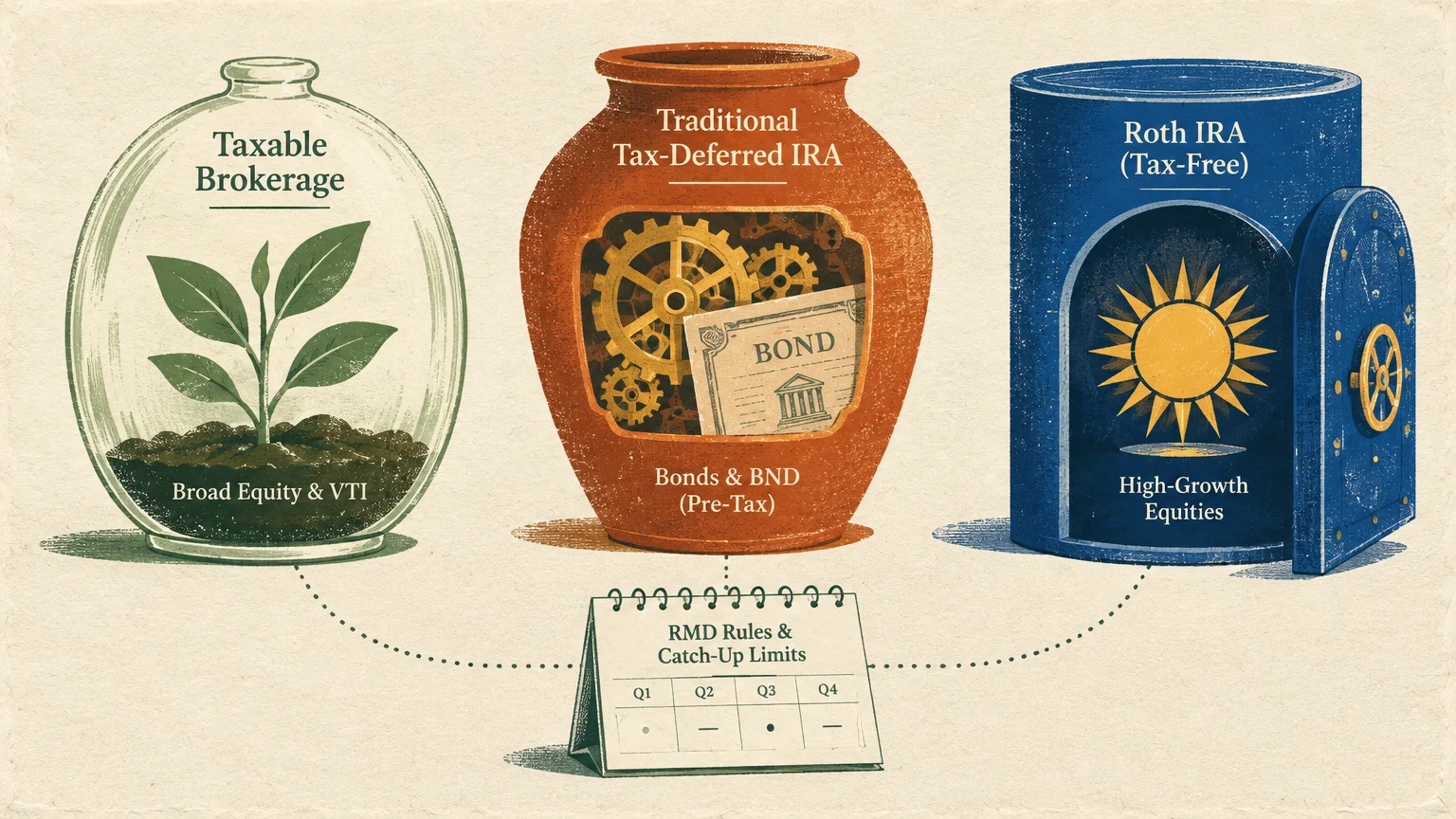
Because SCHZ, VTIP, and VBIL generate ordinary interest taxed at your regular income rate, keeping them inside a Traditional IRA or 401(k) shields those annual payouts from immediate taxation. Broad equity ETFs like VTI and VOO are naturally tax-efficient and fit well inside taxable brokerage accounts or Roth IRAs.
If you are age 55 or older and still working, late-career contributions can turbocharge these lifelong holdings. Under IRS Notice 2026-66, standard 401(k), 403(b), and 457 deferral limits stand at $24,500 in 2026 and rise to $25,500 in 2027.
Catch-up provisions expand those limits further depending on your age and prior-year income:
- Standard age 50+ workplace catch-up: $8,000 in 2026 ($32,500 total) and $8,500 in 2027 ($34,000 total).
- SECURE 2.0 super catch-up (ages 60–63): $11,250 in 2026 ($35,750 total) and $11,750 in 2027 ($37,250 total).
- Mandatory Roth catch-up rule: Starting in 2026, workers age 50+ whose prior-year wages with their plan sponsor topped $150,000 must route catch-up contributions into a Roth (after-tax) account.
- Traditional and Roth IRA limits: $7,500 annually for both 2026 and 2027, plus a $1,100 catch-up for ages 50+ ($8,600 total).
Once you reach age 73, Required Minimum Distributions (RMDs) begin on pre-tax Traditional IRAs and workplace plans under IRS Publication 554. Missing an RMD triggers a steep 25% excise tax on the shortfall—say, $2,500 on a missed $10,000 withdrawal—though prompt correction cuts the penalty to 10%.
Original Roth IRA owners owe no lifetime RMDs, making a Roth account the ideal home for your fastest-growing stock index funds like VTI or VOO. Check IRS retirement plan resources each autumn to confirm current brackets and distribution tables.
Large pre-tax withdrawals or taxable fund sales also affect your healthcare budget. The standard Medicare Part B premium jumped 9.7% from $185 in 2025 to $202.90 per month per person in 2026.
If you file jointly and your modified adjusted gross income (MAGI) exceeds $218,000, income-related monthly adjustment amount (IRMAA) surcharges raise Part B and Part D premiums. Keeping dividends and bond interest inside tax-sheltered accounts and trimming taxable gains gradually helps preserve your base premium on Medicare.gov.
Common Mistakes to Avoid
Even disciplined index investors can lose money to avoidable structural errors in retirement. Watch out for these four pitfalls as you set up your lifelong holdings.
- Buying overlapping funds by accident: Holding VTI, VOO, and a third large-cap growth ETF at the same time concentrates too much money in the exact same top technology stocks rather than diversifying your risk.
- Leaving excess cash idle in low-yield checking: Inflation at 3.7% silently erodes bank cash earning next to nothing, whereas moving your emergency buffer into VBIL earns 3.89% with U.S. Treasury backing.
- Rebalancing inside taxable accounts without checking tax brackets: Selling appreciated index shares in December can push joint filers past the $218,000 IRMAA threshold, costing thousands in extra Medicare premiums.
- Chasing hot active funds after a strong year: With 86% of active U.S. large-cap funds trailing the S&P 500 over 10 years, switching out of low-cost index funds for yesterday’s star manager almost always backfires.

Finding the Right Advisor
Index investing keeps portfolio management simple, yet retirement tax law and withdrawal timing still carry high stakes. You do not need an expensive stock picker to justify professional advice when a fee-only fiduciary planner can save you far more in taxes and mistakes.
Consider consulting a Certified Financial Planner (CFP) or CPA in these four specific scenarios:
- Coordinating Social Security and your 3.9% withdrawal plan: An advisor helps map out whether bridging early retirement years with portfolio withdrawals lets you delay Social Security for a larger lifelong check.
- Executing partial Roth conversions before age 73: Moving pre-tax IRA dollars into Roth index funds during lower-income years between retirement and age 73 shrinks future RMDs and protects your surviving spouse’s tax bracket.
- Navigating IRMAA cliffs and mandatory Roth catch-ups: A planner models capital gains, SCHD dividends, and the $150,000 wage threshold for Roth catch-ups so you avoid surprise tax bills or Medicare surcharges.
- Consolidating scattered legacy accounts: If you and your spouse hold old 401(k)s, annuities, and overlapping mutual funds at four firms, an advisor can streamline everything into a clean, seven-fund blueprint.
Before hiring anyone, verify their registration, fee structure, and disciplinary history using the SEC’s Investor.gov portal and FINRA BrokerCheck. Favor fiduciaries who charge transparent flat, hourly, or modest assets-under-management fees rather than commission-based product salespeople.
Frequently Asked Questions About Index Funds for Retirees
Can I hold just two or three index funds instead of all seven?
Yes, many retirees thrive with a simple three-fund mix such as VTI (or VOO) for stocks, SCHZ for bonds, and VBIL for short-term cash. The seven-fund list lets you fine-tune dividend income with SCHD or VIG and add direct inflation protection with VTIP if you want extra precision.
Are ETFs or mutual funds better for retirees?
Both deliver the exact same underlying index performance when expense ratios match, such as VOO at 0.03% versus FXAIX at 0.015%. Mutual funds let you automate exact-dollar monthly withdrawals easily, whereas ETFs often offer slightly cleaner tax efficiency inside taxable brokerage accounts.
How do index funds handle Required Minimum Distributions at age 73?
You can satisfy your annual RMD by directing dividend and interest payouts from SCHD, SCHZ, VTIP, and VBIL to cash inside your IRA rather than reinvesting them. If those distributions fall short of your required RMD amount, simply sell a small slice of whichever fund has grown above your target allocation.
Do dividend index funds like SCHD protect against inflation?
Quality dividend funds help your retirement paycheck grow over time because profitable companies regularly raise cash payouts as prices rise. However, stock prices still drop during recessions, so pair SCHD or VIG with inflation-indexed Treasury bonds like VTIP for short-term purchasing-power protection.
Next Steps for Your Retirement Portfolio
Start by logging into your brokerage or 401(k) portal this week and checking the expense ratio on every fund you currently own. If you see fees near or above the 0.64% active-fund average, look for low-cost index replacements like VTI, VOO, SCHZ, VTIP, or VBIL inside the same tax-sheltered account so switching triggers zero capital gains taxes.
Next, verify your cash buffer, projected Social Security COLA, and upcoming RMD timeline so every dollar has a clear job. This article provides general financial education and information only. Everyone’s financial situation is unique—what works for others may not work for you. For personalized advice tailored to your retirement needs, consider consulting a qualified financial professional such as a CFP or CPA.
Last updated: November 2026. Benefit amounts, tax rules, and program details change annually—verify current figures with official government sources.




Leave a Reply