
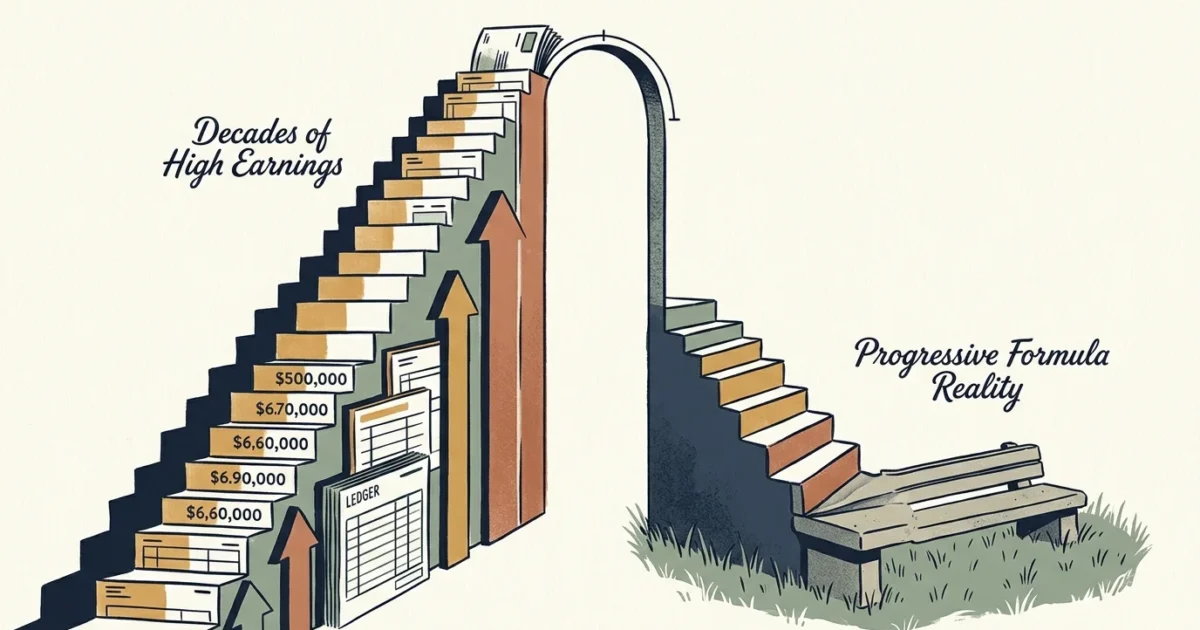
Earning a six-figure salary throughout your career feels like a guarantee of an abundant retirement. Many professionals expect their monthly Social Security check to mirror their substantial paychecks.
The reality often brings an unwelcome surprise. Because federal retirement benefits use a progressive formula, high earners experience a dramatic drop in their income replacement rate.
A consistent $100,000 career average produces a baseline monthly benefit of approximately $3,313 at full retirement age in 2026. Understanding how the government calculates this check helps you protect your retirement standard of living.
The Six-Figure Replacement Rate Reality
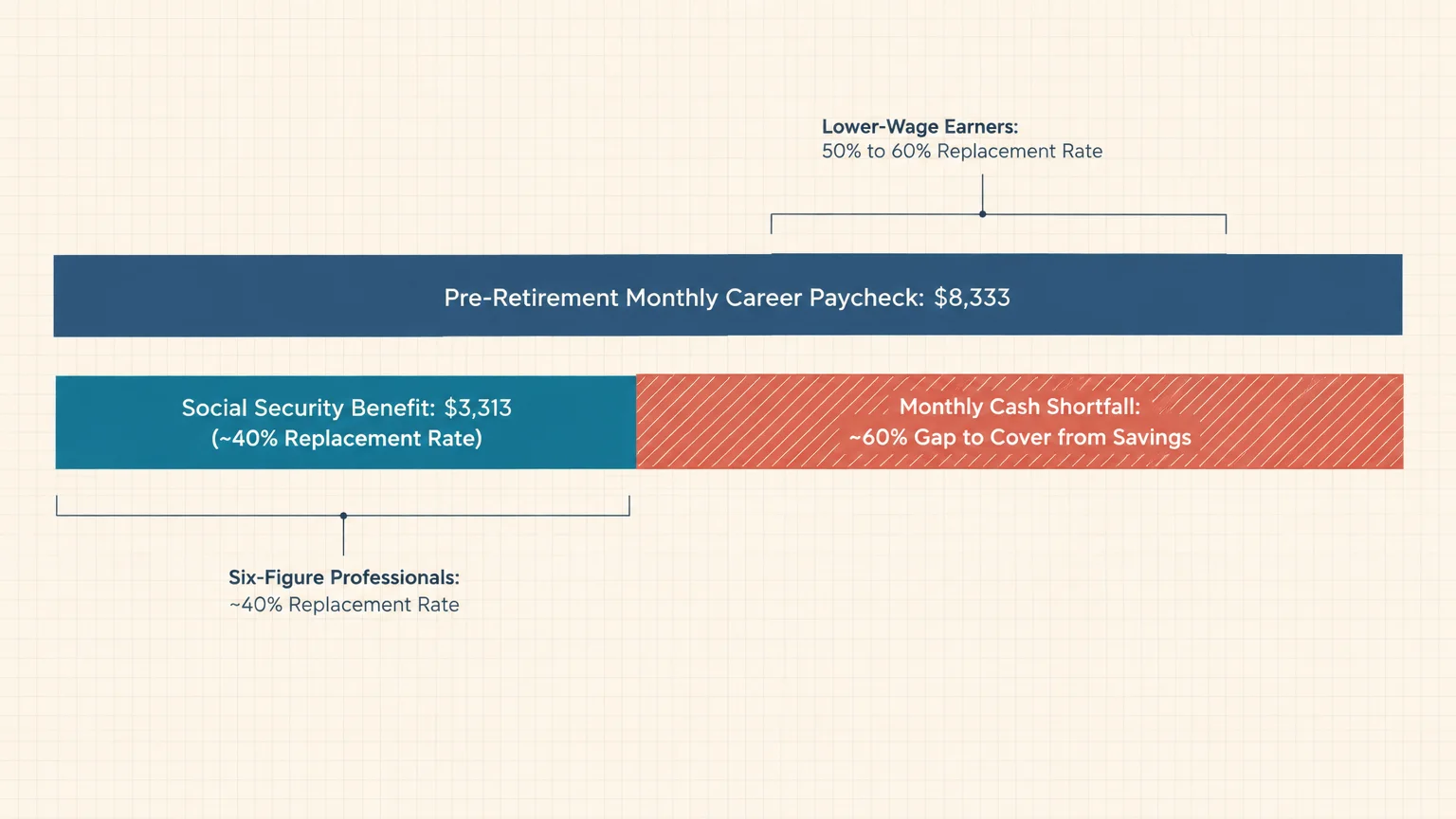
Social Security replaces a much smaller percentage of earnings for six-figure professionals than for lower-wage workers. The system acts as a social safety net rather than an executive pension plan.
Workers earning lower wages often see Social Security replace roughly 50% to 60% of their pre-retirement earnings. In contrast, consistent six-figure earners receive a replacement rate near 40% or even less.
If you take home $8,333 each month during your career, receiving a monthly check of $3,313 creates an immediate monthly cash shortfall. You must cover that remaining 60% difference through personal investments and savings.
Many executives assume higher tax contributions guarantee proportional payouts. The progressive structure deliberately transfers a portion of higher-earner contributions toward raising baseline benefits for lower earners.
Failing to prepare for this drop forces many retirees to downsize earlier than intended. Recognizing your true replacement rate allows you to adjust savings goals while you still earn a salary.
How the 35-Year Calculation Rule Impacts High Earners
The Social Security Administration (SSA) bases your benefit on your 35 highest-earning years. They adjust each year of past wages for national wage growth up to age 60.
The agency sums your 35 indexed years and divides that figure by 420 months. This calculation establishes your Average Indexed Monthly Earnings, commonly known as your AIME.
Missing years can severely penalize professionals who took time away from work. If you worked for 30 years instead of 35, the SSA inserts five zero-dollar years into your calculation.
Those zeroes drag down your career monthly average significantly. Even five years of zero income can reduce your final monthly benefit by hundreds of dollars.
Late bloomers who only crossed six figures during their forties or fifties face a similar hurdle. Lower-earning early career years remain in the 35-year formula until you replace them with higher-earning current years.
Working additional years past traditional retirement age can replace those early low-income years. Each high-earning year you log beyond age 62 pushes a lower-earning year out of your top 35.
The Progressive Formula: How Bend Points Shrink Your Payout
Once the SSA determines your AIME, it applies a formula with two thresholds known as bend points. These bend points calculate your Primary Insurance Amount, which is your baseline benefit at full retirement age.
The formula divides your monthly average into three separate brackets. Each bracket awards a progressively smaller percentage as your earnings rise.
For workers turning 62 in 2026, the formula calculates benefits through the following tiers:
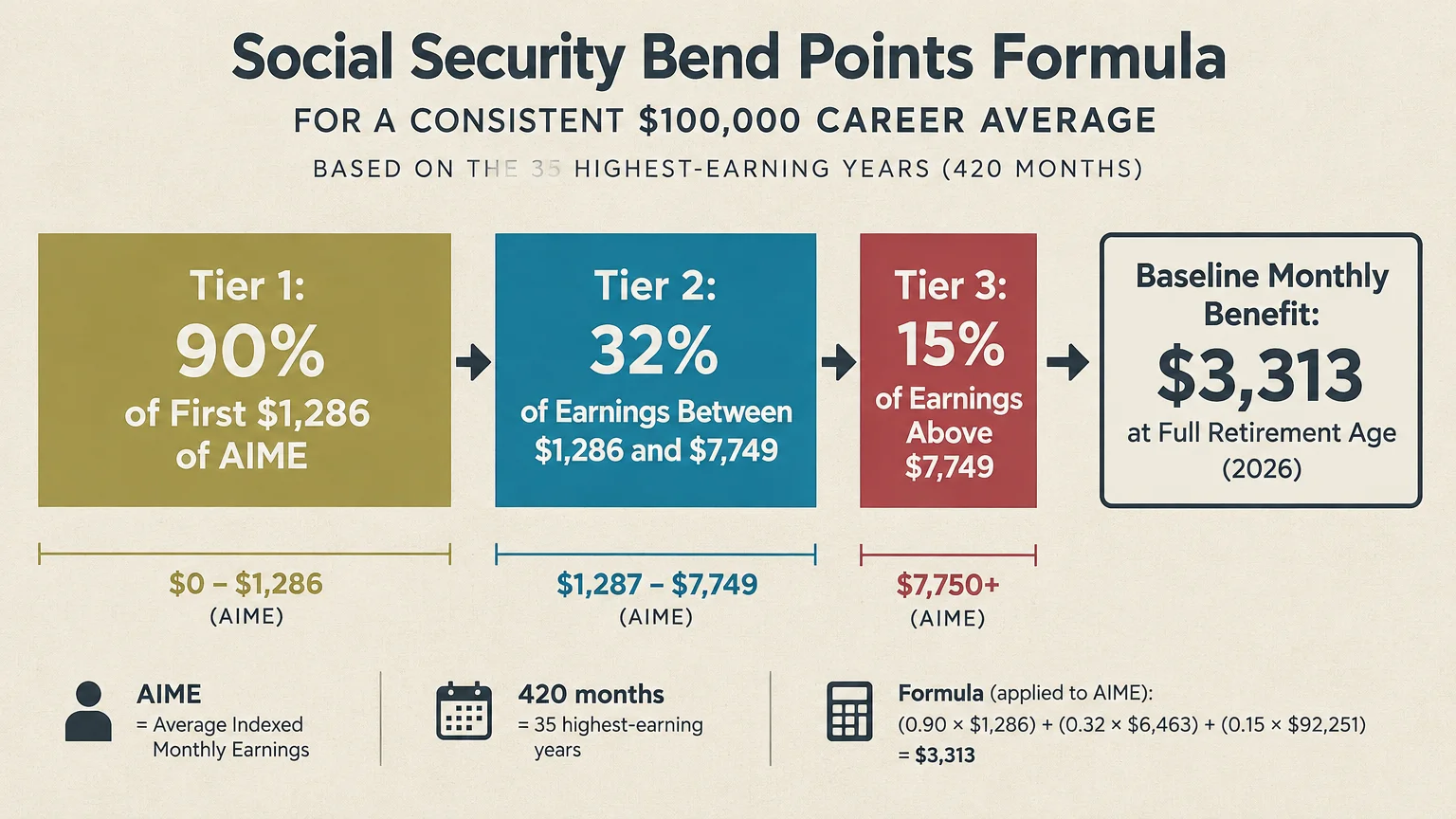
- First Tier: 90% of the first $1,286 of your Average Indexed Monthly Earnings.
- Second Tier: 32% of your earnings between $1,286 and $7,749.
- Third Tier: 15% of your earnings above $7,749 up to the maximum allowable indexed earnings.
For individuals turning 62 in 2027, the thresholds shift higher to reflect economic inflation. The 2027 tiers award 90% of the first $1,340, 32% between $1,340 and $8,077, and 15% over $8,077.
Notice how drastically the return diminishes in the top tier. Every dollar of average monthly income above the second bend point yields only 15 cents in baseline benefits.
This 15% return bracket explains why a massive career salary produces a modest Social Security check. You pay full payroll taxes on those dollars, but they generate minimal monthly retirement credit.
The $100,000 Salary Case Study: A Clear Breakdown
Let us walk through the exact mathematics for a worker who maintained an inflation-indexed career average of $100,000. Dividing $100,000 by 12 months produces an AIME of $8,333.
Under the 2026 bend points, the SSA calculates this earner’s monthly primary insurance amount through three steps:
- Tier 1 Calculation: 90% of $1,286 equals $1,157.40.
- Tier 2 Calculation: 32% of $6,463 (the difference between $7,749 and $1,286) equals $2,068.16.
- Tier 3 Calculation: 15% of $584 (the earnings between $7,749 and $8,333) equals $87.60.
Adding those three amounts together yields a base monthly benefit of approximately $3,313 at Full Retirement Age. On an annual basis, this delivers roughly $39,756.
Under the 2027 formula, an AIME of $8,333 results in a monthly check of approximately $3,400. That equals an annual total of $40,800.
While $3,313 per month is a respectable payment, it represents just 39.8% of the worker’s previous gross monthly income. You face a monthly cash gap of more than $5,000 compared to your active salary.
“The biggest shock for high earners in retirement is realizing that Uncle Sam is still your senior business partner.” — Ed Slott, CPA and Retirement Specialist
The Taxable Wage Base: Why Six Figures Does Not Mean Maximum Benefit
Many earners earning $100,000 or $120,000 mistakenly assume they qualify for the maximum Social Security benefit. In truth, earning six figures does not place you near the maximum payout limit.
The maximum monthly benefit requires you to earn at or above the Social Security taxable wage base for at least 35 full years. The federal government adjusts this cap upward almost every year.
In 2026, the maximum taxable earnings limit sits at $184,500. For 2027, the cap increases to $192,300, meaning workers pay 6.2% payroll taxes up to that threshold.
The taxable wage base first crossed six figures in 2008, when it reached $102,000. If you earned $100,000 in 2008 or any year since, you did not pay the maximum tax.
Because you did not pay tax up to the cap, your career earnings record falls short of the maximum benefit calculation. You will receive a healthy check, but it will not reach the legal maximum.
To see how claiming age alters maximum checks, examine the payout tiers for those who capped out their earnings:
| Claiming Age Milestone | 2026 Maximum Monthly Check | 2027 Maximum Monthly Check |
|---|---|---|
| Early Claiming (Age 62) | $2,969 | $3,094 |
| Full Retirement Age (Age 67) | $4,152 | $4,188 |
| Delayed Claiming (Age 70) | $5,181 | $5,358 |
The difference between claiming at 62 and claiming at 70 exceeds $2,200 each month for maximum earners. Your claiming age dictates your permanent baseline for the rest of your life.
Comparing Claiming Ages: Age 62 vs. Full Retirement Age vs. Age 70
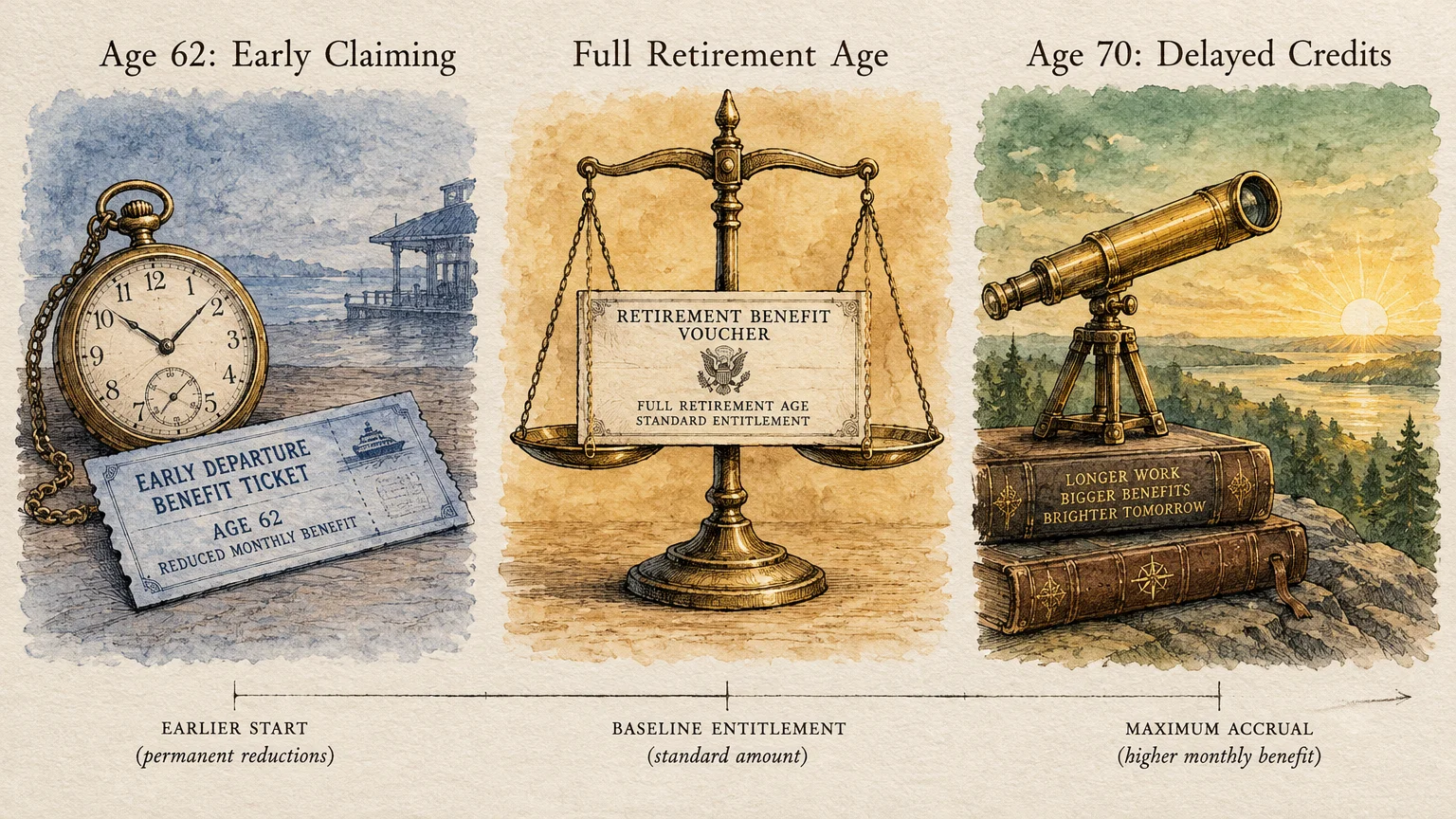
Your Full Retirement Age depends entirely on the year you were born. For everyone born in 1960 or later, full retirement age is exactly 67.
If you were born in 1959, you reach your full retirement age in 2026 at 66 years and 10 months. Claiming before your designated age triggers an irreversible, permanent monthly penalty.
Claiming as early as possible at age 62 slashes your monthly benefit by 30%. For our $100,000 career earner, a $3,313 baseline check drops down to approximately $2,319 per month.
Delaying benefits beyond your full retirement age earns you delayed retirement credits. The government increases your baseline check by 8% per year for every year you delay up to age 70.
That 8% annual boost delivers a 24% total raise if your full retirement age is 67. Waiting until age 70 elevates that same $3,313 baseline check to roughly $4,108 every month.
That extra $795 per month remains yours for life and compounds with every annual cost-of-living adjustment. For high earners with longevity in their families, waiting pays substantial dividends.
The Tax Torpedo: Why Up to 85% of Your Check Faces Income Taxes
Federal taxes on benefits represent another major surprise for six-figure earners. Many retirees assume Social Security benefits arrive entirely tax-free.
Congress introduced taxation on benefits in 1983 and established income thresholds that were never indexed to inflation. As inflation pushed wages and investment balances higher, more retirees fell into these tax brackets.
The Internal Revenue Service (IRS) uses a calculation called provisional income to determine your tax liability. Your provisional income equals your adjusted gross income, plus tax-exempt interest, plus 50% of your annual Social Security benefit.
If you file taxes as an individual, the federal taxation thresholds apply as follows:
- Provisional income between $25,000 and $34,000: Up to 50% of your benefits are subject to income tax.
- Provisional income above $34,000: Up to 85% of your benefits are subject to income tax.
For married couples filing jointly, the income thresholds remain equally compressed:
- Provisional income between $32,000 and $44,000: Up to 50% of your benefits are subject to income tax.
- Provisional income above $44,000: Up to 85% of your benefits are subject to income tax.
Virtually every six-figure earner with distributions from a 401(k) or traditional IRA exceeds the $44,000 threshold. Consequently, you will likely pay regular income taxes on 85% of your Social Security payments.
This tax exposure reduces your net check, shrinking your disposable income in retirement. Factoring federal and state taxes into your retirement budget prevents unexpected cash flow shortfalls.
Working While Claiming Early: The Retirement Earnings Test Trap
Many six-figure professionals ease into retirement by taking consulting roles or working part-time. If you choose to claim benefits before reaching your full retirement age, you face strict earnings limits.
The SSA applies the Retirement Earnings Test to workers who claim benefits early while continuing to earn wages. If your earnings exceed annual caps, the agency temporarily withholds your monthly payments.
In 2026, the earnings cap for workers under full retirement age all year is $24,480. The limit increases to $25,560 in 2027.
The SSA withholds $1 in benefits for every $2 you earn above that annual limit. A lucrative consulting contract can completely wipe out your early monthly Social Security payments.
In the specific calendar year you reach full retirement age, the agency applies a much higher threshold. The cap rises to $65,160 in 2026 and increases to $67,920 in 2027.
During that transition year, the agency withholds $1 for every $3 you earn above the threshold. This withholding applies only to money earned in the months prior to your birthday month.
Once you hit your full retirement age, the earnings limit disappears entirely. You can earn an unlimited salary while keeping 100% of your monthly Social Security check.
The SSA recalculates your check at full retirement age to credit withheld benefits over your lifetime. However, claiming early while working high-paying consulting jobs creates unnecessary administrative friction and tax headaches.

What Can Go Wrong: 4 Costly Mistakes High Earners Make
High earners often make financial missteps because they assume their strong earnings history protects them from rules-based penalties. Avoiding these four common errors preserves tens of thousands of dollars.
- Assuming High Earnings Guarantee the Maximum Benefit: Confusing a $100,000 salary with the taxable maximum leads to severe overestimates. Always verify your actual estimate through your personal SSA account rather than making assumptions.
- Claiming at 62 While Continuing to Earn Consulting Fees: Earning substantial consulting income while taking early benefits triggers the Retirement Earnings Test. You sacrifice 30% of your baseline check permanently while seeing current checks withheld.
- Ignoring the 35-Year Calculation Window: Retiring early after a 28-year career leaves seven zero-dollar years on your record. Working just a few additional years replaces those zeroes with substantial earnings, boosting lifetime checks.
- Overlooking Medicare IRMAA Surcharges: High retirement distributions combined with Social Security can push your modified adjusted gross income past Medicare surcharge thresholds. These surcharges, known as IRMAA, raise your monthly Part B and Part D premiums significantly.
Awareness of these pitfalls allows you to time your claiming decision to your broader wealth plan. Navigating these rules properly protects your wealth from unnecessary friction.
Actionable Strategies to Bridge the Income Gap
Knowing that Social Security covers only 40% of your six-figure lifestyle requires proactive planning. You can implement several practical strategies to replace the missing 60% of your income.
First, delay your benefit claiming until age 70 if your health and personal savings allow it. Earning an 8% guaranteed annual return provides a permanent hedge against inflation that private annuities struggle to match.
Second, execute strategic Roth IRA conversions during the gap years between your retirement and age 70. Converting traditional retirement accounts during lower-income years reduces future Required Minimum Distributions.
Lower distributions keep your future provisional income lower, protecting your Social Security checks from excessive taxation. This strategy also shields you from elevated Medicare IRMAA premiums later in life.
Third, coordinate claiming strategies with your spouse to optimize your household total. The higher earner should often delay until age 70 to secure the largest possible survivor benefit for the surviving spouse.
Fourth, tap non-taxable assets like brokerage accounts or cash reserves to bridge early retirement living expenses. This preserves your ability to defer Social Security without taking forced high-bracket retirement withdrawals.
Review comprehensive consumer guidance on financial planning tools through Investor.gov. Building a multi-tiered income architecture ensures steady cash flow regardless of policy shifts.

When to Consult a Professional
While general rules provide a helpful framework, high-net-worth retirement planning involves interconnected tax and legal variables. You should consider working with a fee-only Certified Financial Planner (CFP) or CPA under specific conditions.
Seek guidance if you hold substantial balances in traditional tax-deferred retirement accounts. A professional can model the impact of future Required Minimum Distributions on your benefit taxation and Medicare brackets.
Consult an advisor if you own a private business or plan to transition into an independent advisory role. Structuring your compensation between salary and dividends can mitigate the Retirement Earnings Test if you claim before age 67.
Professional advice becomes essential when coordinating pensions from public employment that did not pay into Social Security. Rules like the Windfall Elimination Provision require custom modeling to determine your exact payout.
Finally, engage an expert if you experience a large age disparity with your spouse. Custom claiming timelines protect survivor benefits while optimizing cash flow across two distinct lifespans.
Frequently Asked Questions
Does earning $100,000 mean I receive the maximum Social Security check?
No, earning $100,000 does not qualify you for the maximum Social Security benefit. The maximum benefit requires earning at or above the taxable wage base ($184,500 in 2026) for at least 35 years.
How much will Social Security replace of my six-figure salary?
Social Security replaces roughly 40% of pre-retirement earnings for someone averaging $100,000 annually. Higher earners making $150,000 or more will see their replacement rate drop down toward 30% or less.
Can I erase zero-earning years if I keep working past age 65?
Yes, the SSA recalculates your 35 highest-earning years every year you work. Earning high wages past 65 automatically replaces earlier years of zero or low earnings, raising your monthly benefit.
How does inflation affect my monthly benefit after I retire?
The SSA applies an annual Cost-of-Living Adjustment (COLA) to protect your purchasing power. In 2026, benefits received a 2.8% boost, followed by an announced 3.6% COLA adjustment for 2027.
Will my monthly benefit check be taxed if I have no other job?
If you take withdrawals from traditional 401(k) or IRA accounts, those distributions count toward your provisional income. If your combined income exceeds $34,000 as a single filer or $44,000 married, up to 85% of your benefit is taxable.
Next Steps for Your Retirement Plan
Log in to your account on the SSA website today to verify your official earnings record. Confirm that every year of your six-figure earnings history is recorded accurately without missing data.
Compare your estimated monthly check against your current household spending to measure your actual income gap. Taking control of these figures today ensures your retirement lifestyle matches the career you worked hard to build.
This article provides general financial education and information only. Everyone’s financial situation is unique—what works for others may not work for you. For personalized advice tailored to your retirement needs, consider consulting a qualified financial professional such as a CFP or CPA.
Last updated: November 2026. Benefit amounts, tax rules, and program details change annually—verify current figures with official government sources.









Leave a Reply