

Writing your last will and testament brings enormous peace of mind. However, treating a will like a catch-all container for your entire estate can trigger costly legal delays for your family.
Certain assets and requests bypass probate entirely or become public record against your wishes. Putting the wrong details into your documents causes probate court disputes, unnecessary taxes, and accidental disinheritances.
Knowing what not to put in your will protects your heirs and streamlines the transfer of your hard-earned assets. These essential will writing tips keep your estate plan clear, enforceable, and cost-effective.
The Hidden Traps of Last Will and Testaments
A last will serves as a foundational legal instrument, but it does not govern every asset you own. Many Americans assume a will is the final word on everything they leave behind.
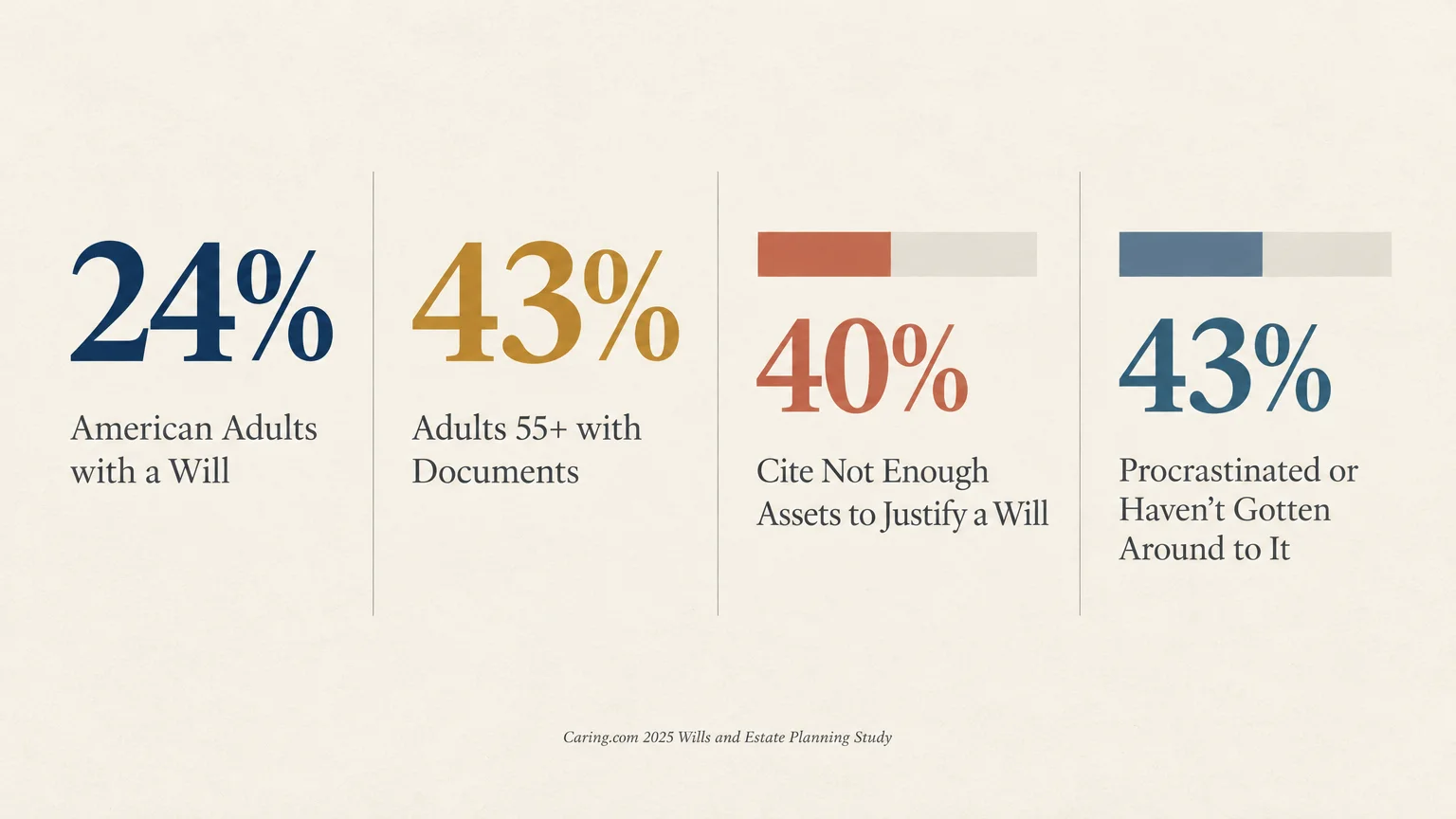
According to Caring.com’s 2025 Wills and Estate Planning Study, only 24% of American adults have a will. While 43% of adults aged 55 and older have documents in place, many drafts contain critical errors.
In fact, 40% of people without estate documents claim they do not have enough assets to justify making one. Procrastination sidelines another 43% of adults who simply have not gotten around to it.
When seniors finally sit down to draft a document, they often overreach. They include items that conflict with state probate codes, contract laws, or federal tax rules.
Every item you list in a will must pass through probate court before your beneficiaries receive it. Probate requires court supervision, legal filings, and public hearings that take months or years to resolve.
Understanding which property passes outside probate helps you bypass court delays. It also shields your family from avoidable administrative expenses and emotional friction during an already stressful period.
1. Retirement Accounts and Assets with Beneficiary Designations
You should never rely on your will to distribute retirement plans like 401(k)s, 403(b)s, or traditional and Roth IRAs. The same rule applies to life insurance policies and commercial annuities.
These financial vehicles operate under private contracts between you and the financial institution. Contract law completely overrides the instructions you leave inside a last will and testament.
If your will leaves your IRA to your daughter, but your custodial form names your former spouse, the financial institution must pay the former spouse. The probate judge cannot alter that outcome.
“A will does not override a beneficiary form. The beneficiary form rules every single time.” — Ed Slott, CPA and Nationally Recognized IRA Expert
Retirement assets also carry distinct tax consequences governed by federal law. The Internal Revenue Service (IRS) enforces strict distribution timelines on inherited tax-advantaged accounts.
Under the SECURE Act, most non-spouse beneficiaries must withdraw all inherited IRA funds within 10 years of your death. Naming an heir directly through the custodian preserves their tax options far better than routing funds through probate.
Take time right now to log into your brokerage and retirement accounts. Verify that your primary and contingent beneficiary designations reflect your current wishes.
2. Jointly Held Real Estate and Bank Accounts
Do not attempt to bequeath property that you own jointly with someone else who holds survivorship rights. This includes property held under joint tenancy with right of survivorship or tenancy by the entirety.
When two spouses buy a house together under joint tenancy, the surviving co-owner absorbs full title automatically upon the other’s death. This transfer happens instantly outside of probate court.
If you state in your will that your half of the family home passes to your sibling, that clause is legally void. Your surviving spouse takes sole ownership of the entire property by operation of law.
The same legal mechanism applies to joint checking, savings, and investment accounts. The surviving named account holder inherits full legal control over the cash reserves immediately.
Writing contradictory instructions into your will regarding joint property only breeds resentment. Family members may believe you left them an inheritance that the executor cannot legally deliver.
If you genuinely want to transfer a fraction of real estate to someone outside the deed, you must change how title is held while living. Consult a real estate attorney to adjust your deed structure.
3. Funeral, Burial, and Memorial Instructions
It feels natural to write down whether you prefer burial or cremation inside your will. However, estate planning experts strongly advise against hiding your final arrangements in this document.
Wills are rarely opened, located, and probated until several weeks or months after someone passes away. By the time your family files your will in probate court, your funeral has already occurred.
According to the National Funeral Directors Association (NFDA), the national median cost of a funeral with viewing and burial is $8,300. Adding a burial vault brings the median cost to $9,995.
Meanwhile, the median cost for a funeral with cremation stands at $6,280, while direct cremation ranges between $1,500 and $2,000. Leaving instructions behind in an unread document leaves your family guessing about these major expenses.
Instead of burying wishes in a will, write a separate, non-probate Letter of Instruction. Hand copies directly to your designated healthcare proxy, your executor, and trusted family members.
You can also complete an advance healthcare directive or appointment of funeral agent form permitted by your state. These documents give someone legal authority to carry out your exact wishes immediately.

4. Direct Inheritances for Beneficiaries with Special Needs
Leaving a direct sum of money to a child or grandchild with special needs is one of the most devastating estate planning mistakes. A well-intended inheritance can permanently destroy their access to vital government safety nets.
Programs like Supplemental Security Income (SSI) and Medicaid enforce strict financial eligibility limits. To qualify for SSI, an individual cannot possess more than $2,000 in countable financial resources, or $3,000 for a married couple.
For 2026, the maximum individual federal SSI benefit pays $994 per month. Receiving even a modest direct inheritance of $5,000 in cash instantly pushes your beneficiary above the resource limit and terminates their monthly checks.
Losing SSI also revokes their Medicaid health coverage, potentially leaving them without medical care, prescription assistance, or subsidized residential support. The state will require them to spend down your inheritance completely before reapplying.
Instead of naming them in a will, work with an elder law attorney to establish a third-party Special Needs Trust (SNT). A trustee oversees the funds, paying for quality-of-life enhancements without jeopardizing public benefits.
You can also direct funds to an ABLE account. The ABLE Age Adjustment Act expanded eligibility to individuals whose qualifying disability began before age 46.
In 2026, individuals and family members can contribute up to $20,000 annually into an ABLE account. Crucially, up to $100,000 saved inside an ABLE account remains completely shielded from the $2,000 SSI resource limit.
5. Conditional Gifts Tied to Personal Lifestyle Demands
Some people try to use their will to control their family from beyond the grave. They attach strict strings or personal ultimatums before an heir can collect their money.
Common examples include demanding that an adult child marry, divorce their current spouse, or adopt a specific religious faith. Other clauses attempt to force an heir to graduate from a specific university.
Probate courts routinely strike down conditional bequests that violate public policy or personal constitutional rights. Provisions requiring someone to divorce a spouse or alter their religious beliefs are almost universally ruled unenforceable.
When a probate judge invalidates an unlawful condition, the court often gives the money to the heir outright. The restriction fails, and the estate absorbs thousands of dollars in litigation fees defending the dispute.
You can legitimately incentivize responsible financial behavior through a properly structured trust rather than a will. For example, a trustee can match an heir’s earned income dollar-for-dollar or distribute funds at milestone ages.
Sticking to milestone-based financial guidelines preserves family harmony and protects your estate. It ensures your assets nurture the next generation rather than fueling bitter courtroom arguments.
6. Passwords, PINs, and Private Digital Credentials
As life moves online, tracking your digital footprint becomes an urgent financial responsibility. However, you should never write your master passwords, online banking credentials, or crypto keys directly inside your will.
Once you pass away and your executor files your will, it becomes an official public record. Anyone in your county can walk into the probate court clerk’s office and read every page.
Exposing account logins, security questions, and safe combinations in a public filing invites financial predators and identity thieves. It exposes your remaining accounts to fraud before your executor settles your final affairs.
According to the Consumer Financial Protection Bureau (CFPB), older adults remain prime targets for identity theft and financial fraud. Securing sensitive data after your death requires strict digital hygiene.
Store your passwords, financial account numbers, and device access codes in an encrypted password manager or a secure physical safe. Leave access keys only with a trusted fiduciary through a secure digital asset directive.
Most states have adopted the Revised Uniform Fiduciary Access to Digital Assets Act. This law lets you legally authorize your executor to manage digital accounts without splashing private passwords across court dockets.

7. Direct Financial Gifts to Family Pets
Loving your companion animals is second nature, and you naturally want them pampered if you pass away first. However, you cannot legally leave money or real estate directly to a cat, dog, or horse in your will.
Under United States law, companion animals are legally classified as personal property. Because personal property cannot own other property, a will clause naming your pet as a cash beneficiary fails immediately.
When an invalid pet bequest fails, that allocated money falls into the residuary estate and flows to human heirs. Those heirs have no legal duty to spend a single dime caring for your pet.
To secure your animal’s future, execute a legally binding pet trust, which is recognized in all 50 states. A pet trust designates a caregiver to manage daily care and a trustee to manage the money.
The trustee holds a fiduciary duty to release funds strictly for your animal’s vet care, food, and grooming expenses. You can also designate a remainder beneficiary to inherit any money remaining after your pet passes away.
Alternatively, establish an informal written agreement with a trusted friend or family member. Bequeath the animal directly to them alongside a modest cash gift to offset long-term care expenses.
8. Day-to-Day Business Operating Directives
If you own a small business, professional practice, or partnership, do not leave tactical operating instructions inside a will. Probate courts move at a deliberate pace that business operations simply cannot survive.
Probate can tie up estate assets for six to eighteen months before an executor receives official letters testamentary. If your company cannot hire staff, sign vendor contracts, or disburse payroll, it will quickly fail.
Business succession planning requires separate commercial legal agreements executed while you are active in the enterprise. These documents function entirely independent of probate administration.
You need a comprehensive buy-sell agreement, an operating agreement for LLCs, or a formal corporate shareholder agreement. These contracts specify how equity transfers and who takes over daily managerial leadership instantly upon your death.
Transferring your business shares into a revocable living trust is another effective succession strategy. The successor trustee takes over immediately, avoiding probate friction and protecting the enterprise’s underlying value.
Clear commercial agreements safeguard your employees and business partners from chaotic courtroom gridlock. They ensure your life’s work continues operating smoothly without disruption.
9. Unlawful Attempts to Disinherit Your Surviving Spouse
In almost every state, the law strictly prohibits you from completely cutting your legally married spouse out of your estate. Even if you explicitly draft a disinheritance clause, state statutory protections override your instructions.
In community property states like California, Texas, and Washington, your spouse already owns 50% of all marital assets accumulated during marriage. You can only control your separate property and your half of the community assets.
In common-law states, statutes protect surviving spouses through an “elective share.” This legal rule allows a surviving spouse to reject the terms of your will and claim an automatic statutory percentage.
In most elective-share jurisdictions, the surviving spouse can claim between 30% and 50% of the probate estate. Attempting to disinherit them results in contentious court petitions, inflated attorney fees, and extensive emotional strain.
The only binding legal method to disinherit a spouse or waive elective share rights is through a prenuptial or postnuptial agreement. Both parties must execute these agreements with full financial disclosure and independent legal representation.
If you have complex family goals in a second marriage, discuss trust structures with an estate planning attorney. A Qualified Terminable Interest Property (QTIP) trust provides lifetime income to a spouse while preserving capital for your children.
10. Assets Already Placed in a Revocable Living Trust
A revocable living trust is an exceptional estate planning tool for bypassing probate and maintaining privacy. However, you must never write clauses in your will that dictate where trust-owned property should go.
Once you re-title a house, bank account, or investment portfolio into your trust, the trust agreement holds legal ownership. The trust document controls the management and distribution of those assets completely.
Inserting contradictory language inside your will creates dangerous ambiguities that estate planning experts constantly warn against. The executor and the successor trustee may be forced to petition a court to determine which document controls the asset.
“People think having a will avoids probate. It doesn’t. A will guarantees probate. If you want to keep your family out of court, you need a revocable living trust.” — Suze Orman, Personal Finance Author and Expert
Instead of listing trust assets in your will, attorneys draft a complementary document called a “pour-over will.” A pour-over will acts as an essential safety net for your estate plan.
If you acquire an asset during life and forget to deed it into your trust, the pour-over will catches it. It instructs the probate court to transfer that stray asset into your living trust at your death.
Maintaining a clear line of separation between trust assets and probate property keeps your estate clean and orderly. It prevents costly legal battles over your true testamentary intent.
Comparing Inheritance Planning Methods
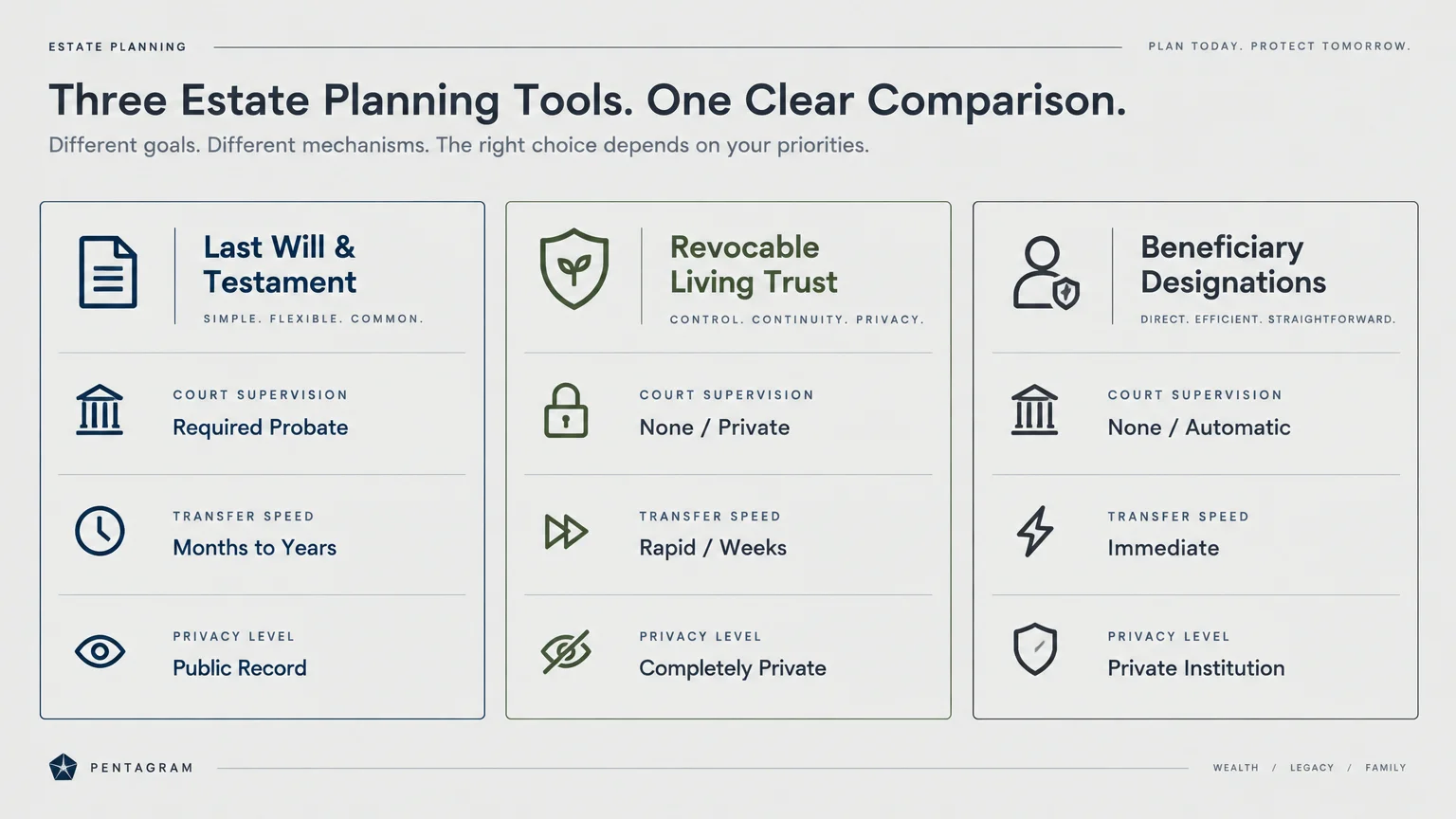
Choosing the correct tool for each asset category prevents court delays and slashes administrative fees. Review this comparison to see how different inheritance planning vehicles handle your estate:
| Feature | Last Will & Testament | Beneficiary Designation (TOD/POD) | Revocable Living Trust |
|---|---|---|---|
| Probate Court Required? | Yes, mandatory in all states | No, bypasses court entirely | No, distributes privately |
| Public Record? | Yes, accessible to anyone | No, private transaction | No, completely confidential |
| Speed of Transfer | Months to years | Days to weeks | Weeks to months |
| Can Include Complex Rules? | Limited (subject to review) | No, outright payment only | Yes, full flexibility |
| Average Setup Cost | $300 to $1,000+ | Free through financial institution | $1,200 to $1,500+ |
According to guides from the National Council on Aging (NCOA), simple online will services cost between $0 and $200. Meanwhile, attorney-drafted wills average a flat fee of $300 to $1,000 or more.
Living trusts cost more upfront, typically ranging from $1,200 to $1,500 and higher. However, trusts save thousands of dollars down the road by avoiding probate statutory fees and court filing expenses.
The average hourly rate for a qualified estate planning attorney nationwide is $391. Investing in professional advice up front prevents costly procedural errors that erode your family’s inheritance.
What Can Go Wrong: 4 Costly Will Mistakes
Even well-intentioned estate plans can collapse when families overlook basic administrative mechanics. Here are four common mistakes seniors make that spark probate chaos:
- Failing to update beneficiary designations: Storing outdated forms with plan administrators overrides even the most pristine will. An ex-spouse can easily inherit an entire pension or life insurance payout if you forget to file updated paperwork.
- Ignoring unequal tax burdens among heirs: Leaving a $300,000 traditional IRA to one child and a $300,000 cash account to another creates severe inequality. The child receiving the traditional IRA faces substantial ordinary income taxes, while the cash beneficiary pays nothing.
- Leaving an unfunded revocable living trust: Creating trust paperwork without formally re-titling real estate deeds, brokerage accounts, and bank holdings renders the trust useless. Unfunded assets remain trapped in probate court regardless of your good intentions.
- Failing to name contingent beneficiaries: If your primary beneficiary predeceases you and you have no secondary choice on file, the asset defaults to probate. Always name contingent heirs on every insurance policy, bank account, and retirement plan.
Spotting these red flags early lets you make adjustments before errors become permanent. A quick annual review of your paperwork protects your family from unexpected tax bills and legal confusion.
Estate Taxes and Transfer Thresholds
Many seniors believe writing a will helps them dodge estate and gift taxes. In reality, a will provides zero tax-sheltering benefits on its own.
Fortunately, federal estate taxes affect only the wealthiest households in the country. Following the July 4, 2025 tax legislation (Public Law 119-21), the federal estate tax exemption did not sunset by half as originally feared.
For 2026, the baseline federal estate and gift tax exemption stands at $15 million per individual, or $30 million for married couples. For 2027, the IRS announced the exemption increases to $15.48 million for individuals, or $30.96 million for married couples.
You can also transfer wealth during your lifetime using the annual gift tax exclusion. For 2026, you can gift up to $19,000 per recipient ($38,000 for married couples) tax-free without reducing your lifetime exemption limit.
The IRS announced this annual exclusion increases to $20,000 per recipient ($40,000 for couples) in 2027. Gifting money while living is a proven method to reduce probate burdens and assist loved ones immediately.
However, twelve states and the District of Columbia impose separate state-level estate taxes with much lower exemption thresholds. Check your local state revenue statutes to confirm whether your estate triggers local death taxes.

When to Consult a Professional
While basic do-it-yourself online software works for simple situations, certain life circumstances demand experienced legal counsel. You should schedule a consultation with an estate planning attorney if your situation includes any of the following:
- Blended families with children from prior marriages: Dividing assets between a current spouse and biological children requires protective trusts to avoid unintended disinheritance.
- Real estate holdings across multiple state lines: Owning real property in more than one state triggers ancillary probate in every jurisdiction where land is owned unless held in trust.
- Providing for dependents with disabilities: Navigating strict Social Security Administration (SSA) benefit thresholds requires specialized third-party special needs trusts.
- High-net-worth assets near state exemption limits: States like Oregon, Massachusetts, and Washington tax estates valued at $1 million to $2.19 million, requiring sophisticated tax sheltering strategies.
Consulting an experienced attorney provides tailored legal protections that generic forms cannot match. Professional guidance ensures every asset transfers smoothly according to state and federal law.
Frequently Asked Questions
Can a last will override a named beneficiary on a bank account?
No, a will cannot override a payable-on-death (POD) or transfer-on-death (TOD) beneficiary on a bank or brokerage account. Financial institution contracts supersede probate instructions in every state.
What happens to my assets if I die without a will?
Dying without a will is called dying intestate. Your state’s intestacy statutes will determine who inherits your property based on strict familial hierarchy, regardless of your personal wishes.
Are online wills legally binding for seniors?
Yes, online wills are legally binding provided they meet your state’s execution formalities. Most states require you to sign the document in front of two independent, adult witnesses and a notary.
Can I use my will to disinherit an adult child?
Yes, parents can legally disinherit adult children in all states except Louisiana under specific circumstances. However, you must state your intention explicitly in the document to prevent claims of accidental oversight.
Protecting Your Legacy with Confidence
Estate planning is not just about writing down where your possessions go. It is about choosing the right legal pathways so your family receives their inheritance without court delays, heavy taxes, or stress.
Take time this week to review your current deeds, account titles, and beneficiary forms across all financial institutions. Aligning these items with your broader estate plan guarantees your final wishes stand secure for years to come.
The information in this guide is meant for educational purposes. Your specific circumstances—including income, benefits, tax situation, and health needs—may require different approaches. When in doubt, consult a licensed financial advisor or tax professional.
Last updated: November 2026. Benefit amounts, tax rules, and program details change annually—verify current figures with official government sources.








Leave a Reply