
Your last will and testament does not determine who inherits your 401(k), traditional IRA, life insurance, or bank accounts; contractual beneficiary designations take complete precedence over instructions in a will. Failing to update these legal forms after major personal changes can accidentally disinherit loved ones or direct your hard-earned wealth to an ex-spouse. Recent survey data from Caring.com indicates that only 24% to 32% of American adults maintain an estate plan, with 40% mistakenly assuming they lack sufficient assets. Reviewing your account forms after key life changes guarantees your assets pass directly, efficiently, and privately to the people you choose while avoiding costly probate delays.

Why Beneficiary Designations Overrule Your Will
Many seniors believe that creating a comprehensive last will and testament covers all aspects of their estate. However, financial institutions transfer assets based on account contract law rather than probate instructions. When you open a 401(k), traditional IRA, Roth IRA, annuity, or life insurance policy, you sign a binding contract with the account custodian. That contract dictates that upon your death, the institution must pay the account balance directly to the listed primary and contingent beneficiaries.
Because these contractual designations bypass the probate court entirely, your designated beneficiaries receive their funds significantly faster—often within weeks rather than months or years. Bank accounts can also utilize Transfer on Death (TOD) or Payable on Death (POD) arrangements to achieve the same direct transfer. For additional guidance on protecting your financial accounts, the Consumer Financial Protection Bureau provides detailed educational guides for older adults.
| Feature | Beneficiary Designation Form | Last Will and Testament |
|---|---|---|
| Governing Authority | Contract law (Financial Custodian) | Probate Court |
| Transfer Speed | Fast (Usually 2 to 6 weeks) | Slow (Requires 6 to 18 months in probate) |
| Privacy Level | Private (Not public record) | Public (Filed in court records) |
| Legal Precedence | Overrides the Will | Subordinate to financial account contracts |
| Cost to Update | Free (Completed online or via standard form) | Requires attorney fees or formal codicil |

8 Life Events Requiring an Immediate Beneficiary Update
Whenever your personal structure or financial landscape evolves, updating retirement account beneficiaries should sit at the top of your priority list. Below are eight critical milestones when to update your beneficiaries immediately.
1. Marriage or Remarriage
Getting married fundamentally changes your legal status regarding financial assets. Under the federal Employee Retirement Income Security Act of 1974 (ERISA), employer-sponsored plans—such as 401(k)s and 403(b)s—automatically treat your surviving spouse as the 100% primary beneficiary. If you remarry and wish to leave a portion of your employer account to children from a previous marriage, federal law invalidates those instructions unless your new spouse signs a notarized spousal waiver form.
Individual Retirement Accounts (IRAs) operate under state contract laws rather than ERISA. However, if you live in one of the nine community property states—Arizona, California, Idaho, Louisiana, Nevada, New Mexico, Texas, Washington, or Wisconsin—assets earned during the marriage belong equally to both spouses. In these states, IRA custodians require written spousal consent before you can designate a non-spouse for more than 50% of the account. Navigating life changes and estate planning requires updating these forms immediately after saying “I do.”
2. Divorce or Legal Separation
Failing to update account designations after a divorce represents one of the most destructive beneficiary designation mistakes seniors make. Many states maintain “revocation upon divorce” statutes that automatically strike an ex-spouse from a will. However, federal ERISA regulations explicitly preempt state law for employer-sponsored plans.
In the landmark case Egelhoff v. Egelhoff, the United States Supreme Court ruled that an employer plan administrator must pay the designated beneficiary on file, even if a state court decree revoked the ex-spouse’s rights. If you forget to remove an ex-spouse from your 401(k) or group life insurance form, your former partner receives the entire asset payout, leaving your children or current partner empty-handed. Submit fresh beneficiary forms as soon as your divorce decree becomes final.
3. Death of a Named Beneficiary
If a primary beneficiary passes away before you, your account strategy suffers a significant disruption. If you listed multiple primary beneficiaries without specifying precise instructions—or if your sole primary beneficiary dies and you failed to name contingent beneficiaries—the account assets default to the custodian’s default policy. In many cases, the custodian pays the balance directly to your probate estate.
Plunging assets into your probate estate subjects those funds to court costs, executor fees, creditor claims, and lengthy distribution delays. When a loved one passes away, take time to review every account and adjust both primary and secondary (contingent) beneficiary tiers to reflect your current family structure.
4. Birth, Adoption, or Arrival of Grandchildren
Welcoming new children or grandchildren into your family brings immense joy, but it also warrants an estate checkup. Many seniors attempt to add grandchildren directly to financial account forms, but naming minor children creates severe legal complications. Financial institutions cannot legally transfer assets or distribute cash directly to minors under the age of 18 or 21 (depending on state law).
If a minor inherits account funds directly, the probate court must appoint a legal guardian to manage the money until the child reaches legal age. This process drains account balances through legal fees and court reporting requirements. Instead, name a trusted adult as a custodian under the Uniform Transfers to Minors Act (UTMA/UGMA) or establish a revocable trust for the benefit of the minor.
When dividing assets among adult children, pay attention to specific distribution language:
- Per Stirpes: If one of your adult children passes away before you, their designated percentage automatically splits equally among their surviving children (your grandchildren).
- Per Capita: If one of your adult children passes away before you, their designated share is revoked and redistributed proportionally among your surviving named children.
5. Changes in Federal Tax and Retirement Regulations
Legislative updates periodically change the tax treatment of inherited retirement accounts, necessitating strategic adjustments. The SECURE Act and SECURE 2.0 significantly altered legacy planning by eliminating the “stretch IRA” for most non-spouse beneficiaries. Previously, non-spouse heirs could extend inherited IRA distributions over their lifetime, allowing tax-deferred growth for decades.
Under current regulations, most non-spouse heirs inheriting traditional or Roth IRAs must withdraw all funds within 10 years of the original account owner’s death. Furthermore, if you pass away after reaching your Required Minimum Distribution (RMD) age—which SECURE 2.0 set at age 73 (rising to age 75 in 2033)—your non-spouse heirs must take annual distributions during years 1 through 9 before liquidating the remaining balance in year 10. You can review full regulatory details directly on the Internal Revenue Service website.
Additionally, SECURE 2.0 eliminated lifetime RMD requirements for employer-sponsored Roth 401(k) and Roth 403(b) accounts, bringing them into alignment with Roth IRAs. Inheriting a large traditional IRA can push an adult child in their peak earning years into a much higher tax bracket. In such cases, naming tax-exempt charitable organizations or spreading pre-tax assets among lower-income heirs offers far greater financial efficiency.
6. Diagnosis of Special Needs or Disability for an Heir
If a child, grandchild, or relative receives a diagnosis of a long-term disability or special needs, listing them as a direct beneficiary on an IRA or life insurance policy can create unintended hardship. Direct gifts or inheritances—often as small as $2,000—can instantly disqualify individuals from essential public assistance benefits like Supplemental Security Income (SSI) and Medicaid.
To support a family member with special needs without endangering their public assistance, do not name them directly on beneficiary forms. Instead, consult an attorney to create a Third-Party Special Needs Trust (SNT). You then list the Special Needs Trust as the account beneficiary. The trustee can manage distributions for supplemental care, education, and medical needs without compromising government support eligibility. Resources at the National Council on Aging provide valuable guidance on balancing public benefits and personal care planning.
7. Significant Shifts in Personal Wealth or Assets
A major liquidity event—such as selling a home, liquidating a business, or receiving a personal inheritance—can dramatically alter your net worth. As account balances expand, your distribution strategy must adapt. A distribution model that made sense with a $50,000 balance might fail when applied to a $1,000,000 portfolio.
Avoid specifying fixed dollar amounts on beneficiary forms (e.g., “$50,000 to Child A and $50,000 to Child B”). If market conditions contract the account value to $80,000, administrative confusion and family disputes arise. Always use percentages (e.g., “50% to Child A and 50% to Child B”) to ensure fair, proportional distribution regardless of market performance. Educational materials from FINRA and Investor.gov regularly stress using percentage allocations to avoid unintended account depletion.
8. Relationship Breakdown or Long-Term Estrangement
Relationships evolve over time, and estrangements unfortunately occur. If you suffer an enduring relational rift with a family member or former friend, take time to remove them from your beneficiary designations immediately. Relying on an updated will to disinherit someone will not work if their name remains on your 401(k) or brokerage account form.
If an estranged child remains listed as a primary beneficiary on your life insurance policy, the insurance carrier must pay the proceeds directly to that individual upon your death. Updating primary and secondary allocations ensures your assets flow exclusively to trusted family members, close friends, or charitable causes that align with your current values.

Common Beneficiary Designation Mistakes to Avoid
Preventing estate planning errors requires recognizing how small oversights lead to significant legal barriers. Below are major beneficiary designation mistakes seniors must actively avoid:
- Naming Your Estate as Beneficiary: Designating “My Estate” as the beneficiary voids the asset’s ability to bypass probate, exposing funds to court fees, creditors, and public records.
- Leaving the Contingent Beneficiary Section Blank: If your primary beneficiary passes away before you and no secondary choices exist, the asset defaults to probate court or custodian default rules.
- Forgetting About Transfer on Death (TOD) Options: Failing to add TOD or POD instructions to standard bank accounts and non-retirement brokerage accounts leaves those assets subject to probate.
- Failing to Notify Designated Beneficiaries: Keeping account locations secret makes it difficult for heirs to claim funds, often causing unclaimed property to revert to the state.

Finding the Right Advisor
While basic beneficiary forms can be completed independently, complex family structures and tax situations require professional guidance. Here are three common scenarios where hiring a qualified advisor is essential:
- Scenario 1: Complex Blended Families: If you have children from previous marriages and want to balance spousal support with child inheritances, hire an experienced Estate Planning Attorney. They can draft marital agreements, construct trusts, and structure ERISA spousal waivers correctly.
- Scenario 2: Substantial Pre-Tax IRA Assets: If you hold large traditional IRAs affected by the SECURE Act 10-year rule, work with a Fee-Only Certified Financial Planner (CFP) or CPA. They can evaluate partial Roth conversions, stretch distributions strategically, and optimize charitable giving.
- Scenario 3: Caring for Heirs with Special Needs: If you want to leave assets to a disabled relative, partner with a Special Needs Estate Attorney to establish a Supplemental Needs Trust and protect government benefit thresholds.
Step-by-Step Guide: Updating Retirement Account Beneficiaries
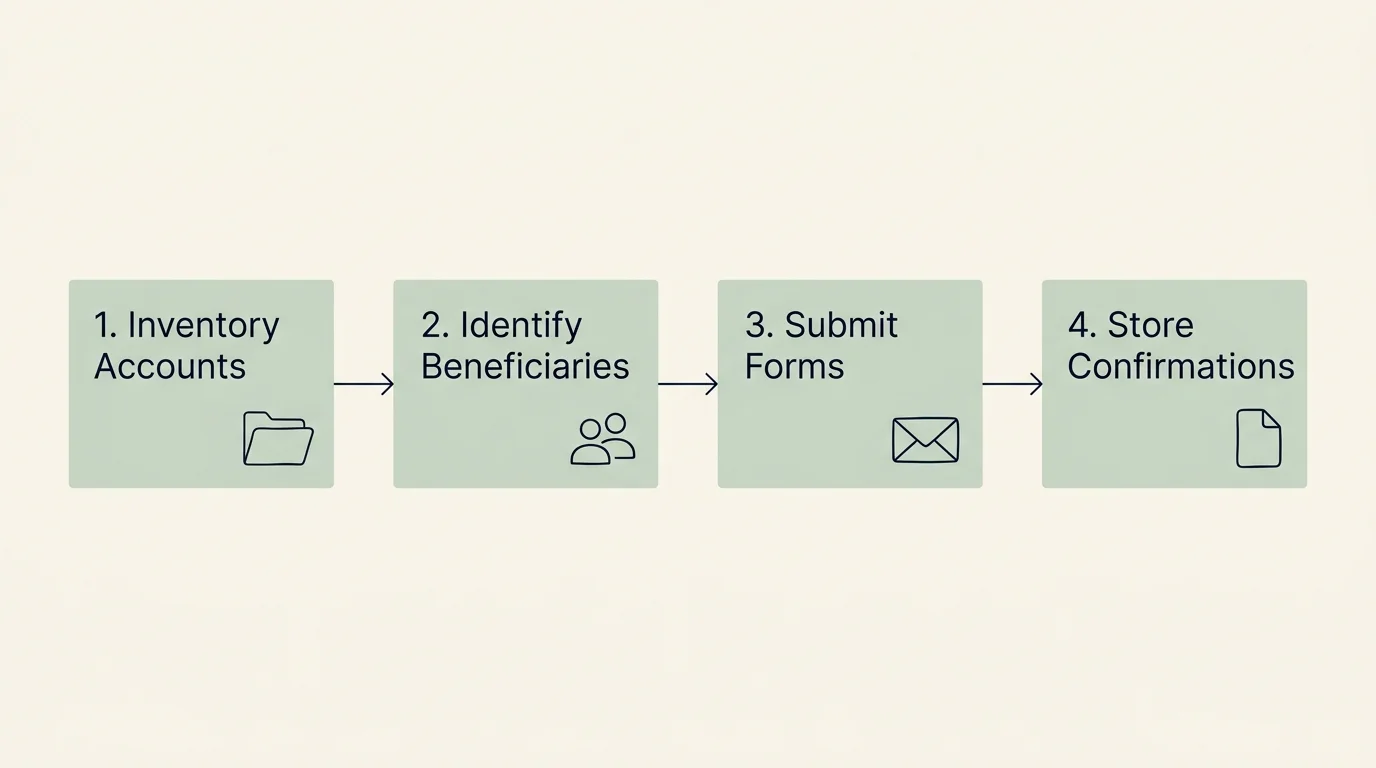
Updating your financial account paperwork is a simple, straightforward process. Follow these concrete steps to ensure your records are complete and accurate:
- Compile a Master Account List: Gather statements for all financial holdings, including 401(k)s, 403(b)s, traditional IRAs, Roth IRAs, annuities, pensions, life insurance policies, checking accounts, savings accounts, and brokerage accounts.
- Collect Legal Beneficiary Details: Gather the full legal name, Social Security number, date of birth, current address, and relationship for every individual or entity you plan to list.
- Review Statutory Rules: Check if you live in a community property state or hold ERISA employer accounts that require notarized spousal consent prior to making changes.
- Access Custodian Portals: Log into your account online or request formal paper change-of-beneficiary forms directly from each financial custodian.
- Specify Tiers and Percentages: Explicitly assign primary and contingent allocations. Ensure total percentages within each tier equal exactly 100%.
- Submit and Store Confirmations: Submit completed forms online or via certified physical mail. Save written confirmation receipts alongside your main estate planning documents.
“A beneficiary form on an IRA or 401(k) will override a will every single time. It doesn’t matter what your will says if your beneficiary form names someone else.” — Ed Slott, CPA and Retirement Account Expert
“Failing to update your beneficiaries is one of the most expensive financial mistakes you can make. You can spend thousands on a perfect trust, but an old 401(k) form will still give your money to your ex.” — Suze Orman, Personal Finance Author and Expert
Frequently Asked Questions
Does a prenuptial agreement automatically update my retirement account beneficiaries?
No. A prenuptial agreement is a legal contract between spouses, but it does not execute changes with financial account custodians. Furthermore, federal courts have consistently ruled that prenuptial agreements signed prior to marriage do not satisfy ERISA spousal waiver rules for 401(k) plans; a formal spousal waiver must be signed after marriage.
What is the difference between primary and contingent beneficiaries?
A primary beneficiary is first in line to inherit your financial assets upon your death. A contingent (or secondary) beneficiary inherits the funds only if all primary beneficiaries pass away before you or formally disclaim their right to the assets.
Can I name a non-profit charity as a primary or secondary beneficiary?
Yes. Naming a 501(c)(3) charitable organization as a beneficiary of traditional IRAs or 401(k)s is highly tax-efficient. Non-profit charities pay zero income tax on inherited traditional retirement distributions, allowing 100% of the funds to support your chosen cause.
How often should I review my beneficiary forms?
Review your beneficiary forms annually during routine financial checkups, as well as immediately following major life changes requiring beneficiary update—such as a marriage, birth, divorce, death, or major economic shift.
Taking immediate control of your financial designations ensures your legacy transfers smoothly to the people and causes you love. By conducting a quick annual review and submitting proper updates following major life events, you protect your estate from costly court battles and legal delays.
This is educational content based on general financial principles for seniors. Individual results vary based on your situation. Always verify current benefit amounts, tax rules, and program eligibility with official government sources.
Last updated: February 2026. Benefit amounts, tax rules, and program details change annually—verify current figures with official government sources.









Leave a Reply