

Testing whether you can live on 100 a week sounds extreme when everyday prices keep climbing. Yet a focused retirement budget challenge can reveal where your cash actually goes without forcing permanent deprivation.
Households headed by adults 65 and older average $64,445 in annual spending, according to 2025 U.S. Bureau of Labor Statistics (BLS) data. At $5,200 a year, $100 a week works best as a variable spending cap—not an all-in survival budget.
Separating fixed bills from weekly discretionary purchases lets you test low cost retirement living safely. Here is how the real numbers stack up and how you can run a four-week trial.
What $100 a Week Can—and Cannot—Cover in Retirement
Before you start budgeting for retirees on a tight weekly limit, you need to compare $5,200 a year against real national baselines. That math immediately shows which expenses belong inside your test and which ones sit outside it.
In the BLS 2025 Consumer Expenditure Survey, households led by someone age 65 to 74 spent an average of $69,333 per year. Spending dropped to $57,959 per year for households age 75 and older.
Even households in the lowest income quintile across the entire country averaged $37,935 in 2025. Meanwhile, the 2026 Federal Poverty Guideline set by the U.S. Department of Health and Human Services (HHS) stands at $15,960 per year for a one-person household in the 48 contiguous states and D.C.
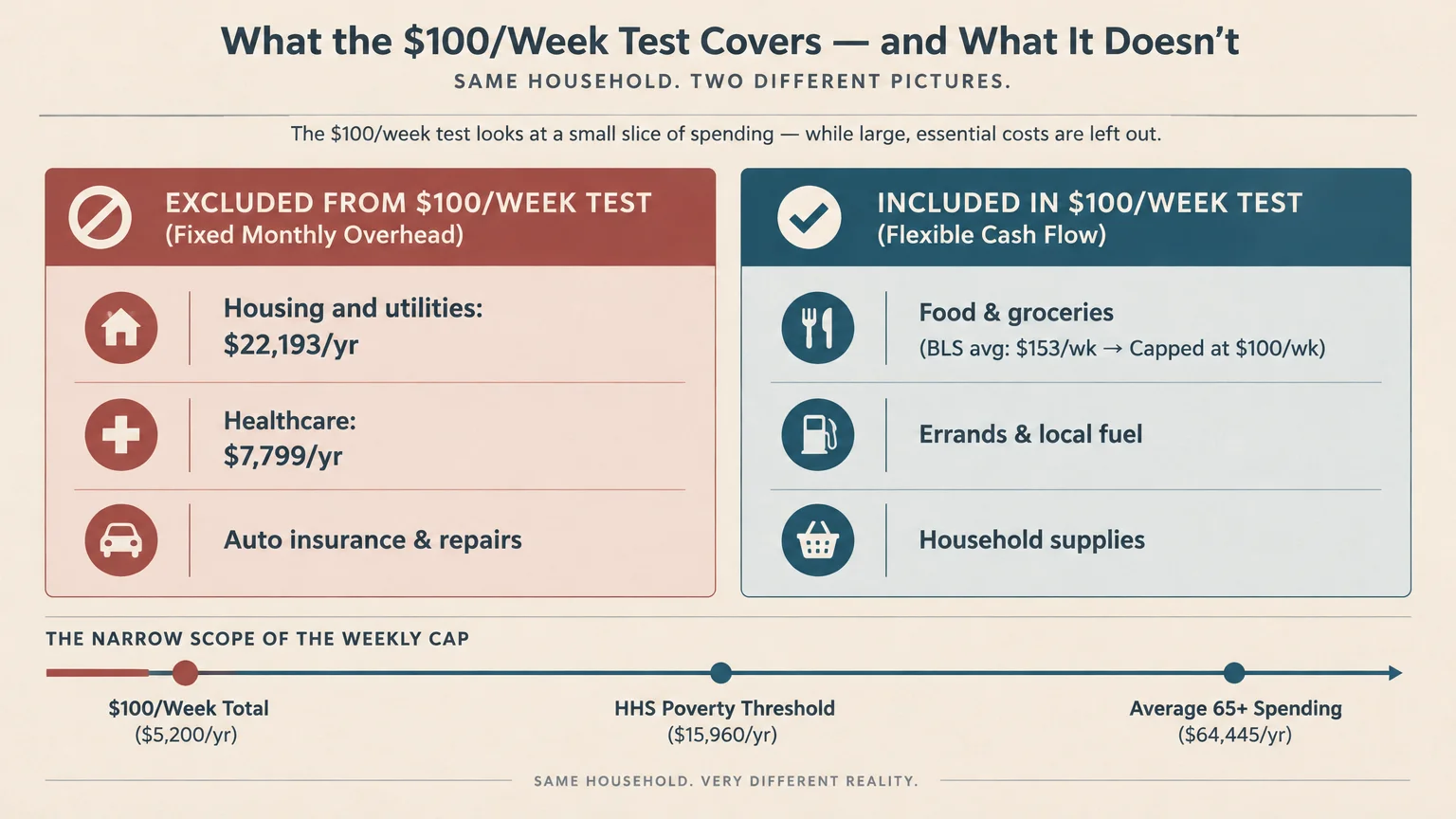
Because $5,200 is roughly one-third of that poverty threshold, $100 a week cannot cover rent, property taxes, utilities, insurance, and medical premiums together. Trying to squeeze housing and healthcare into $100 a week only sets you up for failure.
Instead, a realistic frugal retirement challenge focuses strictly on variable weekly cash flow. You pay fixed monthly obligations from regular income first, then challenge yourself to keep weekly flexible purchases at or below $100.
| Spending Category | 2024 BLS Average (65+ Households) | Included in a $100/Week Test? |
|---|---|---|
| Housing and utilities | $22,193 per year | No — paid as a fixed monthly obligation |
| Transportation | $9,538 per year | Partially — fuel and local errands only, not insurance or repairs |
| Food (groceries and dining) | $7,940 per year (~$153/week) | Yes — primary target of the weekly cap |
| Healthcare | $7,799 per year (rose to $7,986 in 2025) | No — premiums, deductibles, and prescriptions stay protected |
| All other expenses | $13,962 per year | Partially — household supplies, personal care, and entertainment |
Looking at the BLS 2024 breakdown explains why food dominates any weekly challenge. Older households averaged roughly $153 per week on food alone, which leaves little margin when your total weekly cap sits at $100.
Research from the Employee Benefit Research Institute (EBRI) shows that 79% of retirees follow a monthly spending plan, and 81% spend under $4,000 per month. Still, 29% report that their spending exceeds what they can comfortably afford.
Running a short, structured test gives you concrete feedback before overspending erodes your nest egg. According to the Federal Reserve’s Survey of Consumer Finances, median retirement savings peak at $200,000 for ages 65 to 74 and decline to $130,000 for ages 75 and older.
Grocery and Inflation Reality Check for Older Adults
Food will eat up most of your $100 weekly allowance during a challenge, so official grocery benchmarks help you set fair expectations. The USDA Food and Nutrition Administration publishes monthly food plans that estimate the cost of a nutritious diet prepared entirely at home.
Those USDA figures exclude restaurant meals, takeout, paper goods, and cleaning supplies. They also start from a four-person household baseline, which assumes bulk-buying savings that solo seniors and couples rarely capture.
To adjust for smaller kitchens, the USDA recommends adding 20% to individual estimates for a one-person household. Couples should add 10% per person to reflect higher per-meal packaging costs and smaller portions.
| Age and Sex Group | Thrifty Plan (4-Person Baseline) | Low-Cost Plan (Baseline) | Moderate-Cost Plan (Baseline) | Liberal Plan (Baseline) |
|---|---|---|---|---|
| Women ages 51–70 | $54.60/week ($236.40/mo) | $62.10/week | $76.50/week | $92.20/week |
| Women ages 71+ | $60.10/week ($260.60/mo) | $61.90/week | $76.10/week | $91.00/week |
| Men ages 51–70 | $64.90/week ($281.20/mo) | $69.10/week | $86.50/week | $103.60/week |
| Men ages 71+ | $61.90/week ($268.40/mo) | $68.40/week | $84.10/week | $103.40/week |
Once you apply the 20% solo household adjustment to the September 2026 Thrifty Food Plan, a single older adult faces roughly $65.50 to $77.90 per week just for home-cooked groceries. That leaves only about $22 to $34 each week for soap, laundry detergent, gasoline, and leisure.
For a two-person household trying to live on 100 a week combined, the math tightens even further. Two adults on the Thrifty plan typically exceed $100 per week in groceries alone once you factor in the 10% couple adjustment.
Recent inflation figures confirm why restaurant meals quickly break a strict weekly budget. Over the 12 months ending September 2026, the BLS Consumer Price Index (CPI-U) rose 3.7% overall, pushed higher by a 20.4% jump in energy costs.
During that same 12-month stretch, overall food prices climbed 2.5%. Grocery prices rose 1.8%, while restaurant and takeout prices jumped 3.5%.
Monthly inflation continued nudging budgets higher into the fall. In October 2026, CPI-U rose 0.4% from the previous month following a 0.6% increase in September, with groceries up 0.4% and dining out up 0.5%.
Cooking almost every meal at home gives you the strongest leverage during a low cost retirement living test. Even one casual restaurant dinner can consume a third of your weekly allowance before you buy produce for the week.

Fixed Healthcare and Income Numbers That Sit Outside Your Test
A smart weekly spending test never ignores the fixed income and mandatory healthcare deductions shaping your monthly check. Understanding those background figures keeps your challenge grounded in how retirement cash flow actually works.
As of September 2026, the average Social Security retired-worker benefit stood at $2,088.79 per month, or $25,065.48 per year, according to the Social Security Administration (SSA) Monthly Statistical Snapshot. That benefit covers roughly 41% of average annual spending for households age 65 and older.
Benefits received a 2.8% cost-of-living adjustment (COLA) in 2026, and relief is scheduled for the new year. In October 2026, SSA announced a 3.6% COLA taking effect in January 2027 for nearly 72 million Social Security beneficiaries.
That 2027 increase will add roughly $75 per month to the average retired-worker benefit, lifting it from about $2,095 to $2,170 per month. Supplemental Security Income (SSI) recipients will see their adjusted payments begin on December 31, 2026.
You can verify your personal benefit estimate and withholding status anytime through your account on the Social Security Administration website. Knowing your exact net deposit tells you how much fixed income remains after Medicare deductions.
Medicare premiums take a sizable bite before money ever reaches your checking account. In 2026, the standard Medicare Part B monthly premium is $202.90—nearly $47 per week on its own—alongside a $283 annual deductible.
Higher-income retirees pay more through Income-Related Monthly Adjustment Amount (IRMAA) tiers, which climb as high as $689.90 per month in 2026. Meanwhile, the 2026 Medicare Part A inpatient hospital deductible sits at $1,736 per benefit period.
Several Medicare updates affect 2026 and 2027 planning:
- One-time 2026 rebate: CMS began issuing a one-time $90 Part B rebate payment in October 2026 to roughly 20.8 million Original Medicare beneficiaries, excluding Medicare Advantage and Medicaid dual-eligible enrollees.
- Higher 2027 drug cap: For 2027, the finalized Part D prescription drug annual out-of-pocket cap rises from $2,100 to $2,400, and the maximum standard deductible increases from $615 to $700.
- Medicare Advantage shifts: CMS reports the average Medicare Advantage monthly premium drops from $14.37 to $12.00 for 2027, though roughly 3 million enrollees must pick new coverage due to plan exits during Open Enrollment from October 15 through December 7, 2026.
- Projected Part B increase: Although not yet finalized as of mid-November 2026, the Medicare Trustees Report projects a 2027 standard Part B premium of $209.50 per month and a $292 deductible.
Long-term medical costs also explain why you should never skimp on preventive care just to pass a weekly challenge. According to Fidelity Investments’ 25th annual Retiree Health Care Cost Estimate released in July 2026, a 65-year-old retiring in 2026 can expect to spend an average of $185,500 in after-tax savings on healthcare over retirement, excluding long-term care.
You can review current plan options, deductibles, and drug coverage rules directly on Medicare.gov. Pair that healthcare check with a quick look at your portfolio withdrawal pace.
While the classic 4% withdrawal rule dates back to Bill Bengen’s 1994 research, Morningstar’s 2026 State of Retirement Income report places a conservative starting safe withdrawal rate at 3.9% for a balanced portfolio over 30 years. Using flexible spending rules—like trimming discretionary cash during down market years—helps retirees sustain higher spending safely.
If you still work part-time to supplement fixed income, watch Social Security’s Retirement Earnings Test before full retirement age (FRA). In 2026, SSA withholds $1 in benefits for every $2 earned above $24,480 per year, rising to $25,560 in 2027.
During the calendar year you reach FRA, a higher threshold of $65,160 applies in 2026 and rises to $67,920 in 2027, with $1 withheld per $3 over until your FRA month. Those still earning can also use 2026 contribution limits of $24,500 for 401(k)s—plus $8,000 in catch-ups at 50 or $11,250 for ages 60 to 63—and $7,500 for IRAs with a $1,100 catch-up.
Finally, factor in the new $6,000 senior tax deduction available in 2026, subject to income thresholds. Checking current deduction and bracket rules on the Internal Revenue Service (IRS) website ensures you do not overpay taxes on retirement withdrawals.
How to Run a Four-Week $100 Retirement Budget Challenge
Testing a $100 weekly budget works best as a short, structured experiment rather than a permanent rule. Four full weeks—28 days—gives you enough time to cycle through grocery restocks, errands, and weekend habits without feeling trapped.
Follow these six steps to run your retirement budget challenge accurately and comfortably:
- Wall off your fixed and medical obligations. List housing, utilities, insurance, Medicare premiums, prescription copays, and automatic charity gifts as protected monthly bills. None of those expenses come out of your $100 weekly test allowance.
- Audit your last four weeks of variable spending. Pull bank and credit card statements to total what you actually spent on groceries, dining out, coffee, gas, household items, gifts, and entertainment. Divide that monthly total by four to see your true starting baseline.
- Choose your tracking method before day one. Withdraw $100 in cash each Monday morning into a dedicated envelope, or load $100 onto one standalone debit card. Keeping test money physically separate prevents accidental overspending from your main checking account.
- Inventory your pantry and freezer first. Plan your first week of meals around ingredients you already own so you do not waste money on duplicates. Shop with a written list anchored to USDA Thrifty staples like oats, dry beans, rice, eggs, frozen vegetables, and seasonal produce.
- Log every purchase and your stress level daily. Write down each dollar spent along with a quick note on whether cutting back felt empowering or frustrating. Tracking emotions matters just as much as tracking receipts when testing budgeting for retirees.
- Review your results after day 28 and set a sustainable target. Add up what you spent across all four weeks and note any delayed purchases you pushed into month two. If $100 felt too tight for a healthy diet or social life, adjust your permanent weekly target upward until comfort and savings balance.
Remember that EBRI data shows 48% of lower-income retirees stick closely to their spending plans. The goal of your trial is not winning a contest—it is discovering the lowest weekly number that still preserves your health, nutrition, and peace of mind.
If your trial lands at $120 or $140 per week instead of $100, count the experiment a success anyway. Cutting even $30 or $40 from wasteful weekly habits frees up thousands of dollars over a decade of retirement.

Practical Ways to Stretch $100 a Week Without Sacrificing Comfort
You do not need extreme couponing or bland meals to make a lean weekly allowance feel generous. A few intentional shifts in how you shop, cook, and socialize stretch every dollar noticeably further.
Use these practical strategies during your four-week challenge and beyond:
- Replace restaurant meals with home gatherings. Because dining out rose 3.5% over the past year while grocery inflation stayed at 1.8%, inviting friends over for coffee or potluck soup saves cash without isolating you.
- Shop unit prices instead of package prices. Solo retirees often pay a hidden penalty on small single-serve items, so compare cost per ounce and freeze extra portions of meat, bread, and soup in single-meal containers.
- Borrow entertainment instead of buying it. Public libraries offer free books, audiobooks, streaming movies, museum passes, and senior workshops that replace paid subscriptions and ticketed outings.
- Batch errands into one driving loop. Energy prices jumped 20.4% over the 12 months through September 2026, so combining grocery runs, pharmacy pickups, and library visits cuts fuel costs fast.
- Check benefit programs if your budget stays tight. Households near 150% of the 2026 Federal Poverty Guideline—$1,995 per month for one person or $2,705 per month for two—often qualify for food, utility, or Medicare cost-sharing assistance.
If your income falls near those thresholds, never leave earned assistance on the table out of pride. You can screen for federal and state food, energy, and healthcare support programs through Benefits.gov.
Older adults can also run a quick, confidential eligibility screening through the National Council on Aging (NCOA). Connecting with just one property tax credit, utility discount, or prescription assistance program can relieve far more pressure than clipping grocery coupons.
Pitfalls to Watch For
Frugal retirement experiments work wonderfully until hidden traps distort your numbers or harm your well-being. Watch closely for four common mistakes seniors make when testing a tight weekly limit.
First, never skip prescriptions, dental cleanings, or fresh produce just to hit $100 on paper. Deferring medical care or nutritious food creates bigger bills later and defeats the purpose of smart retirement planning.
Second, do not confuse delayed spending with real savings. If you postpone buying laundry detergent, pet food, or birthday gifts until week five so week four looks cheap, your test results will mislead you.
Third, watch out for irregular annual expenses lurking outside your weekly envelope. Car registration renewals, home repairs, holiday travel, and Medicare deductibles—including the $283 Part B deductible and $1,736 Part A hospital deductible—still require dedicated monthly savings.
Fourth, do not ignore annual Medicare plan changes while focusing solely on grocery receipts. With roughly 3 million Medicare Advantage enrollees forced to switch exiting plans for 2027 and Part D’s maximum deductible rising to $700, missing Open Enrollment can cost far more than $100 a week.

Getting Expert Help
A do-it-yourself spending challenge clarifies daily habits, yet major retirement decisions often call for professional guidance. Consider seeking qualified help in these four specific situations:
- Your spending regularly exceeds income: If you fall among the 29% of retirees whose outlays outpace affordable income, a fee-only Certified Financial Planner (CFP) can restructure withdrawals, debts, or housing costs before savings run dry.
- You plan to work while claiming Social Security: If your earnings approach the $24,480 limit in 2026 or $25,560 in 2027 before full retirement age, an advisor can help time your claim to avoid unexpected benefit withholding.
- Your Medicare plan is exiting or changing drug tiers: State Health Insurance Assistance Program (SHIP) counselors offer free, unbiased one-on-one help comparing 2027 Part D formularies and Medicare Advantage options.
- You want to optimize taxes on retirement withdrawals: A Certified Public Accountant (CPA) can coordinate IRA or 401(k) distributions with the 2026 $6,000 senior tax deduction and help prevent triggering higher Medicare IRMAA surcharges.
Frequently Asked Questions About Living on $100 a Week
Can a single retiree realistically live on $100 a week for everything?
No, $100 a week—or $5,200 a year—cannot cover housing, utilities, transportation, and healthcare alongside food. However, it works well as a short-term cap for variable groceries, supplies, and local leisure once fixed bills are already paid.
Does $100 a week cover groceries for one person in 2026?
Yes, if you cook at home and stick closely to basic staples. After adding the USDA’s 20% solo-household adjustment to the September 2026 Thrifty Food Plan, groceries for one older adult run roughly $65.50 to $77.90 per week.
How does Social Security fit into a low-cost retirement budget?
The September 2026 average retired-worker benefit of $2,088.79 per month covers about 41% of average 65+ household spending. Pairing that steady check—plus the 3.6% COLA arriving in January 2027—with a lean weekly cap helps stretch modest savings.
What should I do if $100 a week feels too restrictive during my test?
Adjust the weekly target upward rather than abandoning your budget altogether. Even trimming $25 or $50 from your old weekly average strengthens your long-term retirement cash flow without sacrificing comfort.
Your Next Step for a More Confident Retirement Budget
Pick a Monday on your calendar, separate your fixed monthly bills, and test a $100 weekly cap for the next 28 days. Whether you stick with $100 or settle on a slightly higher figure, knowing your true weekly baseline puts you firmly in control of your money.
This article provides general financial education and information only. Everyone’s financial situation is unique—what works for others may not work for you. For personalized advice tailored to your retirement needs, consider consulting a qualified financial professional such as a CFP or CPA.
Last updated: November 2026. Benefit amounts, tax rules, and program details change annually—verify current figures with official government sources.









Leave a Reply