

Your monthly Social Security survivor benefit will increase by 3.6% starting in January 2027. This official cost-of-living adjustment lifts the average monthly payment for an aged widow living alone from $1,936 to $2,005.
While an extra $69 each month brings welcome relief against utility bills and groceries, rising Medicare premiums can quietly eat into those gains.
Learning how your surviving spouse benefit adjusts for 2027 allows you to budget accurately and protect every dollar of your monthly household income.

How the 2027 COLA Expands Survivor Monthly Checks
The Social Security Administration announced the 3.6% Cost-of-Living Adjustment (COLA) on October 14, 2026. This boost directly affects approximately 76 million Americans who receive Social Security or Supplemental Security Income payments.
The 2027 increase outpaces the 2.8% adjustment from 2026. It reflects sustained inflationary pressure on core expenses like healthcare, energy, and housing.
For an aged widow or widower living alone, the average monthly payment moves from $1,936 to $2,005. That adjustment equals an average annual increase of $828.
Widowed parents caring for children also see higher payments. A widowed mother with two qualifying children will see average monthly benefits climb from $3,932 to $4,074, an increase of $142 per month.
For comparison, the average benefit for all retired workers climbs from $2,095 to $2,170 per month. That represents a $75 monthly increase.
You can verify your specific payment record by visiting the official Social Security Administration website. Your individual raise depends entirely on your late spouse’s historical earnings record.
The Core Mechanics of Social Security Survivor Benefits
Survivor benefits provide essential monthly income to surviving spouses, but the calculation rules differ from standard retired worker benefits. Understanding these rules helps you avoid costly claiming errors.
If you have reached full retirement age, you are eligible to receive up to 100% of your deceased spouse’s basic benefit amount. This includes any delayed retirement credits your spouse earned before passing away.
Full retirement age sits at 67 for anyone born in 1960 or later. Beneficiaries born in 1960 reach their full retirement age during 2027.
You can claim surviving spouse benefits as early as age 60, or age 50 if you have a qualifying disability. However, claiming before your full retirement age permanently reduces your monthly check.
A reduced survivor benefit claimed at age 60 pays approximately 71.5% of the deceased worker’s full amount. That reduction remains permanent for the rest of your life.
When a spouse passes away, Social Security rules do not allow you to combine both checks. Instead, you keep the single higher benefit of the two, while the smaller check stops completely.
An aged couple receiving an average combined benefit of $3,238 in 2026 would see that figure rise to $3,355 in 2027. Yet if one spouse passes, the household drops to a single check.
“A survivor benefit is not just a monthly check; it is a vital safety net that requires proactive management to protect your security.” — Suze Orman, Personal Finance Expert
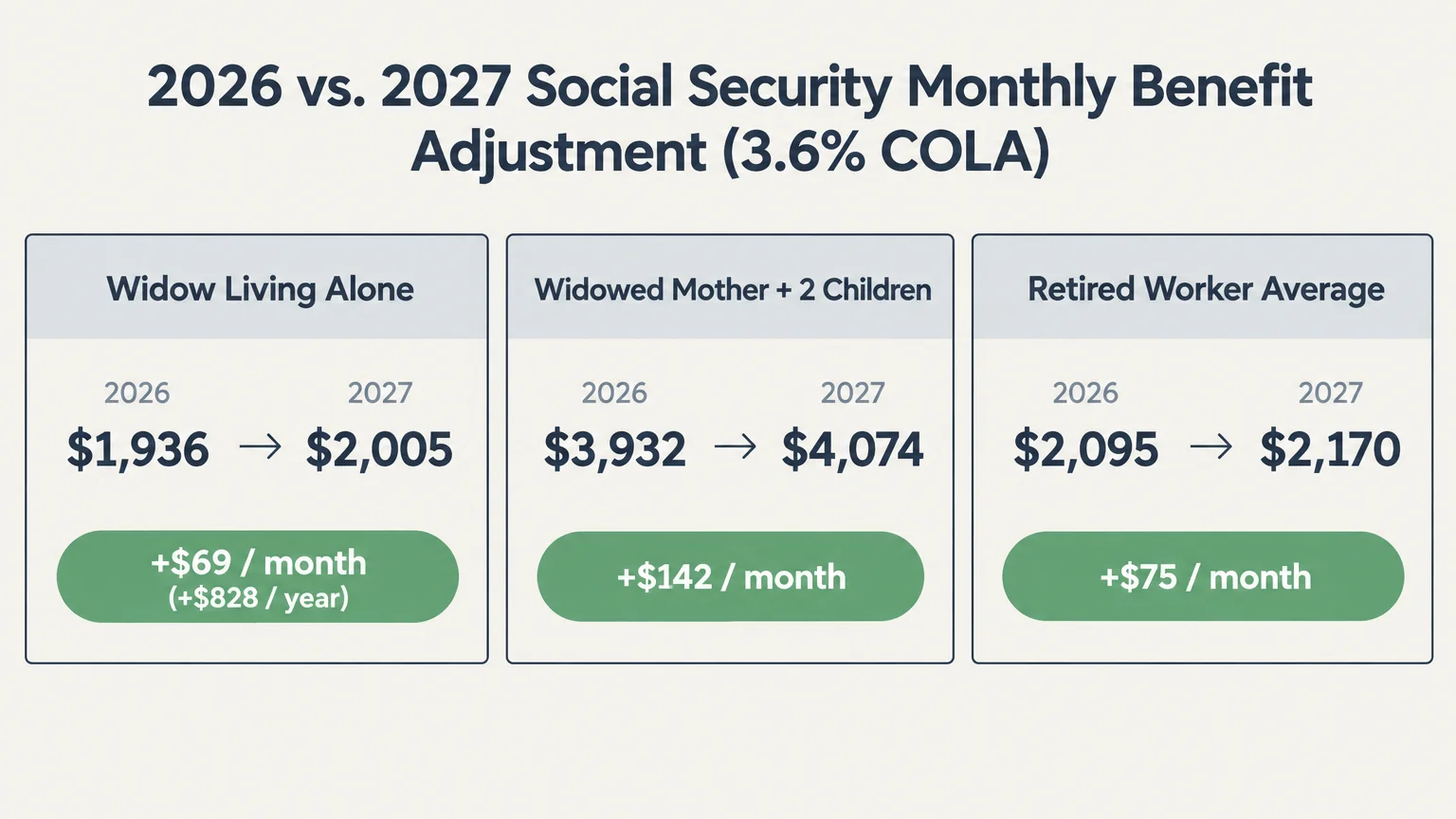
Benefit Comparison: 2026 vs. 2027 Payment Amounts
The 3.6% COLA applies uniformly across all Social Security benefit programs. The actual dollar increase you receive depends directly on the size of your current monthly payment.
The table below highlights the estimated average monthly and annual payments across major beneficiary categories for 2026 and 2027.
| Beneficiary Category | 2026 Average Monthly Benefit | 2027 Average Monthly Benefit (3.6% COLA) | Estimated Monthly Increase | Estimated Annual Increase |
|---|---|---|---|---|
| Aged Widow(er) Living Alone | $1,936 | $2,005 | +$69 | +$828 |
| Widowed Mother with 2 Children | $3,932 | $4,074 | +$142 | +$1,704 |
| All Retired Workers | $2,095 | $2,170 | +$75 | +$900 |
| Aged Couple (Both Receiving) | $3,238 | $3,355 | +$117 | +$1,404 |
If your current monthly survivor benefit is higher than the national average, your dollar raise will be larger. For example, a widow receiving $2,500 per month in 2026 gains $90 each month in 2027.
Conversely, a monthly benefit of $1,500 increases by $54 per month. Checking your gross payment amount helps you project your exact numbers accurately.
The Medicare Part B Deduction and Your Real Take-Home Pay
Most widowed retirees do not receive their gross Social Security raise in full. The federal government automatically deducts Medicare Part B medical insurance premiums directly from your monthly payment.
In 2026, the standard monthly Medicare Part B premium was $202.90. The Medicare Trustees projected the 2027 standard Part B premium to rise to roughly $209.50 per month.
An increase of approximately $6.60 in your Part B premium offsets your monthly COLA raise. For an average widow receiving a $69 monthly raise, the actual net increase equals roughly $62.40.
Higher-income widows face an additional hurdle known as the Income-Related Monthly Adjustment Amount (IRMAA). IRMAA adds a monthly surcharge to your Medicare Part B and Part D premiums.
Single filers face IRMAA surcharges when modified adjusted gross income exceeds $109,000. That threshold is half the $218,000 limit allowed for married couples filing jointly.
You can review detailed healthcare coverage rules and premium tiers through Medicare.gov. Factoring healthcare deductions into your retirement ledger gives you an honest picture of your net income.
Navigating the “Widow’s Penalty” at Tax Time
The loss of a spouse creates major changes in your federal tax obligations. Financial planners often refer to this abrupt shift as the “widow’s penalty.”
In the year following your spouse’s death, your tax filing status shifts from Married Filing Jointly to Single. This change cuts your tax bracket widths nearly in half.
The standard deduction also drops significantly for single taxpayers. This means a larger portion of your remaining income falls into higher tax brackets.
Federal tax thresholds on Social Security benefits do not adjust for inflation. These thresholds have remained fixed since their introduction decades ago.
If your combined income exceeds $25,000 as a single filer, up to 50% of your Social Security benefits become taxable. Combined income includes your adjusted gross income, nontaxable interest, and half your Social Security benefits.
If your combined income exceeds $34,000 as a single filer, up to 85% of your benefits become subject to federal income tax. For married couples filing jointly, those thresholds are $32,000 and $44,000 respectively.
“When you shift from a joint tax return to a single return as a widow, the tax bite on your retirement income can be devastating if you do not plan ahead.” — Ed Slott, CPA and Retirement Distribution Expert
A surviving spouse with an identical household income often pays thousands of dollars more in federal taxes. You can verify your filing requirements and tax status through the Internal Revenue Service.

Working While Receiving Survivor Benefits: 2027 Earnings Limits
Many widowed retirees choose to work part-time or full-time to supplement their monthly income. If you work while collecting survivor benefits before reaching full retirement age, the Retirement Earnings Test applies.
For 2027, the earnings test exempt amount for beneficiaries under full retirement age for the entire year rises to $25,560. That equals $2,130 per month, up from $24,480 in 2026.
If your earnings exceed $25,560, the Social Security Administration withholds $1 in benefits for every $2 you earn over the limit. This withholding reduces your monthly benefit checks throughout the year.
A different earnings limit applies during the calendar year you reach your full retirement age. For 2027, that higher limit rises to $67,920 per year, or $5,660 per month, up from $65,160 in 2026.
In the months leading up to your 67th birthday, the agency withholds $1 for every $3 you earn above $67,920. Only earnings accumulated before the month you hit full retirement age count toward this limit.
Once you reach your full retirement age, the earnings limit disappears entirely. You can earn an unlimited income from wages or self-employment without losing a single dollar of your survivor benefit.
Withheld benefits are not lost forever. Once you reach full retirement age, the agency recalculates your monthly benefit upward to credit back the months your payments were withheld.
Smart Claiming Strategies: Switching Between Benefits
Survivor benefits offer a unique strategic advantage that standard retirement benefits do not. You do not have to claim your survivor benefit and your own retirement benefit at the same time.
Federal rules allow you to claim one benefit early while letting the other benefit grow untouched. This flexibility creates substantial long-term financial opportunities for surviving spouses.
You can collect a reduced survivor benefit as early as age 60. While you receive those checks, your own retirement benefit continues to earn delayed retirement credits up to age 70.
Personal retirement benefits grow by 8% per year for every year you delay claiming between full retirement age and age 70. At age 70, you can switch to your own higher retirement benefit.
Alternatively, if your deceased spouse was the primary high earner, you can claim your own smaller retirement benefit at age 62. You can then let your survivor benefit grow to its full 100% value at age 67.
At age 67, you step up to the full survivor benefit based on your spouse’s record. This dual-track claiming strategy can add tens of thousands of dollars to your lifetime retirement income.
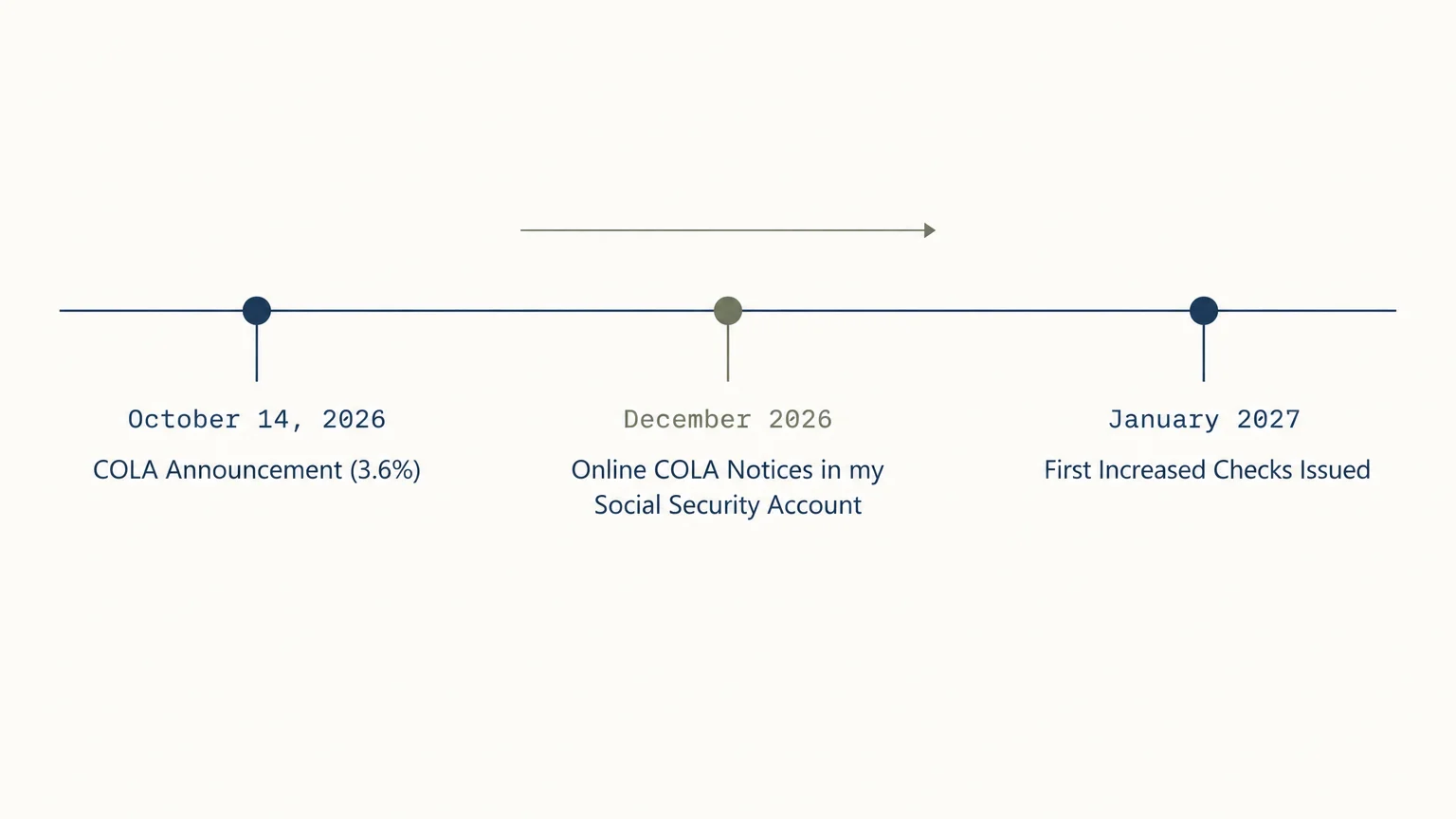
Key 2026–2027 Dates and Accessing Your COLA Notice
Tracking key administrative deadlines ensures you receive your 2027 COLA notice on time and review your updated benefit amounts without delay.
Beneficiaries should keep these critical transition dates in mind:
- November 18, 2026: Deadline for beneficiaries without a my Social Security account to create one online and enroll in paperless notices to view their 2027 COLA rate digitally.
- Late November 2026: The Social Security Administration uploads 2027 COLA notices into the secure Message Center for all registered online users.
- December 2026: Traditional paper COLA notices are mailed to all beneficiaries who did not opt into paperless digital notifications.
- December 31, 2026: Supplemental Security Income (SSI) recipients receive their first adjusted 2027 payment, raising the individual maximum federal rate to $1,029 per month.
- January 2027: Social Security survivor and retirement beneficiaries receive their first official payment reflecting the 3.6% COLA raise.
Your exact payment date in January depends on your day of birth. If you collect benefits based on your late spouse’s record, payment schedules follow your spouse’s date of birth.
Beneficiaries born between the 1st and 10th receive checks on the second Wednesday of January. Those born between the 11th and 20th receive funds on the third Wednesday.
Beneficiaries born after the 20th receive their checks on the fourth Wednesday of the month. Anyone who began receiving Social Security before May 1997 receives payment on the third day of the month.
Pitfalls to Watch For
Navigating survivor benefits involves complicated administrative and tax rules. Avoiding these common mistakes will protect your household finances heading into 2027.
1. Assuming the Benefit Transfer Is Automatic
The Social Security Administration does not automatically convert your spousal benefits into survivor benefits when your spouse passes away. You must formally apply for survivor benefits.
Funeral directors often report deaths directly to the government, but that only stops the deceased spouse’s check. You must contact the agency directly by phone or schedule an appointment to claim survivor payments.
2. Overlooking the Single Tax Bracket Shock
Many widows fail to adjust their income tax withholding after losing a spouse. Moving to the single filing bracket can result in a surprise tax bill in April.
You can submit IRS Form W-4V to the Social Security Administration to request voluntary federal tax withholding. Choosing a 7%, 10%, 12%, or 22% withholding rate prevents unexpected tax penalties.
3. Claiming Benefits in the Wrong Order
Filing for both your own retirement benefit and your survivor benefit simultaneously locks you into a single payment calculation. You forfeit the chance to let one benefit grow independently.
Always evaluate which benefit offers the higher lifetime return before submitting your claim. Consult a financial planner to calculate whether delaying your own benefit to age 70 produces superior income.
4. Violating the Earnings Limit While Working
Earning more than $25,560 in 2027 while collecting survivor benefits under full retirement age triggers mandatory benefit withholdings. This surprise disruption can temporarily freeze your monthly cash flow.
Track your monthly wages carefully if you work part-time. If your earnings will exceed the threshold, alert the agency promptly to prevent accidental overpayments that must be repaid later.

Getting Expert Help
While basic Social Security rules appear simple, survivor benefit coordination frequently intersects with complex estate and retirement regulations. Seeking professional guidance can protect your long-term security.
Consider consulting a qualified financial advisor, such as a Certified Financial Planner (CFP) or CPA, in the following scenarios:
- Managing Government Pension Offsets (GPO): If you receive a government pension from non-Social Security covered employment, a specialist can calculate how the GPO reduces your survivor benefit.
- Coordinating Traditional IRA Withdrawals: An advisor can help you time Required Minimum Distributions (RMDs) to avoid pushing your combined income over the $25,000 Social Security tax threshold.
- Choosing Between Dual Benefit Streams: A planner can model whether claiming early survivor benefits while deferring your own retirement check to age 70 maximizes your lifetime net wealth.
- Assessing State-Specific Public Assistance: If your monthly income remains limited, specialists via Benefits.gov can connect you with Medicare Savings Programs and Supplemental Nutrition Assistance.
Professional financial guidance helps you make objective decisions during emotional transitions. An advisor ensures your income plan accounts for inflation, rising taxes, and healthcare expenses.
Frequently Asked Questions About 2027 Survivor Benefits
When will I see the 3.6% COLA in my bank account?
You will receive your increased benefit payment in January 2027. Your payment arrives on the second, third, or fourth Wednesday of January, depending on your late spouse’s birth date.
Can I collect survivor benefits if I decide to remarry?
If you remarry after reaching age 60 (or age 50 if disabled), your remarriage does not affect your eligibility for survivor benefits. If you remarry before turning age 60, you cannot receive survivor benefits while married.
How do I know whether to take my own benefit or my survivor benefit?
You should compare your personal benefit at age 70 against your deceased spouse’s full benefit. If your personal benefit will be higher at age 70, consider claiming reduced survivor benefits early while letting your own check grow.
Does the 2027 COLA apply to the one-time death payment?
No, the 3.6% COLA does not apply to the lump-sum death payment. That payment remains fixed by law at $255 and has not adjusted for inflation since 1954.
Steps to Take Before January 2027
Securing your finances as a widowed retiree requires proactive preparation before the new year arrives. Start by reviewing your monthly spending plan to incorporate the 3.6% raise alongside updated utility and grocery costs.
Log in to your my Social Security account before late November 2026 to verify your personal COLA notice. Check your projected Medicare Part B premium deduction to confirm your exact take-home payment.
Review your tax withholding using IRS Form W-4V to prevent bracket-shift penalties under the single filing status. Taking these clear steps today gives you complete confidence and control over your financial future.
This article provides general financial education and information only. Everyone’s financial situation is unique—what works for others may not work for you. For personalized advice tailored to your retirement needs, consider consulting a qualified financial professional such as a CFP or CPA.
Last updated: November 2026. Benefit amounts, tax rules, and program details change annually—verify current figures with official government sources.









Leave a Reply