

Many retirees build their spending plans around housing and food, only to watch their monthly reserves evaporate. Spotting subtle financial leaks early protects your hard-earned nest egg and keeps your lifestyle intact.
Overlooked medical bills, sudden property spikes, and family bailouts can easily drain an extra $2,000 every single month. Understanding these hidden retirement expenses empowers you to plug the leaks before they derail your security.
Here are eight major budget drains you need to prepare for right now, along with actionable steps to control them.
1. Out-of-Pocket Healthcare and Dental Gaps
Many seniors enter retirement believing Medicare covers every medical necessity. That assumption can leave an enormous hole in your monthly budget.
According to Fidelity’s 2026 Retiree Health Care Cost Estimate, an average 65-year-old retiring in 2026 can expect to spend $185,500 on out-of-pocket medical expenses throughout retirement. For a married couple, that estimate reaches $371,000.
That figure represents a 7.5% jump from 2025 calculations alone. Routine premiums, deductibles, and cost-sharing form a heavy baseline expense before you even receive treatment.
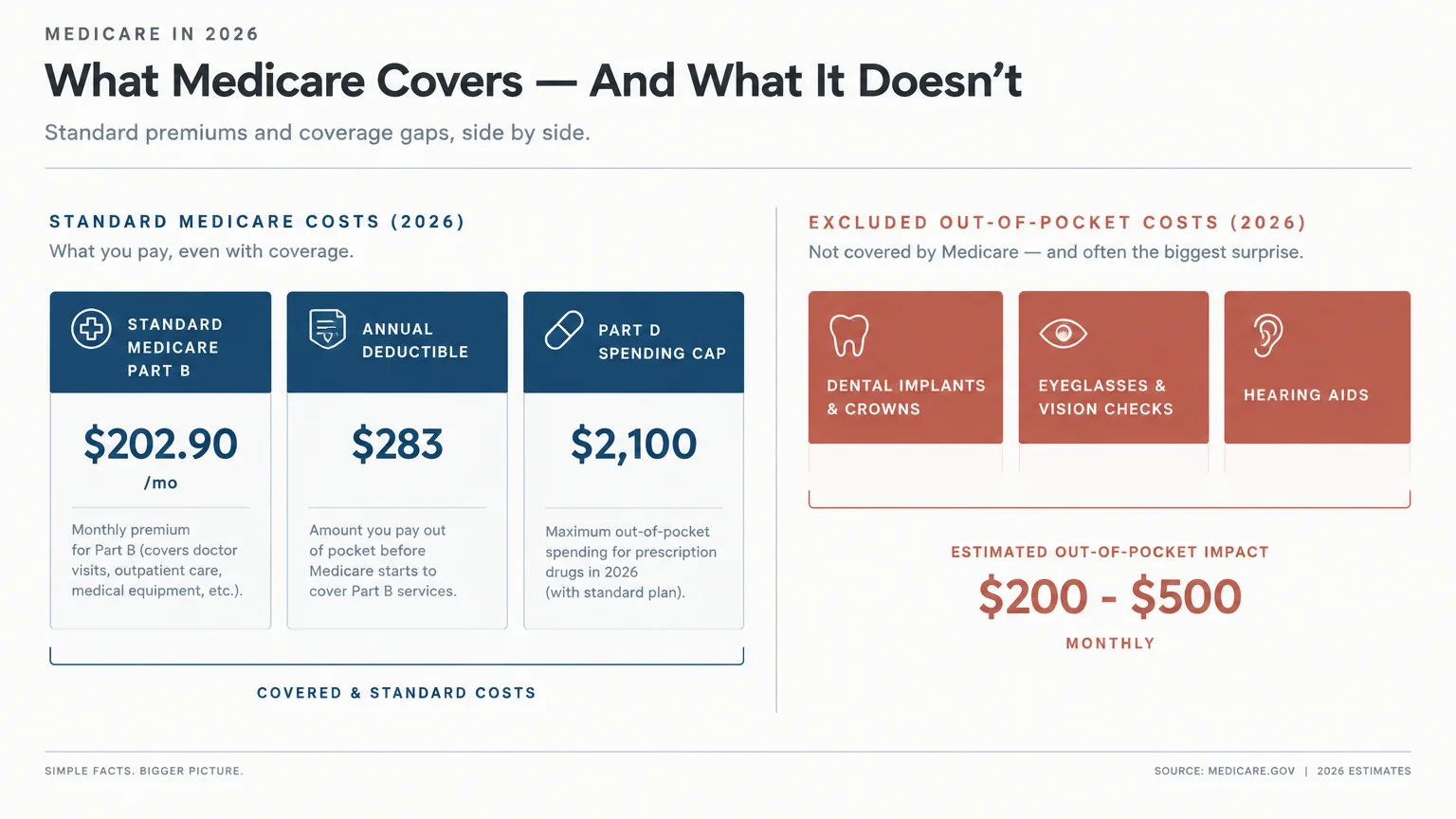
In 2026, the standard monthly Medicare Part B premium is $202.90, alongside an annual deductible of $283. Projections from the 2026 Medicare Trustees Report indicate standard Part B premiums will climb to $209.50 monthly in 2027.
Prescription drugs present another recurring cost. In 2026, Medicare Part D features an annual out-of-pocket spending cap of $2,100, with a maximum deductible of $615.
The largest out-of-pocket shocks, however, stem from services Original Medicare explicitly excludes. Medicare Parts A and B do not cover routine dental exams, cleanings, crowns, dentures, vision checks, or hearing aids.
A single dental implant or extensive bridge work can easily cost several thousand dollars. Paying out of pocket for routine cleanings, eyeglasses, and hearing care can easily siphon $200 to $500 monthly from your bank account.
To avoid unexpected medical shocks, you can take practical protective measures:
- Review private dental and vision insurance plans during open enrollment to compare annual premiums against expected treatment costs.
- Explore Medicare Advantage plans that incorporate dental, vision, and hearing allowances, checking their provider networks carefully.
- Establish a designated liquid health savings reserve to cushion the blow of crowns, root canals, and new eyeglasses.

2. Medicare IRMAA Surcharges for Modest Incomes
If you managed your career well and built substantial savings, Medicare might bill you significantly more each month. This extra charge is known as the Income-Related Monthly Adjustment Amount (IRMAA).
IRMAA functions as a stealth surcharge on your Medicare Part B and Part D premiums. The Social Security Administration evaluates your tax return from two years prior to determine your bracket.
For 2026, retirees whose 2024 Modified Adjusted Gross Income (MAGI) exceeded $109,000 for single filers or $218,000 for married couples filing jointly trigger these surcharges. Even exceeding the threshold by a single dollar moves you into the penalty tier.
Under IRMAA in 2026, total monthly Part B premiums climb from the standard $202.90 up to ranges between $284.10 and $689.90 per person. That extra charge applies every single month.
Part D prescription coverage incurs an additional monthly IRMAA surcharge as well. In 2026, that extra charge ranges from $14.50 to $91.00 per month above your normal plan premium.
For a retired couple trapped in higher brackets, IRMAA surcharges alone can quietly drain $500 to $1,000 each month from a joint budget. Common events like selling a home, taking large IRA withdrawals, or realizing capital gains often trigger these cliffs unexpectedly.
You can manage or dispute these surcharges using targeted methods:
- Submit Form SSA-44 if you experienced a qualifying life-changing event, such as retirement, work reduction, or the death of a spouse.
- Execute strategic Roth IRA conversions in your early sixties before reaching age 63 to keep taxable distributions low later.
- Monitor your taxable income thresholds closely before taking capital gains or large, lump-sum withdrawals from traditional retirement accounts.

3. The Phantom Carrying Costs of a Paid-Off Home
Eliminating your mortgage is a wonderful milestone, but it does not mean your housing is free. Carrying costs on a debt-free house represent one of the fastest-growing monthly expenses retirees encounter.
According to an October 2026 analysis by Zillow and Thumbtack, the typical U.S. homeowner pays $16,566 annually in hidden costs beyond a mortgage. That equates to $1,380 each month.
This spending includes an average of $11,171 annually for routine maintenance, $3,129 for property taxes, and $2,266 for homeowners insurance. Aging homes frequently require roof replacements, plumbing repairs, and exterior painting.
Factoring in utilities, broadband, and energy expenses pushes costs even higher. Bankrate’s Hidden Costs of Homeownership study revealed that adding utilities elevates total non-mortgage carrying costs to an average of $21,400 per year, or $1,783 monthly.
Property insurance poses an especially severe threat to monthly cash flow. Over the past five years, homeowners insurance premiums have surged 54% nationwide, with some high-risk regions experiencing increases over 70%.
Property tax reassessments can also introduce sudden budget shocks. Even without a monthly mortgage coupon, homeownership easily consumes $1,200 to $1,800 each month in non-negotiable carrying expenses.
You can keep property overhead under control with these steps:
- Shop and compare your homeowners insurance policies annually, raising your deductible if you hold adequate cash reserves.
- Apply for senior property tax homestead exemptions through your local county appraisal district to freeze or lower annual valuations.
- Budget 1% to 2% of your home’s total market value into an annual sinking fund dedicated solely to repairs and replacements.

4. Routine In-Home Support and Caregiver Gaps
Most seniors want to age comfortably in their existing homes as long as possible. However, the costs of hiring assistance for basic activities can catch families completely unprepared.
Medicare does not pay for non-skilled custodial assistance, such as help with bathing, dressing, meal preparation, or housekeeping. Those expenses fall entirely on your personal budget.
According to the 2026 CareScout and Genworth Cost of Care Survey, the national median rate for a non-medical home health aide is $35 per hour. If you need 44 hours of care each week, that translates to $80,080 per year, or approximately $6,673 monthly.
If your health requires skilled private-duty nursing care at home, median rates reach $90 per hour. Assisted living facilities provide another benchmark, with private rooms carrying a national median cost of $6,200 per month ($74,400 annually).
Compounding this burden, home care expenses are escalating much faster than normal living costs. An AARP Public Policy Institute report highlighted that home care inflation has climbed 7.9% annually over the past five years.
Needing just 15 hours of basic help a week at $35 per hour generates a monthly invoice of over $2,100. That single expense can overwhelm a standard pension and Social Security check.
Consider these proactive options to prepare for potential care costs:
- Investigate hybrid life insurance policies that include long-term care riders before your health conditions change.
- Contact your local Area Agency on Aging through the Eldercare Locator to explore respite care and community support programs.
- Downsize or relocate into a low-maintenance, single-level living environment to minimize reliance on outside domestic help.

5. Ongoing Financial Subsidies for Adult Children
Supporting grown children is one of the most common retirement budget leaks today. Giving money out of love can rapidly turn into an unsustainable monthly commitment.
According to data from Savings.com, 50% of parents with adult children provide them with regular financial assistance. These parents spend an average of $1,474 per month, totaling nearly $18,000 every year.
For parents within ten years of retirement, the average financial support jumps to a staggering $2,100 per month. Diverting that volume of capital damages your compounding returns right when you need stability.
A LendingTree survey showed that 71% of parents have supported adult children financially at some stage. Furthermore, 44% did so within the past two years, paying for groceries (53%), mobile phone plans (35%), and housing (25%).
“You must put your own financial security first. When you compromise your retirement for your adult children, you risk becoming a financial burden to them later.” — Suze Orman, Personal Finance Expert
Covering rent, auto insurance, or credit card bills for family members introduces an ongoing strain. Many retirees surrender $1,000 to $2,000 monthly without formally tracking the cumulative damage to their portfolios.
You can establish healthy financial boundaries with your family using these approaches:
- Separate your personal retirement budget from discretionary family gifts by establishing strict monthly caps.
- Transition adult children onto their own mobile phone, streaming, and auto insurance policies over an agreed three-month timeline.
- Offer non-monetary assistance, such as cooking meals, providing childcare, or sharing financial guidance, instead of writing checks.
6. Federal Taxes on Social Security Benefits
Many retirees anticipate that their Social Security checks will arrive entirely tax-free. In reality, millions of seniors pay federal income taxes on a substantial portion of their benefits.
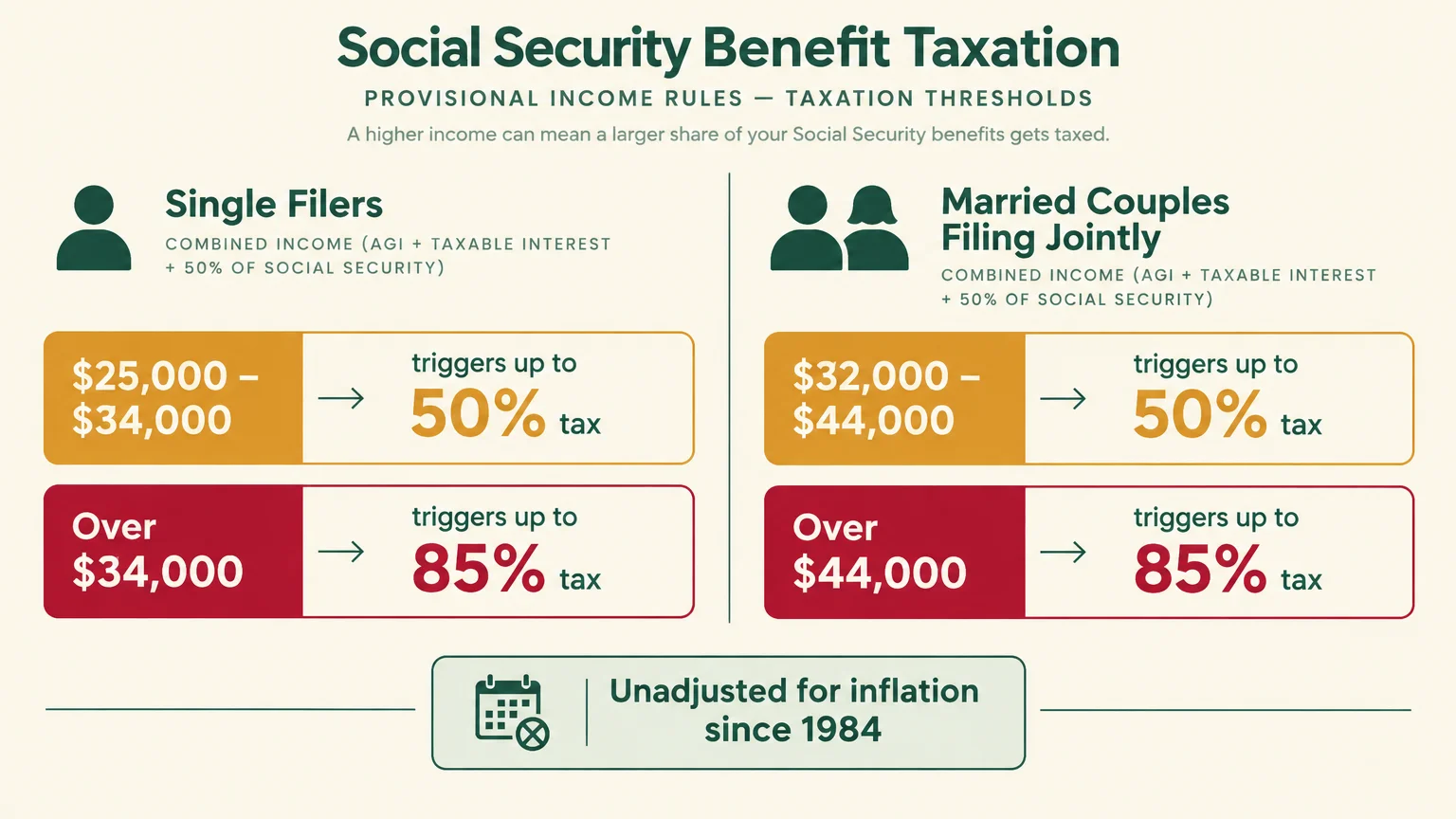
The IRS measures your liability using a formula called “combined income.” This calculation adds your adjusted gross income, nontaxable interest, and half of your annual Social Security benefits.
Congress established the taxation thresholds for Social Security in 1983 and never adjusted them for inflation. As a result, standard wage increases and cost-of-living adjustments drag more retirees into taxable territory every year.
If your combined income lands between $25,000 and $34,000 as a single filer, you pay tax on up to 50% of your benefits. Joint filers with combined income between $32,000 and $44,000 face that same 50% threshold.
If your combined income exceeds $34,000 for single filers or $44,000 for married couples, up to 85% of your Social Security benefits become taxable. Because these numbers are static, normal cost-of-living increases steadily expand the tax bite.
For instance, the Social Security Administration announced a 3.6% Cost-of-Living Adjustment (COLA) for 2027, adding roughly $75 monthly to the average benefit check. Unfortunately, that raise will push many retirees across tax thresholds, reducing their net take-home gains.
Between federal income taxes and state levies, benefit taxes can reduce your household cash flow by $300 to $600 each month. You can check your tax responsibilities directly with the Internal Revenue Service.
You can reduce taxes on your benefits through careful distribution planning:
- Draw living expenses from Roth accounts, which generate tax-free distributions that do not count toward combined income calculations.
- Manage capital gain realizations carefully each tax year to avoid bumping your Social Security income into the 85% taxable tier.
- Consider working with a tax specialist to optimize the sequence of withdrawals across your taxable, tax-deferred, and tax-free accounts.

7. Required Minimum Distribution (RMD) Tax Cascades
Tax-deferred savings accounts like traditional IRAs and 401(k) plans provide great upfront deductions during your working years. In retirement, however, the IRS requires you to withdraw those funds whether you need them or not.
Under SECURE 2.0 legislation, your Required Minimum Distribution (RMD) age begins at 73. That mandatory starting age is scheduled to adjust to 75 in 2033.
Every dollar withdrawn from a traditional tax-deferred account is taxed as ordinary income at your highest marginal rate. A significant RMD can suddenly push you into a higher tax bracket, increasing your overall annual bill.
“Taxes will be your single biggest expense in retirement if you do not plan ahead. The time to manage your distributions is before the IRS forces you to take them.” — Ed Slott, CPA and Retirement Specialist
Failing to take your full distribution triggers severe IRS penalties. The excise tax penalty stands at 25% of the amount not distributed on schedule, though it drops to 10% if corrected within two years.
Beyond direct taxes, mandatory distributions create an expensive cascade effect across your budget. An inflated distribution increases your MAGI, which can trigger Medicare IRMAA surcharges two years later and make 85% of your Social Security taxable.
A forced $50,000 distribution can easily lead to thousands of dollars in surprise taxes and surcharges. Spreading that cost across the calendar year represents a loss of several hundred dollars each month.
You can neutralize the negative effects of RMDs with proactive strategies:
- Utilize Qualified Charitable Distributions (QCDs) starting at age 70½ to transfer funds directly from your IRA to charity without increasing taxable income.
- Complete partial Roth conversions between your retirement date and age 73 to systematically shrink the future tax-deferred account balance.
- Use systematic monthly tax withholdings on required distributions to prevent a huge, painful tax balance due every April.

8. Invisible Lifestyle Creep, Micro-Subscriptions, and Utility Surges
Retirement gives you 40 or more open hours every single week. While having extra leisure time is wonderful, unstructured days frequently lead to hidden spending leaks.
Small, regular outings, dining out with friends, and spontaneous online purchases accumulate rapidly. Spending an extra $25 a day on casual outings quietly consumes $750 each month.
Digital subscriptions represent another silent drain on retirement cash flow. Multiple television streaming services, digital magazine subscriptions, audiobook clubs, and unused gym memberships often renew invisibly in the background.
According to research from the Consumer Financial Protection Bureau, recurring automated charges frequently go unnoticed for months. Auditing your credit card statements regularly helps eliminate charges for services you no longer use.
Home utility expenses also climb noticeably once you spend all day inside the house. Keeping heating and air conditioning running continuously during peak hours adds $100 to $250 to monthly utility statements.
Vehicle maintenance on older cars, combined with rising auto insurance rates, presents another subtle drain. When combined, casual lifestyle creep, recurring subscriptions, and utility increases can easily drain $400 to $800 each month.
You can reclaim control over these everyday leaks with simple habit shifts:
- Conduct a line-by-line review of your credit card statements once a quarter to cancel unused recurring memberships.
- Install a smart programmable thermostat to manage home heating and cooling during hours when you are active or asleep.
- Designate an explicit monthly “pocket money” allowance in cash to prevent spontaneous purchases from undermining your core budget.
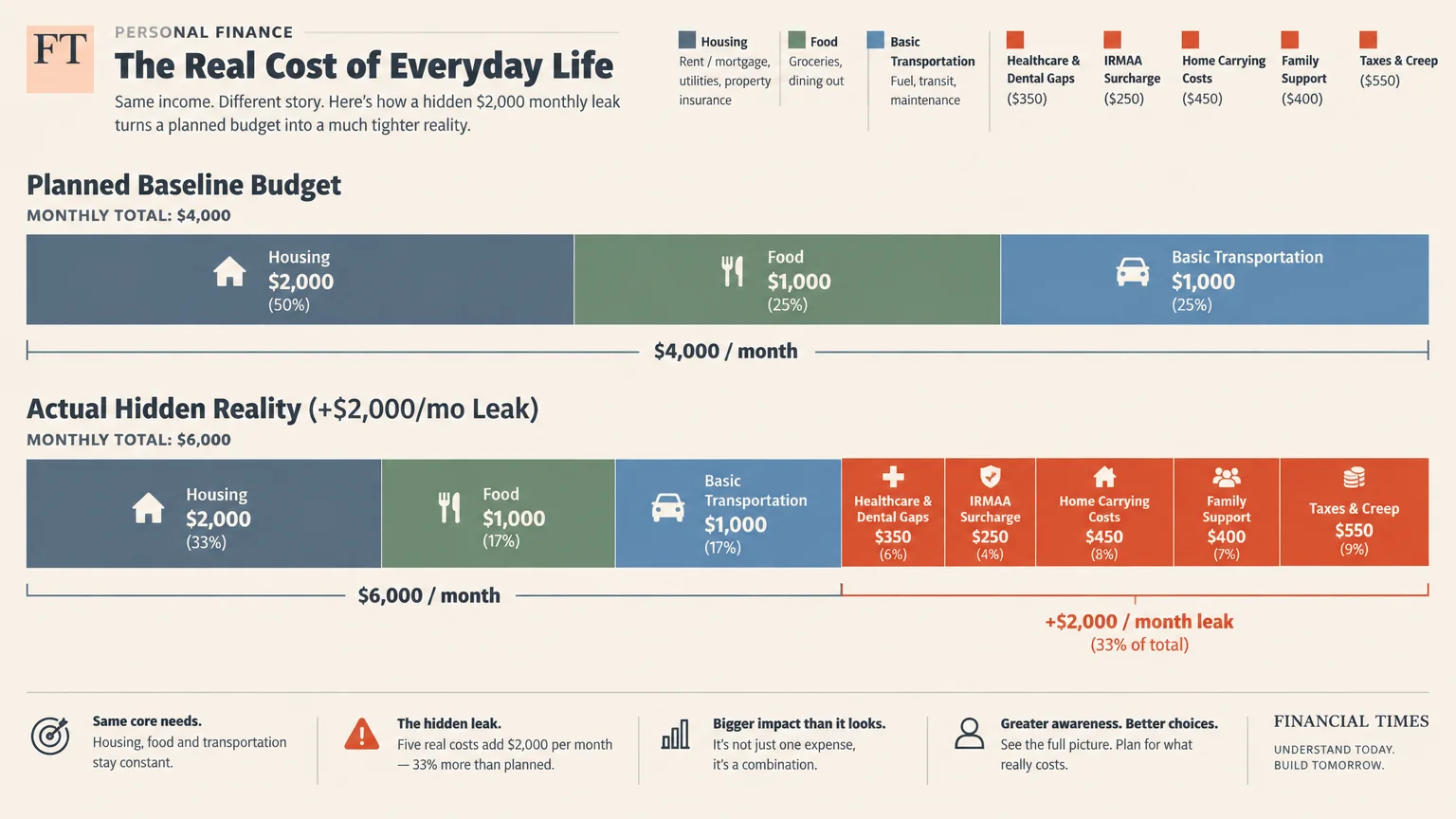
Monthly Expense Leak Analysis: Traditional Budget vs. Hidden Reality
Seeing how these costs interact helps illustrate how easily retirement budgets go off track. Many individuals create financial projections based solely on basic living essentials.
The table below compares estimated standard budget assumptions against the unexpected expenses that emerge over a typical year.
| Expense Category | Assumed Monthly Cost | Actual Monthly Drain (With Gaps) | Monthly Budget Variance |
|---|---|---|---|
| Healthcare & Dental | $202.90 (Part B only) | $650.00 (Part B, Part D, dental, vision) | +$447.10 |
| Medicare IRMAA | $0.00 | $350.00 (Part B & D surcharges) | +$350.00 |
| Home Maintenance & Insurance | $250.00 (Modest upkeep) | $1,380.00 (Taxes, insurance, repairs) | +$1,130.00 |
| Family Financial Support | $0.00 | $500.00 to $1,474.00 (Subsidies for adult children) | +$500.00 to +$1,474.00 |
| Social Security Benefit Taxes | $0.00 (Assumed tax-free) | $350.00 (Federal & state tax bite) | +$350.00 |
| Subscriptions & Utility Spikes | $150.00 | $400.00 (Continuous AC/heat, micro-fees) | +$250.00 |
| Total Potential Monthly Leaks | $602.90 | $3,630.00 to $4,604.00 | +$2,000+ per month |
When these categories overlap, retirees frequently experience a cash drain exceeding $2,000 beyond their planned targets. Addressing even three of these leaks provides immediate financial relief.

Common Mistakes to Avoid With Retirement Budget Leaks
Retirees often fall into predictable behavioral traps when managing these costs. Recognizing these pitfalls helps you steer clear of expensive missteps.
Treating your nest egg as an open bank for family members. Helping your children is natural, but doing so at the expense of your own retirement solvency creates serious risks. If you deplete your savings, your family will face greater burdens down the road.
Assuming Medicare will handle all long-term care needs. Many seniors discover too late that Medicare does not cover custodial, non-medical care at home or in assisted living. Relying on Medicare for daily assistance results in rapid personal asset depletion.
Ignoring the ripple effects of taxable distributions. Pulling extra funds from traditional retirement accounts to cover immediate expenses can inadvertently trigger IRMAA penalties and higher Social Security taxes. Always calculate the broader tax consequence of any withdrawal.
Overlooking regular maintenance on a mortgage-free house. Neglecting small repairs on your property inevitably leads to major structural expenses later. Routine maintenance preserves home equity and prevents catastrophic emergency costs.

Finding the Right Advisor for Cash Flow Protection
Navigating dynamic tax brackets, health regulations, and investment strategies can feel overwhelming. Partnering with a vetted financial professional provides valuable clarity.
Different retirement situations require specialized guidance. Here is how to select the right advisor for your specific needs:
When facing substantial traditional IRA assets: Seek a Certified Financial Planner (CFP) or CPA who specializes in distribution planning. They can design multi-year Roth conversions and Qualified Charitable Distributions to minimize RMD tax spikes.
When navigating complex healthcare choices: Consult an independent Medicare broker or elder law attorney. They can review supplemental policies, clarify IRMAA surcharge appeals, and help structure assets for potential care needs.
When structuring overall cash flow: Look for a fee-only fiduciary advisor affiliated with organizations like the National Association of Personal Financial Advisors (NAPFA). Fee-only fiduciaries do not earn product commissions, ensuring objective advice.
Verify any advisor’s disciplinary history and background through FINRA’s BrokerCheck or the SEC’s Investment Adviser Public Disclosure database before signing an agreement.
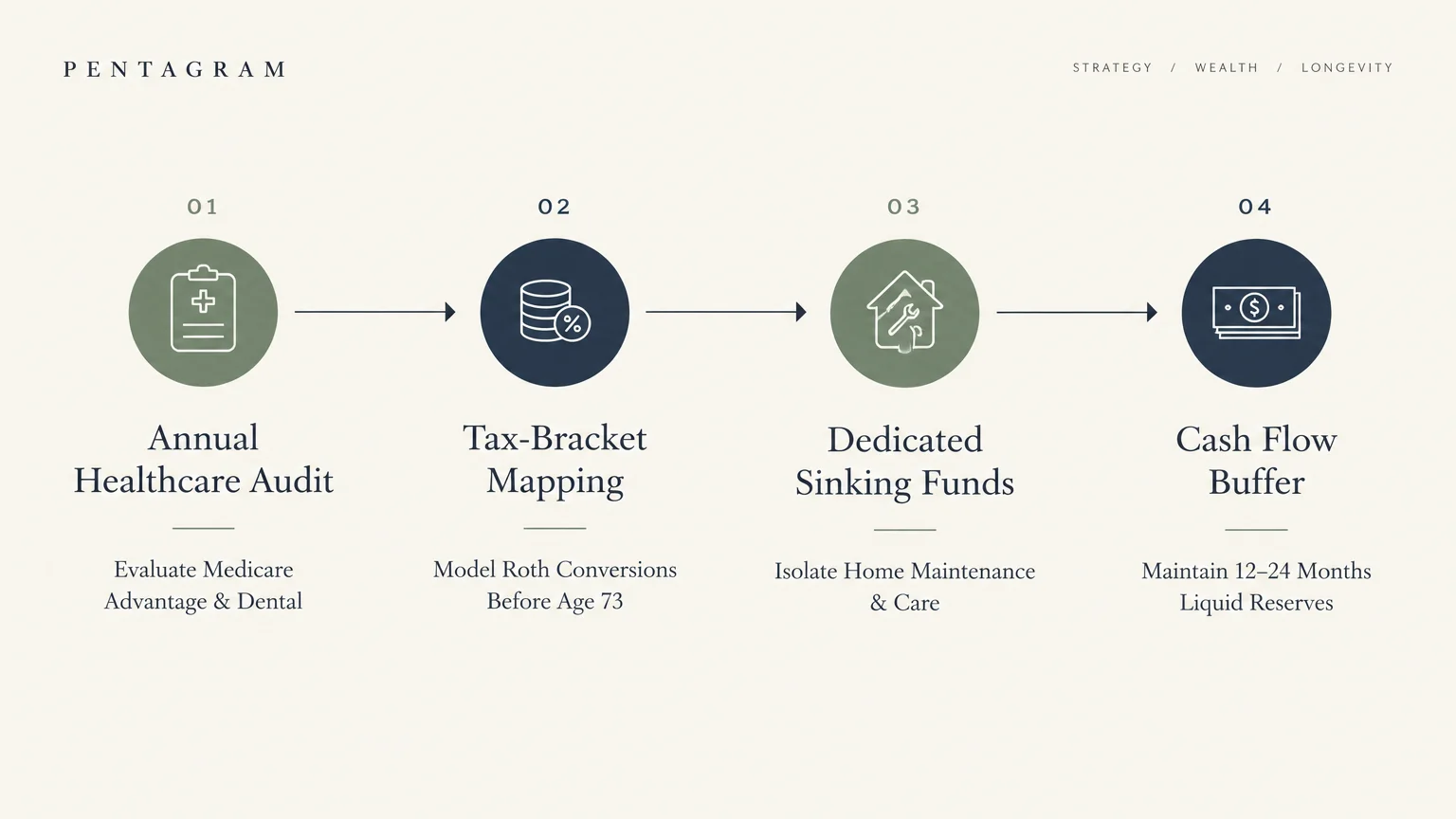
Proactive Steps to Protect Your Monthly Cash Flow
Plugging cash leaks does not require living an austere life. It simply requires deliberate attention to where your money travels each month.
Begin by conducting a comprehensive spending audit covering the past six months of bank and credit card statements. Categorize your expenses into fixed living costs, variable lifestyle choices, and recurring background charges.
Next, calculate your tax exposure on Social Security and evaluate whether your current income triggers future IRMAA surcharges. Making small distribution adjustments today shields your income from penalties two years from now.
Review your property insurance coverage and explore local property tax relief programs available for older adults. Trimming insurance costs and freezing assessments preserves hundreds of dollars each year.
Finally, have clear, transparent conversations with family members regarding your budget limits. Establishing boundaries protects your future independence while helping loved ones develop their own financial confidence.
Frequently Asked Questions About Hidden Retirement Expenses
What is the quickest way to lower my Medicare IRMAA surcharges?
If you recently stopped working, had your hours reduced, or lost a spouse, you can appeal your surcharge using Form SSA-44. Providing documentation of your life-changing event allows the Social Security Administration to recalculate premiums using current income rather than older tax returns.
Can I use a Health Savings Account (HSA) to pay for Medicare premiums?
Yes, you can use funds from an existing HSA to pay premiums for Medicare Parts B and D, as well as Medicare Advantage plans. However, you cannot use HSA funds to pay for Medicare Supplement (Medigap) policy premiums, and you cannot contribute new money to an HSA once enrolled in Medicare.
How can Qualified Charitable Distributions reduce my tax burden?
If you are age 70½ or older, a Qualified Charitable Distribution allows you to transfer funds directly from your traditional IRA to a qualified non-profit charity. The distributed amount counts toward your Required Minimum Distribution without being added to your Adjusted Gross Income, preventing tax and IRMAA spikes.
Why are property carrying costs rising so quickly for retirees?
Severe weather events, higher construction material costs, and labor shortages have driven homeowners insurance rates up 54% nationwide over five years. Simultaneously, rising home valuations have triggered higher property tax assessments in many municipal areas.
Final Thoughts on Preserving Your Retirement Capital
A rewarding retirement should be defined by peace of mind and personal freedom, not constant financial anxiety. Taking control of unseen expenses allows you to enjoy the retirement you worked so hard to build.
The information in this guide is meant for educational purposes. Your specific circumstances—including income, benefits, tax situation, and health needs—may require different approaches. When in doubt, consult a licensed financial advisor or tax professional.
Last updated: October 2026. Benefit amounts, tax rules, and program details change annually—verify current figures with official government sources.









Leave a Reply