

Your Social Security check will rise by 3.6% in 2027, adding an average of $75 per month for retired workers. Thanks to a two-year tax lookback rule, that raise will not bump you into a higher Medicare bracket in 2027.
Even so, the 2027 COLA and Medicare rules still interact in ways that affect your wallet right away and two years down the road. Knowing how these numbers connect helps you protect your retirement income before surcharges lock in.
Here is how the timing works, where 2027 brackets stand right now, and what steps keep an unexpected Medicare surcharge off your monthly statement.
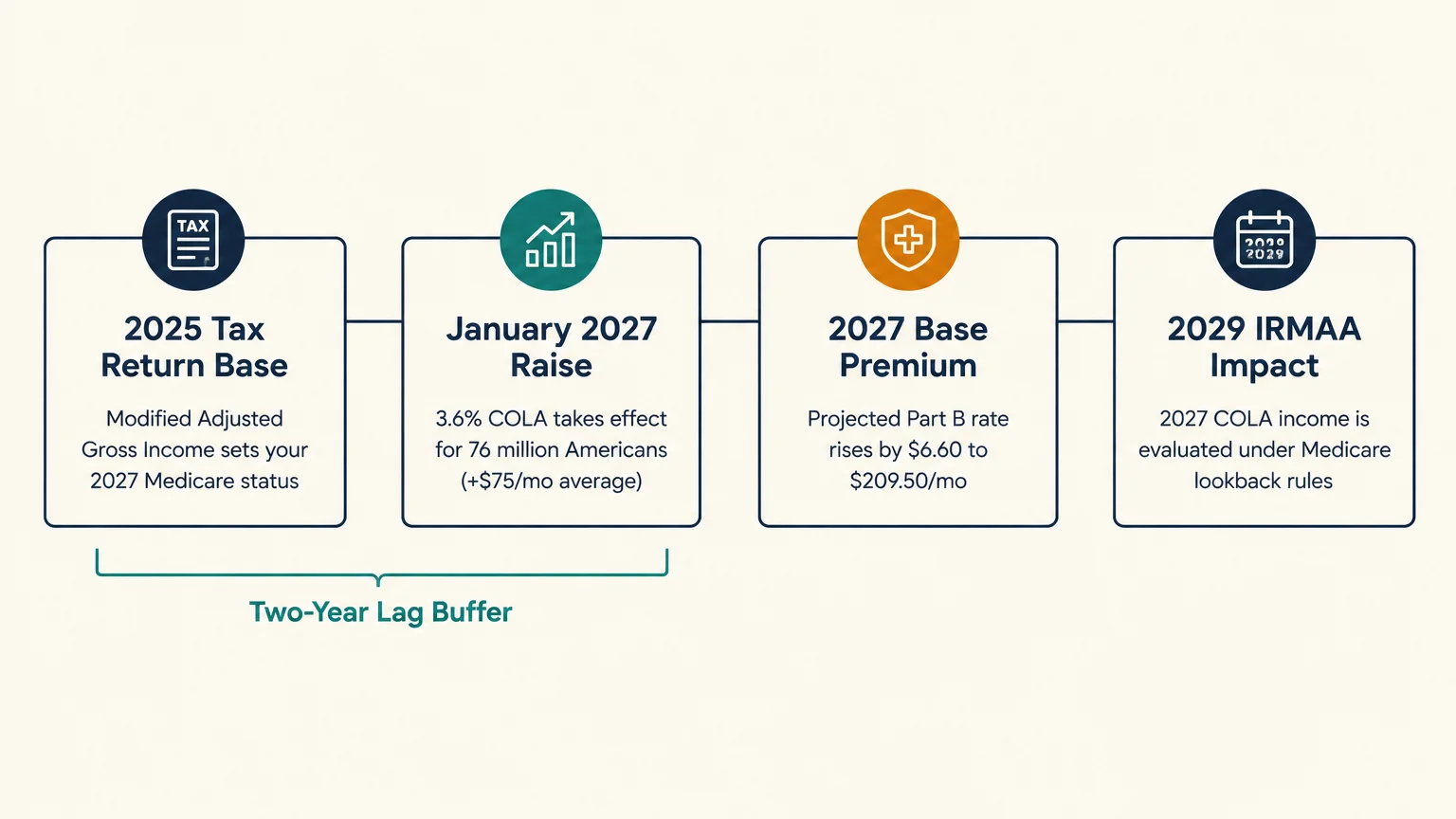
At a Glance: How the 2027 COLA and Medicare Brackets Connect
Understanding how Social Security raises affect Medicare premium brackets starts with separating what happens in January 2027 from what shows up on your 2029 statement. The four points below capture the timeline at a glance.
- The 2027 raise: Social Security and Supplemental Security Income (SSI) benefits increase by 3.6% for 76 million Americans, starting January 2027 for Social Security recipients and December 31, 2026 for SSI recipients.
- The two-year lag: Income-Related Monthly Adjustment Amount (IRMAA) brackets in 2027 rely on your 2025 federal tax return, so your 2027 COLA will not count toward IRMAA until 2029.
- Projected Part B costs: While official 2027 IRMAA 2027 tiers and Part B rates are still pending from the Centers for Medicare & Medicaid Services (CMS), trustees project the standard Part B premium will rise by $6.60 to $209.50 per month.
- Deduction trap: The up-to-$6,000 per-person senior tax deduction enacted in 2025 lowers taxable income, yet it does not reduce the income figure Medicare uses to assess surcharges.
Why Your 2027 COLA Will Not Change Your 2027 Medicare Bracket
According to the Social Security Administration (SSA), Social Security retirement benefits will climb by 3.6% in 2027, up from 2.8% in 2026 and 2.5% in 2025. That boost brings a typical retired worker benefit from roughly $2,092–$2,095 per month in late 2026 to about $2,170 per month.
Seeing a bigger deposit often sparks worry about losing ground to income related premiums. Fortunately, federal rules prevent your 2027 COLA from changing your 2027 Medicare tier.
Under SSA rules, IRMAA uses your Modified Adjusted Gross Income (MAGI) from the federal tax return filed two years earlier, or three years earlier if the two-year-old return is unavailable. Your 2027 IRMAA status therefore depends entirely on your 2025 tax return.
By the same token, the 3.6% raise you receive throughout 2027 goes onto your 2027 tax return. That means the 2027 COLA will not enter your IRMAA calculation until 2029.
Your 2027 Medicare surcharge depends on 2025 income, while your 2027 Social Security COLA helps determine whether you face higher premiums in 2029.
Earlier raises, however, are already working their way through the pipeline. The 2.5% COLA from 2025 sits inside the 2025 tax numbers setting 2027 brackets, and the 2.8% COLA from 2026 feeds into 2028 brackets.
What Actually Reduces Your Net 2027 Social Security Check
Even if you stay safely in the standard Medicare tier, higher base premiums still trim part of your 2027 COLA. Most beneficiaries have their Medicare Part B premium deducted straight from their monthly Social Security deposit.
In its 2026 Annual Report, the Medicare Board of Trustees projected the standard Part B monthly premium will rise by $6.60—roughly 3.25%—from $202.90 in 2026 to $209.50 in 2027. For an average retiree gaining $75 per month from the COLA, that $6.60 increase leaves most of the raise intact.
If your Social Security benefit is much smaller, the hold-harmless rule under the Social Security Act protects your net check. It ensures a standard Part B increase cannot exceed your dollar COLA so your monthly payment does not drop.
Keep in mind that the hold-harmless rule leaves out several groups of beneficiaries. You do not receive hold-harmless protection if any of the following apply to you:
- You pay an IRMAA surcharge on Part B.
- You are enrolling in Medicare Part B for the first time in 2027.
- You pay Part B premiums directly rather than having them deducted from Social Security.
- You are dually eligible for Medicaid, which covers your Part B premiums.
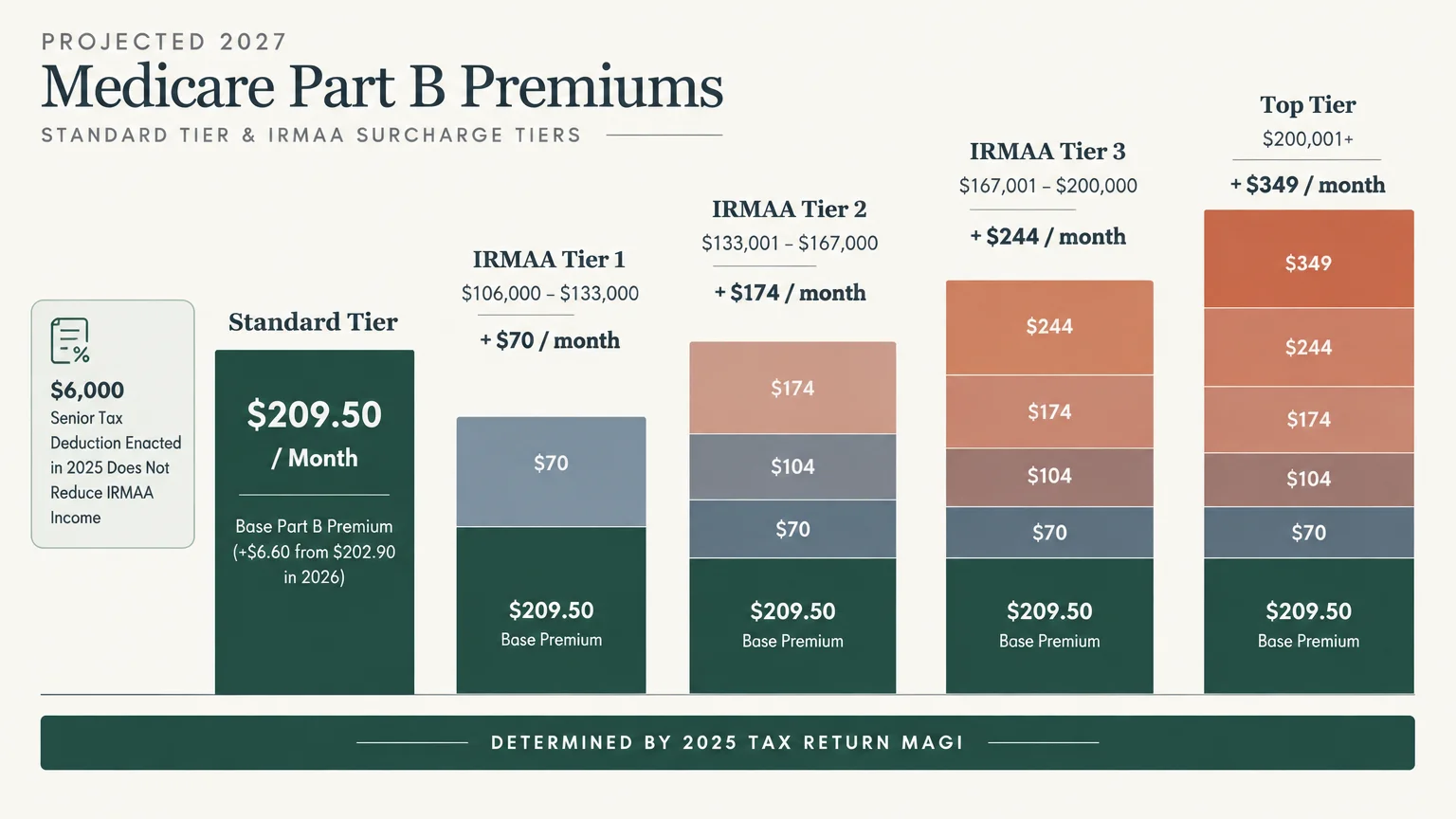
Where 2027 Medicare Premium Brackets Stand Right Now
As of November 17, 2026, CMS has not yet published official 2027 Part B standard premiums, Part B deductibles, or 2027 IRMAA brackets. For comparison, CMS released the 2026 figures on November 14, 2025.
Projecting the exact 2027 IRMAA income cutoffs has also hit an unusual snag this year. Because the Bureau of Labor Statistics (BLS) did not publish official October 2025 CPI-W data during the 2025 federal government shutdown, analysts had only 11 of the 12 monthly CPI figures normally used to forecast bracket indexing.
While Part B and IRMAA 2027 numbers remain pending, CMS has already finalized key 2027 limits for Medicare Part D prescription drug coverage and Medicare Advantage plans. You can review official plan details anytime on Medicare.gov.
- 2027 Part D out-of-pocket cap: $2,400 for the year, up from $2,100 in 2026.
- 2027 maximum Part D deductible: $700, up from $615 in 2026.
- 2027 Medicare Advantage out-of-pocket limit: $9,850 maximum for in-network care, up from $9,250 in 2026.
- Projected 2027 Part B deductible: $292, up from $283 in 2026 according to the 2026 Medicare Board of Trustees Annual Report.
Current 2026 IRMAA Reference Brackets
Until CMS publishes the official 2027 schedule, the 2026 IRMAA tiers provide your clearest benchmark for estimating where you stand. Standard enrollees pay roughly 25% of Part B and Part D program costs, whereas IRMAA tiers require paying 35%, 50%, 65%, 80%, or 85%.
Roughly 8% of Part B beneficiaries—about 5.1 million people in 2025—pay these surcharges. In 2026, the standard Part B premium is $202.90 per month and the Part D national base beneficiary premium is $38.99.
| 2026 IRMAA Tier | Individual 2024 MAGI | Joint 2024 MAGI | Monthly Part B Total (2026) | Monthly Part D Surcharge (2026) |
|---|---|---|---|---|
| Tier 0 (Standard) | $109,000 or less | $218,000 or less | $202.90 ($0 surcharge) | $0 (plan premium only) |
| Tier 1 | $109,000.01 to $137,000 | $218,000.01 to $274,000 | $284.10 (+$81.20) | +$14.50 |
| Tier 2 | $137,000.01 to $171,000 | $274,000.01 to $342,000 | $405.80 (+$202.90) | +$37.50 |
| Tier 3 | $171,000.01 to $205,000 | $342,000.01 to $410,000 | $527.50 (+$324.60) | +$60.40 |
| Tier 4 | $205,000.01 to under $500,000 | $410,000.01 to under $750,000 | $649.20 (+$446.30) | +$83.30 |
| Tier 5 (Top Tier) | $500,000 or more | $750,000 or more | $689.90 (+$487.00) | +$91.00 |
While the first four IRMAA brackets adjust for inflation each year, the top tier at $500,000 for individuals and $750,000 for joint filers is frozen by law. Enacted under the Bipartisan Budget Act of 2018, that top threshold will not resume inflation indexing until 2028.
Married couples who file separate returns and lived together at any point during the tax year face much steeper rules. In 2026, Tier 0 ends at $109,000, Tier 4 jumps in right above $109,000 up to under $391,000, and the Top Tier starts at $391,000.
How Future COLAs Push You Across the IRMAA Cliff
Understanding the link between COLA and Medicare requires looking closely at how SSA builds your IRMAA MAGI. SSA starts with your Adjusted Gross Income (AGI) on Line 11 of IRS Form 1040 and adds your tax-exempt interest from Line 2a.
Only the taxable portion of your Social Security benefits lands inside AGI, while qualified withdrawals from a Roth IRA or Roth 401(k) stay completely out of the calculation. However, the tax rules governing Social Security create a compounding effect whenever COLAs arrive.
Under IRS Section 86, your benefit taxability depends on provisional income—your AGI excluding Social Security, plus tax-exempt interest, plus half of your Social Security benefits. Those statutory thresholds have never been adjusted for inflation.
- Single filers: Up to 50% of Social Security benefits become taxable between $25,000 and $34,000 of provisional income, and up to 85% become taxable above $34,000.
- Joint filers: Up to 50% of benefits become taxable between $32,000 and $44,000 of provisional income, and up to 85% become taxable above $44,000.
When a typical retired worker sees a $75 monthly COLA—adding $900 over the year—that extra income can push more existing benefits into taxable territory if provisional income sits near those frozen thresholds. Higher taxable Social Security raises AGI, which directly lifts IRMAA MAGI.
Why a Single Dollar Costs You All Year
Unlike federal income tax brackets that tax only the dollars inside a higher tier, Medicare premium brackets act as strict cliffs. Crossing a cutoff by $1 triggers the entire surcharge for all 12 months of that Medicare year.
Using 2026 figures as an example, landing at $109,001 as a single filer moves you from Tier 0 to Tier 1. That extra $1 adds $81.20 per month to Part B and $14.50 per month to Part D—totaling $95.70 monthly, or $1,148.40 for the year.
For married couples filing jointly, the hit doubles because each Medicare-enrolled spouse pays the surcharge individually. Moving $1 above $218,000 at 2026 rates triggers two separate Tier 1 surcharges totaling $2,296.80 across the year.
IRMAA status can also disqualify you from extra Medicare relief. For example, people paying IRMAA—along with Medicare Advantage enrollees and Medicaid premium-assistance recipients—were excluded from the one-time $90 Original Medicare Part B rebate announced in October 2026.
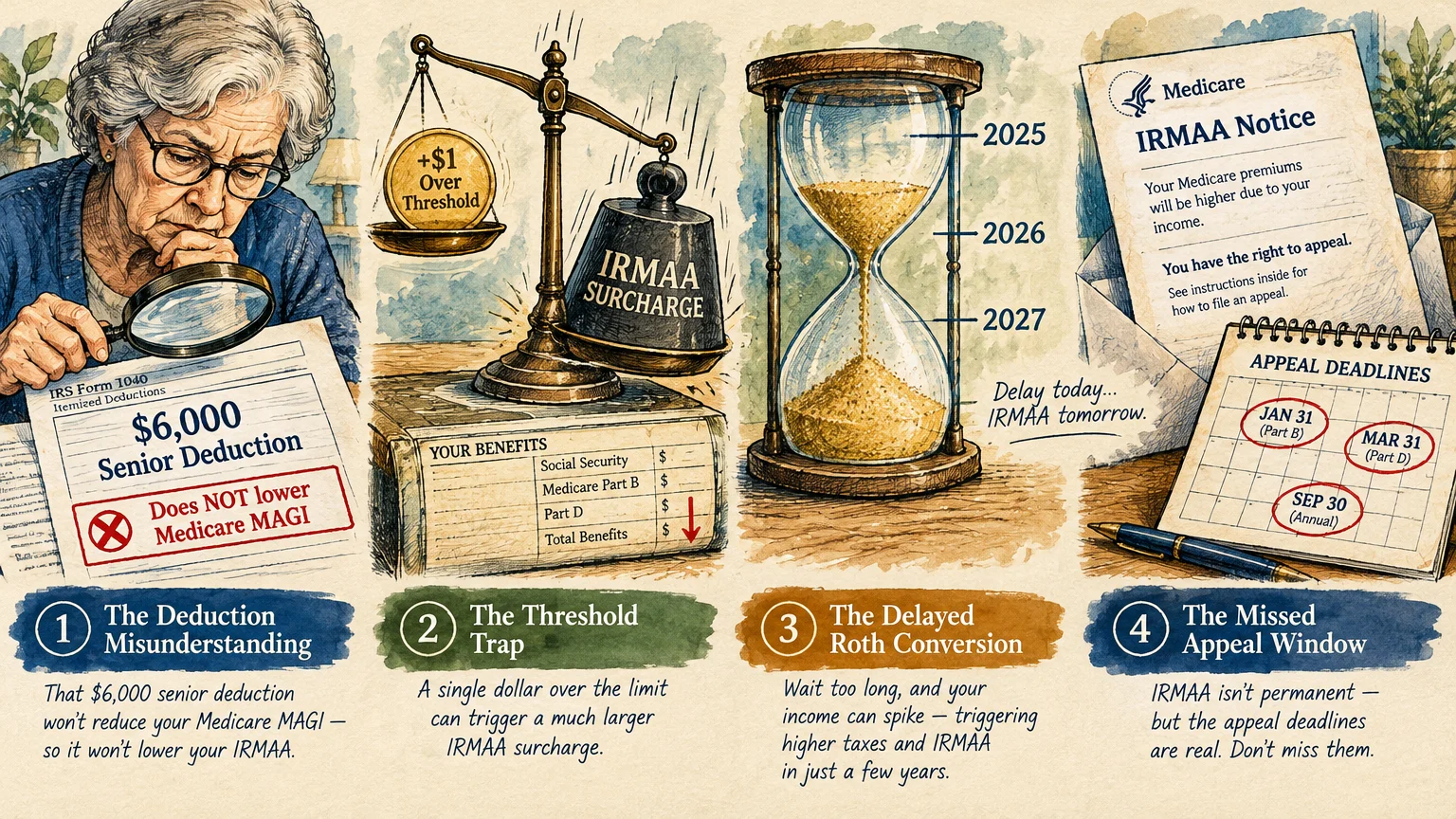
What Can Go Wrong: 4 Common Mistakes Seniors Make With COLA and IRMAA
Small misunderstandings around tax deductions, filing status, and appeal deadlines often trigger an avoidable Medicare surcharge. Watch out for these four common errors as you review your 2027 income plan.
1. Counting on the New Senior Tax Deduction to Lower IRMAA
Starting in tax year 2025, legislation known as the One Big Beautiful Bill Act introduced an up-to-$6,000 per-person senior tax deduction. While that break lowers your federal income tax bill, it is a below-the-line deduction.
Because below-the-line deductions apply after Line 11 on Form 1040, the senior deduction does not reduce AGI, provisional income, or IRMAA MAGI. Relying on it to stay below a Medicare cutoff can leave you surprised by a surcharge two years later.
2. Triggering the Cliff With a One-Time Income Spike
Selling appreciated investments, cashing out a large traditional IRA withdrawal, or completing a big Roth conversion adds directly to your AGI. If that spike pushes your 2027 return over an IRMAA line alongside your 3.6% COLA, your 2029 premiums will jump.
Worse yet, SSA does not accept one-time capital gains, home sales, or Roth conversions as grounds for an IRMAA appeal. Once that spike hits your return, you generally must pay the surcharge for the full calendar year.
3. Assuming Married Filing Separately Shields One Spouse
Some couples file separate tax returns hoping to isolate one spouse’s high income from the other spouse’s Medicare premiums. If you lived together at any time during the tax year, that strategy usually backfires badly.
At 2026 rates, a separate filer who lived with a spouse jumps straight from Tier 0 at $109,000 into Tier 4 above $109,000—skipping Tiers 1, 2, and 3 altogether. That adds $446.30 per month for Part B and $83.30 per month for Part D.
4. Waiting for SSA to Notice That You Retired
If your 2025 income included full-time wages and you retired in 2026, CMS will still bill you based on 2025 earnings for 2027. SSA does not automatically lower your Medicare surcharge when your paychecks stop.
Without a formal appeal, you will overpay every month until your post-retirement tax returns catch up two years later. Always submit an appeal promptly after a qualifying drop in income.
Practical Steps to Protect Yourself From Higher Income-Related Premiums
Even though official 2027 Medicare brackets are not out yet, you can take concrete steps right now to gauge your 2027 exposure and plan ahead for 2029. Start with your upcoming Social Security paperwork and work backward from your tax return.
- Check your 2027 COLA notice: Personalized 2027 COLA notices appear online in late November 2026 inside your my Social Security account if you enrolled in paperless notices by November 18, 2026, while paper notices arrive by mail in December 2026.
- Audit your 2025 IRMAA MAGI: Pull out your 2025 Form 1040, add Line 11 (AGI) and Line 2a (tax-exempt interest), and compare that total against the 2026 tiers to see if you sit close to a cutoff.
- Use Roth funds for extra cash needs: Qualified withdrawals from Roth IRAs and Roth 401(k)s do not count toward IRMAA MAGI or Social Security provisional income, whereas municipal bond interest still counts on Line 2a.
- File Form SSA-44 after a life-changing event: If your income fell after 2025 because of a qualifying event, ask SSA to recalculate your 2027 surcharge using a more recent year’s income.
How Form SSA-44 Appeals Work
When your income drops due to a major transition, AARP and SSA guidance highlight Form SSA-44—officially titled Medicare Income-Related Monthly Adjustment Amount – Life-Changing Event—as your primary tool for relief. You can qualify if your lower income stems from one of these eight recognized events:
- Marriage
- Divorce or annulment
- Death of a spouse
- Work stoppage, including retirement
- Work reduction
- Loss of income-producing property beyond your control, not through a sale or transfer
- Loss of pension income
- An employer settlement payment
Approved appeals typically take 30 to 90 days to process and can apply retroactively to the date of the event. Gathering supporting documents—such as a letter from a former employer, a retirement notice, or a signed tax estimate—helps speed up your review.
If your income stays modest and health costs still strain your budget, check broader assistance programs through the National Council on Aging (NCOA). Screening tools can identify Medicare Savings Programs or prescription support that offset premiums and copays.

When to Consult a Professional
Most retirees whose income sits comfortably below $109,000 as individuals or $218,000 as joint filers can monitor COLA notices and Medicare brackets on their own. However, four situations make personalized advice from a Certified Financial Planner (CFP) or Certified Public Accountant (CPA) worth the cost.
- You sit within a few thousand dollars of a bracket cliff: A tax professional can model exact traditional IRA withdrawals, charitable distributions, and taxable gains before year-end so your 2027 income—including the 3.6% COLA—does not trigger a 2029 surcharge.
- You are weighing a Roth conversion: Converting traditional retirement funds raises MAGI today to cut taxes later, so a planner should compare long-term tax savings against the added Part B and Part D surcharges for both spouses two years later.
- You experienced a complex qualifying event: Navigating Form SSA-44 documentation after losing income-producing property, losing a pension, or receiving an employer settlement often requires careful paperwork to avoid delays.
- You are considering Married Filing Separately: A CPA can run side-by-side tax and Medicare projections to confirm whether filing separately creates higher combined surcharges than filing jointly.
Frequently Asked Questions About the 2027 COLA and Medicare Premiums
Will the 2027 COLA wipe out my Social Security raise through higher Medicare premiums?
For most retirees, no. SSA projects the 3.6% COLA will add an average of $75 per month in 2027, while the 2026 Medicare Board of Trustees Annual Report projects the standard Part B premium will rise by $6.60 per month to $209.50. If your Part B premium is deducted from Social Security and you do not pay IRMAA, the hold-harmless rule also prevents standard Part B hikes from exceeding your dollar COLA.
When will CMS announce the official IRMAA 2027 brackets?
As of November 17, 2026, CMS has not yet released official 2027 Part B premiums or IRMAA brackets. CMS announced the 2026 schedule on November 14, 2025, and missing October 2025 CPI-W data from BLS during the 2025 federal shutdown has made exact outside projections harder this year.
Does the $6,000 senior tax deduction keep me out of higher 2027 Medicare brackets?
No. The up-to-$6,000 per-person senior deduction enacted in 2025 is a below-the-line deduction, so it lowers taxable income without changing AGI on Line 11, provisional income, or IRMAA MAGI. You must still track Line 11 plus Line 2a against the IRMAA cutoffs.
Can I appeal an IRMAA surcharge if a capital gain or Roth conversion pushed me over?
No. One-time income spikes from selling a home, selling investments, withdrawing a large IRA balance, or converting to a Roth IRA do not qualify as life-changing events for Form SSA-44. Only specific events recognized by SSA—such as retirement, reduced work hours, or the death of a spouse—support an appeal.
Take a few minutes this week to check Line 11 and Line 2a on your 2025 tax return so you know where you stand before CMS releases official 2027 rates. Planning your withdrawals with 2029 in mind keeps more of your 3.6% Social Security raise working for you.
This article provides general financial education and information only. Everyone’s financial situation is unique—what works for others may not work for you.
For personalized advice tailored to your retirement needs, consider consulting a qualified financial professional such as a CFP or CPA.
Last updated: November 2026. Benefit amounts, tax rules, and program details change annually—verify current figures with official government sources.





Leave a Reply