

Unchecked retirement income can quietly trigger severe Medicare premium surcharges and drain thousands from your Social Security checks. You can protect your monthly budget by actively managing income thresholds and claiming qualifying life event exemptions.
Medicare calculates your monthly costs using a two-year lookback at your reported tax return. Understanding these specific income triggers gives you the power to avoid costly surcharge cliffs.
Whether you face sudden income spikes or plan routine withdrawals, strategic planning keeps your health care expenses manageable. Here is your complete guide to keeping Medicare costs low.
Understanding IRMAA and the Two-Year Lookback Rule
The Income-Related Monthly Adjustment Amount, commonly called IRMAA, is a monthly surcharge added directly to your Medicare Part B and Part D premiums. The federal government applies this extra fee if your income exceeds specific statutory limits.
The Social Security Administration determines your IRMAA status using your Modified Adjusted Gross Income, or MAGI. For Medicare calculations, your MAGI represents your adjusted gross income plus any tax-exempt municipal interest you earned.
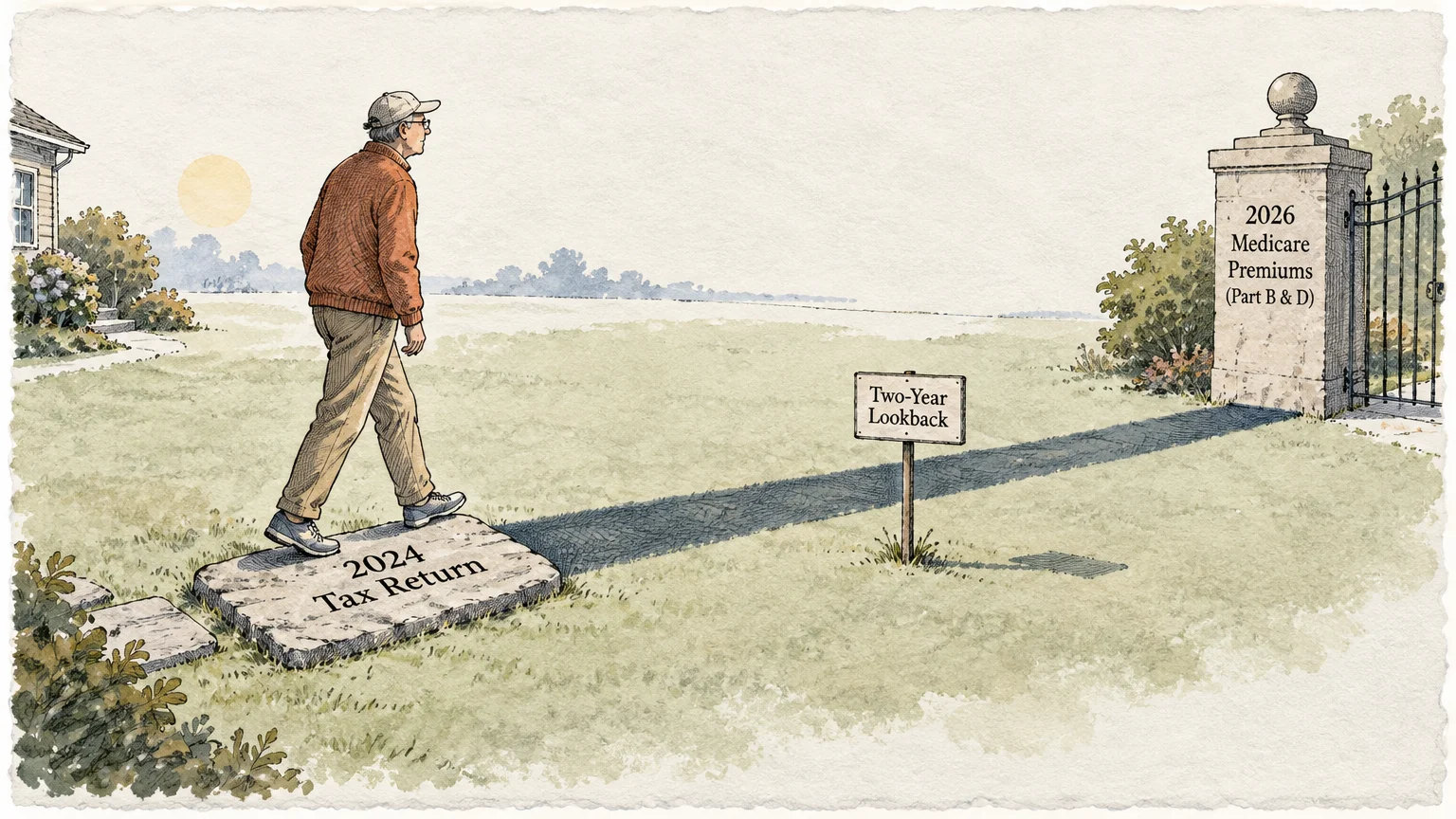
Medicare uses a strict two-year lookback period to establish your monthly premium rates. That means the financial choices you make right now determine your health care expenses two calendar years later.
For example, your 2026 Medicare premiums depend on the MAGI reported on your 2024 federal tax return. In the same way, your 2025 tax return dictates your 2027 premiums, and your 2026 tax return governs your 2028 costs.
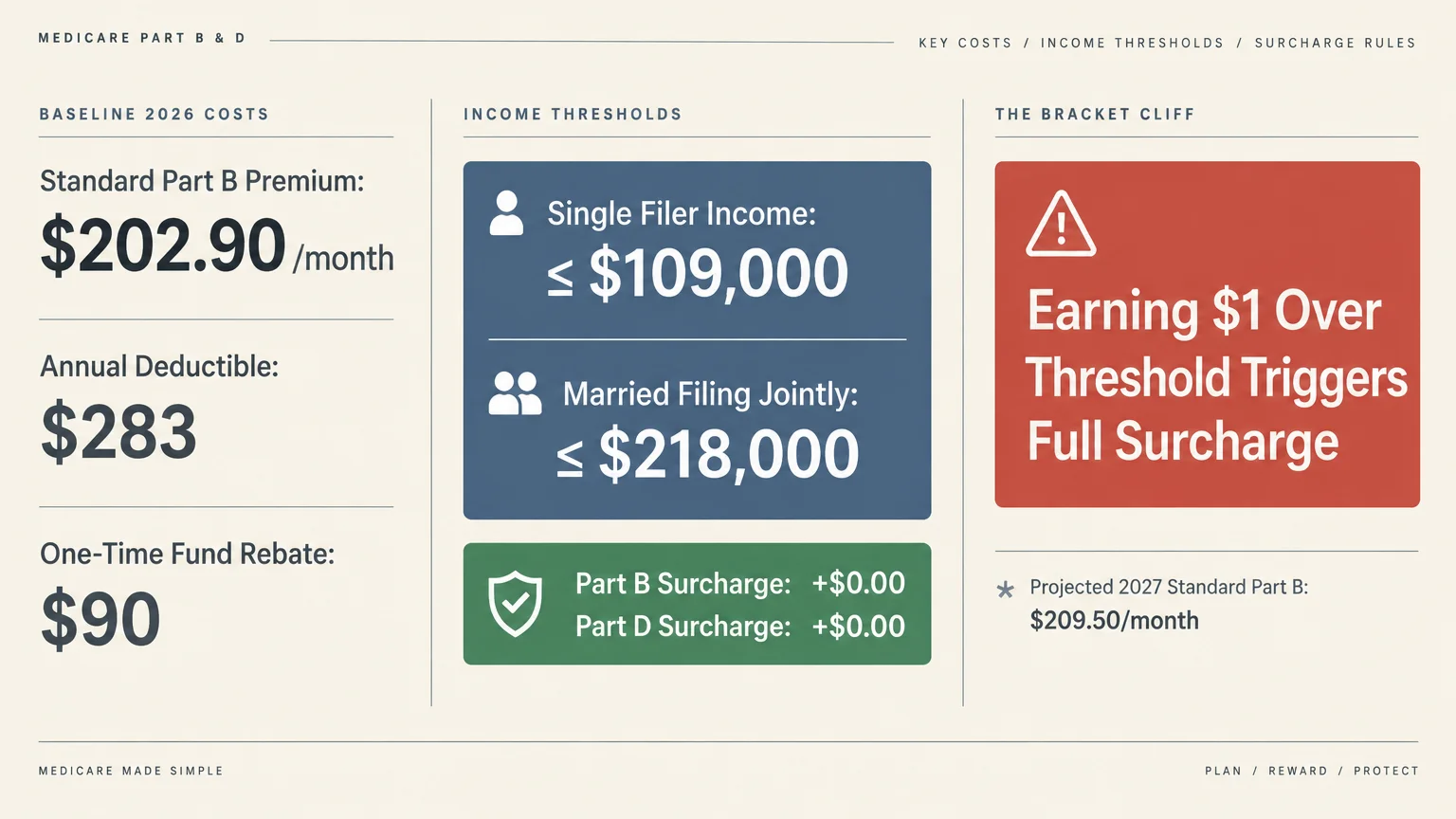
Unlike ordinary federal tax brackets, Medicare surcharges operate as rigid financial cliffs. Earning just one single dollar over a tier limit triggers the entire surcharge for the entire twelve-month period.
If you cross an income threshold by five dollars, you cannot pay a partial surcharge on that excess amount. You must pay the full monthly surcharge every single month for that calendar year.
Understanding this cliff mechanism is essential for every retiree taking income distributions. Careful year-end planning prevents small, unnecessary income increases from causing outsized Medicare premium hikes.
“The Medicare surcharges are the ultimate hidden tax on retirees. Moving one dollar over the threshold can trigger thousands of dollars in extra costs over a single year.” — Ed Slott, CPA and Retirement Specialist
2026 and 2027 Medicare Premium Surcharge Brackets
For 2026, the standard Medicare Part B monthly premium is $202.90, alongside an annual deductible of $283. Beneficiaries also receive a one-time automatic cash rebate of $90 per individual ($180 for eligible couples) in October 2026 from the Medicare Improvement Fund.
According to the 2026 Medicare Trustees Report, the standard Part B premium is projected to increase by $6.60 to $209.50 per month in 2027. The annual deductible is projected to reach $292, with official rates confirmed by the Centers for Medicare & Medicaid Services in late 2026.
For Part D prescription plans, the national base beneficiary premium is $38.99 per month in 2026. This base figure serves as the baseline calculation point for Part D surcharge tiers.
Review the confirmed 2026 IRMAA brackets below to see where your reported income places you. The table outlines the exact extra surcharges you must pay based on your 2024 tax filing status.
| Income Bracket (Single Filer) | Income Bracket (Married Filing Jointly) | Part B Monthly Surcharge | Part D Monthly Surcharge | Total Part B Monthly Cost |
|---|---|---|---|---|
| $109,000 or less | $218,000 or less | +$0.00 | +$0.00 | $202.90 |
| $109,001 to $137,000 | $218,001 to $274,000 | +$81.20 | +$14.50 | $284.10 |
| $137,001 to $171,000 | $274,001 to $342,000 | +$202.90 | +$37.50 | $405.80 |
| $171,001 to $205,000 | $342,001 to $410,000 | +$324.60 | +$60.40 | $527.50 |
| $205,001 to $499,999 | $410,001 to $749,999 | +$446.30 | +$83.30 | $649.20 |
| $500,000 or more | $750,000 or more | +$487.00 | +$91.00 | $689.90 |
For married individuals filing separately who lived together, different rules apply. Filers with MAGI between $109,001 and $390,999 pay $649.20 monthly for Part B, while those at $391,000 or higher pay $689.90.
Looking ahead to 2027, the initial surcharge threshold is projected to rise by approximately 3.67 percent due to inflation adjustments. Projections estimate the baseline cutoff will reach roughly $113,000 for single filers and $226,000 for couples.
The upper tiers for 2027 are expected to adjust accordingly, with top Part B surcharges projected to reach $502.60 per month. However, the top $500,000 single and $750,000 joint limits remain frozen under federal law until at least 2028.

Strategic Moves to Lower Your Modified Adjusted Gross Income
You can lower your Medicare costs significantly by managing the income components that feed into your MAGI calculation. Taking deliberate steps before December 31 shields you from unexpected surcharges two years later.
Start by evaluating your capital gains realized within taxable brokerage accounts. Delaying the sale of appreciated securities or harvesting capital losses balances out your taxable profits.
Tax-loss harvesting allows you to offset unlimited capital gains and write off up to $3,000 in ordinary income annually. This basic strategy can keep your total MAGI comfortably beneath a punitive surcharge boundary.
Watch your municipal bond holdings closely throughout the year. Many retirees believe municipal bond interest is completely tax-free and disregard it entirely during planning.
While municipal interest avoids federal income tax, Medicare rules specifically add tax-exempt interest back into your MAGI. Holding excessive municipal debt can inadvertently shove you over an IRMAA cliff.
You can also utilize Health Savings Account distributions to pay for qualified out-of-pocket medical expenses. HSA withdrawals for medical bills remain completely tax-free and never enter your MAGI total.
If you still work part-time or consult, maximize your contributions to tax-deferred retirement accounts. Contributing to a traditional 401(k), 403(b), or SEP IRA reduces your adjusted gross income dollar for dollar.
“Smart money management in retirement is about keeping what you earned. Controlling your visible tax footprint preserves both your wealth and your independence.” — Suze Orman, Personal Finance Author
Using Qualified Charitable Distributions and Roth Conversions
Required Minimum Distributions, or RMDs, force retirees to withdraw taxable money from traditional retirement accounts starting at age 73. These mandatory distributions often generate unexpected income surges that trigger hefty Medicare surcharges.
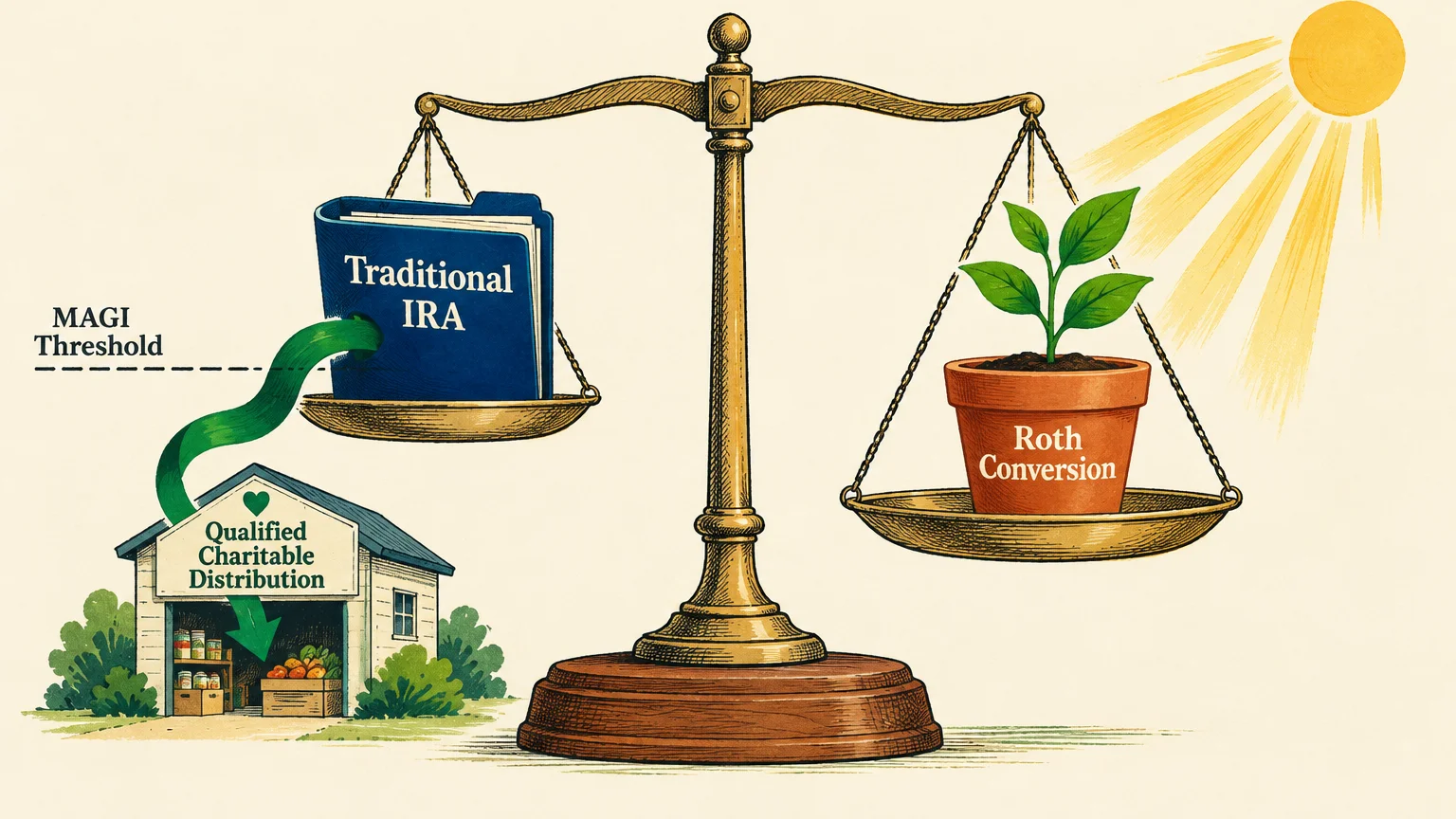
If you are age 70½ or older, Qualified Charitable Distributions provide one of the most powerful shields against IRMAA. A QCD lets you transfer money directly from a traditional IRA to an eligible 501(c)(3) charity.
For 2026, the Internal Revenue Service allows individuals to transfer up to $111,000 annually via QCDs. A married couple with separate IRAs can donate up to $222,000 combined.
The money donated through a QCD counts directly toward satisfying your annual RMD requirement. Best of all, that distribution is completely excluded from your adjusted gross income and MAGI calculation.
A standard charitable tax deduction only helps if you itemize deductions on your federal return. In contrast, a QCD lowers your MAGI directly, keeping you below Medicare surcharge brackets regardless of standard deduction choices.
Roth IRA conversions offer another essential planning avenue, though they require careful advance timing. Converting traditional IRA balances into a Roth account triggers ordinary income tax in the year you convert.
Executing large Roth conversions after age 63 will trigger severe Medicare surcharges two years later. Therefore, the optimal window for Roth conversions is often between retirement and age 63.
Once funds reside inside a Roth IRA, all subsequent qualified distributions come out entirely tax-free. Roth withdrawals do not count as income for federal tax calculations or Medicare IRMAA assessments.
If you convert funds after enrolling in Medicare, execute smaller, multi-year conversions. Measure your bracket headroom carefully so the converted amount stops just short of the next IRMAA tier.
How to Appeal Medicare Surcharges with Form SSA-44
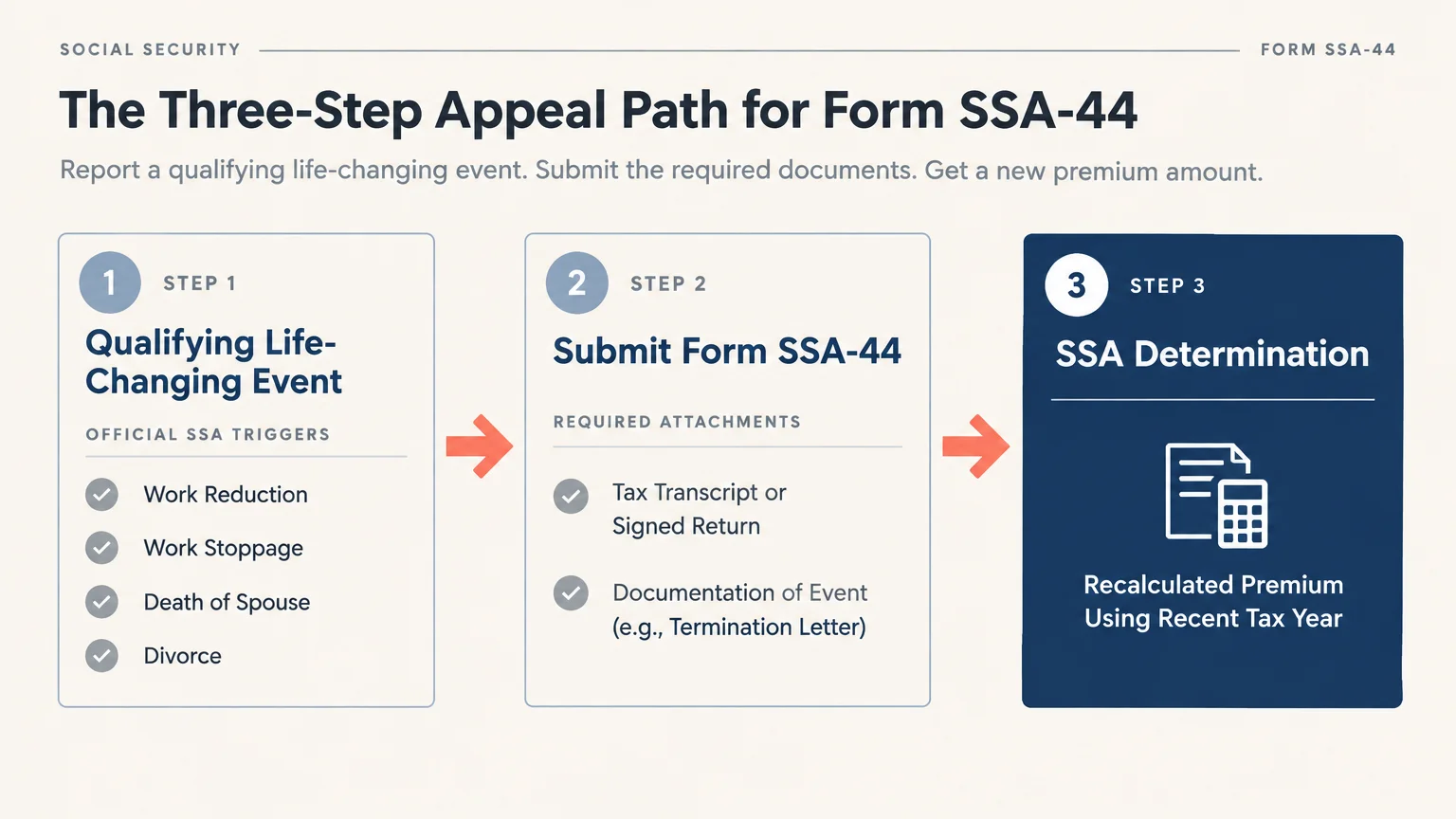
If your income dropped sharply after your lookback tax year, you do not have to accept an unfair Medicare surcharge. The Social Security Administration provides a formal appeal mechanism through Form SSA-44.
This form allows you to request a premium reduction based on a life-changing event. You must demonstrate that your current year income will be significantly lower than the income reported two years earlier.
The Social Security Administration only recognizes eight specific qualifying life-changing events. You cannot file an appeal simply because your stock portfolio declined or you experienced general cost-of-living increases.
- Work stoppage, including full retirement from your career.
- Work reduction, such as transitioning from full-time employment to part-time consulting.
- Death of a spouse, which changes both household income and tax filing thresholds.
- Marriage or legal remarriage during the lookback period.
- Divorce or legal annulment of a marriage.
- Loss of income-producing property due to a natural disaster, fraud, or eminent domain.
- Loss or substantial reduction of pension income due to plan termination or employer default.
- Receipt of an employer settlement payment caused by company closure, reorganization, or bankruptcy.
Retirement is the most common reason retirees successfully file Form SSA-44. If you retired in 2025 or 2026, your 2024 tax return reflects high corporate wages that no longer exist.
To file your appeal, download Form SSA-44 from the official Social Security website. Complete the document using an honest, conservative estimate of your expected income for the current calendar year.
You must provide concrete documentary evidence alongside your appeal submission. Required documentation includes retirement letters, signed termination notices, death certificates, divorce decrees, or certified tax documents.
Submit your completed paperwork to your local Social Security field office in person or by certified mail. Once approved, the agency recalculates your premiums and issues retroactive refunds for any overpayments made.

Avoiding Lifelong Medicare Late Enrollment Penalties
Income surcharges are not the only way your Medicare premiums can skyrocket. Missing your initial enrollment deadlines triggers permanent statutory penalties that remain attached to your monthly premiums for life.
Your Initial Enrollment Period spans seven months surrounding your 65th birthday. It begins three months before your birth month, covers your birth month, and concludes three months afterward.
If you do not enroll in Part B during this window and lack qualifying employer coverage, you incur a Part B penalty. This penalty adds a 10 percent surcharge to the standard monthly premium for every full twelve-month period delayed.
A senior who delays Part B enrollment for three full years faces a permanent 30 percent penalty surcharge. In 2026, that penalty adds an extra $60.87 every single month to the baseline $202.90 premium.
To avoid this penalty legally, you must maintain active group health insurance through your own or your spouse’s current employment. The employer must employ 20 or more workers to qualify as primary coverage.
COBRA continuation health coverage and standard retiree health packages do not qualify as active employer coverage for Part B. Relying on COBRA after retiring is a widespread blunder that triggers severe, lifelong penalties.
Medicare Part D also enforces a separate late enrollment penalty for failing to carry creditable drug coverage. You must maintain creditable prescription insurance from an employer, the VA, or a commercial plan.
The Part D penalty calculates at 1 percent of the national base beneficiary premium per month of delayed enrollment. For 2026, that base benchmark is $38.99, meaning each uncovered month compounds into significant annual expenses.

Lowering Costs Through Open Enrollment and Assistance Programs
Reviewing your coverage options during the annual Medicare Fall Open Enrollment window saves substantial money. Open Enrollment runs every year from October 15 through December 7.
During this period, you can switch between original Medicare and Medicare Advantage, or swap Part D prescription drug plans. Plan premiums, formularies, and networks change every January, making annual plan comparison essential.
Certain Medicare Advantage plans provide a valuable Part B giveback benefit. Under this arrangement, the private insurer covers a portion, or occasionally all, of your monthly Part B premium.
The carrier reduces the Part B premium deduction taken from your monthly Social Security check. If your plan offers an $80 giveback, your effective monthly Part B cost drops substantially.
Be sure to examine network restrictions and maximum out-of-pocket thresholds before choosing a giveback plan. A cheaper monthly premium provides little benefit if your essential medical specialists fall outside the plan’s network.
Beneficiaries with limited income and assets should evaluate state-administered Medicare Savings Programs. These programs provide vital financial lifelines for individuals struggling with routine medical expenses.
- Qualified Medicare Beneficiary (QMB) program: Covers full Part B premiums, annual deductibles, and co-payments.
- Specified Low-Income Medicare Beneficiary (SLMB) program: Pays the complete monthly Part B premium for eligible enrollees.
- Qualifying Individual (QI) program: Covers monthly Part B premiums through annual state block grants.
- Qualified Disabled and Working Individuals (QDWI) program: Assists working disabled individuals under age 65 with Part A premiums.
Enrolling in an MSP automatically qualifies you for the federal Extra Help program. Extra Help lowers Part D prescription plan premiums, eliminates drug deductibles, and caps individual medication co-pays.

Costly Errors to Sidestep
Avoiding higher Medicare costs requires staying alert to common miscalculations. Sidestepping these four financial pitfalls protects your hard-earned retirement assets from unnecessary erosion.
First, never trigger an income cliff accidentally near the end of the tax year. Selling mutual funds that distribute large end-of-year capital gains can push you into a higher IRMAA tier without warning.
Check your projected taxable income in November before authorizing asset sales or retirement withdrawals. A five-hundred-dollar distribution should never cost you hundreds of dollars in extra Medicare fees.
Second, do not assume that selling your primary residence is exempt from Medicare surcharge calculations. The IRS allows you to exclude up to $250,000 of home sale profit ($500,000 for married couples) from income tax.
Any capital gain exceeding that statutory home sale exclusion counts as taxable income and flows directly into your MAGI. That large gain can trigger top-tier IRMAA surcharges two years down the road.
Third, do not assume filing taxes separately automatically protects you from Medicare surcharges. The IRMAA thresholds for married couples filing separately who lived together are exceptionally strict.
The initial surcharge threshold for married individuals filing separately is just $109,000, quickly reaching maximum tier surcharges. In most situations, filing separately actually increases your overall household health care costs.
Fourth, avoid failing to appeal your IRMAA assessment after experiencing an eligible life change. The government relies entirely on historical tax returns and cannot guess that you recently stopped working.
If you retired or lost a spouse, you must take the initiative to submit Form SSA-44. Failing to file the appeal paperwork leaves you paying elevated premiums you do not legally owe.

When DIY Isn’t Enough
While self-directed planning handles basic Medicare decisions, certain complex financial situations demand professional guidance. Working alongside a qualified fee-only financial planner or CPA prevents costly oversights.
Consult a professional if you plan to sell a private business, farm, or commercial real estate holding. These sales produce massive one-time income spikes that require sophisticated deferral strategies, like installment agreements.
Professional input is invaluable when constructing multi-year Roth conversion ladders. A seasoned advisor models conversion amounts precisely to fill standard income tax brackets without spilling over into higher IRMAA tiers.
Seek guidance if you experience complicated life changes involving contested divorces, spousal deaths, and divided retirement assets. Untangling these legal events requires accurate reporting to avoid prolonged Social Security disputes.
Finally, work with an expert if you hold significant assets in non-qualified annuities and complex trusts. Income from these instruments generates unique tax consequences that directly affect your Medicare calculations.
Frequently Asked Questions About Lowering Medicare Costs
How long does an IRMAA surcharge last once applied?
An IRMAA surcharge lasts for one calendar year, running from January 1 through December 31. Social Security recalculates your premium status every autumn using your most recently filed federal tax data.
Does a one-time capital gain from selling stock qualify for an IRMAA appeal?
No, one-time investment gains or property sales do not qualify as life-changing events under Social Security rules. You can only appeal if your income dropped due to one of the eight officially recognized events, such as retirement or widowhood.
Can I use a Health Savings Account to pay for Medicare premiums?
Yes, you can use pre-tax distributions from an existing HSA to pay Medicare Part B and Part D premiums tax-free. However, you cannot use an HSA to pay premiums for private Medicare Supplement (Medigap) policies.
Do distributions from a reverse mortgage increase my Medicare premiums?
No, proceeds received from a reverse mortgage count as loan advances rather than earned or taxable income. These funds do not appear on your federal tax return and do not affect your Medicare MAGI.
What happens if my appeal on Form SSA-44 gets denied?
If the Social Security Administration denies your appeal, you have the right to request an official reconsideration. You can escalate the review through four administrative levels, ending with an administrative law judge hearing.
Take Control of Your Health Care Expenses
Managing your health care expenses requires vigilance, strategic tax management, and a firm grasp of government regulations. By keeping your taxable distributions below key cliffs, you safeguard your monthly retirement budget.
Review your annual income every autumn before taking discretionary withdrawals, and file timely appeals whenever qualifying life events occur. Consistent, disciplined planning ensures your retirement assets support your personal lifestyle instead of paying unnecessary government surcharges.
This is educational content based on general financial principles for seniors. Individual results vary based on your situation. Always verify current benefit amounts, tax rules, and program eligibility with official government sources.
Last updated: October 2026. Benefit amounts, tax rules, and program details change annually—verify current figures with official government sources.









Leave a Reply