
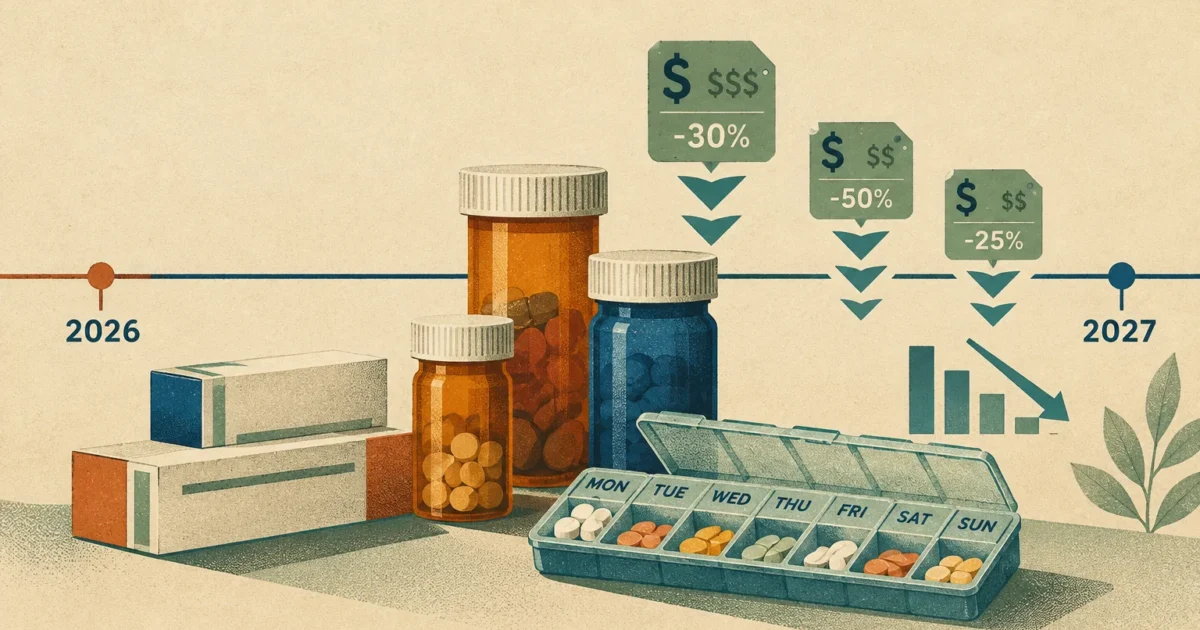
Your Medicare prescription drug costs are shifting dramatically across 2026 and 2027. Major federal policy updates under the Inflation Reduction Act continue to reshape what you pay directly at the pharmacy checkout counter.
Knowing these figures ahead of time protects your retirement budget from unexpected pharmacy surprises. Tracking annual benchmark updates also ensures you select the most economical plan during Medicare open enrollment.
From negotiated price caps to restructured out-of-pocket rules, these updates directly influence your monthly healthcare spending. Here are the seven essential Medicare prescription price changes you need to track.
1. The Out-of-Pocket Spending Limit Rises to $2,400 in 2027
One of the most consequential protections for your wallet is the annual Part D out-of-pocket spending cap. This ceiling protects seniors from catastrophic medical costs caused by expensive specialty treatments.
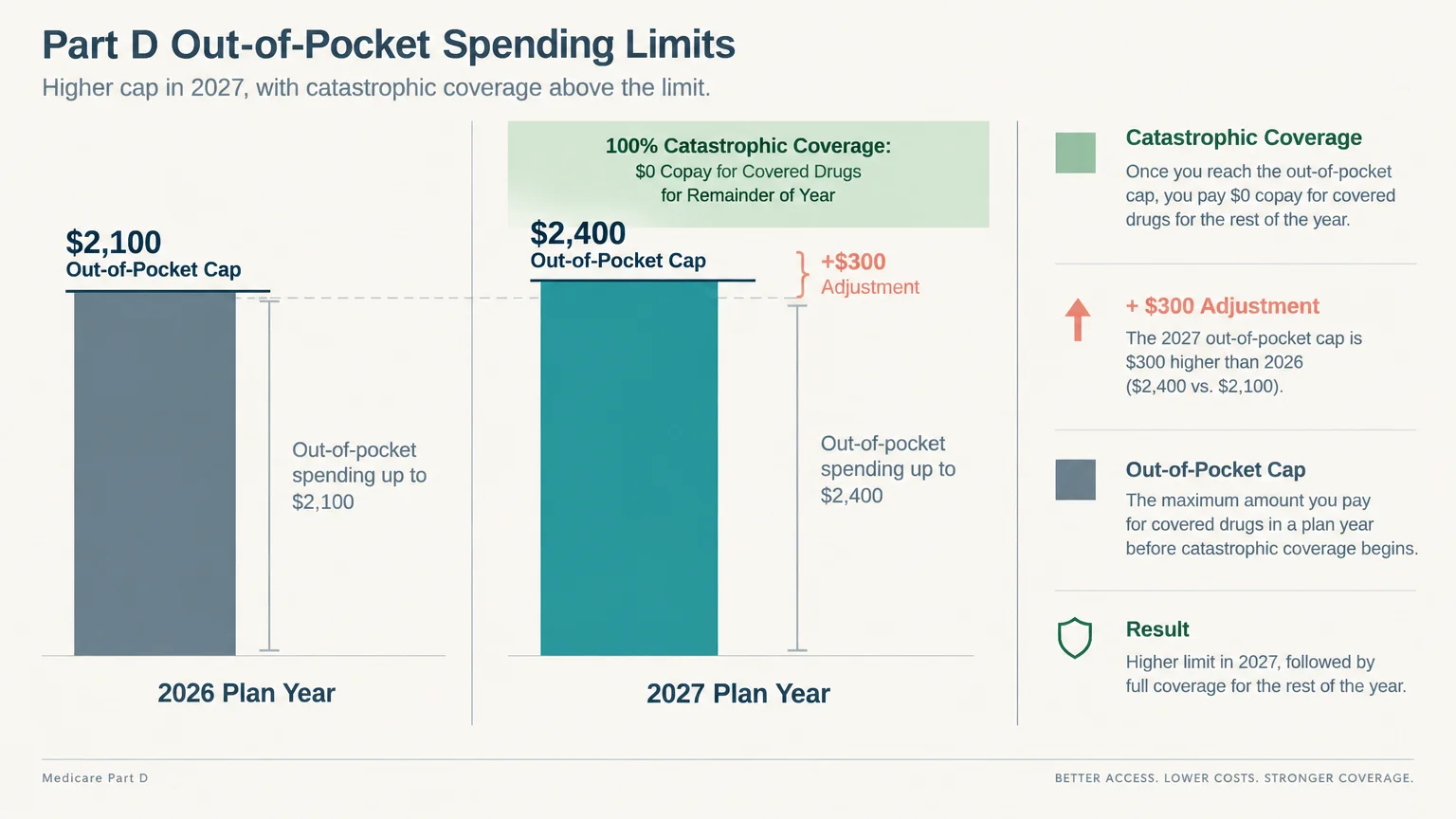
For the 2026 plan year, your covered out-of-pocket prescription spending is capped at $2,100. Federal law indexes this benchmark annually to account for per-capita drug expenditure growth.
Starting January 1, 2027, the annual out-of-pocket maximum increases to $2,400. While this represents a $300 increase, it remains an extraordinary shield compared to older Medicare rules.
Before 2025, seniors faced an uncapped catastrophic coverage phase where they paid a continuous 5% coinsurance fee. Today, once your eligible spending hits that annual ceiling, you pay $0 for covered Part D drugs for the rest of the year.
If you take high-cost medications for rheumatoid arthritis, oncology, or multiple sclerosis, you will likely hit this ceiling early in the calendar year. Planning for this $2,400 cap allows you to budget your liquid savings with exact certainty.
Keep in mind that only payments for formulary-covered medications apply toward this benchmark. Monthly plan premiums and non-covered pharmacy purchases do not count toward your out-of-pocket total.

2. Medicare Price Negotiation Expands to 15 Major Medications
Direct federal price negotiation is actively lowering the retail cost of high-demand medications. Under the Inflation Reduction Act, Medicare negotiates “Maximum Fair Prices” directly with pharmaceutical manufacturers.
Round 1 of these negotiations took effect on January 1, 2026, targeting ten initial high-cost Part D drugs. That initial list included widely prescribed treatments such as Eliquis, Jardiance, Xarelto, and Januvia.
The program broadens significantly for the 2027 plan year. Negotiated prices for a second group of 15 blockbuster Part D drugs take effect on January 1, 2027.
This second wave includes major treatments that millions of seniors rely on daily. You can review the selected Round 2 medications below:
- Ozempic, Rybelsus, and Wegovy (diabetes and chronic weight management)
- Trelegy Ellipta and Breo Ellipta (respiratory and chronic obstructive pulmonary disease)
- Xtandi and Ibrance (oncology treatments)
- Otezla (psoriatic arthritis and plaque psoriasis)
- Linzess and Xifaxan (gastrointestinal disorders)
- Janumet and Tradjenta (type 2 diabetes management)
- Vraylar (mental health management)
- Pomalyst and Calquence (blood cancers)
- Ofev (idiopathic pulmonary fibrosis)
- Austedo (movement disorders)
According to the Centers for Medicare & Medicaid Services (CMS), these 15 negotiated prices will save Medicare beneficiaries an estimated $685 million in out-of-pocket costs in 2027 alone. Lower negotiated prices mean your percentage-based coinsurance payments drop substantially.
Looking further down the road, CMS selected a third round of 15 additional Part B and Part D drugs in January 2026. Those negotiated discounts—covering treatments like Trulicity, Biktarvy, Entyvio, and Botox—will take effect on January 1, 2028.

3. Expiration of the Premium Stabilization Demonstration
While drug prices face lower caps, standalone Part D premiums face transitional pressures in 2027. Seniors enrolled in traditional Medicare with standalone Part D plans must pay close attention to their monthly statements.
Across 2025 and 2026, CMS operated the voluntary Part D Premium Stabilization Demonstration. This federal initiative distributed $9.8 billion in subsidies to private insurers to cushion premium spikes caused by sweeping legislative reforms.
CMS is discontinuing this temporary demonstration at the end of 2026. Without these extra federal stabilization subsidies, insurers must price their plans to independently cover projected risk.
CMS projects the enrollment-weighted average monthly premium for standalone Part D plans will move from $35.09 in 2026 to $36.00 in 2027. While that national average looks stable, individual plan shifts will vary significantly.
Some private standalone plans may raise monthly premiums more sharply to offset the loss of federal support. Conversely, average Medicare Advantage prescription drug plan premiums are projected to drop from $14.37 in 2026 to $12.00 in 2027.
Additionally, the Part D base beneficiary premium increases from $38.99 in 2026 to $41.33 in 2027. This figure serves as the baseline for calculating Part D late-enrollment penalties if you miss your initial enrollment window.
4. The Maximum Part D Deductible Increases to $700
Your annual prescription deductible represents the amount you must pay out-of-pocket before your plan begins sharing medication costs. Federal guidelines define the maximum allowable standard deductible each year.
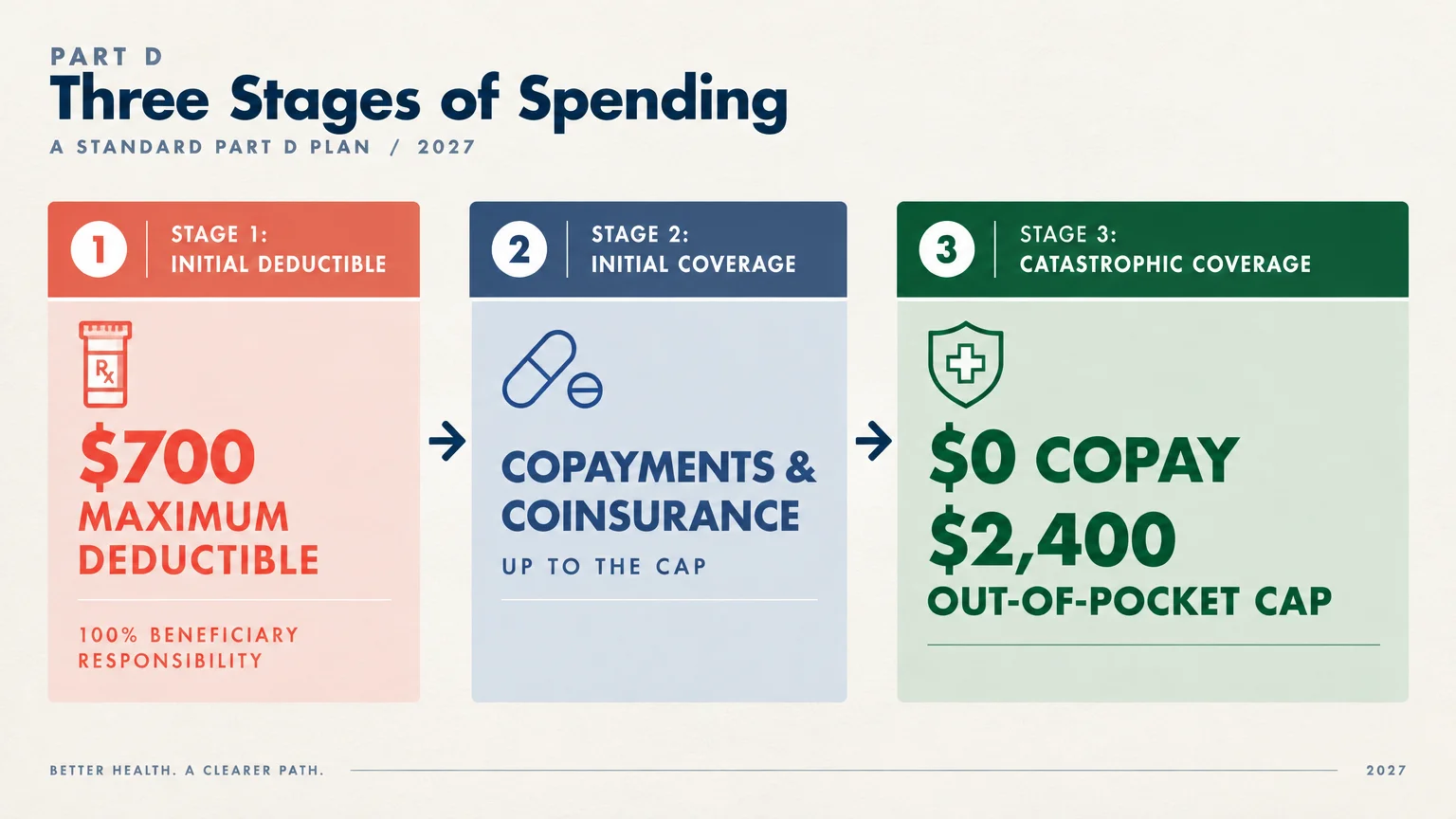
For 2026, the maximum standard Part D deductible is $615. For the 2027 benefit year, CMS set the maximum standard deductible at $700.
Private insurance carriers can offer plans with lower deductibles or even $0 deductibles on preferred tiers. However, insurers cannot legally charge a deductible higher than the $700 benchmark in 2027.
Many basic standalone plans adjust their deductible right to the federal ceiling each year. If you enroll in a plan featuring the standard deductible, you must pay full negotiated prices until you reach $700.
Crucially, certain vital medications remain completely exempt from your deductible by federal mandate. Covered insulin products and recommended adult vaccines cannot be subjected to any deductible whatsoever.

5. Automatic Renewal for the Medicare Prescription Payment Plan
Managing large prescription bills early in January often strains fixed retirement incomes. The Medicare Prescription Payment Plan helps seniors manage this timing challenge without incurring debt.
This program allows enrollees to spread their out-of-pocket drug costs across monthly, interest-free installments throughout the calendar year. It does not reduce your total annual spending, but it eliminates sudden, massive pharmacy charges in January and February.
Starting across the 2026 and 2027 plan years, participation in this payment program automatically renews. If you opt into the payment plan, you remain enrolled for subsequent years without filing new paperwork.
Automatic renewal continues as long as you stay enrolled in the same Medicare Part D plan. If you switch to a different insurance carrier during open enrollment, you must re-elect the payment option with your new sponsor.
You can opt out of the payment smoothing program at any time if you prefer paying standard pharmacy copays at the register. You remain responsible for any outstanding monthly balances accrued during your enrollment period.
6. New GLP-1 Coverage Bridge and Cash Discount Tools
Demand for advanced metabolic medications has skyrocketed among older adults. However, traditional Medicare coverage rules historically restricted medications prescribed primarily for weight loss.
For 2027, CMS introduced the Medicare GLP-1 Bridge program to address this critical coverage gap. This program offers qualifying Part D enrollees access to select GLP-1 medications for a standardized $50 monthly copay.
This bridge program applies when your specific plan formulary does not otherwise cover the medication for secondary conditions like cardiovascular risk reduction. It provides structured financial relief while long-term coverage regulations continue to evolve.
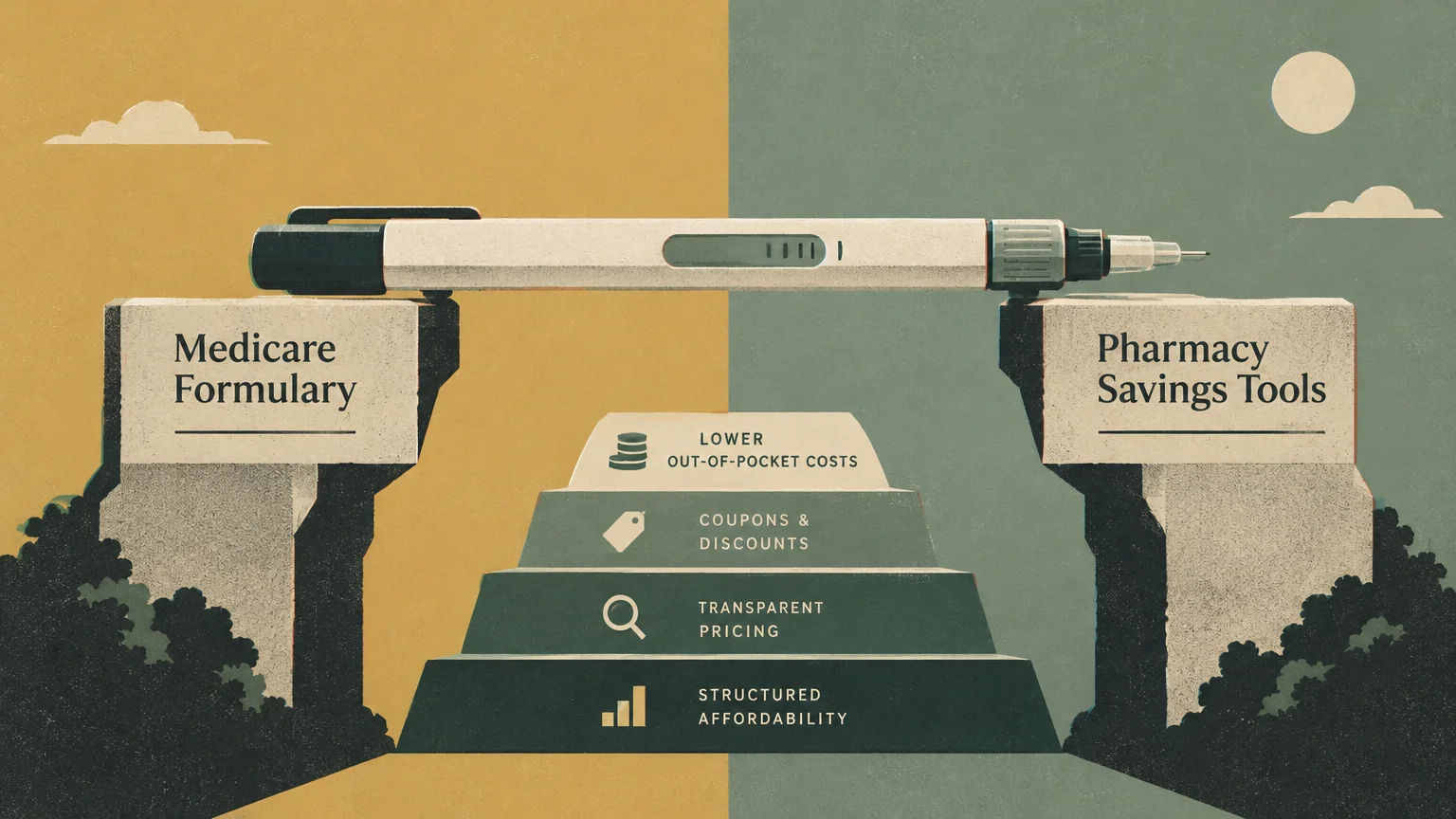
At the same time, official Medicare guidance highlights cash and coupon comparison portals such as TrumpRx.gov. These digital platforms help seniors compare retail cash prices against insurance copays for generic and brand-name drugs.
However, you must consider an important financial caveat before paying cash outside your Medicare plan. Cash purchases made outside your Part D insurance do not count toward your $2,400 annual out-of-pocket cap.
If you take multiple daily prescriptions, bypassing your Part D benefit could delay your progress toward the $2,400 cap. Always calculate whether immediate cash savings outweigh the long-term benefit of reaching catastrophic $0 coverage.

7. Permanent Protections: $35 Insulin, Free Vaccines, and No Donut Hole
Alongside shifting annual numbers, foundational Medicare cost protections remain permanently locked into place. These legislative safeguards provide reliable stability for everyday retirement budgets.
First, covered insulin products remain strictly capped at $35 for a one-month supply across both 2026 and 2027. Your plan cannot apply a deductible to these insulin products, regardless of whether you take them via vial or disposable pen.
Second, all adult vaccines recommended by the Advisory Committee on Immunization Practices remain available at $0 out-of-pocket. This includes vital preventive immunizations for shingles, pneumonia, tetanus, RSV, and annual influenza.
Finally, the infamous Part D coverage gap—widely known as the “donut hole”—remains permanently eliminated. Before 2025, seniors who reached a middle spending threshold suddenly paid 25% coinsurance out-of-pocket.
Today, your Part D plan design consists of three straightforward stages: the deductible phase, the initial coverage phase, and the catastrophic phase. Once you satisfy your deductible, you pay standard copays until your spending hits the annual cap, where all costs drop to zero.
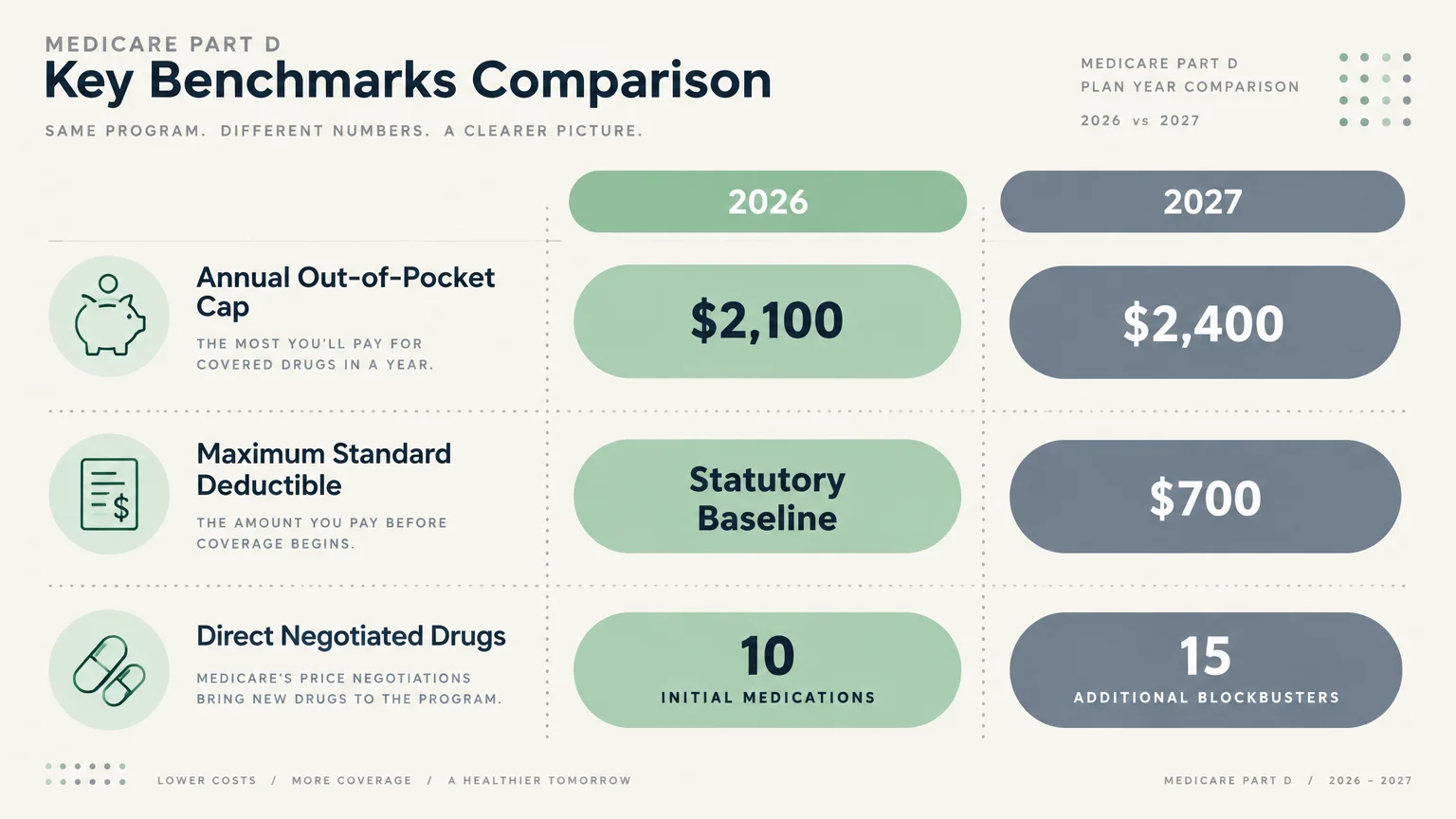
Comparing Medicare Part D Costs: 2026 vs. 2027
Understanding how baseline Medicare figures adjust between plan years allows you to audit your healthcare spending. The comparison table below outlines the confirmed regulatory updates taking effect between 2026 and 2027.
| Medicare Cost Metric | 2026 Plan Year | 2027 Plan Year |
|---|---|---|
| Annual Out-of-Pocket Cap | $2,100 maximum | $2,400 maximum |
| Maximum Standard Deductible | $615 | $700 |
| Negotiated Drug Prices Active | 10 Part D drugs (Round 1) | 25 Part D drugs (Rounds 1 & 2) |
| Average Standalone Part D Premium | $35.09 per month | $36.00 per month (projected) |
| Average Medicare Advantage Premium | $14.37 per month | $12.00 per month (projected) |
| Part D Base Beneficiary Premium | $38.99 per month | $41.33 per month |
| Covered Insulin Monthly Limit | $35 maximum per month | $35 maximum per month |
| Recommended Adult Vaccines | $0 copay | $0 copay |
| Premium Stabilization Subsidy | Active ($9.8B pilot) | Expired / Discontinued |
These benchmarks establish the legal boundaries for all approved private insurance carriers. Checking these figures ensures your plan complies fully with federal consumer protection standards.
“Planning for healthcare costs means preparing for regular policy adjustments rather than hoping prices stay flat.” — Suze Orman, Personal Finance Author

How to Evaluate Your Coverage During Fall Open Enrollment
Every autumn, you have a formal window to update your Medicare health and drug selections. The Medicare Annual Enrollment Period runs strictly from October 15 through December 7, with coverage taking effect January 1.
During late September, your current insurance company will mail you an Annual Notice of Change (ANOC). This vital document outlines every forthcoming adjustment to your premium, deductible, formulary tiers, and pharmacy network.
Never discard this document without reading it thoroughly. A plan that offered outstanding value this year may alter its drug tiers or drop preferred pharmacy partnerships for next year.
Log into your personal account on Medicare.gov to input your current medication list and dosages. The official Plan Finder tool automatically calculates your total annual costs—including premiums, deductibles, and copays—across every available plan.
You can also seek personalized, unbiased guidance through local State Health Insurance Assistance Programs (SHIP). Trusted advocacy resources like the National Council on Aging (NCOA) provide free assistance to help you navigate plan comparisons.
Taking sixty minutes to review your options during open enrollment frequently saves hundreds of dollars annually. Routine annual reviews ensure your prescription benefits match your evolving health profile.

Common Mistakes to Avoid
Navigating changing Medicare rules requires careful attention to detail. Seniors often fall into predictable traps that lead to unnecessary out-of-pocket expenses throughout the year.
1. Putting Plan Enrollment on Autopilot
Assuming your existing plan will remain unchanged is one of the costliest errors you can make. Formularies shift annually, and medications can move to higher cost-sharing tiers without warning.
Take the time each October to verify that every medication you take remains covered affordably. An hour spent reviewing your formulary prevents painful surprises at the pharmacy counter in January.
2. Overlooking the Monthly Payment Plan
Many seniors struggle with heavy pharmacy bills early in the year without realizing relief exists. The Medicare Prescription Payment Plan is designed specifically to smooth these costs into predictable monthly payments.
If you take costly brand-name drugs, contact your Part D sponsor to opt into this installment program. Spreading your expenses evenly across twelve months protects your monthly retirement cash flow.
3. Counting Cash Discounts Toward Your Cap
Pharmacy discount cards and cash comparison portals often offer attractive immediate prices. However, these independent transactions completely bypass your Medicare Part D insurance record.
Cash purchases do not count toward your $2,400 out-of-pocket catastrophic spending cap. If you plan to reach the cap early, processing medications through your Part D coverage remains your most economical strategy.
4. Ignoring Pharmacy Network Designations
Part D plans divide pharmacies into preferred, standard, and out-of-network categories. Filling prescriptions at a standard retail location rather than a preferred pharmacy can double your copayment.
Always verify whether your local neighborhood pharmacy retains preferred status under your 2027 plan design. Switching to a designated preferred pharmacy or approved mail-order service delivers immediate savings on recurring prescriptions.
Frequently Asked Questions About Medicare Drug Price Changes
How does the $2,400 cap work if I switch plans mid-year?
Your accrued out-of-pocket spending transfers with you if you change Part D plans during a valid enrollment period. Your new plan must credit verified spending toward your $2,400 annual catastrophic threshold.
Will negotiated drug prices apply if I take a generic version?
Medicare drug price negotiations target specific, single-source brand-name medications that lack direct generic competition. If a generic alternative enters the marketplace, traditional market competition dictates the retail price.
What should I do if my standalone Part D premium spikes in 2027?
If your plan raises premiums significantly due to the expiration of federal stabilization subsidies, shop alternatives on Medicare.gov. You can switch to another standalone plan or explore Medicare Advantage options during open enrollment.
Are all GLP-1 medications automatically capped at $50 in 2027?
No, the $50 copay applies specifically under the targeted Medicare GLP-1 Bridge program guidelines for qualifying enrollees. Review your plan’s formulary criteria to confirm specific clinical eligibility requirements before filling your prescription.
Next Steps for Your Retirement Health Budget
Proactive planning is your best defense against shifting prescription expenses. Mark October 15 on your calendar today so you are fully prepared when the Fall Open Enrollment window opens.
Gather your prescription bottles, document your current monthly spending, and compare available options through trusted consumer organizations like AARP and Medicare.gov. Taking proactive control of your Medicare coverage preserves your hard-earned retirement savings for the years ahead.
This is educational content based on general financial principles for seniors. Individual results vary based on your situation. Always verify current benefit amounts, tax rules, and program eligibility with official government sources.
Last updated: February 2026. Benefit amounts, tax rules, and program details change annually—verify current figures with official government sources.









Leave a Reply