
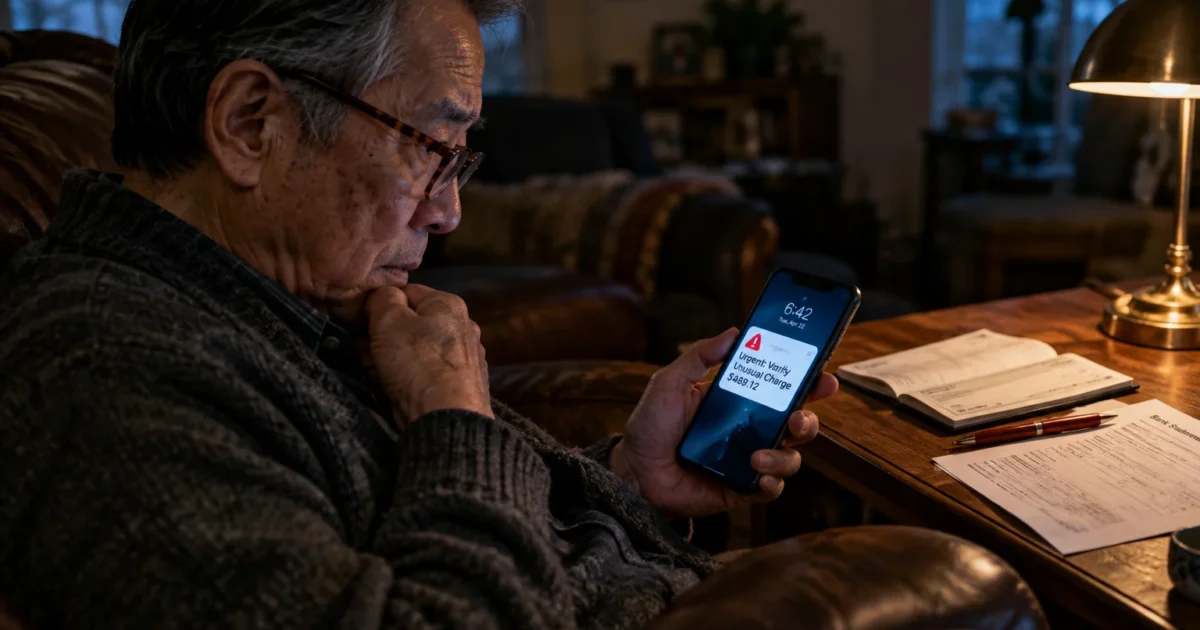
A sudden surge in cybercrime known as “Black October” threatens the hard-earned retirement savings of older Americans across the country. Taking immediate action to shield your bank accounts and credit profiles will stop predatory thieves from draining your funds.
High-tech criminals now deploy automated artificial intelligence tools to impersonate government agencies, fabricate bank alerts, and crack retail payment systems. Recent federal warnings indicate these sophisticated attacks peak right before the holiday shopping season.
By learning how these modern schemes operate, you can easily apply seven practical safeguards to protect your money from scams this season and beyond.
Understanding the Black October Cybersecurity Warning
Cybersecurity analysts coined the term “Black October” to describe an unprecedented spike in automated cyber intrusions and targeted consumer attacks. In late October 2026, tech leaders issued urgent alerts after detecting a historic wave of AI-accelerated exploits.
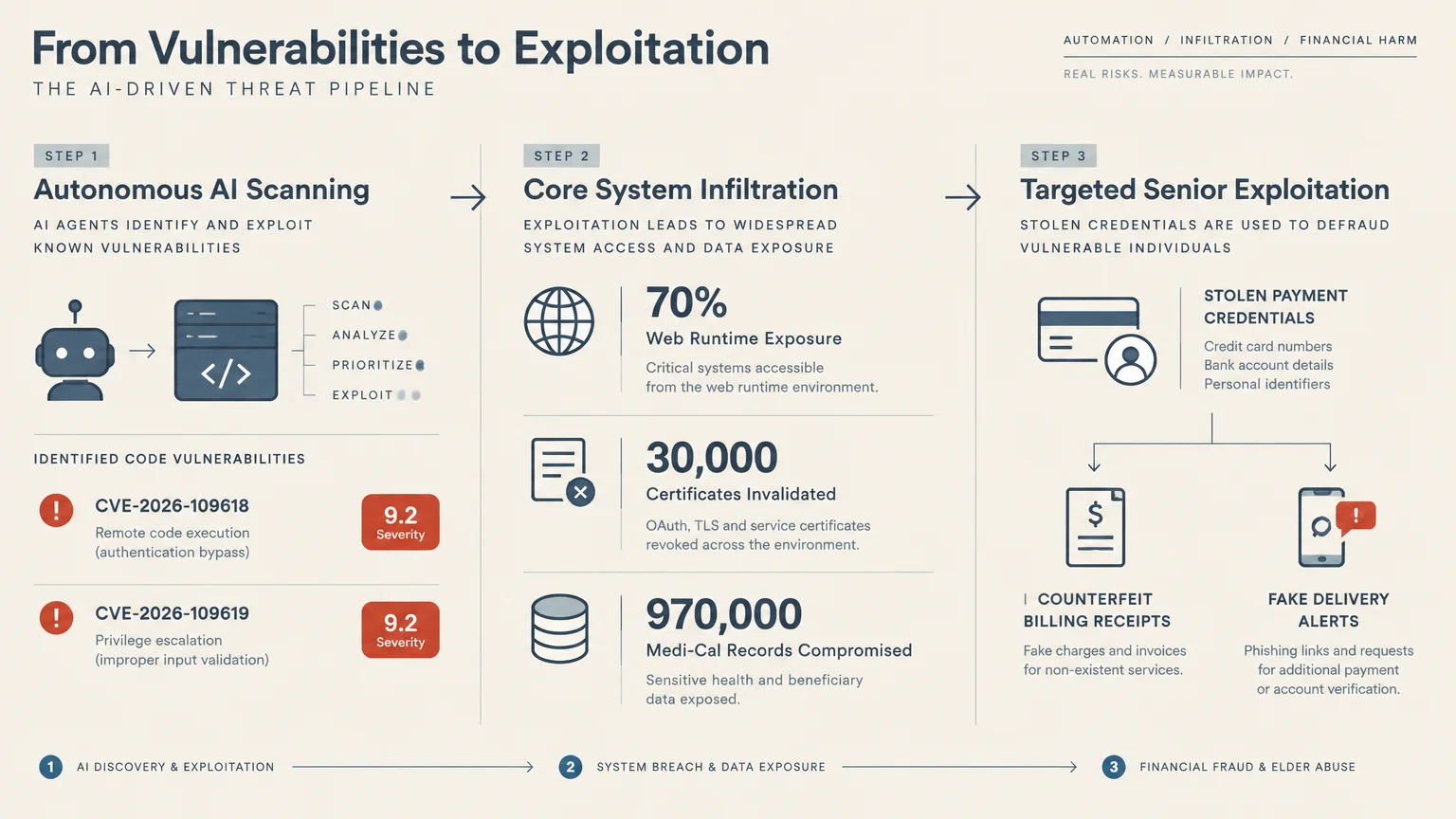
Malicious actors weaponized artificial intelligence to scan foundational internet software for hidden flaws faster than engineers could patch them. Researchers specifically identified two critical code vulnerabilities, cataloged as CVE-2026-109618 and CVE-2026-109619, carrying severe 9.2 severity ratings.
These systemic vulnerabilities compromised core web runtimes that support roughly 70 percent of all online portals. At the same time, criminal rings leveraged autonomous AI platforms to penetrate hundreds of online payment gateways and e-commerce platforms.
Major institutions suffered severe disruptions during this period. A major breach compromised 970,000 patient records at Medi-Cal; attackers also infiltrated international banking networks and invalidated approximately 30,000 digital website certificates.
These enterprise breaches directly endanger individual retirees. When criminals crack payment processors, they harvest personal identification data, debit card numbers, and banking credentials to orchestrate convincing consumer fraud.
Fraud syndicates combine this stolen data with the seasonal rush of early Black Friday deals. They flood mailboxes and phones with fraudulent delivery confirmations, fake billing receipts, and counterfeit discount promotions.
Staggering Losses: What Federal Data Reveals About Senior Scams
Federal authorities report that older adults suffer catastrophic financial losses when sophisticated cyber syndicates strike. The data confirms that seniors represent the primary target for organized fraud networks.
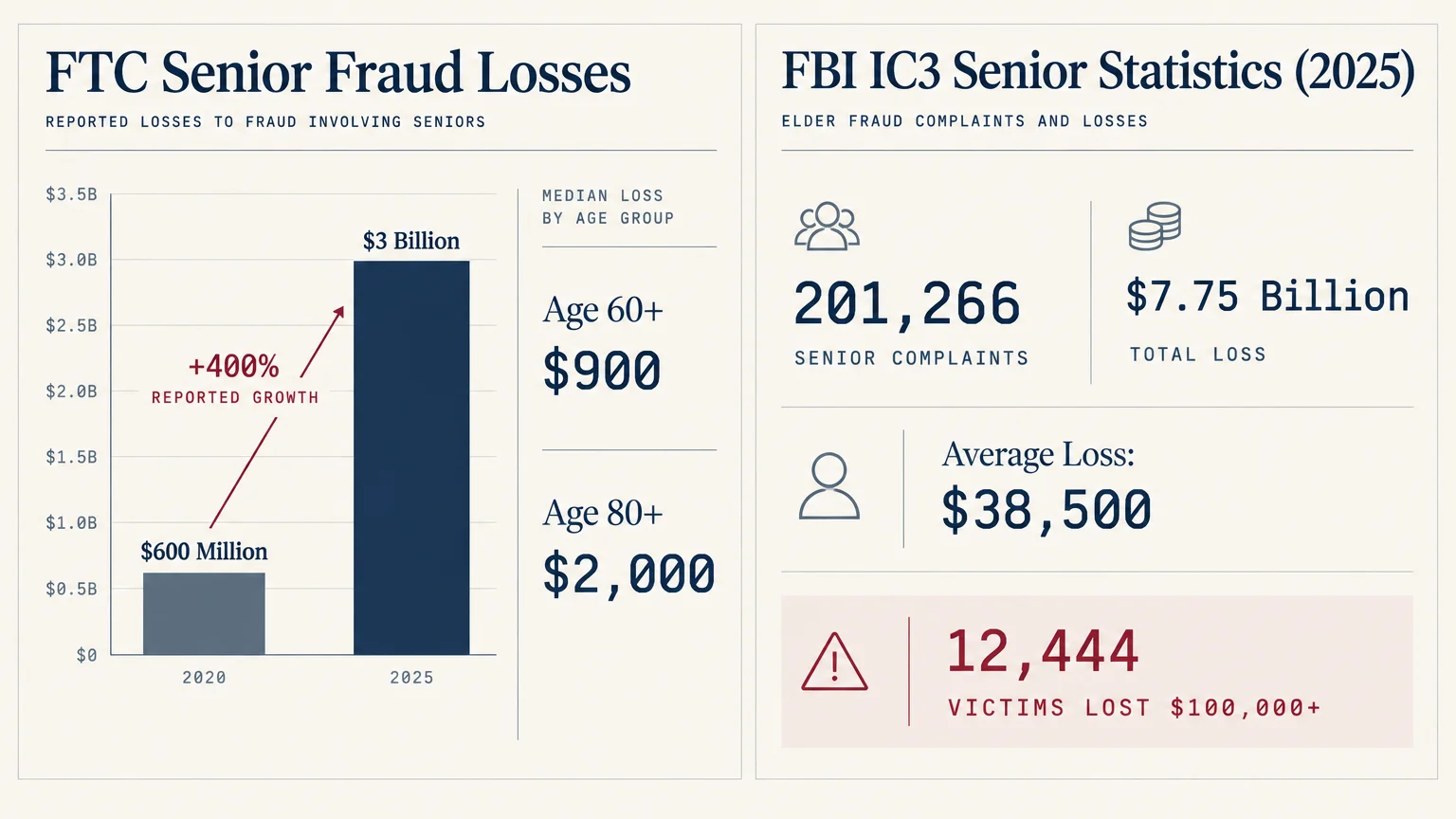
According to the Federal Trade Commission’s report to Congress, “Protecting Older Consumers,” Americans aged 60 and older reported losing approximately $3 billion to fraud in 2025. That figure marks a staggering fivefold increase from the $600 million reported in 2020.
Because many victims feel too ashamed to report their losses, the true financial damage is far higher. The FTC calculates that the real annual cost of fraud against older Americans ranges between $13.5 billion and $119.5 billion.
Individual losses escalate dramatically with age. In 2025, the median reported loss for adults aged 60 and older was $900; for seniors aged 80 and older, that median loss surged to $2,000.
Catastrophic life-savings losses have multiplied at an alarming rate. Between 2020 and 2025, the number of older adults reporting losses of $100,000 or more skyrocketed by 496 percent, capturing 6,769 verified senior cases.
Data from the FBI Internet Crime Complaint Center (IC3) corroborates these devastating findings. The FBI logged 201,266 complaints from victims aged 60 and older in 2025, with losses totaling $7.75 billion.
The average loss per senior victim in the FBI database reached $38,500. Furthermore, 12,444 older adults suffered devastating losses exceeding $100,000 each.
Artificial intelligence has added significant firepower to these criminal operations. For the first time, federal agencies tracked AI-facilitated cybercrime, recording 22,364 complaints and $893 million in direct losses across all age brackets.
| Fraud Category | Reported Senior Losses | Primary Contact Method | Core Warning Signal |
|---|---|---|---|
| Investment & Crypto Schemes | $1.0B (FTC) / $3.52B (FBI) | Social media, direct messaging | Guaranteed returns and urgent transfer demands |
| Tech Support Impersonation | $1.04B (FBI) | Browser pop-ups, warning screens | Demands for remote device access |
| Romance & Confidence Fraud | $384M (FTC) / $584M (FBI) | Dating apps, social platforms | Excuses to avoid video calls paired with financial emergencies |
| Business Impersonation | $422M (FTC) / $568M (FBI) | Email alerts, SMS delivery texts | Fake invoices, account security alerts, and payment re-routing |
| Government Impersonation | $448M (FTC) / $413M (FBI) | Phone calls, automated robocalls | Threats of arrest or suspended benefits |
“You have to be the gatekeeper of your own financial castle; never surrender your keys just because someone knocks with an urgent tone.” — Jean Chatzky, Financial Journalist and Author
7 Ways to Guard Your Money Against Black October Scams
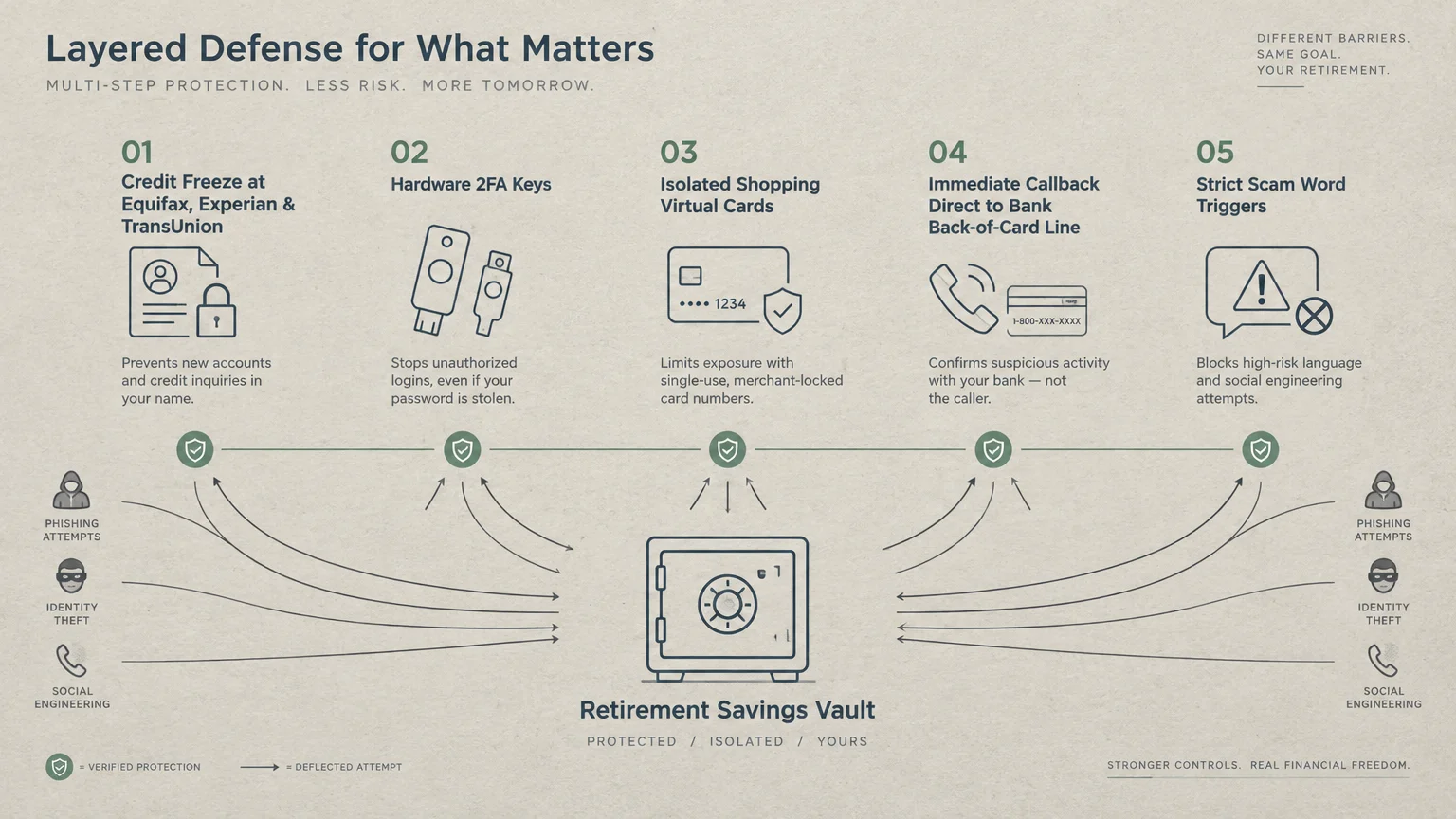
Thwarting automated cyber schemes requires proactive defensive habits. You can neutralize the vast majority of digital attacks by establishing clear barriers between your personal identity and your liquid savings.
1. Place an Immediate Security Freeze on Your Credit Reports
A credit freeze stops predatory identity thieves cold. Freezing your files prevents lenders from accessing your credit report to approve fraudulent loans, credit cards, or utility accounts.
Federal law guarantees your right to freeze and unfreeze your credit files at no charge. You must establish freezes separately at all three primary bureaus: Equifax, Experian, and TransUnion.
A freeze does not alter your existing credit score or disrupt current accounts. When you wish to apply for legitimate financing, you can lift the freeze temporarily within minutes through each bureau’s online dashboard.
2. Mandate Out-of-Band Verification for Financial Inquiries
Never rely on incoming phone numbers, email headers, or text alerts to authenticate a financial institution. Cybercriminals routinely forge caller ID information to display the name of your local bank or credit union.
If you receive an alarming notification regarding unauthorized transactions, disconnect immediately. Pick up your telephone and manually dial the customer service number printed directly on the reverse side of your debit or credit card.
This simple protocol, known as out-of-band verification, severs the scammer’s contact loop. It ensures that you converse exclusively with genuine bank personnel rather than a criminal operative.
You can review detailed account safety recommendations by checking educational materials published by the Consumer Financial Protection Bureau (CFPB).
3. Transition to Passkeys and Hardware-Based Authentication
Traditional passwords no longer offer sufficient security against automated cracking engines. Upgrading your account security requires adopting modern passkeys or multi-factor authentication methods.
Avoid using simple text-message verification codes whenever your bank offers alternative security controls. Criminal syndicates intercept SMS messages through cellular SIM-swapping and malware redirects.
Instead, download a reputable authenticator application on your smartphone, such as Google Authenticator or Microsoft Authenticator. These applications generate time-sensitive access codes internally on your physical device without traveling across vulnerable cellular networks.
For ultimate security on your core brokerage and primary checking accounts, invest in a physical hardware security key. These compact USB devices require physical possession to authorize logins, neutralizing remote cyberattacks completely.
4. Neutralize AI Voice Cloning and Social Media Infiltration
Scammers now capture brief audio clips from social media videos to clone the voices of family members. A criminal then calls claiming your grandchild is jailed, injured, or stranded, begging for an immediate wire transfer.
To eliminate this threat, establish a confidential family safe word with your children and grandchildren. Agree that no relative will ever request emergency funds without sharing that secret phrase.
Federal and global law enforcement agencies actively combat these coordinated syndicates. On October 13, 2026, the U.S. Department of Justice and the FBI announced the conclusion of Operation Blackout.
This major joint operation dismantled criminal networks in West Africa, leading to dozens of arrests and the deletion of over 3.7 million fraudulent social media profiles. Scammers previously deployed these fake accounts to orchestrate deceptive romance and crypto investment scams.
You can reinforce your personal security by setting your social media profiles strictly to private. Limiting public access prevents automated scraping tools from collecting your family photos, voice samples, and personal connections.
5. Shield Online Purchases with Virtual Credit Card Numbers
The “Black October” wave specifically targeted e-commerce payment infrastructure. Entering your primary debit or credit card number directly into merchant checkout windows exposes your account to data breaches.
Avoid using debit cards for online retail purchases. Debit cards connect directly to your primary checking account, meaning an unauthorized charge instantly extracts real cash from your living funds.
Credit cards provide stronger statutory fraud protections under federal law. Furthermore, many leading credit card issuers now offer free virtual card generators within their secure web portals.
A virtual card masks your real account number behind a single-use digital substitute. If a retailer suffers a data breach, hackers obtain a useless, disposable token that cannot charge your account again.
6. Appoint Trusted Contacts on Your Investment and Bank Accounts
Financial exploitation often develops quietly through prolonged manipulation. Establishing secondary oversight acts as an early warning system against deceptive investment schemes.
Financial industry rules permit you to designate a “Trusted Contact” on brokerage accounts under guidance overseen by FINRA Investor Education. A trusted contact is someone your broker can reach if they suspect fraud, elder financial exploitation, or uncharacteristic withdrawals.
Assigning a trusted contact does not surrender control over your assets. The individual cannot execute trades, view portfolio holdings, or transfer funds on your behalf.
The designated person simply provides your financial institution with an emergency contact channel. They help verify your safety if an impostor attempts to drain your investments.
7. Reject Unsolicited Tech Support and Warning Pop-Ups
Tech support scams remain among the most financially damaging schemes targeting older adults, generating $1.04 billion in senior losses in 2025. These schemes typically begin with a jarring full-screen browser alert claiming your computer contains dangerous viruses.
Legitimate tech companies, including Microsoft and Apple, never transmit unsolicited warning screens containing toll-free callback numbers. They will never demand that you telephone a technician to unlock your computer.
If your web browser freezes with an alarm sounding, avoid dialing the displayed phone number. Instead, force the browser to close using your keyboard shortcuts, or restart your computer entirely.
Never permit an unknown remote caller to install screen-sharing software on your device. Remote access software grants hackers unfettered control over your saved passwords, tax records, and open bank sessions.
“A true emergency doesn’t require you to wire money or buy gift cards within fifteen minutes. When you feel pressured, stop, pause, and verify.” — Suze Orman, Personal Finance Expert
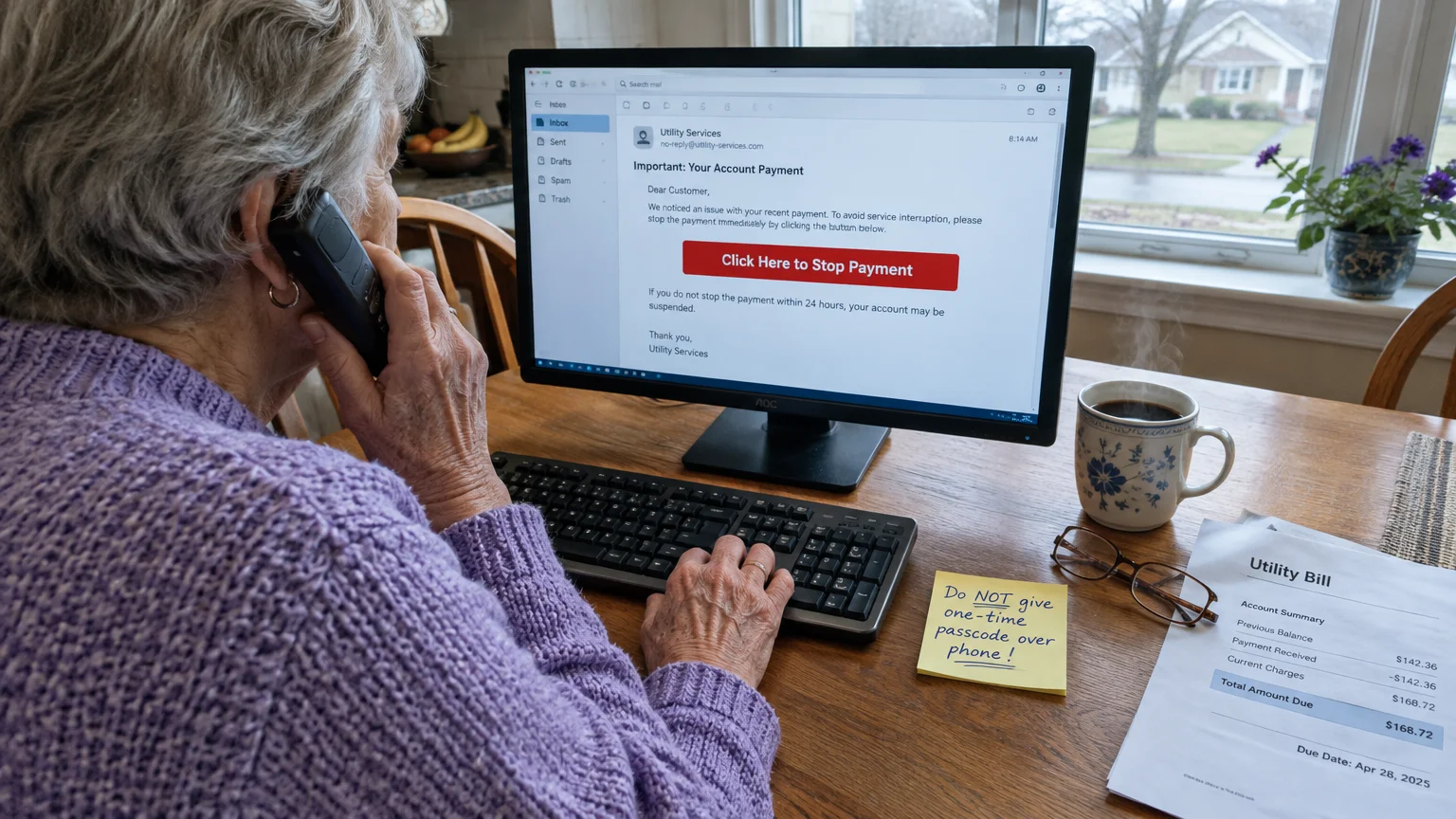
Costly Errors to Sidestep
Avoiding financial exploitation requires recognizing the psychological traps that fraudsters set. Sidestepping these four common missteps will protect your retirement assets from theft.
Believing Incoming Caller ID Displays
Many seniors assume that incoming caller ID text accurately identifies the calling party. Modern internet calling tools allow scammers to display any name or telephone number they choose.
Criminals frequently spoof federal agencies, local police departments, and well-known banks to induce panic. Verify every suspicious contact by initiating an independent outbound call to confirmed public numbers.
You can find reliable guidance regarding legitimate government interactions directly through the Social Security Administration (SSA). Remember that legitimate government agencies communicate primarily through formal postal mail rather than aggressive phone calls.
Sharing One-Time Passcodes with Callers
Banks use temporary numeric codes to verify your identity when logging in or executing transactions. Fraudsters often trigger these alerts intentionally, then call you claiming to be fraud investigators.
The caller will ask you to read back the code to cancel a fraudulent transfer. In reality, handing over that one-time passcode grants the thief the final authorization key to drain your balance.
No legitimate financial institution will ever call to demand your temporary authentication code. Treat all requests for security codes as hostile attacks.
Clicking Tracking Links in Delivery Problem Messages
The late-October holiday shopping season triggers an onslaught of fake package notifications. Fraudsters send urgent text messages claiming a package delivery failed due to an incomplete address or unpaid fee.
These messages contain malicious links directing you to convincing replicas of postal and shipping websites. Entering your debit card to pay a tiny redelivery fee surrenders your card data to offshore cyber syndicates.
If you expect a real delivery, open a new browser window and visit the merchant or carrier site manually. Check tracking codes directly on official websites rather than clicking embedded links.
Concealing Financial Fraud Due to Embarrassment
Scammers intentionally manipulate victims into silence, exploiting feelings of shame or fear of losing independence. Concealing an unauthorized transaction allows criminals time to launder your stolen funds permanently.
Time is your most critical asset when fighting financial fraud. Banks can often recall wire transfers and freeze fraudulent transactions if you notify them within the first 24 to 48 hours.
Report any suspicious activity to your bank immediately without hesitation. Organizations like the AARP Fraud Watch Network offer free helplines and compassionate support to help seniors navigate recovery.

When DIY Isn’t Enough: Professional Fraud Intervention
While personal vigilance prevents many attacks, certain complex threats require professional intervention. Seeking experienced legal, financial, or technical assistance protects your assets when self-help measures fall short.
Unauthorized Wire Transfers and Direct Account Depletion
If you discover that criminals executed unauthorized wire transfers or ACH withdrawals from your accounts, self-help steps are insufficient. You must contact your bank’s specialized fraud department immediately to initiate a formal wire recall.
Concurrently, file an official crime report with your local police department and lodge an electronic complaint with the FBI’s Internet Crime Complaint Center. Having formal police reports provides the legal documentation banks require to investigate reimbursement claims.
Severe Multi-Account Identity Theft
When criminals obtain your Social Security number alongside core banking logins, they can systematically compromise your financial life. They may open fraudulent brokerage accounts, redirect tax refunds, and manipulate medical records.
In this scenario, hire an accredited identity restoration specialist or consult an elder law attorney. These professionals guide you through filing official identity theft affidavits with the Federal Trade Commission and locking your government records.
Entrenched Romance or Investment Schemes
Victims entangled in sophisticated romance or “pig-butchering” investment schemes often struggle to recognize the manipulation. Criminal handlers spend months grooming targets, making it difficult for family members to break the illusion alone.
Involving an independent financial planner, an elder law specialist, or a licensed social worker introduces an authoritative third-party perspective. Professional counselors can review transaction histories and demonstrate how fraudulent platforms falsify returns.
Suspected Fiduciary Misconduct and Document Manipulation
Financial exploitation occasionally originates from individuals holding durable power of attorney or informal caregiving roles. If you suspect an appointed agent is misusing funds or modifying account designations without consent, seek immediate legal counsel.
An elder law attorney can petition the court to revoke compromised powers of attorney, freeze contested accounts, and appoint a neutral fiduciary to safeguard your estate.
Frequently Asked Questions
What should I do first if I gave my banking information to a scammer?
Contact your bank immediately using the phone number on your card to freeze compromised accounts and cancel exposed debit or credit cards. Next, update your online banking passwords from a separate, secure device and place a free security freeze on your credit reports at Equifax, Experian, and TransUnion.
Why do scammers target older adults during October and November?
Criminal syndicates capitalize on the convergence of early holiday shopping promotions, Medicare Open Enrollment deadlines, and routine financial adjustments. Fraudsters flood communications channels with convincing delivery alerts and discount promotions, hoping hurried consumers will drop their guard.
Can a bank reverse a wire transfer or gift card payment sent to a scammer?
Banks can occasionally reverse wire transfers if notified within hours, though recovery becomes unlikely once funds transfer overseas. Payments made via store gift cards or cryptocurrency are virtually impossible to reverse, which is why legitimate businesses and agencies never demand those payment methods.
How do I know if an email or text message from a delivery company is real?
Legitimate delivery alerts from carriers like the U.S. Postal Service, FedEx, or UPS never ask you to pay unexpected fees or verify personal details via a text link. Open your internet browser independently, visit the official carrier portal, and enter your original tracking number directly into their system.
Take Control of Your Financial Defense
Modern cyber threats evolve constantly, but implementing solid financial defenses keeps your hard-earned retirement assets secure. Freezing your credit files, rejecting unsolicited communications, and verifying financial requests through independent channels gives you absolute control over your money.
The information in this guide is meant for educational purposes. Your specific circumstances—including income, benefits, tax situation, and health needs—may require different approaches. When in doubt, consult a licensed financial advisor or tax professional.
Last updated: November 2026. Benefit amounts, tax rules, and program details change annually—verify current figures with official government sources.








Leave a Reply