

A sudden surge in your retirement income today can trigger an unwelcome surprise on your Medicare statements two years later. Known as the Income-Related Monthly Adjustment Amount, or IRMAA, this federal surcharge penalizes higher earners with steep premium hikes.
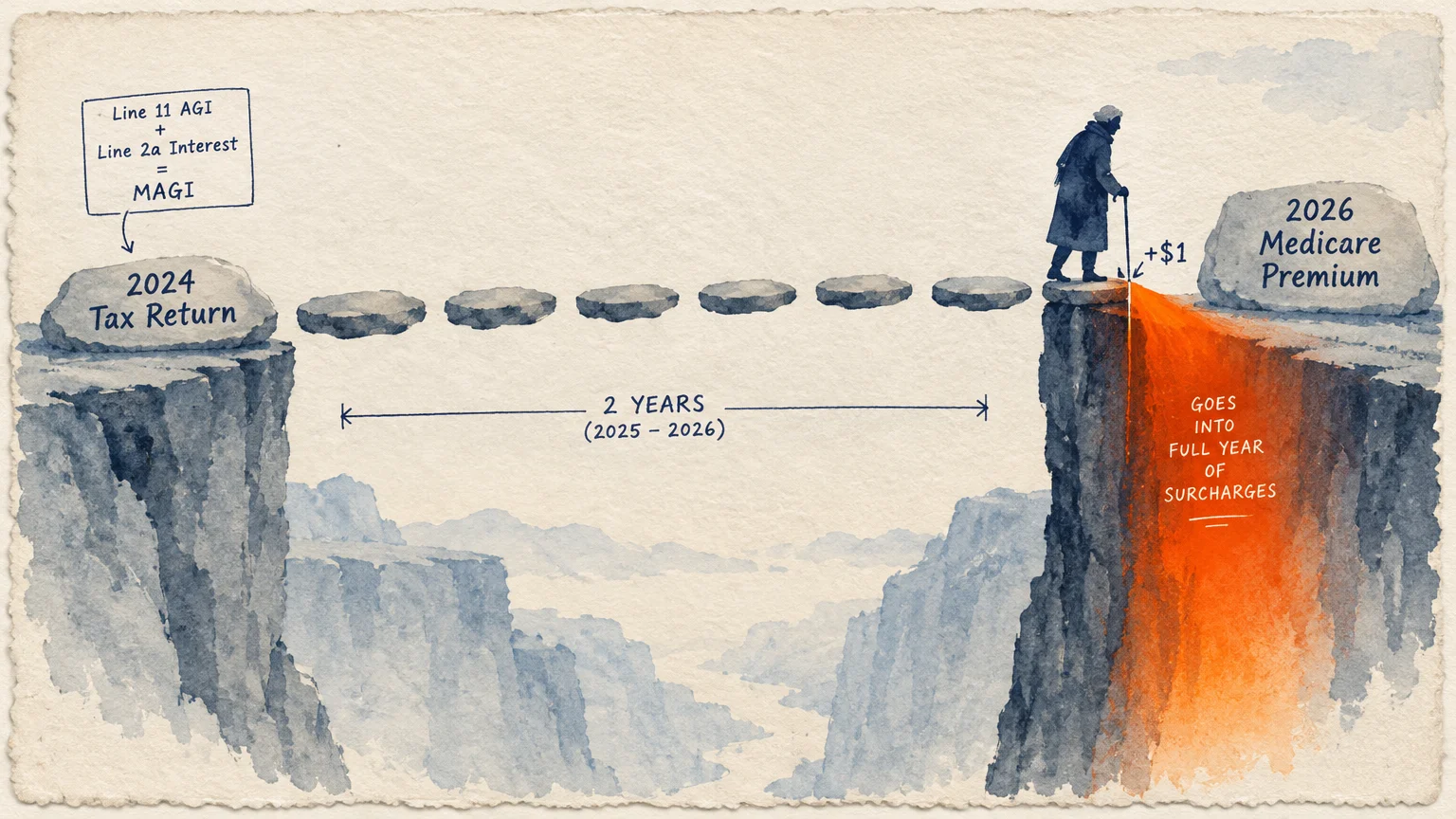
Because Medicare reviews your tax return from two years prior, a financial move made in 2024 directly dictates your 2026 healthcare costs. Crossing an income threshold by just one single dollar can cost you hundreds or even thousands of dollars.
Understanding which taxable and non-taxable revenue streams activate these surcharges allows you to protect your monthly Social Security check. Here is what you need to know about navigating the Medicare two-year lookback.
How the Medicare Two-Year Lookback and IRMAA Work
Medicare Part B covers doctor visits and outpatient care, while Part D handles prescription drug coverage. Most beneficiaries pay the standard base premium for Part B, which sits at $202.90 per month in 2026.
If your earnings surpass specific statutory thresholds, the federal government adds an extra surcharge on top of that base cost. This surcharge applies to both Part B and Part D plans, driving up your total monthly outlay.
To determine whether you owe this surcharge, the Social Security Administration examines your tax return from two years prior. Your 2026 premiums depend entirely on your 2024 tax filing; your 2027 premiums will depend on your 2025 return.
This timeline creates a delayed shock for unsuspecting retirees. Many seniors discover their Medicare premiums have spiked only after the taxable event is long past and impossible to reverse.
The government measures your earnings using a specific metric called Modified Adjusted Gross Income (MAGI). For Medicare purposes, your MAGI is calculated using a very strict statutory formula.
The calculation starts with your Adjusted Gross Income found on Line 11 of IRS Form 1040. The Social Security Administration then adds back any tax-exempt interest income reported on Line 2a, along with certain untaxed foreign earnings.
Unlike regular federal income tax brackets, IRMAA does not operate on a graduated, marginal scale. Instead, Medicare surcharges operate as rigid financial cliffs.
If your MAGI exceeds an IRMAA income trigger by a single dollar, you jump into the higher tier. That tiny one-dollar overrun obligates you to pay the full monthly surcharge for all twelve months of the year.
2026 Medicare Part B and Part D IRMAA Premium Brackets
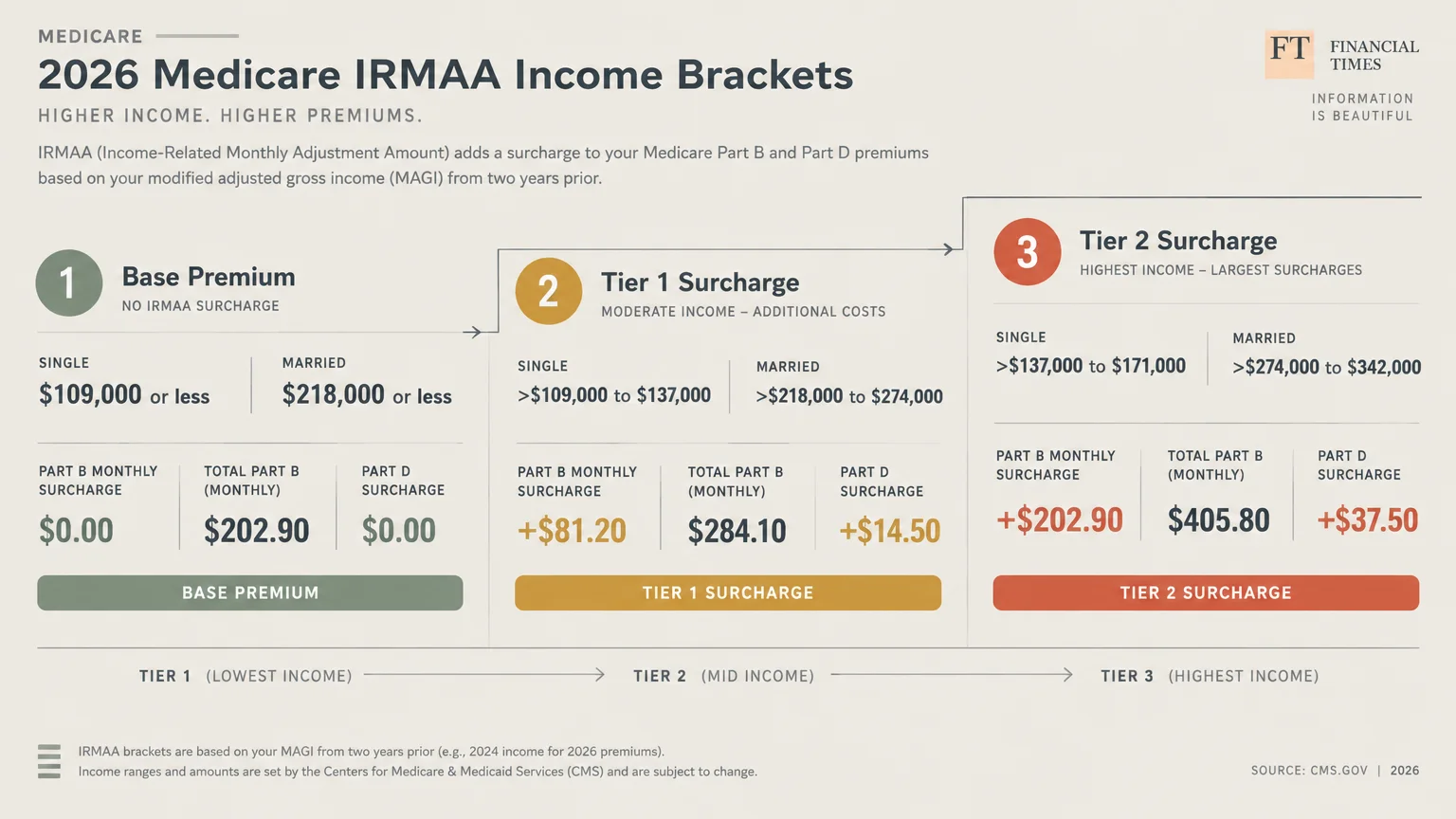
In 2026, IRMAA surcharges begin when your 2024 MAGI exceeds $109,000 for single tax filers. For married couples filing a joint tax return, the threshold begins at $218,000.
Beneficiaries who remain under these limits pay only the standard monthly Part B premium of $202.90. They also pay only their private insurer’s standard base plan premium for Part D prescription coverage.
The table below outlines the official 2026 premium tiers based on your reported 2024 income levels. Keep in mind that Part D surcharges are paid in addition to your private plan’s regular monthly premium.
| 2024 MAGI (Single / Head of Household) | 2024 MAGI (Married Filing Jointly) | Monthly Part B Surcharge | Total Monthly Part B Premium | Monthly Part D Surcharge |
|---|---|---|---|---|
| $109,000 or less | $218,000 or less | $0.00 | $202.90 | $0.00 |
| >$109,000 to $137,000 | >$218,000 to $274,000 | $81.20 | $284.10 | $14.50 |
| >$137,000 to $171,000 | >$274,000 to $342,000 | $202.90 | $405.80 | $37.50 |
| >$171,000 to $205,000 | >$342,000 to $410,000 | $324.60 | $527.50 | $60.40 |
| >$205,000 to <$500,000 | >$410,000 to <$750,000 | $446.30 | $649.20 | $78.60 |
| $500,000 or more | $750,000 or more | $487.00 | $689.90 | $91.00 |
Married individuals who lived with their spouse at any point during the year but choose to file separately face much harsher rules. Their brackets compress dramatically to eliminate tax advantages.
For these separate filers, a 2024 MAGI between $109,000 and $391,000 triggers the Tier 4 rate of $649.20 monthly. Any income at or above $391,000 lands them immediately in the maximum Tier 5 bracket.
Notice how steep the costs become for married couples filing jointly who cross into the highest tier. Together, two spouses will pay nearly $1,400 per month for Part B coverage alone, plus separate Part D surcharges.

9 Income Sources That Can Trigger Higher Medicare Premiums
Many retirees believe their income drops into permanent safety once they leave the workforce. However, normal portfolio moves, real estate transactions, and mandatory tax distributions can generate substantial phantom income on paper.
Review these nine common income streams carefully so you can plan your withdrawals without accidentally triggering the medicare two year lookback penalty.
1. Large Roth IRA Conversions
Converting funds from a pre-tax traditional IRA into a post-tax Roth IRA represents a popular long-term wealth strategy. You pay taxes today so your money can grow and exit entirely tax-free in your later years.
However, every dollar converted counts as ordinary income in the calendar year the transaction occurs. A substantial Roth conversion adds directly to your Adjusted Gross Income on Line 11 of Form 1040.
If you convert $80,000 in a single year, that entire sum stacks right on top of your Social Security and pension income. Two years later, that conversion can easily push you past an IRMAA tier threshold.
“IRMAA is one of the most punitive stealth taxes in the entire retirement code because exceeding a bracket by even one single dollar triggers a penalty on every month of coverage.” — Ed Slott, CPA and Retirement Distribution Specialist
While a Roth conversion IRMAA hit might be acceptable as part of a long-term plan, you must calculate the Medicare surcharge in advance. Failing to account for it turns an efficient tax move into an expensive shock.
2. Required Minimum Distributions (RMDs)
Under the SECURE 2.0 Act, seniors must begin taking Required Minimum Distributions from traditional IRAs and 401(k)s at age 73. That mandatory starting age increases to 75 in 2033 for individuals born in 1960 or later.
The IRS requires you to calculate these distributions based on your total pre-tax balances divided by your life expectancy factor. As you age, the mandatory withdrawal percentage increases each year.
Because traditional retirement withdrawals are treated as ordinary taxable income, large RMDs often shove retirees over the IRMAA edge. You cannot decline an RMD simply because it will raise your Medicare premiums.
Seniors with multi-million-dollar traditional account balances often find their RMDs exceed six figures annually. When combined with other retirement assets, these mandatory withdrawals routinely lock retirees into the top surcharge tiers indefinitely.
3. Capital Gains from Selling Real Estate
Downsizing your family home or selling a long-held vacation property can unleash substantial capital gains. The IRS provides Section 121 relief for primary residences, allowing you to exclude up to $250,000 in profit if single, or $500,000 if married.
Yet, in an appreciating real estate market, home appreciation frequently exceeds those statutory exclusion caps. Furthermore, those exclusion amounts are not indexed to inflation and have remained frozen for decades.
Any capital gain exceeding your primary home exemption is added straight into your Adjusted Gross Income. If you sell a rental property or second home, you receive no primary exclusion at all.
A single real estate closing can easily create a $200,000 capital gain spike in a single calendar year. Exactly two years later, you may face maximum Medicare surcharges, even if your actual daily living income remains modest.
4. Capital Gains from Taxable Investment Sales
Liquidating stocks, mutual funds, or exchange-traded funds in a regular, non-retirement brokerage account triggers capital gains tax events. While long-term capital gains receive preferential tax rates on your federal return, Medicare does not care about tax discounts.
The Social Security Administration includes every dollar of net capital gains inside your Line 11 Adjusted Gross Income. Whether gains are taxed at 0%, 15%, or 20%, they expand your MAGI dollar for dollar.
Routine portfolio rebalancing can inadvertently cause this problem. If your investment advisor sells heavily appreciated equities to shift your portfolio into conservative bonds, that trade generates realized capital gains.
Mutual fund end-of-year capital gains distributions can also catch you off guard. Even if you reinvest those distributions automatically back into the fund, the IRS reports them as realized income that counts toward IRMAA.
5. Tax-Exempt Municipal Bond Interest
Many retirees purchase municipal bonds specifically because the interest payments are completely exempt from federal income taxes. Investors often assume that because the IRS does not tax this income, Medicare will ignore it as well.
This assumption is one of the most widespread and expensive misconceptions in retirement planning. Federal law explicitly requires the SSA to add tax-exempt interest back into your Adjusted Gross Income when determining IRMAA.
Whenever you complete IRS Form 1040, you must report your tax-exempt interest on Line 2a. The Medicare MAGI formula combines Line 11 and Line 2a together before checking your income against the premium brackets.
Consequently, holding a substantial portfolio of municipal bonds offers zero protection against Medicare surcharges. That tax-free income can easily push you over a cliff threshold and cause significant premium increases.
6. Taxable Social Security Benefits
Your Social Security benefit checks are not automatically exempt from federal taxation. Depending on your total earnings, up to 85% of your Social Security benefits can become subject to ordinary income tax.
The IRS uses a metric called provisional income to determine benefit taxability. If your provisional income exceeds $25,000 for single filers or $32,000 for joint filers, a large portion of your benefit becomes taxable.
Once those benefits become taxable, they flow directly into your Line 11 Adjusted Gross Income. That taxable Social Security income then sits right in the crosshairs of the Medicare two-year lookback formula.
While the non-taxable portion of your Social Security benefit escapes the calculation, the taxable 85% portion actively fuels IRMAA. As annual cost-of-living adjustments lift your gross benefit, the taxable slice grows larger as well.
7. Traditional Pension Payments and Lump-Sum Buyouts
Defined benefit pensions provide wonderful financial stability, but they count entirely as ordinary income on your federal tax return. Monthly payments from state, federal, military, or corporate pensions elevate your baseline AGI every single year.
Because pension income cannot be paused or adjusted, it establishes a high permanent income floor. If your joint pension equals $180,000 per year, you sit uncomfortably close to the $218,000 joint threshold before touching any savings.
The danger multiplies dramatically if your former employer offers a pension buyout and you elect to take a direct cash payout. Depositing that lump sum into a regular bank account triggers immediate taxation on the full balance.
A $400,000 cash buyout will instantly throw you into the highest IRMAA tier for that tax year. Rolling the buyout directly into a traditional IRA avoids immediate income recognition and protects your Medicare premiums.
8. Deferred Compensation and Severance Packages
Executives and senior professionals often participate in non-qualified deferred compensation plans during their peak earning years. These programs allow workers to delay receiving portions of their salary until after they formally retire.
However, when those deferred payments finally distribute, they land on your tax return as taxable W-2 compensation. If your payout schedule releases large sums in your first two years of retirement, IRMAA will strike shortly thereafter.
Severance packages create an identical trap for workers retiring between ages 63 and 65. Because of the two-year lookback, high earnings received at age 63 establish your Medicare Part B costs at age 65.
If you accept an attractive retirement severance package at 63, do not expect standard base premiums when enrolling in Medicare. That final corporate check will dictate your healthcare bills the exact month you turn 65.
9. Gambling Winnings and Surprise Windfalls
A lucky evening at a casino, a lottery prize, or game show winnings can generate significant immediate income. The IRS classifies all gambling proceeds as ordinary taxable income, reporting them on Form W-2G.
Here lies the danger: you must report your total gross winnings on your tax return, which directly inflates your Line 11 AGI. Even if you lost equal money throughout the year, you cannot net your losses against your winnings on Line 11.
Gambling losses can only be claimed as an itemized deduction on Schedule A. Because IRMAA relies strictly on Adjusted Gross Income before itemized deductions are applied, those losses do nothing to reduce your Medicare MAGI.
A retiree who wins $50,000 on a slot machine will see their Medicare MAGI rise by that full $50,000 amount. That windfall can trigger an IRMAA surcharge that erases a substantial portion of the prize two years later.

Strategies to Shield Your Retirement Income from IRMAA
Preventing an unexpected Medicare surcharge requires active, multi-year income management. Because Medicare enforces strict cliff thresholds, keeping your MAGI just a few dollars below a bracket boundary yields outsized savings.
Consider implementing these proven financial strategies to lower your Adjusted Gross Income and manage the medicare two year lookback efficiently.
- Execute Qualified Charitable Distributions (QCDs): If you are age 70½ or older, you can send money directly from your traditional IRA to a qualified charity. In 2026, you can transfer up to $111,000 per individual (up from $108,000 in 2025). This distribution satisfies your annual RMD requirement without ever touching your Form 1040 AGI.
- Spread Roth Conversions Over Multiple Years: Instead of converting an entire $300,000 IRA in a single transaction, divide the conversion across several tax seasons. Calculate your existing income and convert only enough to stay safely beneath the next IRMAA tier.
- Harvest Capital Losses to Offset Gains: When rebalancing taxable portfolios, deliberately sell losing positions to match realized capital gains. The IRS allows you to offset unlimited capital gains dollar-for-dollar, plus up to $3,000 of ordinary income each year.
- Utilize Health Savings Accounts (HSAs): If you work past 65 and delay Medicare enrollment while covered by an HSA-eligible plan, maximize your contributions. HSA contributions reduce your gross taxable income directly on Line 11.
- Time Real Estate Sales Strategically: When planning to downsize, consider selling your property during your final working years before age 63. Taking the income hit prior to the lookback window ensures the capital gain will not affect your initial Medicare premiums at 65.

Costly Errors to Sidestep When Managing IRMAA
Navigating Medicare regulations requires extreme precision because simple administrative oversights can carry steep multi-thousand-dollar price tags. Avoid these common mistakes retirees frequently make when organizing their annual finances.
The first widespread error involves ignoring municipal bond interest when evaluating income thresholds. Investors frequently buy tax-free bonds to avoid tax, forgetting that Medicare pulls that money straight back onto Line 2a.
Another common mistake is crossing an IRMAA threshold by a trivial amount due to dividend reinvestment. An unexpected $50 dividend payment at year-end can push you past a tier limit, triggering an $974 annual surcharge for a single filer.
Retirees also routinely overlook the “widow’s penalty” after losing a spouse. Surviving spouses shift from joint tax brackets to single filing status, cutting their IRMAA threshold from $218,000 down to $109,000.
Finally, many seniors mistakenly assume that any sudden drop in income allows them to appeal an IRMAA bill. In reality, the Social Security Administration only accepts appeals for specific, officially recognized life-changing events.
How to Appeal an IRMAA Surcharge Using Form SSA-44
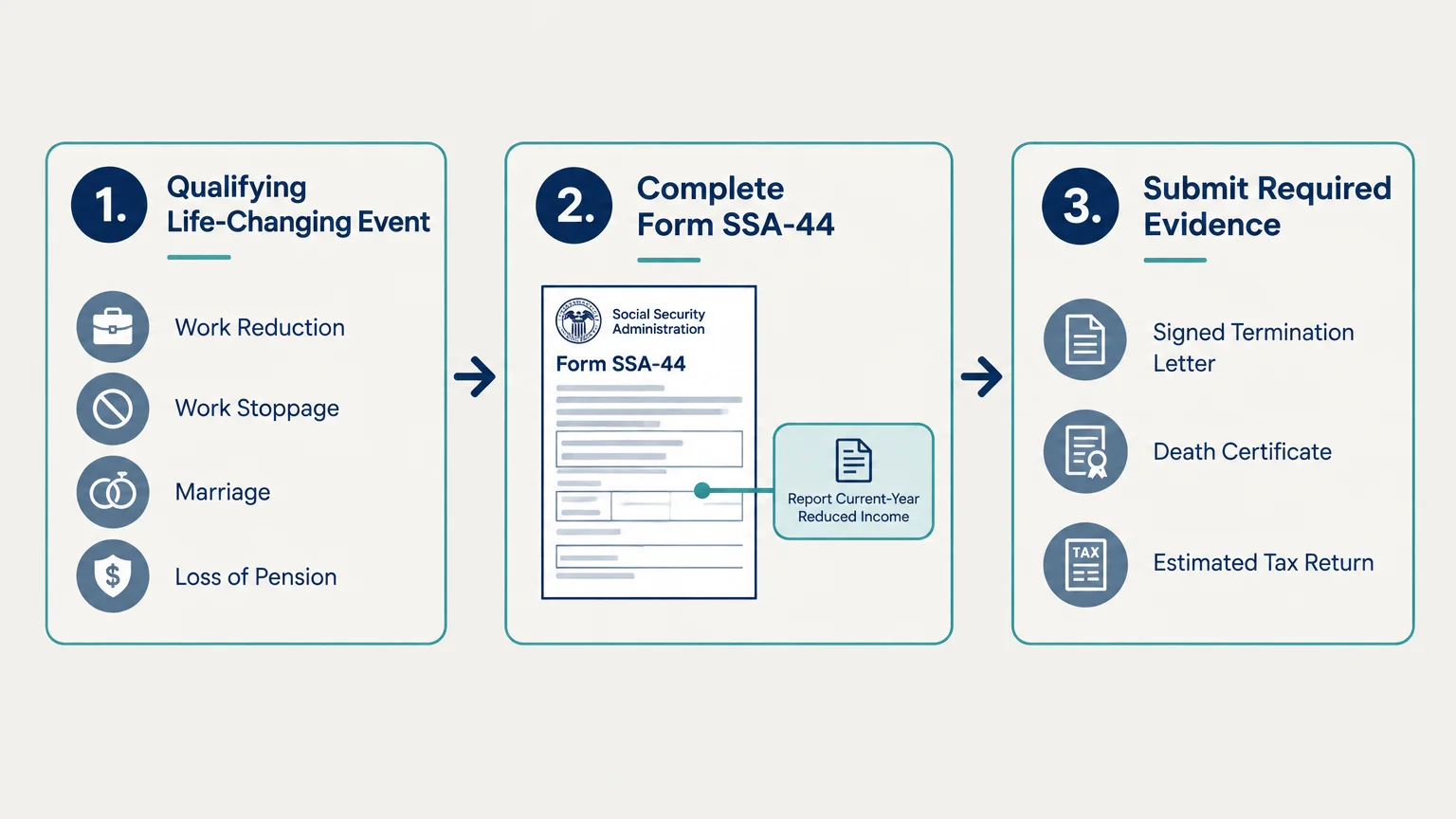
If your income drops significantly between your tax lookback year and your current enrollment year, you may not have to pay the higher rate. The Social Security Administration provides a formal appeal mechanism through Form SSA-44.
However, the government does not grant appeals simply because you experienced an anomalous one-time income spike. You cannot appeal an IRMAA surcharge caused by selling a home, realizing capital gains, or completing a Roth conversion.
To qualify for a premium recalculation using Form SSA-44, your income reduction must stem directly from one of eight recognized Life-Changing Events (LCEs):
- Death of a spouse
- Marriage
- Divorce or legal annulment
- Work stoppage (formal retirement)
- Work reduction (shifting from full-time to part-time employment)
- Loss of income-producing property due to a natural disaster, fraud, or theft
- Loss or reduction of pension income due to plan termination or cessation
- Receipt of a settlement payment from an employer due to closure or bankruptcy
The most common qualifying event is retirement itself. If you earned $250,000 in 2024 while working, but retired in 2025 to live on $60,000, you should not pay 2026 IRMAA surcharges based on your 2024 corporate salary.
You can submit Form SSA-44 to your local Social Security office along with supporting documentation, such as a retirement letter from your employer. You must provide an honest, written estimate of your current year’s expected MAGI to establish your updated premium rate.

When DIY Isn’t Enough: Navigating Complex Income Spikes
While basic retirement budgeting is manageable on your own, certain complex financial crossroads warrant guidance from a certified financial planner or CPA. Miscalculating your exposure during significant transition years can lock you into peak healthcare expenses.
If you plan to sell a multi-unit rental property or family business, seek professional tax modeling beforehand. A qualified advisor can help you structure installment sales across multiple calendar years to soften the annual income spike.
Corporate executives transitioning into retirement with deferred compensation, restricted stock units, and severance packages face intricate timing challenges. Coordinating the release of these assets demands meticulous coordination to prevent overlapping IRMAA thresholds.
Retirees holding large pre-tax traditional IRA balances exceeding $2 million should also seek specialized distribution planning. Developing a coordinated strategy involving QCDs, partial conversions, and disciplined withdrawals prevents catastrophic RMD spikes at age 73.
Finally, surviving spouses navigating estate transfers should work with an advisor immediately following a partner’s passing. Restructuring income-generating assets protects the survivor from stumbling blindly into compressed single-filer IRMAA brackets.
Frequently Asked Questions About Medicare IRMAA
Does an IRMAA surcharge last forever once it is triggered?
No, an IRMAA surcharge is recalculate annually and lasts for only one calendar year at a time. If your income drops below the threshold in the following tax year, your Medicare premiums return to the standard base rate two years later.
Can doing Roth conversions before age 65 trigger higher Medicare bills?
Yes, because of the two-year lookback rule enforced by Medicare. Any taxable Roth conversion executed at age 63 will show up on the 2024 tax return used to set your initial Medicare premiums when you turn 65.
How does Medicare collect these monthly surcharge payments?
If you receive Social Security benefits, Medicare automatically deducts your Part B and Part D surcharges directly from your monthly benefit check. If you have deferred Social Security, the Centers for Medicare & Medicaid Services will bill you quarterly.
Will Medicare notify me before charging higher premiums?
Yes, the Social Security Administration mails an Initial IRMAA Determination notice late in the year, typically between October and December. This notice outlines your calculated MAGI, your premium tier, and instructions for filing an appeal.
Managing your retirement income requires careful attention to the hidden costs lurking beneath the tax code. By monitoring your Adjusted Gross Income, planning asset sales thoughtfully, and leveraging tools like Qualified Charitable Distributions, you can protect your hard-earned savings from unexpected healthcare penalties.
Take time this month to review your latest tax filings and projected income streams with your financial advisor. Making small adjustments today ensures your future Medicare premiums remain predictable, fair, and firmly within your budget.
This is educational content based on general financial principles for seniors. Individual results vary based on your situation. Always verify current benefit amounts, tax rules, and program eligibility with official government sources.
Last updated: October 2026. Benefit amounts, tax rules, and program details change annually—verify current figures with official government sources.








Leave a Reply