

In January 2027, the average retired worker receives roughly $2,170 a month after a 3.6% cost-of-living raise, according to the Social Security Administration. Making that check cover housing, healthcare, and daily life along the East Coast takes careful planning.
High coastal prices push many retirees out of major metro areas where housing alone consumes over a third of household budgets. Fortunately, several affordable places to retire along the eastern seaboard combine lower home prices with senior-friendly tax rules.
These ten charming East Coast retirement cities can stretch your fixed benefits further. Use the housing figures, Medicare deductions, and tax rules below to narrow down your best match.
How Far Does Your Social Security Check Stretch in 2026 and 2027?
Before comparing towns, you need an accurate picture of what actually lands in your bank account each month. Gross benefit headlines look larger than your real spending budget once healthcare deductions come out.
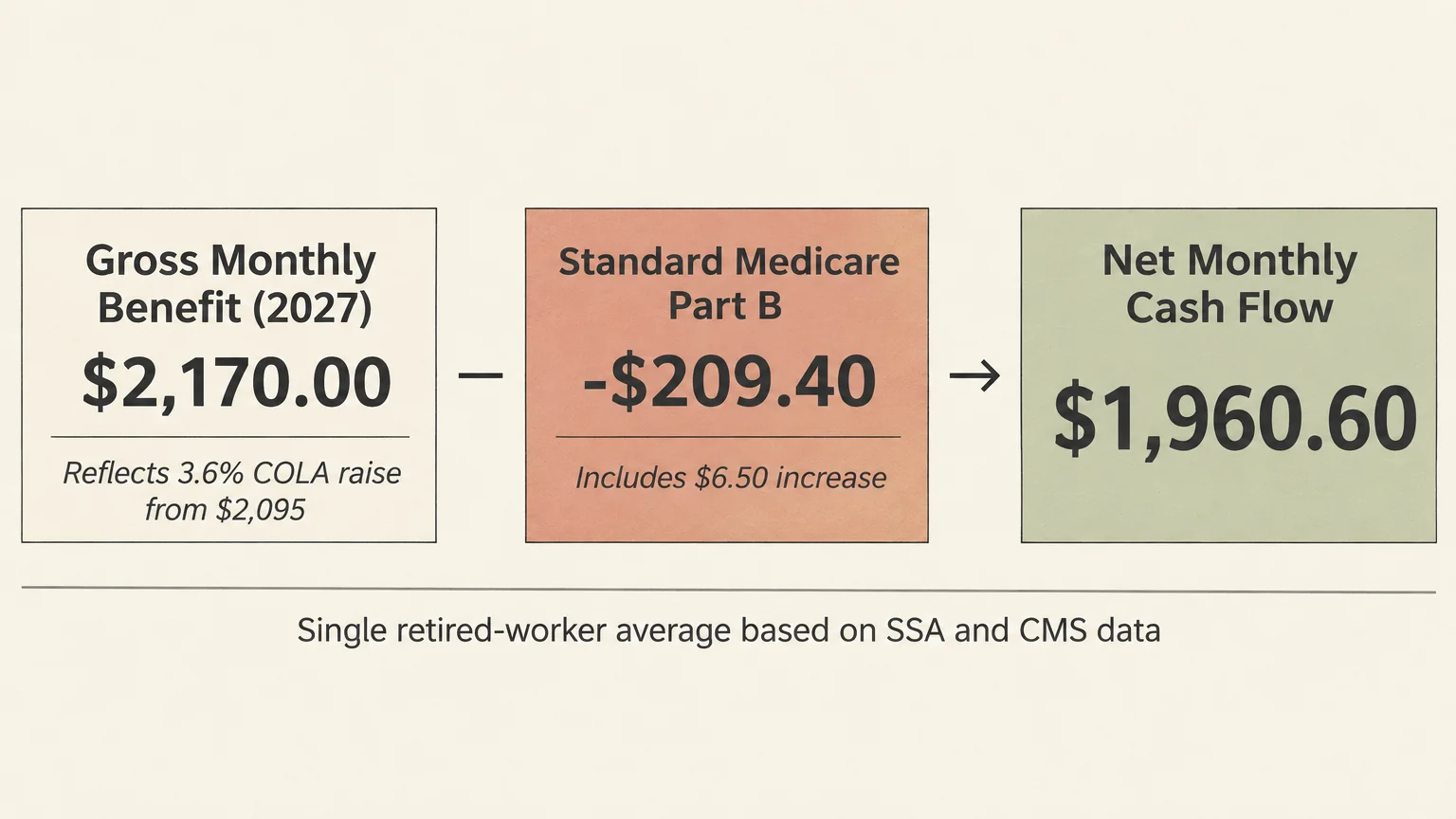
Per the Social Security Administration (SSA), the average retired-worker benefit is $2,095 per month in 2026. Following a 2.8% cost-of-living adjustment (COLA) in 2026, a 3.6% COLA raises that average check by roughly $75 to $2,170 per month in January 2027.
That annual total equals $26,040 for an individual retiree. Couples where both spouses receive average checks bring in closer to $4,340 per month combined, while high earners claiming the maximum benefit at Full Retirement Age receive $4,152 in 2026 and $4,188 in 2027.
Most retirees have Medicare Part B premiums deducted straight from their monthly check. According to the Centers for Medicare & Medicaid Services (CMS), the standard Part B premium rises from $202.90 per month in 2026 by $6.50 to $209.40 in 2027.
Subtracting that $6.50 increase leaves an average retiree with a net COLA gain of about $68.50 per month in 2027. After the $209.40 Part B deduction, a single retiree with an average benefit keeps roughly $1,960.60 per month to live on.
Your monthly housing cost decides whether Social Security can fund your retirement. Keeping rent low—or arriving mortgage-free—frees your benefit check for healthcare, groceries, and enjoying your new town.
National spending averages show why picking the right town matters so much. According to Bureau of Labor Statistics (BLS) data, households headed by someone age 65 to 74 spent an average of $65,354 per year ($5,446 per month), including $22,329 for housing.
Households age 75 and older spent $55,834 per year ($4,653 per month), with $21,999 going toward housing. Across all U.S. households in 2025, housing alone represented 33.9% of total spending, or $27,790 per year.
You cannot easily match those national averages if you stay in a high-cost city. In October 2026, the National Association of Realtors (NAR) put the U.S. median existing-home price at $416,700, while Freddie Mac reported average 30-year mortgage rates at 7.18% in November 2026.
Meanwhile, national median rent stood at $1,379 per month as of May 2026, according to Upmetrics data. When you choose low cost of living towns below those national baselines, Social Security goes from tight to workable.

Comparison Table: 10 Affordable East Coast Cities for Retirees
The table below compares ten East Coast cities verified for lower housing costs or top national retirement rankings in 2026. Review both the housing figures and state tax rules to see where your income stretches furthest.
| City and State | Verified 2026 Housing Cost | State Tax on Social Security (2026) | Standout Benefit for Retirees |
|---|---|---|---|
| New Bedford, Massachusetts | $846/mo median rent; $395,400 home value | Exempt | Lowest rent on this list; walkable harbor charm |
| Pawtucket, Rhode Island | $970/mo median rent; $363,900 home value | Exempt at FRA under $107,000 single / $133,750 joint | Riverfront parks and fast access to Providence care |
| Wilmington, Delaware | $1,071/mo median rent | Exempt | No state sales tax; strong mid-Atlantic transit |
| Bridgeport, Connecticut | $1,211/mo median rent; $312,200 home value | Exempt under $75,000 single / $100,000 joint AGI | Long Island Sound shoreline and ferry access |
| Daytona Beach, Florida | $1,371/mo median rent; $331,500 home value | Exempt (0% state income tax) | Cost of living 5.1% below U.S. average; warm beaches |
| Columbus, Georgia | $200,074 median home price | Exempt | Half the U.S. median home price; mild winters |
| New Bern, North Carolina | $254,839 median home price | Exempt | Historic riverfront living near coastal beaches |
| Elizabeth City, North Carolina | $258,371 median home price | Exempt | Quiet harbor town near the Outer Banks |
| Lynchburg, Virginia | $276,646 median home price | Exempt | 2026 top-10 U.S. retirement ranking; Blue Ridge views |
| Altoona, Pennsylvania | Top-10 U.S. retirement city for low relative housing costs | Exempt (plus pensions and retirement accounts) | 2026 top-10 U.S. retirement ranking; broad tax exemptions |
Notice the difference between renting and owning free and clear in these best cities for retirees. Paying $846 per month in rent leaves far more breathing room on a $2,170 check than paying $1,371 per month.

10 Charming East Coast Retirement Cities to Consider
Housing affordability motivates most retirement moves today. A 2026 MoveBuddha survey reported by Kiplinger found that 87% of respondents would relocate for a lower cost of living, and an April 2026 PODS study showed 61% of movers made affordability their top priority.
Each city below offers genuine East Coast character alongside real financial relief for Social Security budgets.
1. New Bedford, Massachusetts
New Bedford delivers classic New England coastal charm at a fraction of Boston prices. According to a November 2026 FinanceBuzz analysis, median rent in New Bedford sits at just $846 per month, making it the most affordable rental market on this list.
Run the numbers on an average 2027 Social Security check of $2,170 per month. After deducting $209.40 for Medicare Part B and $846 for rent, a single retiree still keeps about $1,114.60 per month for groceries, utilities, and personal expenses.
Massachusetts does not tax Social Security benefits, protecting every dollar of your federal check from state income tax. Median home values are higher at $395,400, so New Bedford shines brightest for renters or downsizers rolling substantial equity into a purchase.
2. Pawtucket, Rhode Island
Just north of Providence along the Blackstone River, Pawtucket blends historic brick mill neighborhoods with revitalized parks and art studios. FinanceBuzz reports a median rent of $970 per month and a median home value of $363,900 in 2026.
Rhode Island is one of only three East Coast states that tax Social Security in some cases, yet Social Security-only retirees typically owe nothing. Under recent state rules, benefits are exempt at Full Retirement Age when adjusted gross income stays below $107,000 for singles or $133,750 for joint filers.
On an average 2027 check, paying $970 in rent and $209.40 for Part B leaves roughly $990.60 each month for remaining bills. You also gain close proximity to major hospitals and commuter rail connections without big-city rent.
3. Wilmington, Delaware
Wilmington offers tree-lined neighborhoods, Brandywine Valley gardens, and easy train access between Philadelphia and Washington, D.C. Median rent averages $1,071 per month in 2026, per FinanceBuzz—more than $300 below the national median.
Delaware’s tax structure gives fixed-income retirees two major wins at once. According to 2026 state tax tables and a June 2026 Due report, Delaware exempts Social Security benefits from state income tax and charges zero state sales tax.
Skipping sales tax stretches every trip to the grocery store, pharmacy, and hardware store. If your household receives two Social Security checks, Wilmington’s $1,071 median rent leaves substantial room for travel and healthcare reserves.
4. Bridgeport, Connecticut
Located along Long Island Sound, Bridgeport gives retirees access to waterfront parks, ferry routes to Long Island, and cultural venues at prices well below nearby Fairfield County towns. FinanceBuzz lists a 2026 median rent of $1,211 per month and a median home value of $312,200.
Like Rhode Island, Connecticut taxes Social Security only at higher income levels. Benefits are fully exempt when adjusted gross income stays below $75,000 for single filers or $100,000 for married couples filing jointly, and taxable amounts are capped at 25% above those thresholds.
Retirees living strictly on Social Security pay zero Connecticut tax on their benefits. Buying a modest home or condo near the $312,200 median with cash from a prior home sale can make Bridgeport especially comfortable.
5. Daytona Beach, Florida
Warm weather, Atlantic beaches, and zero state personal income tax keep Daytona Beach popular among retirees looking to leave snow behind. FinanceBuzz reports a 2026 median rent of $1,371 per month, a median home value of $331,500, and an overall cost of living 5.1% below the U.S. average.
Florida charges 0% state personal income tax alongside a 6.0% base state sales tax, per HOMEiA data from July 2026. Still, single renters must watch the math carefully here.
Paying $1,371 for median rent plus $209.40 for Medicare Part B on an average 2027 benefit leaves roughly $590 per month for everything else. As a result, Daytona Beach works best if you buy mortgage-free, share costs with a partner, or hold higher benefits.
6. Columbus, Georgia
Set along the Chattahoochee River with a lively walkable uptown, Columbus stands out for ultra-low home purchase prices. Keeping Up With Inflation reported in July 2026 that the median metro home price was $200,074—less than half the $416,700 U.S. existing-home median.
Georgia strengthens that housing advantage by exempting Social Security and retirement benefits from state income tax, according to 55places. Mild winters also help keep seasonal heating bills lower than in northern states.
If you sell a higher-priced home elsewhere and buy near $200,000 with cash, your ongoing housing expense drops to property taxes, insurance, and maintenance. That shift makes retiring on Social Security alone far less stressful.
7. New Bern, North Carolina
New Bern sits where the Neuse and Trent rivers meet, offering a historic waterfront downtown, sailboat marinas, and relaxed southern pace. In July 2026, Keeping Up With Inflation listed New Bern’s median home price at $254,839—roughly $161,800 below the national median.
North Carolina pairs reasonable coastal living with gentle taxes for seniors. In 2026, the state charges a 3.99% flat income tax with a 4.75% base sales tax while granting a full income tax exemption for Social Security benefits, per HOMEiA.
You stay within easy driving distance of Atlantic beaches without paying barrier-island housing prices. Downsizers arriving with equity can lock in modest monthly expenses and keep money available for Medicare copays.
8. Elizabeth City, North Carolina
Known as the Harbor of Hospitality, Elizabeth City sits along the Pasquotank River near the Virginia border and the Outer Banks. Keeping Up With Inflation placed its median home price at $258,371 in July 2026, keeping homeownership well within reach for equity-rich retirees.
Residents benefit from the same North Carolina rules as New Bern: zero state income tax on Social Security, a 3.99% flat rate on any other taxable income, and a 4.75% base sales tax. Quiet residential streets and waterfront parks make daily walks easy and free.
Because it sits near the Chesapeake-to-Outer-Banks corridor, you can reach larger regional medical centers in Virginia when needed while enjoying small-town housing costs at home.
9. Lynchburg, Virginia
Nestled in the foothills of the Blue Ridge Mountains, Lynchburg blends historic brick neighborhoods, river trails, and university culture with standout affordability. Keeping Up With Inflation recorded a median home price of $276,646 in July 2026.
U.S. News & World Report named Lynchburg among its top 10 overall U.S. places to retire in 2026, as reported by Newsweek in October 2026. The ranking highlighted how well the city keeps housing costs low relative to healthcare, groceries, and everyday essentials.
Virginia is also among the 42 states that do not tax Social Security benefits in 2026. Combining four mild seasons with low day-to-day living costs makes Lynchburg a reliable choice for single and married retirees alike.
10. Altoona, Pennsylvania
Surrounded by the Allegheny Mountains in central Pennsylvania, Altoona gives budget-conscious retirees strong value on daily necessities. U.S. News & World Report ranked Altoona in its top 10 overall U.S. retirement cities for 2026 alongside Lynchburg, noting its low housing burden relative to healthcare and groceries.
Pennsylvania offers one of the broadest tax shelters in the country for older adults. According to Holafly’s September 2026 tax overview, Pennsylvania exempts not only Social Security, but also pensions and most retirement account withdrawals from state income tax.
Even if you supplement Social Security with small IRA withdrawals or a modest pension, your state income tax bill on those funds stays at zero. That makes Altoona especially appealing for retirees stretching every income stream.
Federal and East Coast State Taxes That Protect Your Benefits
Choosing a town with low rent or modest home prices is only half the equation. Keeping federal and state taxes off your benefits protects the purchasing power of every COLA raise.
At the federal level, the Internal Revenue Service (IRS) determines whether your benefits are taxable using your combined income—your adjusted gross income, plus nontaxable interest, plus half of your Social Security benefits.
- Zero percent taxable: Combined income stays at or below $25,000 for single filers or $32,000 for married couples filing jointly.
- Up to 50% taxable: Combined income falls between $25,000 and $34,000 for singles, or between $32,000 and $44,000 for joint filers.
- Up to 85% taxable: Combined income exceeds $34,000 for single filers or $44,000 for joint filers.
If Social Security is your only income, half of an average $26,040 annual benefit is $13,020—well below the $25,000 federal threshold. Even if you take modest savings withdrawals, new tax rules offer major relief through 2028.
Under Public Law 119-21, enacted July 4, 2025, taxpayers age 65 and older can claim an enhanced $6,000 deduction ($12,000 for married couples if both spouses are 65 or older) for tax years 2025 through 2028. This deduction applies whether you itemize or take the standard deduction, phasing out by 6% of modified adjusted gross income above $75,000 single or $150,000 joint.
That bonus sits on top of the regular standard deduction and existing age-65-plus extra deduction. Per IRS Revenue Procedure 2026-35, regular standard deductions are $16,100 single and $32,200 joint in 2026 (plus $2,050 single or $1,650 per spouse age 65+), rising in 2027 to $16,600 single and $33,200 joint (plus $2,100 single or $1,700 per spouse).
With this enhanced senior deduction in place, a White House Council of Economic Advisers analysis cited by Fidelity estimates only about 12% of seniors pay federal taxes on Social Security. At the state level, 42 states and Washington, D.C. do not tax Social Security in 2026 after West Virginia completed its phaseout.
Along the entire East Coast, only Connecticut, Rhode Island, and Vermont tax benefits at all in 2026—and all three exempt retirees below generous income ceilings. Vermont, for example, provides full relief under $55,000 single or $70,000 joint.

Common Mistakes to Avoid When Retiring on Social Security Alone
A move to an affordable town can still backfire if hidden expenses catch you off guard. Watch out for these four common mistakes before signing a lease or buying a home.
- Ignoring Medicare out-of-pocket costs beyond Part B: Beyond the $209.40 monthly Part B premium in 2027, CMS sets the annual Part B deductible at $292 (up from $283 in 2026) and the Part A hospital inpatient deductible at $1,776 per benefit period. Build a monthly health reserve for deductibles and supplemental coverage.
- Triggering the Retirement Earnings Test with part-time work: If you claim Social Security before Full Retirement Age and take a part-time job, SSA withholds $1 in benefits for every $2 earned above $24,480 in 2026 or $25,560 in 2027. In the year you reach Full Retirement Age, the limit rises to $65,160 in 2026 and $67,920 in 2027 ($1 withheld per $3 above).
- Financing a home at high mortgage rates: With 30-year fixed rates averaging 7.18% in November 2026, borrowing heavily on a fixed check drains cash quickly. Prioritize renting below $1,100 per month or buying mortgage-free with equity from your current home.
- Forgetting state sales taxes and everyday cost differences: Zero income tax does not automatically mean low living costs. Compare local essentials carefully—for instance, Delaware’s 0% state sales tax keeps everyday purchases cheaper than Florida’s 6.0% base sales tax or North Carolina’s 4.75% base rate.
You can also screen for local property tax relief, utility assistance, or food programs through the National Council on Aging (NCOA) or Benefits.gov before finalizing your budget. Even one local property tax exemption can save hundreds of dollars each year.

Finding the Right Advisor
When your margin for error is tight, a short consultation with a fee-only financial planner, CPA, or HUD-approved housing counselor can prevent costly relocation errors. Consider professional guidance in these four situations:
- Selling a long-time home to buy mortgage-free: An advisor can calculate net sale proceeds, closing costs, and moving expenses so you know your exact cash budget for cities like Columbus, New Bern, or Lynchburg.
- Coordinating IRA withdrawals with the $6,000 senior deduction: Because the enhanced senior deduction runs only from 2025 through 2028, a tax pro can help you time modest withdrawals without crossing federal benefit-tax thresholds or Medicare IRMAA surcharges (which start above $112,000 single or $224,000 joint 2025 MAGI for 2027).
- Moving into a state with income-capped exemptions: If you are eyeing Bridgeport, Pawtucket, or a town in Vermont, a tax specialist can confirm your total income stays below state exemption cliffs.
- Reviewing affordable housing or senior rental assistance: If your benefit falls near the 2027 federal SSI maximum of $1,029 per month single ($1,544 couple), a counselor through the U.S. Department of Housing and Urban Development (HUD) can help you locate income-restricted senior apartments.
Frequently Asked Questions
Can a single person retire on Social Security alone on the East Coast?
Yes, provided housing stays well below national averages. On a 2027 average benefit of $2,170 per month ($1,960.60 after the $209.40 Part B deduction), renting in lower-cost markets like New Bedford ($846) or Pawtucket ($970) or owning a home mortgage-free makes a solo retirement realistic.
Which East Coast states do not tax Social Security benefits in 2026?
Across the country, 42 states and Washington, D.C. do not tax Social Security in 2026, including major East Coast retirement states such as Massachusetts, Delaware, Pennsylvania, Virginia, North Carolina, Georgia, and Florida. Only Connecticut, Rhode Island, and Vermont tax benefits at higher incomes.
How much does Medicare take out of a Social Security check in 2027?
According to CMS, the standard Medicare Part B monthly premium rises $6.50 from $202.90 in 2026 to $209.40 in 2027. Most enrollees pay no Part A premium, though higher-income retirees with 2025 MAGI above $112,000 single or $224,000 joint pay IRMAA surcharges starting at $293.10 per month.
Should I rent or buy a home when retiring on a fixed Social Security check?
If you can use home equity to buy mortgage-free in an affordable market like Columbus ($200,074 median) or New Bern ($254,839 median), owning cuts your monthly cash outflow dramatically. If buying requires taking on a 7.18% mortgage, renting below $1,100 per month usually protects your budget better.
Your Next Steps Toward an Affordable East Coast Move
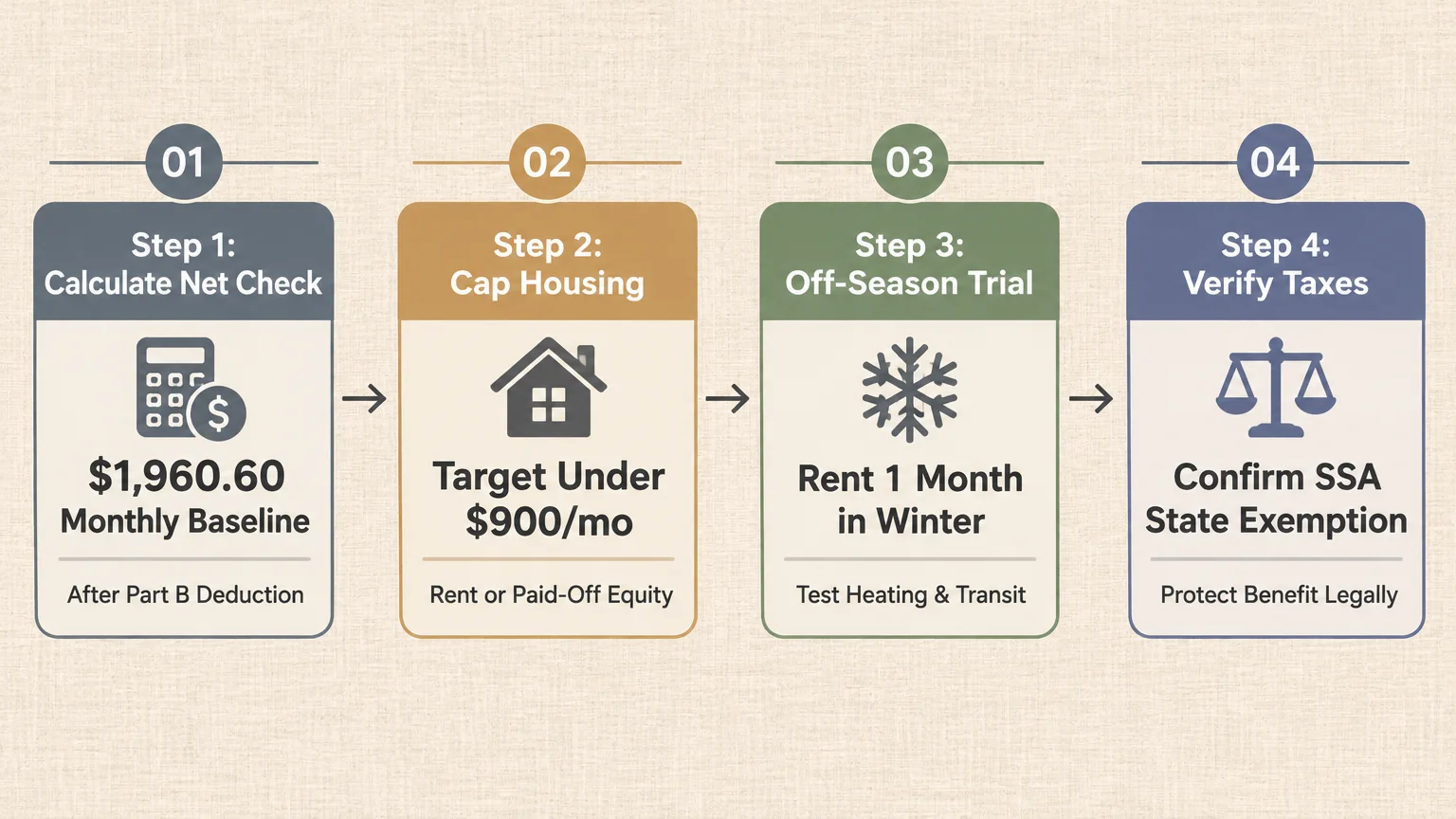
Start by logging into your personal account at SSA.gov and checking your exact benefit estimate alongside Medicare.gov premium projections. Pick two or three cities from this list, visit during an off-peak season, and test-drive a monthly budget using local grocery and utility estimates before you pack.
The information in this guide is meant for educational purposes. Your specific circumstances—including income, benefits, tax situation, and health needs—may require different approaches.
When in doubt, consult a licensed financial advisor or tax professional.
Last updated: November 2026. Benefit amounts, tax rules, and program details change annually—verify current figures with official government sources.





Leave a Reply