

Employers actively seek experienced workers because reliability and low turnover save companies real money. Data from the Bureau of Labor Statistics shows workers age 65 and older stay with employers for a median of 9.9 years—more than triple younger adults.
That loyalty opens strong doors if you want extra retirement income, daily structure, or workplace camaraderie. Roughly 11 million Americans age 65 and older already work, with 62% holding full-time schedules.
Below, you will find eight careers that reward life experience, current median wages, and the 2026 and 2027 Social Security rules that protect your paycheck.
Why Employers Actively Seek Experienced Workers
Mature employees have become an essential pillar of the American economy rather than a rare exception. According to a U.S. Government Accountability Office report, workers age 55 and older grew from 15% to 23% of the U.S. workforce over the past 20 years.
Labor force participation among older adults continues to climb well past traditional retirement milestones. Bureau of Labor Statistics figures show that nearly one in five Americans age 65 and older worked in 2025, including 23.1% of men and 15.7% of women.
As of October 2026, the labor force participation rate for all workers age 55 and older stood at 37.20%. Projections released by the Bureau of Labor Statistics in September 2026 show participation rising through 2035 across every older age group.
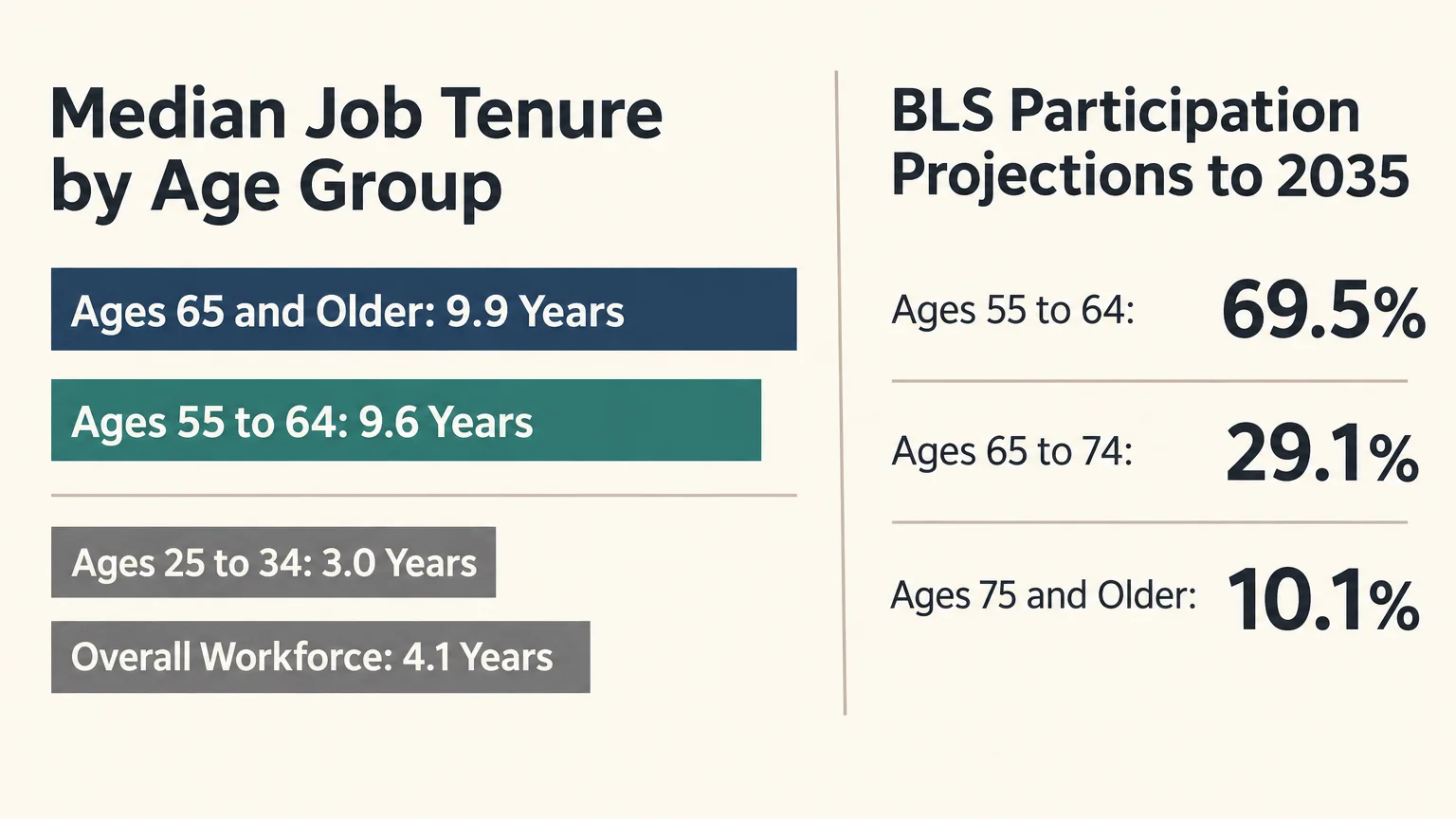
- Ages 55 to 64: Participation is projected to climb from 66.6% in 2025 to 69.5% in 2035.
- Ages 65 to 74: Participation is projected to rise from 26.7% to 29.1% over the same decade.
- Ages 75 and older: Participation is expected to increase from 8.5% to 10.1% by 2035.
Pew Research Center data highlights just how skilled and independent today’s senior workforce has become. About 19% of Americans age 65 and older work—up from 11% in 1987—and 44% hold at least a bachelor’s degree.
Even more striking, 23% of workers age 65 and older are self-employed, more than double the 10% rate among adults ages 25 to 64. Collectively, older workers accounted for 7% of all U.S. wages and salaries in 2023.
Retention gives hiring managers their biggest reason to prioritize jobs for older workers. According to the January 2026 Bureau of Labor Statistics Employee Tenure report, median tenure reached 9.6 years for workers ages 55 to 64 and 9.9 years for those 65 and older.
Compare that stability to a median tenure of just 3.0 years for workers ages 25 to 34 and 4.1 years across the entire workforce. Among workers ages 60 to 64, 52.6% have stayed with their employer for 10 or more years, versus 20.3% of those ages 35 to 39.
Many businesses still struggle to connect with this reliable talent pool. Research from the Organisation for Economic Co-operation and Development cited by AARP shows that over 70% of employers want age-friendly workplaces, yet over 95% do not know how to build them.
That gap works in your favor when you approach employers hiring seniors with clear availability and a problem-solving mindset. You bring calm judgment, strong customer rapport, and a proven track record of showing up every day.

8 Jobs Where Your Experience Gives You an Edge
To help you weigh pay rates fairly, keep national benchmarks from the Bureau of Labor Statistics in mind. Across all U.S. occupations in May 2025, the median annual wage stood at $50,980, while average projected job growth through 2035 sits at 3%.
Several roles beat or match that median pay while offering flexible scheduling, low physical strain, or seasonal breaks. Here are eight standout jobs over 60 where hiring managers consistently value seasoned applicants.
1. Tax Preparer
Clients prefer discussing personal finances with someone who projects patience, discretion, and steady confidence. Tax firms actively recruit retirees for seasonal schedules that leave your spring, summer, and fall completely free for travel or family.
According to May 2025 Bureau of Labor Statistics data, tax preparers earn a median annual wage of $54,920. Employment is projected to grow 4.7% from 95,800 jobs in 2025 to 100,300 by 2035, outpacing the national average.
You typically need only a high school diploma or equivalent plus moderate-term on-the-job training to get started. H&R Block, an AARP Employer Pledge participant, offers structured internal tax-preparer training and flexible seasonal shifts designed around experienced learners.
Before taking paid tax clients, you will register for a Preparer Tax Identification Number through the Internal Revenue Service. If you enjoy numbers and organized paperwork, seasonal tax preparation delivers strong pay without a year-round commitment.
2. Management Analyst or Consultant
If you spent decades managing budgets, operations, healthcare clinics, or supply chains, organizations gladly pay for your judgment without adding full-time benefits to their payroll. This career path directly supports the high self-employment rate among workers over 65.
Management analysts earned a median annual wage of $101,860 in May 2025, nearly double the national median across all jobs. Roles in this field are projected to grow 10% through 2035—much faster than average—creating roughly 94,100 openings each year.
Most positions require a bachelor’s degree alongside deep industry familiarity. Because executives want advisors who have navigated real business cycles, younger graduates rarely compete on equal footing with seasoned specialists.
You can pitch project-based contracts directly to former employers, local nonprofits, or mid-sized companies needing temporary leadership. Setting your own retainer fees also lets you cap weekly hours to match your lifestyle.
3. Bookkeeping, Accounting, and Auditing Clerk
Small businesses, medical offices, and local nonprofits depend on trustworthy people to manage invoices, payroll, and daily ledgers. Accuracy and financial integrity matter far more to these employers than decades of software trend chasing.
Bureau of Labor Statistics figures from May 2025 place median pay for bookkeeping, accounting, and auditing clerks at $50,670 per year, or $24.36 per hour. Roughly 1,532,400 people held these roles nationwide in 2025.
Although automation contributes to a projected 6% overall employment decline through 2035, steady retirements generate constant replacement openings. Many small offices prefer hiring a dependable part-time bookkeeper for 15 to 25 hours weekly rather than training entry-level staff.
Brushing up on widely used cloud accounting tools can quickly set your resume apart. Highlight your attention to detail, ethical track record, and ability to spot costly billing mistakes early.
4. Real Estate Broker or Sales Agent
Buying or selling a home ranks among the biggest financial moves any household makes, and clients often gravitate toward mature agents who stay calm during tense negotiations. Older buyers and retirees downsizing their homes especially value peers who understand neighborhood shifts and estate timelines.
Real estate brokers and sales agents earned an overall median wage of $57,400 per year, or $27.59 per hour, in May 2025. Broken down further, brokers earned a median of $73,220 annually while sales agents earned $52,830.
Employment is projected to grow 2% from 2025 to 2035, generating roughly 40,400 annual openings. Every state requires you to complete pre-licensing coursework and pass a state licensing exam before representing clients.
This path rewards strong community networks and patient communication over high-pressure sales tactics. You control your own calendar and can partner with a supportive brokerage team to share weekend showings.
5. School or Transit Bus Driver
School districts and municipal transit agencies face persistent driver shortages and prioritize applicants with clean driving records and calm temperaments. Parents and administrators trust older drivers to maintain safe, respectful environments aboard school buses.
In May 2025, bus drivers overall earned a median pay of $49,390 per year, or $23.75 per hour. School bus drivers earned a median of $47,920 annually, while transit and intercity drivers earned a median of $59,050.
Job growth is projected at 2% through 2035, producing roughly 77,600 annual openings nationwide. Split school schedules give you midday hours free for errands or appointments, plus summers and school holidays off.
Expect to earn a Commercial Driver’s License with passenger endorsements, often through paid district training. You must also maintain a clean driving history and pass routine physical, vision, hearing, and background checks.
6. Short-Term Substitute Teacher
School principals value retired educators, former professionals, and calm communicators who can step into a classroom on short notice and keep students focused. Substitute teaching offers total schedule control because you accept or decline daily assignments online.
Bureau of Labor Statistics data from May 2025 counted 524,770 short-term substitute teachers working across the country. They earned a median hourly wage of $20.03, with a mean wage of $22.32 per hour, or $46,420 on a full-year equivalent basis.
Licensing rules vary by state and local school district, though many districts accept an associate degree, bachelor’s degree, or substitute permit alongside a background check. Choosing elementary, middle, or high school assignments lets you match your energy to the grade level you enjoy most.
Working two or three days a week keeps your mind engaged while preserving long weekends. Many retirees also appreciate knowing their work directly supports teachers and families in their neighborhood.
7. Customer Service Representative
De-escalating frustrated callers and solving billing or scheduling hiccups takes patience that usually comes with life experience. Employers in healthcare, hospitality, and insurance increasingly hire mature representatives to boost customer satisfaction and cut staff turnover.
Customer service representatives earned a median wage of $44,770 per year, or $21.53 per hour, in May 2025. Despite a projected 5% decline through 2035 due to automated tools, turnover and retirements create roughly 289,500 openings every year.
Major brands actively recruit older applicants for both in-person and work-from-home support desks. CVS Health hires experienced workers for remote customer support and pharmacy technician teams, while Marriott welcomes mature staff at hotel front desks, reservations, and guest services.
Look for remote roles if you prefer avoiding a daily commute or winter driving. Clear speech, reliable home internet, and steady empathy give you an immediate advantage during phone interviews.
8. Retail Specialist in Hardware, Grocery, or Pharmacy
Shoppers walking into a hardware store or pharmacy want accurate answers from someone who has actually repaired a sink or managed household errands. Employers recognize that seasoned associates build shopper loyalty faster than rushed seasonal hires.
Retail sales workers earned a median annual wage of $35,560 in May 2025 and require no formal educational credential. High replacement needs generate roughly 550,600 openings per year through 2035, making part-time roles easy to find near home.
Age-inclusive employers in this sector stand out for welcoming retirees with hands-on know-how. The Home Depot actively values retirees with practical construction, plumbing, electrical, or gardening knowledge in its hardware and garden departments.
Grocery and pharmacy chains including Wegmans, Walgreens, and CVS Health also rank among notable employers hiring seniors for flexible shifts. Ask during interviews about employee discounts, flexible shift swapping, and standing mats or seated cashier options.
Bonus High-Fit Roles Worth Exploring
Beyond those eight core careers, four specialized fields reward maturity, dependability, and people skills with solid pay or strong job growth through 2035.
- Travel Agents: May 2025 median pay reached $50,160 per year with about 5,900 annual openings, ideal if you love planning cruises and group trips.
- Tour and Travel Guides: May 2025 median pay hit $38,120 per year ($18.33 per hour), backed by 6.3% projected growth through 2035.
- Security Guards: May 2025 median pay stood at $38,020 per year with 1% growth and about 157,200 annual openings at museums, campuses, and offices.
- Home Health and Personal Care Aides: May 2025 median pay was $35,800 overall—rising to $37,060 in continuing care and assisted living communities—with rapid 18% projected growth.
Pay and Outlook Comparison for Top Senior-Friendly Jobs
Comparing wages alongside training requirements and schedule flexibility helps you avoid spending months chasing a credential that does not fit your budget. Review these May 2025 Bureau of Labor Statistics benchmarks and 2025 to 2035 projections side by side.
| Job Title | May 2025 Median Pay | Entry Requirement | 2025–2035 Outlook / Annual Openings | Schedule Style |
|---|---|---|---|---|
| Management Analyst / Consultant | $101,860 / year | Bachelor’s degree | 10% growth / ~94,100 openings | Project or part-time |
| Real Estate Broker or Agent | $57,400 / year ($73,220 broker; $52,830 agent) | State license | 2% growth / ~40,400 openings | Self-set flexible hours |
| Tax Preparer | $54,920 / year | High school diploma + training | 4.7% growth (2025–2035) | Seasonal winter/spring |
| Bookkeeping / Accounting Clerk | $50,670 / year ($24.36/hr) | Software familiarity / experience | -6% decline / replacement openings | Part-time or steady weekly |
| Bus Driver (School & Transit) | $49,390 / year ($47,920 school; $59,050 transit) | CDL + physical & background check | 2% growth / ~77,600 openings | Split shifts / summers off |
| Customer Service Representative | $44,770 / year ($21.53/hr) | High school diploma + training | -5% decline / ~289,500 openings | Part-time, full-time, or remote |
| Substitute Teacher (Short-Term) | $20.03 / hour ($46,420 mean annual) | State/district permit + background check | Steady school-year demand | Pick your own days |
| Retail Sales Specialist | $35,560 / year | No formal credential required | ~550,600 annual openings | Flexible local shifts |
Notice how roles with lower upfront licensing barriers—like substitute teaching, retail hardware, and tax preparation—let you start earning within weeks. By contrast, consulting and real estate deliver higher earnings ceilings if you already hold credentials or can invest upfront study time.
How Working Affects Your Social Security and Payroll Taxes in 2026 and 2027
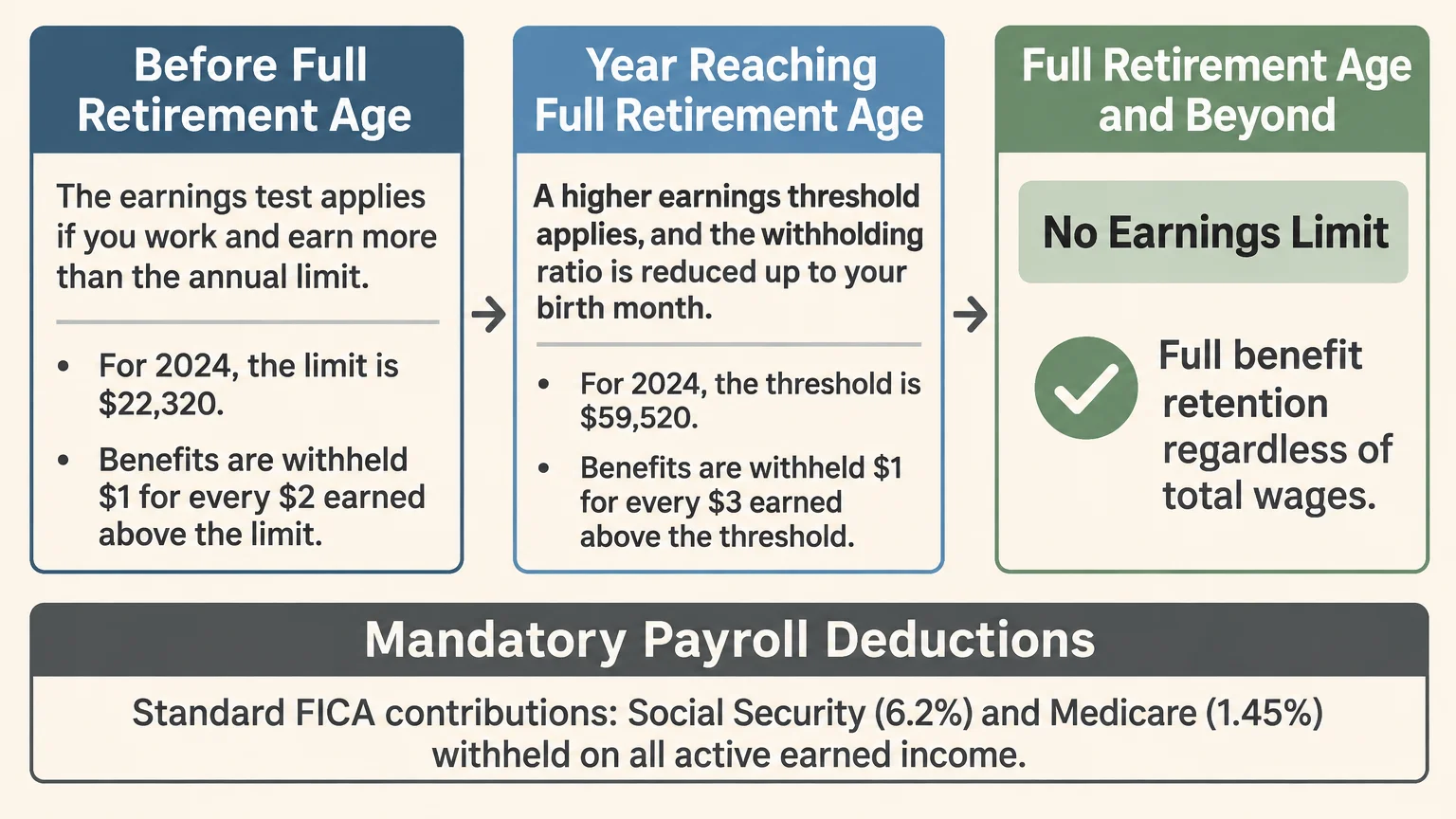
Before accepting a job offer, check how your expected paycheck interacts with your Social Security benefits. The Social Security Administration applies a Retirement Earnings Test only if you collect retirement or survivor benefits before reaching your Full Retirement Age.
If you are under Full Retirement Age for the entire calendar year, the annual earnings limit is $24,480 ($2,040 per month) in 2026. That threshold rises to $25,560 ($2,130 per month) in 2027.
When you earn above that annual limit, the Social Security Administration withholds $1 in benefits for every $2 you earn over the cap. Suppose you earn $30,480 as a bookkeeper or retail specialist in 2026 while under Full Retirement Age all year.
Because your wages exceed the $24,480 limit by $6,000, the agency withholds $3,000 from your Social Security payments for the year. Planning part-time hours early prevents an unexpected pause in your monthly checks.
A much higher limit applies during the calendar year you actually reach Full Retirement Age. In 2026, you can earn up to $65,160 ($5,430 per month) in the months before your birthday month, rising to $67,920 ($5,660 per month) in 2027.
During that transition year, the agency withholds only $1 in benefits for every $3 earned above the limit, counting only wages earned before the month you reach Full Retirement Age. Once you hit that milestone month, earnings limits disappear completely.
Withheld Social Security checks are not lost forever—once you reach Full Retirement Age, the Social Security Administration permanently recalculates your monthly benefit upward to credit you for every month benefits were withheld.
Keep payroll taxes in mind alongside benefit limits, because working seniors still pay FICA taxes regardless of age or benefit status. Employees pay 7.65% of wages—6.2% for Social Security plus 1.45% for Medicare—matched by their employer.
If you choose self-employment as a consultant or real estate agent, you owe both halves—a combined 15.30% self-employment tax. The 6.2% Social Security portion applies up to the taxable maximum of $184,500 in 2026 and $192,300 in 2027, while the 1.45% Medicare tax has no income cap.

Spotting Age-Friendly Employers and Knowing Your Legal Rights
Knowing where to apply saves hours of frustration with automated portals that overlook non-traditional career paths. Start by checking AARP job resources, where over 2,500 companies have signed the AARP Employer Pledge Program committing to age-diverse hiring.
In addition, more than 160 organizations participate in AARP’s Employer Alliance to recruit and retain experienced talent. Companies widely recognized for age-inclusive hiring include The Home Depot, H&R Block, CVS Health, Walgreens, Wegmans, and Marriott.
You can also look for community job boards and training programs listed through the National Council on Aging if you need local placement help or computer refreshers. Pairing targeted applications with local networking gets your resume past keyword filters much faster.
Federal law backs up your right to fair consideration at every stage of the hiring process. Under the Age Discrimination in Employment Act of 1967, the U.S. Equal Employment Opportunity Commission protects job applicants and employees age 40 and older from age-based bias.
This law covers hiring, pay, promotions, layoffs, and workplace benefits at government agencies and private employers with 20 or more workers. Several states—including Colorado and Connecticut—also prohibit employers from requesting your age, date of birth, or graduation dates on initial applications.
If you ever face unlawful age discrimination, strict filing deadlines apply. Most private-sector workers have 180 days to file a formal charge with the Equal Employment Opportunity Commission, while federal employees have 45 days to contact an agency counselor.
Step-by-Step Guide to Landing Jobs Over 60
Applying for work later in life works best when you treat your job search like a focused business project rather than a numbers game. Follow these five practical steps to position yourself for roles that reward maturity.
- Set your target hours and income cap first: Check whether you are under Full Retirement Age so you can structure part-time shifts around the $24,480 (2026) or $25,560 (2027) Social Security limit.
- Trim your resume to the last 10 to 15 years: Focus on recent achievements, drop college graduation years, and list current computer skills such as video calls or scheduling apps.
- Target age friendly employers with built-in training: Apply to seasonal tax offices, school districts, or retail brands that actively value reliable older staff and offer paid onboarding.
- Lead with reliability and problem-solving in interviews: Frame your decades of experience around calming upset customers, mentoring younger teammates, and cutting costly workplace mistakes.
- Ask clear questions about scheduling and physical demands: Confirm shift flexibility, remote options, and ergonomic seating or breaks before accepting an offer.
If you want extra practice before an interview, ask a former colleague or friend to run through three common questions with you. Speaking calmly about what you want to contribute today shifts attention away from dates on a page.
Costly Errors to Sidestep
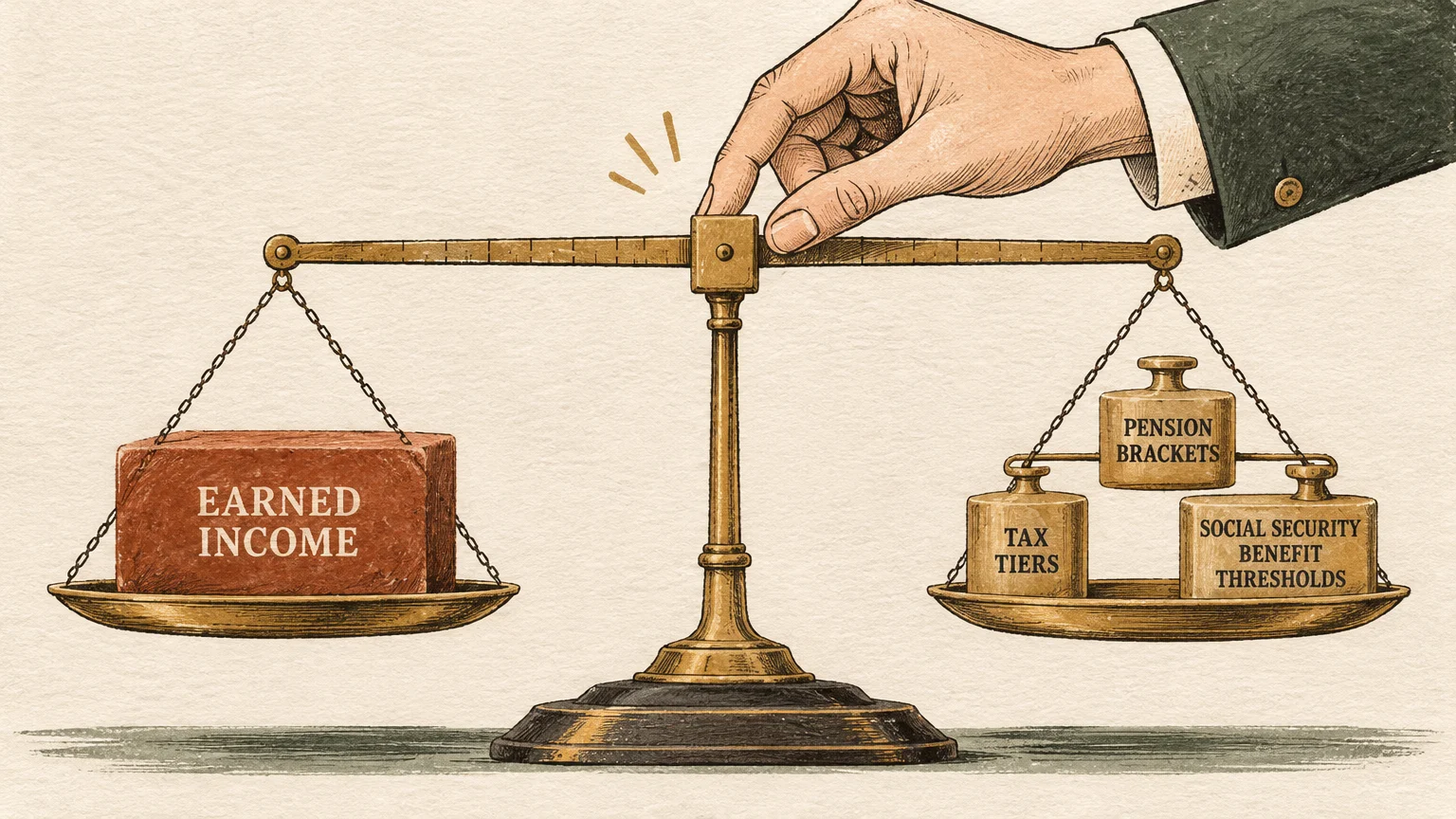
Even a great part-time paycheck can trigger avoidable financial surprises if you overlook tax or benefit rules. Watch out for these four frequent mistakes before signing an offer letter.
- Ignoring the Social Security earnings limit mid-year: Accepting unexpected overtime before Full Retirement Age can push your pay past $24,480 in 2026 and temporarily pause upcoming monthly benefit checks.
- Forgetting quarterly taxes on consulting or commission work: Self-employed consultants and real estate agents owe 15.30% self-employment tax plus regular income tax, so set aside cash every time a client pays you.
- Overlooking licensing or physical exam timelines: State real estate exams, tax preparer credentials, and Commercial Driver’s License medical checks take time and money, so budget several weeks before expecting your first paycheck.
- Underpricing your reliability: Accepting minimum wage when you bring proven dependability sells your value short, especially when national median wages across roles like bookkeeping, tax prep, and transit driving exceed $49,000 per year.
Taking ten minutes to verify your numbers with payroll or your tax preparer protects every dollar you earn. A smart paycheck adds genuine breathing room to your budget rather than April tax headaches.
Frequently Asked Questions
Do you lose Social Security benefits forever if you earn over the limit?
No, benefits withheld under the Retirement Earnings Test are not permanently lost. Once you reach Full Retirement Age, the Social Security Administration recalculates your monthly payment upward to credit you for months when checks were reduced or withheld.
What are the best part-time jobs over 60 that require little extra schooling?
Retail hardware or grocery roles, short-term substitute teaching, customer service, and seasonal tax preparation require little to no new schooling. Many school districts and tax firms provide paid orientation or internal training once you pass a background check.
Do working seniors still have to pay Social Security and Medicare taxes?
Yes, wage earners of every age pay 7.65% in FICA payroll taxes, and self-employed workers pay 15.30%, on earnings up to the Social Security taxable limit ($184,500 in 2026 and $192,300 in 2027). Your extra earnings can also boost future Social Security benefits if they replace a lower-earning year in your top 35 years.
How can you tell if a company is genuinely age friendly?
Look for organizations participating in the AARP Employer Pledge Program or Employer Alliance, both of which signal public commitment to age-diverse hiring. During interviews, watch whether hiring managers highlight flexible scheduling, multi-generational teams, and training support.

Taking Your Next Step Toward Work That Fits
Employers across finance, education, retail, and consulting recognize that seasoned professionals bring unmatched steadiness to the workplace. Choosing one of these jobs for older workers lets you boost your retirement savings, stay mentally sharp, and set boundaries that respect your time.
Pick two roles from the comparison table above that match your energy level and financial goals, then check local openings this week. Remember to verify current Social Security earnings limits with the Social Security Administration before locking in your weekly hours.
This article provides general financial education and information only. Everyone’s financial situation is unique—what works for others may not work for you.
For personalized advice tailored to your retirement needs, consider consulting a qualified financial professional such as a CFP or CPA.
Last updated: November 2026. Benefit amounts, tax rules, and program details change annually—verify current figures with official government sources.





Leave a Reply