

You can turn your lifelong knack for numbers into steady, flexible income without leaving your home. Many businesses actively seek experienced adults who can balance ledgers, interpret reports, or organize complex data.
Remote roles allow you to set your own hours while protecting your free time. You can boost your monthly cash flow and keep your analytical skills sharp on your own terms.
Whether you spent decades in corporate accounting or simply managed family budgets with precision, opportunities abound. Here is how to find the right remote numbers-based role for your retirement.

Why Numbers-Focused Remote Work Fits Retirement
Analytical skills do not fade with age. Decades of handling household accounts, workplace projects, and investments make older adults exceptional problem solvers.
Many companies struggle to find reliable staff who pay attention to fine details. You bring patience, emotional maturity, and professional diligence that prevents expensive errors.
Working with figures from home eliminates taxing daily commutes and rigid office politics. You decide whether you want to work five hours a week or twenty.
Most quantitative tasks follow predictable rules and clear schedules. That structural clarity makes remote finance work far less stressful than customer service or sales roles.
“Accounting is the language of business. If you take the time to learn the language, you will find it much easier to navigate economic life.” — Warren Buffett, CEO of Berkshire Hathaway
Modern cloud software enables you to complete client work securely from any standard desktop or laptop. You can coordinate with clients across the country from your personal desk.
This flexibility lets you travel, spend time with grandchildren, or pursue personal hobbies without giving up meaningful, paid work.
Social Security Earnings Limits to Know Before You Start
Before accepting paid work, you must review how earned income interacts with your Social Security payments. Earning money in retirement can temporarily reduce your monthly benefit if you have not reached full retirement age.
For individuals born in 1960 or later, Full Retirement Age (FRA) is 67. If you claim benefits earlier than your FRA, the Social Security Administration (SSA) applies an earnings test to your wages.
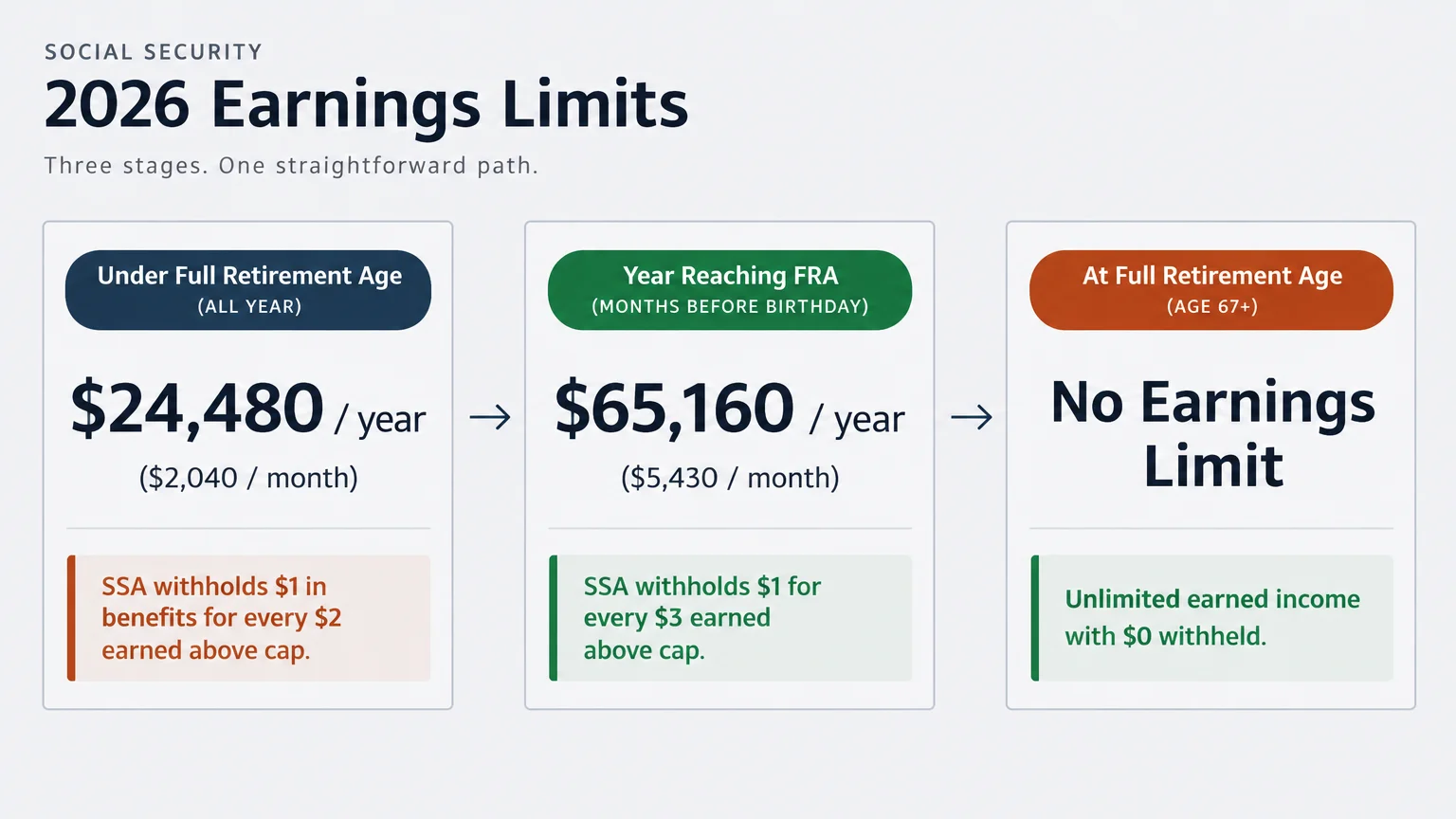
According to the Social Security Administration (2026), you can earn up to $24,480 per year ($2,040 per month) in 2026 if you remain under FRA all year. The SSA withholds $1 in benefits for every $2 earned above that cap.
The rules change favorably in the calendar year you reach Full Retirement Age. In 2026, the limit rises to $65,160 per year ($5,430 per month) for the months before your birth month.
During that specific period, the SSA withholds $1 for every $3 you earn above the threshold. Once you celebrate your 67th birthday, the earnings cap disappears entirely.
You can earn unlimited income from remote work after reaching your FRA without any benefit withholding. Any benefits withheld before your FRA are not lost forever; the SSA recalculates your monthly check at FRA to credit those withheld amounts.

10 Rewarding Remote Jobs for Retirees Good With Numbers
Retirees with mathematical and analytical backgrounds can choose from varied positions across multiple industries. Here are ten remote roles offering flexible schedules and dependable pay.
1. Remote Bookkeeper
Bookkeepers track daily financial transactions, record expenses, balance checking accounts, and produce monthly financial statements. Small business owners often lack the time to maintain their ledgers and gladly outsource this responsibility.
You do not need a Certified Public Accountant (CPA) license to succeed in bookkeeping jobs retirees enjoy. Practical familiarity with basic debits, credits, and double-entry accounting principles is sufficient for most entry-level clients.
Most modern small businesses rely on cloud programs like QuickBooks Online or Xero. You can obtain software certifications online in a few weeks to prove your technical competence to prospective clients.
According to the U.S. Bureau of Labor Statistics (BLS), bookkeeping, accounting, and auditing clerks earned a median annual wage of $50,670 as of May 2025. Although overall industry employment is projected to decline 6% through 2035, the BLS projects 144,100 openings per year to replace retiring staff.
This steady turnover creates consistent opportunities for organized older adults who want to service three or four small business clients each month.
2. Virtual Tax Return Preparer
Tax preparation provides seasonal intensity followed by months of total freedom. If you prefer concentrated work between January and April, accounting remote jobs focusing on individual tax returns fit perfectly.
Preparers gather client receipts, input income statements, calculate deductions, and file state and federal returns. You can work for national retail tax firms that provide remote platforms, or you can serve private clients.
To prepare returns professionally for a fee, you must obtain a Preparer Tax Identification Number (PTIN) through the Internal Revenue Service. The IRS also offers the Annual Filing Season Program, which helps non-credentialed preparers build current tax knowledge.
The BLS reports that tax preparers earned a median annual wage of $54,920 in May 2025. Employment in this field is projected to grow 5% from 2025 to 2035, creating roughly 9,400 annual job openings.
After mid-April, tax preparers can transition into off-season consulting, extension filings, or enjoy extended leisure time until the next tax year.
3. Remote Payroll Specialist
Every operating business must pay its workers accurately and on schedule. Payroll specialists calculate gross wages, track paid time off, withhold payroll taxes, and initiate direct deposits.
This position demands methodical precision and strict adherence to deadlines. Because payroll runs on recurring weekly, bi-weekly, or semi-monthly cycles, you can organize your calendar with great accuracy.
Employers generally use dedicated payroll platforms such as ADP, Gusto, or Paychex. Experience handling confidential personnel records makes mature workers attractive candidates for these sensitive roles.
Financial clerks specializing in payroll and billing earned a median annual wage of $49,990 according to May 2025 BLS data. The BLS anticipates approximately 88,000 openings each year across financial clerk roles despite a projected 4% decline in aggregate positions.
You can often negotiate contracts to manage payroll runs during off-peak morning or evening hours that fit your personal schedule.
4. Remote Data Entry Specialist
If you prefer straightforward numeric work without the legal liability of tax or payroll reporting, consider data entry seniors roles. These positions involve transferring numbers from paper invoices, receipts, or spreadsheets into enterprise databases.
Speed, consistent accuracy, and reliable 10-key typing skills represent the main requirements. You verify numeric sequences, confirm transaction totals, and flag discrepancies for department managers.
According to the BLS May 2025 wage survey, data entry keyers earned a median annual wage of $41,340, which equals approximately $19.88 per hour. The national median wage across all U.S. occupations was $50,980 during the same period.
While data entry is accessible, automation is shrinking the sector rapidly; the BLS projects a 25.5% employment decline between 2025 and 2035. However, temporary agencies and healthcare billing offices still hire remote contractors for backlog remediation projects.
These short-term assignments allow you to earn extra income periodically without long-term commitments or ongoing management obligations.
5. Part-Time Budget Analyst
Budget analysts help non-profit organizations, educational institutions, and municipal agencies organize their operating funds. You review departmental budget requests, evaluate spending trends, and ensure programs stay within allocated resources.
This work suits retirees who spent their careers in corporate finance, project management, or public administration. You will create financial forecasts, examine past variance reports, and produce summary slides for directors.
The BLS reports that budget analysts earned a median annual wage of $91,640 as of May 2025. Employment is projected to grow 2% from 2025 to 2035, resulting in an average of 2,900 openings annually.
Small charities and local community foundations often cannot justify full-time budget directors. They frequently contract part-time analysts for twenty hours a month to guide board meetings and balance annual fiscal plans.
This role provides intellectual engagement while letting you support causes and non-profit missions you care about deeply.
6. Fractional Financial Analyst
Retirees with extensive corporate finance or investment backgrounds can thrive in fractional analyst positions. These remote finance jobs involve assessing financial performance, building operational models, and evaluating commercial opportunities.
Rather than managing day-to-day operations, you provide higher-level insights to growing firms on a contract basis. You might analyze product pricing margins, assess inventory turnover, or prepare valuation metrics for business sales.
Financial and investment analysts earned a median annual wage of $102,740 in May 2025, according to BLS data. The profession demonstrates healthy growth, with an expected 7% increase and 24,700 openings each year through 2035.
Fractional arrangements let you bill premium hourly consulting rates for your institutional wisdom. You can maintain one or two corporate engagements while retaining full control over your work volume.
This pathway allows experienced financial professionals to phase gradually into full retirement while staying connected to industry developments.
7. Online Math or Accounting Tutor
Teaching math, statistics, or introductory college accounting lets you share your knowledge with ambitious students. Virtual tutoring platforms connect instructors with middle schoolers, high schoolers, and adult college learners worldwide.
You can teach algebra, business calculus, financial accounting principles, or quantitative test preparation for exams like the GRE or GMAT. Sessions take place over interactive video platforms with virtual whiteboards.
Online tutoring lets you establish your availability down to the exact hour. Many retirees teach two or three sessions in the late afternoon or early evening while keeping their days free.
Hourly rates vary widely depending on subject complexity, ranging from basic school tutoring to advanced professional exam instruction. Tutors teaching collegiate accounting or advanced statistics often command rates well above typical hourly office work.
Working directly with eager learners offers tremendous personal satisfaction and intellectual stimulation without corporate administrative overhead.
8. Accounts Payable and Receivable Specialist
Accounts payable (AP) and accounts receivable (AR) clerks keep business money moving in and out correctly. AP specialists verify incoming vendor bills, confirm receipt of goods, and prepare disbursement schedules.
AR specialists draft outgoing customer invoices, track aging accounts, record customer payments, and resolve delinquent balances. Both functions require strong mathematical organization, clear documentation, and polite communication.
These positions exist inside virtually every industry, from regional construction suppliers to software companies. Many businesses have moved their entire invoicing departments to remote workflows.
Because tasks center on routine billing cycles, you can manage your daily obligations independently. As noted by the BLS, financial clerks earn a median annual wage of $49,990, providing dependable part-time compensation.
You can find AP and AR positions listed as part-time or contract roles on reputable job boards, offering steady ten-to-twenty-hour weekly commitments.
9. Small Business Financial Consultant
Many independent trade contractors, salon owners, and restaurant operators understand their craft but struggle with cash flow management. A small business financial consultant acts as a trusted mentor to guide these entrepreneurs.
In this role, you analyze cash flow statements, identify unnecessary overhead costs, and assist owners in setting profitable pricing models. You help business owners understand why a profitable ledger does not always equal cash in the bank.
Unlike certified auditing, consulting focuses on advisory guidance, operational best practices, and mentoring. Your life experience and business acumen provide immense reassurance to younger founders.
Consultants typically charge monthly retainer fees to review financial statements and host two advisory video calls per month. Managing three small business clients can generate steady, low-stress retirement income.
This model allows you to deliver massive real-world impact to local business communities without executing tedious daily data processing.
10. Remote Cost Estimator and Inventory Auditor
Cost estimators calculate the time, money, materials, and labor required to manufacture products, build facilities, or provide commercial services. They evaluate engineering drawings, subcontractor quotes, and historical material prices.
Similarly, remote inventory auditors track stock valuations, analyze supply chain shrinkage reports, and reconcile warehouse counts against digital ledgers. Both roles require sharp quantitative skills and comfort navigating extensive spreadsheets.
Manufacturing firms, construction contractors, and e-commerce companies frequently hire remote analysts with number acumen to evaluate bids. You examine quotes systematically to ensure bids leave an adequate profit margin.
These remote jobs numbers specialists rely on emphasize precision and analytical logic over rapid output. You can analyze project blueprints or cost files during your quietest, most focused hours of the day.
This specialized niche rewards thoroughness and provides older workers with steady, project-based remuneration.
Comparison of Remote Number Jobs for Retirees
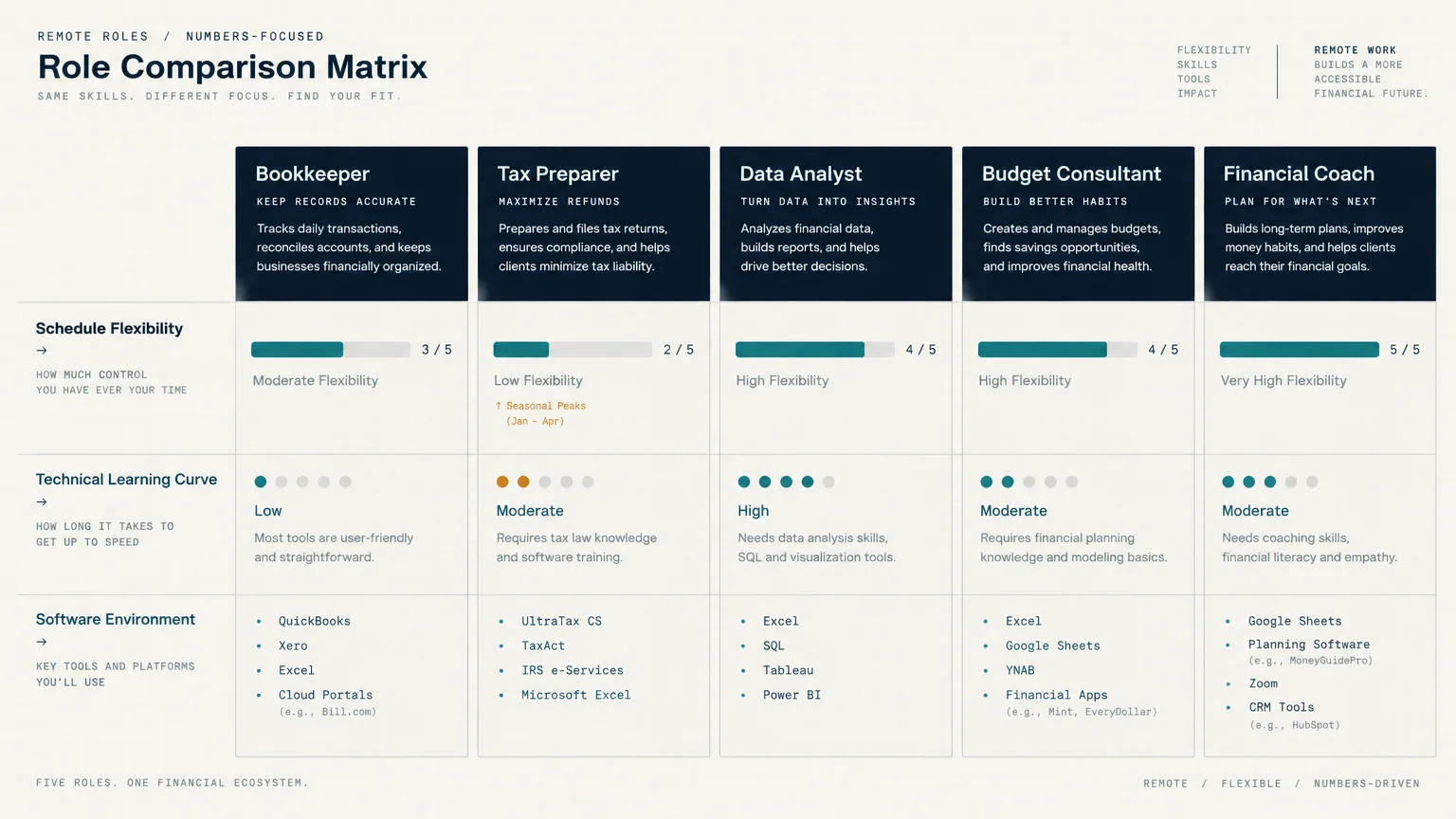
Comparing your options side-by-side helps clarify which role matches your background, income goals, and desired retirement lifestyle. The following table highlights compensation benchmarks and operational conditions for these ten remote opportunities.
| Job Title | Median Annual Wage (BLS May 2025) | 10-Year Outlook (2025–2035) | Schedule Flexibility | Typical Entry Requirements |
|---|---|---|---|---|
| Remote Bookkeeper | $50,670 | -6% (144,100 yearly openings) | High | Accounting software knowledge |
| Virtual Tax Preparer | $54,920 | +5% (9,400 yearly openings) | Seasonal / Concentrated | Active IRS PTIN registration |
| Remote Payroll Specialist | $49,990 | -4% (88,000 yearly openings) | Moderate (Rigid deadlines) | Payroll software experience |
| Data Entry Specialist | $41,340 ($19.88/hr) | -25.5% (Fast shrinking) | High | Accurate 10-key typing |
| Part-Time Budget Analyst | $91,640 | +2% (2,900 yearly openings) | High | Finance or public admin background |
| Fractional Financial Analyst | $102,740 | +7% (24,700 yearly openings) | High | Extensive corporate finance experience |
| Online Math/Accounting Tutor | Varies by subject | Stable demand | Very High | Strong subject mastery |
| AP / AR Specialist | $49,990 | -4% (88,000 yearly openings) | Moderate | Basic ledger and spreadsheet skills |
| Small Business Consultant | Varies (Client retainers) | Entrepreneurial | Very High | General business acumen |
| Cost Estimator / Auditor | $75,000+ benchmark | Project-driven | High | Industry-specific math skills |
Keep in mind that median wages represent full-time employment across the entire United States workforce. As a part-time retiree contractor, your actual earnings will reflect the specific hours you choose to bill each month.

Essential Tools and Technology for Remote Financial Work
Working with numbers remotely requires a functional, secure home office setup. You do not need enterprise server hardware, but you must invest in basic tools that ensure speed and data protection.
A dual-monitor display setup significantly improves productivity for quantitative workers. Placing a source invoice or bank statement on one screen while entering figures into your software on the second eliminates errors.
Mastering modern cloud applications is equally critical. Most remote employers expect familiarity with the following core tools:
- Cloud Accounting Software: QuickBooks Online, Xero, and FreshBooks dominate the small business sector.
- Spreadsheet Programs: Advanced formulas, VLOOKUP, XLOOKUP, and pivot tables in Microsoft Excel and Google Sheets.
- Document Management: Secure cloud storage solutions like Microsoft OneDrive, Dropbox Business, or Google Drive.
- Communication Portals: Video conferencing via Zoom or Microsoft Teams and asynchronous messaging through Slack.
- Data Security: Dedicated password managers, multi-factor authentication tools, and encrypted virtual private networks (VPNs).
“Retirement is not the end of work. It is an opportunity to work on your own terms doing things you enjoy.” — Jean Chatzky, Financial Journalist and Author
Maintaining strong digital security is paramount when handling clients’ proprietary numbers and banking transactions. Never access client ledgers over unsecured public Wi-Fi networks without an encrypted VPN connection.
Consider dedicating a specific computer solely to professional tasks. Keeping personal browsing, games, and family emails separate prevents accidental malware infections.
What Can Go Wrong: 4 Costly Mistakes to Avoid
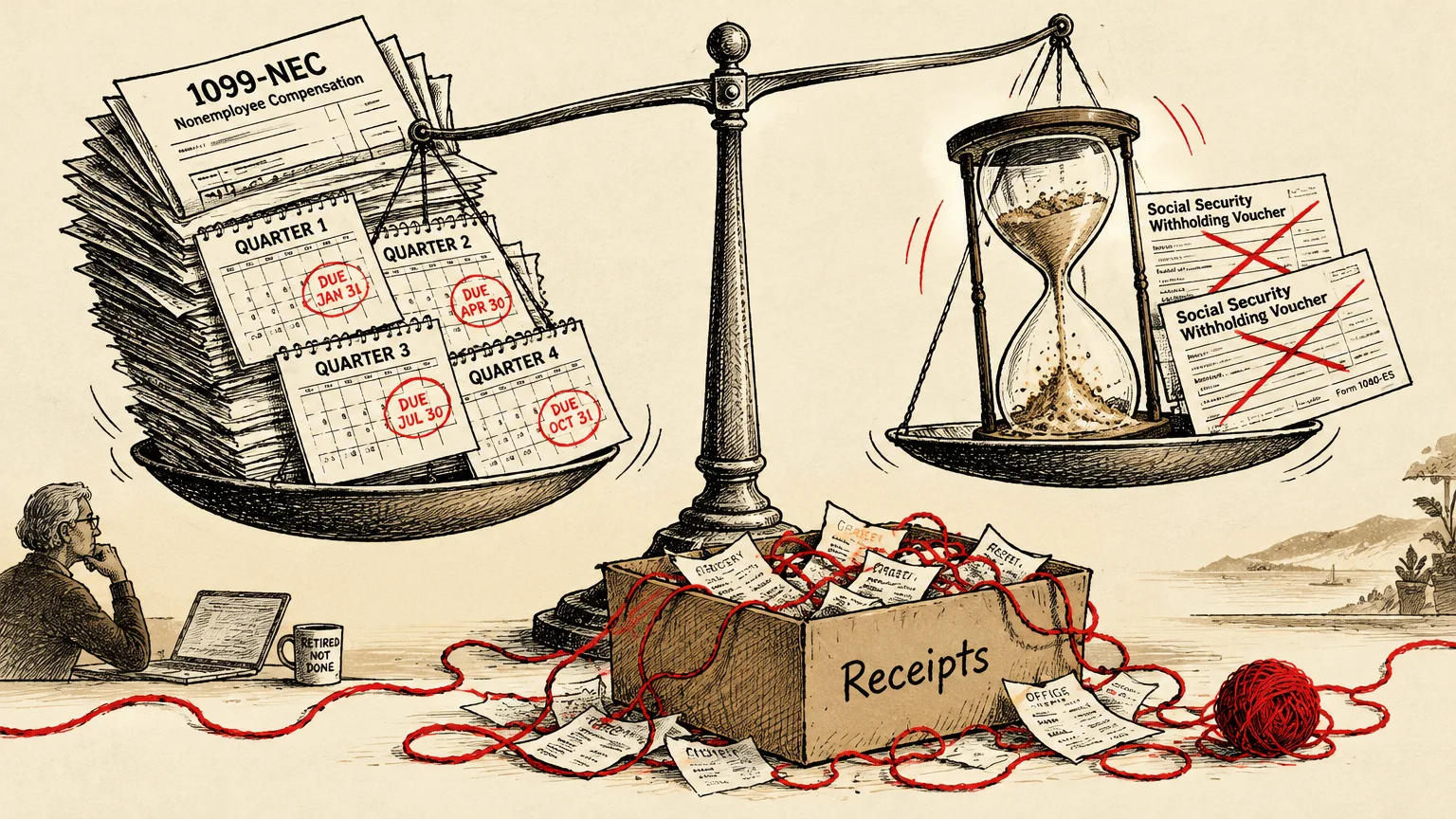
Returning to the workforce during retirement offers substantial financial rewards, but simple missteps can cause frustration or financial loss. Protect your nest egg and peace of mind by steering clear of these common pitfalls.
1. Overearning Before Reaching Full Retirement Age
The most common mistake involves exceeding the Social Security earnings limitation prior to your Full Retirement Age. Earning substantial contract income without planning can trigger benefit withholding and unwelcome letters from the SSA.
If you are under 67 in 2026, track your gross earned wages monthly against the $24,480 yearly threshold ($2,040 monthly). Remember that the earnings test applies only to earned wages and net self-employment income, not pension checks, dividends, or IRA distributions.
2. Forgetting Self-Employment and Quarterly Taxes
When you work as an independent contractor (filing an IRS Form 1099), clients do not withhold income taxes or FICA taxes from your compensation. You become responsible for paying the self-employment tax, which covers Medicare and Social Security contributions.
According to the IRS, independent contractors must file quarterly estimated tax payments using Form 1040-ES if they expect to owe at least $1,000. Failing to remit quarterly payments can result in underpayment penalties at tax time.
Set aside roughly 25% to 30% of every independent client payment into a separate high-yield savings account immediately. This discipline ensures you hold adequate liquidity when estimated tax deadlines arrive in April, June, September, and January.
3. Falling for Remote Job and Overpayment Scams
Scammers aggressively target older adults seeking work-from-home employment, particularly in data entry and accounting. Criminals post enticing job advertisements promising high hourly wages for simple clerical tasks.
A frequent scheme involves sending a counterfeit cashier’s check to purchase home office equipment, followed by a request to wire back remaining funds. The fake check eventually bounces, leaving you liable for every dollar transferred.
Legitimate employers provide equipment directly or pay you strictly through verified payroll channels after work is completed. As highlighted by advocacy organizations like AARP and the Consumer Financial Protection Bureau, you should never pay fees upfront for software or background checks to secure a job.
4. Overcommitting Hours and Compromising Retirement
Retirement should provide freedom and personal rejuvenation. Many former professionals accept multiple client engagements simultaneously, only to recreate the burnout they sought to escape.
Establish strict boundaries regarding your availability. Decide in advance how many hours you intend to work each week, and inform your clients of those operating parameters upfront.
Block out your calendar for exercise, medical checkups, family commitments, and travel before booking client appointments. Guarding your personal time ensures your remote number work remains an enjoyable, fulfilling supplement rather than an exhausting burden.

When to Consult a Professional
Navigating taxes, business entities, and retirement benefits can become complex when you add wage income to your existing financial landscape. Seek personalized guidance from certified specialists in these scenarios:
- Choosing a Business Structure: Consult a business attorney or CPA before deciding whether to operate as a sole proprietor or establish a formal Single-Member LLC.
- Managing Medicare IRMAA Surcharges: If extra self-employment income pushes your modified adjusted gross income over Medicare thresholds, consult a financial planner to avoid substantial Part B and Part D premium hikes.
- Pension and Disability Offsets: If you receive a public service pension or private long-term disability benefits, consult your plan administrator to verify whether outside earnings reduce your monthly checks.
- Multi-State Tax Filings: When servicing clients headquartered in other states, an accountant can determine whether you trigger non-resident state tax filing requirements.
Frequently Asked Questions
Do I need a CPA license to do remote bookkeeping or tax preparation?
No, you do not need a CPA license to work as a freelance bookkeeper or basic tax preparer. For tax preparation, you only need to obtain an active PTIN from the IRS and meet your home state’s specific registration rules.
Can earned income from a remote job push my Social Security into a higher tax bracket?
Yes, earned income increases your combined provisional income, which determines how much of your Social Security is subject to income tax. Up to 85% of your Social Security benefits can become taxable if your total income exceeds established thresholds.
How do I prove my skills to remote employers after years away from work?
Complete short, modern software certifications through QuickBooks Online, Xero, or Microsoft Excel to show current technical aptitude. Creating a clean, one-page functional resume highlighting specific financial accomplishments will reassure hiring managers.
Is data entry still a viable remote job for seniors?
Data entry roles remain accessible for short-term projects, but the field is contracting rapidly due to automated scanning and software integration. Bookkeeping, payroll support, and billing clerk roles offer far greater job stability and higher compensation.
Practical Next Steps to Begin Your Remote Search
Transitioning into remote quantitative work begins with simple, organized preparation. Start by auditing your current computer equipment to verify your operating system supports current business software.
Update your resume to emphasize accuracy, software proficiency, and reliability rather than your complete chronology of early career roles. Connect with former business associates and local small businesses to let them know you have part-time financial availability.
Begin by securing a single, low-stress client to test your workflow and establish comfortable boundaries. Working with numbers gives you the power to earn dependable supplemental income while enjoying the freedom and flexibility of your retirement years.
This is educational content based on general financial principles for seniors. Individual results vary based on your situation. Always verify current benefit amounts, tax rules, and program eligibility with official government sources.
Last updated: October 2026. Benefit amounts, tax rules, and program details change annually—verify current figures with official government sources.









Leave a Reply