

Trading a high-cost suburb for peaceful waterfront living sounds out of reach when you live primarily on Social Security. Yet smart location choices still let retired couples enjoy lake views without straining their monthly cash flow.
Rising Medicare premiums and elevated mortgage rates make every housing dollar count in 2027. By focusing on affordable lake towns with favorable tax rules, you can keep housing costs manageable and preserve your nest egg.
Below, you will see how an average Social Security budget stretches, which tax and flood rules matter most, and ten welcoming lake towns worth exploring.
What a Retired Couple’s Social Security Budget Buys in 2027
Your monthly benefit check stretches further when you plan around real net income rather than gross estimates. According to the Social Security Administration (SSA) on October 14, 2026, benefits will rise by a 3.6% cost-of-living adjustment (COLA) in 2027.
That 3.6% boost improves on the 2.8% COLA in 2026 and reaches nearly 72 million Social Security beneficiaries starting in January 2027. Nearly 7.3 million Supplemental Security Income recipients will see their increase begin on December 31, 2026.
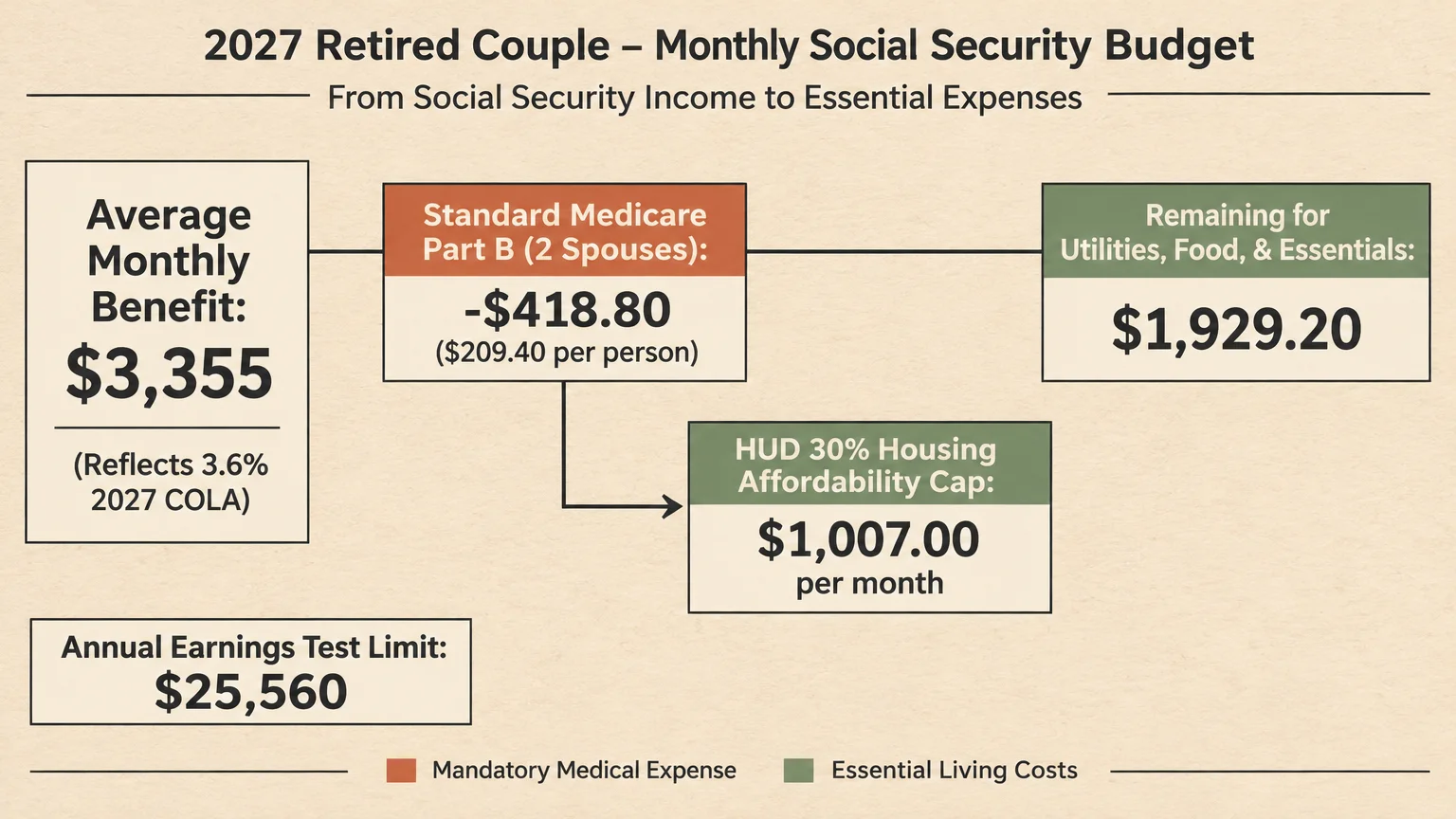
For an aged couple where both spouses receive benefits, the SSA’s 2027 COLA Fact Sheet projects an average monthly check of $3,355 in January 2027. That equals $40,260 per year, up $117 per month from $3,238 in 2026.
Individual retired workers see an average increase of $75 per month, moving from $2,095 to $2,170. If you claimed at full retirement age with maximum lifetime earnings, the top monthly benefit rises from $4,152 in 2026 to $4,188 in 2027.
Before locking in a monthly rent or mortgage payment, subtract healthcare premiums taken directly from your check. On November 17, 2026, the Centers for Medicare & Medicaid Services (CMS) set the 2027 standard Medicare Part B premium at $209.40 per month.
That represents a $6.50, or 3.2%, jump from the $202.90 rate in 2026. For a couple both paying the standard rate, combined Part B premiums climb from $405.80 in 2026 to $418.80 per month in 2027.
Out-of-pocket medical deductibles are edging upward as well. CMS raised the annual Part B deductible from $283 in 2026 to $292 in 2027, while the Part A inpatient hospital deductible moves from $1,736 to $1,776.
Those deductions matter deeply because most retirees lean heavily on their monthly checks. Research from the Pew Research Center shows 63% of beneficiaries get at least half of their income from Social Security, while 27% rely on it exclusively.
Some couples supplement their checks with part-time work near the water. A T. Rowe Price survey cited in October 2026 found roughly 20% of retirees hold full- or part-time jobs, with another 7% looking for work.
If you work before reaching full retirement age, watch the SSA earnings test carefully. The exempt annual limit climbs from $24,480 ($2,040 per month) in 2026 to $25,560 ($2,130 per month) in 2027.
To keep housing safe for a retired couples budget, apply the affordability benchmark used by the U.S. Department of Housing and Urban Development (HUD). HUD classifies households spending over 30% of gross income on housing as cost-burdened and over 50% as severely cost-burdened.
On the average 2027 couple benefit of $3,355 per month, HUD’s 30% ceiling equals roughly $1,007 per month. That target is tough to hit at the national level, where the National Association of Realtors reported a $416,700 median existing-home price in October 2026.
Borrowing costs also demand caution if you plan to finance a home instead of paying cash from home equity. Freddie Mac’s November 19, 2026 survey placed the average 30-year fixed mortgage at 7.28% and the 15-year fixed rate at 6.66%.
One bright spot is stronger buyer leverage in slower markets. Existing-home sales fell to a 3.75 million annual pace in October 2026 while unsold inventory reached a 5.1-month supply, giving buyers more room to negotiate price cuts and seller concessions.
Keeping total housing costs at or below 30% of your combined Social Security check protects your emergency savings against Medicare increases, property tax hikes, and unexpected home repairs.
How State and Federal Taxes Shape Your Lake Town Choice
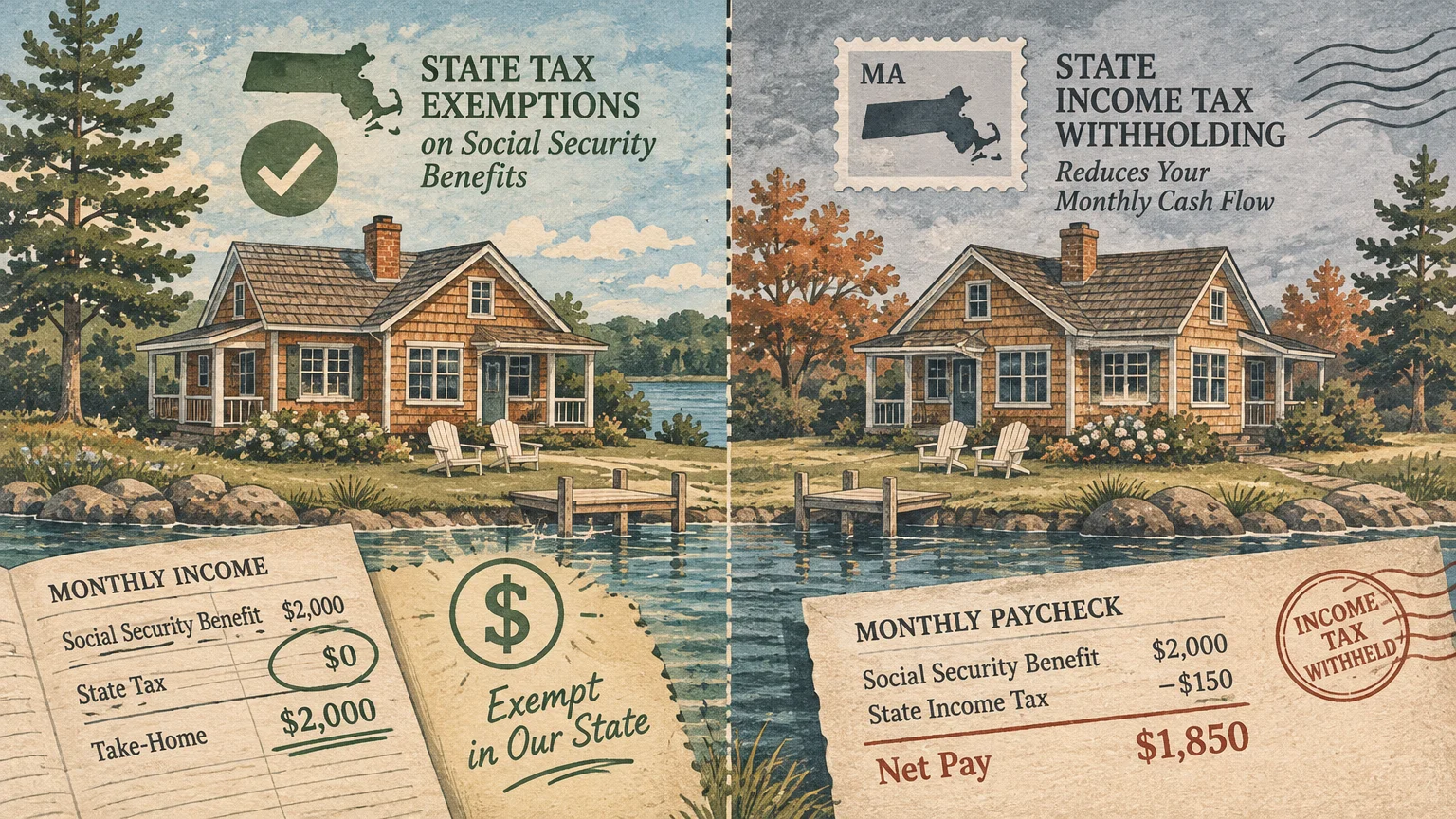
Choosing the right state can immediately save hundreds or thousands of dollars a year on a fixed income. For the 2026 tax year, 42 states and Washington, D.C. do not tax Social Security benefits at all.
That list expanded recently as more states phased out retirement taxes. West Virginia completed its phase-out in 2026, following Kansas, Missouri, and Nebraska, which ended Social Security taxation in 2024.
Only eight states still tax Social Security benefits in some form during 2026. Those states are Colorado, Connecticut, Minnesota, Montana, New Mexico, Rhode Island, Utah, and Vermont, though most provide age- or income-based exemptions.
Federal taxes follow separate rules under Internal Revenue Code Section 86 and IRS Publication 915. The IRS calculates your combined income by adding your adjusted gross income, nontaxable interest, and half of your annual Social Security benefits.
For joint filers, up to 50% of benefits become federally taxable once combined income tops $32,000 ($25,000 for single filers). Up to 85% becomes taxable once combined income exceeds $44,000 for couples ($34,000 for singles).
Recent tax legislation offers extra breathing room if you and your spouse are 65 or older. For tax years 2025 through 2028, IRC Section 151(d)(5)(C) provides a temporary $6,000 senior deduction per eligible person, or $12,000 for qualifying couples.
That deduction phases out by 6 cents for every dollar of modified adjusted gross income above $150,000 for joint filers ($75,000 single). It drops to zero at $250,000 for couples ($175,000 single).
Keep an eye on your modified adjusted gross income if you sell a high-value home to downsize onto a lake. In 2027, Medicare’s high-income surcharges (IRMAA) kick in above $224,000 for joint filers or $112,000 for single filers.
10 Affordable Lake Towns for Couples on Social Security
Finding affordable retirement towns near water means looking beyond flashy resort coastlines. The ten lake towns for retirees below offer strong community amenities, boating or fishing access, and realistic pathways for waterfront living retirement.
Four towns include verified 2026 market figures from published housing trackers. For the remaining six, check current local listings, HUD Fair Market Rents, and county property tax records before making an offer.
1. Grenada, Mississippi (Grenada Lake)
Set in north-central Mississippi, Grenada borders Grenada Lake, a favorite destination for crappie fishing, kayaking, and quiet shoreline picnics. FinanceBuzz data from August 2026 puts Grenada’s average home value at $131,337 and average rent at $775 per month.
That rent sits well below HUD’s $1,007 monthly housing guideline for the average Social Security couple. FinanceBuzz also notes Grenada’s overall cost of living runs 29% below the U.S. average, while Mississippi fully exempts Social Security from state income tax.
Before buying, check drive times to your preferred medical specialists and inspect older homes for crawl-space moisture. Staying slightly back from the water’s edge often secures lower insurance costs while keeping boat ramps minutes away.
2. Sandusky, Ohio (Lake Erie)
If you want Great Lakes scenery, ferry access to Lake Erie islands, and walkable neighborhoods, Sandusky delivers serious value. FinanceBuzz reported an average home value of $153,976 and an average rent of $1,200 per month in August 2026.
Ohio does not tax Social Security benefits, helping couples keep more of their monthly COLA gains. You also get established healthcare facilities in town and easy highway access to major medical centers in Cleveland and Toledo.
Winters off Lake Erie bring snow and heating bills, so factor utility averages into your monthly cash flow. Touring neighborhoods during winter or early spring helps you evaluate snow removal and home insulation firsthand.
3. Guntersville, Alabama (Lake Guntersville)
Surrounded by water on a scenic peninsula, Guntersville sits on Alabama’s largest lake along the Tennessee River. Warm seasons stretch well into autumn, giving retirees months of pontoon cruising, bass fishing, and paved lakeside walking trails.
Alabama is among the 42 states that do not tax Social Security benefits, which helps preserve fixed incomes. The town also features a regional hospital, community recreation programs, and straightforward driving access to Huntsville’s larger medical network.
Waterfront parcels command higher premiums, so many retirees buy modest ranch homes one or two streets off the shoreline. Verify local county property taxes and homeowner association dock rules before signing a contract.
4. Hot Springs Village, Arkansas (Ouachita Mountain Lakes)
Spanning forested hills in the Ouachita Mountains, Hot Springs Village is a gated retirement community with multiple recreational lakes inside its borders. You can spend mornings paddling calm coves or enjoying golf courses, pickleball courts, and walking clubs.
Arkansas exempts Social Security benefits from state income tax, supporting a predictable retired couples budget. Nearby Hot Springs provides full-service hospitals, shopping, and cultural events without big-city traffic congestion.
Because the community charges monthly property owners association assessments, add those recurring dues directly into your housing budget. Compare townhome rentals and single-family resales using current local listings to stay under your monthly target.
5. Eufaula, Oklahoma (Lake Eufaula)
Anchored along Lake Eufaula’s sprawling shoreline in eastern Oklahoma, this small town appeals to couples seeking unhurried days and friendly neighbors. Boating marinas, lakeside state parks, and quiet fishing coves sit right outside the downtown core.
Oklahoma does not tax Social Security benefits, leaving more of your check intact for groceries, fuel, and recreation. Living in a smaller rural hub keeps everyday expenses low, though specialty medical visits may require driving to larger regional cities.
Look carefully at well, septic, and roof ages when touring older lake cottages around Eufaula. Asking county assessors for current property tax estimates prevents surprises after your first year of ownership.
6. Kimberling City, Missouri (Table Rock Lake)
Tucked into the Ozark hills on clear Table Rock Lake, Kimberling City draws retirees who love wooded bluffs and gentle boating waters. You sit close enough to Branson for live shows and clinics while enjoying quieter neighborhood streets at home.
Missouri ended state taxation of Social Security benefits in 2024, boosting its appeal for couples trying to retire on Social Security. Regional hospitals in Branson and Springfield provide solid specialty care within driving distance.
Steep Ozark driveways and private community dock leases can add unexpected upkeep costs for older homeowners. Focus on single-level homes with flat parking and verify municipal water and sewer connections early.
7. Lake Havasu City, Arizona (Lake Havasu)
For couples who dislike snow shovels, Lake Havasu City offers sunny desert waterfront living along the Colorado River. Clear water, sandy coves, and active senior clubs create an energetic social calendar from fall through spring.
Arizona is one of the 42 states that exempt Social Security from state income tax. Town clinics, an acute-care hospital, and wide retail options make daily errands manageable without leaving the area.
Peak summer temperatures drive heavy air-conditioning usage, so review twelve months of past utility bills before renting or buying. Inland residential neighborhoods often offer lower prices and simpler upkeep than direct channel-front properties.
8. Seneca, South Carolina (Lake Keowee and Lake Hartwell)
Sitting in South Carolina’s Upstate foothills, Seneca gives retirees easy public access to both Lake Keowee and Lake Hartwell. Mild four-season weather lets you enjoy hiking, kayaking, and lakeside parks nearly year-round.
South Carolina does not tax Social Security benefits and provides favorable property tax treatment for primary residences. Proximity to a local medical center plus Greenville’s major hospital system adds peace of mind as healthcare needs evolve.
Direct Lake Keowee frontage often carries steep price tags, making nearby Seneca neighborhoods a smarter financial play. Confirm primary-residence homestead exemptions with the Oconee County assessor so your tax estimate reflects owner-occupied rates.
9. Brainerd Lakes, Minnesota (Gull Lake Chain)
Famous for pine-lined shores and clear glacial lakes, the Brainerd Lakes region offers classic Upper Midwest summer living. Homesgofast reports median sold home prices in the area under $300,000, typically ranging between $220,000 and $270,000.
Buying in cash from prior home equity helps keep monthly housing costs low despite those higher regional purchase prices. You also gain strong local healthcare networks, paved bike trails, and vibrant summer community events.
Minnesota is one of the eight states that taxes Social Security benefits above certain income thresholds, though exemptions apply for lower incomes. Account for state tax rules, winter heating bills, and snowplowing fees before committing.
10. Pocono Lake, Pennsylvania (Pocono Mountains)
Located within driving distance of major Northeast cities, Pocono Lake lets retirees enjoy wooded mountain lakes near adult children and grandchildren. Homesgofast reports a median selling price of $319,000, requiring careful budgeting or substantial home equity.
Pennsylvania offers a major tax advantage because it completely exempts Social Security and most retirement income from state tax. Quiet lake communities offer beaches, clubhouses, and four-season scenery in the Pocono Mountains.
Many neighborhoods sit inside private lake associations with annual dues and strict building rules. Compare school and county property taxes alongside association fees to make sure total monthly housing costs fit your income.
Side-by-Side Comparison of Affordable Lake Towns
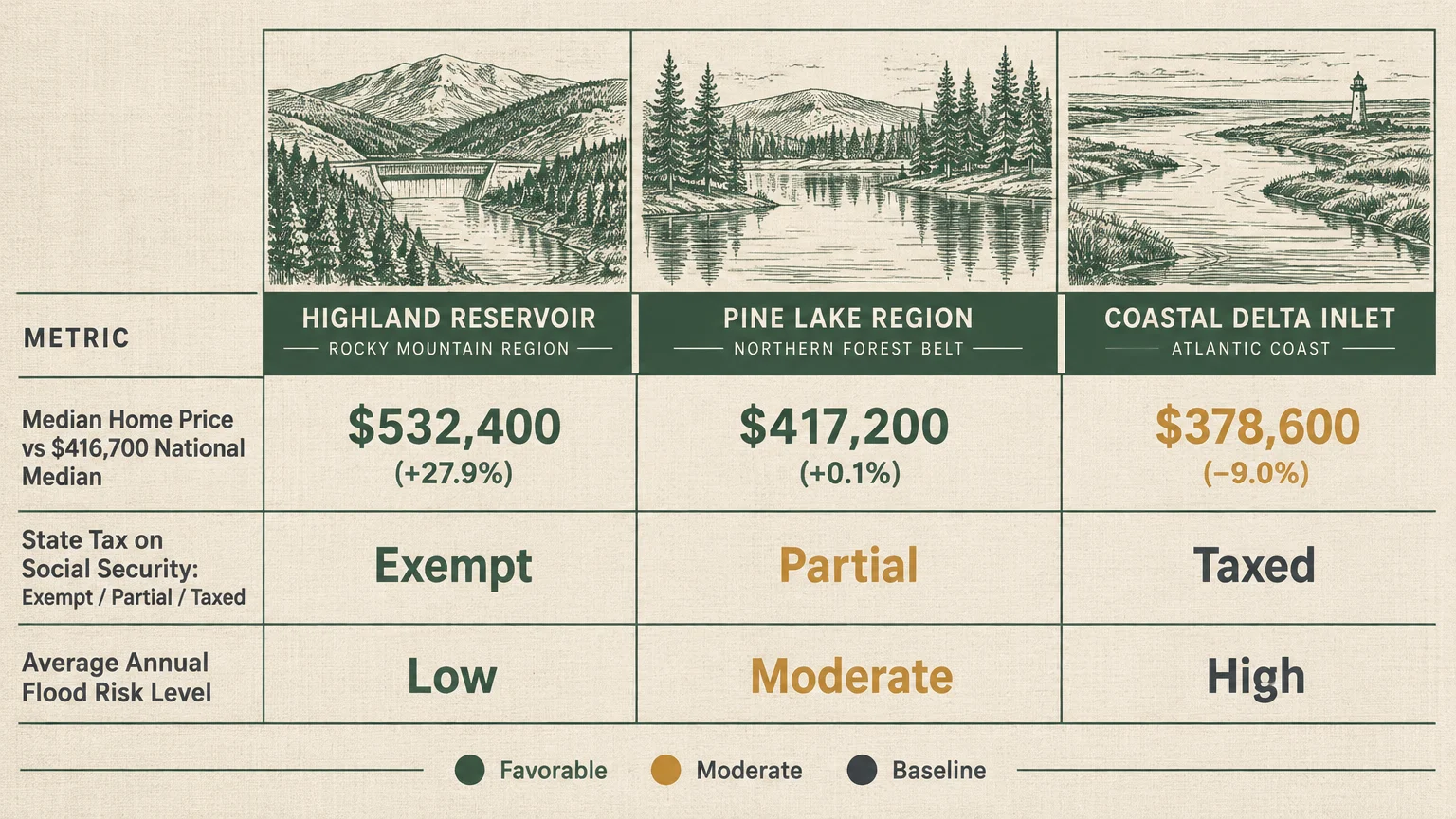
Use the summary table below to compare state Social Security tax treatment and available pricing benchmarks across all ten towns. Always confirm current local listings and property tax rates directly before relocating.
| Lake Town | Primary Water Body | State Tax on Social Security (2026) | Verified Housing Benchmark / Local Check |
|---|---|---|---|
| Grenada, MS | Grenada Lake | Exempt | Avg. home $131,337; avg. rent $775/mo (Aug. 2026) |
| Sandusky, OH | Lake Erie | Exempt | Avg. home $153,976; avg. rent $1,200/mo (Aug. 2026) |
| Guntersville, AL | Lake Guntersville | Exempt | Verify local listings, county taxes, and dock HOA dues |
| Hot Springs Village, AR | Community Mountain Lakes | Exempt | Verify resale prices and monthly POA assessments |
| Eufaula, OK | Lake Eufaula | Exempt | Verify local listings, septic records, and county taxes |
| Kimberling City, MO | Table Rock Lake | Exempt (ended 2024) | Verify local listings, slope access, and dock rules |
| Lake Havasu City, AZ | Lake Havasu | Exempt | Verify local listings and summer electric utility bills |
| Seneca, SC | Lakes Keowee & Hartwell | Exempt | Verify local listings and primary-residence tax ratio |
| Brainerd Lakes, MN | Gull Lake Chain | Taxed above thresholds | Median sold prices typically $220,000–$270,000 |
| Pocono Lake, PA | Pocono Mountain Lakes | Exempt | Median selling price $319,000; check HOA dues |
Budgeting for Waterfront Flood Insurance and Hidden Costs
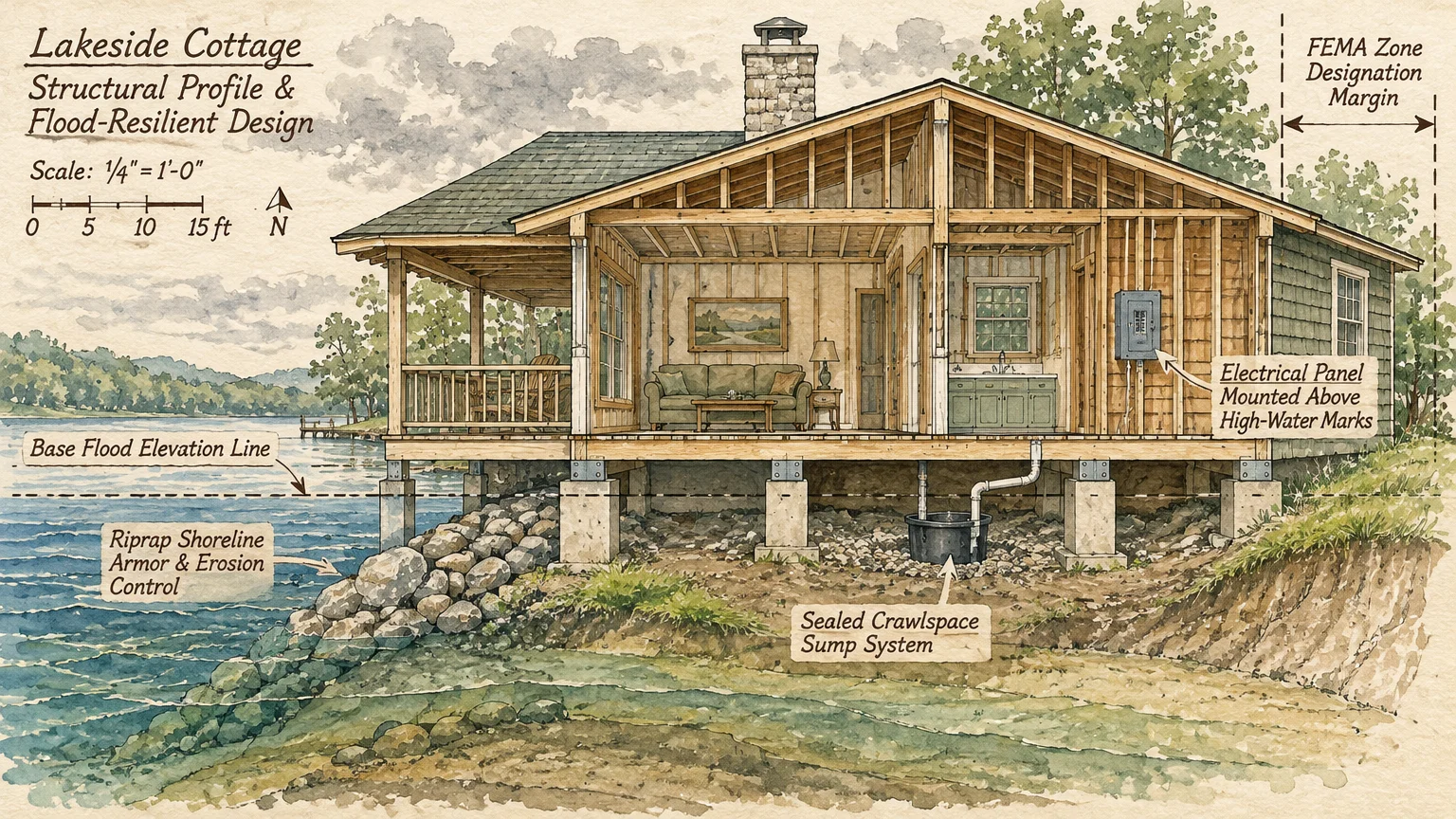
Water views bring specific insurance rules that can surprise couples moving from inland suburbs. Standard homeowners policies exclude flood damage, meaning you must budget separately if your property faces water risk.
Under the Flood Disaster Protection Act of 1973, federally backed mortgages on homes inside a FEMA Special Flood Hazard Area require flood insurance. These Zones A or V areas represent the 100-year floodplain with a 1% annual flood chance.
FEMA notes that a home inside a Special Flood Hazard Area carries a 26% chance of flooding over a 30-year mortgage. Even if you buy with cash and no lender forces coverage, skipping insurance exposes your retirement savings.
Outside mapped floodplains, risk still exists. An October 2026 Government Accountability Office report (GAO-27-108012) found roughly 13 million high-risk U.S. properties lie outside FEMA’s mapped Special Flood Hazard Areas.
Standard National Flood Insurance Program (NFIP) policies for one-to-four-family homes cap coverage at $250,000 for the building and $100,000 for contents. According to a NerdWallet analysis of 2026 NFIP rates, the national average premium is $976 per year, or about $81 per month.
Policies in higher-risk Zone AE neighborhoods commonly run between $800 and $3,500 per year. Under FEMA’s Risk Rating 2.0 pricing system, most existing NFIP policies have annual premium increases capped by law at 18% per year.
Beyond flood coverage, evaluate these recurring lakefront ownership expenses before signing a lease or purchase agreement:
- Association and Dock Fees: Private lake communities and condominium boards often charge monthly or annual fees for road upkeep, security gates, and boat slips.
- Septic and Well Maintenance: Rural lake cottages frequently rely on private wells and septic systems that require periodic pumping and pricey replacements.
- Healthcare Travel Distances: Smaller lake towns may lack specialized cardiology or orthopedic clinics, adding fuel and lodging costs for out-of-town appointments.
- Seasonal Utility Swings: Damp lakeside humidity, winter lake-effect cold, or triple-digit desert summers can push electric and heating bills higher than inland averages.
- Senior Property Tax Relief: Many counties offer homestead exemptions or property tax freezes for residents age 65 and older, but you usually must apply manually.
Pitfalls to Watch For When Buying a Lakefront Retirement Home
Moving to the water on a fixed income leaves less room for expensive missteps. Watch closely for four common mistakes that catch retiring couples off guard.
First, never skip an independent flood-zone and elevation check just because a seller says the home never flooded. Remember the GAO finding that millions of high-risk homes sit outside federal flood maps, so request real NFIP quotes during your inspection window.
Second, avoid stretching past HUD’s 30% housing threshold by taking on a large mortgage at elevated interest rates. With 30-year rates averaging 7.28% in late 2026, financing a high balance can quickly lock up half your Social Security income.
Third, do not assume every affordable lake state treats retirement checks equally at tax time. Buying in one of the eight states that still taxes Social Security without checking income exemptions can trim hundreds of dollars from your annual cash flow.
Fourth, plan carefully before selling a long-time family home with large capital gains. A sudden spike in modified adjusted gross income can trigger Medicare IRMAA surcharges in 2027 above $224,000 for joint filers, raising Part B costs two years later.
Getting Expert Help Before You Relocate
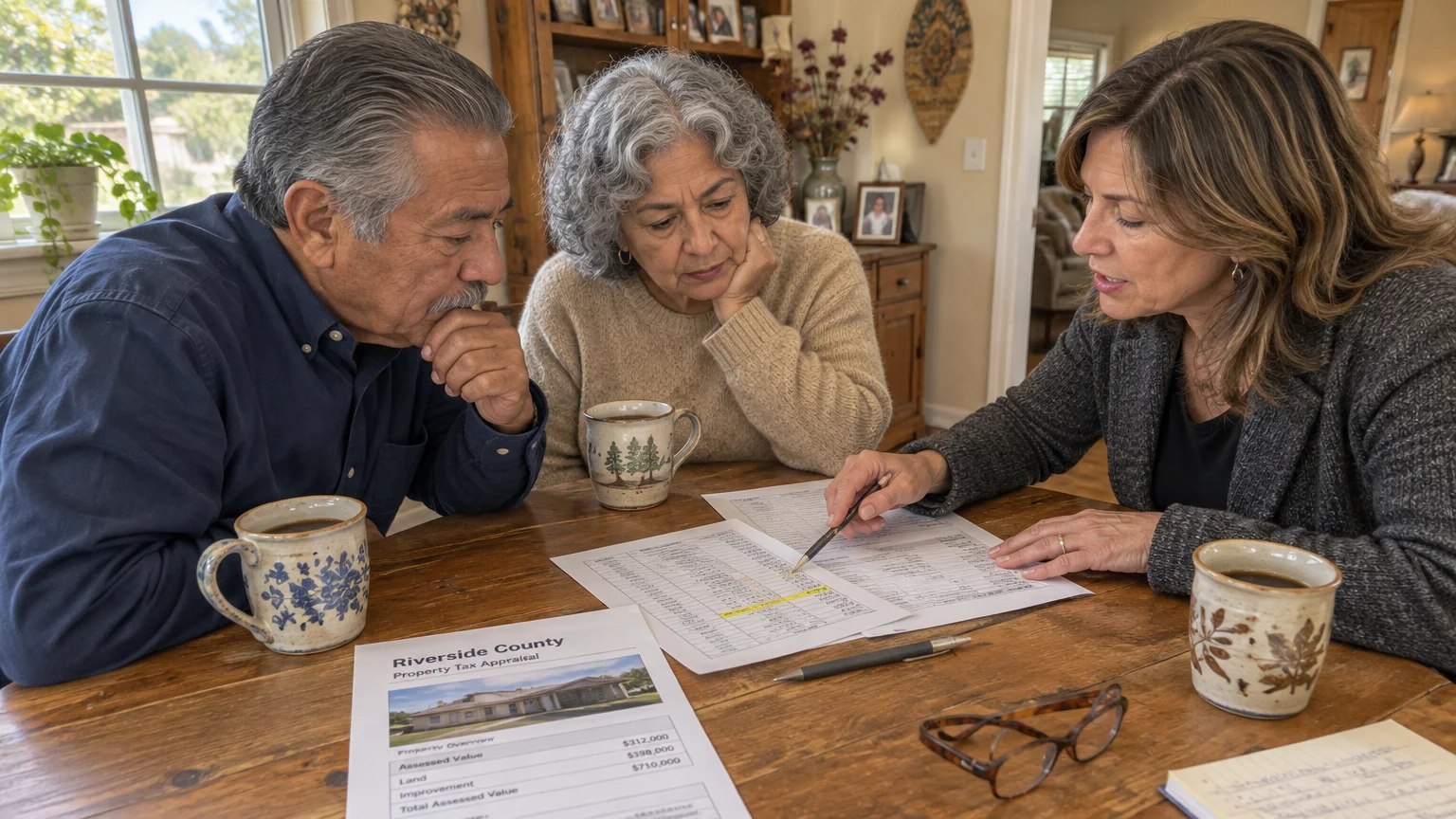
You do not need to navigate cross-state taxes, mortgage rates, and insurance maps alone. Reaching out to qualified professionals makes sense in four specific relocation scenarios:
- Timing a Home Sale and Downsize: A certified public accountant or fee-only financial planner can help you structure your sale to avoid Medicare IRMAA brackets and preserve the $12,000 temporary senior deduction.
- Comparing Renting vs. Financing at 7.28%: A HUD-approved housing counselor or resources from the Consumer Financial Protection Bureau (CFPB) can help you model total monthly housing costs without sales pressure.
- Evaluating Flood and Wind Coverage: An independent insurance broker licensed in your destination state can pull both NFIP and private flood quotes alongside homeowners premiums before you make an offer.
- Checking State Tax Rules on Combined Income: If you are eyeing a town in Minnesota or another state that taxes Social Security, a local tax preparer can run an exact projection using your pensions and IRA withdrawals.
Frequently Asked Questions
Can a couple really live near a lake on Social Security alone?
Yes, especially if you choose low-cost towns like Grenada, Mississippi, where average rent sits around $775 per month, or buy a modest home with cash from prior equity. Keeping housing below HUD’s 30% benchmark leaves room for Medicare Part B premiums, food, and utilities.
Do I need flood insurance if my lake house is not in a FEMA flood zone?
Lenders only require flood insurance for federally backed mortgages inside mapped Special Flood Hazard Areas. However, because roughly 13 million high-risk U.S. properties lie outside those maps, getting an NFIP quote is smart protection against costly storm surges or heavy rain.
Should we rent for six months before buying in a lake town?
Renting first lets you test winter weather, summer tourist crowds, local medical clinics, and true utility bills before paying closing costs. In slower housing markets with a 5.1-month supply of homes, taking time to explore rarely hurts your buying options.
How much will Medicare take out of our 2027 Social Security COLA?
While the 2027 COLA raises the average aged couple’s benefit by $117 per month to $3,355, two standard Part B premiums rise by a combined $13 per month to $418.80. Most couples will still keep the majority of their 2027 cost-of-living increase.

Your Next Steps Toward Waterfront Retirement
Start by picking two or three lake towns from the list above that match your climate preferences and distance from family. Pull your latest benefit estimates from the SSA, subtract 2027 Medicare Part B premiums, and lock in a firm monthly housing ceiling near 30% of gross income.
Plan a weeklong off-season visit to tour neighborhoods, check hospital drive times, and speak with local insurance agents about flood and property taxes. This is educational content based on general financial principles for seniors. Individual results vary based on your situation. Always verify current benefit amounts, tax rules, and program eligibility with official government sources.
Last updated: November 2026. Benefit amounts, tax rules, and program details change annually—verify current figures with official government sources.





Leave a Reply