

Switching employers in your 50s or 60s alters your retirement timeline faster than you might expect. A late-career job change directly impacts how you access, protect, and grow your hard-earned 401(k) balance.
While a fresh position can boost your earnings, handling your legacy retirement account incorrectly triggers severe tax penalties and forfeits vital distribution perks.
Understanding the specific rules governing older workers ensures you preserve your nest egg and keep your retirement date on schedule. Here is what happens to your 401(k) when you change jobs late in life.
1. You Could Accidentally Forfeit the Rule of 55
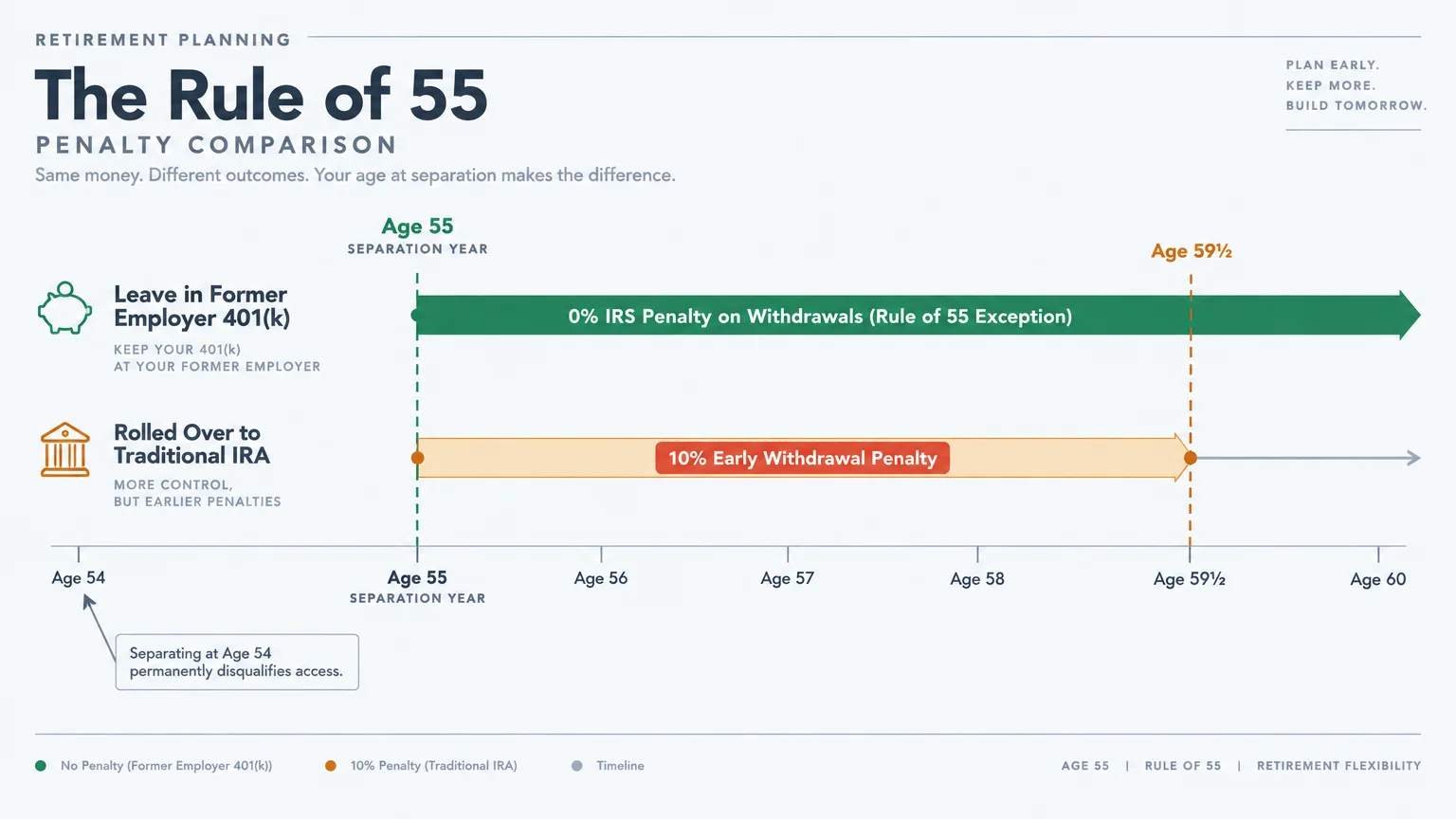
Leaving an employer during or after the calendar year you turn 55 unlocks a major Internal Revenue Service exception. Under this provision, you can withdraw funds from that specific employer’s 401(k) without the standard 10% early withdrawal penalty.
Most workers assume they should immediately transfer their old account into an Individual Retirement Arrangement. However, rolling those funds into a traditional IRA permanently eliminates your Rule of 55 protection.
Once your money enters an IRA, the government locks it down until you reach age 59½. Any early withdrawal from the IRA will trigger an immediate 10% penalty unless you qualify for a different hardship exception.
If you plan to retire before age 59½, leaving your savings in your former employer’s plan provides crucial income flexibility. Check the official guidelines at the Internal Revenue Service before executing any transfer.
To utilize this exemption, you must separate from service during or after the year you turn 55. If you leave your job at age 54, even by a single day, you lose access to this penalty-free distribution window.
2. Required Minimum Distribution Rules Shift for Active Workers
Under the SECURE 2.0 Act, Required Minimum Distributions (RMDs) currently begin at age 73 for retirees, shifting to age 75 in 2033. However, working past age 73 offers a unique tax advantage known as the “still-working” exception.
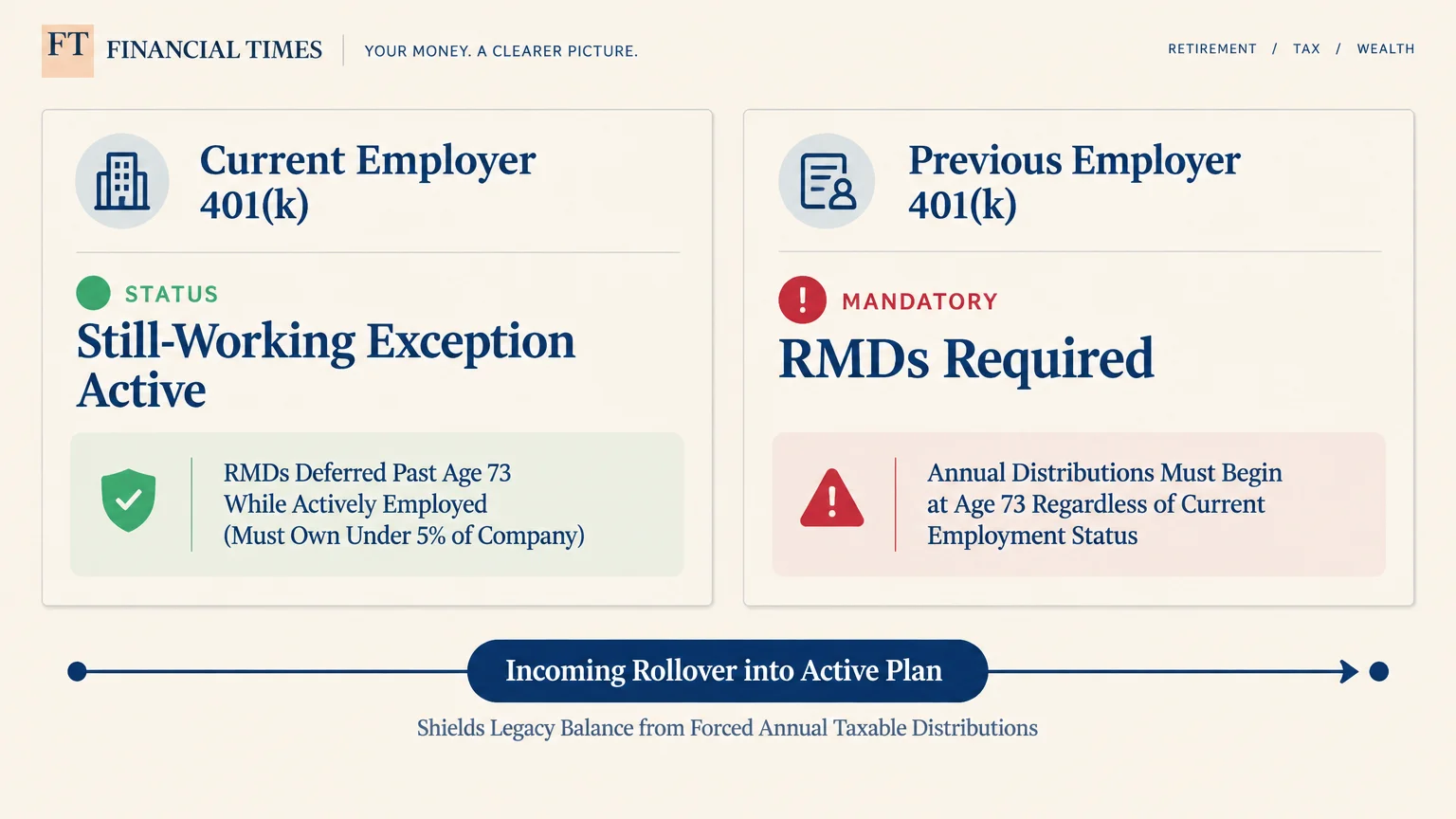
If you own less than 5% of the company, you can defer RMDs from your current employer’s 401(k) until you officially retire. This exception keeps your active retirement assets compounding tax-deferred without forced taxable distributions.
Unfortunately, this special exception does not extend to your previous employers’ plans. Leaving a retirement balance at a former company requires you to take annual RMDs starting at age 73, even while working full-time elsewhere.
To postpone forced withdrawals across all accounts, ask your new employer if their plan accepts incoming rollovers. Transferring old accounts into your active plan shields those balances from mandatory distributions while you stay on the job.
Rolling older accounts into your new active plan consolidates your paperwork and delays taxable distributions. However, you must confirm that your new plan documents formally permit incoming rollover transfers from prior employer accounts.
3. Your Catch-Up Contributions Encounter New Limits and Rules
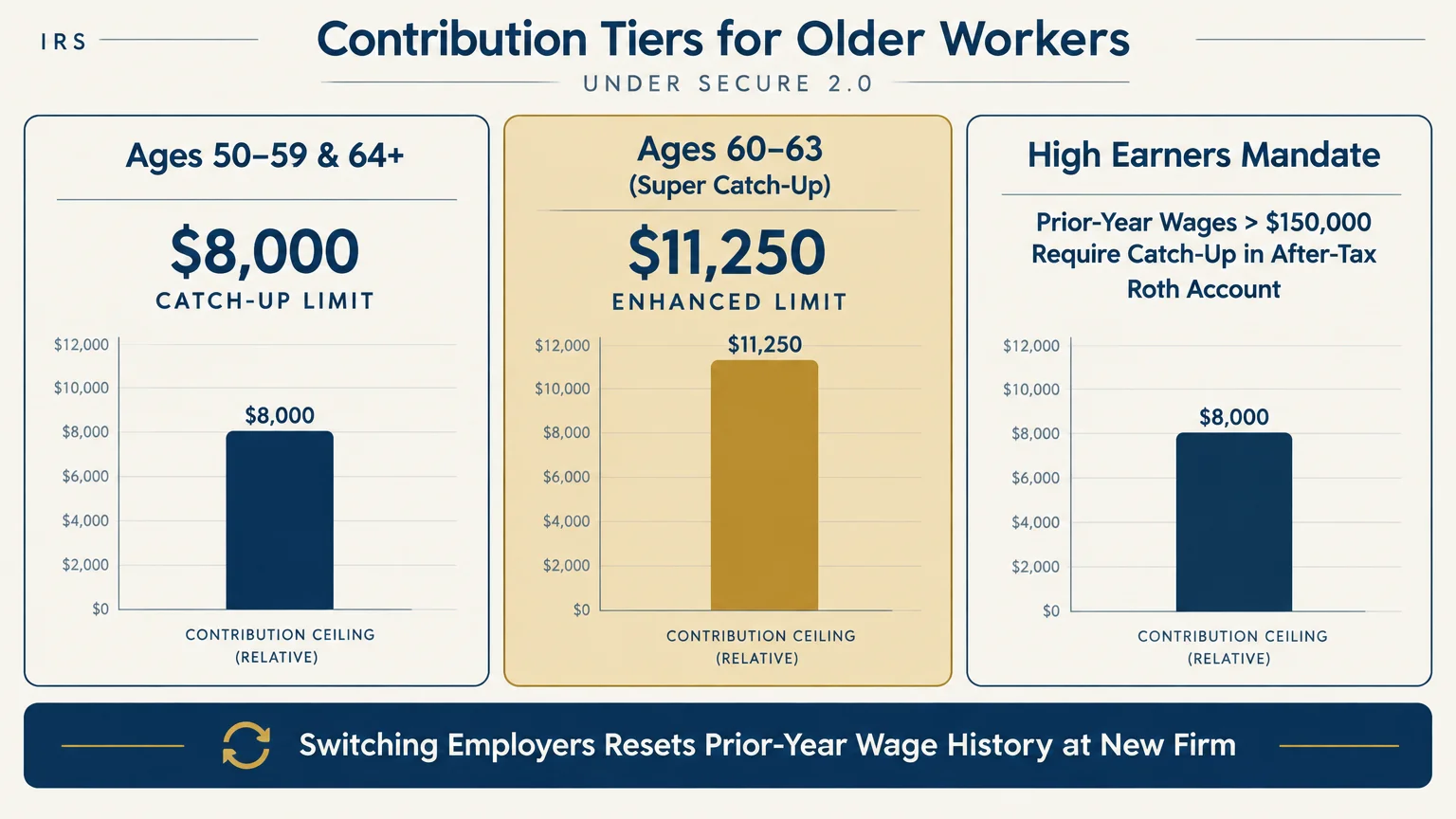
Changing jobs allows you to reset your savings strategy, but older workers face updated contribution thresholds. According to IRS guidelines for 2026, employees aged 50 and older can contribute an additional $8,000 catch-up amount beyond standard elective deferrals.
If you are between ages 60 and 63, the SECURE 2.0 Act introduces an enhanced “super catch-up” limit. For 2025 and 2026, eligible employees can save up to $11,250 in catch-up contributions if their plan permits it.
You must also navigate the high-earner Roth catch-up mandate that takes effect in 2026. If your prior-year Social Security wages from that employer exceeded $150,000, federal law requires your catch-up contributions to enter an after-tax Roth account.
Switching jobs resets your wage history at the new firm for the initial calendar year. Always verify with your new benefits department how their payroll system classifies your catch-up contributions during your first year of service.
Standard elective deferrals reach $24,500 in 2026, meaning eligible workers aged 60 to 63 can deposit up to $35,750 into their 401(k). Maximizing these enhanced limits requires adjusting your paycheck contribution percentages right away.
4. Small Balances Can Face Involuntary Account Transfers
If you leave behind a modest balance at your previous job, your former employer might not keep you in the plan. Companies prefer to remove terminated employees to minimize administrative costs, recordkeeping fees, and legal liabilities.
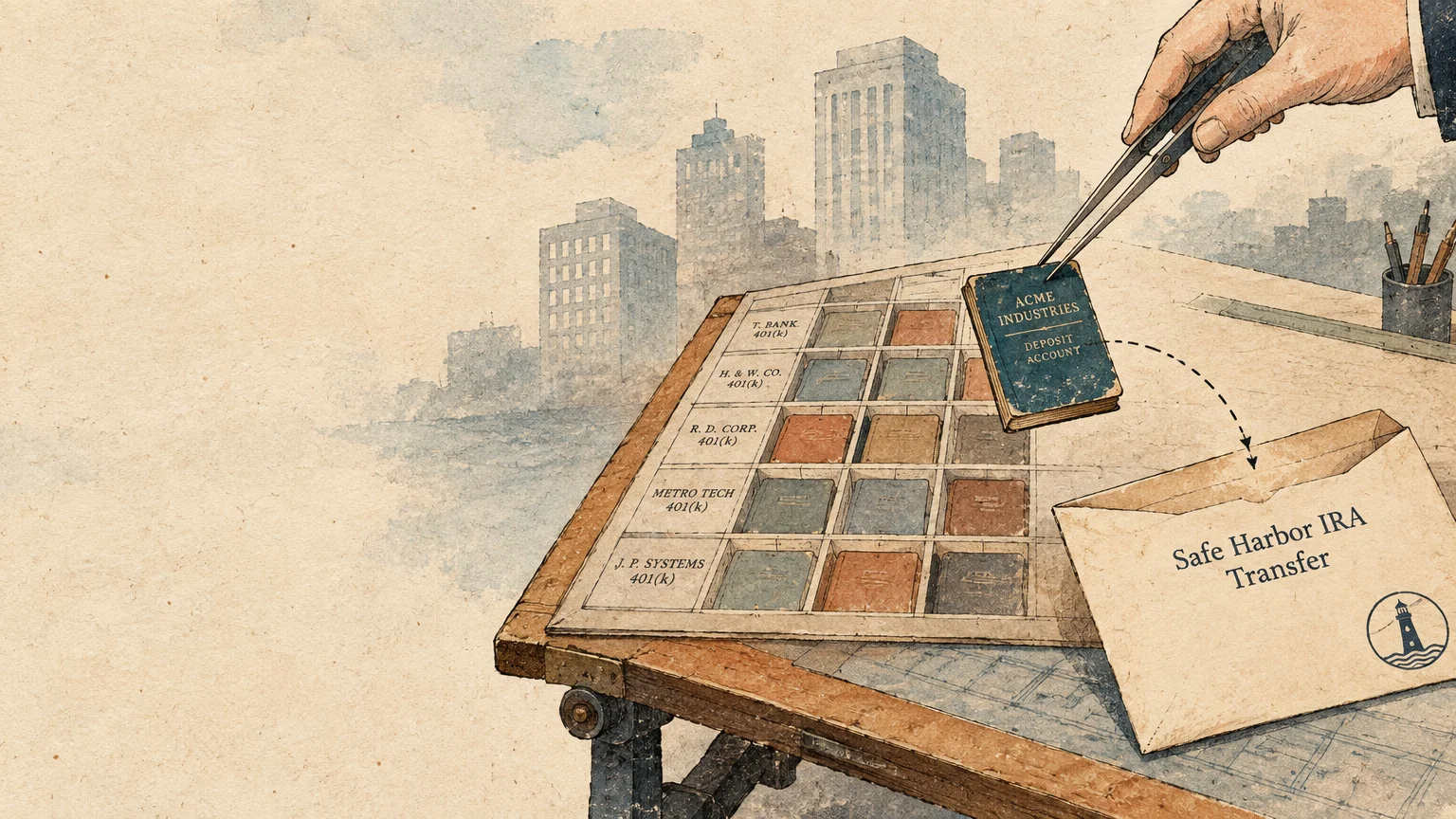
Under recent federal updates, plan sponsors can automatically transfer balances between $1,000 and $7,000 into a default safe-harbor IRA. If your balance sits below $1,000, your former company can simply mail you a cash-out check.
An unexpected check in the mail creates immediate tax liabilities and can trigger premature distribution penalties. Default safe-harbor IRAs often park your assets in ultra-conservative money market funds that barely outpace inflation over time.
Monitor your balances closely and give clear instructions to your former plan administrator. Choosing your own destination account prevents your retirement money from languishing in a low-yielding default vehicle.
Even if your former employer allows you to stay, small balances may get hit with higher monthly maintenance charges. Former employees often bear the full burden of administrative fees that the employer previously subsidized.
5. Vesting Schedules Could Erase Recent Employer Matches
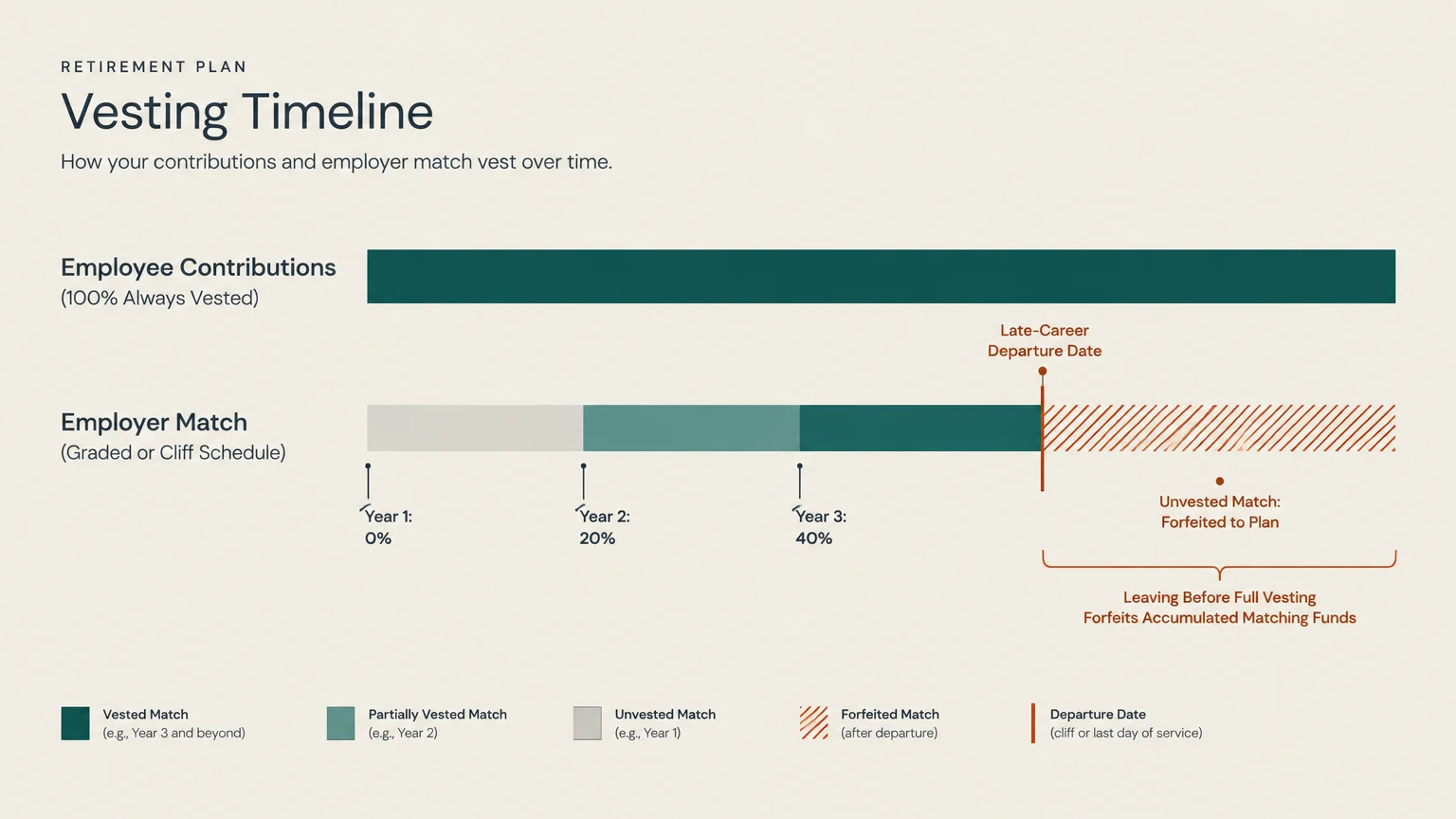
You always own 100% of your personal salary deferrals, but employer matching dollars follow a strict vesting schedule. If you leave a company late in your career, unvested matching contributions stay behind with your former employer.
Federal regulations allow businesses to use cliff vesting up to three years or graded vesting schedules spanning up to six years. Starting a new role in your early 60s requires careful attention to these timelines.
If your new company uses a three-year cliff vesting schedule and you retire after two years, you forfeit every matching cent. Factor this vesting schedule into your overall compensation analysis before accepting a late-career position.
Always ask your prospective employer’s human resources team for a copy of their Summary Plan Description. Reviewing the matching formula and vesting schedule in advance prevents unpleasant surprises when you decide to retire permanently.
6. Unpaid 401(k) Loans Trigger a Compressed Repayment Clock
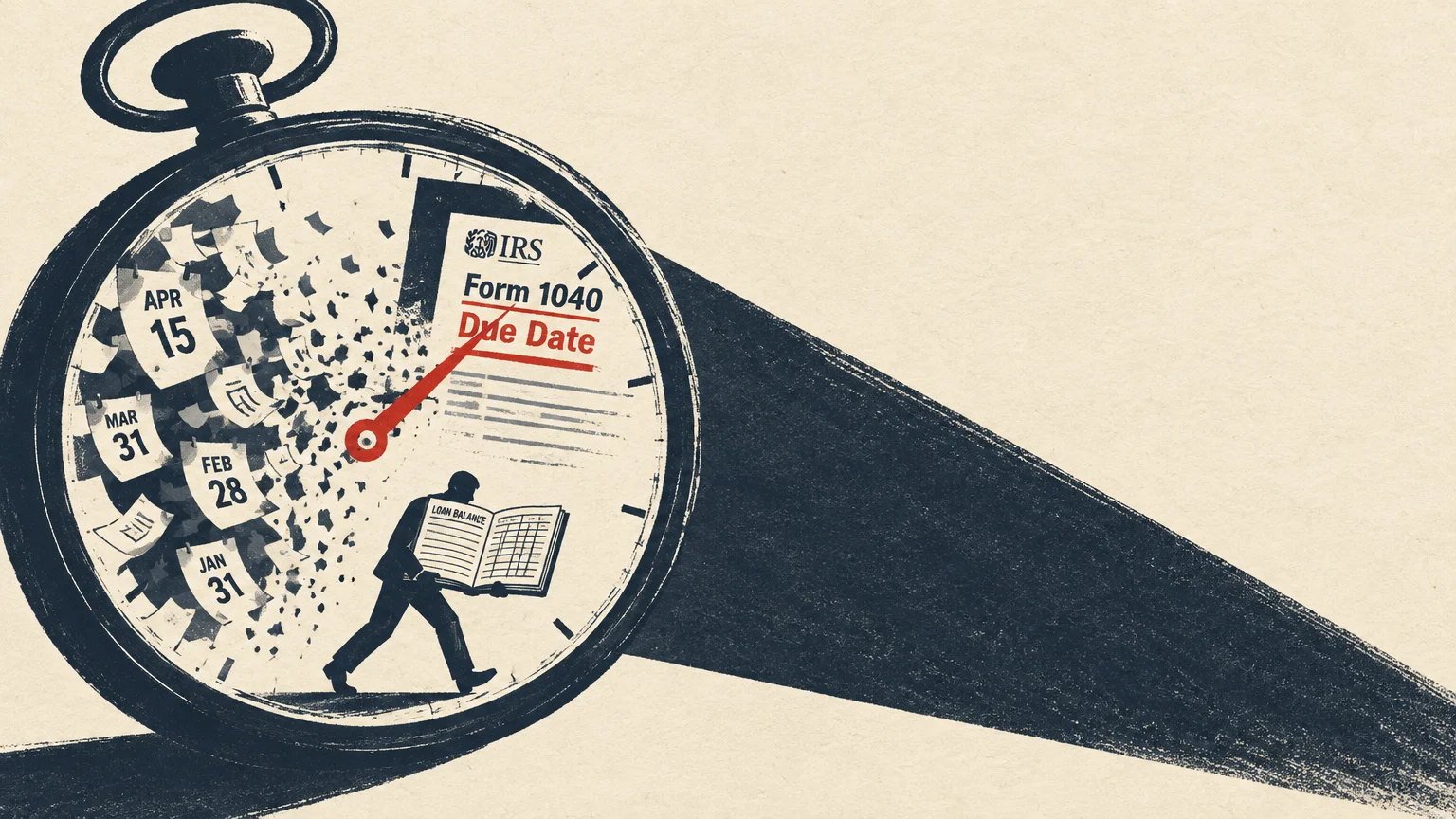
Leaving a job with an outstanding retirement loan creates an urgent financial deadline. When your employment terminates, the plan administrator will demand the remaining balance, turning any unpaid sum into a “plan loan offset.”
Under previous rules, employees had only 60 days to repay the balance or suffer steep taxes. Fortunately, the Tax Cuts and Jobs Act extended this window significantly to relieve pressure on departing employees.
You now have until the federal tax filing deadline, including extensions, for the year your employment ended to replace the loan balance. You can review debt and borrowing rules on Consumer Financial Protection Bureau resources.
If you fail to deposit the equivalent cash amount into an eligible IRA or your new 401(k), the IRS treats the offset as taxable ordinary income. For workers under 59½ who do not qualify for an exemption, a 10% penalty also applies.
If you cannot repay the full loan offset, pay back as much as possible before filing your tax return. Any portion you replace reduces the taxable distribution and limits your exposure to potential income tax brackets.
7. You May Forfeit Valuable Net Unrealized Appreciation (NUA)
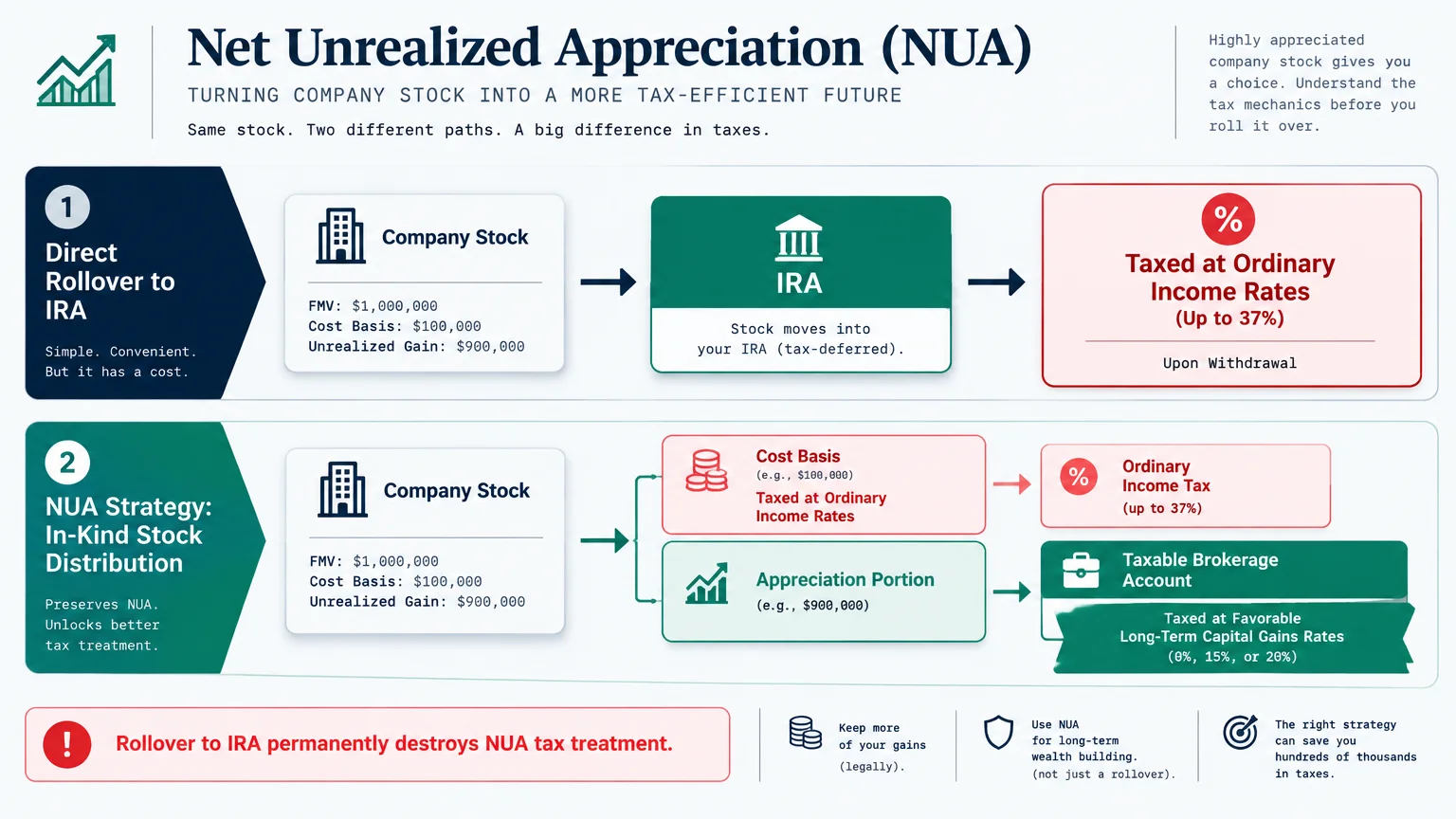
If you accumulated substantial shares of company stock in your old 401(k), leaving your job creates a unique tax planning opportunity. The IRS permits special tax treatment for company stock known as Net Unrealized Appreciation (NUA).
Under NUA rules, you transfer the company shares to a taxable brokerage account instead of an IRA. You pay ordinary income tax solely on the cost basis—the price your plan paid when buying the shares.
Any growth above that basis receives favorable long-term capital gains tax treatment when sold, regardless of how long you hold the distributed shares. Long-term capital gains tax rates remain significantly lower than standard federal income tax brackets.
Rolling that company stock directly into an IRA permanently destroys your NUA eligibility. Once the shares land in an IRA, all future distributions get taxed as ordinary income at ordinary rates.
Evaluating an NUA strategy requires weighing the immediate tax bill on the basis against long-term capital gains tax savings. A financial professional can calculate your cost basis to verify whether this strategy produces meaningful savings.
8. Indirect Rollovers Expose You to a 20% Mandatory Tax Trap
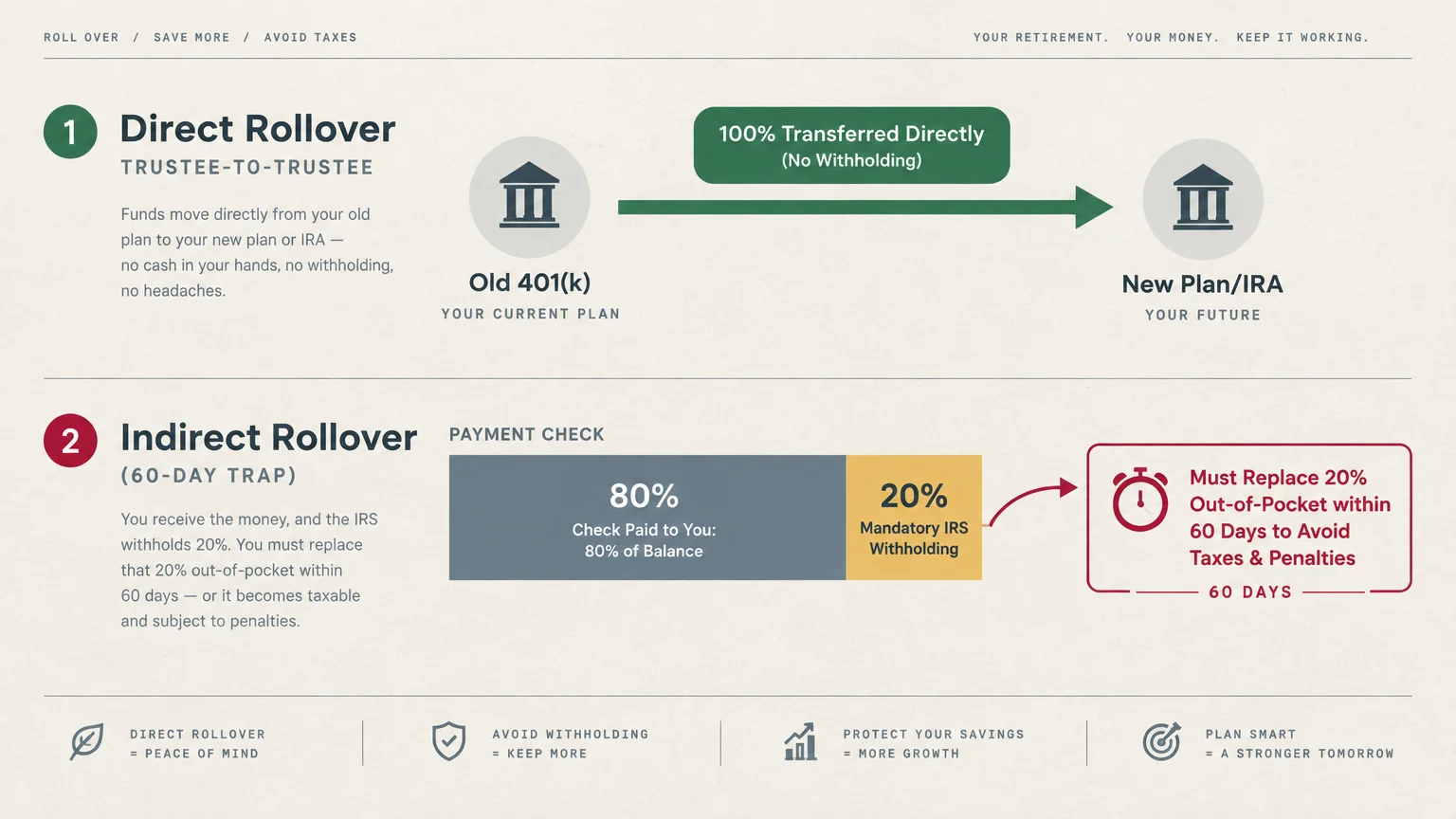
Moving your nest egg requires selecting the correct rollover procedure to prevent unnecessary tax erosion. When rolling over savings, you must choose between a direct trustee-to-trustee transfer and an indirect rollover.
In an indirect rollover, your former administrator writes a check made payable directly to your name. By federal law, the plan sponsor must withhold 20% of your account balance for federal income taxes immediately.
You must deposit 100% of the original distribution into a new qualified retirement account within 60 days. To complete the transfer, you must replace that withheld 20% out of your own personal savings.
If you cannot replace the withheld cash, the IRS treats that 20% as a taxable distribution. Always request a direct trustee-to-trustee rollover, where funds move electronically between custodians without triggering withholding rules.
Request that your former custodian write the rollover check directly to your new account custodian for your benefit. This simple formatting step eliminates the mandatory 20% tax withholding and protects your retirement savings from accidental taxes.
“The biggest mistake people make with rollovers is moving money too quickly without knowing the tax rules. Once a rollover is done, you cannot undo it.” — Ed Slott, CPA and IRA Expert
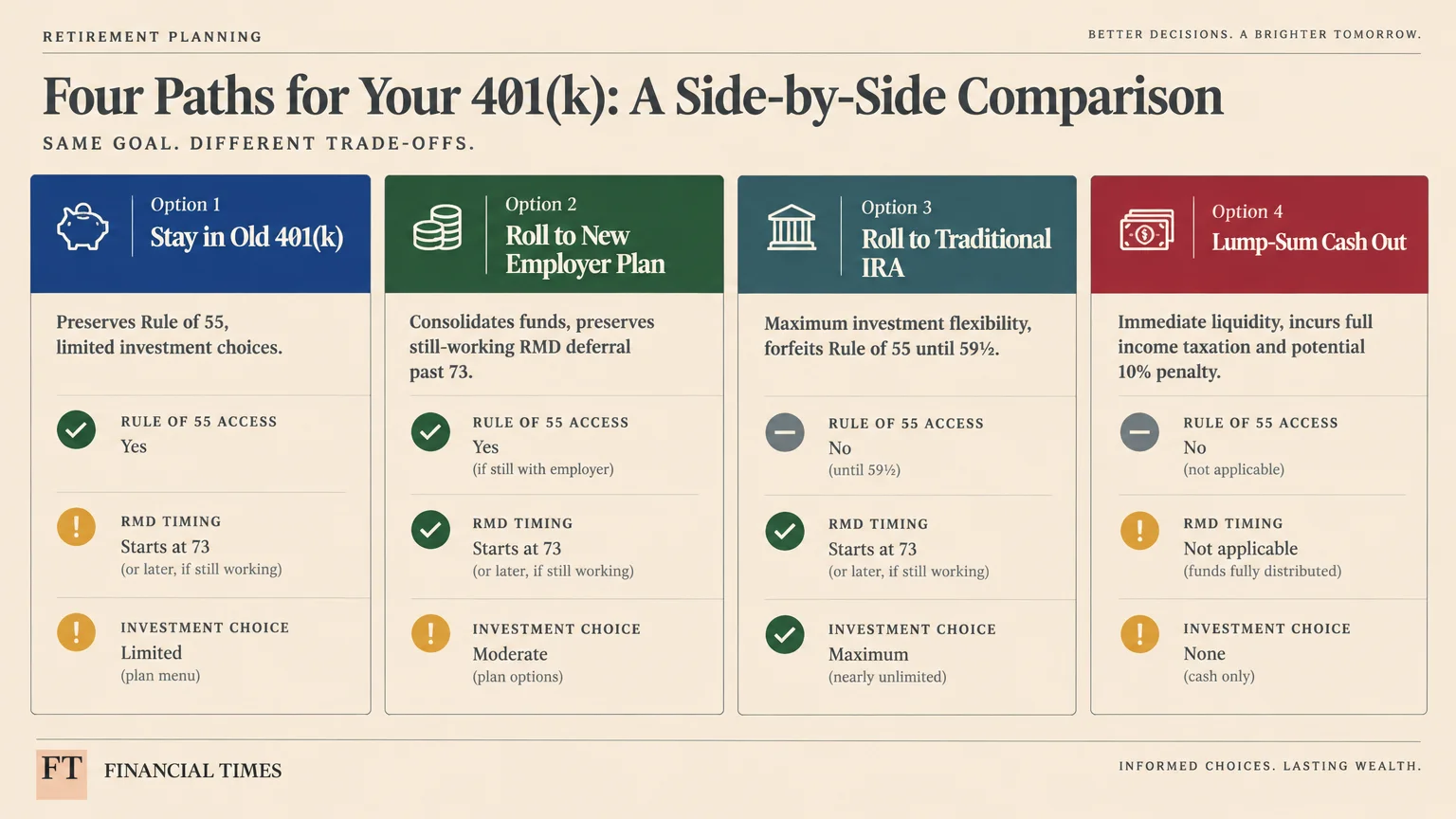
Comparing Your 4 Late-Career 401(k) Options
Deciding what to do with your former retirement account involves weighing tax consequences, withdrawal flexibility, and administrative fees. Reviewing these pathways side-by-side helps clarify which move aligns with your upcoming retirement date.
| Transfer Strategy | Penalty-Free Access (Ages 55–59½) | RMD Delay After Age 73 | Investment Variety | Best Suited For |
|---|---|---|---|---|
| Leave in Former 401(k) | Preserves Rule of 55 exemption | No; RMDs mandatory at 73 | Limited to former employer’s menu | Retiring before age 59½ with low plan fees |
| Roll to New 401(k) | Subject to new employer separation rules | Yes; still-working exception applies | Limited to new employer’s menu | Consolidating accounts and working past 73 |
| Roll to Traditional IRA | No; 10% penalty applies until 59½ | No; RMDs mandatory at 73 | Extensive stocks, bonds, and mutual funds | Ages 59½ and older seeking broad investment choice |
| Lump-Sum Cash Out | Not applicable; triggers income taxes | Not applicable; balance emptied | None; funds enter taxable bank account | Rarely recommended due to immediate tax penalties |
Comparing these options thoroughly helps you avoid unexpected tax bills during an already demanding career transition. Explore additional investment education guides at Investor.gov to support your long-term wealth strategy.
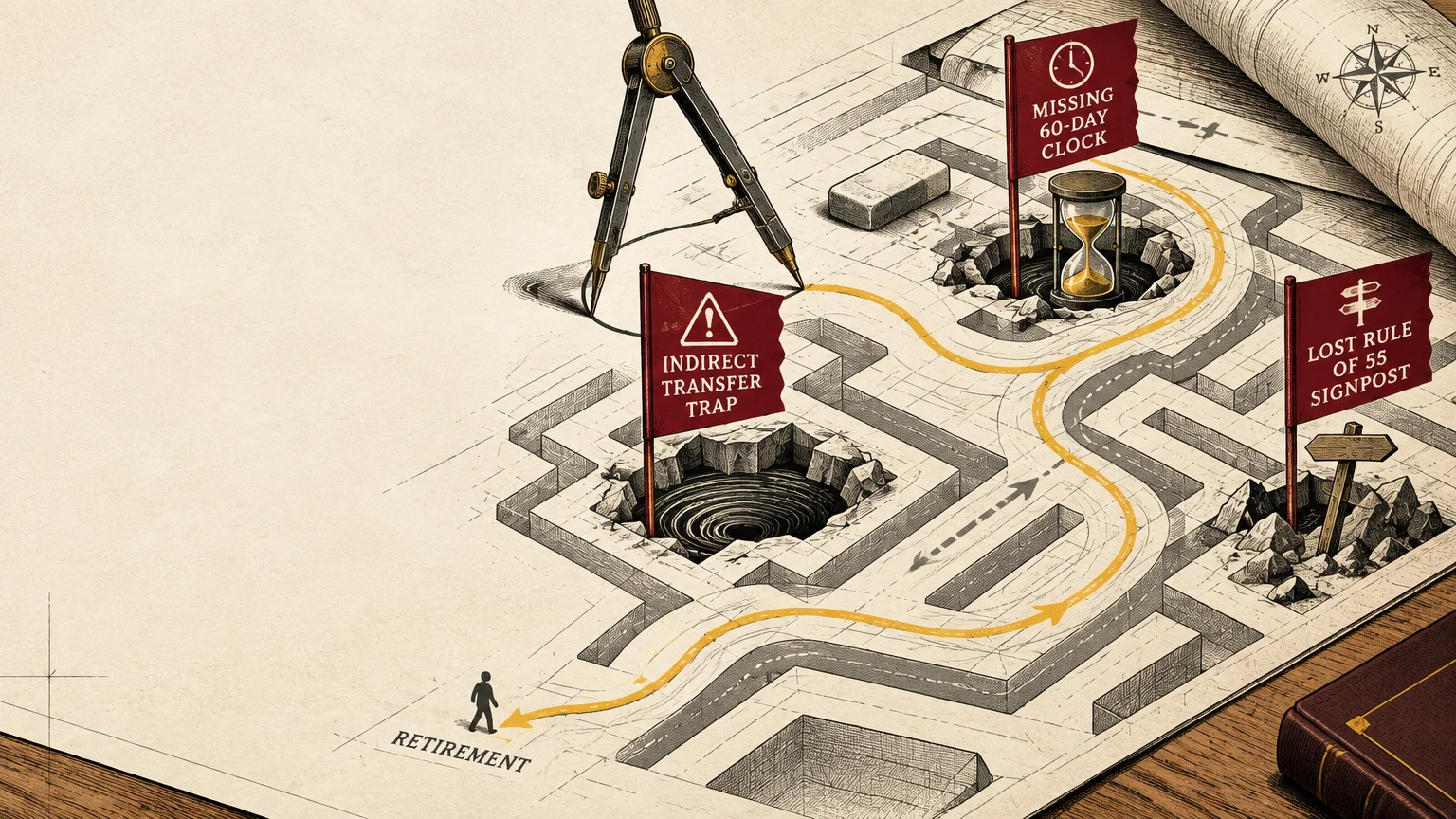
Costly Errors to Sidestep
Late-career financial missteps carry permanent consequences because you have fewer working years left to rebuild lost savings. Avoiding these critical errors protects your accumulated wealth and preserves your retirement flexibility.
- Forgetting the Rule of 55 advantage: Rolling funds out of your old plan before age 59½ locks up money you could have withdrawn completely penalty-free.
- Rolling over company stock prematurely: Transferring appreciated employer shares directly into an IRA destroys NUA treatment and converts lower capital gains rates into higher ordinary income tax.
- Falling into the 60-day indirect rollover trap: Taking a check made out to your name triggers 20% mandatory tax withholding that you must replace out-of-pocket.
- Ignoring new vesting schedules: Leaving a company before meeting matching vesting milestones forces you to surrender valuable employer contributions.
Protecting your assets from these avoidable missteps ensures you keep more of your hard-earned wealth intact. You can review rollover protections and standards through FINRA Investor Education resources.

When DIY Isn’t Enough
While managing a 401(k) rollover seems straightforward, late-career job changes often present complex tax scenarios. Self-managing your transition makes sense in basic cases, but specific financial circumstances demand professional expertise.
You should seek professional guidance if you hold highly appreciated company stock inside your retirement plan. Calculating the net unrealized appreciation and determining whether to utilize an NUA distribution requires careful tax analysis.
Consult a certified financial planner if you plan to retire before age 59½ and need penalty-free cash flow. A specialist helps coordinate your Rule of 55 distributions alongside private brokerage withdrawals to optimize your tax bracket.
High earners earning more than $150,000 should consult a tax professional regarding mandatory Roth catch-up contributions starting in 2026. Structuring your deferred compensation correctly prevents unexpected payroll withholding surprises.
Finally, seek guidance if you coordinate retirement accounts alongside Social Security planning and Medicare premium thresholds. Extra taxable income from rollovers can inadvertently elevate your Medicare Part B and Part D premiums through IRMAA surcharges.
Frequently Asked Questions
Can I roll my old 401(k) into my new employer’s plan right away?
Most employer plans accept rollover contributions from former qualified accounts immediately upon hiring. However, you must verify your new employer’s plan document, as companies are not legally required to accept incoming rollovers.
What happens if I forget about an old 401(k) under $7,000?
Under SECURE 2.0 regulations, your previous employer can automatically transfer balances between $1,000 and $7,000 into a safe-harbor IRA. Balances under $1,000 may be liquidated and mailed to you as a taxable check.
Does changing jobs late in life affect my Social Security benefits?
Changing jobs only affects your Social Security benefit if your earnings replace a lower-earning year in your top 35 years. Check your official earnings record directly at the Social Security Administration website.
Can I borrow money from my old 401(k) after leaving the company?
Federal law prohibits taking new loans from a retirement plan once you separate from that employer. If you require borrowing privileges, you must roll those funds into an active plan that permits participant loans.
Navigating a late-career job transition requires deliberate planning, but taking control of your 401(k) ensures your financial independence remains intact. Review your plan documents, weigh your rollover options, and protect your distribution rights before initiating any transfers.
This is educational content based on general financial principles for seniors. Individual results vary based on your situation. Always verify current benefit amounts, tax rules, and program eligibility with official government sources.
Last updated: February 2026. Benefit amounts, tax rules, and program details change annually—verify current figures with official government sources.









Leave a Reply