

Receiving a pension buyout offer forces a critical fork in your retirement journey. You must weigh the certainty of guaranteed monthly checks against the flexibility of a single upfront payment.
Taking a payout hands you total control over your investments, but it also transfers market and longevity risks onto your shoulders. A hasty choice can permanently drain your retirement security.
Walking through eight crucial questions before signing any paperwork protects your nest egg from costly tax blunders. These practical checkpoints ensure your final choice supports your lifelong financial needs.

1. What Monthly Income Are You Giving Up for Life?
Your pension buyout offer replaces a predictable monthly paycheck. Before you accept a lump sum, calculate the exact lifetime cash flow you are walking away from.
A defined benefit pension provides steady income regardless of stock market downturns or economic recessions. That monthly check continues whether the broader economy booms or stalls.
Look closely at your pension benefit election form. Your plan administrator typically presents two primary choices: a single-life annuity or a joint-and-survivor annuity.
A single-life annuity pays a higher monthly benefit that ceases entirely upon your death. In contrast, a joint-and-survivor annuity reduces your monthly amount to provide continuing income for a surviving spouse.
Calculate your basic living expenses before deciding. Tally up your essential monthly obligations, including housing, utilities, groceries, and supplemental health insurance premiums.
If your Social Security benefit and your monthly pension combined cover these essential costs, your retirement foundation remains sturdy. Surrendering that guaranteed floor forces you to generate equivalent monthly cash flow from personal investments.
2. How Does Current Interest Rate Math Affect Your Offer?
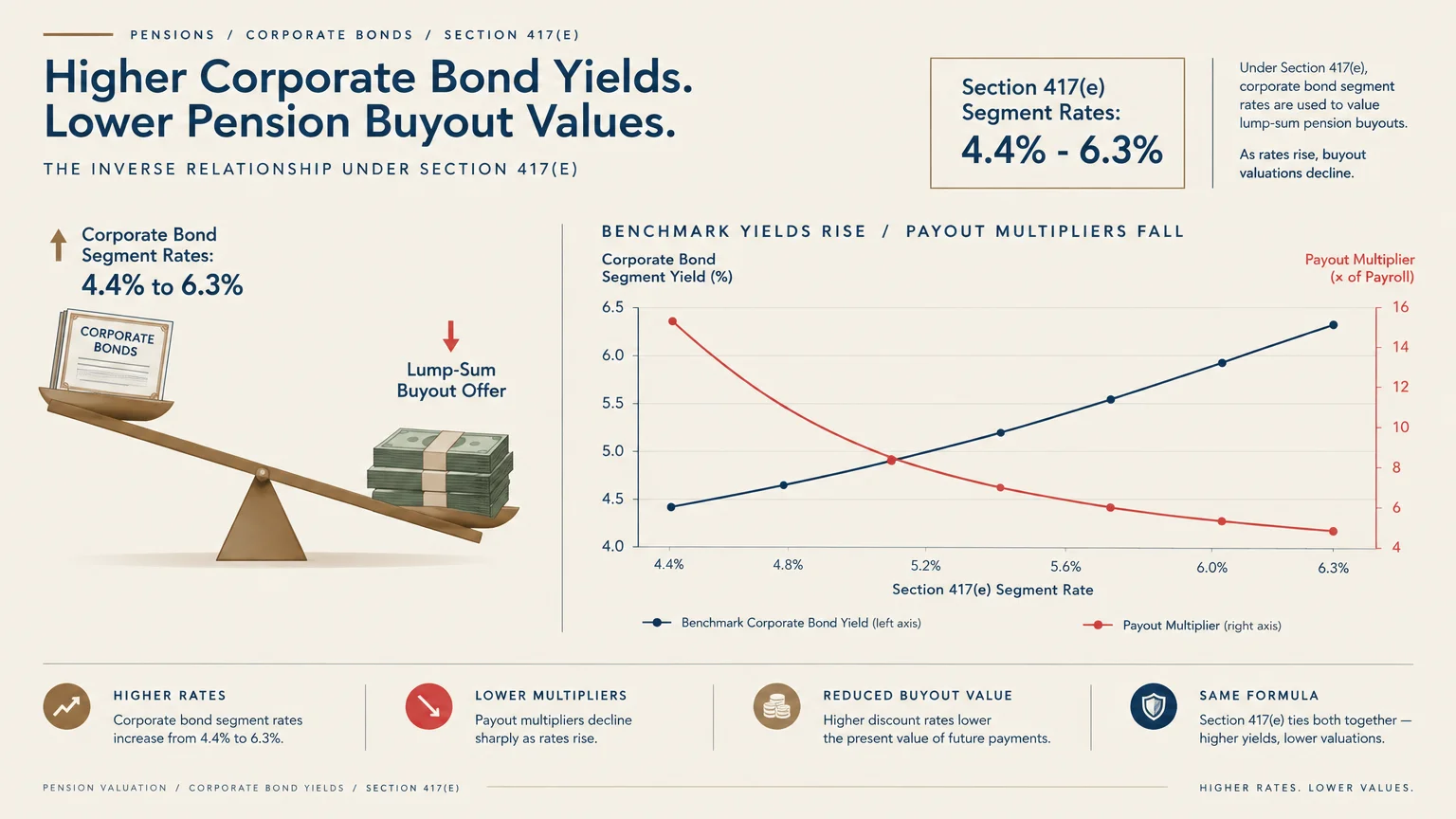
Federal law dictates how plan administrators calculate lump-sum buyout offers. Under Section 417(e) of the Internal Revenue Code, employers must calculate lump sums using specific corporate bond segment rates.
This formula creates an inverse relationship between interest rates and pension lump sums. When market interest rates rise, lump-sum values drop significantly.
Conversely, when benchmark interest rates fall, lump-sum offers rise. Pension plans calculate payouts based on how much cash they must hand you today to generate your promised lifetime annuity.
When high-grade corporate bond yields sit higher, a smaller upfront cash balance can theoretically generate that monthly income stream. In 2026, corporate bond segment rates have hovered between 4.4% and 6.3% across short-, intermediate-, and long-term maturities.
These prevailing rates mean today’s lump-sum offers are noticeably smaller than those offered during the historic low-rate era of recent years. You receive fewer upfront dollars today for the exact same promised monthly check.
Request the specific calculation date and segment rates your plan administrator used for your buyout offer. Reviewing these figures helps you determine whether timing or market yield shifts depressed your cash payout.

3. Can You Realistically Match This Return in the Market?
Taking a cash buyout assumes you can invest those funds and generate superior lifetime returns. However, achieving dependable growth while avoiding steep portfolio drawdowns requires discipline and skill.
Calculate the implied rate of return your pension annuity offers. Divide your annual pension payment by the total lump-sum cash offer to find your baseline hurdle rate.
If your pension promises $30,000 annually and your buyout offer is $400,000, your starting payout rate is 7.5%. Generating an equivalent 7.5% cash distribution from a private portfolio without risking your principal is exceptionally difficult.
Managing your own investments exposes you to sequence-of-returns risk during your early retirement years. Experiencing an extended market downturn right after you retire can decimate your portfolio balance permanently.
When you draw money from a declining portfolio to cover daily bills, you lock in losses and deplete capital. A defined benefit pension absorbs that market volatility entirely on your behalf.
You can research historical portfolio drawdown rates and safe withdrawal strategies through Investor.gov. Compare those conservative withdrawal models against your plan’s guaranteed annuity rate before making an irreversible choice.

4. What Does Your Health and Family Longevity Look Like?
Pension plans calculate lump-sum distributions using standardized unisex mortality tables published by the Internal Revenue Service. These tables assume an average life expectancy for all participants of your age.
Your actual lifespan may differ dramatically from general actuarial tables. Your personal health status and family medical history must guide your decision.
If your parents and grandparents lived well into their nineties, your chances of a long retirement remain high. A lifetime monthly annuity protects you against outliving your savings, functioning as longevity insurance.
Outliving your assets represents one of the greatest financial hazards facing seniors today. The longer you live, the more total money your monthly pension delivers.
Conversely, facing a serious, life-limiting medical diagnosis can change your calculation entirely. If your life expectancy is truncated, taking a lump sum allows you to use those assets immediately or pass them to your heirs.
Annuities generally end when you or your surviving spouse pass away, leaving nothing behind for children or grandchildren. A lump-sum rollover lets unspent balances transfer directly to designated beneficiaries.
“When you take a lump sum, you take on all the investment risk, all the longevity risk, and all the tax management.” — Ed Slott, CPA and Retirement Distribution Specialist

5. How Will Your Decision Affect Your Surviving Spouse?
Your pension decision rarely affects just you. For married retirees, federal law establishes clear protections under the Employee Retirement Income Security Act (ERISA).
Private-sector defined benefit plans legally default to a Qualified Joint and Survivor Annuity (QJSA). This structure ensures that your surviving spouse continues receiving monthly income after your death.
To take a lump sum instead, your spouse must sign a formal, notarized waiver surrendering their survivor rights. Never treat this requirement as a mere administrative formality.
Women statistically outlive men by several years, making survivor income an urgent concern. Eliminating a lifetime pension could leave a surviving spouse vulnerable if the lump sum is drained by market losses or medical expenses.
Examine how your household income shifts when the first spouse passes away. Remember that the surviving spouse also loses the smaller of your two Social Security checks.
If you choose a lump sum, you must establish a clear plan for your surviving spouse’s ongoing support. That strategy might involve earmarking specific investment accounts or maintaining dedicated life insurance coverage.
6. How Solid Is Your Former Employer’s Pension Plan?
Relying on a monthly check for thirty years requires faith in your pension sponsor’s long-term financial health. Corporate distress can jeopardize underfunded plans.
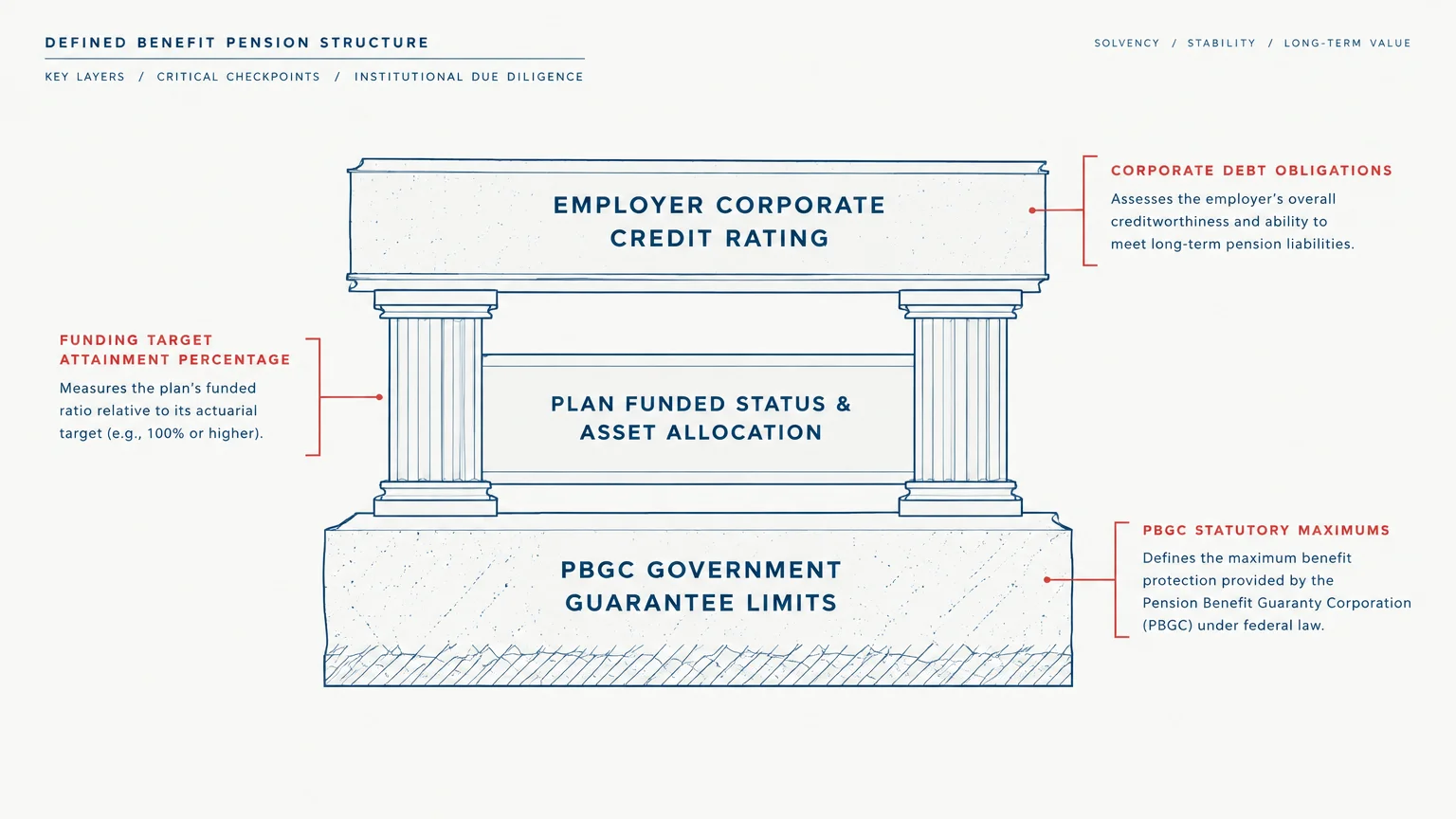
Review the Annual Funding Notice sent by your pension administrator each year. This document outlines your plan’s Adjusted Funding Target Attainment Percentage (AFTAP).
Under Section 436 of the Internal Revenue Code, plans funded below 80% face legal restrictions on paying full lump sums. If a plan’s funding level falls between 60% and 80%, administrators can generally pay only up to 50% of your lump sum.
Plans that fall below 60% funded status cannot legally pay lump sums at all. If your plan exhibits severe underfunding, electing a lump sum while it remains available may shield you from corporate decline.
However, private defined benefit plans enjoy backing from the Pension Benefit Guaranty Corporation (PBGC). The PBGC single-employer program insures retirement benefits for approximately 30 million American workers across roughly 23,500 plans.
The PBGC single-employer insurance fund remains financially robust, maintaining a surplus of $62.2 billion. If a covered employer enters bankruptcy, the PBGC steps in to pay benefits up to statutory limits.
For plans terminating in 2026, the maximum PBGC guarantee for a 65-year-old taking a straight-life annuity is $7,789.77 per month ($93,477.24 annually). For a joint-and-50% survivor annuity at age 65, the guarantee caps at $7,010.79 per month.
If your promised monthly benefit falls well below these federal caps, PBGC guarantees protect your payments even if your employer fails. However, public-sector municipal pensions and church plans lack PBGC coverage, requiring independent evaluation of their solvency.
7. What Are the Immediate and Long-Term Tax Consequences?
Tax treatment can make or break the value of your pension buyout. Taking a cash distribution paid directly to your checking account triggers an immediate tax disaster.
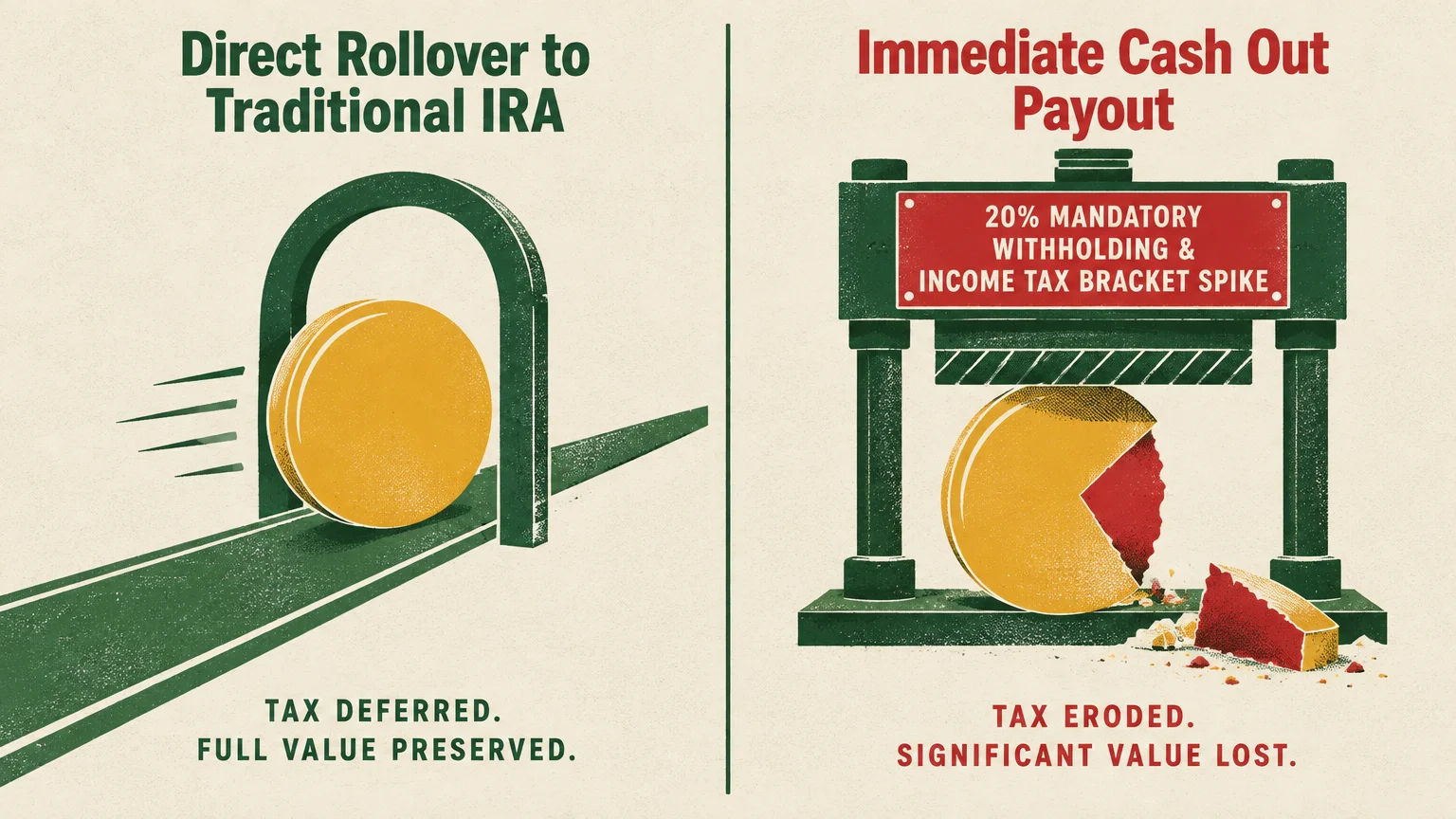
If your plan administrator issues a check directly to you, the IRS mandates an automatic 20% federal tax withholding. Furthermore, the entire taxable distribution counts as ordinary income in the year you receive it.
A $300,000 cash distribution can push you into the highest federal and state tax brackets overnight. That single transaction could consume a massive portion of your hard-earned wealth.
To avoid immediate taxation, execute a direct trustee-to-trustee rollover into a traditional Individual Retirement Account (IRA). A direct rollover moves funds straight between institutions without triggering withholding or immediate taxes.
If you receive the funds personally, you face a strict 60-day window to deposit the entire distribution into a qualified account. You must also replace that 20% withheld tax out of pocket, or the IRS treats it as a taxable distribution.
Review early withdrawal penalties if you leave your company before traditional retirement age. Distributions taken before age 59½ generally incur a 10% IRS early withdrawal penalty alongside ordinary income taxes.
However, the federal Rule of 55 offers relief for qualified employer plans. If you separate from service during or after the calendar year you turn 55, you can take distributions directly from that employer’s plan penalty-free.
Rolling those funds into an IRA forfeits your Rule of 55 exemption. Once inside an IRA, you must wait until age 59½ to access funds without the 10% penalty.
Consider future tax obligations as well. Under the SECURE 2.0 Act, you must begin taking Required Minimum Distributions (RMDs) from traditional IRAs at age 73.
That RMD age increases to 75 in 2033. If you fail to withdraw your full RMD, the IRS imposes a 25% penalty on the shortfall, reduced to 10% if corrected promptly.
Under Section 415(b) of the Internal Revenue Code, the maximum annual benefit payable by a defined benefit plan in 2026 is capped at $290,000. Review the detailed rollover guidance published by the Consumer Financial Protection Bureau to avoid costly structural errors.

8. Do You Have the Discipline to Manage a Large Windfall?
Holding several hundred thousand dollars in an investment account feels empowering. Yet managing a large balance requires emotional discipline and long-term budgeting restraint.
A lifetime monthly pension removes human temptation and spending errors from your everyday finances. The check arrives automatically on the first of each month, regardless of your personal habits.
A lump-sum payout presents constant temptation to overspend during early retirement. Retirees often spend down windfalls on family loans, home renovations, or expensive vacations, depleting their capital prematurely.
Managing a lump sum also invites attention from predatory financial salespeople promoting high-commission products. Retirees frequently encounter aggressive pitches for illiquid, high-fee annuities or speculative investments.
You can verify any financial advisor’s licensing and disciplinary record for free using BrokerCheck through FINRA. Never hand over your pension proceeds without thoroughly researching the professional advising you.
If managing an investment portfolio causes you persistent anxiety, a lump sum may harm your quality of life. The psychological peace of mind provided by guaranteed monthly income carries substantial practical value.
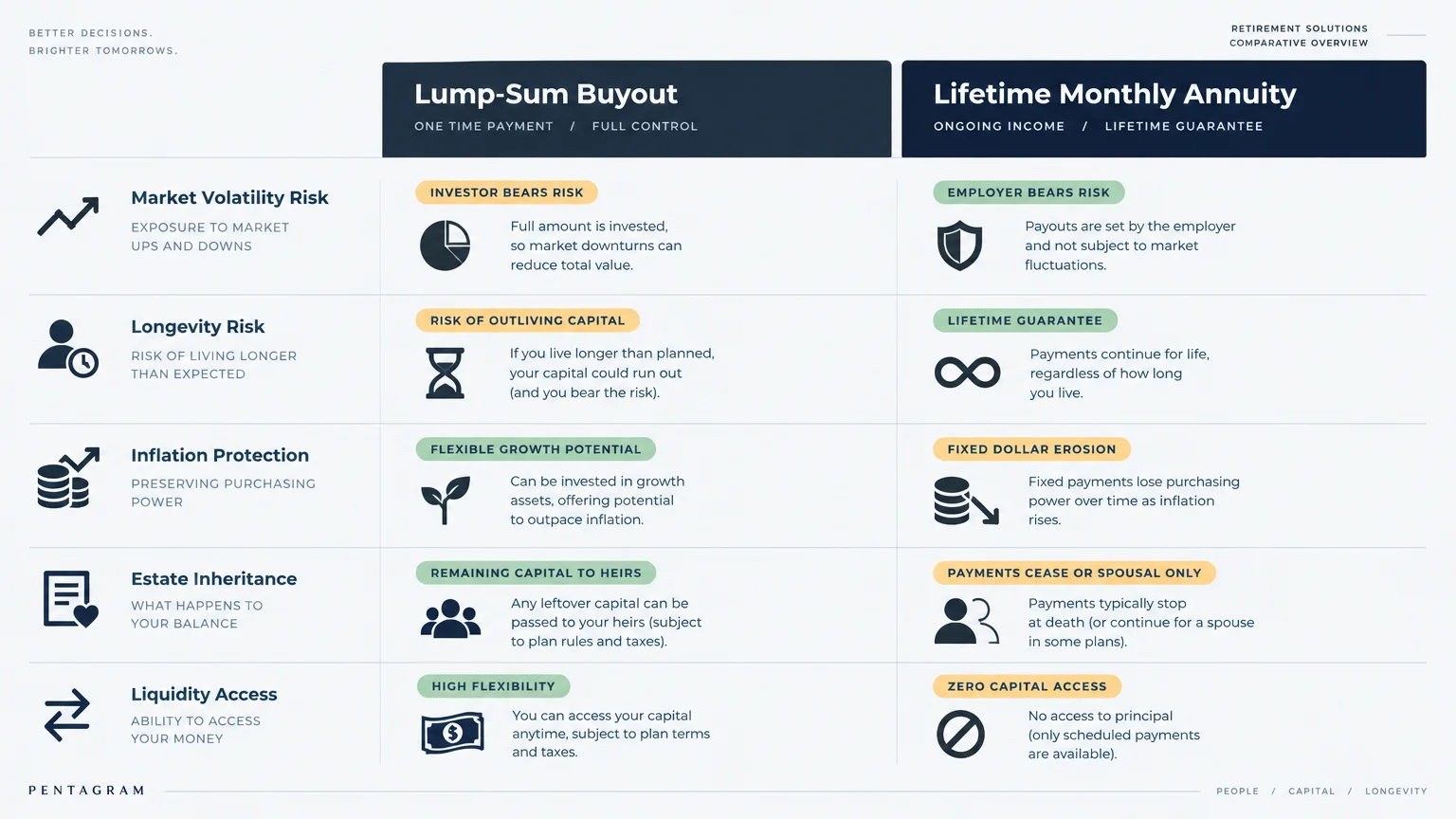
Lump Sum vs. Lifetime Annuity: Key Factors Compared
Deciding between an ongoing annuity and a cash buyout requires balancing multiple competing priorities. Use this comparison table to evaluate how each path handles critical retirement risks.
| Decision Factor | Pension Lump-Sum Rollover | Lifetime Monthly Annuity |
|---|---|---|
| Longevity Risk | You bear the entire risk of outliving your investment portfolio. | Plan sponsor guarantees monthly checks for your entire lifetime. |
| Market Volatility | Portfolio values fluctuate based on prevailing stock and bond performance. | Income remains steady regardless of economic or stock market crashes. |
| Inflation Impact | Investments can potentially grow to help offset rising living expenses. | Fixed payments lose purchasing power over time unless plan offers a COLA. |
| Spousal Protection | Surviving spouse inherits remaining assets directly in qualified accounts. | Requires electing a joint-and-survivor option to continue payments. |
| Estate Legacy | Unspent account balances pass directly to designated family heirs. | Payments end upon the death of the participant and surviving spouse. |
| Creditor & Insolvency Protection | IRAs receive state-level creditor protections that vary across jurisdictions. | Protected by ERISA rules and PBGC guarantees up to federal limits. |
Costly Errors to Sidestep
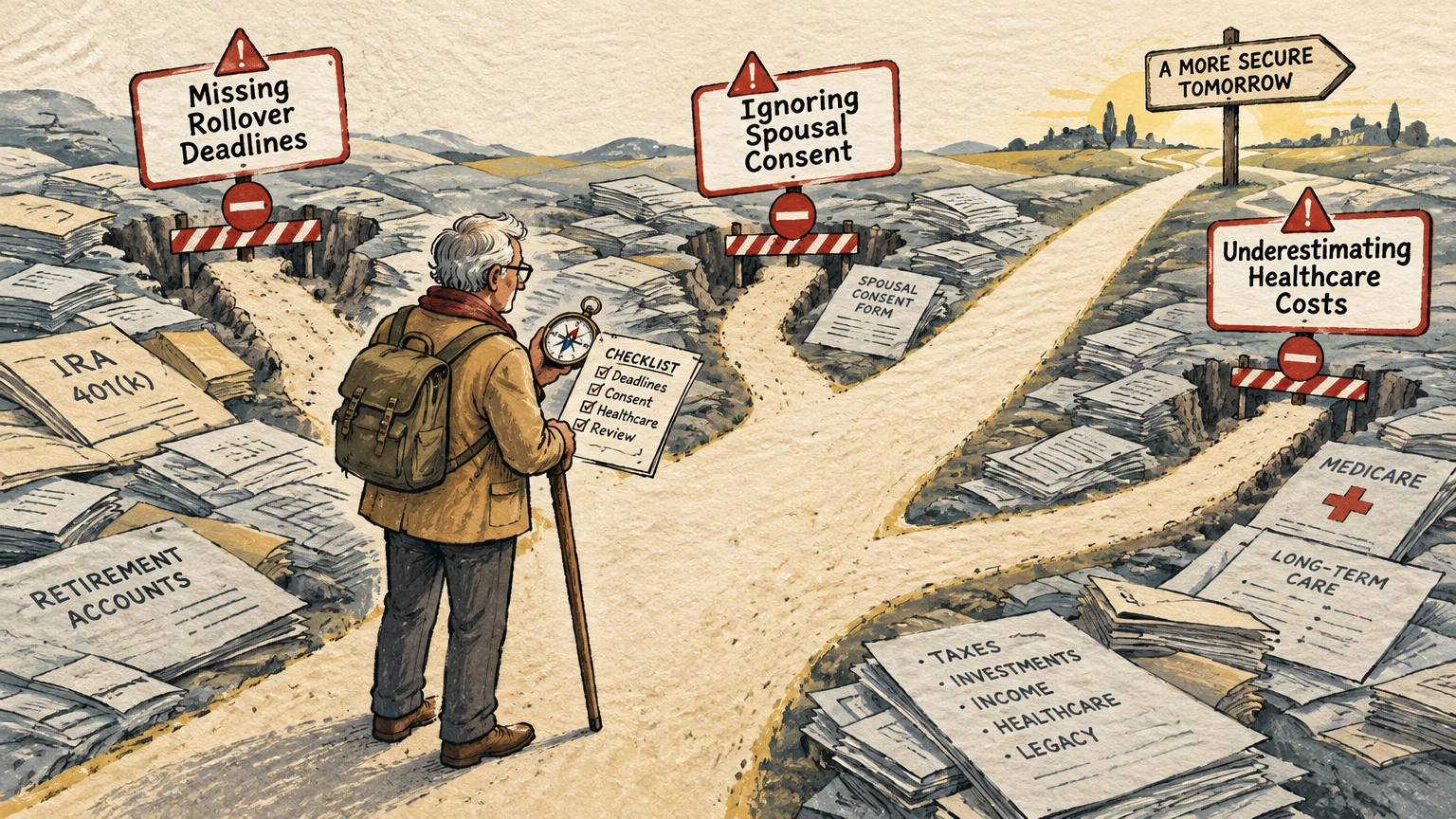
Making a mistake with your pension buyout can create irreparable financial damage. Sidestep these four frequent missteps when evaluating your employer’s offer.
- Taking Cash in Hand Instead of a Direct Rollover: Having your employer issue a check payable to you triggers mandatory 20% federal tax withholding. Always request a direct trustee-to-trustee rollover to preserve your full account balance.
- Forfeiting Rule of 55 Protections Prematurely: Rolling your pension into an IRA after leaving your job at age 55 eliminates penalty-free early access. You lose that early withdrawal privilege until you turn age 59½.
- Overlooking Required Minimum Distributions: Traditional IRA rollovers face mandatory RMD withdrawals starting at age 73. Missing an RMD deadline triggers a stiff 25% tax penalty on the untaken amount.
- Waiving Spousal Rights Without a Contingency Plan: Electing a single-life annuity or taking a lump sum without proper insurance leaves a surviving spouse vulnerable. Ensure adequate assets exist to replace lost income.

When DIY Isn’t Enough
While researching your pension options empowers your decision-making, certain scenarios demand personalized professional guidance. Navigating complex institutional rules alone can lead to expensive oversights.
Seek advice from a fee-only fiduciary financial advisor or CPA under these specific circumstances:
- Your Plan Reports Underfunding: If your employer’s annual funding notice indicates a funding ratio near or below 80%, professional analysis helps assess insolvency exposure.
- You Face Significant Tax Bracket Shifts: When a buyout interacts with deferred compensation, Social Security, or rental income, careful tax modeling prevents bracket creep.
- Health Disparities Between Spouses: If one spouse suffers from chronic health conditions while the other has significant family longevity, customized cash-flow planning is critical.
- Estate Distribution Across Blended Families: Leaving assets to children from a prior marriage while supporting a current spouse requires specialized trust and beneficiary structuring.
Frequently Asked Questions
Can you change your mind after choosing a pension buyout?
No, pension buyout decisions are permanent and irrevocable. Once your paperwork is processed and the distribution occurs, you cannot return the money to restore your monthly pension.
What happens if my former employer goes bankrupt after I choose the annuity?
If your private-sector employer goes bankrupt, the PBGC steps in to pay covered benefits. For 2026, the maximum PBGC guarantee at age 65 covers up to $7,789.77 per month for a straight-life annuity.
Can I roll my pension lump sum directly into a Roth IRA?
Yes, you can roll your pension directly into a Roth IRA through a taxable Roth conversion. However, you must pay ordinary income tax on the entire converted amount in the year of the transfer.
Does a monthly pension offer protection against inflation?
Most private-sector pensions do not include Cost-of-Living Adjustments (COLAs), meaning payments remain flat over time. Over a twenty-year retirement, inflation can significantly erode the purchasing power of a fixed monthly check.
Taking Your Next Steps
Your pension decision will influence your financial freedom and cash flow for decades. Treat your buyout election packet with the attention and diligence your years of service deserve.
Request formal benefit estimates from your HR department showing both single-life and joint-and-survivor monthly payout options. Compare those figures directly against your lump-sum buyout value using current interest rate benchmarks.
The information in this guide is meant for educational purposes. Your specific circumstances—including income, benefits, tax situation, and health needs—may require different approaches. When in doubt, consult a licensed financial advisor or tax professional.
Last updated: October 2026. Benefit amounts, tax rules, and program details change annually—verify current figures with official government sources.








Leave a Reply