

Deciding when to claim Social Security as a couple can alter your combined lifetime retirement income by tens of thousands of dollars. Coordinating your filing strategies allows you to secure higher survivor payments and lower your tax burdens.
Many couples mistakenly treat their benefits as separate accounts rather than viewing them as a joint financial foundation. Making coordinated decisions before either spouse files ensures you do not leave guaranteed monthly income behind.
Here are the eight essential Social Security choices you and your spouse should discuss together to protect your shared financial future.
1. Coordinating Your Full Retirement Ages and Filing Timelines
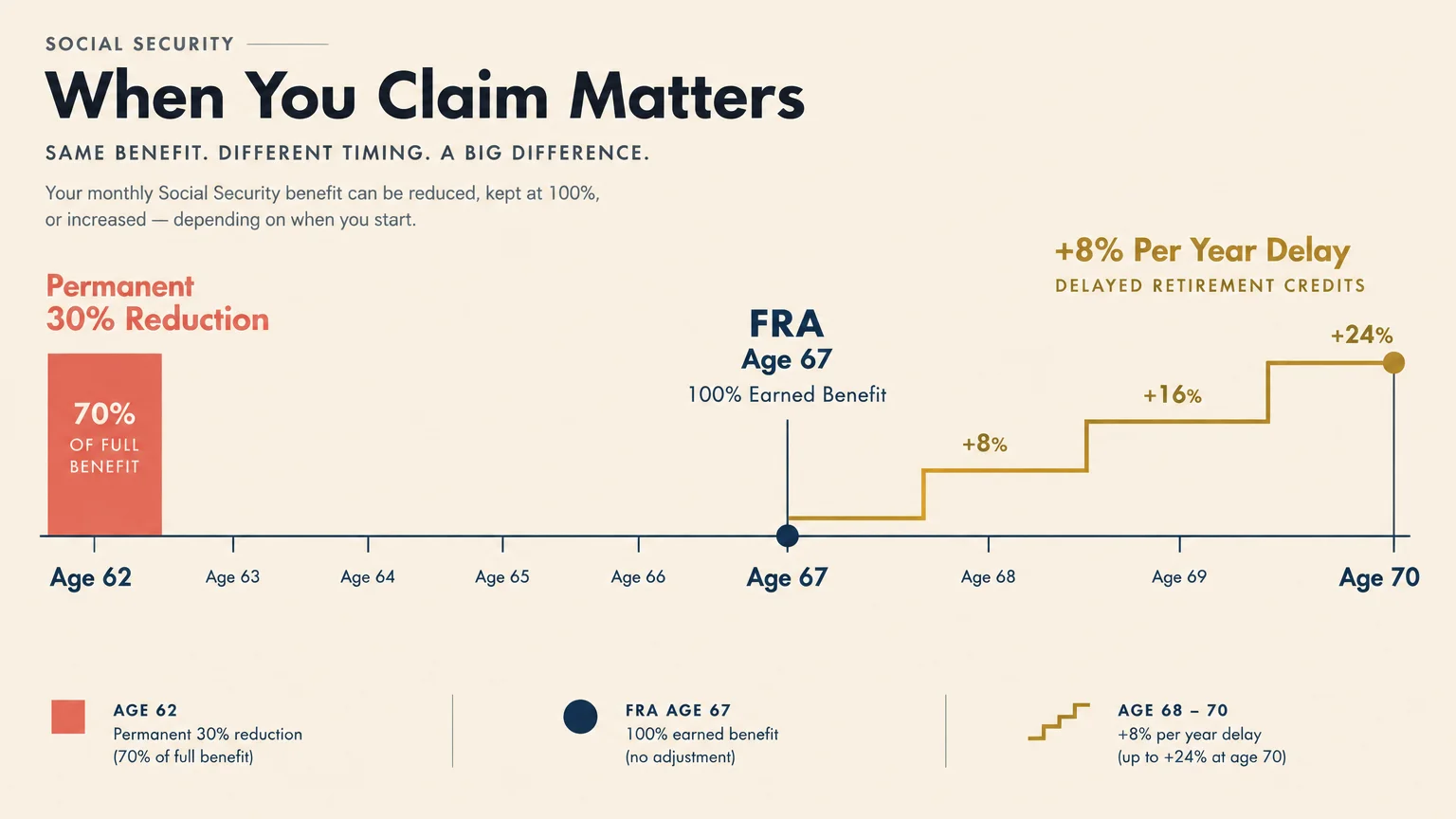
Your Full Retirement Age (FRA) determines when you can collect 100% of your earned retirement benefit. For anyone born in 1960 or later, your FRA is 67, while workers born in 1959 reach FRA at 66 years and 10 months.
You can claim benefits as early as age 62; however, doing so permanently reduces your monthly check. Filing at age 62 when your FRA is 67 results in a permanent 30% reduction.
Conversely, waiting past your FRA earns you delayed retirement credits. Your benefit grows by 8% per year for every year you delay until age 70.
Couples must evaluate how their respective ages align. If you and your spouse are several years apart, your claiming timelines will naturally stagger.
Filing at different times often creates the most effective balance between immediate income and long-term security. Sit down with your spouse to verify your official FRAs using the Social Security Administration (SSA) benefit tables.
2. Maximizing the Higher Earner’s Benefit for Long-Term Protection
In most marriages, one spouse earned significantly more over their career than the other. The higher earner’s claiming age is the single most critical Social Security choice a couple can make.
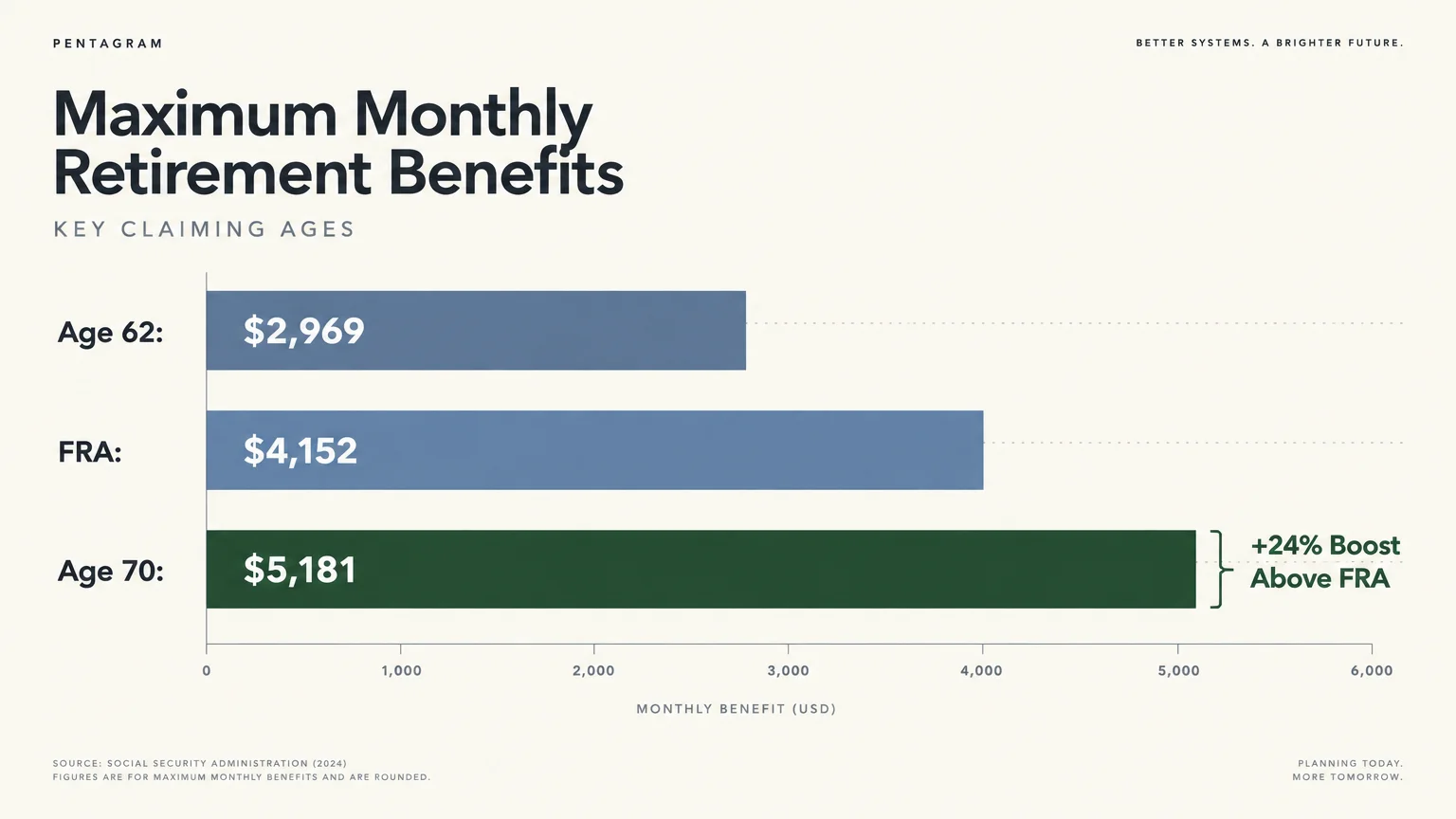
When the higher earner delays claiming until age 70, their monthly payout reaches its absolute maximum. According to the Social Security Administration (2026), the maximum monthly benefit at age 70 is $5,181, compared to $4,152 at FRA and $2,969 at age 62.
This 24% boost above FRA stays with the higher earner for life. More importantly, this larger amount eventually serves as the survivor benefit for the remaining spouse.
“Delaying Social Security is the best investment return available in retirement. You cannot match a guaranteed, inflation-protected return anywhere else.” — Suze Orman, Personal Finance Author
If the higher-earning spouse claims early at 62, they permanently lock in a smaller payment for both themselves and their future surviving spouse. Treating the higher earner’s benefit as household insurance pays significant dividends later in retirement.
Discuss whether your household budget allows the higher earner to delay until age 70. Prioritizing this delay provides the largest possible inflation-adjusted income base for your household.
3. Navigating Spousal Benefit Rules and Age Reductions
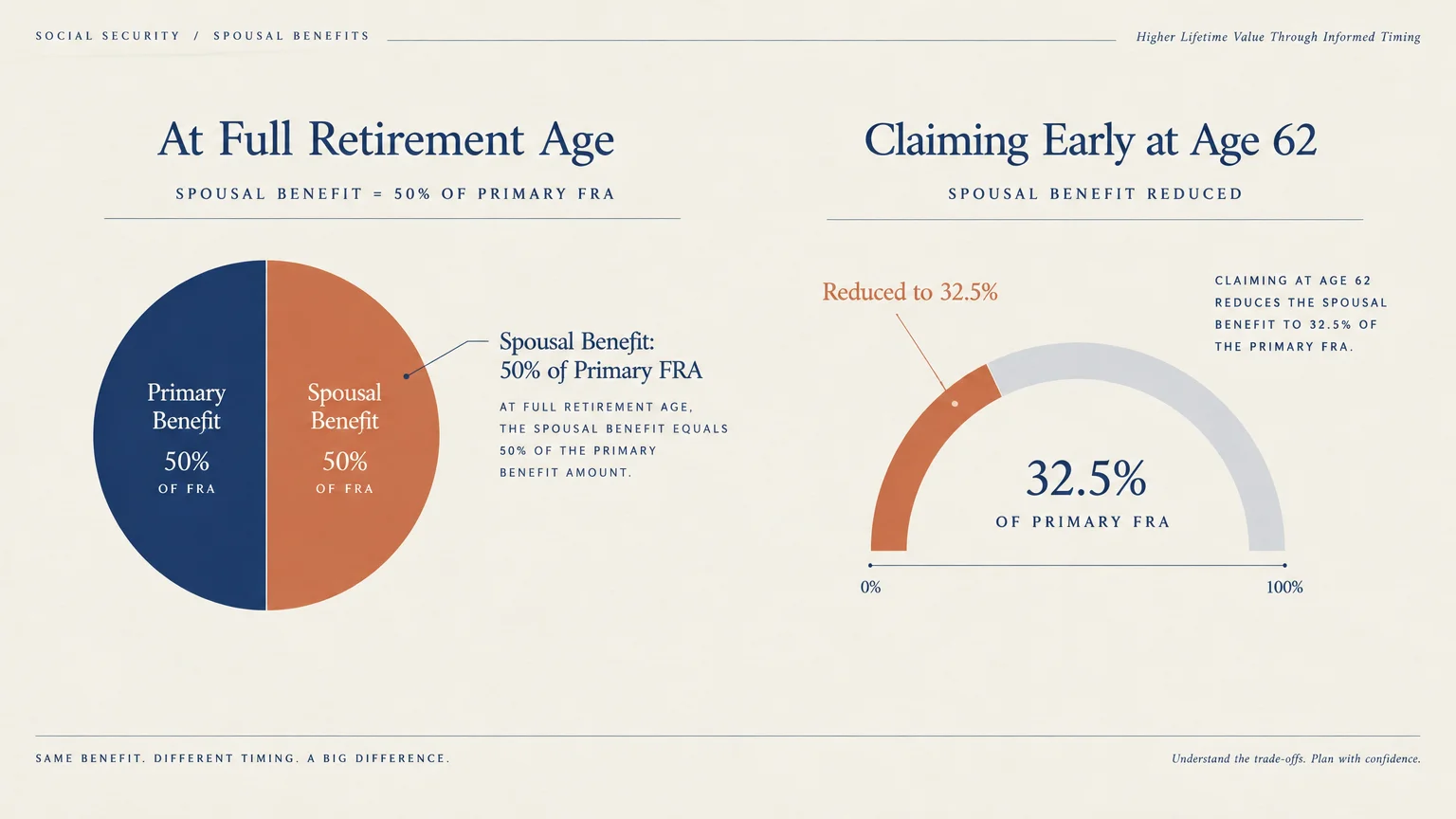
A lower-earning or non-working spouse can claim a spousal benefit based on the primary earner’s work history. At Full Retirement Age, the spousal benefit equals exactly 50% of the primary worker’s Full Retirement Age benefit amount.
The primary worker must file for their own retirement benefits before the secondary spouse can receive spousal payments. You cannot collect a spousal benefit while the primary earner continues to delay their own claim.
If the lower earner files for a spousal benefit before reaching their own FRA, that payout faces permanent reductions. For a spouse with an FRA of 67 who claims at age 62, the spousal benefit drops to 32.5% of the primary earner’s FRA amount.
Unlike regular retirement benefits, spousal benefits do not earn delayed retirement credits. A spousal benefit does not grow beyond your Full Retirement Age.
Waiting past age 67 to claim a spousal benefit leaves money on the table. Lower-earning spouses should claim their spousal benefit as soon as they reach their own Full Retirement Age, provided the primary earner has filed.
Couples must also satisfy the marriage duration rule. Current spouses must remain legally married for at least one continuous year to qualify for spousal benefits.
If you are divorced, you can claim on an ex-spouse’s earnings record if your marriage lasted at least 10 years and you remain unmarried.

4. Planning Ahead for the Survivor Benefit Reality
Few couples realize that when one spouse passes away, one of their two Social Security checks disappears completely. The surviving spouse keeps only the larger of the two monthly payments.
This sudden drop in household income can create severe financial strain if you fail to plan ahead. Household living expenses rarely drop by half when one partner passes away.
A surviving spouse is entitled to up to 100% of the deceased worker’s benefit, including any delayed retirement credits the worker accumulated. Delaying the higher earner’s claim directly protects the surviving spouse against poverty in advanced age.
Surviving spouses can claim reduced survivor benefits as early as age 60, or age 50 if disabled. However, claiming survivor benefits before your own survivor FRA causes a permanent monthly reduction.
Survivor benefits feature a distinct procedural advantage known as benefit switching. Under Social Security rules, “deemed filing” does not apply to survivor claims.
A widow or widower can claim a survivor benefit first while allowing their own retirement benefit to accumulate delayed credits until age 70. Alternatively, a surviving spouse can claim their own smaller benefit early and switch to the maximum survivor benefit at Full Retirement Age.

5. Factoring in Continued Work and the Retirement Earnings Test
Many couples plan to work part-time or consult during their early retirement years. If you claim Social Security before your Full Retirement Age while continuing to work, the Retirement Earnings Test applies.
According to the Social Security Administration (2026), workers under FRA for the entire year forfeit $1 in benefits for every $2 earned above $24,480. In 2027, that threshold increases to $25,560.
In the calendar year you reach your FRA, the rule eases considerably. The SSA withholds $1 for every $3 earned above $65,160 in 2026 ($67,920 in 2027), counting only the earnings before your birthday month.
Once you reach your Full Retirement Age, the earnings cap vanishes completely. You can earn unlimited wages from employment without losing a single dollar of your monthly benefit.
Withheld benefits are not lost forever. When you reach your FRA, the SSA recalculates your monthly check upward to credit you for the payments that were withheld.
Couples should calculate their anticipated employment wages before filing. If your planned job earnings will trigger heavy benefit withholdings, delaying your claim until your earnings drop or you reach FRA makes clear financial sense.
6. Minimizing Federal Income Taxes on Combined Benefits
Social Security benefits are not entirely tax-free for most retirees. The Internal Revenue Service (IRS) taxes your benefits based on your combined household income.
Your combined income equals your Adjusted Gross Income (AGI), plus nontaxable interest, plus half of your annual Social Security benefits. For married couples filing jointly, the tax thresholds have remained fixed since 1984 without adjustments for inflation.
If your joint combined income falls between $32,000 and $44,000, up to 50% of your Social Security benefits become subject to federal income tax. If your joint combined income exceeds $44,000, up to 85% of your benefits are taxable.
“Failing to plan your retirement distributions creates an avoidable tax trap. Coordinated withdrawals from IRAs and Social Security keep you in lower brackets.” — Ed Slott, CPA and Retirement Distribution Specialist
Taking large distributions from traditional 401(k) or IRA accounts pushes more of your Social Security benefits into the taxable category. This compounding effect is often called the retirement “tax torpedo.”
Couples should coordinate the timing of retirement account withdrawals and Social Security checks. You can complete partial Roth conversions in the years before claiming Social Security to lower your future taxable income.

7. Accounting for the Social Security Fairness Act and Public Pensions
Couples with public service careers recently received monumental news that reshaped their retirement landscape. On January 5, 2025, the Social Security Fairness Act was signed into law, retroactive to January 2024.
This landmark legislation permanently repealed both the Windfall Elimination Provision (WEP) and the Government Pension Offset (GPO). Formerly, these rules severely reduced or erased Social Security benefits for public workers receiving non-covered pensions.
Teachers, police officers, firefighters, and federal employees under the Civil Service Retirement System (CSRS) no longer face benefit reductions. If you or your spouse worked in public service, your earned Social Security benefits will now pay out at full value.
Furthermore, the GPO repeal means a public servant can now claim a full spousal or survivor benefit on their spouse’s record. Previous law eliminated two-thirds of that benefit, frequently wiping it out entirely.
If you previously accepted reduced benefits or chose not to apply due to WEP or GPO, review your records immediately. You and your spouse should update your joint income projections to incorporate these restored payments.

8. Bridging the Cash Flow Gap Before Age 70
Delaying the higher earner’s claim until age 70 provides significant financial protection; however, it leaves a multi-year cash flow gap if you retire earlier. Couples must agree on a concrete plan to fund living expenses while waiting for that maximum benefit.
One common solution involves an asymmetric claiming strategy. The lower-earning spouse claims their benefit at 62 or FRA to provide baseline cash flow, while the higher earner delays until 70.
Another option utilizes personal savings, taxable brokerage assets, or traditional retirement accounts to bridge the gap. Spending down personal investments first allows your Social Security asset to compound at a guaranteed 8% annual rate.
This delay is particularly valuable because Social Security benefits receive annual Cost-of-Living Adjustments (COLA). The SSA announced a 2.8% COLA for 2026, followed by a 3.6% COLA for 2027.
Starting with a larger baseline monthly payment means every future percentage-based COLA delivers larger dollar increases to your bank account. According to the SSA, the 2027 COLA increases the average retired worker’s benefit from roughly $2,095 to $2,170 per month.
Evaluate your liquid reserves together to see if you have sufficient non-Social Security assets to bridge the years between work and age 70. Building a designated bridge fund removes the stress of delaying your primary claim.
Comparing Claiming Strategies for Married Couples
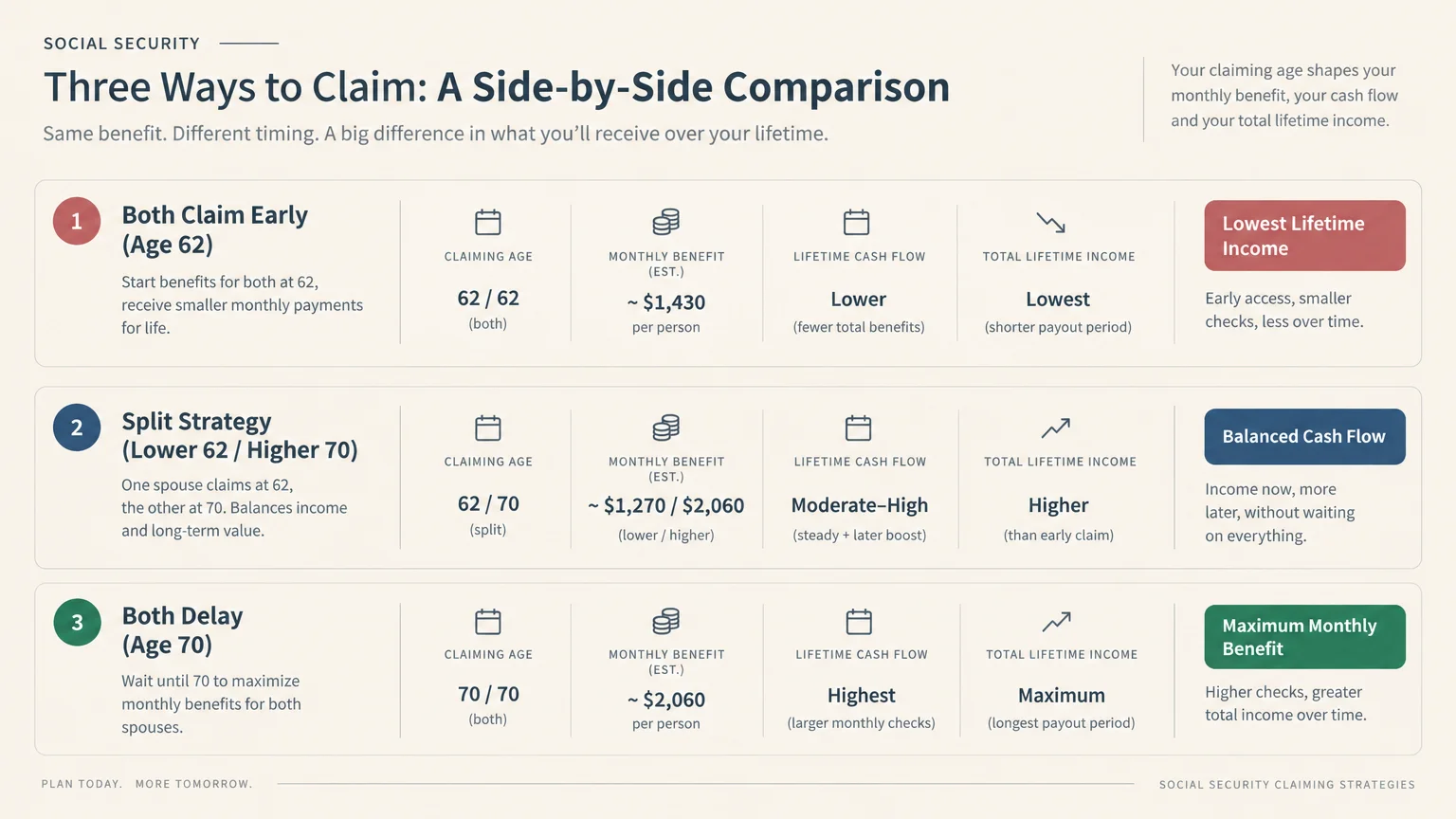
Every couple brings unique ages, health backgrounds, and savings balances to the retirement table. Reviewing how various strategies perform side-by-side helps clarify which path fits your household best.
| Strategy | Primary Earner Claim | Secondary Earner Claim | Survivor Protection | Primary Advantage |
|---|---|---|---|---|
| Both Claim Early | Age 62 | Age 62 | Lowest (30% cut locked in) | Immediate household cash flow |
| Both Claim at FRA | Age 67 | Age 67 | Moderate (100% of PIA) | No early claiming penalties |
| Asymmetric Split | Age 70 | Age 62 to 67 | Maximum (124% of PIA) | Balances early cash with top survivor benefit |
| Both Delay to 70 | Age 70 | Age 70 | Maximum (124% of PIA) | Highest combined monthly checks |
Notice that the asymmetric strategy provides a healthy balance for many couples. It generates early income from the lower earner while preserving the maximum survivor payout from the higher earner.
Use online modeling tools from consumer advocates like the National Council on Aging (NCOA) to evaluate your customized break-even ages together.

What Can Go Wrong: 4 Critical Claiming Traps
Small filing missteps can permanently reduce your monthly retirement checks. Avoid these four common claiming traps that frequently trip up married couples.
- Filing simultaneously at age 62: Claiming benefits early out of habit or convenience locks both partners into a permanent 30% reduction. If the higher earner claims at 62, the household permanently damages the survivor benefit that the surviving spouse will rely on later.
- Delaying spousal benefits past Full Retirement Age: Spousal benefits never earn delayed retirement credits past age 67. Leaving an earned spousal benefit unclaimed after Full Retirement Age forfeits monthly income without increasing the future payout by a single cent.
- Ignoring the tax consequences of retirement withdrawals: Liquidating large amounts from traditional IRAs while receiving Social Security can cause 85% of your benefits to become taxable. Coordinate your retirement distribution timing to prevent moving into higher federal tax brackets.
- Missing survivor switching windows: Surviving spouses often assume they must stick with their existing benefit type. Forgetting that survivors can switch between their own benefit and a survivor benefit leaves significant lifetime income unclaimed.
Recognizing these traps early protects your household budget. Discuss each pitfall frankly to ensure neither spouse makes an uncoordinated filing move.

When to Consult a Professional
While general claiming rules provide a helpful framework, personal complexities often demand personalized guidance. Seeking professional financial advice makes sense in several specific situations.
Consider consulting a fee-only Certified Financial Planner (CFP) if you and your spouse have an age difference of five or more years. Wide age gaps alter break-even timelines and require precise spousal benefit coordination.
Professional guidance is equally valuable if one spouse faces a chronic health condition or shortened life expectancy. In this scenario, maximizing the healthy spouse’s survivor protection becomes the top priority.
You should also consult an adviser if your household holds substantial pre-tax retirement accounts. A professional can design a multi-year Roth conversion plan to minimize Social Security taxation and future Required Minimum Distributions (RMDs).
Finally, seek guidance if you have a blended family or a past marriage lasting at least 10 years. Ex-spousal rules intersect with current spousal benefits, and optimizing both records requires careful navigation.
You can also access consumer financial resources through the Consumer Financial Protection Bureau (CFPB) to protect your retirement savings from scams and predatory schemes.
Frequently Asked Questions About Couples Claiming Strategies
Can my spouse collect benefits if they never worked outside the home?
Yes, your spouse can collect a spousal benefit equal to up to 50% of your Full Retirement Age benefit. To qualify, you must already have filed for your own retirement benefit, and your spouse must be at least 62 years old.
What happens to our monthly benefits if one of us passes away?
The smaller of your two monthly Social Security checks ends upon the death of one spouse. The surviving spouse retains the larger check, which includes any delayed retirement credits earned by the deceased worker.
Can I claim a spousal benefit while my partner delays their own benefit to age 70?
No, current Social Security rules prohibit you from receiving a spousal benefit until the primary worker files for their own retirement benefit. You may, however, claim your own earned retirement benefit while your spouse delays their claim.
Does delaying spousal benefits past Full Retirement Age increase the monthly payout?
No, spousal benefits do not earn delayed retirement credits. Your spousal benefit reaches its maximum value when you reach your Full Retirement Age, making further delays unnecessary.
How does the repeal of WEP and GPO affect married couples?
Under the Social Security Fairness Act, public employees with non-covered government pensions can now receive their full earned Social Security, spousal, and survivor benefits without deductions.
Taking Your Next Steps Together
The most important step you can take today is starting an open conversation about your Social Security goals. Do not leave claiming choices to guesswork or wait until the week before you retire.
Log into your personal accounts at the Social Security Administration website to print your current benefit estimates. Review your earnings histories together to identify the higher earner and evaluate potential spousal benefit amounts.
This is educational content based on general financial principles for seniors. Individual results vary based on your situation. Always verify current benefit amounts, tax rules, and program eligibility with official government sources.
Last updated: October 2026. Benefit amounts, tax rules, and program details change annually—verify current figures with official government sources.








Leave a Reply