


The U.S. Bureau of Labor Statistics reported that 19.1% of Americans age 65 and older remained in the labor force in 2025. Earning quick certifications lets you launch a flexible second career after 60 without returning to college for years.
Whether you want seasonal income, remote work from home, or hands-on local projects, targeted credentials open real doors. Each of the six programs below takes under three months and fits comfortably into your schedule.
You will also find verified 2026 costs, current pay benchmarks, and rules showing how new earnings affect your Social Security benefits.
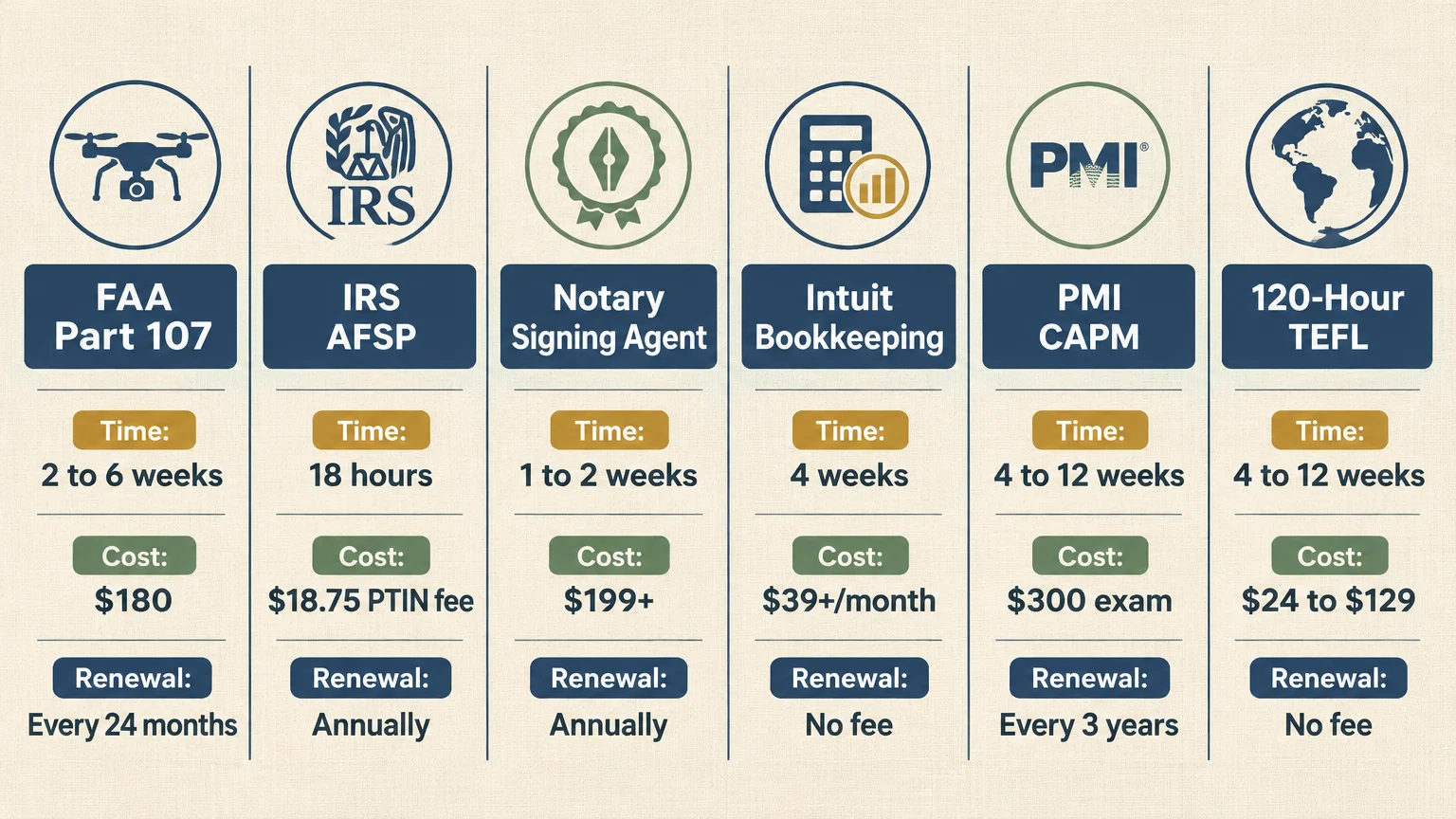
Quick Comparison of Fast Credentials for Retirees
Choosing among certifications for retirees starts with matching your timeline, budget, and preferred work environment. Some credentials take just two weeks, while others require up to 12 weeks of steady study.
Review the table below to compare minimum out-of-pocket costs, experience rules, and renewal schedules across all six options.
| Certification | Typical Timeframe | Minimum 2026 Cost | Prior Experience Needed | Renewal Cycle |
|---|---|---|---|---|
| FAA Part 107 Remote Pilot | 2 to 6 weeks | $180 ($175 exam + $5 registration) | None | Every 24 months (free online course) |
| IRS Annual Filing Season Program | 18 hours of coursework | $18.75 PTIN fee + CE course cost | None | Annually |
| Notary Signing Agent (NNA) | 1 to 2 weeks (once commissioned) | $199+ (plus state notary fees) | Active state Notary commission | Annually |
| Intuit Academy Bookkeeping | 4 weeks at 10 hrs/week | $39/month (after 7-day trial) | None | No renewal fee |
| PMI CAPM (Project Management) | 4 to 12 weeks | $300 exam + prep course (~$150+) | High school/GED + 23 course hours | Every 3 years |
| 120-Hour Online TEFL | 4 to 12 weeks | ~$24 to $129+ depending on provider | None | No renewal fee |
Look closely at whether a credential requires ongoing fees or state licensing before you enroll. Low-cost programs with zero renewal fees often deliver the highest return if you only plan to work part time.
1. FAA Part 107 Remote Pilot Certificate (Commercial Drone Pilot)
If you enjoy photography, technology, or spending time outdoors, flying drones commercially offers an engaging way to earn income on your own terms. Real estate agents, roofers, event planners, and agricultural businesses regularly hire certified pilots for aerial photos and inspections.
Under Federal Aviation Administration (FAA) Part 107 rules, you must hold a Remote Pilot Certificate before accepting any compensation for drone flights. Even photographing a neighbor’s property for a small fee requires this federal license.
Eligibility and Exam Details
To qualify, you must be at least 16 years old and able to read, speak, write, and understand English. You also need to be in safe physical and mental condition to operate a small unmanned aircraft and pass a TSA security background check.
Most retirees prepare in just a few weeks using the free FAA study guide or structured online courses. Once ready, you take the in-person Unmanned Aircraft General – Small (UAG) exam at an FAA-approved testing center.
- Exam length: 60 multiple-choice questions with a 2-hour time limit.
- Passing score: 70% or higher to earn your credential.
- Topics covered: Airspace rules, weather reading, airport charts, drone loading, and emergency procedures.
2026 Costs and Renewal Rules
Your minimum out-of-pocket cost is $180, which covers the $175 exam fee paid to PSI testing centers and a $5 commercial drone registration valid for three years via FAADroneZone. The IACRA certificate application and TSA security vetting cost $0.
Optional online prep courses range from $59 to $299 or more if you prefer video lessons and practice tests. Once certified, you keep your license active by completing a free online FAA recurrent training course (ALC-677 on FAASafety.gov) every 24 calendar months.
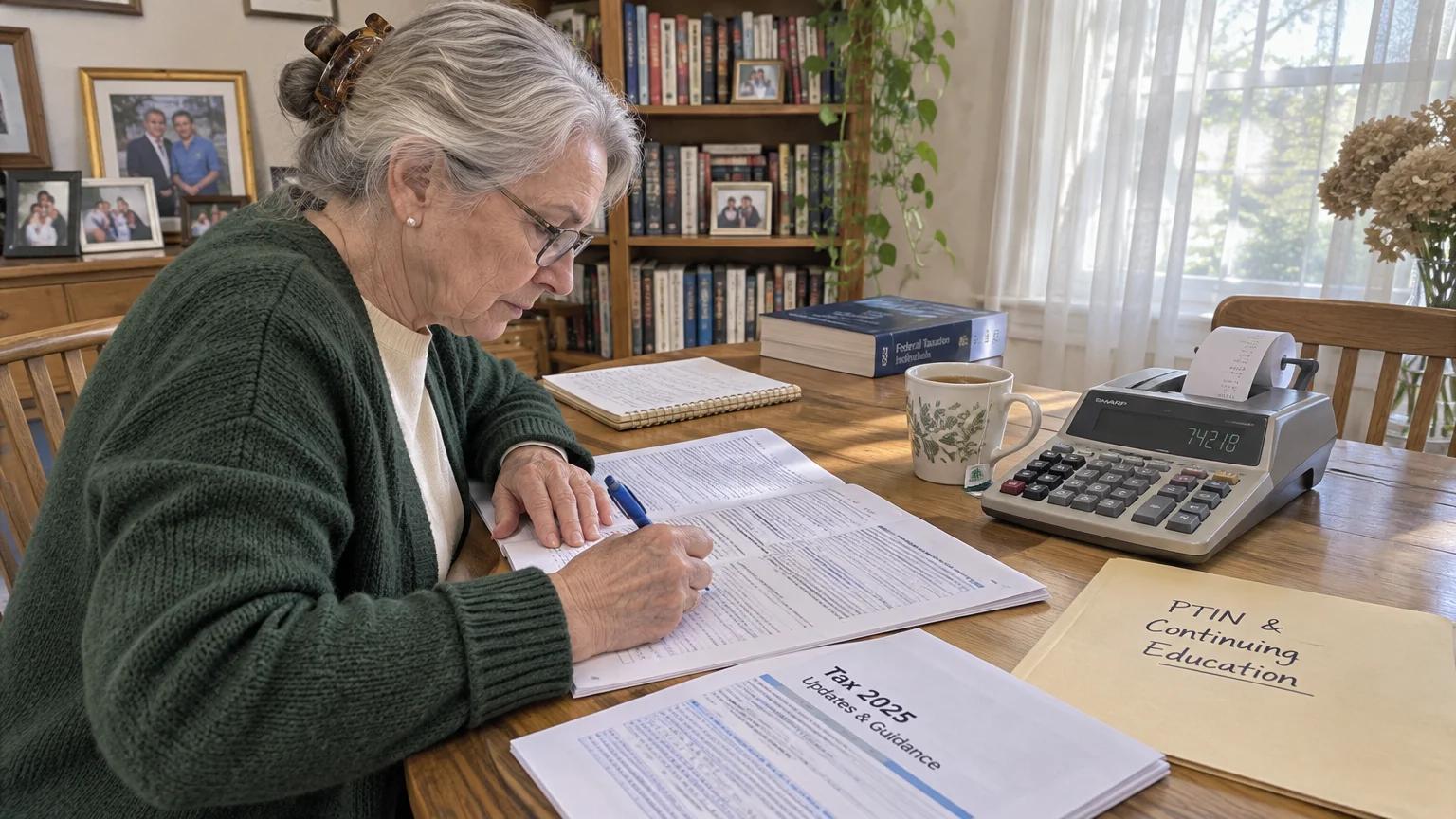
2. IRS Annual Filing Season Program (AFSP) – Record of Completion
Seasonal tax preparation is a natural fit if you like working with numbers and want steady income between January and April. You get to help neighbors and small-business owners organize their finances while keeping the rest of your year completely free.
Anyone preparing federal tax returns for pay must first obtain a Preparer Tax Identification Number (PTIN) from the Internal Revenue Service. Applying online takes roughly 15 minutes, while paper Form W-12 takes four to six weeks to process.
Training Requirements and Benefits
While a PTIN lets you legally file returns, non-credentialed preparers—those who are not CPAs, attorneys, or enrolled agents—gain extra credibility through the voluntary Annual Filing Season Program. Earning your Record of Completion places you in the official IRS public directory and grants limited client representation rights.
To qualify before the filing season starts, non-exempt preparers must complete 18 hours of IRS-approved continuing education by December 31:
- Annual Federal Tax Refresher (AFTR): 6 hours of coursework plus a 100-question, 3-hour comprehension test requiring a 70% passing score.
- Federal tax law updates: 10 hours covering current deductions, credits, and filing rules.
- Ethics training: 2 hours reviewing professional standards, plus formal consent to Circular 230 obligations.
Exempt preparers—such as those who have passed certain state or national exams—need 15 continuing education hours instead of 18. Because these courses total fewer than 20 hours, most beginners can finish them quickly.
Costs and Pay Benchmarks
The IRS charges a non-refundable $18.75 annual fee for your PTIN, while the AFSP credential itself carries a $0 IRS fee. You only pay the third-party, IRS-approved education provider you select for your continuing education hours.
According to U.S. Bureau of Labor Statistics data from May 2025 (released May 2026), 76,480 tax preparers employed nationally earned a median hourly wage of $26.40. The mean annual wage was $60,930, making seasonal preparation lucrative even part time.
3. Notary Signing Agent Certification
Notary Signing Agents guide borrowers through real estate loan documents during mortgage closings and refinances. Title companies and signing services hire independent agents per appointment, allowing you to accept or decline jobs around your personal calendar.
Before pursuing Signing Agent status, you must hold an active Notary Public commission in your state. State notary commission fees typically run $20 to $100 or more, depending on where you live.
Fast Certification Process
Once you hold a state commission, earning certification through the National Notary Association (NNA) usually takes just one to two weeks. Much of that wait goes toward the two to five business days needed to clear your criminal background screening.
The NNA process includes self-paced online training, a proctored online exam requiring an 80% passing score, and annual renewal. Before spending money on training, check whether your state restricts who may conduct real estate closings.
The NNA identifies 19 states with specific Signing Agent restrictions or extra licensing rules. For example, Connecticut, Delaware, Georgia, Massachusetts, South Carolina, Vermont, and West Virginia require attorney involvement at closings, while Indiana, Maryland, Minnesota, and Virginia require separate professional licenses.
Costs and Insurance
NNA Certified Notary Signing Agent packages start at $199 in 2026, varying by the supplies and study materials included. You will also likely need Errors and Omissions (E&O) insurance before title companies send you assignments.
The Signing Professionals Workgroup recommends carrying at least $25,000 in E&O coverage, which costs roughly $20 to $40 per year. Upgrading to $100,000 in coverage runs approximately $100 to $175 annually, according to NNA estimates.
4. Intuit Academy Bookkeeping Professional Certificate
Small businesses constantly need reliable help tracking invoices, reconciling bank statements, and managing payroll. Online certificate programs like the Intuit Academy Bookkeeping Professional Certificate on Coursera give you practical skills from your own kitchen table.
This four-course, self-paced series totals roughly 54 hours of instruction covering the accounting cycle, financial statements, and QuickBooks Online. Coursera lists the completion pace at four weeks if you study 10 hours per week, making it an ideal quick certification.
Credential Details and Costs
No college degree or accounting background is required to enroll, and the series prepares U.S. residents for the Intuit Academy Bookkeeping exam with zero renewal fees. Keep in mind that this is an Intuit course and exam credential rather than an independent certification like AIPB or NACPB.
In 2026, Coursera charges $39 per month in the U.S. and Canada after a seven-day free trial, putting your total cost around $39 to $160 depending on your pace. It is also included in Coursera Plus at $59 per month or $399 per year, with a $239 promotional first-year offer running through November 30, 2026.
Coursera ended free full-course auditing in August 2025, though first-module previews and financial aid remain available if you qualify. Finishing within one or two months keeps your out-of-pocket expense remarkably low.
Pay and Job Outlook
Bookkeeping, accounting, and auditing clerks earned a median annual wage of $50,670 in May 2025, according to the Bureau of Labor Statistics Occupational Outlook Handbook (August 2026 release). The lowest 10% earned under $36,000, while the highest 10% topped $74,550.
Although overall employment in this category is projected to decline 6% between 2025 and 2035, the BLS still projects roughly 144,100 openings each year. Most of those openings come from replacement needs as veteran bookkeepers retire—creating steady part-time opportunities for organized seniors.
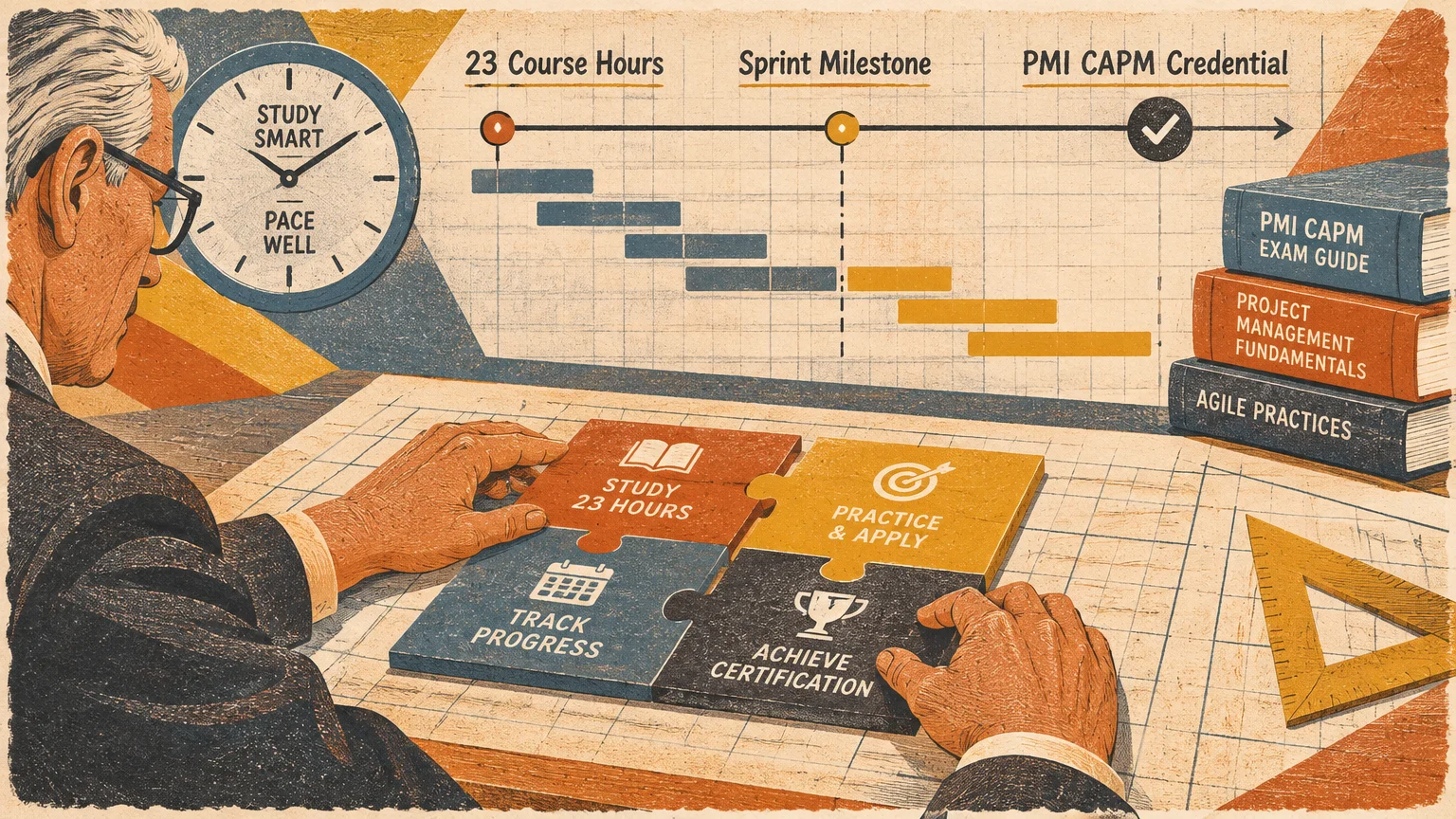
5. PMI Certified Associate in Project Management (CAPM)
Decades of career experience coordinating teams, budgets, or community events already give you strong project management instincts. The Project Management Institute (PMI) Certified Associate in Project Management (CAPM) credential translates that lifetime wisdom into a respected, entry-level business title.
In August 2024, PMI eliminated the former 1,500-hour experience requirement for this exam. You now only need a high school diploma, GED, or equivalent plus 23 contact hours of formal project management education.
Exam Structure and Study Time
Most candidates complete the required 23-hour course and pass the exam within four to 12 weeks. The test contains 150 questions across a 180-minute window and evaluates four distinct domains:
- Project management fundamentals and core concepts: 36% of the exam.
- Business analysis frameworks: 27% of the exam.
- Agile frameworks and methodologies: 20% of the exam.
- Predictive, plan-based methodologies: 17% of the exam.
Because Agile and business analysis make up nearly half the test, choose an updated 23-hour prep course aligned with current exam outlines. Self-paced online classes generally run $150 to $300.
Smart Cost Math and Renewal
In 2026, the CAPM exam fee is $225 for PMI members and $300 for non-members. Because PMI annual membership costs roughly $139 to $159, joining strictly for the $75 exam discount actually increases your total spending.
Unless you plan to use PMI’s member networking tools and job boards, paying the $300 non-member rate keeps your total investment around $400 to $800. Your CAPM remains valid for three years and renews with 15 professional development units (PDUs) plus $60 for members or $150 for non-members.
6. 120-Hour Online TEFL Certification
Teaching English as a Foreign Language (TEFL) lets retirees connect with students worldwide over video chat without leaving home. You can set early morning or evening hours to match overseas time zones while earning supplemental income.
A 120-hour TEFL or TESOL certificate is the standard baseline required by most online English-tutoring platforms and international language schools. Because courses are self-paced online, you can finish in four to 12 weeks—or two to six weeks with intensive daily study.
Understanding Pricing Differences
TEFL course pricing varies dramatically based on tutor feedback, accreditation, and job-placement support. Budget self-paced 120-hour online programs start around $24 to $34, while tutor-supported or advanced programs commonly run $129 or more.
Before buying the cheapest package available, verify that the provider includes verifiable certificate numbers and clear grammar-instruction modules. Reputable online platforms look for solid lesson-planning skills and clear audio-video setups rather than expensive university diplomas.

Bonus Fast-Track Options Worth Considering
If none of the six core credentials match your interests, two additional online certificate programs and fitness paths deserve a closer look. Both offer recognizable names and flexible schedules for retirees.
Google Career Certificates and AI Training
Google offers seven core career tracks on Coursera—including Project Management, IT Support, Data Analytics, Cybersecurity, UX Design, Digital Marketing and E-commerce, and Advanced Data Analytics—plus a newer Google AI Professional Certificate. The AI track spans seven courses of roughly one hour each, taking one to two months.
Core Google tracks cost $49 per month after a seven-day trial and are designed for three to six months at 10 hours weekly, though full-time learners often finish in six to eight weeks. The certificates are recognized by Google’s consortium of over 150 employers.
NASM Certified Personal Trainer (CPT)
Fitness-minded retirees often excel at coaching older adults on strength, balance, and mobility. The National Academy of Sports Medicine (NASM) offers exam-only registration for $599, while its base Self-Study package—including one exam attempt—was $999 in October 2026 with a 180-day window to test.
You will need a current CPR/AED certification before testing (about $49 online), and retakes cost $199 if needed, with renewal every two years requiring 20 continuing education hours and $99. Per May 2025 BLS data, fitness trainers earned a median annual wage of $47,160, with faster-than-average 7% job growth projected from 2025 to 2035 and roughly 68,000 annual openings.
How New Earnings Affect Social Security and Taxes
Before you invoice your first client or accept a part-time paycheck, review how earned wages interact with your Social Security Administration (SSA) benefits. Earning too much before reaching Full Retirement Age (FRA) can trigger temporary benefit withholdings.
The SSA applies an annual retirement earnings test based on your age during the calendar year:
- Under Full Retirement Age all of 2026: You can earn up to $24,480 per year before reductions apply, with $1 withheld for every $2 earned above the cap (rising to $25,560 in 2027).
- In the calendar year reaching FRA in 2026: Your limit is $65,160 on earnings during months before reaching FRA, with $1 deducted for every $3 over the cap (rising to $67,920 in 2027).
- Starting the month you reach FRA: There is no earnings limit and zero benefit reduction regardless of how much you earn.
Reaching Full Retirement Age removes the Social Security earnings cap completely—giving you total freedom to earn extra income without triggering benefit withholdings.
If you retire mid-year and start collecting benefits under FRA, a special monthly rule lets you earn up to $2,040 per month in 2026 without reductions. However, self-employed retirees under this rule cannot perform substantial services in self-employment, which SSA defines as devoting more than 45 hours monthly—or 15 to 45 hours monthly in a highly skilled occupation.
Remember too that new income may push a higher share of your Social Security benefits into taxable territory or raise future Medicare premiums. Setting aside a portion of freelance earnings for quarterly taxes prevents surprises in April.
Free and Low-Cost Job Training for Seniors
If paying $180 to $400 out of pocket stretches your monthly budget, check federal and nonprofit job training seniors can access at little or no cost. You may qualify for paid community placements or tuition aid before spending your own savings.
The U.S. Department of Labor funds the Senior Community Service Employment Program (SCSEP) under the Older Americans Act, backed by $380,321,305 in Program Year 2026 funding. SCSEP serves unemployed adults age 55 or older whose family incomes sit at or below 125% of the federal poverty level, giving priority to veterans, qualified spouses, and adults over 65.
Participants work an average of 20 hours per week in local community service roles while earning the highest of federal, state, or local minimum wage. You can explore local eligibility through Benefits.gov or connect with career resources at the National Council on Aging.
For self-paced online learning, always use seven-day free trials on platforms like Coursera to preview course materials before paying. Many public libraries and AARP local chapters also host free digital-skills workshops and resume clinics for older job seekers.
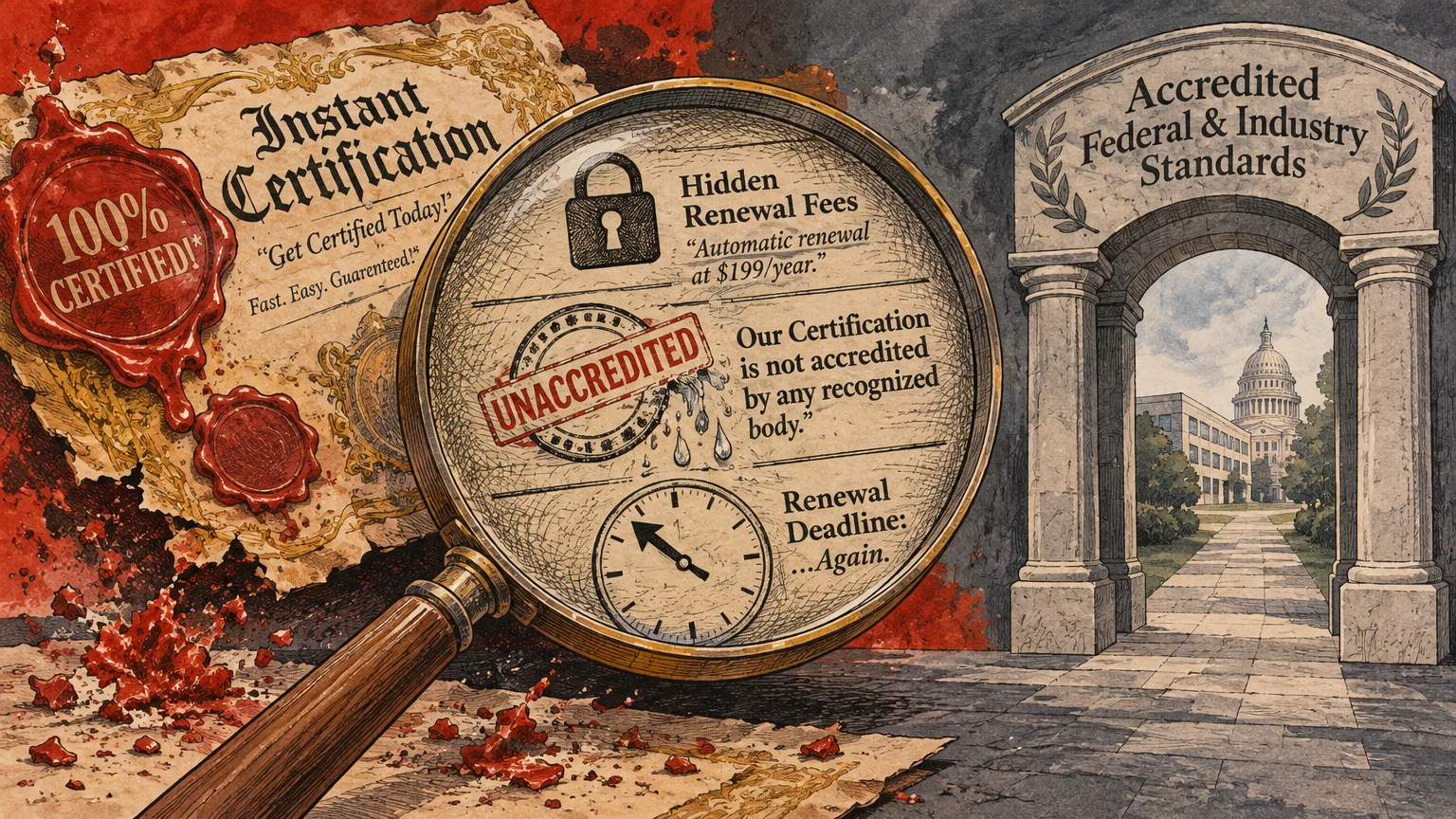
What Can Go Wrong When Choosing a Certificate Program
Enthusiasm for a fresh start can sometimes lead retirees into costly shortcuts or overlooked regulations. Watch closely for these four common mistakes before entering your credit card details:
- Buying unaccredited or worthless certificates: Flashy websites promising instant six-figure jobs after a weekend course often sell credentials no employer recognizes. Stick to federal agencies like the FAA or IRS, established associations like PMI and NNA, or well-known platforms like Coursera.
- Ignoring state-specific licensing barriers: Spending $199 on Notary Signing Agent training before checking local laws can stall your plans if you live in one of the 19 states with Signing Agent restrictions or limitations.
- Overpaying for unnecessary memberships: Buying a $139 to $159 PMI membership strictly to save $75 on the CAPM exam leaves you $64 to $84 poorer overall. Always run the math on member versus non-member pricing first.
- Overlooking Social Security earnings caps: Earning $35,000 in a busy drone or tax business while collecting benefits before FRA triggers $1-for-$2 withholdings on everything above $24,480 in 2026.
When to Consult a Professional
Even straightforward second-career plans occasionally intersect with complex tax, legal, or benefit rules. Consider scheduling a brief consultation with a qualified expert in these specific situations:
- Estimating pre-FRA Social Security withholdings: Speak with an SSA representative or fiduciary financial planner if your projected earnings will cross the $24,480 or $65,160 thresholds in 2026.
- Setting up freelance or sole-proprietor taxes: Consulting a CPA or Enrolled Agent helps you track deductible expenses—like drone gear, E&O insurance, or home-office mileage—and calculate quarterly estimated payments.
- Navigating Medicare IRMAA brackets: A tax advisor can show whether extra freelance income could push your modified adjusted gross income high enough to increase future Medicare Part B and Part D surcharges.
- Verifying state notary closing laws: Check with your state Secretary of State office or a local real estate attorney if you live in a state with Signing Agent restrictions.
Frequently Asked Questions
Can I earn these certifications without a college degree?
Yes, none of the six featured certifications require a college degree. The PMI CAPM requires a high school diploma or GED alongside 23 contact hours, while the FAA Part 107, IRS AFSP, Intuit Bookkeeping, and 120-hour TEFL programs have no degree requirement at all.
Does self-employment income count toward Social Security earnings limits?
Yes, net earnings from self-employment count toward the annual SSA retirement earnings test alongside regular wages. If you use the special first-year monthly rule under Full Retirement Age, the SSA also reviews how many hours you spend working in your business each month.
Are online certificate programs worth it after age 60?
Online certificate programs are worthwhile when they match active local demand or remote hiring standards without draining your retirement savings. Programs costing under $200 to $400—such as bookkeeping, tax preparation, or drone licensing—can pay for themselves within your first few clients.
How can I spot a certification scam?
Walk away from any program guaranteeing job placement, promising unrealistic hourly wages, or pressuring you with countdown timers. Verify the issuing organization independently through official government portals like USA.gov or trusted industry bodies before paying any tuition.

Taking Your Next Step
Starting a second career after 60 does not require four years of tuition or starting from scratch. Pick one credential that fits your daily energy, verify local licensing and Social Security caps, and set a realistic 60-day study target.
This is educational content based on general financial principles for seniors. Individual results vary based on your situation.
Always verify current benefit amounts, tax rules, and program eligibility with official government sources.
Last updated: November 2026. Benefit amounts, tax rules, and program details change annually—verify current figures with official government sources.





Leave a Reply