


Heading south for the winter does not have to drain your retirement savings. Warm-state seasonal jobs let snowbirds earn extra cash, stay active, and enjoy local perks during peak tourist months.
Employers across Florida, Arizona, and Texas rely heavily on dependable winter workers from January through April. Whether you want free RV hookups or a steady hourly paycheck, you can find flexible part-time roles built around your schedule.
Below, you will find seven practical seasonal jobs for retirees, verified pay ranges, state wage floors, and key Social Security rules to check before you clock in.
Why Warm-State Seasonal Work Fits Snowbird Budgets
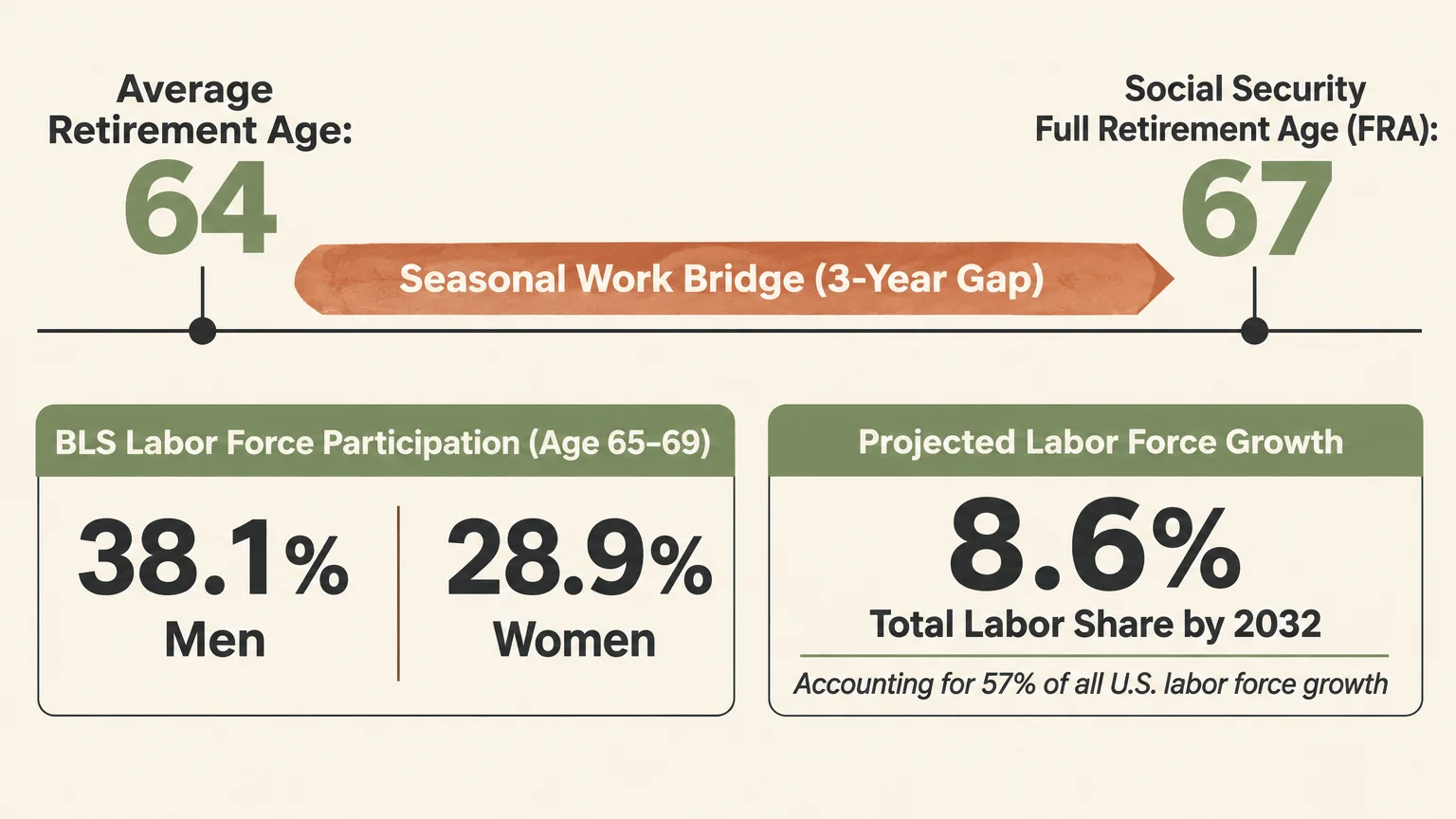
Working during your winter stay is far more common than many retirees realize. In 2025, 19.1% of Americans age 65 and older worked or actively looked for work, including 23.1% of men and 15.7% of women, according to the U.S. Bureau of Labor Statistics (BLS).
That rate represents a major shift from 12.9% in 2000 and stood at 18.7% as of October 2026. Older adults are projected to grow from 6.6% of the U.S. labor force in 2022 to 8.6% in 2032, accounting for 57% of all labor force growth.
Naturally, participation tapers with age as health and travel priorities change. BLS figures from 2025 show 38.1% of men and 28.9% of women ages 65 to 69 in the labor force, compared with 22.3% of men and 15.7% of women ages 70 to 74.
Even among Americans age 75 and older, 11.1% of men and 6.6% of women still participate. For snowbirds, seasonal work bridges an important financial gap between the average U.S. retirement age of 64 and the Social Security Full Retirement Age (FRA) of 67 for anyone born in 1960 or later.
A winter paycheck can cover campground fees, dining out, and travel expenses without forcing you to tap investment accounts early. Better yet, you leave the job behind when spring arrives and you head back north.
At a Glance: Comparing 7 Top Snowbird Jobs
Different winter jobs trade higher hourly pay for lighter schedules, free housing, or specialized skills. Use the table below to compare typical seasons, verified pay benchmarks, and physical demands before you apply.
| Seasonal Role | Peak Season | Verified Pay Benchmark | Best Warm States | Physical Demand |
|---|---|---|---|---|
| Campground Host / Park Worker | Oct.–April | Free RV site (volunteer) or $15.16–$31.43/hr paid | Arizona, Florida, Texas | Light to moderate |
| MLB Spring Training Staff | Feb.–March | At least state minimum ($15.00 FL / $15.65 AZ in 2027) | Arizona, Florida | Light to moderate |
| Theme Park Cast / Team Member | Year-round / winter peak | $18.50–$20.50/hr starting base (Orlando) | Florida | Moderate (standing/walking) |
| Tour and Travel Guide | Nov.–April | $18.33/hr national median (May 2025) | Florida, Arizona, California | Light to moderate |
| Resort and Golf Recreation Worker | Nov.–April | $33,810–$36,560/yr median equivalent (May 2025) | Florida, Arizona, Texas | Light to moderate |
| Seasonal Tax Preparer | Jan.–April | $26.40/hr national median (May 2025) | All warm states / remote | Low (desk-based) |
| Seasonal Retail Associate | Nov.–March | $17.03/hr national median (May 2025) | All warm states | Moderate (standing) |
7 Seasonal Jobs in Warm States for Snowbirds
1. Campground Hosting and Paid Park Roles
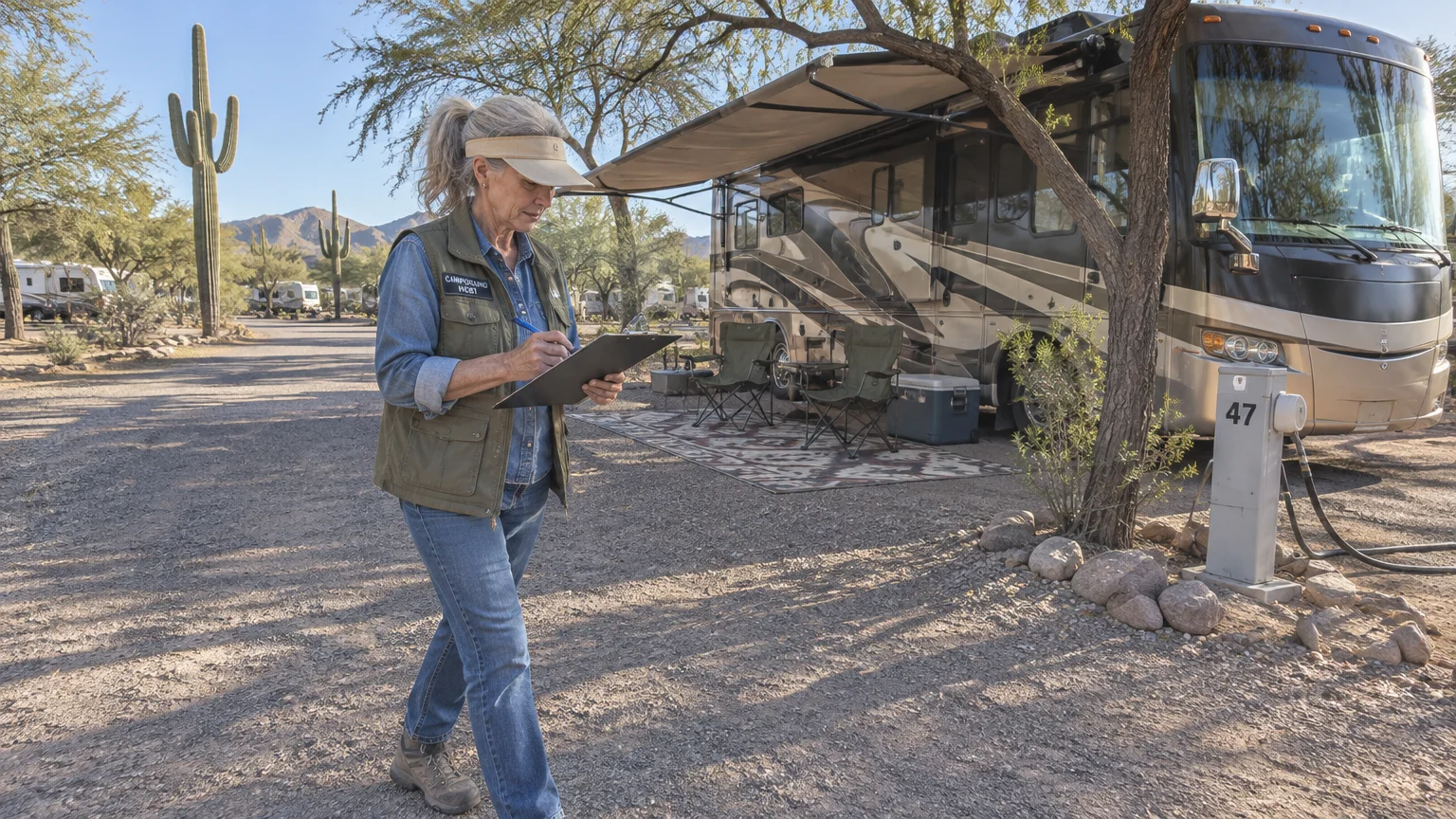
If you travel by RV or camper, campground hosting lets you eliminate your biggest winter housing expense. Volunteer hosts live on-site and handle light duties like greeting guests, checking reservations, tidying campsites, and answering park questions.
Arizona State Parks and Trails uses volunteer hosts across more than 30 state parks, providing a free campsite with utility hookups in most locations. In return, volunteers commit to at least 25 hours per week individually or 40 combined hours per week as a couple.
Florida State Parks offers a similar trade, providing a free RV site in exchange for volunteer service. According to Florida State Parks guidelines, standard assignments require 24 hours per week per campsite, though select park roles list 20 hours.
If you prefer cash wages on top of lodging, look at private campgrounds and federal park concessionaires. For example, 2027 Arizona KOA listings advertise $15.16 to $17.50 per hour, with some roles including an RV site.
Federal parks also hire paid winter help. National Park Service seasonal Recreation Fee Clerk and Technician positions pay between $15.54 and $31.43 per hour, depending on grade and location.
Start applying six to nine months ahead of your arrival, especially for popular desert or coastal parks. Keep copies of your RV insurance, driver license, and any customer service background ready for park coordinators.
2. MLB Spring Training Stadium and Event Staff
Baseball brings massive crowds to Sunbelt towns every late winter, creating short-term jobs tailored to retirees. All 30 Major League Baseball clubs train across two warm-weather hubs: Arizona’s Cactus League and Florida’s Grapefruit League.
Fifteen teams train around the Phoenix metro area in Arizona, while 15 teams spread across Florida’s Gulf Coast, Tampa Bay, Central Florida, and Treasure Coast. Stadiums hire seasonal workers for ticket scanning, ushering, guest services, retail kiosks, and parking control.
MLB announced that 2027 Spring Training games officially begin Friday, February 19, 2027, running through roughly March 20 to March 23 ahead of Opening Day on March 25. Keep in mind that MLB’s Collective Bargaining Agreement expires December 1, 2026, so labor talks could shift the 2027 calendar.
Pay typically starts at or above the local state minimum wage, which means at least $15.00 per hour in Florida and $15.65 per hour in Arizona during early 2027. Many ushers and ticket takers also enjoy watching games between innings while working short, predictable shifts.
Because the season lasts roughly five to six weeks, stadium work suits snowbirds who only want a brief commitment. Watch team career pages and staffing partners in November and December for early hiring fairs.
3. Theme Park Cast and Team Members
Central Florida offers some of the highest entry-level seasonal pay in the hospitality sector. Major resorts hire part-time and seasonal staff to manage winter holiday surges and spring break crowds.
At Walt Disney World, union contract rules with the Service Trades Council Union pushed the minimum hourly wage for non-tipped roles to $20.00 per hour on October 4, 2026, for newer hires. Longer-tenured staff hired before December 3, 2023, receive a $20.50 base.
Universal Orlando Resort also raised its base starting hourly rate to $18.50 per hour in mid-2025. Roles span park greeting, attraction queuing, merchandise, food service, and resort front-desk support.
Before applying, think carefully about physical stamina and commute times along Interstate 4. Many shifts require standing outdoors in warm humidity for several hours at a time.
Ask recruiters specifically about minimum weekly hour requirements for seasonal or part-time classifications. Some park roles offer complimentary admission perks that visiting grandchildren will love.
4. Tour and Travel Guides
Retired teachers, history buffs, and outgoing storytellers often thrive as seasonal tour guides. Winter destinations need knowledgeable guides for botanical gardens, historic districts, art museums, boat cruises, and wildlife preserves.
According to the BLS Occupational Outlook Handbook, tour and travel guides earned a national median wage of $18.33 per hour, or $38,120 per year, in May 2025. Part-time schedules are standard across this field.
Demand is also growing faster than average. BLS projects 6% employment growth from 2025 to 2035, double the 3% average across all occupations, generating roughly 11,900 openings each year.
Many museum docent programs are unpaid, so verify early whether a role is salaried, hourly, or tip-supported. Walking tours, trolley narration, and riverboat commentary often combine base hourly pay with guest tips.
Highlight public speaking experience, volunteer leadership, or local knowledge on your application. Employers prize guides who stay calm with large groups and clearly project their voices.
5. Resort, Golf Course, and Recreation Workers
Winter resorts, golf clubs, and active-adult communities expand their staffs every autumn when northern residents arrive. You can find openings as golf starters, pro-shop attendants, tennis court monitors, fitness desk hosts, and community activity coordinators.
BLS data from May 2025 reports a national median annual wage of $36,560 for recreation workers overall and $33,810 within amusement and recreation industries. The field produces about 67,000 openings annually through 2035, with heavy reliance on part-time and seasonal workers.
Golf course roles are especially popular among retirees because shifts often start early and finish by early afternoon. Many clubs also include discounted or complimentary golf privileges on slow weekdays.
If you live inside a 55-plus community in Florida or Arizona, check your own clubhouse bulletin board first. Resident-friendly schedules and a five-minute commute make recreation work easy to balance with social plans.
6. Seasonal Tax Preparers
If you prefer air-conditioned desk work over standing on your feet, seasonal tax preparation lines up almost identically with snowbird travel dates. Offices ramp up in January and wind down right after the mid-April filing deadline.
Tax preparers earned a national median wage of $26.40 per hour, or $54,920 per year, in May 2025, with a mean wage of $29.30 per hour, according to BLS occupational wage data. Even entry-level earners at the 10th percentile earned $16.23 per hour.
The occupation carries a 4.7% projected growth rate from 2025 to 2035 and roughly 9,400 annual openings. Notably, 17.6% of tax preparers are self-employed, giving experienced professionals room to consult independently.
Major national tax chains offer structured training courses every fall for newcomers who want to learn basic individual return preparation. You will need a Preparer Tax Identification Number through the Internal Revenue Service (IRS) before preparing returns for pay.
Former accountants, bookkeepers, bankers, and detail-oriented managers adapt quickly to tax software. Because appointments peak in February and March, many firms welcome part-time preparers working 20 to 30 hours weekly.
7. Seasonal Retail Associates
Retail stores in coastal towns, outlet malls, and tourist corridors face severe winter staffing shortages once college students return to class. Boutiques, hardware stores, specialty grocers, and gift shops actively recruit dependable retirees.
Retail salespersons earned a national median wage of $17.03 per hour in May 2025, ranging from $13.08 at the 10th percentile to $23.02 at the 90th percentile, per BLS data. Turnover and retirements create roughly 550,600 openings every year.
Unlike summer holiday rushes back home, warm-state retail demand stays steady from November through March. Store managers appreciate retirees who arrive on time, treat shoppers patiently, and can work morning shifts.
Some RV travelers also ask about warehouse fulfillment programs like Amazon CamperForce. Active again on a smaller scale in 2026 after a 2023 review, CamperForce hires RV dwellers for 10- to 16-week peak assignments from roughly September through January at $15.00 to $19.55 per hour.
Certain sites in states like Texas and Nevada may include a weekly CampPay campground stipend near $120, though that perk is no longer guaranteed everywhere. Weigh the physical demands carefully before applying, because warehouse shifts last 10 hours, require lifting up to 49 pounds, and involve walking 12 to 15 miles per day.
Minimum Wage Floors Across Major Snowbird States
Your paycheck depends heavily on which warm state you choose for the winter. Under federal labor rules enforced by the U.S. Department of Labor (DOL), minimum wage laws follow the physical state where you perform the work, not your home state.
When federal, state, and local wage floors differ, employers must pay whichever rate is highest. Here is how the four largest snowbird states compare heading into 2027:
- Florida: Reached $15.00 per hour on September 30, 2026, with an $11.98 minimum cash wage for tipped workers based on a fixed $3.02 tip credit. Under the Florida Constitution, the $15.00 floor holds through December 31, 2027, before annual inflation adjustments begin January 1, 2028.
- Arizona: Paid $15.15 per hour in 2026 ($12.15 for tipped staff) and rises to $15.65 per hour on January 1, 2027, through its annual inflation adjustment.
- California: Paid $16.90 per hour in 2026 and increases to $17.40 per hour on January 1, 2027, with higher local minimums in several coastal cities.
- Texas: Follows the federal minimum wage of $7.25 per hour, unchanged since July 24, 2009, though competitive urban employers often pay well above that floor to attract staff.
Check local city or county ordinances before accepting an entry-level offer, especially in California and Arizona. Knowing the exact state wage floor prevents you from accepting outdated pay rates.
How Winter Wages Affect Social Security and Payroll Taxes
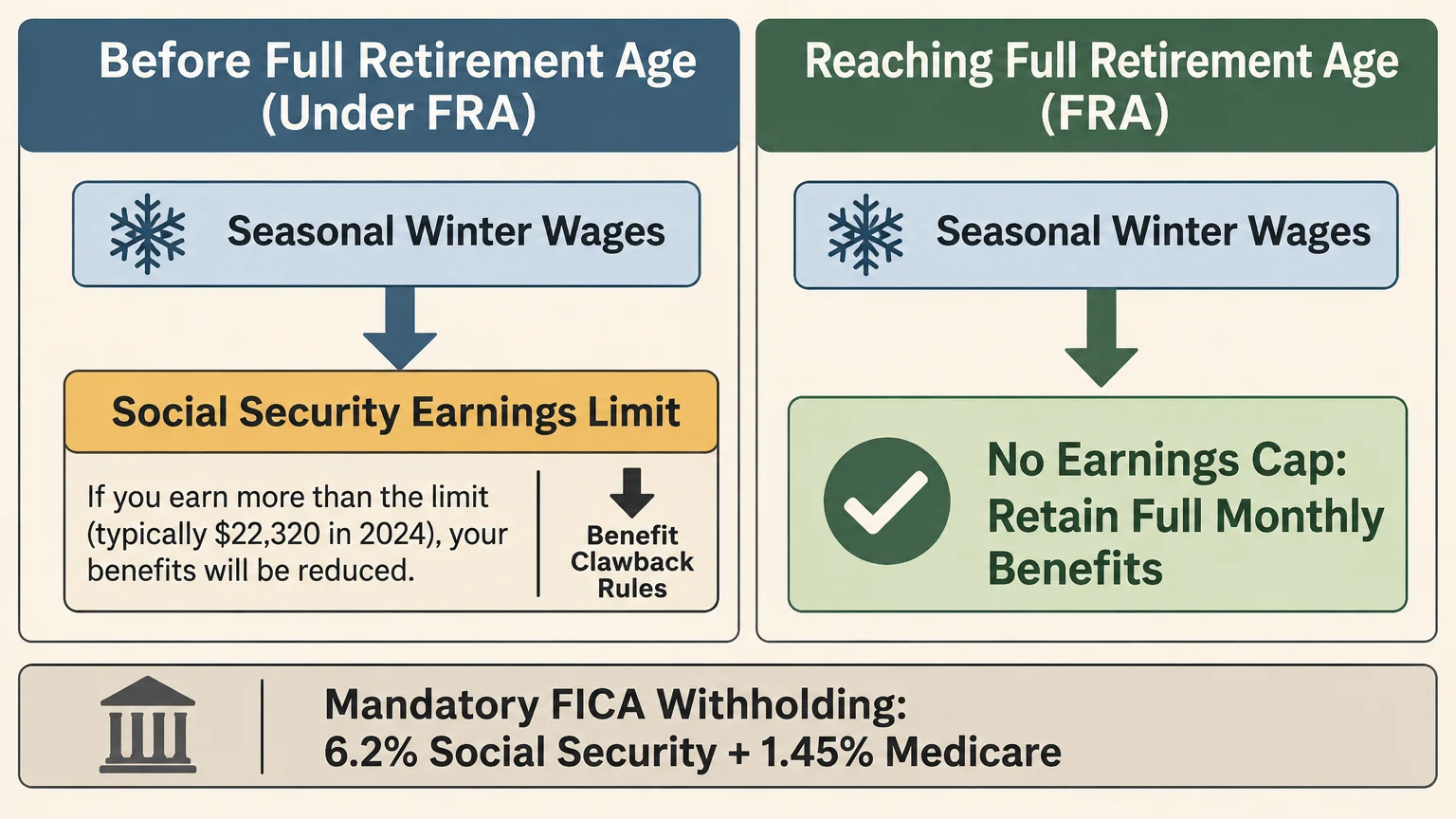
Before taking a seasonal job, check how extra earned income interacts with your Social Security retirement benefits. The rules depend entirely on whether you have reached your Full Retirement Age.
According to the Social Security Administration (SSA) 2027 COLA Fact Sheet, anyone under FRA for all of 2026 faces an annual earnings limit of $24,480 ($2,040 per month). That threshold rises to $25,560 ($2,130 per month) in 2027.
If you earn above that limit while under FRA all year, SSA withholds $1 in benefits for every $2 you earn over the cap. Suppose you are 64 in 2027 and earn $29,560 from seasonal work and consulting, putting you $4,000 above the $25,560 threshold.
In that scenario, SSA would withhold $2,000 from your benefits for the year. Keep in mind that withheld dollars are not lost forever, because SSA recalculates and increases your monthly check once you reach FRA.
Higher limits apply during the calendar year you actually reach FRA. In 2026, the limit is $65,160 ($5,430 per month), rising to $67,920 ($5,660 per month) in 2027, counting only wages earned in the months before your FRA birthday month.
During that transition year, SSA withholds $1 for every $3 earned above the threshold. Starting in the month you reach FRA, the earnings limit disappears completely, allowing you to earn any amount with zero benefit withholding.
Remember three important payroll details when budgeting your winter income:
- Only earned income counts: SSA counts W-2 wages and net self-employment income toward the earnings test, not IRA withdrawals, pensions, dividends, interest, or capital gains.
- FICA payroll taxes still apply: Seasonal W-2 workers pay the standard 6.2% Social Security tax (up to a $192,300 wage cap in 2027) and 1.45% Medicare tax regardless of age.
- Extra credits can boost future benefits: Earning one Social Security work credit requires $1,890 in 2026 and $1,970 in 2027, and higher recent earnings can occasionally replace lower years in your benefit formula while your check already adjusts for the 2.8% COLA in 2026 and 3.6% COLA in 2027.
You can review your current earnings record and test claiming scenarios through your online My Social Security account. Checking the numbers in advance saves you from unexpected mid-year benefit pauses.
Costly Errors to Sidestep When Working Out of State
Seasonal work feels simple on the surface, yet cross-state logistics can trip up even experienced snowbirds. Watch out for these four common mistakes before signing an offer letter:
- Misjudging physical demands: Signing up for a 10- to 16-week warehouse assignment or an outdoor theme park shift without testing your stamina can lead to injury or early quitting. Verify lifting requirements, standing hours, and shade availability before committing.
- Missing early hiring windows: Peak winter jobs fill well before snow starts falling up north. MLB Spring Training roles, Florida state park host slots, and tax preparation training classes often recruit in late summer or autumn.
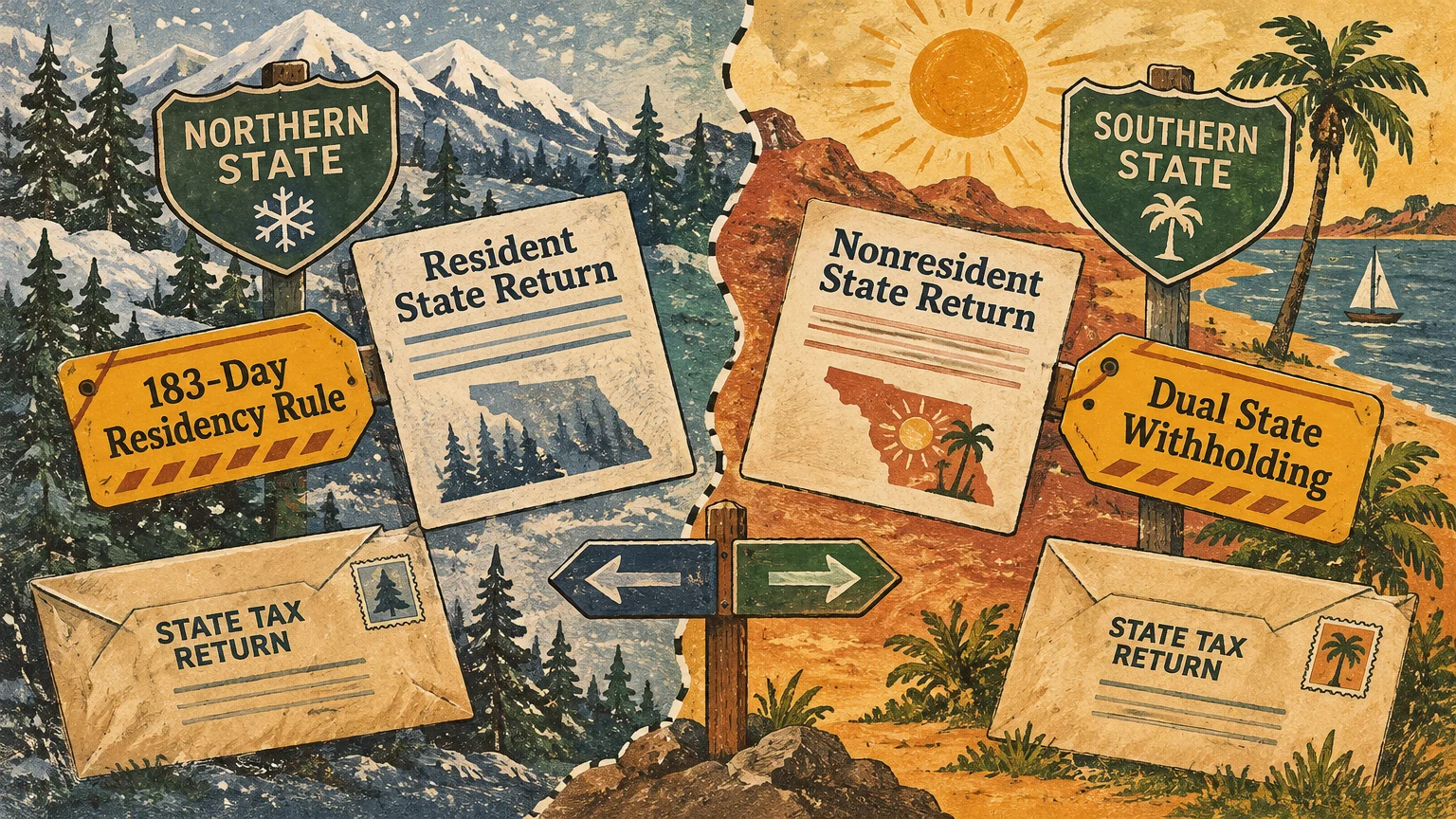
- Ignoring multi-state tax withholding: Working in a warm state with no state income tax like Florida or Texas simplifies paychecks, while earning wages in Arizona or California can trigger a nonresident state tax return. Confirm how your payroll department sets up state withholding on day one.
- Overlooking total housing and travel costs: A $16 hourly job looks less appealing if high winter RV park rent or daily commuting eats half your take-home pay. Always calculate net earnings after fuel, uniforms, and lodging.
A quick spreadsheet comparing net hourly pay against housing expenses keeps your winter budget realistic. Do not let a fun-sounding title mask an expensive commute.
When DIY Isn’t Enough
Most retirees can handle a straightforward winter retail or campground job on their own. However, certain financial intersections call for a qualified tax preparer, certified financial planner, or benefits counselor.
Consider seeking professional guidance in these three situations:
- Working while claiming early Social Security: If you collect benefits before FRA and expect fluctuating seasonal wages, a planner can help you report accurate income estimates to SSA and avoid surprise overpayment notices.
- Splitting income across two states: Earning W-2 or 1099 income in Arizona or California while keeping a primary residence in a northern income-tax state creates multi-state filing rules. An enrolled agent or CPA helps you claim proper credits so the same dollars are not taxed twice.
- Coordinating wages with Medicare and retirement withdrawals: Adding $10,000 to $20,000 of seasonal income alongside IRA distributions or Roth conversions can affect federal tax brackets, Social Security taxation, and future Medicare premium surcharges.
Free and low-cost retirement guidance is also available through the National Council on Aging (NCOA) and government benefit portals like USA.gov Benefits. Getting an outside check before tax season protects more of your winter paycheck.
Frequently Asked Questions
Do winter wages reduce my Social Security check permanently?
No, any benefits withheld under the Social Security earnings test before Full Retirement Age are not lost permanently. Once you reach FRA, SSA recalculates your monthly benefit upward to credit the months in which payments were withheld.
Which state’s minimum wage applies if my permanent home is in the North?
Minimum wage laws follow the physical state where you perform the job, not your permanent residence. If you live in Ohio or Michigan but work at a stadium in Arizona in 2027, your employer must pay at least Arizona’s $15.65 hourly floor.
Can I get free RV housing in exchange for winter work in Florida or Arizona?
Yes, volunteer campground host programs in both Arizona State Parks and Florida State Parks provide free RV campsites, often with utility hookups, in exchange for roughly 20 to 25 weekly volunteer hours (or 40 combined hours per couple in Arizona).
How early should snowbirds apply for warm-state winter jobs?
Start applying three to six months ahead for retail, resort, and tax jobs, and six to nine months ahead for desirable state park host slots. MLB Spring Training stadiums typically recruit during late fall ahead of February games.

Your Next Step for a Profitable Winter
Pick two roles from this list that match your energy level, housing setup, and preferred winter state. Check your Social Security earnings limit if you are under Full Retirement Age, update a concise one-page work history, and apply before peak hiring closes.
This is educational content based on general financial principles for seniors. Individual results vary based on your situation. Always verify current benefit amounts, tax rules, and program eligibility with official government sources.
Last updated: November 2026. Benefit amounts, tax rules, and program details change annually—verify current figures with official government sources.





Leave a Reply