

Retiring from your lifelong career does not mean leaving the workforce permanently. Many older adults find that the right part-time role provides healthy daily structure, social connection, and reliable supplemental income.
Finding enjoyable work can transform your post-career routine without the pressure of full-time corporate demands. The best positions offer flexible schedules, supportive colleagues, and low stress.
Ten retirees recently shared the most rewarding part-time jobs they ever held. Here is what made these roles exceptional, alongside the financial and tax rules you need to protect your retirement benefits.
Why More Seniors Are Returning to Part-Time Work
Today’s retirement looks radically different than it did for previous generations. Many older adults find that complete leisure quickly leads to boredom, isolation, and a loss of daily routine.
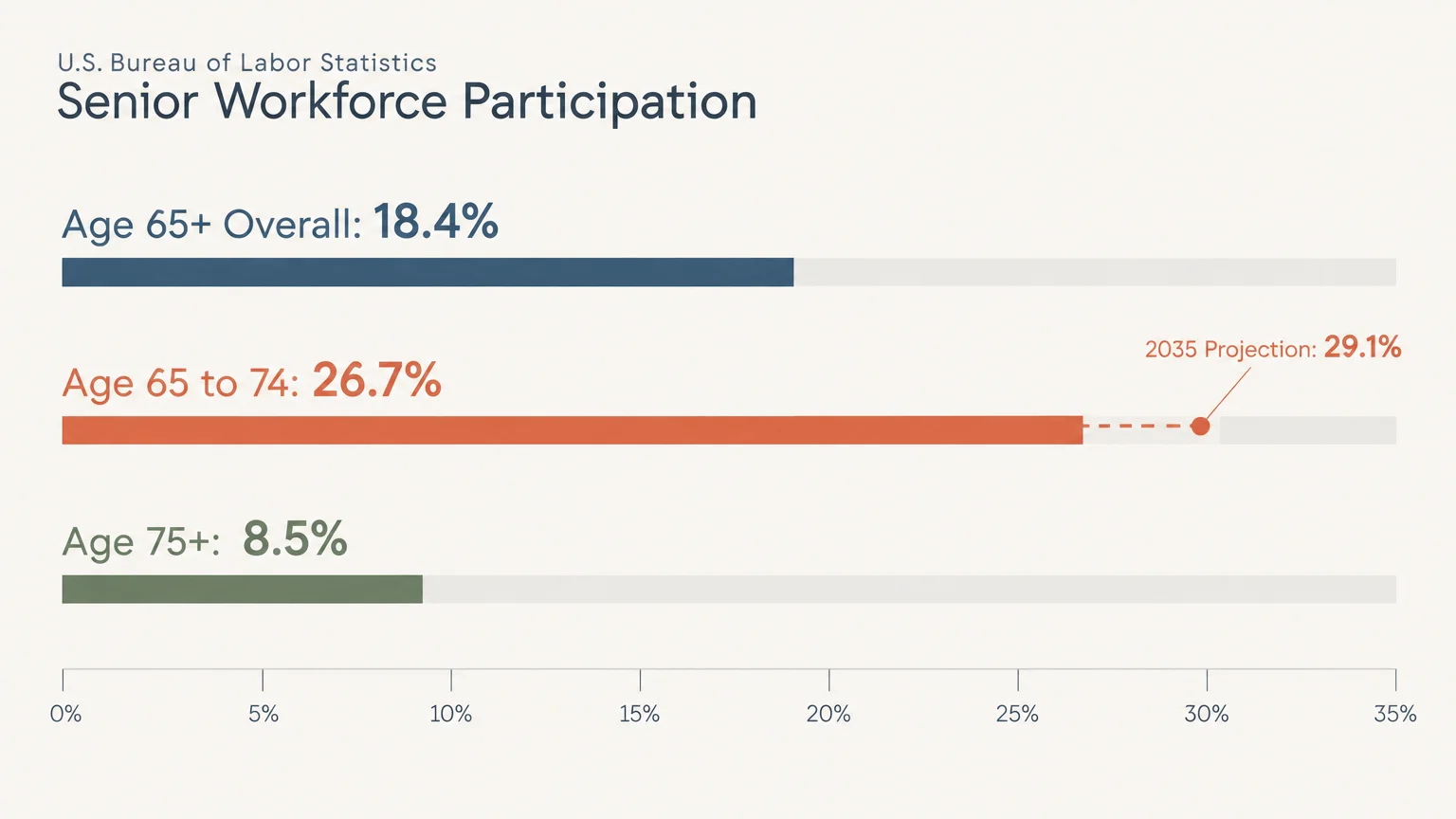
According to the U.S. Bureau of Labor Statistics, the labor force participation rate for Americans aged 65 and older stands at 18.4%. Older workers represent one of the fastest-growing segments of the national labor force.
Among adults aged 65 to 74, labor participation reaches 26.7%, and projections suggest that figure will hit 29.1% by 2035. Even for seniors aged 75 and older, labor participation sits at 8.5% and continues to climb.
Financial considerations play a major role in this trend. Supplemental part-time earnings cushion your household budget against inflation, allowing you to withdraw less from your retirement accounts each year.
“Retirement isn’t the end of work; it’s an opportunity to do work you love on your own terms.” — Jean Chatzky, Financial Journalist and Author
Beyond monetary gains, part-time work provides cognitive stimulation and gentle physical exercise. Interacting with diverse colleagues and customers helps maintain sharp mental faculties while preventing senior loneliness.

Retiree Work Stories: The Top 10 Part-Time Jobs
The following positions earned top ratings from working retirees across the country. These roles emphasize personal fulfillment, community connection, and healthy work-life balance over corporate climb.
1. Botanical Garden and Public Park Guide
If you love nature and fresh air, botanical gardens and municipal park conservancies offer outstanding opportunities. Guides lead visitor tours, answer questions about native plants, and assist with seasonal flower displays.
Arthur, 68, spent three decades as an insurance underwriter before becoming a conservatory guide. He works two four-hour shifts each week greeting guests and leading weekend walking tours.
“I log four miles of walking every shift without ever feeling like I am exercising,” Arthur shared. “I spend my mornings surrounded by rare orchids and chatting with curious travelers from around the world.”
These roles pay an hourly wage and provide light cardiovascular activity throughout your shift. They also offer seasonal schedules that allow you to work primarily during pleasant spring and autumn months.
To secure these positions, contact municipal parks departments or botanical societies in late winter before spring hiring surges begin. Emphasize any personal gardening experience or community volunteering on your application.
2. Public Library Assistant
Municipal libraries offer quiet, climate-controlled environments centered on community learning. Library assistants check books in and out, shelve returned volumes, assist patrons with digital catalogs, and help organize weekly reading clubs.
Clara, 71, sought a part-time job that allowed her to stay intellectually engaged without heavy physical strain. She works twelve hours a week at her local suburban library branch.
“The atmosphere is peaceful, and the patrons genuinely appreciate your assistance,” Clara explained. “I get first access to newly released literature, and helping young children find books brings immense personal joy.”
Library positions offer predictable morning or afternoon shifts that never interfere with evening family dinners. Many local governments also extend modest municipal discounts to part-time staff.
Check your city or county civil service job board regularly for library page and circulation assistant openings. Highlighting basic computer literacy and strong organizational skills will strengthen your candidacy.
3. Golf Course Starter or Course Marshal
For golf lovers, working at a municipal or daily-fee course is an ideal retirement arrangement. Starters manage tee times at the first tee, while marshals monitor pace of play across the course.
Greg, 66, retired from commercial logistics and took a starter position at a nearby public course. He works two early-morning weekday shifts each week.
“The hourly wage is decent, but the free golf privileges are the real benefit,” Greg noted. “I save thousands of dollars annually on green fees while spending sunny mornings outdoors with friendly players.”
This role demands approachable authority and clear communication skills to keep groups moving without conflict. It provides plenty of fresh air, gentle cart driving, and consistent social engagement.
Visit local clubhouses in early spring to speak directly with head golf professionals or general managers. Offering weekend flexibility or willingness to open early gives you an advantage over other applicants.
4. Specialty Hardware or Craft Store Associate
Big-box department retail can be grueling, but neighborhood hardware centers and specialty craft stores offer a far warmer atmosphere. These retailers actively recruit older workers for their practical knowledge and dependable attendance.
Marian, 69, worked as a school administrator before taking a position in the garden department of a local hardware center. She advises homeowners on soil amendments, seasonal bulbs, and lawn care.
“Customers come to me seeking advice on their home projects, not just ringing up merchandise,” Marian said. “The employee discount also saves me considerable money on my own home renovation hobbies.”
Managers frequently accommodate retirees by assigning consistent weekday morning shifts. You get to share your lifelong hobbies while enjoying steady hourly pay and store discounts.
Apply in person and ask to speak with the store manager about seasonal department needs. Point out your specific hands-on proficiencies, such as woodworking, framing, plumbing, or textile crafts.
5. School Bus or Activity Driver
Public school districts nationwide face steady demand for responsible, safety-conscious drivers. Districts typically provide commercial driver’s license (CDL) training at no charge to qualified candidates.
Dave, 65, became a district bus driver after retiring from long-haul freight operations. He drives a morning route from 6:30 to 8:30 a.m. and an afternoon run from 2:00 to 4:00 p.m.
“The split-shift schedule gives me five full hours in the middle of the day to exercise or run errands,” Dave remarked. “Having summers, winter holidays, and spring breaks completely free fits my travel plans.”
School driving roles offer higher hourly compensation than typical retail or food service jobs. Some districts also offer partial health benefits or guaranteed minimum weekly pay hours to reliable drivers.
Contact your local district transportation office in July or August to enroll in upcoming driver certification classes. Ensure you possess a clean driving record and pass a standard commercial physical exam.
6. Professional Pet Sitter and Dog Walker
Pet care enables animal-loving retirees to manage flexible solo businesses or work with established regional agencies. Daily tasks include dog walking, feeding household pets, and providing medication while owners work or travel.
Linda, 67, started walking dogs in her neighborhood three afternoons each week. She manages four regular canine clients within walking distance of her home.
“Spending time with dogs provides unconditional affection and keeps me walking every single day,” Linda said. “I choose my own clients, set my rates, and block off calendar dates whenever I travel.”
Because independent pet care operates on a self-employed basis, you set your own service boundaries. Tracking your business expenses and vehicle travel can yield valuable tax write-offs at year-end.
Complete a pet first-aid certification course and obtain basic commercial liability insurance before taking clients. Distributing flyers in local senior communities or pet supply shops generates steady neighborhood referrals.
7. Adult Education and Community College Instructor
Your career expertise remains deeply valuable long after you leave full-time employment. Community colleges, arts councils, and adult education centers hire industry veterans to lead non-credit evening or weekend classes.
Robert, 72, retired as a corporate accountant and now teaches basic personal bookkeeping at his local community college. He teaches two evenings each week during the spring and fall semesters.
“Teaching keeps my technical skills sharp while allowing me to mentor adults starting small businesses,” Robert explained. “There is no corporate politics, no administrative bureaucracy, and no grading pressure.”
These roles typically pay per course or by instruction hour. They provide an intellectual outlet and let you impart decades of professional wisdom to motivated adult students.
Draft a short syllabus proposal detailing an introductory class in your field and send it to the continuing education director. Practical courses in home maintenance, cooking, investing, and writing remain in high demand.
8. Museum Docent and Heritage Tour Guide
Local historical societies, art museums, and maritime centers rely on docents to bring cultural exhibits alive for visitors. Guides lead group tours, narrate historical events, and monitor gallery spaces during operational hours.
Evelyn, 70, transitioned from corporate paralegal work to serving as a paid historic mansion guide. She conducts ninety-minute walking tours three days a week for school groups and tourists.
“I immerse myself in local history and share captivating stories with enthusiastic audiences,” Evelyn noted. “Working in a beautiful, climate-controlled setting makes the physical activity effortless and rewarding.”
Tour guide roles stimulate memory recall and enhance public speaking abilities. They are ideal for retirees who enjoy storytelling, local culture, and interacting with diverse travelers.
Consider volunteering for a seasonal exhibit at a local historical venue to learn the ropes. Volunteer docents frequently receive first consideration when paid guide positions open up.
9. Remote Customer Care Representative
If you prefer working from home, remote customer support provides structured part-time employment. Many national brands hire home-based agents to answer customer questions, process orders, and schedule appointments.
James, 68, spent forty years commuting through dense traffic as an office manager before accepting a remote customer service role for an apparel retailer. He works sixteen scheduled hours each week.
“I completely eliminated gasoline costs, toll charges, and vehicle wear-and-tear,” James said. “I log into the company portal, assist friendly customers, and disconnect the moment my shift ends.”
Employers usually provide the necessary computer equipment, secure headsets, and operational software. This work requires dependable high-speed internet and a quiet workspace free from household background noise.
Target retail and healthcare companies known for hiring mature workers during their seasonal surges. Highlight your patience, clear telephone communication, and typing accuracy on your application.
10. Non-Emergency Medical or Campus Shuttle Driver
Healthcare systems, senior living communities, and university campuses hire drivers to transport patients, residents, and students along designated local routes. These positions prioritize calm driving habits and attentive passenger care over speed.
Frank, 73, operates a passenger van for a regional medical center two mornings each week. He transports seniors from suburban transit hubs to their outpatient appointments.
“My passengers are deeply grateful for safe, courteous transportation,” Frank explained. “The driving routes are predictable, the vehicles are professionally maintained, and the work provides genuine civic purpose.”
Unlike commercial ride-sharing apps, institutional driving jobs provide regular hourly wages and eliminate wear on your personal vehicle. Most employers cover all fuel, insurance, and vehicle maintenance costs.
Inquire directly with human resources departments at regional hospitals, community transit authorities, and university transportation offices. A clean personal driving record and a courteous disposition are the primary prerequisites.
Comparing the Best Part-Time Retirement Jobs
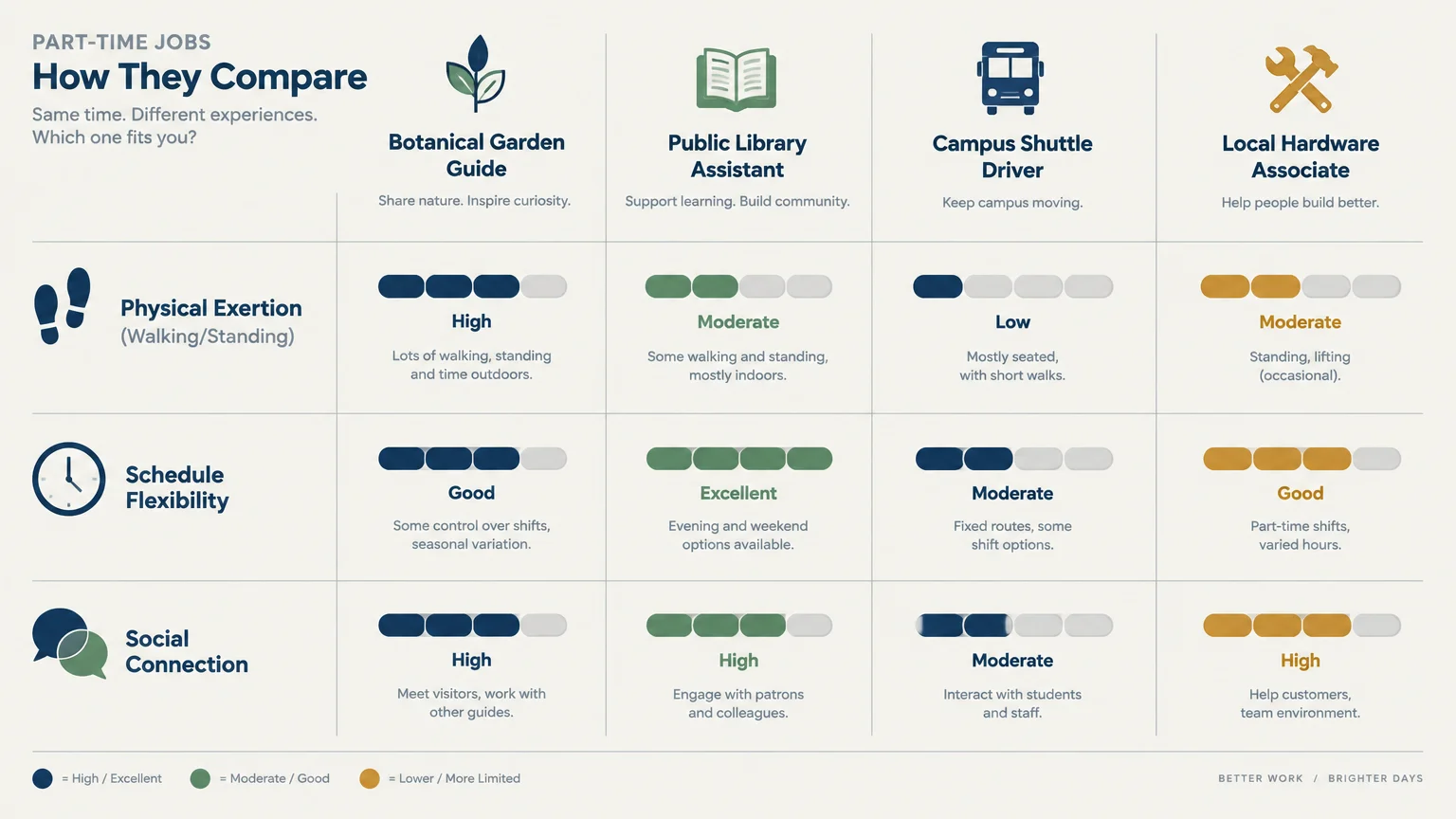
Choosing the right part-time job requires balancing physical stamina, hourly earnings, and personal schedule requirements. Evaluating roles across these dimensions ensures you select work that enhances your retirement lifestyle.
The table below summarizes key attributes of these popular retirement positions, including typical pay structures and physical activity demands.
| Job Title | Physical Demand | Social Interaction | Schedule Flexibility | Typical Pay Structure |
|---|---|---|---|---|
| Botanical Garden Guide | Moderate (Walking/Standing) | High (Tour Groups) | High (Seasonal/Shifts) | Hourly W-2 Wage |
| Public Library Assistant | Low to Moderate (Light Shelving) | Moderate (Patron Help) | Moderate (Set Shifts) | Hourly W-2 Wage |
| Golf Course Starter | Low (Sitting/Standing) | High (Golfers) | Moderate (Morning Runs) | Hourly W-2 + Free Golf |
| Hardware Store Associate | Moderate (Standing/Walking) | High (Customer Advice) | Moderate (Retail Shifts) | Hourly W-2 + Store Discount |
| School Bus Driver | Low (Seated Driving) | Moderate (Students/Staff) | High (Split Shifts/Summers Off) | Hourly W-2 Wage |
| Pet Sitter / Dog Walker | Moderate to High (Walking) | Low to Moderate (Pet Owners) | High (Self-Directed) | Per Visit / 1099 Income |
| Adult Education Instructor | Low (Classroom Delivery) | High (Students) | High (Evenings/Semesters) | Per Course / Contract Pay |
| Museum Tour Docent | Moderate (Walking Tours) | High (Visitors) | Moderate (Weekend/Day Shifts) | Hourly W-2 Wage |
| Remote Customer Support | Low (Desk Bound) | High (Phone/Digital Chat) | Moderate (Scheduled Windows) | Hourly W-2 Wage |
| Campus / Medical Shuttle Driver | Low (Seated Driving) | Moderate (Riders) | Moderate (Weekday Shifts) | Hourly W-2 Wage |
Review these distinctions carefully before submitting applications. A role with high schedule flexibility may require independent tax management, whereas W-2 roles handle tax withholding automatically.

Understanding Social Security Earnings Limits
Earning extra money during retirement can affect your Social Security benefits if you collect payments before reaching your Full Retirement Age (FRA). The Social Security Administration (SSA) applies an annual retirement earnings test to early beneficiaries.
For retirees who are under their FRA for the entire calendar year, the earnings limit is $24,480 ($2,040 per month). If you earn more than this cap, the SSA withholds $1 in benefits for every $2 earned above the threshold.
During the calendar year you reach your Full Retirement Age, a higher earnings limit applies. In that specific year, you can earn up to $65,160 ($5,430 per month) in the months prior to reaching your birthday.
For every $3 earned above this higher limit, the SSA withholds $1 in benefits. Once you reach your birthday month and hit your FRA, the earnings limit disappears entirely.
Full Retirement Age is 67 for anyone born in 1960 or later. After reaching age 67, you can earn an unlimited income from any job without losing a single dollar of your monthly Social Security benefit.
Withheld benefits are not permanently lost. When you attain your FRA, the SSA recalculates your monthly benefit upward to credit you for the payments withheld earlier.
Social Security benefits recently received a 2.8% cost-of-living adjustment (COLA). Monitoring your part-time wages alongside your updated benefit amount prevents unexpected benefit suspension.

Taxes, Mileage, and Take-Home Pay for Working Seniors
Working after retirement carries distinct tax obligations that differ from your career years. Even if you already collect monthly Social Security checks, your part-time earnings remain subject to federal payroll taxes.
All W-2 wage earners pay FICA taxes at a standard rate of 7.65%, covering Medicare and Social Security contributions. If you take independent contractor (1099) roles, you must pay self-employment tax at the full 15.3% rate.
Working as a 1099 contractor allows you to deduct qualifying business expenses against your gross income. The Internal Revenue Service (IRS) permits valuable standard mileage deductions for business-related driving.
For the tax year, the IRS established a split standard mileage rate for business use of a personal vehicle. The deductible rate is 72.5 cents per mile from January 1 through June 30.
For business miles driven between July 1 and December 31, the deductible rate increases to 76 cents per mile. Keeping a detailed driving log ensures you capture every qualifying business mile on your tax return.
“A part-time paycheck in retirement does more than boost your bank account; it protects your principal investments.” — Suze Orman, Personal Finance Author
Earning additional wages can also push your combined income into ranges where a greater portion of your Social Security benefits becomes taxable. Calculating your combined income annually protects you from surprise tax bills.

Costly Errors to Sidestep
Entering the part-time workforce without a strategic financial plan can trigger avoidable tax penalties and benefit reductions. Here are four common mistakes older workers make and how you can avoid them.
Overlooking the Early Social Security Earnings Ceiling: Earning wages above $24,480 before your FRA leads to withheld benefit checks. Track gross wages monthly to ensure you stay under the threshold if you rely on every check.
Neglecting Quarterly Estimated Tax Payments: Self-employed gig workers and independent pet sitters often forget that taxes are not automatically withheld from client payments. Filing quarterly estimated taxes prevents IRS underpayment penalties at year-end.
Triggering Higher Medicare Part B and Part D Premiums: Significant part-time wages can increase your modified adjusted gross income enough to trigger Medicare’s Income-Related Monthly Adjustment Amount (IRMAA). Check how supplemental wages affect your two-year lookback tax threshold.
Underestimating Physical Demands on Aging Joints: Accepting a retail or logistics role requiring six continuous hours of standing can cause chronic joint pain or fatigue. Always clarify physical standing and lifting expectations during your interview.

When DIY Isn’t Enough
While many seniors navigate part-time work independently, complex tax and benefits rules sometimes require professional financial guidance. Consulting a certified public accountant (CPA) or certified financial planner (CFP) makes sense in several specific situations.
- Coordinating Required Minimum Distributions (RMDs) With Wages: If you are 73 or older and taking mandatory retirement withdrawals, adding part-time earnings can push your income into a higher tax bracket. A tax professional can model optimal withdrawal strategies.
- Evaluating 1099 Independent Contractor vs. W-2 Status: Transitioning to consulting work requires sophisticated tax planning around business expense deductions and home office rules. An accountant ensures you calculate your 15.3% self-employment liability correctly.
- Protecting Means-Tested Senior Assistance Benefits: If you receive Supplemental Security Income, Medicaid, or SNAP food assistance, extra earned wages can jeopardize your eligibility. An elder law attorney or benefits specialist can calculate exact program limits.
- Managing Multi-State Tax Filing Obligations: Snowbirds who split time across state lines while working seasonal jobs face overlapping state income tax requirements. A professional accountant ensures you file properly across multiple state tax jurisdictions.
Organizations like the National Council on Aging (NCOA) and AARP offer valuable community resources to help older adults explore employment programs safely.
Frequently Asked Questions About Retirement Work
Do I have to pay Social Security taxes on part-time wages if I already collect benefits?
Yes. Federal law mandates that all employees pay the 7.65% FICA tax on earned wages regardless of age or benefit status.
These additional contributions can sometimes increase your primary insurance amount if your recent earnings replace lower-earning years in your top 35 wage history.
How many hours a week can a retiree work without losing benefits?
The Social Security Administration monitors your total earned gross dollars, not the number of hours you work each week.
If you are under Full Retirement Age, you can work as many hours as you choose as long as annual earnings remain under $24,480.
Can I contribute to a Roth IRA using money earned from a part-time job?
Yes, earned income from part-time employment qualifies you to make annual contributions to a traditional or Roth IRA.
You cannot contribute investment dividends or pension payments, but taxable wages from part-time work allow you to keep saving.
Will working a part-time job affect my Medicare coverage?
Part-time wages do not alter your basic Medicare eligibility once you reach age 65.
However, substantial earned income could increase your Medicare Part B and Part D premiums if your total income exceeds IRMAA thresholds.
Taking Your Next Steps Toward Rewarding Work
Part-time work in retirement offers far more than an extra paycheck; it provides community connections, mental sharpness, and personal fulfillment. Choosing a role that matches your physical capabilities and passions ensures your post-career years remain joyful.
Take time to assess your local job market, review the Social Security earnings ceilings, and talk with hiring managers about flexible scheduling. With the right part-time role, you can enjoy rewarding engagement alongside the freedom of retirement.
This article provides general financial education and information only. Everyone’s financial situation is unique—what works for others may not work for you. For personalized advice tailored to your retirement needs, consider consulting a qualified financial professional such as a CFP or CPA.
Last updated: October 2026. Benefit amounts, tax rules, and program details change annually—verify current figures with official government sources.









Leave a Reply