

Searching for a retirement job is rarely just about earning an hourly wage. The right role should protect your lifestyle and help preserve your accumulated nest egg.
According to the U.S. Bureau of Labor Statistics, roughly one in five Americans aged 65 and older now participates in the civilian workforce. Over 38% of those workers hold part-time positions.
Discovering flexible jobs for retirees with top benefits transforms ordinary part-time hours into genuine financial security. Knowing what to look for in a retirement job can drastically reduce your out-of-pocket expenses.

Schedule Control and Flexible Working Arrangements
Schedule flexibility serves as the single most vital non-monetary perk in any retirement job. You spent decades bound to rigid schedules; your encore career should honor your hard-earned personal freedom.
Target employers offering compressed workweeks, self-scheduling portals, or job-sharing models. These arrangements allow two workers to split a single full-time position without losing coverage.
If you enjoy traveling or wintering in warmer climates, look for seasonal contracts or snowbird-friendly policies. Many national hardware retailers, hospitality chains, and park services routinely accommodate extended seasonal leaves.
Remote and hybrid opportunities also eliminate commute times and transit costs. Roles in virtual customer support, bookkeeping, and online tutoring grant complete geographic freedom while keeping your mind sharp.
Healthcare Coverage and the 20-Employee Medicare Rule
Securing employer-sponsored health insurance is one of the best retirement job perks available today. This perk delivers enormous savings if you retire before reaching Medicare eligibility at age 65.
Major employers like Starbucks, Costco, and Lowe’s historically offer part-time jobs for retirees with benefits, including group medical insurance. Earning coverage on a 20-hour weekly schedule can bridge costly pre-65 health insurance gaps.
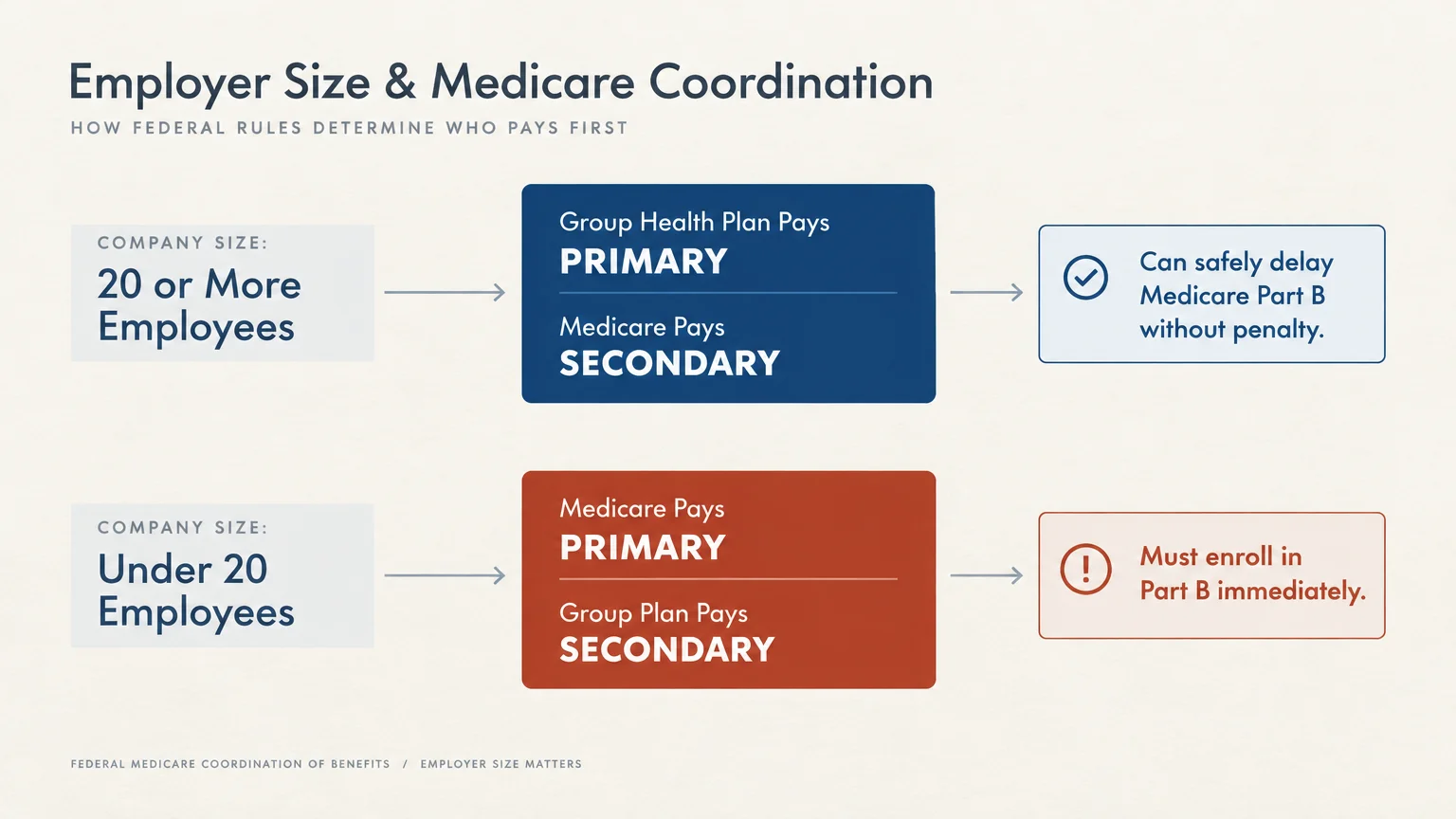
If you are 65 or older, you must evaluate employer coverage under federal Medicare coordination rules. According to Medicare.gov, the size of your company dictates which insurance pays first.
If your employer has 20 or more employees, the group health plan pays primary, while Medicare pays secondary. In this scenario, you can safely delay Medicare Part B without incurring late-enrollment penalties.
If the business employs fewer than 20 workers, Medicare acts as your primary payer. You must enroll in Part B immediately, because small-group policies will reject claims that Medicare should cover.
Be careful if your workplace offers a high-deductible plan paired with a Health Savings Account (HSA). Enrolling in any Medicare tier—even premium-free Part A—permanently disqualifies you from contributing to an HSA.

Workplace Retirement Plans and SECURE 2.0 Opportunities
A retirement job can actively fortify your investments rather than simply providing spending cash. Recent legislation expanded retirement plan access for part-time workers across the country.
Under the federal SECURE 2.0 Act, Long-Term Part-Time (LTPT) rules became fully effective on January 1, 2025. Employers must now include part-time workers who log at least 500 hours annually for two consecutive years.
This federal rule grants you access to salary deferrals in company 401(k) and ERISA-governed 403(b) plans. Matching employer contributions remain optional, but automated savings provide immediate tax advantages.
You can also capitalize on updated catch-up contribution provisions verified through the Internal Revenue Service (IRS). Workers turning ages 60 to 63 qualify for enhanced “super catch-up” limits.
In 2025 and 2026, eligible workers in that specific age bracket can defer an extra $11,250 into their 401(k). That provides a substantial boost over standard catch-up caps.
Beginning in 2026, employees whose prior-year FICA wages exceeded $150,000 must direct their catch-up contributions into post-tax Roth accounts. This rule diversifies your future tax liability while keeping current assets compounding.
Protecting Social Security: The Retirement Earnings Test
Earning an outside paycheck requires careful planning if you claim Social Security before reaching your Full Retirement Age (FRA). Anyone born in 1960 or later reaches Full Retirement Age at 67.
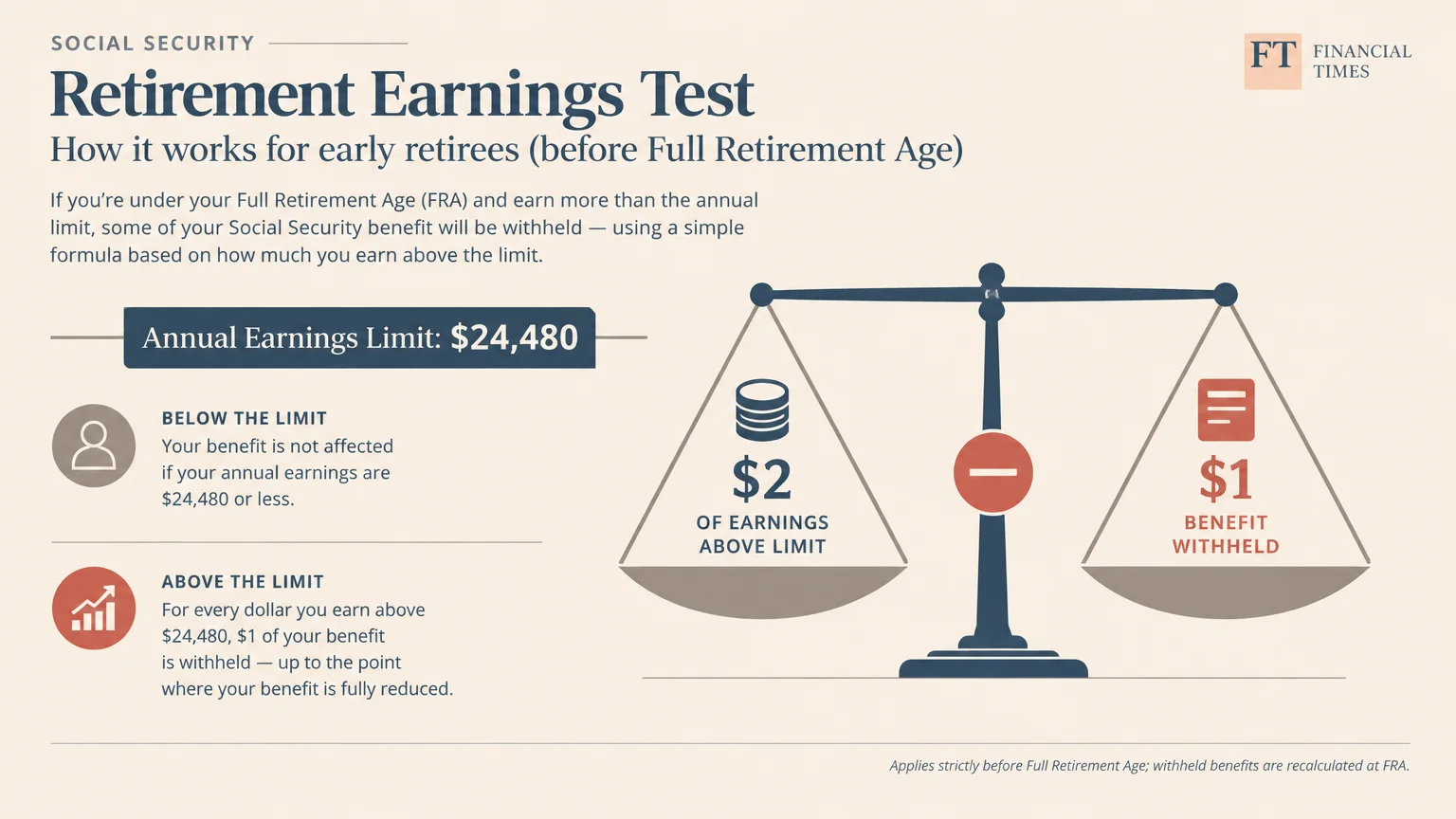
If you claim benefits early, the Social Security Administration (SSA) applies the Retirement Earnings Test (RET). Exceeding annual statutory earnings thresholds leads to temporary benefit withholdings.
For 2025, the annual exempt earnings limit is $23,400, rising to $24,480 in 2026. The SSA temporarily withholds $1 of benefits for every $2 you earn above these baseline amounts.
In the calendar year you reach Full Retirement Age, a much higher earnings limit applies. That exempt threshold is $62,160 in 2025, climbing to $65,160 in 2026.
For those months prior to your birthday in that FRA year, the SSA withholds $1 for every $3 earned over the limit. Once you hit your FRA month, all earnings limits disappear permanently.
These withheld funds are not lost forever. Once you achieve Full Retirement Age, the SSA recalculates your monthly benefit upward to credit all previously withheld payments.
Retiree Job Perks Comparison Guide
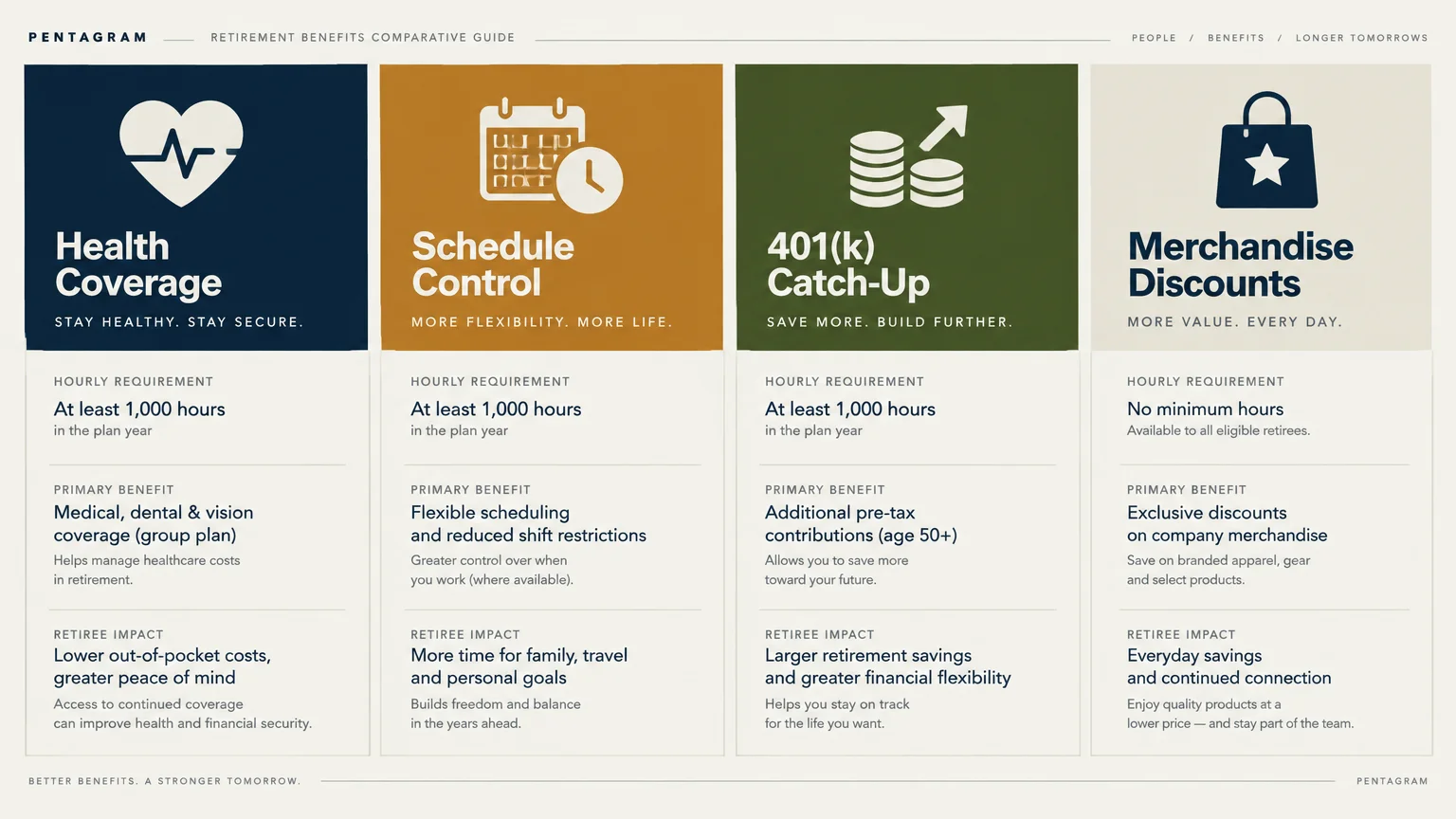
Evaluating potential compensation requires weighing financial value against your available time and health. Use this retiree job benefits guide to compare common offerings.
| Benefit Category | Key Advantages | Ideal Candidate | Regulatory Rule to Verify |
|---|---|---|---|
| Group Health Insurance | Covers major medical bills, reduces monthly premiums, and supplies affordable prescription coverage. | Pre-65 retirees or spouses without affordable primary health coverage. | The 20-employee Medicare payer coordination threshold. |
| 401(k) / 403(b) Access | Lowers current adjusted gross income and unlocks high-tier catch-up contribution limits. | Workers aged 55–63 seeking to rebuild retirement capital. | SECURE 2.0 500-hour service eligibility requirement. |
| Flexible Shift Swapping | Guarantees personal time for family caregiving, travel, and personal hobbies. | Retirees seeking healthy social engagement without corporate stress. | Minimum hour obligations for active employee status. |
| Tuition Assistance | Funds lifelong learning, continuing education, and skill acquisition at zero out-of-pocket cost. | Curious seniors pursuing creative or technical pursuits. | IRS Section 127 annual tax-free limits ($5,250). |
| Store & Service Discounts | Provides substantial savings on home repair, groceries, pet supplies, and travel. | Budget-conscious seniors managing ongoing household renovations. | Employee discount taxation guidelines under IRS rules. |

Valuable Secondary Perks: Discounts, Travel, and Wellness
Beyond standard health and retirement accounts, secondary perks can save you thousands of dollars annually. When reviewing compensation, do not overlook employee merchandise discounts.
Working part-time at hardware centers, nursery retailers, or craft stores often unlocks 10% to 25% savings. If you maintain a garden or manage home improvement projects, those savings quickly rival cash wages.
Retirees with a passion for global travel frequently pursue customer service or ramp agent roles with major commercial airlines. These positions offer standby travel passes for workers and their spouses.
Educational institutions offer another incredible, underutilized work environment. Community colleges and universities regularly extend tuition waivers to part-time staff, enabling you to audit classes or earn new certifications for free.
Many senior-friendly employers also sponsor comprehensive wellness benefits. Subsidized gym memberships, annual health screenings, and on-site ergonomics keep you active, healthy, and energized.

Expert Perspective on Working in Retirement
Working in your later years provides psychological, cognitive, and financial benefits that compound over time. Leading financial minds consistently praise the multiplying effect of part-time labor.
“Working even a few years longer—or working part-time in retirement—is one of the most powerful moves you can make to secure your financial future.” — Jean Chatzky, Financial Journalist and Author
Earning even $15,000 to $20,000 annually significantly reduces portfolio withdrawals. This allows your underlying assets to weather market downturns without triggering forced liquidations.
Organizations like the National Council on Aging (NCOA) emphasize that structured work promotes cognitive vitality. Routine social connections combat isolation and support overall mental longevity.
Common Mistakes to Avoid
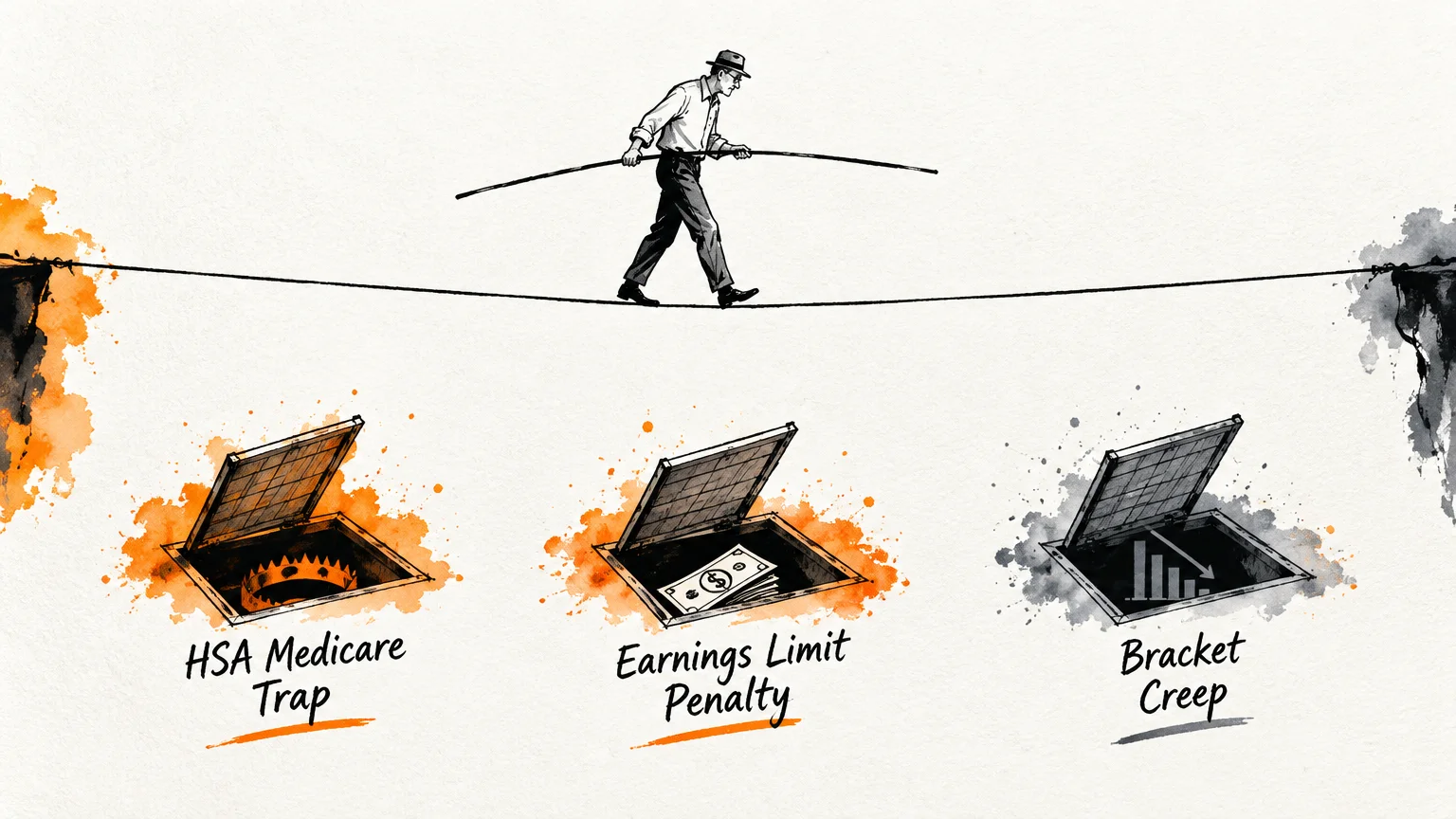
Stepping back into the workforce presents hidden traps that can disrupt your taxes and benefits. Watch out for these common missteps before accepting an employment offer.
- Misjudging the Medicare 20-Employee Limit: Assuming your new company’s medical plan pays first can cause massive unpaid hospital bills. Always verify company headcount directly with human resources.
- Accidentally Triggering Social Security Clawbacks: Earning beyond the $23,400 limit (in 2025) or $24,480 limit (in 2026) while under FRA triggers unexpected benefit reductions. Track your monthly pay stubs meticulously.
- Contributing to an HSA While on Medicare: If you enroll in any part of Medicare, continuing to fund an HSA triggers IRS excise penalties. Cease all contributions at least six months before enrolling in Part A.
- Overcommitting to Rigid Work Hours: Taking a role that demands constant overtime undermines the purpose of retirement. Always set clear, enforceable scheduling boundaries during your initial interview.

Finding the Right Advisor for Your Second Career
Introducing wage income to existing pension payouts, dividends, and Social Security benefits complicates your tax return. Consulting a credentialed professional helps you sidestep expensive pitfalls.
A Certified Financial Planner (CFP) or CPA can evaluate how extra earnings influence your tax bracket. Modest earned income might inadvertently expose more of your Social Security benefits to federal taxation.
Advisors also help high earners monitor Income-Related Monthly Adjustment Amount (IRMAA) tiers. Earning too much at your retirement job could trigger surcharges on your Medicare Part B and Part D premiums.
Seek out fee-only fiduciary advisors who do not sell commission-based insurance products. Professional guidance guarantees your new paycheck enhances your financial freedom rather than eroding your hard-won benefits.
Frequently Asked Questions About Retirement Job Perks
Can I contribute to a 401(k) if I work part-time in retirement?
Yes. Under the SECURE 2.0 Act, part-time employees working at least 500 hours for two consecutive years can contribute pre-tax salary to employer-sponsored plans.
Will a part-time job reduce my monthly Social Security benefits?
Your benefits will only be temporarily withheld if you are younger than Full Retirement Age and earn more than $23,400 in 2025 (or $24,480 in 2026).
Can I drop Medicare Part B if my retirement job offers health insurance?
You can safely delay or drop Part B only if your employer has 20 or more workers. If the employer has fewer than 20 workers, Medicare remains primary.
Are employee discounts considered taxable income by the IRS?
Qualified employee discounts on merchandise are tax-free up to the employer’s gross profit percentage. Services are tax-free up to a 20% discount under IRS rules.
Next Steps for Your Job Search
Start your job search by cataloging your primary lifestyle goals alongside your monetary requirements. Decide whether schedule autonomy, medical protection, or simple retail discounts deliver the greatest net value to your household.
Explore reputable platforms such as the AARP Job Board to locate age-friendly employers. Prioritize positions that respect your boundaries, celebrate your vast experience, and support your long-term independence.
This article provides general financial education and information only. Everyone’s financial situation is unique—what works for others may not work for you. For personalized advice tailored to your retirement needs, consider consulting a qualified financial professional such as a CFP or CPA.
Last updated: February 2026. Benefit amounts, tax rules, and program details change annually—verify current figures with official government sources.









Leave a Reply