
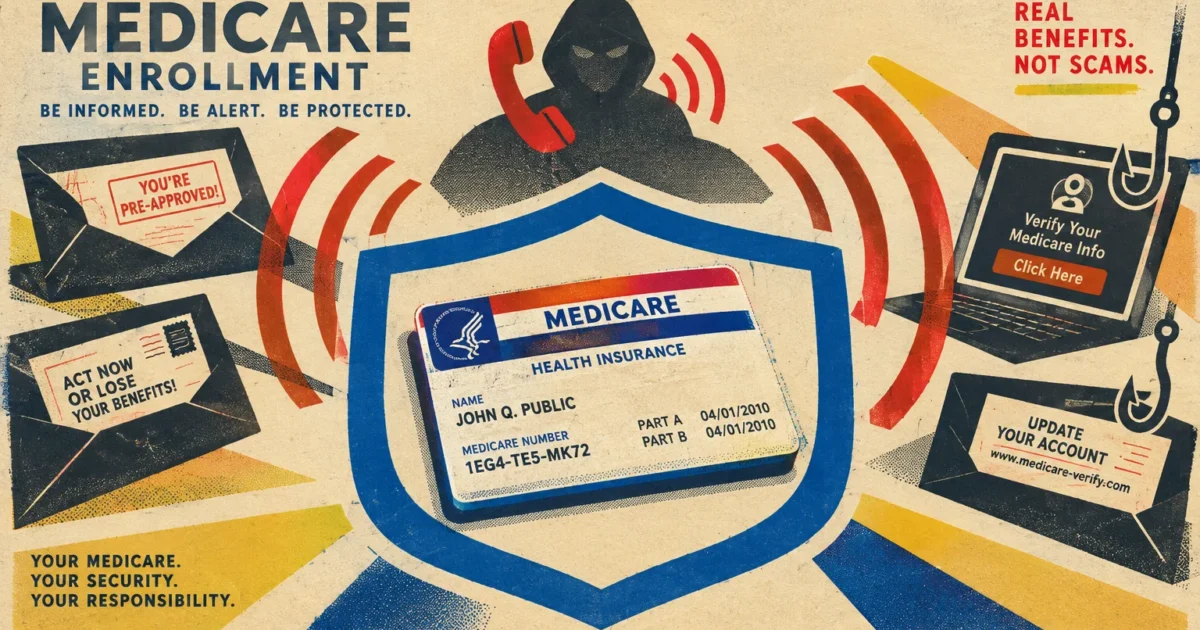
Medicare Open Enrollment creates a prime window for identity thieves and predatory marketers seeking your personal information. Between October 15 and December 7, aggressive callers use confusing healthcare rules to pressure unsuspecting seniors.
Con artists target your red, white, and blue paper card to bill billions in bogus services or divert your benefits. Learning their deceptive playbooks keeps your hard-earned healthcare safe and your monthly budget intact.
This detailed guide reveals the exact tactics criminals deploy during enrollment season and gives you practical defenses to safeguard your coverage.
The Massive Scope of Medicare Fraud Targeting Retirees
Healthcare fraud places an enormous financial burden on public systems and individual retirees alike. Criminal syndicates treat annual enrollment periods as open season on senior savings.
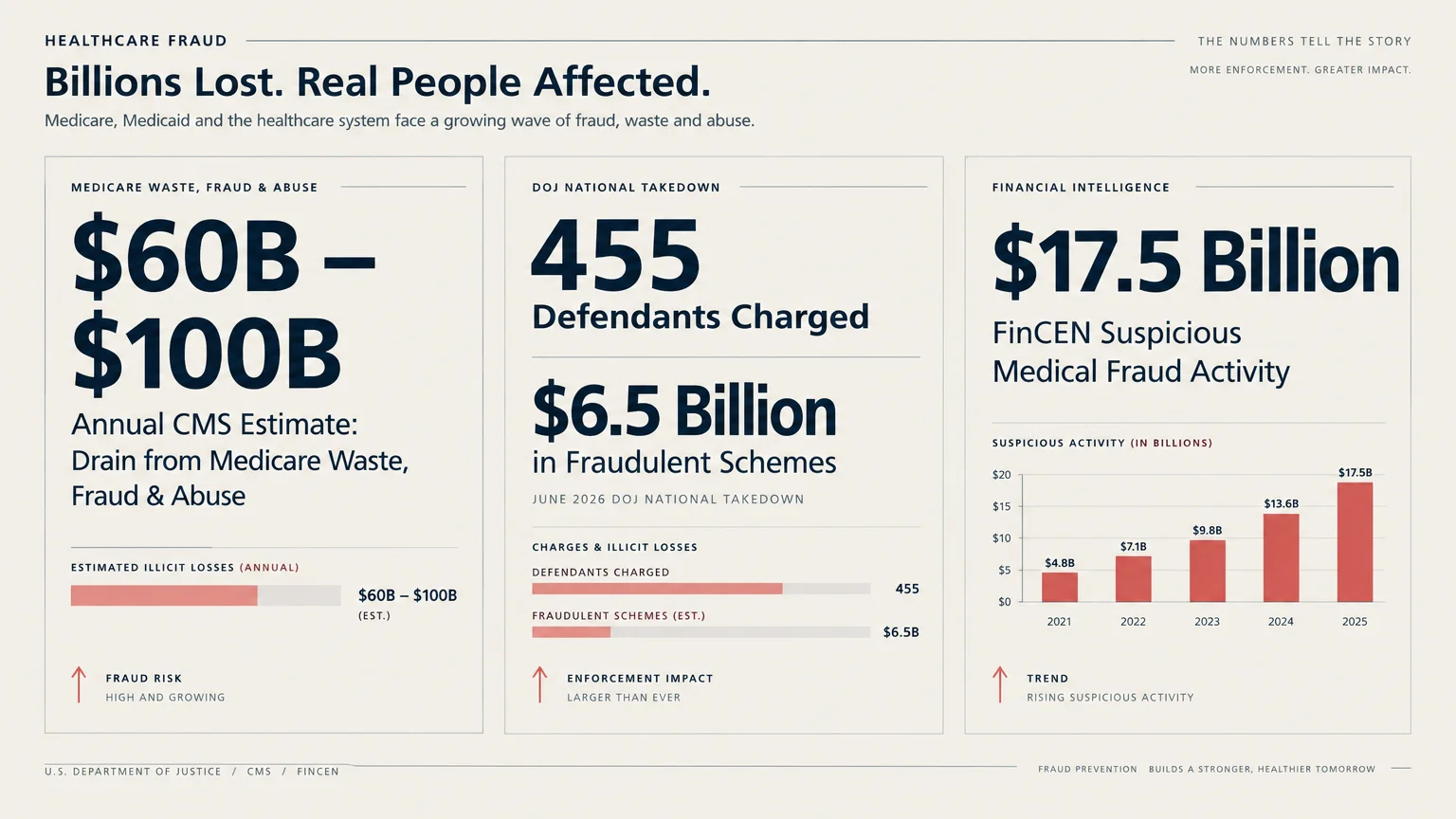
According to the Centers for Medicare & Medicaid Services, fraudulent billing, waste, and abuse drain between $60 billion and $100 billion from taxpayers every year.
The U.S. Department of Justice highlighted this ongoing crisis during its June 2026 National Health Care Fraud Takedown. Federal prosecutors charged 455 defendants who participated in over $6.5 billion in fraudulent healthcare schemes.
Additionally, the Financial Crimes Enforcement Network identified $17.5 billion in suspicious financial activity linked to medical fraud in September 2026. Criminal networks systematically harvest stolen identifiers to file illegitimate claims across the nation.
Protecting your coverage requires understanding how these networks operate. Scammers continuously adapt their scripts around federal policy changes and genuine program updates to trick you.
1. The “New Plastic or Chipped Medicare Card” Deception
One of the most persistent schemes involves callers offering a replacement card. Scammers claim Medicare is replacing paper cards with modern plastic, metal, or microchipped cards for the 2027 plan year.
The caller insists that your current coverage will expire unless you verify your identity. They demand your 11-character Medicare Beneficiary Identifier to issue your upgraded card.
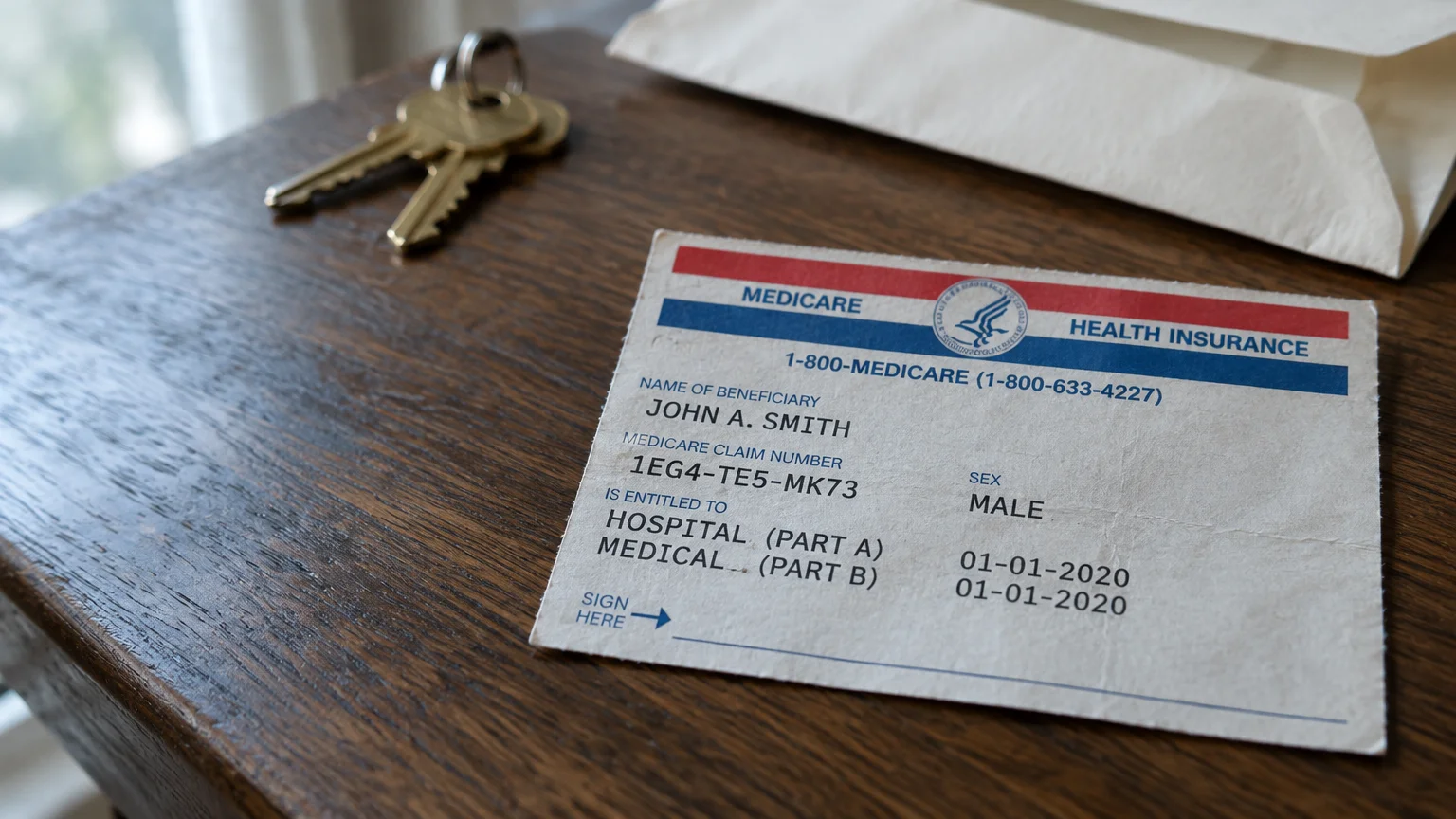
In reality, Medicare never issues plastic, metal, or smart-chipped identification cards. Official cards remain paper, displaying your unique alphanumeric identifier alongside the red, white, and blue design.
The government will never contact you unannounced to demand personal details for a replacement card. If a caller insists your card is obsolete, hang up immediately.
2. The Fake “Part B Giveback” and Direct Deposit Rebate
High healthcare costs make the promise of extra monthly income tempting. Scammers exploit this reality by promoting fake premium refund programs.
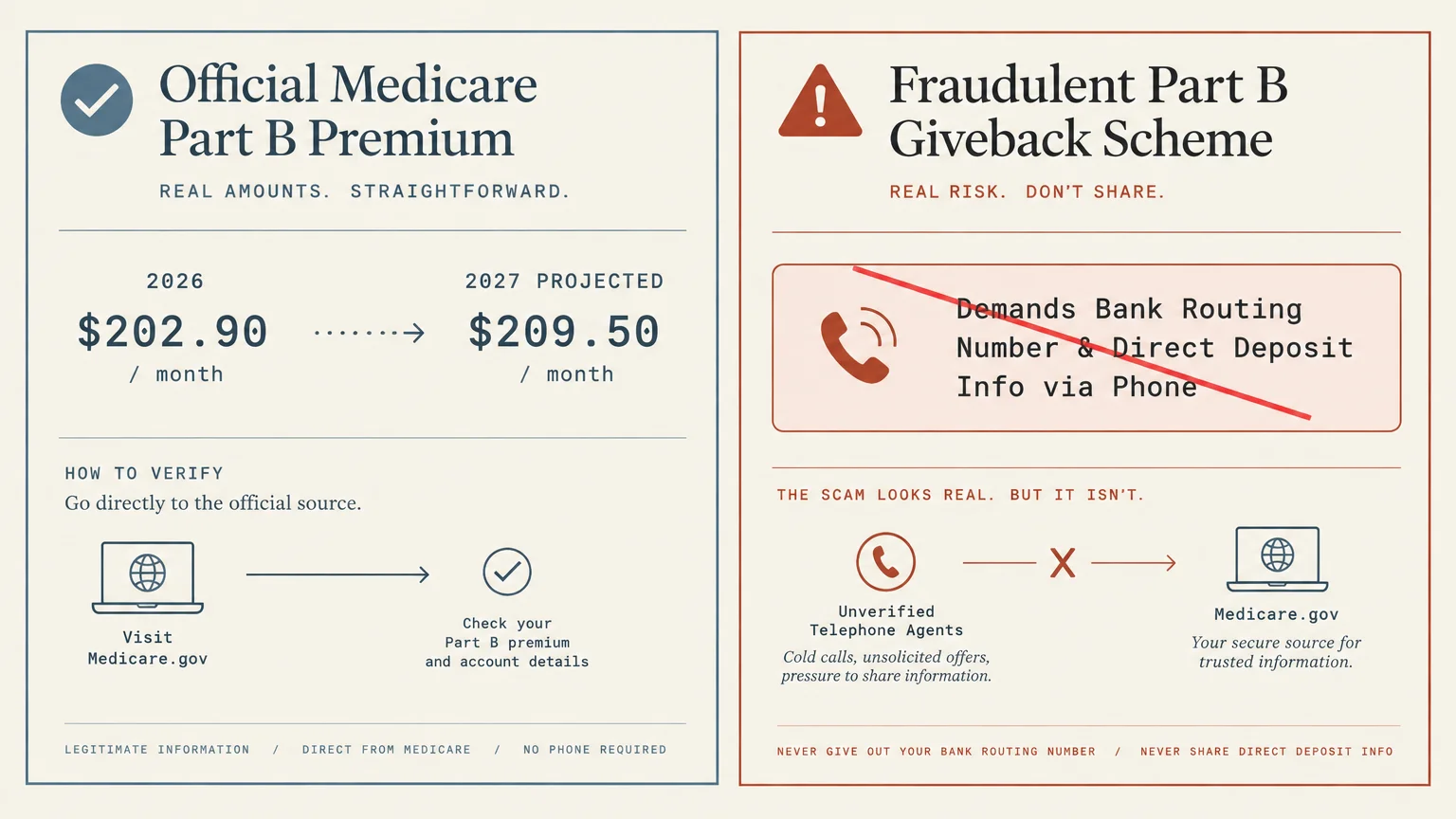
The standard Medicare Part B premium sits at $202.90 per month in 2026 and is projected to rise to $209.50 in 2027. Fraudsters promise to deposit that entire premium back into your checking account.
To qualify you for this nonexistent rebate, the caller asks for your Medicare identifier, Social Security number, and direct deposit routing information. Once obtained, they use this data to compromise your accounts.
While legitimate Medicare Advantage plans may feature genuine Part B giveback provisions, they never require telephone verification of private banking credentials. Verify all coverage options directly through Medicare.gov rather than accepting telephone offers.

3. Bogus Deadlines and Coverage Cancellation Threats
High-pressure sales representatives frequently weaponize fear to force hasty decisions. Callers claim you must take immediate action to avoid losing your prescription drug coverage or hospital benefits.
These imposters often invent artificial deadlines weeks before the actual close of Open Enrollment on December 7, 2026. Alternatively, they claim sudden rule changes require urgent re-enrollment over the phone.
All plan selections finalized during the fall window take effect on January 1, 2027. Traditional Medicare coverage does not expire simply because you decide not to change plans.
Legitimate federal agencies do not threaten beneficiaries with coverage termination over unsolicited calls. When anyone creates a sense of panic regarding your benefits, step back and verify the claim independently.

4. Telemarketing Violations and Unsolicited Cold Calling
Unsolicited sales pitches represent one of the most common enrollment violations. Shady insurance agents routinely buy lead lists to conduct illegal cold calling campaigns.
The Centers for Medicare & Medicaid Services enforces strict marketing rules governing private insurance agents. Licensed representatives cannot call, text, or email you unless you submitted an explicit request for contact.
Agents cannot approach you in public spaces, visit your home uninvited, or offer gifts exceeding statutory limits. Cold callers often use deceptive scripts to switch your coverage without informed consent.
If an unknown agent contacts you out of nowhere, end the conversation. Report unsolicited sales calls directly to your state insurance commissioner or the National Council on Aging network.
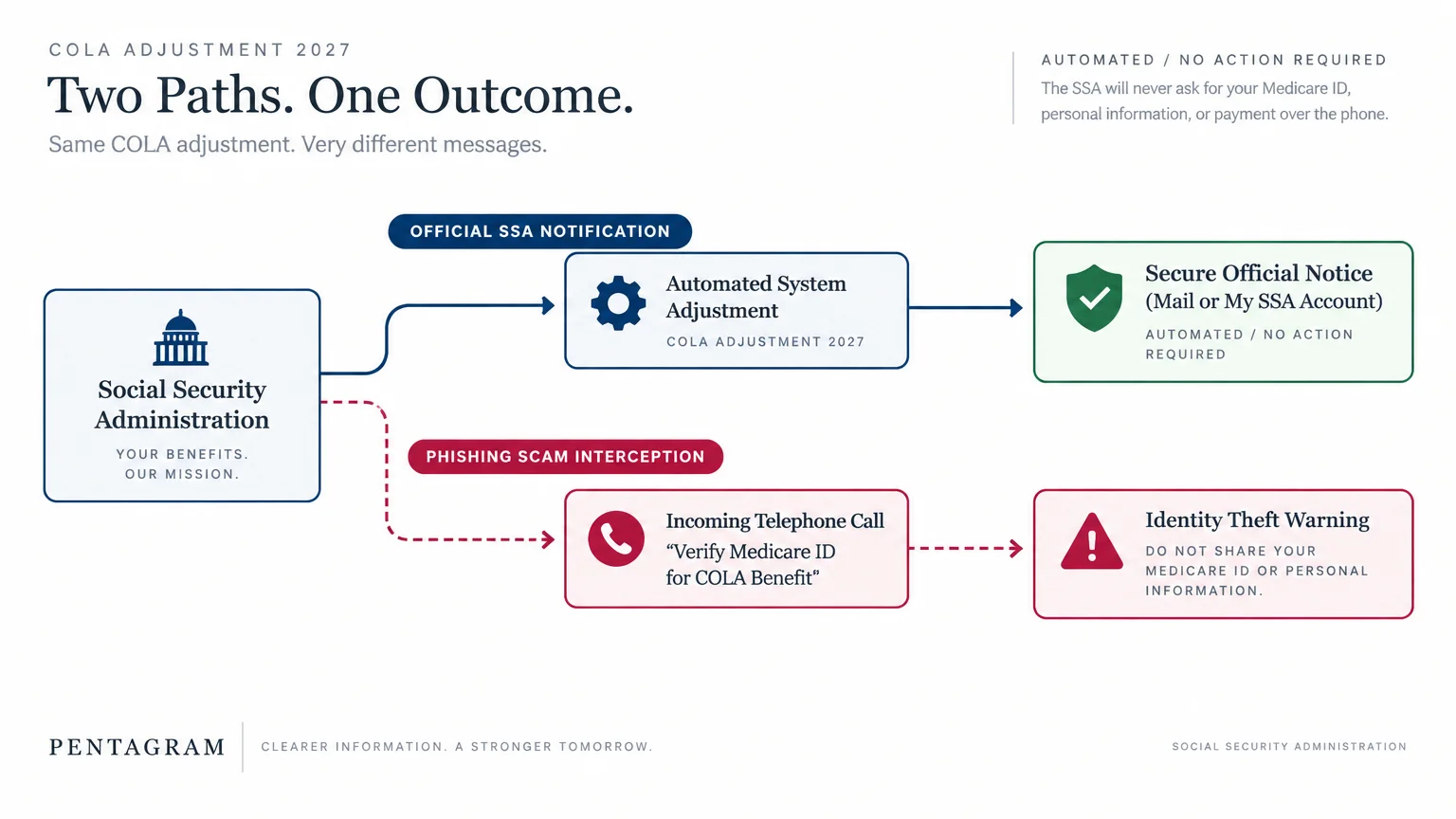
5. The 2027 Social Security COLA Verification Trap
Every autumn, the Social Security Administration announces the annual Cost-of-Living Adjustment for the upcoming calendar year. Scammers quickly incorporate these figures into predatory Medicare phone scripts.
The Social Security Administration announced a 3.6% COLA increase for 2027, adding approximately $75 per month for the average retired worker. Fraudsters use this announcement to manufacture believable cover stories.
Callers claim that your Part B premium increase will completely erase your raise unless you re-register your coverage. They promise to lock in lower rates if you provide your Medicare number.
The Social Security Administration handles COLA adjustments automatically. You never need to verify personal numbers or complete applications to receive your cost-of-living increase.
“Scammers rely on fear and confusion to steal your hard-earned security; knowing the rules is your best defense.” — Jean Chatzky, Financial Journalist and Author

6. Catheter and Medical Equipment Billing Schemes
Medical identity theft often goes unnoticed until strange claims appear on your quarterly Medicare Summary Notice. Stolen numbers fuel nationwide billing cartels that fleece federal healthcare programs.
In September 2026, federal regulators blocked $3.4 billion in fraudulent claims across 11 medical supply companies. These rogue entities billed Medicare for unrequested durable medical equipment, wound care, and urinary catheters.
Fraudulent operators often call seniors offering “free” back braces, knee supports, or specialty diabetic monitors. Once you share your identifier, they bill Medicare thousands of dollars while sending cheap, defective equipment.
Never accept unsolicited medical shipments that your personal doctor did not prescribe. Review your quarterly statements regularly and challenge any billing entries from providers you never visited.

7. Prescription Drug Cap Confusion and Phony Discount Cards
Significant updates to Medicare Part D create an ideal environment for misleading sales pitches. Swindlers take advantage of policy nuances to sell fake supplement policies.
The Part D annual out-of-pocket prescription cap increases from $2,100 in 2026 to $2,400 in 2027. Meanwhile, the maximum standard Part D deductible climbs to $700 in 2027 from $615 in 2026.
Con artists call retirees claiming these cost changes mean your current drug plan is being cancelled. They pitch proprietary discount cards that allegedly eliminate all deductibles and copayments for an upfront fee.
Legitimate Medicare Part D plans never charge separate subscription fees over the telephone to access federal coverage limits. Always confirm prescription formulary changes directly with your current plan administrator.

8. GLP-1 and Weight-Loss “Bridge” Phishing Schemes
High public demand for metabolic and weight-management drugs has spawned sophisticated digital fraud rings. Cybercriminals target older adults seeking affordable coverage for these expensive medications.
Recent federal initiatives, such as the Medicare GLP-1 Bridge program offering a $50 copay for qualifying treatments, have drawn heavy attention. The launch of TrumpRx.gov for cash-price drug discounts also provides scammers with fresh material.
Scammers launch fake websites and sponsored search advertisements mimicking official portals. They promise instant access to premium brand-name medications if you complete an online health questionnaire containing your Medicare identifier.
Once you submit your details, thieves sell your medical identity on illicit forums or bill Medicare for bogus services. Only access federal prescription programs through verified government websites ending in .gov.
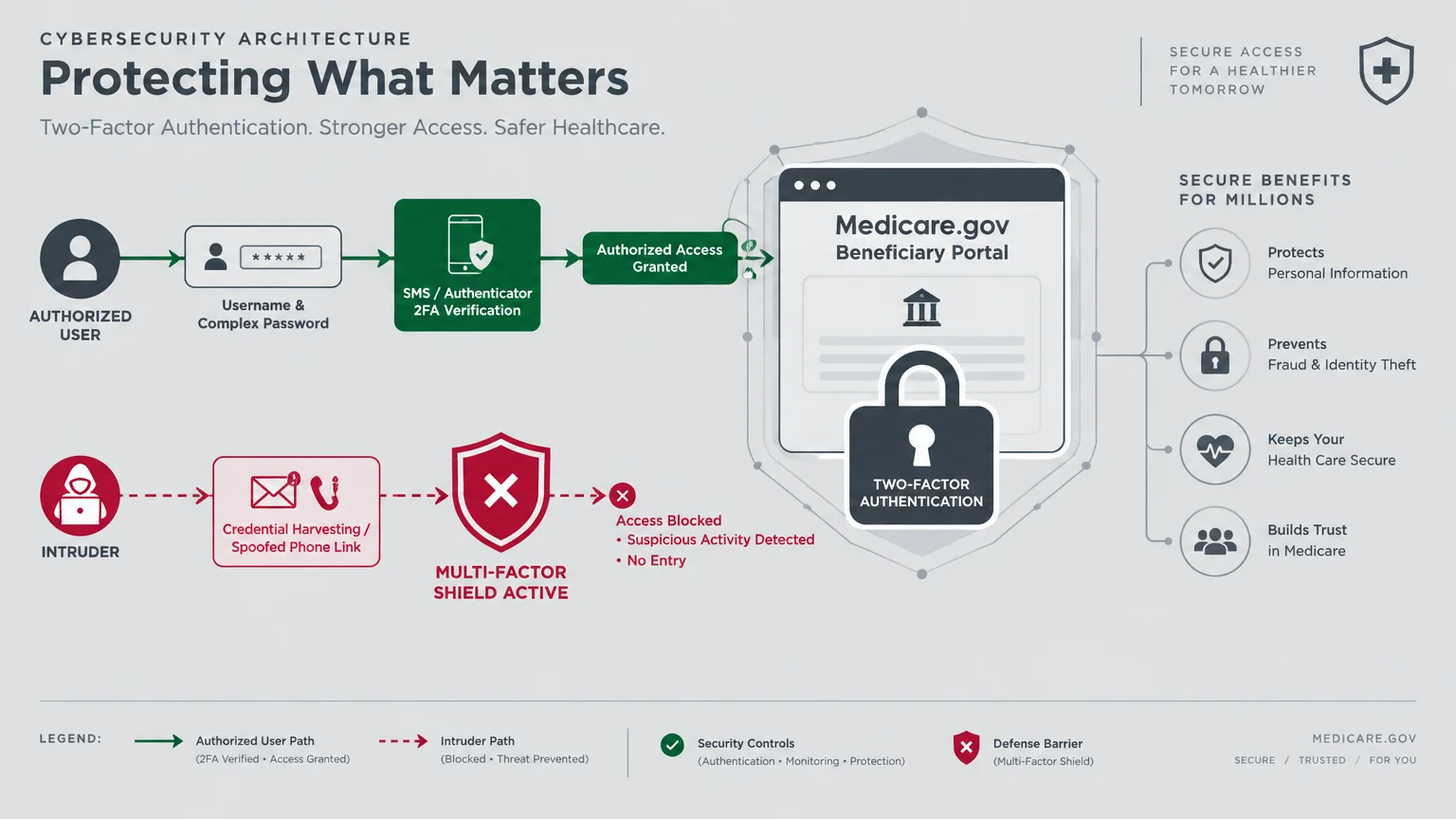
9. Medicare.gov Account Takeovers and Credential Theft
Account security plays an increasingly critical role during Open Enrollment. Cybercriminals target online portal credentials to redirect prescription deliveries and alter coverage selections without your knowledge.
To counteract identity theft, Medicare integrated multi-factor identity platforms like ID.me, CLEARme.com, and Login.gov. Fraudsters attempt to bypass these safeguards through deceptive credential harvesting.
You may receive text messages or emails claiming your Medicare portal account has been locked. The message includes an urgent link directing you to a forged login page.
Entering your username, password, or security codes on these fake pages gives criminals total control over your health profile. Access your account solely by typing the official address directly into your web browser.

10. Free Genetic Screening Kits and Bogus Hospice Enrollments
Some fraudulent enrollment operations rely on deceptive clinical pitches. Unscrupulous marketers target retirement communities, health fairs, and senior living facilities offering complimentary health evaluations.
Representatives offer free genetic cancer screenings, cardiovascular risk assessments, or cognitive tests. They claim Medicare covers the full expense and only request your card to process the test.
Unscrupulous operators use your details to bill thousands of dollars for unnecessary laboratory analysis. In extreme cases uncovered by federal investigators, brokers have enrolled seniors into hospice care without their consent.
Entering hospice revokes your curative medical benefits and access to standard treatments. Never accept medical screenings or genetic testing kits from anyone other than your trusted primary physician.
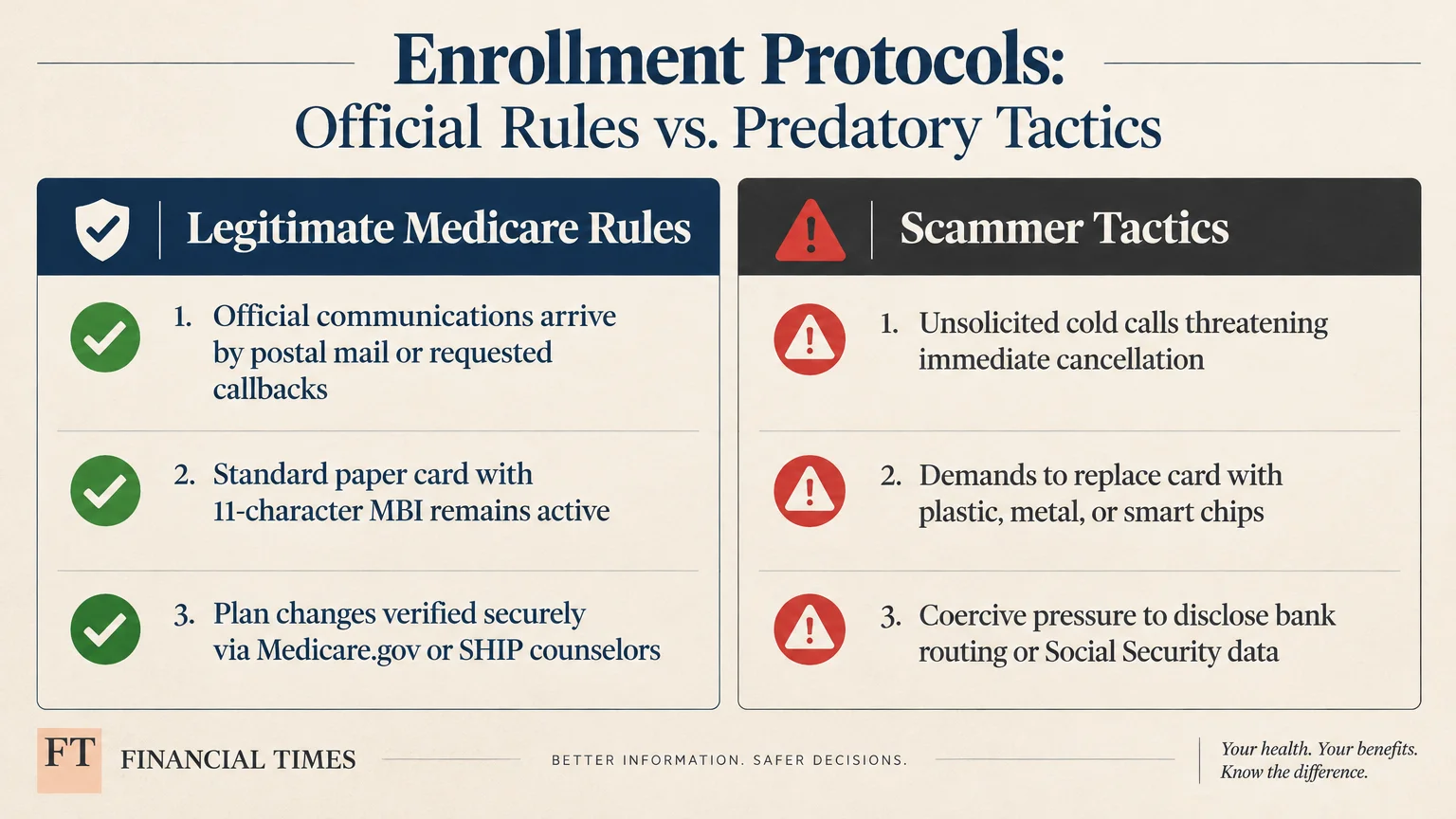
Legitimate Medicare Rules vs. Scammer Tactics
Differentiating authorized healthcare communications from criminal solicitation prevents catastrophic mistakes. Understanding these core distinctions helps you identify fraudulent contact immediately.
| Operational Area | Legitimate Medicare Protocol | Common Scammer Deception |
|---|---|---|
| Initial Contact | Official notifications arrive via postal mail; CMS never cold calls. | Unsolicited phone calls, text messages, or unannounced front-door visits. |
| Physical Identification | Issues exclusively paper red, white, and blue cards with an 11-digit MBI. | Offers modern plastic, metal, or biometric cards with microchips for a fee. |
| Enrollment Windows | Open Enrollment runs strictly from October 15 through December 7 annually. | Claims fake emergency extensions or urgent early cutoffs to force compliance. |
| Part B Giveback | Offered only by select private Medicare Advantage plans in specific areas. | Promises direct electronic deposits of your full $202.90 Part B premium. |
| Account Verification | Secure logins utilize official identity platforms like ID.me and Login.gov. | Sends suspicious phishing links to unlock suspended accounts or benefits. |
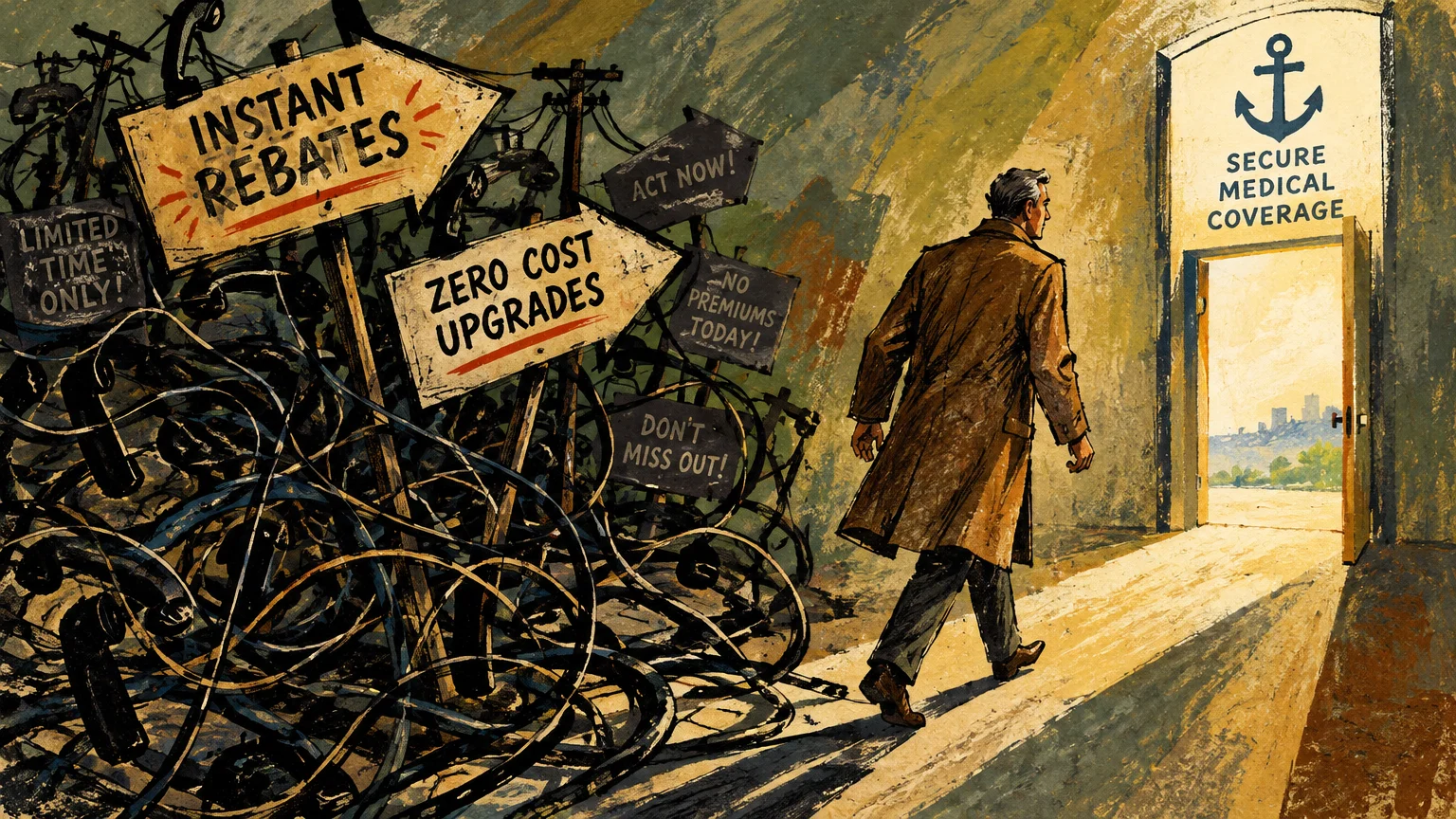
What Can Go Wrong: Critical Mistakes to Avoid
Even cautious retirees make missteps when confronting well-rehearsed imposters. Understanding common errors helps you protect your benefits during Open Enrollment.
The most frequent error involves reading your Medicare number over the phone to verify your identity. Legitimate representatives already have access to your account and never demand this information.
Another major mistake involves switching plans based solely on telephone promises about dental or grocery allowances. Rogue brokers frequently move seniors into plans that exclude their primary doctors and essential medications.
Never sign blank enrollment forms or agree to verbal confirmations without reviewing full plan details in writing. Unchecked plan switches disrupt your treatment schedules and create substantial out-of-pocket expenses.
Retirees also fail to review their Medicare Summary Notices regularly. Ignoring quarterly statements allows billing schemes to continue undetected for months, depleting program reserves and complicating your medical history.

Essential Steps to Protect Your Medicare Identifier
Treating your Medicare Beneficiary Identifier with the same diligence as your Social Security card prevents fraud. Follow these actionable rules whenever reviewing healthcare options.
- Keep your paper Medicare card stored safely at home when you do not have scheduled doctor visits.
- Carry a photocopy of your card with the middle numbers obscured if you need emergency identification.
- Refuse to engage with any telephone caller asking to confirm personal details or coverage numbers.
- Monitor your quarterly Medicare Summary Notices for unauthorized clinical claims, durable equipment, or prescriptions.
- Establish your personal online portal account at Medicare.gov to block identity thieves from registering in your name.
- Consult trusted consumer resources like AARP to stay informed about active fraud patterns.
Active monitoring stops identity theft before it compromises your care. Take immediate action whenever an unfamiliar medical billing entry appears on your official statements.

When to Consult a Professional
Navigating Medicare options requires accurate, unbiased guidance. Certain situations warrant contacting accredited professionals rather than attempting to resolve complex coverage disputes alone.
Contact your local State Health Insurance Assistance Program if you suspect an agent enrolled you in a plan without consent. SHIP counselors provide free, unbiased assistance to undo unauthorized plan switches.
Reach out to the Senior Medicare Patrol at 1-877-808-2468 if you identify fraudulent claims on your healthcare notices. SMP coordinators investigate billing irregularities and coordinate directly with federal authorities.
If financial information or bank accounts have been compromised during an enrollment pitch, contact the Consumer Financial Protection Bureau. You should also report identity theft to local police and your banking institutions immediately.
Frequently Asked Questions
Will Medicare ever call me directly to update my coverage?
No, Medicare representatives will never call you uninvited to demand personal information or sell plans. Official correspondence arrives exclusively through the U.S. Postal Service.
Can I change my plan if a scammer switched my coverage without permission?
Yes, you can request a Special Enrollment Period to restore your original coverage. Call 1-800-MEDICARE immediately to explain the fraudulent enrollment and begin corrective action.
Is there a fee to replace a damaged or lost Medicare card?
No, official replacement paper cards are completely free of charge. You can print a copy directly through your secure Medicare.gov portal or request one by mail.
What should I do if an unwanted medical package arrives at my house?
Refuse delivery if possible, or mark the package return to sender. Never use the equipment, and immediately check your Medicare account to see if fraudulent claims were submitted.
Safeguard Your Coverage for the Coming Year
Protecting your retirement benefits requires vigilance during Open Enrollment. You control your healthcare decisions, and no legitimate representative will ever pressure you to surrender private information.
Take your time reviewing plan details, consult official government resources, and verify every claim independently. Staying alert keeps your healthcare benefits secure and your retirement savings protected.
The information in this guide is meant for educational purposes. Your specific circumstances—including income, benefits, tax situation, and health needs—may require different approaches. When in doubt, consult a licensed financial advisor or tax professional.
Last updated: October 2026. Benefit amounts, tax rules, and program details change annually—verify current figures with official government sources.









Leave a Reply