

Knowing whether your retirement savings are truly on track can mean the difference between leaving the workforce with total confidence or facing unexpected financial stress. Life rarely follows a static spreadsheet; unexpected market swings, inflation spikes, health events, and family changes frequently require a proactive retirement savings timeline review. Spotting the warning signs early gives you maximum flexibility to adjust your contributions, modify your exit date, or optimize your investment mix before small deficits compound into major shortfalls. Evaluating these indicators helps you regain control over your financial destiny and enjoy the retirement you earned.

Why Regular Retirement Checkups Matter
Planning for retirement is not a one-time event that you set in your thirties and forget. Economic conditions fluctuate, tax laws evolve, and personal circumstances shift over decades of working life. An ongoing evaluation of your nest egg ensures that your target exit date matches the mathematical reality of your savings balance.
According to research from major financial institutions, retirees today face longer life expectancies alongside rising healthcare costs and fluctuating purchasing power. When you conduct regular checkups on your nest egg, you can implement minor mid-course corrections rather than making drastic lifestyle cuts later in life. Staying alert to specific warning signals empowers you to protect your wealth and make informed decisions about your future.
“The biggest mistake people make is looking only at the balance of their retirement account rather than what they actually get to keep after the tax bite.” — Ed Slott, CPA and Retirement Distribution Expert
8 Critical Signs Your Retirement Savings Timeline Needs Adjusting
1. You Fall Significantly Behind Age-Based Savings Benchmarks
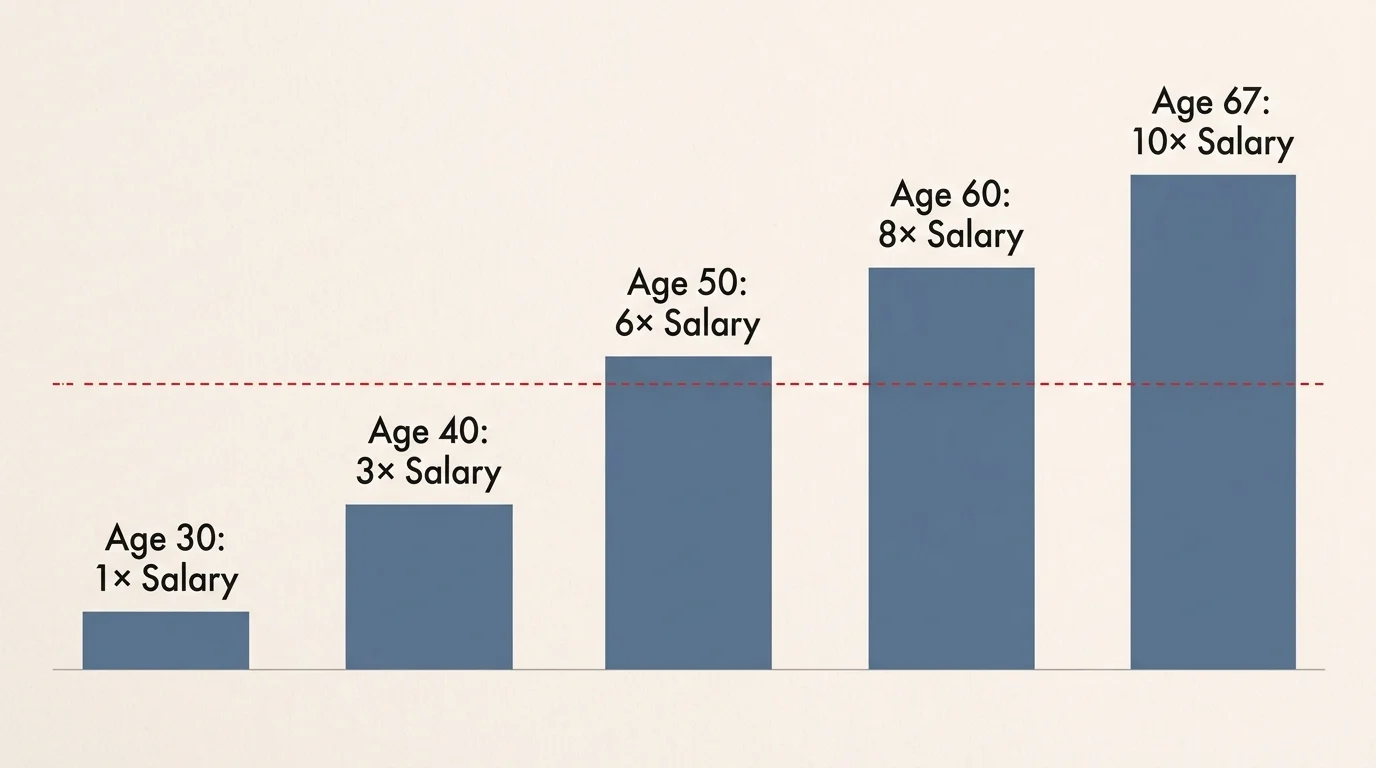
One of the clearest indicators that your target retirement date requires attention is falling short of widely recognized savings milestones. While individual spending needs vary, major institutions like Fidelity suggest standard benchmarks based on multiples of your pre-retirement annual salary:
- Age 30: 1× your annual salary
- Age 40: 3× your annual salary
- Age 50: 6× your annual salary
- Age 60: 8× your annual salary
- Age 67: 10× your annual salary
If you earn $85,000 per year at age 55 but have accumulated $200,000 across your accounts, you are tracking below the targeted benchmark of approximately 7× salary ($595,000). A gap of this magnitude indicates that your current timeline may force a lifestyle contraction unless you boost your savings rate or push back your target retirement age.
2. High-Interest Debt Follows You Toward Your Exit Date
Entering retirement with unsecured debt or high-interest balances poses a direct threat to your financial security. Fixed retirement incomes cannot easily absorb revolving credit card interest rates that frequently exceed 20%. According to data from the Consumer Financial Protection Bureau (CFPB), older Americans carrying debt into retirement face higher rates of financial strain and housing insecurity.
If you still carry significant credit card debt, personal loans, or large auto balances with only three to five years left until your desired retirement date, your timeline needs immediate recalibration. Every dollar diverted toward interest payments is a dollar that cannot generate compound returns or support your daily living expenses in retirement.
3. Your Healthcare and Long-Term Care Projections Fall Short
Many pre-retirees mistakenly assume that Medicare covers all medical needs once they reach age 65. In reality, Medicare parts A and B do not cover routine dental care, vision exams, hearing aids, or custodial long-term care services. You will also pay monthly premiums, deductibles, and coinsurance costs out of pocket.
According to the Fidelity Retiree Health Care Cost Estimate, an average 65-year-old individual retiring needs approximately $185,500 in after-tax savings to cover medical expenses and Medicare premiums throughout retirement; a married couple needs roughly $371,000. These figures exclude the potentially catastrophic costs of extended nursing home stays or assisted living. If your nest egg cannot absorb substantial out-of-pocket medical expenses, you must reassess your savings plan.
4. You Rely Solely on Claiming Early Social Security at Age 62
If your plan to leave work early relies on claiming Social Security as soon as you become eligible at age 62, you could permanently impair your lifetime income. For anyone born in 1960 or later, the Social Security Administration (SSA) sets the Full Retirement Age (FRA) at 67.
Claiming benefits at age 62 results in a permanent reduction of up to 30% compared to your full primary insurance amount. Conversely, waiting past your FRA earns you delayed retirement credits of 8% per year up to age 70. If you cannot cover your baseline living expenses without claiming an early, heavily discounted Social Security check, extending your working timeline by even two or three years can dramatically increase your guaranteed monthly income for life.
“A big part of financial freedom is having your heart and mind free from worry about the what-ifs of life.” — Suze Orman, Personal Finance Author & Advisor
5. You Have Not Utilized SECURE 2.0 Catch-Up Provisions
If you are over age 50 and contributing only the standard baseline amounts to your retirement plans, you are leaving valuable tax-advantaged capacity on the table. The Internal Revenue Service (IRS) provides enhanced contribution limits specifically designed to help older workers close savings gaps:
- 401(k), 403(b), and 457 Plans: The elective deferral limit is $24,500, with an additional $8,000 standard catch-up contribution for workers aged 50 and older (totaling $32,500).
- SECURE 2.0 Super Catch-Up (Ages 60–63): Workers aged 60 through 63 receive a higher catch-up limit of $11,250, bringing their maximum annual elective deferral to $35,750. (Note: High earners with prior-year wages exceeding $150,000 must make these catch-up contributions to Roth accounts).
- Traditional and Roth IRAs: The base contribution limit is $7,500, plus an indexed $1,100 catch-up contribution for those age 50 and over (totaling $8,600).
Failing to capitalize on these elevated limits during your peak earning years is a sign that you are not optimizing the final stretch of your savings runway.
6. Your Asset Allocation Is Swung to an Extreme
An unbalanced portfolio can jeopardize your retirement schedule. Pre-retirees often fall into one of two dangerous asset allocation traps: holding an overly aggressive equity portfolio or shifting too defensively into cash and low-yield instruments.
If your entire nest egg remains invested in volatile growth stocks within a few years of retirement, a severe market downturn could wipe out decades of gains and delay your departure date by years. On the other hand, parking too much money in cash accounts exposes your purchasing power to chronic inflation erosion. Aligning your asset allocation with your actual time horizon protects you from both sequence-of-returns risk and long-term purchasing power decay.
7. Recent Major Life Transitions Have Squeezed Your Cash Flow
Personal circumstances rarely follow a linear path. Events such as a mid-career divorce, extended periods of caregiving for aging parents, or providing ongoing financial support to adult children can severely disrupt your savings momentum. If you recently experienced a major life disruption, continuing with your original retirement timeline without adjusting your savings goals can lead to immediate shortfalls.
Reassessing your budget after a major transition allows you to understand your revised baseline expenses and determine whether adjusting your retirement target date will preserve your long-term independence.
8. Your Savings Lack Tax Diversification Ahead of RMDs
Holding all your savings exclusively inside traditional, tax-deferred accounts (like standard 401(k)s and traditional IRAs) creates a substantial future tax liability. Under the SECURE 2.0 Act, Required Minimum Distributions (RMDs) must begin at age 73 (rising to age 75 in 2033). If you fail to take an RMD, the IRS imposes a 25% excise penalty on the shortfall, which drops to 10% if corrected in a timely window.
When large RMDs kick in, they can push you into higher marginal tax brackets, trigger Medicare Part B and D premium surcharges (IRMAA), and cause a larger portion of your Social Security benefits to become taxable. If you lack Roth assets or taxable brokerage funds for tax flexibility, you may need to adjust your timeline to execute multi-year Roth conversion strategies before mandatory distributions take effect.

Comparing Your Options: Adjusting Timelines vs. Changing Habits
When reviewing retirement savings progress, you have several distinct levers you can pull to restore balance. The following table highlights common strategies, their operational impact, and the financial payoff they deliver:
| Strategy | Timeline Impact | Implementation Difficulty | Primary Financial Payoff |
|---|---|---|---|
| Delay Retirement by 2–3 Years | Extends working horizon | Low to Moderate | Increases Social Security payouts by up to 8%/year; allows additional compounding and catch-up contributions. |
| Maximize SECURE 2.0 Catch-Ups | Maintains current timeline | Moderate (requires budget discipline) | Shields up to $35,750/year in 401(k) plans (ages 60–63) from taxes; accelerates asset accumulation. |
| Downsize Housing Ahead of Exit | Maintains or accelerates timeline | Moderate to High | Unlocks home equity; eliminates mortgage debt; permanently lowers property taxes and maintenance overhead. |
| Phase into Part-Time Consulting | Provides flexible transition | Low | Supplements living expenses without drawing down core portfolio principal during early retirement years. |
Actionable Steps for Adjusting Retirement Savings Goals
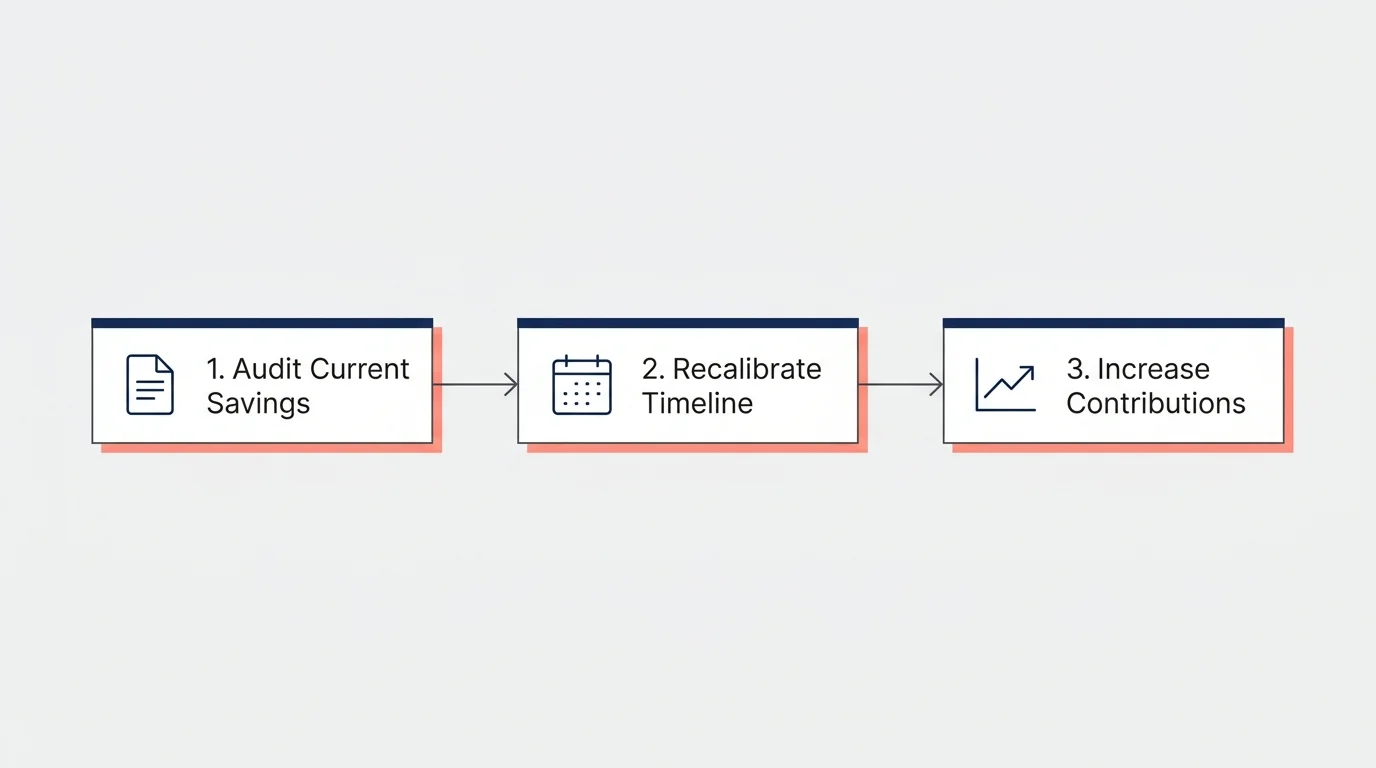
If you recognize one or more of these signs in your own financial life, you do not need to panic. Taking systematic, proactive steps today will put you back in command of your retirement timeline:
- Audit Your True Retirement Expenses: Track your current outlays and eliminate costs that will disappear in retirement (such as daily commuting and payroll taxes), while factoring in increased line items for private healthcare and leisure.
- Supercharge Catch-Up Contributions: Direct annual raises, bonuses, or freed-up cash flow into workplace 401(k)s and IRAs up to the legal catch-up maximums allowed by the IRS.
- Run Social Security Optimization Scenarios: Use tools on Investor.gov or the official SSA portal to model how delaying your filing date from age 62 to your FRA or age 70 enhances your guaranteed lifetime income.
- Build a Dedicated Healthcare Fund: If enrolled in a high-deductible health plan, maximize contributions to a Health Savings Account (HSA). HSAs offer a triple-tax advantage: contributions are tax-deductible, growth is tax-free, and withdrawals for qualified medical expenses are completely tax-free.
- Conduct a Tax-Bracket Analysis: Evaluate whether paying taxes now on modest annual Roth conversions between your retirement date and age 73 will protect you from severe RMD tax brackets later.

Pitfalls to Watch For When Shifting Your Retirement Plan
As you modify your retirement roadmap, avoid common planning errors that could derail your progress:
- Making Emotionally Driven Portfolio Changes: Liquidating equities to hold excessive cash after market drops permanently locks in losses and undermines your ability to outpace inflation.
- Assuming Medicare Replaces Comprehensive Healthcare Planning: Failing to plan for Medicare premiums, deductibles, and supplemental Medigap or Advantage coverage leaves your savings vulnerable to unexpected medical bills.
- Relying on Unrealistic Investment Return Assumptions: Base your retirement models on conservative real rates of return (accounting for 2.5% to 3.5% baseline inflation) rather than projecting past double-digit equity surges indefinitely.
- Overlooking State Income Taxes on Retirement Assets: Different states treat pensions, Social Security, and IRA distributions differently. Make sure your relocation assumptions factor in total state tax burdens, including sales and property taxes.

Getting Expert Help: When to Consult a Professional
While self-directed planning gives you a broad overview, certain complex situations benefit from the specialized expertise of a Certified Financial Planner (CFP) or Certified Public Accountant (CPA):
- Coordinating Multi-Account Distribution Sequences: Determining which accounts to tap first (taxable brokerage, traditional tax-deferred, or Roth) to minimize your cumulative lifetime tax liability.
- Navigating the Mandatory Roth Catch-Up Rules: Navigating high-earner payroll rules and employer plan amendments under SECURE 2.0 guidelines.
- Structuring Long-Term Care Protection: Deciding between traditional long-term care insurance policies, asset-based hybrid life insurance riders, or self-insuring medical risks.
- Handling Complex Relocation Taxes: Planning a cross-state move during retirement that involves selling real estate, shifting residency, and navigating local tax codes.
Frequently Asked Questions
What is the most accurate way to check if my retirement savings are on track?
The most reliable approach is to build a cash-flow projection comparing your guaranteed income sources (Social Security, pensions, annuities) against your expected annual living expenses. Financial planners recommend multiplying your anticipated annual income deficit by 25 to determine your required target nest egg under the traditional 4% withdrawal rule.
How does working two extra years impact my retirement finances?
Working just two additional years delivers a powerful triple benefit: it gives your existing investments more time to compound untouched, allows you to contribute two more years of maximum catch-up savings, and permanently increases your monthly Social Security benefit by deferring your claim.
Can I contribute to both an IRA and a workplace 401(k) in the same year?
Yes. You can contribute up to the maximum limit in your employer-sponsored 401(k) plan and simultaneously contribute to a traditional or Roth IRA, provided you have enough earned income to cover both amounts and fall within IRS income eligibility guidelines for direct Roth IRA contributions.
What happens if I miss my Required Minimum Distribution (RMD)?
Under current SECURE 2.0 legislation, the penalty for failing to take a required minimum distribution is an excise tax of 25% on the undistributed amount. If you correct the error and submit documentation in a timely manner, the penalty is reduced to 10%.
Taking Control of Your Financial Future
Recognizing the signs that your retirement savings timeline needs adjusting is a proactive strength, not a setback. By identifying potential shortfalls now, you grant yourself the time and strategic runway needed to implement catch-up savings, optimize your Social Security claiming strategy, and restructure your investment mix. Review your accounts annually, stay informed on updated IRS limits, and adjust your goals deliberately to build a resilient, rewarding retirement.
This article provides general financial education and information only. Everyone’s financial situation is unique—what works for others may not work for you. For personalized advice tailored to your retirement needs, consider consulting a qualified financial professional such as a CFP or CPA.
Last updated: February 2026. Benefit amounts, tax rules, and program details change annually—verify current figures with official government sources.








Leave a Reply