
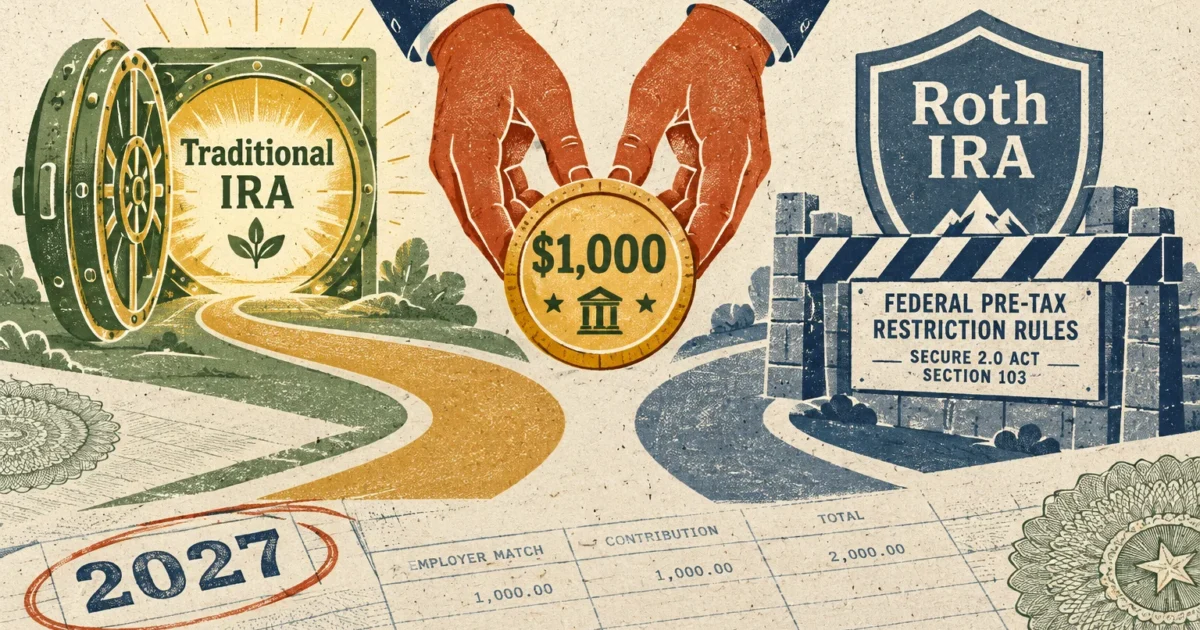
Starting in 2027, the federal government will deposit up to $1,000 directly into retirement accounts for eligible low- and moderate-income workers. This payment replaces the existing Saver’s Credit under Section 103 of the SECURE 2.0 Act.
However, millions of Americans could miss out simply because they save inside the wrong individual retirement account. Federal statutes establish strict limits on which accounts can actually receive the federal deposit.
If your retirement savings sit exclusively in a Roth IRA, your account cannot accept the match directly. Understanding these new rules now will protect your matching funds and prevent surprise tax headaches.
How the 2027 Saver’s Match Program Works
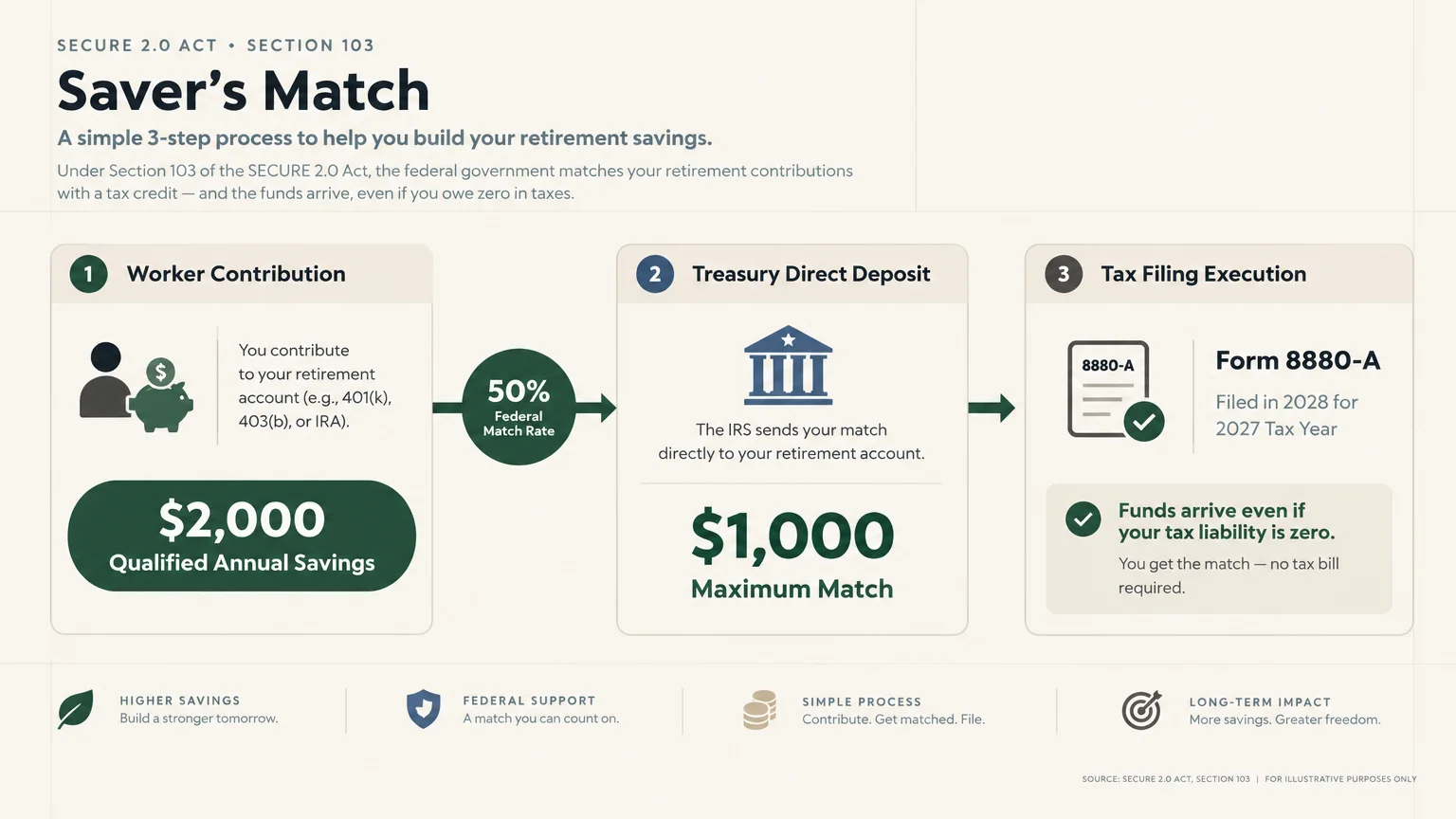
The federal government designed the Saver’s Match to boost long-term wealth for everyday workers. It provides an immediate 50% matching contribution on up to $2,000 of qualified annual retirement savings.
An eligible individual who saves the full $2,000 will receive a maximum federal deposit of $1,000. Married couples who file jointly can earn up to $2,000 if both spouses contribute to their own accounts.
Under the previous rules, the traditional Saver’s Credit provided a nonrefundable tax credit that reduced your tax liability. If you owed zero federal income tax, that old credit provided no practical financial benefit to you.
The new Saver’s Match operates very differently. The Treasury sends real money straight into your designated retirement plan, even if you owe no federal income taxes for the year.
You will claim this federal benefit when filing your 2027 federal income tax return in early 2028. The Internal Revenue Service will process these claims using a brand-new form called Form 8880-A.
Why Your Roth IRA Cannot Receive the Match Directly
Many savers prefer Roth IRAs because qualified withdrawals during retirement remain completely tax-free. Millions of Americans actively funnel their retirement contributions into these popular post-tax accounts every single year.
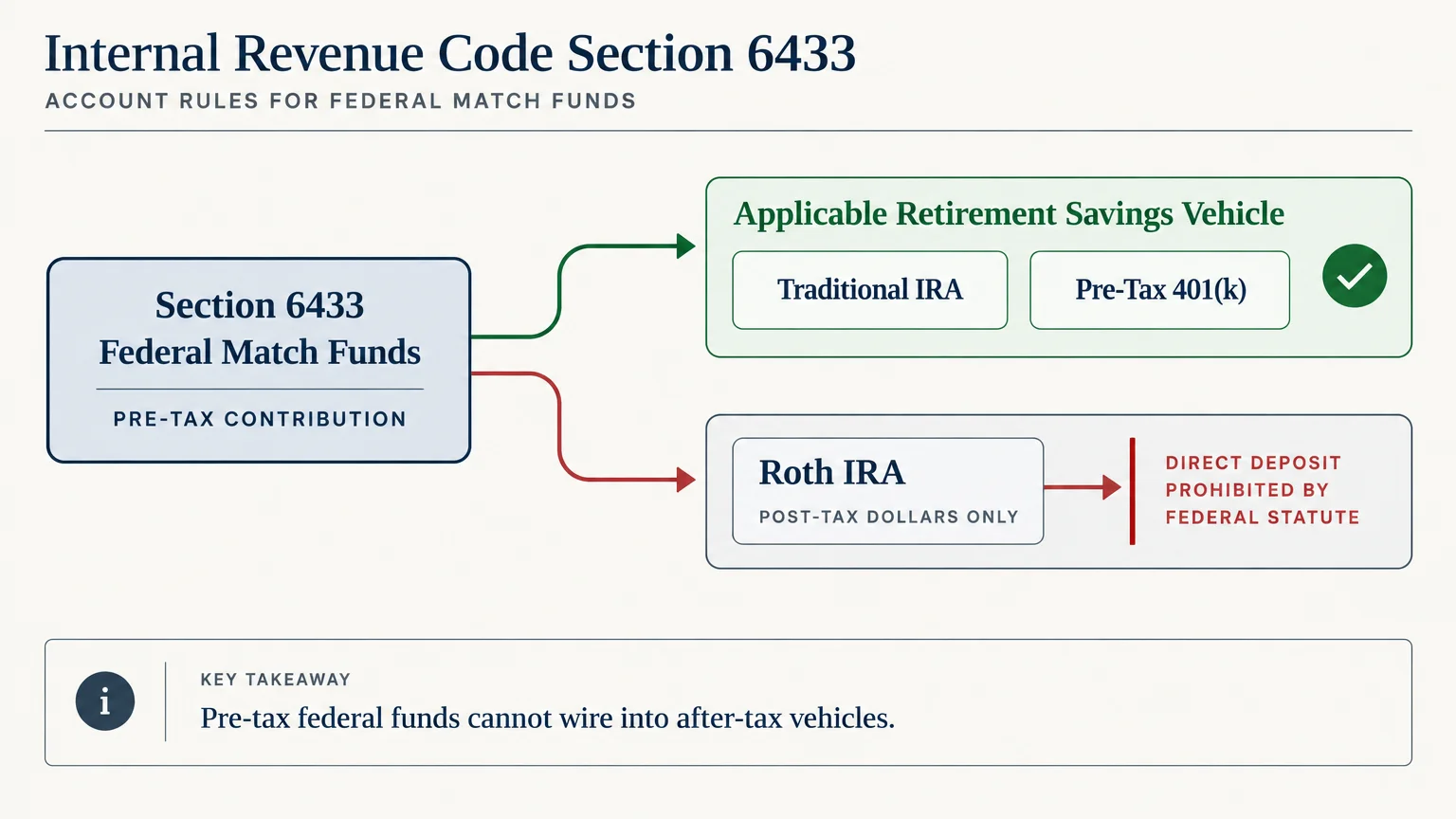
Under Internal Revenue Code Section 6433, contributions you make to a Roth IRA qualify to earn the match. However, the federal matching funds cannot be deposited directly into any Roth IRA account.
Congress structured the Saver’s Match as a pre-tax contribution rather than an after-tax deposit. Because Roth IRAs accept only post-tax contributions, federal law prohibits the Treasury from wiring match funds into them.
The statute dictates that deposits must flow solely into an “Applicable Retirement Savings Vehicle.” That statutory definition excludes designated Roth accounts and standard individual Roth IRAs.
This technical distinction creates a massive hurdle for disciplined savers who use only Roth products. If you do not maintain an eligible pre-tax account, your matching funds have nowhere to go.
“The rules surrounding retirement accounts are strict, and moving pre-tax money into after-tax vehicles without a clear plan always triggers friction.” — Ed Slott, CPA and Retirement Distribution Specialist
The State Auto-IRA Trap: Why Millions Face Account Confusion
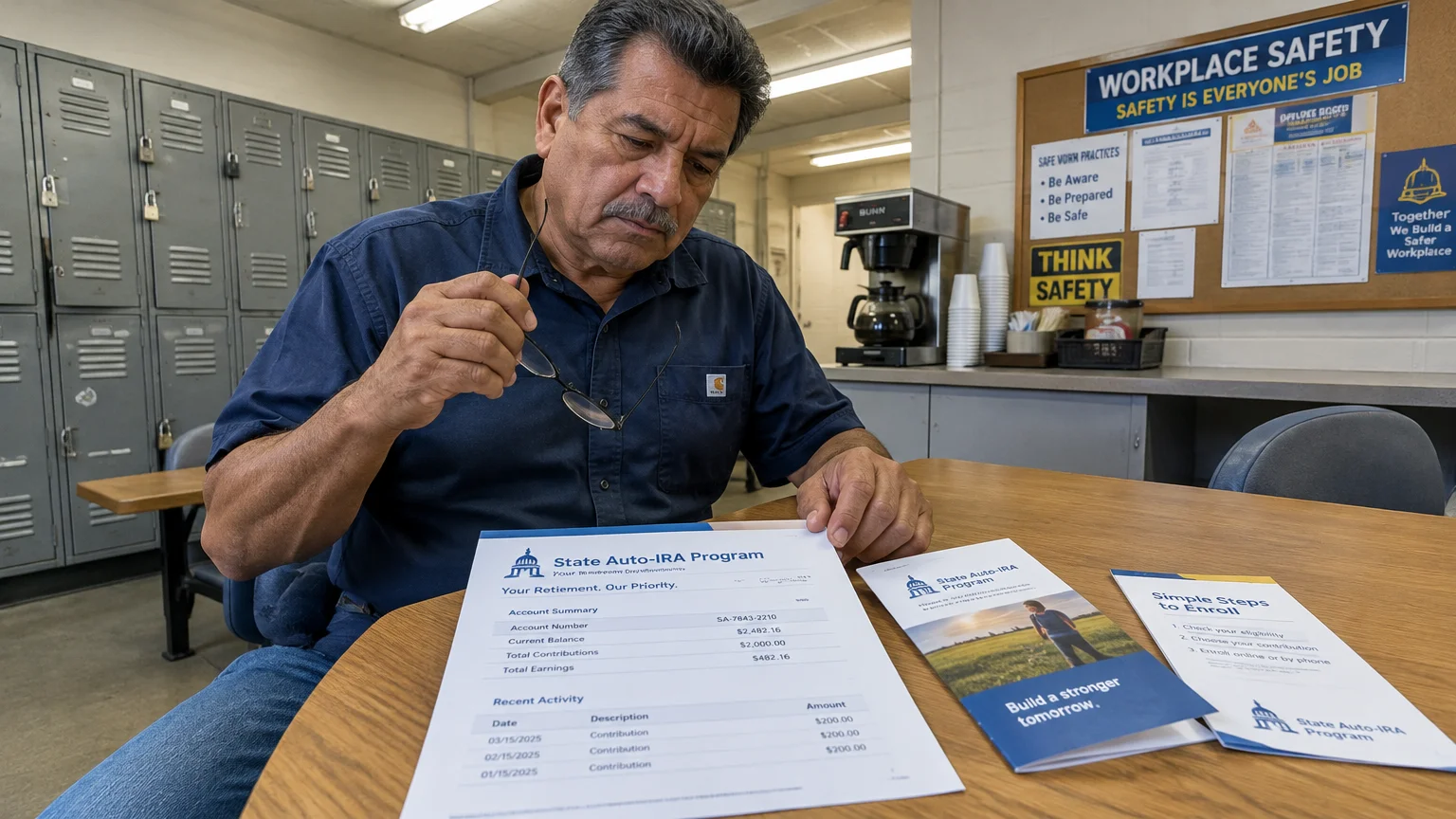
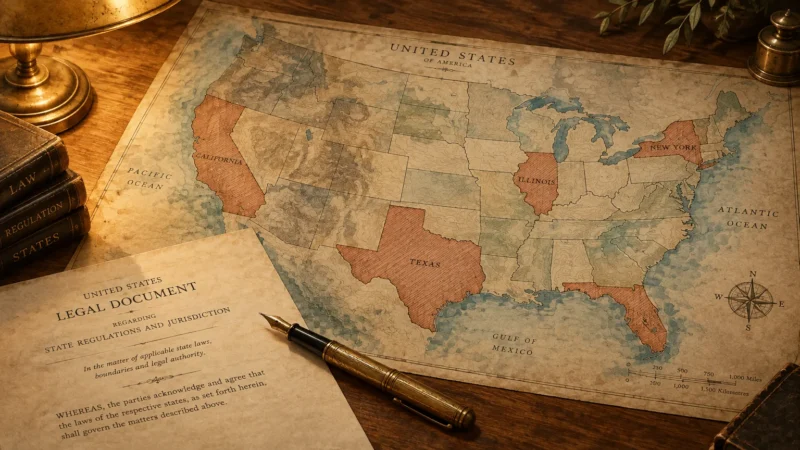
Roughly 17 states now operate automatic enrollment IRA programs for private-sector employees lacking workplace pensions or 401(k) plans. State programs like CalSavers, Illinois Secure Choice, and OregonSaves enroll hundreds of thousands of active workers.
State-mandated auto-IRA programs enroll participants into Roth IRAs by default. Workers who accept the default setting hold only a Roth account with their state program administrator.
Because these accounts are Roth IRAs, the federal government cannot wire the Saver’s Match into them. Millions of working Americans enrolled in state programs will face an administrative wall in 2028.
Unless state auto-IRA participants actively open a separate pre-tax account, their matching contributions will bounce. Many savers might mistakenly believe their state account is fully prepared to receive federal matching funds.
State plan administrators are currently reviewing procedures to help workers address this gap before 2027 arrives. Until state platforms adapt, you must take individual responsibility for establishing an eligible account.
IRS Notice 2026-48 and the Conduit IRA Solution
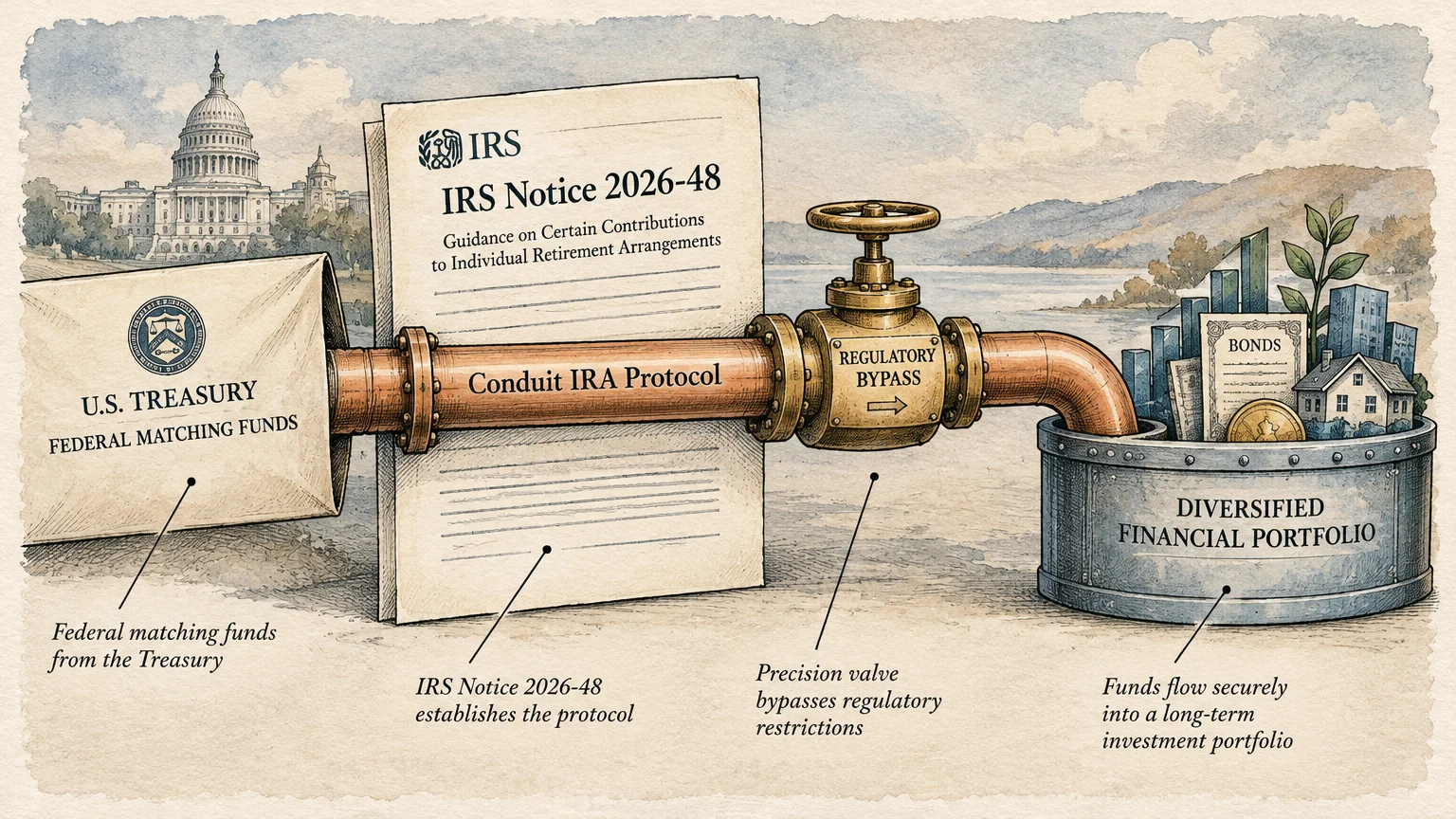
In August 2026, the Treasury Department and the IRS issued Notice 2026-48 to provide initial operational guidance. The notice addresses the dilemma faced by savers who hold only Roth IRAs.
The IRS proposed a workaround involving what it terms a “conduit traditional IRA.” Under this framework, the Treasury deposits your matching funds into a newly established pre-tax conduit account.
The financial institution then performs an immediate trustee-to-trustee transfer of those matching dollars into your designated Roth IRA. While this sounds convenient on the surface, it carries a significant tax trap.
Moving funds from a traditional pre-tax account into a Roth IRA constitutes a formal Roth conversion. Roth conversions represent taxable transactions under federal tax law.
Consequently, receiving your $1,000 match through a conduit IRA triggers unexpected income tax liability. You could face tax withholding or owe income taxes on that transfer when filing returns.
For modest-income households, an unexpected tax bill defeats the primary objective of earning free retirement dollars. Relying on a conduit IRA conversion requires careful cash-flow preparation.
Eligible Receiving Accounts: Traditional IRAs vs. Other Vehicles
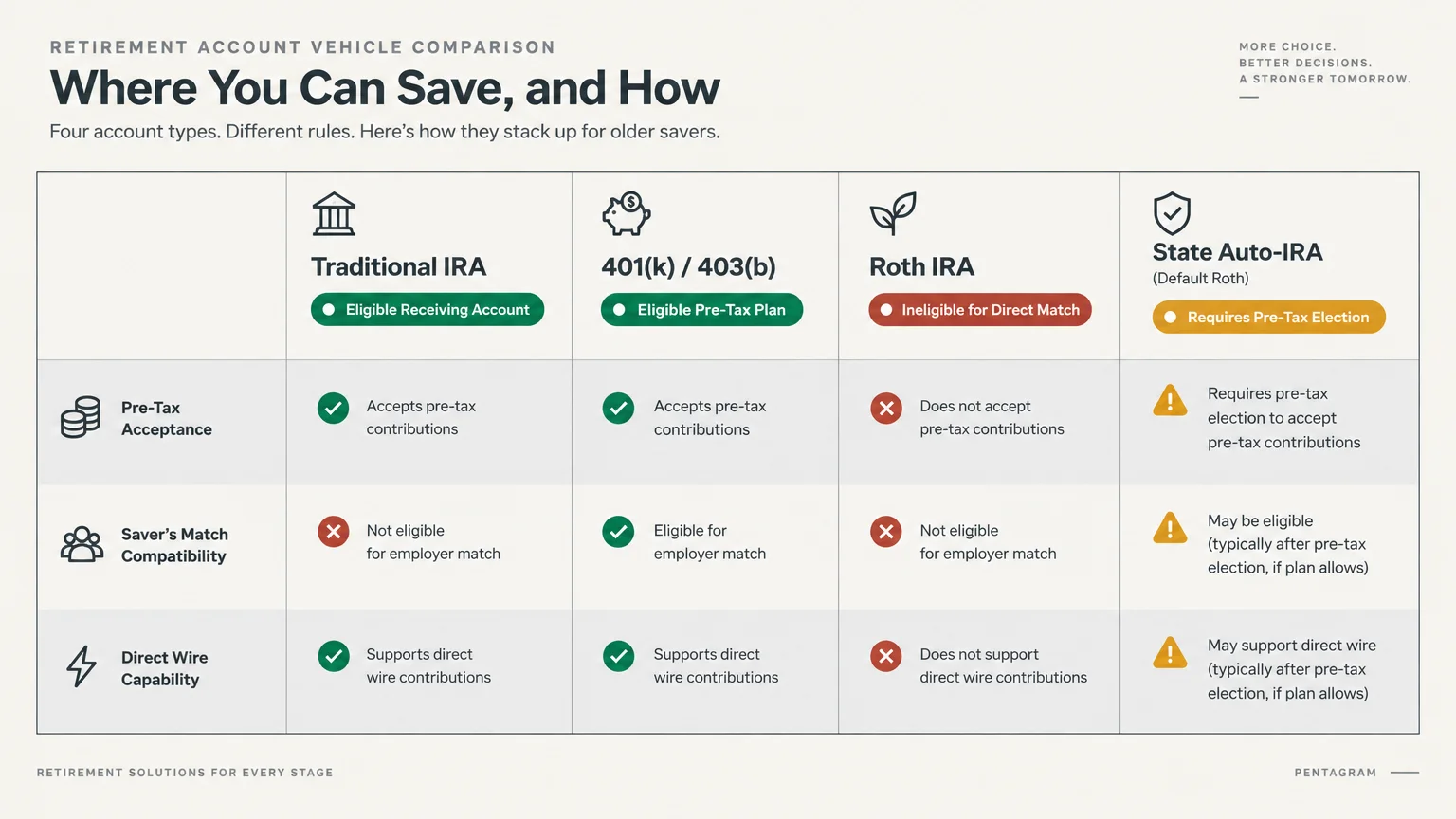
To avoid conversion taxes and deposit rejections, you must designate an account certified to accept pre-tax funds. Traditional individual retirement accounts represent the most straightforward destination for most individual savers.
Qualified workplace plans also serve as eligible receiving vehicles under federal statute. You can direct your Saver’s Match into the pre-tax bucket of a 401(k), 403(b), or governmental 457(b) plan.
While elective deferrals into SEP IRAs and SIMPLE IRAs help earn the match, they cannot receive it directly. Only traditional IRAs and qualifying pre-tax employer-sponsored plans meet the statutory receiving requirements.
Workplace plan sponsors and individual IRA custodians are not legally mandated to accept the federal match. Financial institutions hold the legal right to opt out of the transfer program entirely.
You must confirm that your custodian or employer plan administrator officially participates before directing your match there. Reviewing account compatibility today ensures smooth deposits once 2028 filing begins.
| Account Type | Can Contributions Earn Match? | Can Receive Direct Match Deposit? | Tax Status of Match Deposit |
|---|---|---|---|
| Traditional Pre-Tax IRA | Yes | Yes | Pre-Tax (No immediate tax due) |
| Roth IRA | Yes | No | Ineligible for direct transfer |
| Conduit Traditional IRA | No (Receiving only) | Yes | Taxable conversion if sent to Roth |
| Traditional 401(k) / 403(b) | Yes | Yes (If plan accepts) | Pre-Tax (No immediate tax due) |
| State Auto-IRA (Default Roth) | Yes | No | Ineligible for direct transfer |
| SIMPLE / SEP IRA | Yes (Deferrals count) | No | Must route to traditional IRA |
| ABLE Account | No (Retains old credit) | No | Excluded from Section 103 match |
Reviewing this table clarifies why holding a pre-tax traditional IRA provides the simplest path. It ensures you receive your matching funds without triggering sudden conversion penalties or administrative denials.
Income Limits and Phase-Out Thresholds for 2027
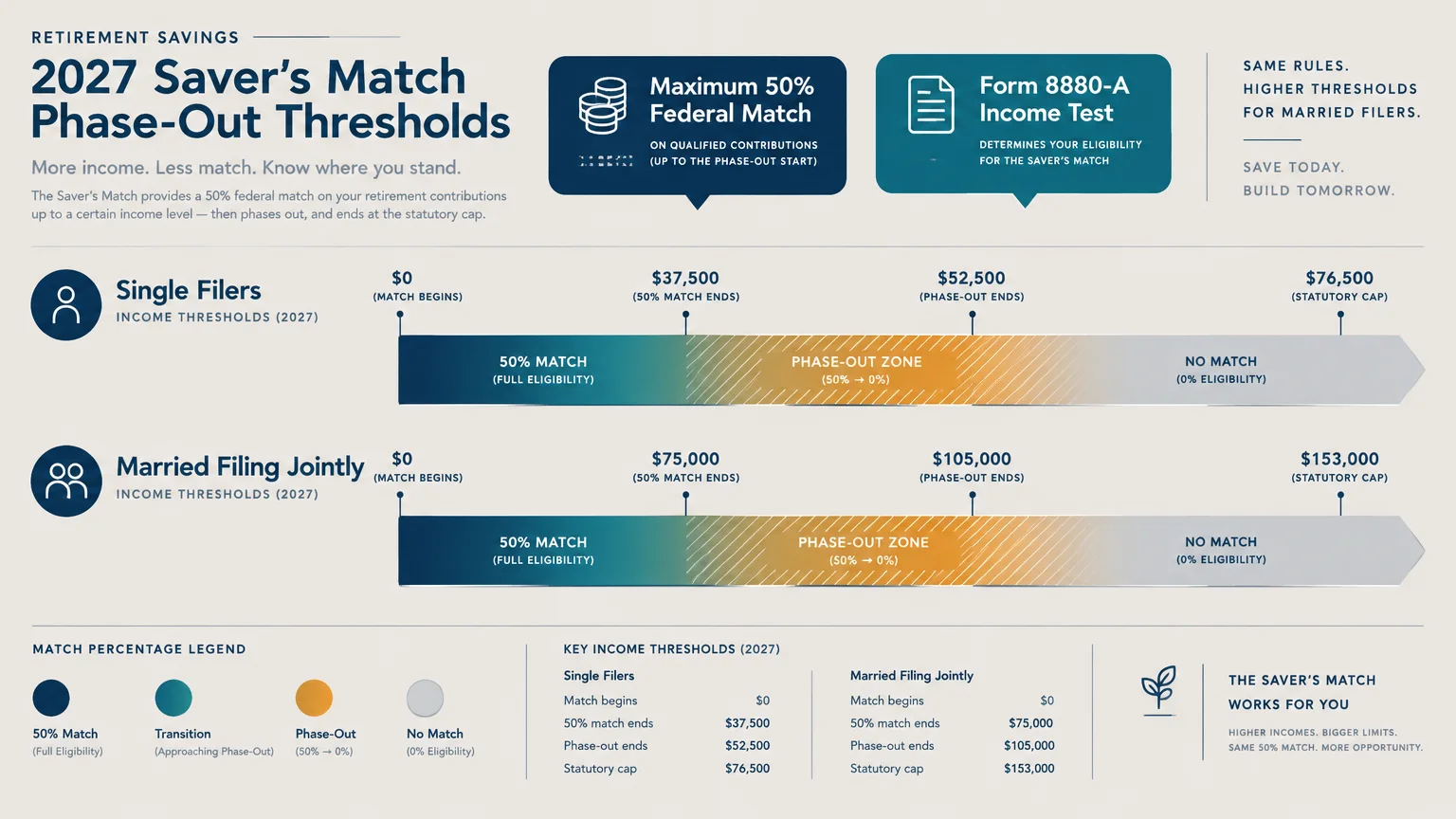
Your eligibility for the 2027 Saver’s Match depends directly on your Modified Adjusted Gross Income, or MAGI. Congress created three specific income tiers based on your federal tax filing status.
For married couples filing jointly, the full 50% match applies to MAGI up to $41,000. The matching percentage steadily phases out between $41,000 and $71,000, dropping to zero at $71,000.
If you file as single or married filing separately, the full match covers MAGI up to $20,500. The match phases out between $20,500 and $35,500, disappearing completely above $35,500.
Heads of household receive the full 50% match for MAGI up to $30,750. The phase-out range extends from $30,750 to $53,250, with no match allowed at $53,250 or more.
These statutory income thresholds apply specifically to the 2027 tax year. The federal government will adjust these brackets for inflation beginning in tax year 2028.
If your household income lands within a phase-out zone, your match rate falls below 50%. Even a partial match delivers free capital that strengthens your long-term nest egg.

Older Adults and Earned Income: Who Qualifies After 55?
Many older adults assume that retirement programs exclude them due to their age. Fortunately, the Saver’s Match includes no upper age cap whatsoever for eligible participants.
However, you must have earned income during the tax year to qualify for the program. Earned income includes wages, salaries, tips, and net earnings from active self-employment.
Unearned income sources do not qualify you to contribute toward the Saver’s Match. Monthly payments from the Social Security Administration, pensions, dividends, and IRA withdrawals do not count as earned income.
If you retired completely at 62 and live exclusively on Social Security, you cannot claim the match. You must report active compensation from labor on your federal tax return.
Older adults working part-time, consulting, or operating seasonal businesses can easily meet this requirement. Earning even $2,000 from a part-time job allows you to secure the maximum $1,000 match.
Non-working spouses can also participate if their partner earns sufficient active compensation. A working spouse can fund a spousal traditional IRA to capture an additional federal match.
Pitfalls to Watch For
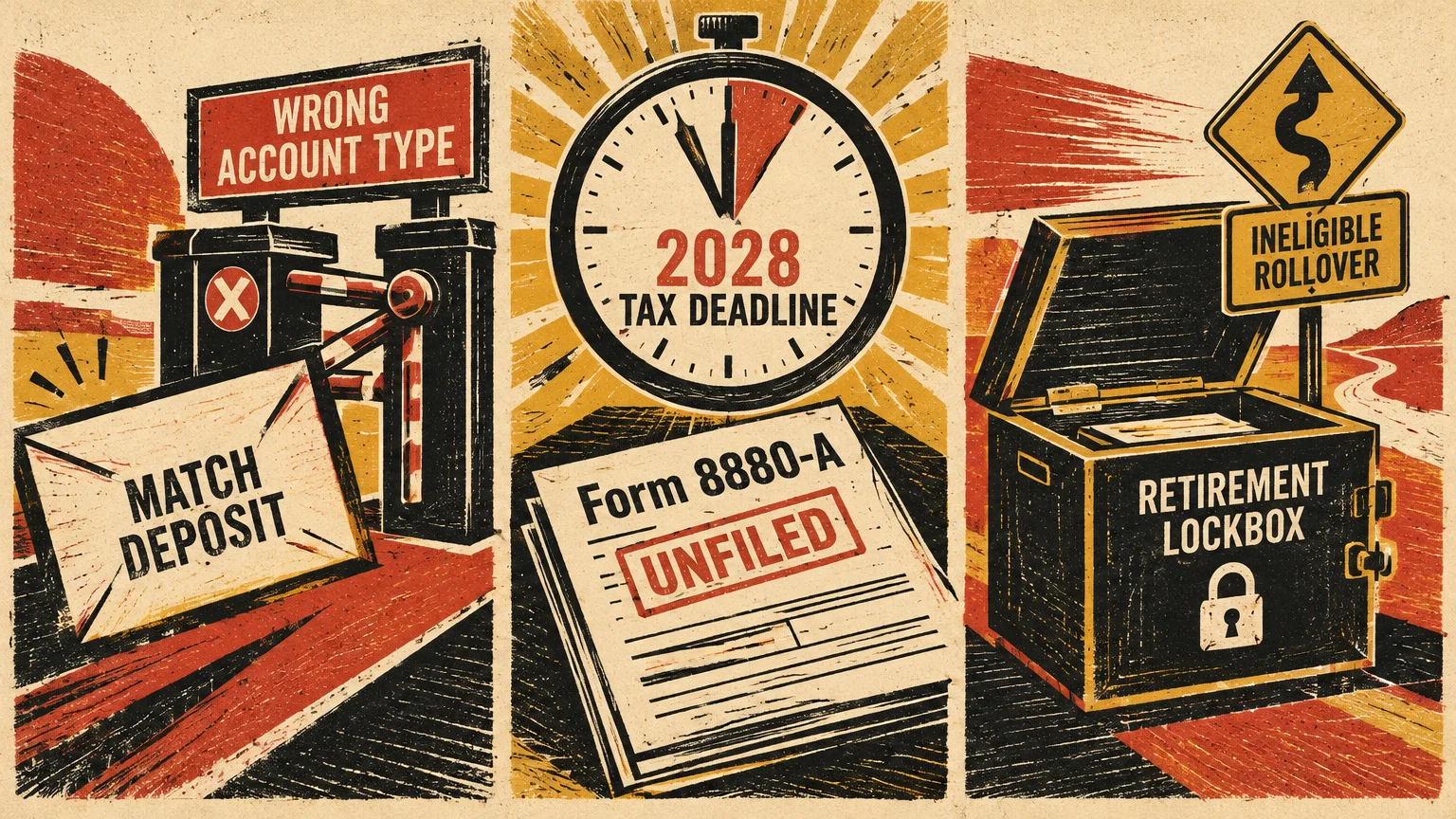
Navigating the Saver’s Match rules requires careful attention to avoid common financial mistakes. Being aware of potential pitfalls protects your hard-earned money and prevents unnecessary IRS complications.
- Assuming a Roth IRA can accept direct deposits: Designating a Roth IRA on Form 8880-A will cause the IRS to reject the deposit transfer. You must provide wiring information for an eligible pre-tax traditional account.
- Relying exclusively on passive income streams: Contributing to an IRA without qualifying earned income creates an excess contribution penalty. Verify that your wages support your retirement contribution before claiming the match.
- Overlooking provider participation rules: Assuming every bank or brokerage accepts federal matching transfers is a mistake. Confirm in advance that your financial institution supports Saver’s Match direct deposits.
- Triggering unintentional Roth conversion taxes: Using a conduit IRA to route money into a Roth account creates taxable income. Savers unaware of this mechanic may face unexpected tax bills in 2028.
Avoiding these four common errors ensures your contributions translate directly into growing retirement capital. Simple proactive verification prevents substantial administrative frustration later.

The Saver’s Match Recovery Tax and Withdrawal Penalties
The federal government provides matching funds to promote long-term retirement security, not short-term spending. To enforce this goal, Congress established rigorous clawback provisions under the tax code.
If you withdraw match money before reaching age 59½, you face standard early withdrawal penalties. In addition, the IRS imposes a special Saver’s Match recovery tax to claw back the matching funds.
Furthermore, Saver’s Match funds deposited into workplace plans receive special statutory protection. Plan administrators cannot distribute these federal matching dollars for standard hardship distributions.
For savers over age 59½, traditional early withdrawal penalties no longer apply under IRS rules. However, taking distributions too quickly after receiving federal funds can still trigger clawback reviews.
You can learn more about standard distribution rules at Investor.gov. Treating your matching funds as permanent investments safeguards your money from recovery penalties.
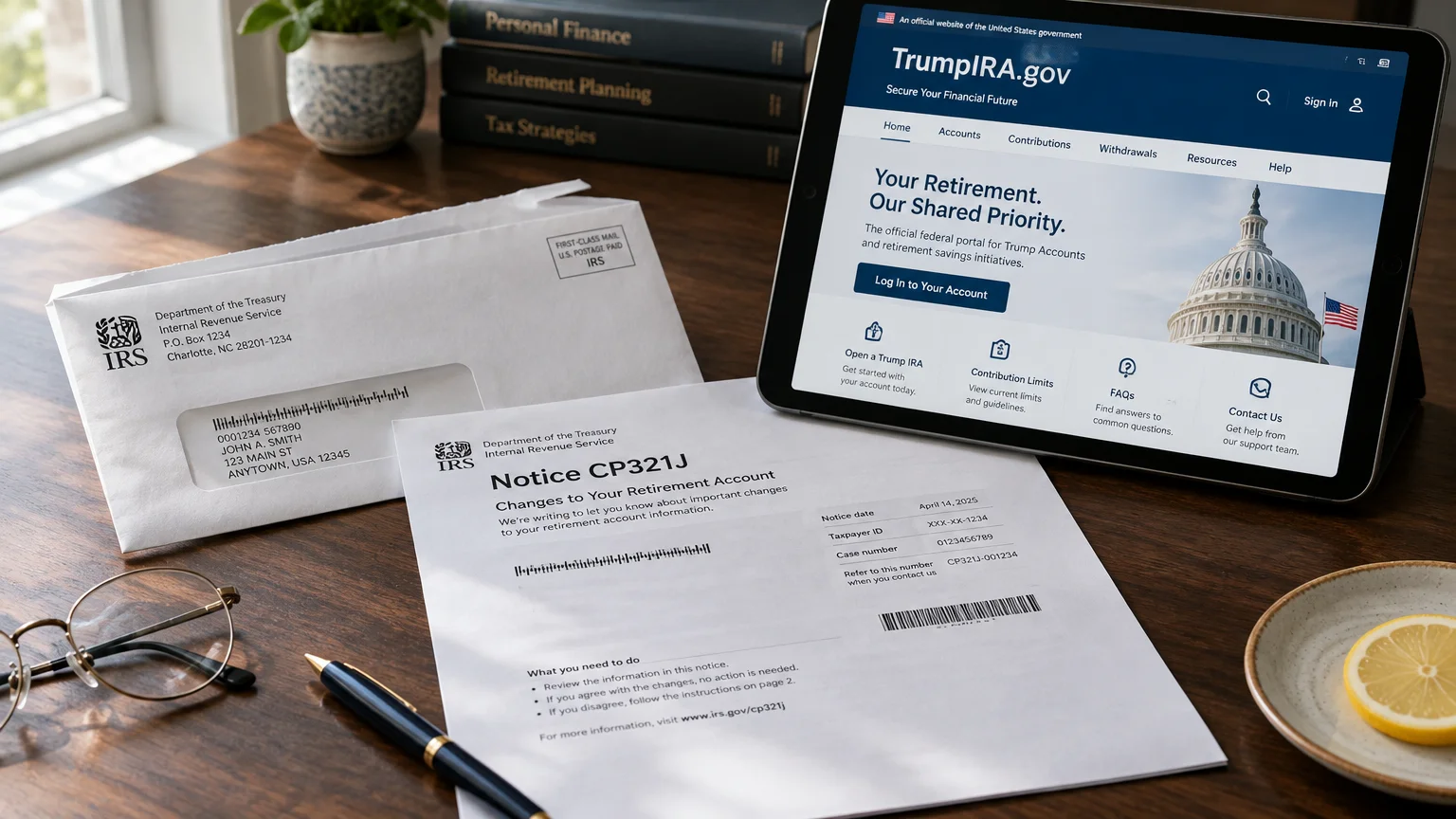
Recent Federal Initiatives: TrumpIRA.gov and IRS Notice CP321J
In 2026, the federal executive branch established TrumpIRA.gov following a targeted executive order. The platform provides a portal where workers without workplace plans can open low-cost traditional IRAs.
These specialized accounts are pre-certified to accept Saver’s Match direct deposits without technical delays. The platform aims to resolve account incompatibility challenges for independent workers and lower-wage employees.
Alongside the platform launch, the IRS began mailing Notice CP321J to millions of households in September 2026. The agency identified potential recipients using income reported on 2025 federal tax returns.
Notice CP321J informs recipients of the upcoming 2027 match and encourages opening eligible pre-tax accounts. If you receive this notice, review your current account structures right away.
Meanwhile, lawmakers continue exploring legislative adjustments to streamline the program further. On September 28, 2026, Senator Ron Wyden introduced the Saver’s Match Enhancement Act, designated as Senate Bill 5507.
The proposed legislation seeks to double the match to 100% and allow direct Roth deposits. However, that bill remains proposed legislation, meaning the SECURE 2.0 restrictions remain current law.
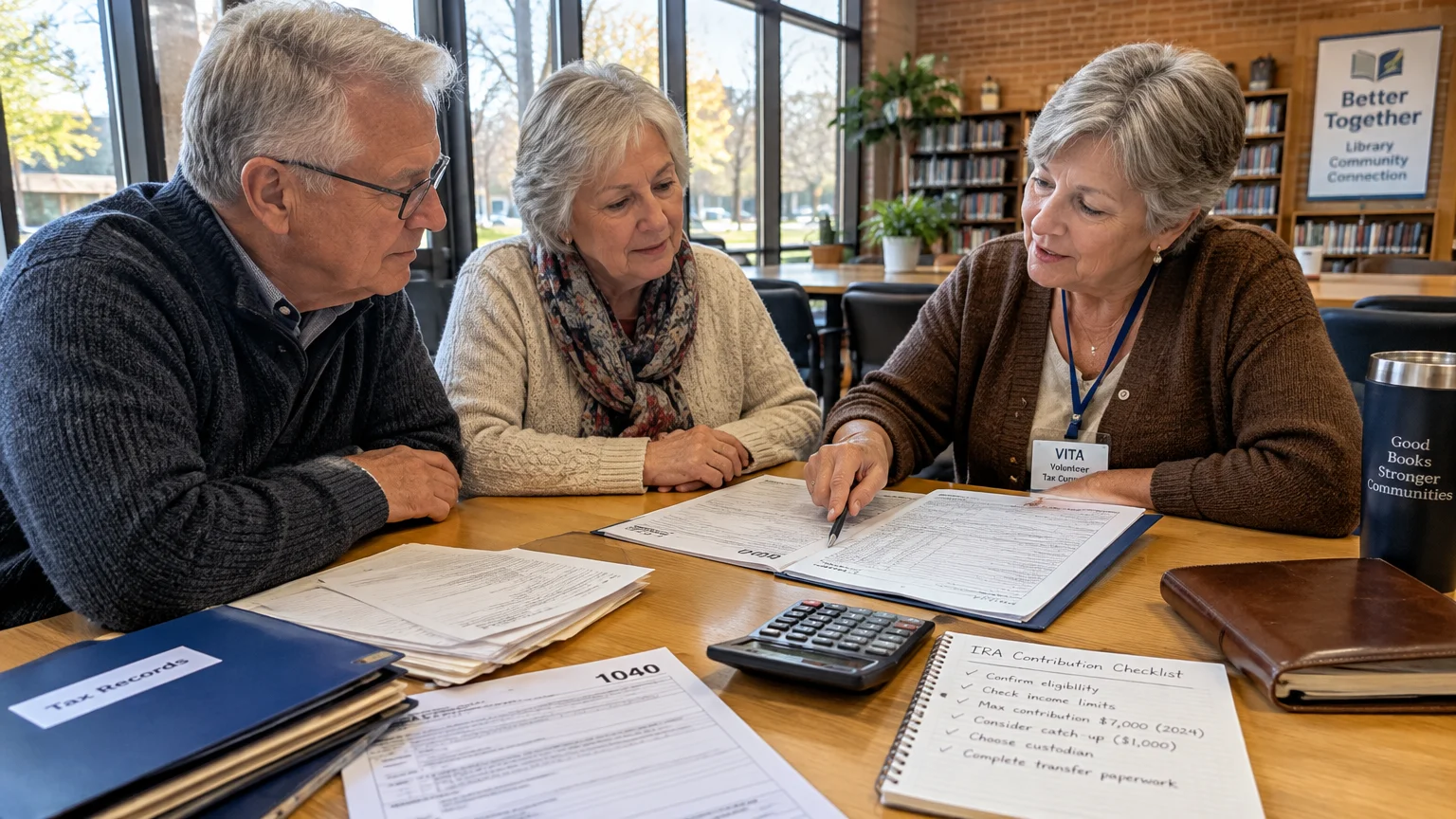
Getting Expert Help
Determining how the 2027 Saver’s Match fits your broader retirement strategy can become complicated. Consulting a qualified professional provides clarity for households navigating multiple financial transitions.
- Transitioning into semi-retirement: A tax advisor can help you balance part-time earned income against Social Security to ensure you qualify for the match.
- Managing state auto-IRA balances: A certified financial planner can help you establish a companion traditional IRA to capture federal funds cleanly.
- Navigating workplace plan restrictions: Your human resources administrator or plan fiduciary can verify whether your company 401(k) accepts Saver’s Match deposits.
- Calculating MAGI thresholds: An accountant ensures your retirement withdrawals or investment capital gains do not push you over the statutory phase-out limits.
Seeking timely assistance from a licensed professional eliminates guesswork and protects your household wealth. Trusted advisors help you optimize federal benefits while avoiding unnecessary tax liabilities.
Frequently Asked Questions
Can I get the $1,000 Saver’s Match if I only have a Roth IRA?
No, you cannot receive the match directly into a Roth IRA. You must open an eligible traditional IRA or utilize an eligible workplace pre-tax retirement plan.
Do Social Security benefits count as earned income for the match?
No, Social Security benefits represent unearned income under federal tax regulations. You must have wages, salaries, or self-employment income to qualify for the match.
How do I claim the matching funds from the federal government?
You will claim the match on Form 8880-A when filing your 2027 tax return in 2028. The IRS will deposit the funds directly into your verified pre-tax account.
Will the Saver’s Match deposit count as taxable income in 2028?
No, the matching deposit functions as a pre-tax contribution that incurs no immediate income tax. You will pay ordinary income taxes only when withdrawing the money during retirement.
Next Steps for Your 2027 Retirement Planning
The upcoming Saver’s Match offers an unprecedented opportunity to secure up to $1,000 in free retirement savings. Preparing your accounts today guarantees you will not forfeit federal dollars when the program launches.
Review your current retirement accounts to verify that you maintain an active pre-tax traditional IRA. Taking a few proactive administrative steps now will ensure your matching funds land safely in 2028.
The information in this guide is meant for educational purposes. Your specific circumstances—including income, benefits, tax situation, and health needs—may require different approaches. When in doubt, consult a licensed financial advisor or tax professional.
Last updated: October 2026. Benefit amounts, tax rules, and program details change annually—verify current figures with official government sources.






Leave a Reply