
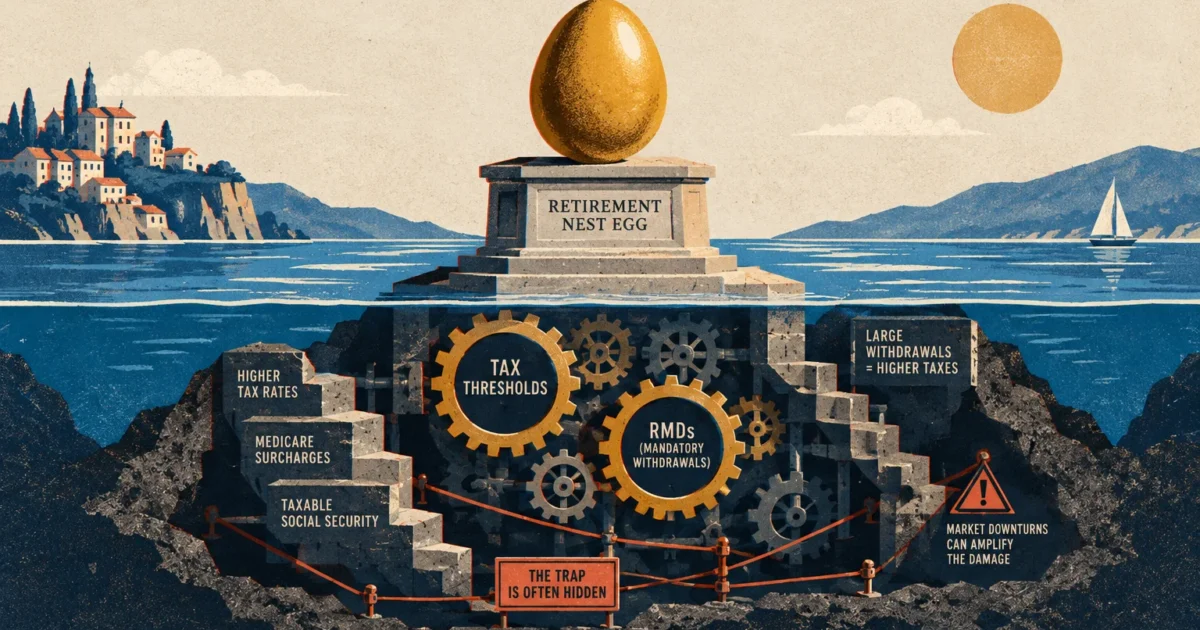
Retiring does not automatically lower your tax bill; without careful planning, Uncle Sam can take a surprisingly large bite from your nest egg. Hidden tax triggers can unexpectedly push you into higher brackets and slash your monthly income.
Many retirees mistakenly assume their living expenses and tax rates drop together. In reality, mandatory withdrawals and benefit formulas create expensive tax traps that catch thousands of older Americans off guard each year.
By learning how these rules operate right now, you can keep significantly more money in your wallet. Here are five major retirement tax traps you must avoid before they cost you.
Trap 1: The Social Security Tax Torpedo
Most retirees look forward to receiving their monthly Social Security checks. However, many people do not realize that the government can tax up to 85% of those benefits.
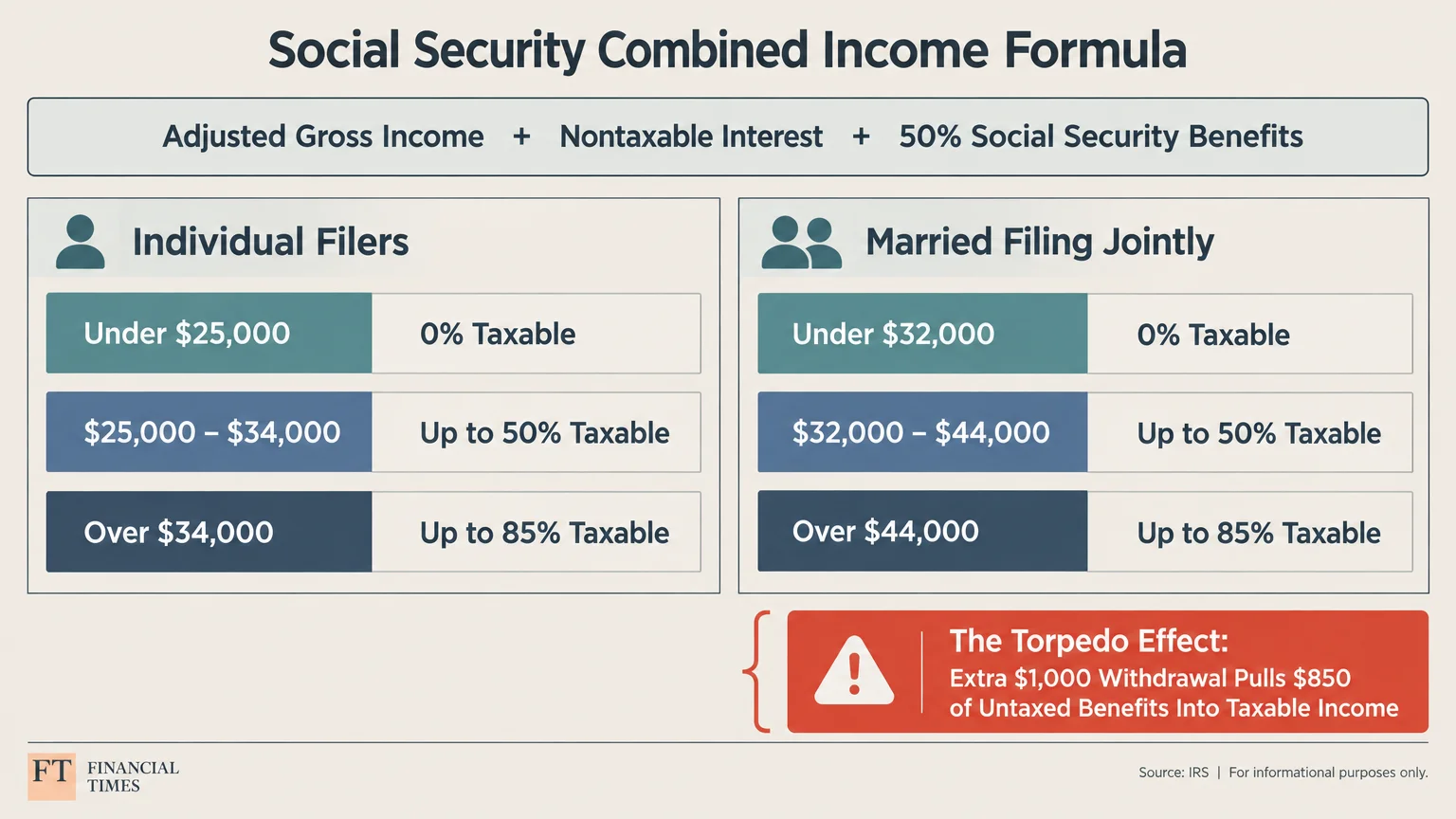
The Social Security Administration (SSA) determines your tax liability using a specific formula known as combined income. Combined income equals your adjusted gross income, plus any nontaxable interest, plus exactly half of your annual Social Security benefits.
Congress established these taxation thresholds back in 1983 and has never indexed them for inflation. Because these numbers remain frozen, normal cost-of-living increases push more seniors into taxable territory every single year.
If you file as an individual, provisional income between $25,000 and $34,000 makes up to 50% of your benefits taxable. Exceeding $34,000 exposes up to 85% of your benefits to federal income taxes.
For married couples filing jointly, provisional income between $32,000 and $44,000 triggers taxation on up to 50% of benefits. If your combined income surpasses $44,000, up to 85% becomes taxable.
The real danger here is the “tax torpedo.” When you withdraw an extra $1,000 from a traditional IRA to cover living expenses, that withdrawal does not just face ordinary income tax.
That extra distribution also pulls another $850 of previously untaxed Social Security benefits into your taxable income. This toxic chain reaction can suddenly push your effective marginal tax rate far above your official tax bracket.
To avoid this trap, plan your income sources before claiming your benefits. You can draw down traditional retirement accounts or execute partial Roth conversions in your early sixties before starting Social Security payments.
Trap 2: The RMD Double-Dip and Timing Errors
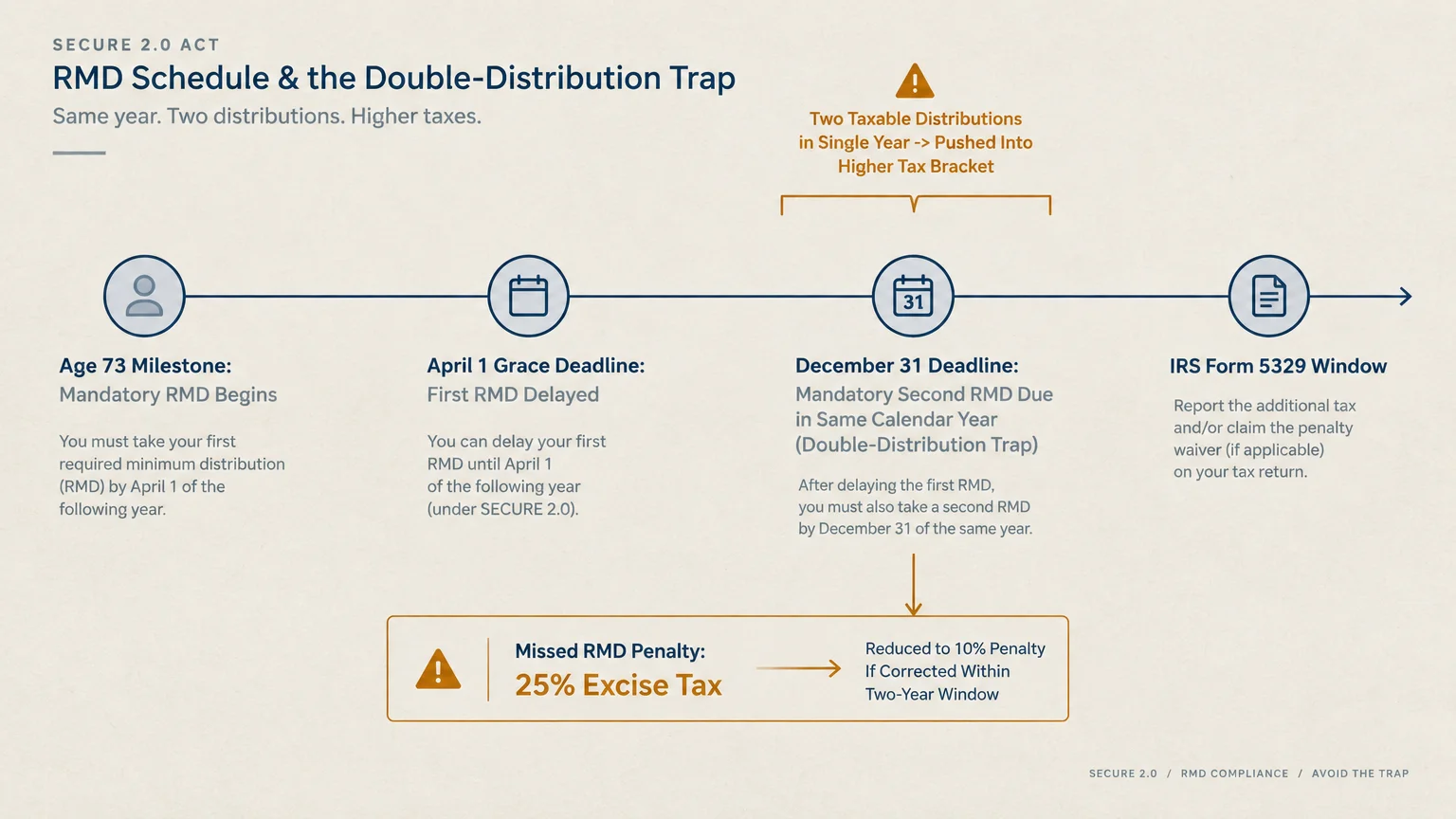
Under the SECURE 2.0 Act, you must begin taking Required Minimum Distributions (RMDs) from pre-tax retirement accounts at age 73. This mandate applies to traditional IRAs, SEP IRAs, and traditional employer plans like 401(k)s.
The law gives you a grace period for your very first distribution. You can delay taking your first RMD until April 1 of the year following the year you turn 73.
Delaying this first withdrawal sounds appealing, but it conceals a costly double-distribution trap. If you turn 73 in 2026 and wait until April 1, 2027 to take your first RMD, you must still take your second RMD by December 31, 2027.
Taking two massive mandatory distributions in a single calendar year can easily shove you into a higher federal income tax bracket. It can also trigger secondary tax penalties on your other investments.
Failing to take an RMD correctly brings severe financial consequences from the Internal Revenue Service (IRS). The IRS imposes an excise tax penalty equal to 25% of the unwithdrawn amount.
Fortunately, you can reduce this penalty to 10% if you correct the mistake quickly. You must withdraw the required funds and submit IRS Form 5329 within a two-year correction window.
You can sidestep the double-dip trap entirely by taking your first RMD during the actual calendar year you turn 73. Smoothing out your withdrawals year by year prevents sudden income spikes.
Remember that Roth 401(k) accounts no longer require mandatory lifetime distributions under current law. Rolling legacy workplace accounts into Roth IRAs eliminates RMD stress altogether.
Trap 3: The Medicare IRMAA Surcharge Cliffs
Medicare provides essential healthcare coverage for seniors, but higher earners pay substantially more for their monthly premiums. These additional charges are known as the Income-Related Monthly Adjustment Amount, or IRMAA.
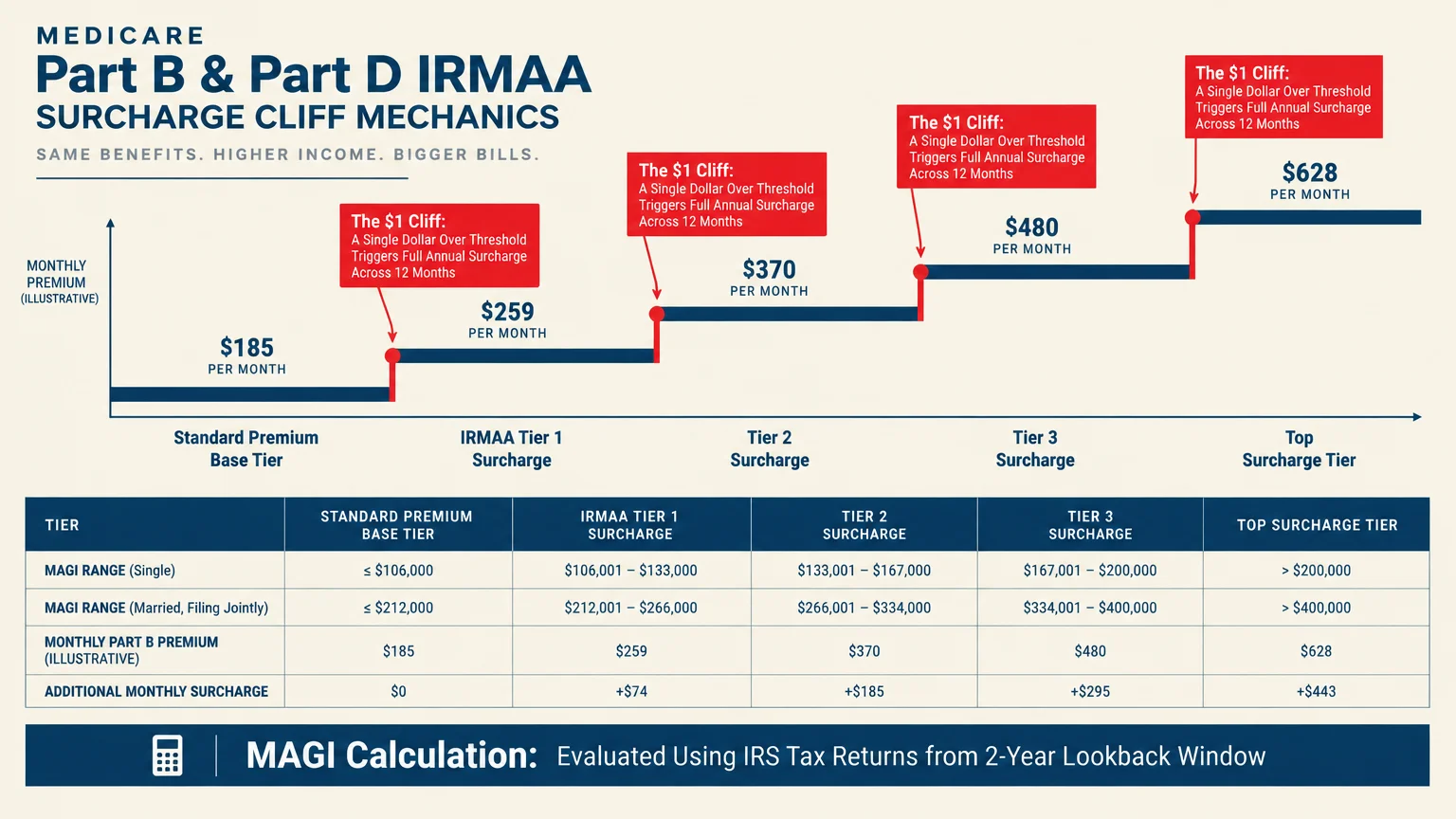
The federal government bases your Medicare premiums on a strict two-year lookback period. Your 2026 Medicare Part B and Part D premiums depend directly on the Modified Adjusted Gross Income (MAGI) reported on your 2024 tax return.
According to Medicare.gov, the standard base monthly premium for Medicare Part B is $202.90, alongside an annual deductible of $283. However, surpassing specific income thresholds triggers aggressive surcharges.
Unlike regular income tax brackets where higher rates only apply to dollars above the line, IRMAA operates as a rigid financial cliff. If your MAGI exceeds a threshold by just one single dollar, you owe the higher premium for the entire year.
| Filing Single (2024 MAGI) | Married Filing Jointly (2024 MAGI) | Total Monthly Part B Premium |
|---|---|---|
| $109,000 or less | $218,000 or less | $202.90 (Standard) |
| $109,001 to $137,000 | $218,001 to $274,000 | $284.10 |
| $137,001 to $171,000 | $274,001 to $342,000 | $405.80 |
| $171,001 to $205,000 | $342,001 to $410,000 | $527.50 |
| $205,001 to $499,999 | $410,001 to $749,999 | $649.20 |
| $500,000 or more | $750,000 or more | $689.90 |
Part D prescription drug coverage carries similar surcharges ranging from $14.50 up to $91.00 per month above your normal plan premium. For a married couple, falling off an IRMAA cliff can easily cost thousands of dollars in unnecessary annual expenses.
To avoid this cliff, monitor your MAGI carefully whenever you sell appreciated real estate or execute large retirement withdrawals. Timing your capital gains and pre-tax distributions prevents you from crossing these strict lines.
If your income dropped significantly due to a major life change such as retirement or the death of a spouse, you can appeal. File Form SSA-44 with the Social Security Administration to request an immediate premium recalculation.
Trap 4: The Senior Bonus Deduction Phaseout
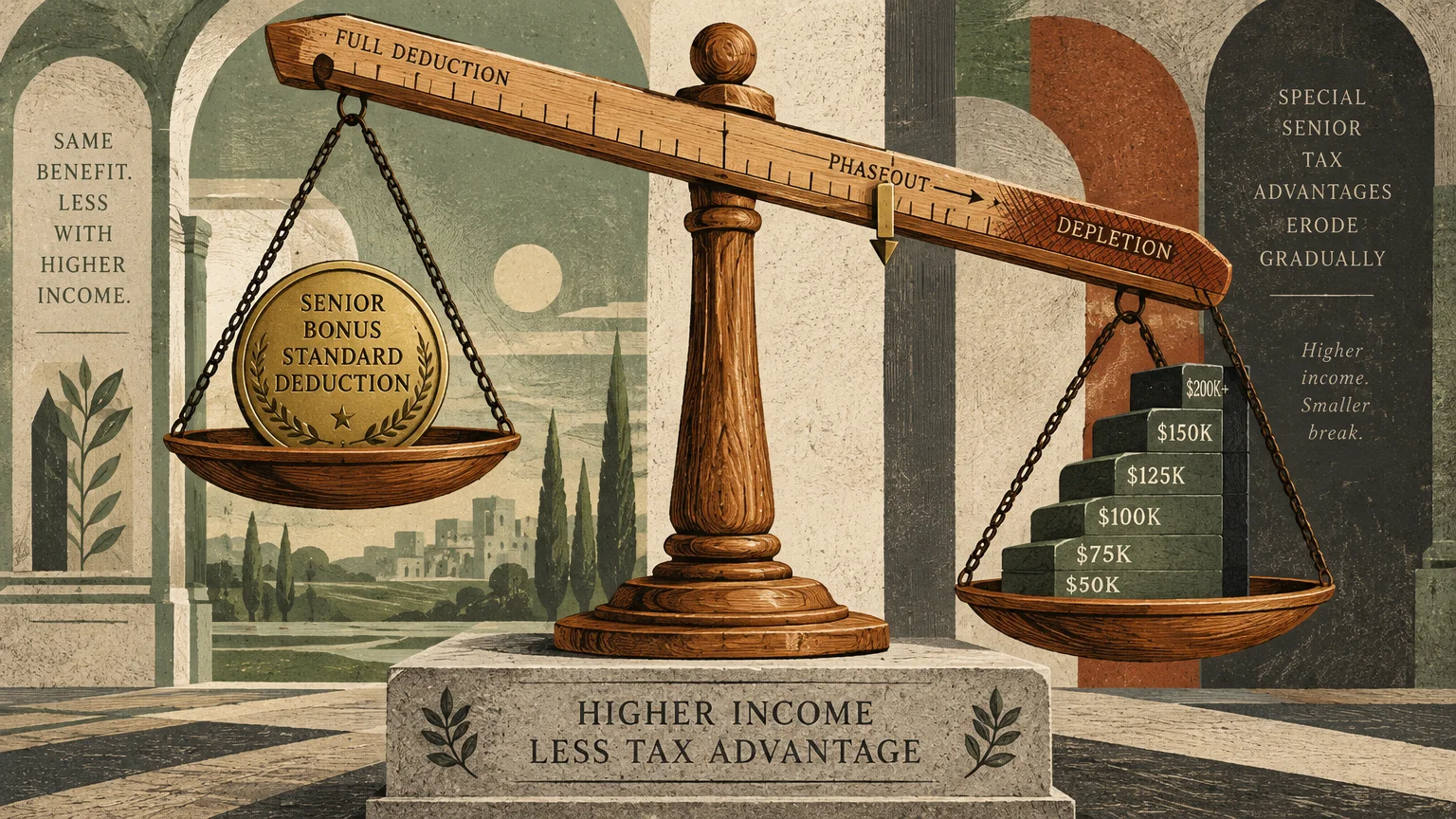
Federal tax laws provide valuable standard deduction benefits to older Americans, but navigating the phaseout rules requires vigilance. For 2026, the base standard deduction is $16,100 for single filers and $32,200 for married couples filing jointly.
Taxpayers age 65 and older receive an additional standard deduction of $2,050 if single, or $1,650 per spouse if filing jointly. In addition, current federal tax provisions grant an enhanced bonus deduction of $6,000 per qualifying senior, or $12,000 for a married couple.
This enhanced senior bonus deduction provides significant tax relief, but it introduces a subtle phaseout trap. The bonus deduction phases out steadily once your MAGI exceeds $75,000 for single filers or $150,000 for married couples.
The deduction reduces at a rate of 6% for every dollar you earn above those income boundaries. It vanishes completely once income reaches $175,000 for individual filers or $250,000 for joint filers.
This phaseout creates a stealth tax bracket. When your income enters the phaseout zone, every additional dollar you withdraw generates normal income tax while simultaneously eroding your deduction.
Consider an example where a retired couple earns $155,000 in MAGI. That extra $5,000 over the threshold wipes out $300 of their senior bonus deduction, raising their taxable income to $155,300.
Retirees conducting Roth conversions often walk straight into this trap without realizing it. Converting too much money from a traditional IRA can inadvertently destroy valuable deductions and inflate your final tax bill.
Check your projected MAGI before year-end to ensure your deductions remain intact. Keeping taxable distributions just below the $75,000 or $150,000 marks protects your full bonus deduction.
Trap 5: Capital Gains and the QCD “First Dollars Out” Blunder
Managing taxable brokerage accounts alongside retirement distributions requires careful coordination. Many retirees aim to take advantage of the 0% federal tax bracket for long-term capital gains and qualified dividends.
In 2026, you can realize long-term capital gains at a 0% federal tax rate if your total taxable income remains at or below $49,450 for single filers or $98,900 for married couples filing jointly. Ordinary income, however, sits at the bottom of the tax stack.
If you take taxable distributions from an IRA or earn pension income, those dollars fill up your lower tax brackets first. Extra ordinary income pushes your investments out of the 0% bracket and straight into the 15% capital gains rate.
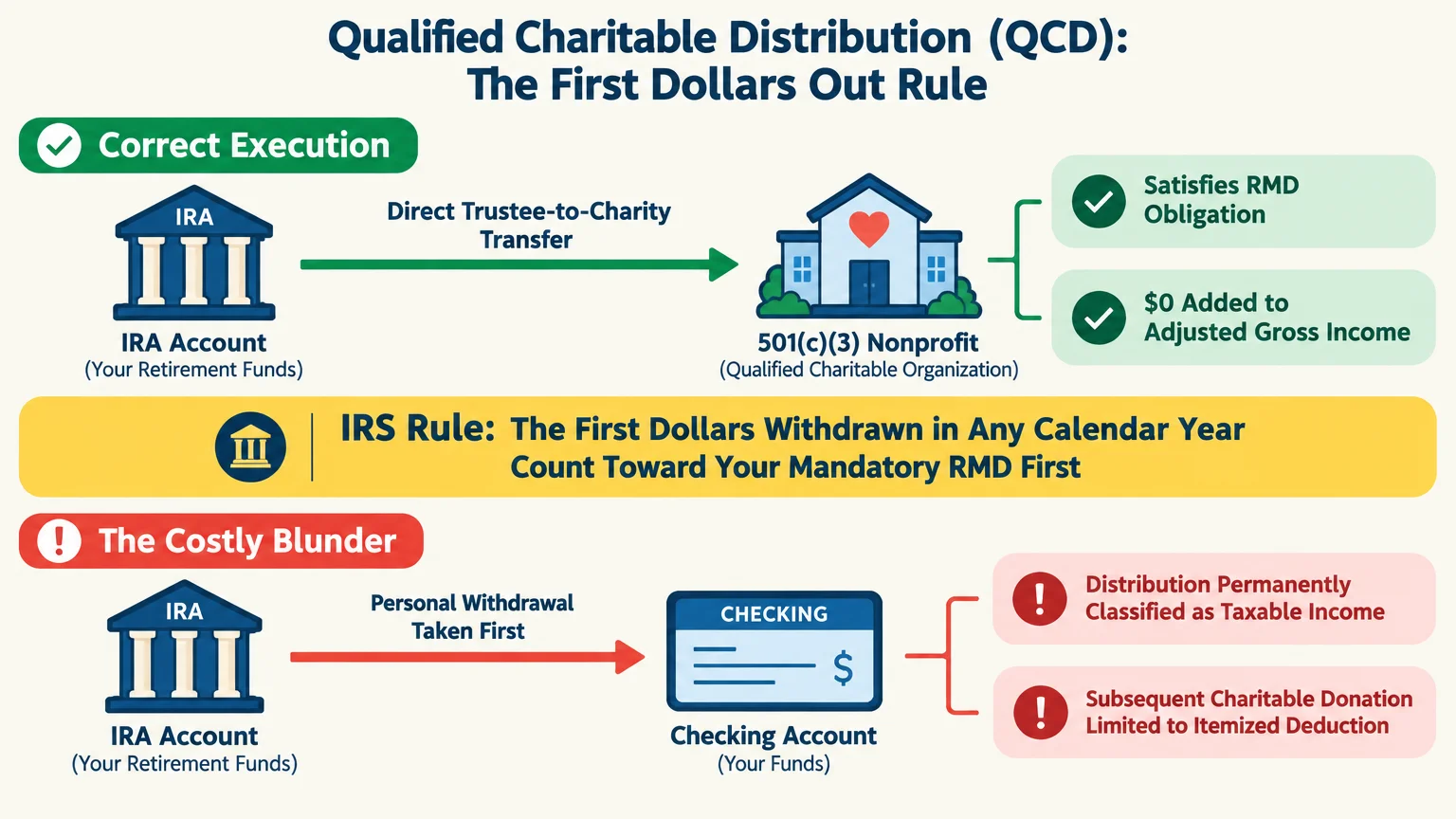
Many generous retirees use Qualified Charitable Distributions (QCDs) to keep their taxable income low. If you are age 70½ or older, you can transfer up to $111,000 directly from an IRA to a qualified charity tax-free.
A properly executed QCD satisfies your annual RMD requirement without adding a single penny to your adjusted gross income. However, thousands of retirees blunder into the strict IRS “first dollars out” rule every year.
The IRS mandates that the very first money withdrawn from an IRA in any calendar year automatically counts toward your RMD. If you withdraw your RMD into your personal checking account in January, that income becomes permanently taxable.
You cannot make a charitable gift in December and retroactively designate your earlier personal distribution as a tax-free QCD. The taxable distribution remains locked onto your tax return, pushing your capital gains into taxable territory.
Charitable giving rules also include an above-the-line deduction up to $1,000 for single filers or $2,000 for couples who do not itemize. Meanwhile, retirees who itemize face a 0.5% AGI deduction floor, making direct QCDs the far superior giving strategy.
Always instruct your IRA custodian to send charitable donations directly to your chosen non-profit organization before taking any personal distributions. Following this sequence shields your income and preserves your 0% capital gains rate.

Expert Perspective on Retirement Tax Planning
Navigating these overlapping tax codes requires a proactive approach rather than reacting when tax filing season arrives. Financial authorities emphasize that taxes during retirement require more ongoing attention than during your working career.
“The single biggest mistake retirees make is not having a plan for their taxes in retirement. Taxes don’t stop when you stop working; they actually become more complex.” — Ed Slott, CPA and Retirement Distribution Expert
Taking control of your tax destiny requires looking several years ahead. Coordinating your withdrawals, conversions, and charitable gifts protects your wealth from unnecessary erosion.
Common Mistakes to Avoid
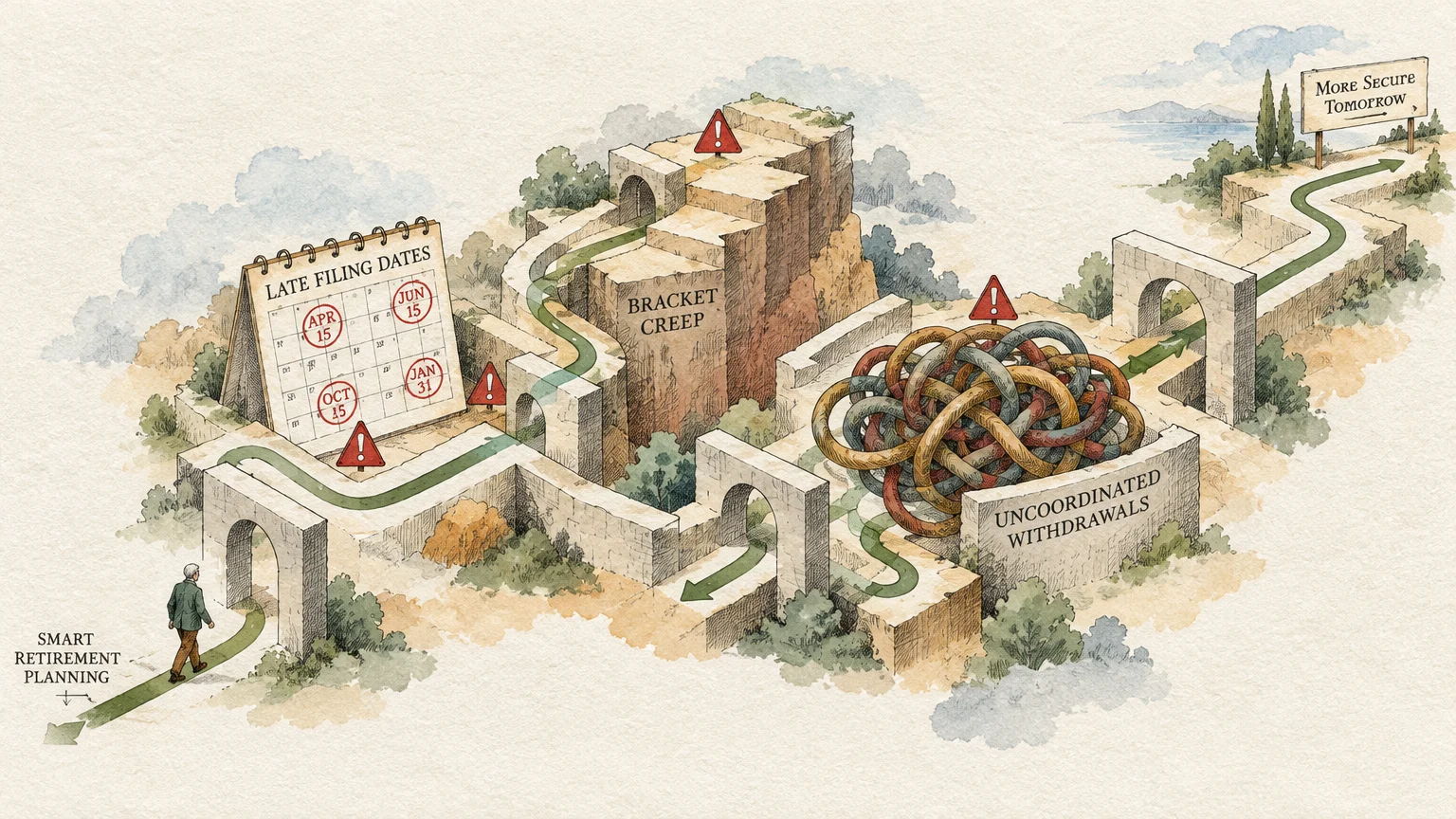
Avoiding severe financial traps requires recognizing basic mistakes before they damage your portfolio. Here are four common missteps seniors frequently make when managing their retirement income:
- Viewing pre-tax retirement balances as pure spendable cash: Remember that a portion of every traditional IRA dollar belongs to the government. Failing to account for future tax liability can distort your retirement budget.
- Ignoring state tax rules on retirement income: While federal taxes demand significant attention, state laws vary dramatically. Some states exempt Social Security and pensions entirely, while others tax retirement distributions heavily.
- Withdrawing funds in the wrong account order: Depleting taxable brokerage accounts first while letting traditional IRAs swell can trigger massive RMD problems later in life. A balanced withdrawal strategy preserves your assets longer.
- Forgetting quarterly estimated tax payments: Taxes are not automatically withheld from all retirement distributions unless you elect withholding. The IRS charges underpayment penalties if you do not submit estimated payments on time.
Staying mindful of these missteps allows you to manage your retirement assets with clarity. Simple adjustments today prevent major tax headaches tomorrow.

Finding the Right Advisor
Not every financial situation requires professional intervention, but complex retirement landscapes often benefit from expert guidance. Knowing when to consult a qualified professional can save you thousands of dollars.
Consider seeking specialized advice under the following scenarios:
- You hold large pre-tax balances approaching age 73: An advisor can design a multi-year Roth conversion schedule to minimize RMD spikes and avoid IRMAA surcharges.
- You plan to sell a primary residence or valuable asset: Real estate transactions can generate significant capital gains that trigger health insurance cliffs and deduction phaseouts.
- You recently lost a spouse: Surviving spouses face the “widow’s tax penalty” when their filing status changes from married filing jointly to single, which shrinks tax brackets drastically.
- You want to optimize charitable legacy gifts: A professional can set up direct QCD channels to fulfill RMDs while supporting your favorite philanthropic causes.
When searching for professional help, look for fee-only fiduciary financial planners or Certified Public Accountants (CPAs). Fiduciaries are legally obligated to put your financial interests first, ensuring you receive unbiased tax planning advice.
Frequently Asked Questions
Can I undo a taxable IRA withdrawal if I realize it triggered an IRMAA surcharge?
Generally, you cannot undo an IRA distribution once the funds reach your personal bank account. The only exception is the IRS 60-day rollover rule, which allows you to redeposit the funds into an eligible retirement account once per 12-month period.
Are Roth IRA withdrawals ever counted toward the Social Security tax formula?
Qualified distributions from a Roth IRA are completely income-tax-free and do not count toward your provisional income. Because Roth distributions do not inflate your combined income, they never trigger taxes on your Social Security benefits.
What happens if a worker earns more than $150,000 and wants to make catch-up contributions?
Under SECURE 2.0 regulations, workers aged 50 and older who earned more than $150,000 in prior-year wages from their employer can no longer make pre-tax catch-up contributions. These workers must direct their catch-up contributions into an after-tax Roth account.
Can I donate my RMD to charity if I am 71 years old?
Yes, you can utilize Qualified Charitable Distributions starting at age 70½, well before your mandatory RMD age of 73 begins. Giving through a QCD at age 71 lowers your overall IRA balance and reduces your future mandatory distributions.
Managing taxes in retirement is not about eliminating taxes entirely; it is about keeping your lifetime tax liability as low as possible. By paying close attention to income thresholds and distribution timing, you can protect your hard-earned wealth and enjoy financial peace of mind.
Take time this week to review your current income sources, upcoming distribution deadlines, and charitable plans. This is educational content based on general financial principles for seniors. Individual results vary based on your situation. Always verify current benefit amounts, tax rules, and program eligibility with official government sources.
Last updated: October 2026. Benefit amounts, tax rules, and program details change annually—verify current figures with official government sources.








Leave a Reply