

Healthcare expenses can derail your retirement budget if you rely solely on Medicare. A Health Savings Account shields your hard-earned money through unmatched tax benefits that traditional retirement accounts cannot duplicate.
By leveraging the HSA triple tax advantage, you eliminate taxes on contributions, investment growth, and qualified withdrawals. This structure provides immediate tax relief today while building a dedicated medical nest egg for your future.
Understanding how these tax savings operate empowers you to keep significantly more money in your pocket throughout retirement.
The Mechanics of the HSA Triple Tax Advantage
Most tax-advantaged accounts give you a single tax break. A Traditional IRA provides an upfront deduction, while a Roth IRA delivers tax-free distributions later in life.
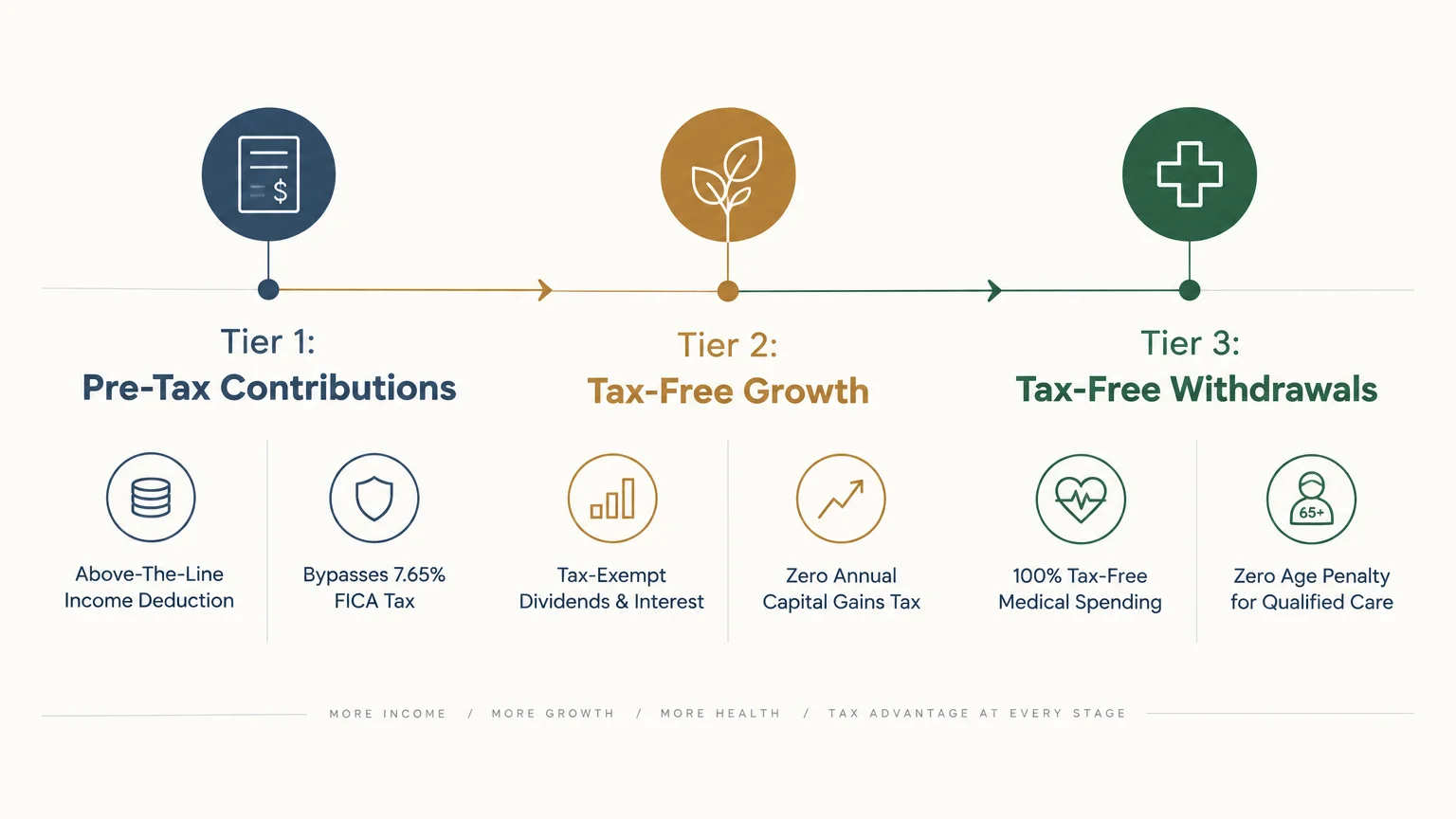
A Health Savings Account (HSA) combines both benefits and adds a third layer of savings. This rare financial structure creates a three-tier shield against taxes.
The first tier begins when you deposit money into your account. Contributions you make through payroll deductions enter the account on a pre-tax basis, lowering your current taxable income.
If you deposit funds directly from your bank account, you claim an above-the-line deduction on your tax return. You do not need to itemize deductions on Schedule A to claim this tax break.
Payroll contributions deliver an added bonus that traditional retirement plans miss. They bypass the 7.65% FICA tax, which covers Social Security and Medicare taxes.
The second tier protects your money while it sits inside the account. Any interest, dividends, or capital gains you earn accumulate completely free from federal income tax.
You can invest your HSA balance in mutual funds, exchange-traded funds, or individual stocks. You never owe taxes on annual earnings, allowing compound growth to work at full strength.
The third tier occurs when you spend the money. Withdrawals remain completely tax-free at any age, provided you spend the funds on qualified medical expenses.
No other savings vehicle in the United States tax code offers this level of complete tax exemption. It gives you a powerful tool to lower lifetime medical bills.
The Reality of Retirement Healthcare Costs
Many seniors mistakenly assume Medicare covers all medical bills once they turn 65. In reality, out-of-pocket healthcare expenses represent one of the largest spending categories in retirement.
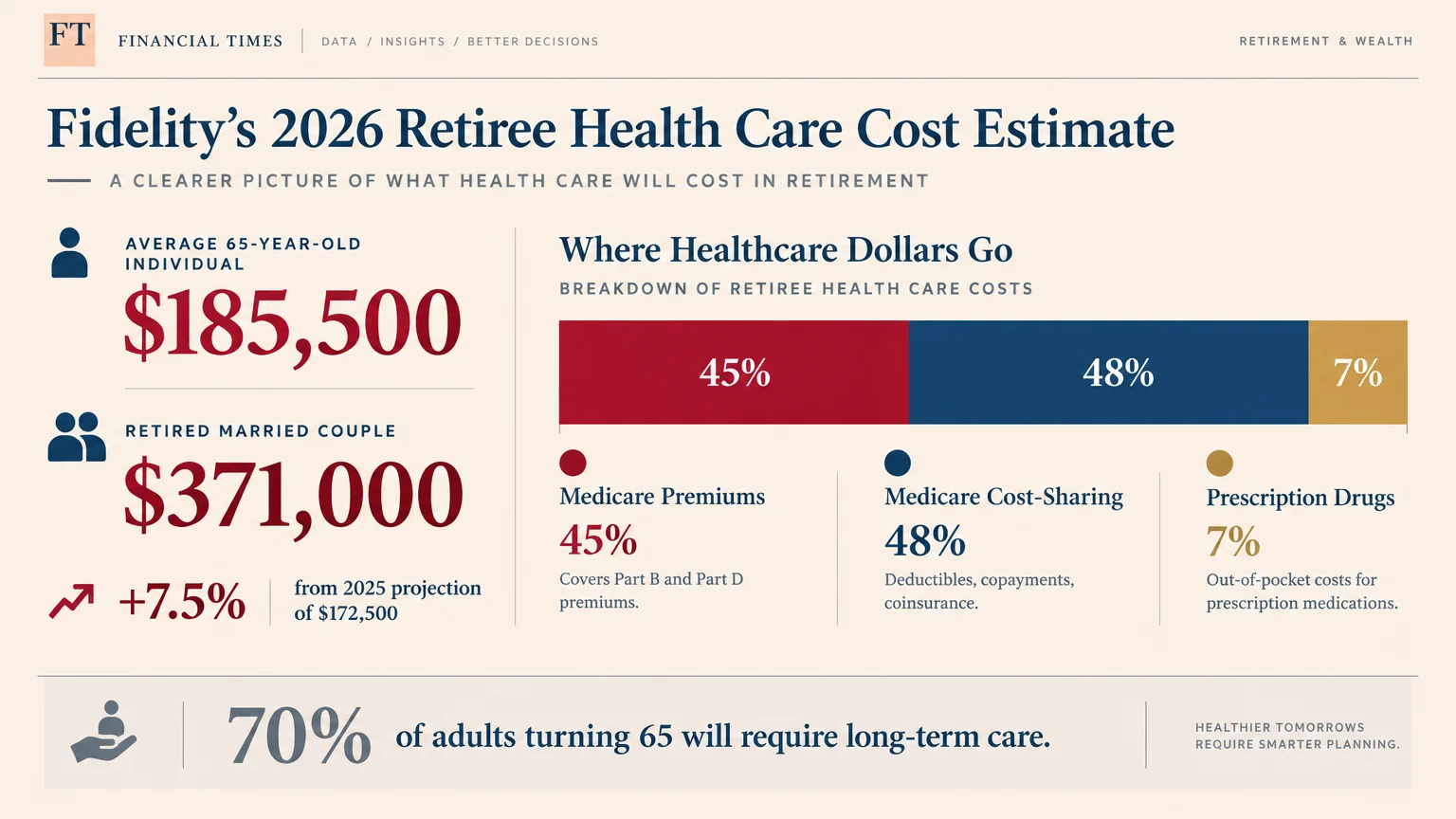
According to Fidelity’s 2026 Retiree Health Care Cost Estimate, an average 65-year-old retiring in 2026 will need approximately $185,500 in after-tax savings for medical expenses. A married couple will require roughly $371,000.
This 2026 estimate marks a 7.5% increase from the 2025 projection of $172,500. Medical inflation consistently outpaces general consumer inflation, eroding standard fixed-income pensions.
Fidelity’s research reveals where these retirement healthcare dollars actually go:
- Medicare Premiums: Approximately 45% of total expenses pay for Medicare Part B and Part D monthly premiums.
- Medicare Cost-Sharing: Roughly 48% covers deductibles, copayments, and coinsurance for doctor visits and hospital stays.
- Prescription Drugs: About 7% pays for out-of-pocket prescription medication expenses.
These projections do not include long-term nursing home care or assisted living. The Department of Health and Human Services estimates that nearly 70% of adults turning 65 will require long-term care services at some point.
Paying these massive costs with ordinary retirement income triggers significant tax liabilities. Using tax-free HSA dollars allows you to stretch your retirement savings much further.
IRS Contribution Limits and Eligibility for 2026 and 2027
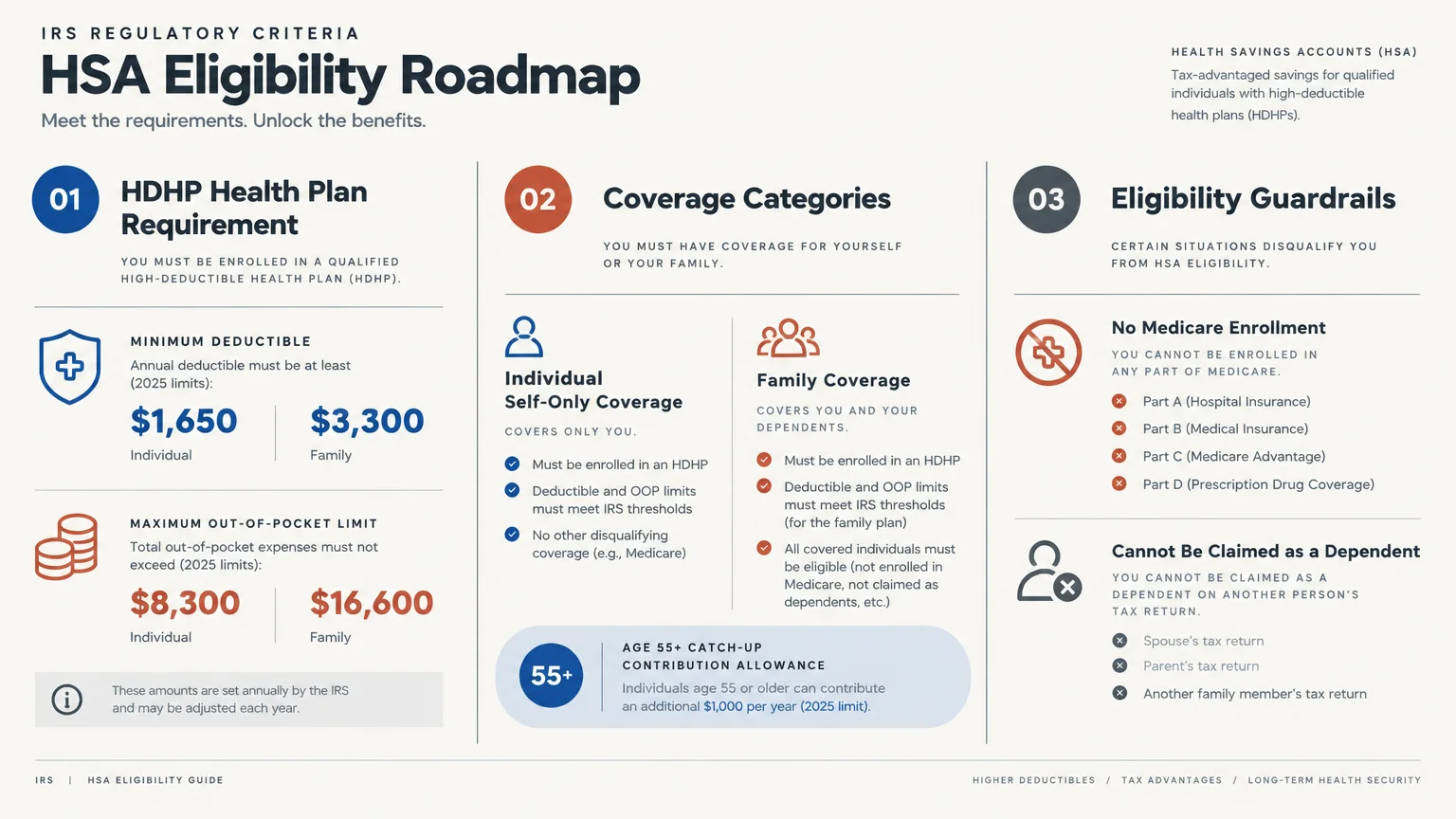
To fund an HSA, you must enroll in a qualifying High-Deductible Health Plan (HDHP). You cannot maintain any disqualifying secondary health coverage or be claimed as a dependent.
The Internal Revenue Service (IRS) establishes strict annual parameters for both plan design and maximum contribution amounts under Revenue Procedure 2026-24.
For 2026, a qualifying HDHP must carry a minimum annual deductible of $1,700 for individual coverage or $3,400 for family coverage. The maximum out-of-pocket spending limit is $8,500 for individuals and $17,000 for families.
For 2027, the minimum deductible increases to $1,750 for self-only coverage and $3,500 for family coverage. The maximum out-of-pocket limit climbs to $8,700 for individuals and $17,400 for families.
The IRS also updated annual contribution caps across both tax years:
- 2026 Individual Limit: You can contribute up to $4,400 for self-only coverage.
- 2026 Family Limit: You can contribute up to $8,750 for family coverage.
- 2027 Individual Limit: The cap rises to $4,500 for self-only coverage.
- 2027 Family Limit: The cap rises to $9,000 for family coverage.
- Age 55+ Catch-Up Contribution: Individuals aged 55 and older can contribute an additional $1,000 per year in both 2026 and 2027.
Under Section 71308 of Public Law 119-21, effective January 1, 2026, individuals with Direct Primary Care arrangements can now contribute to an HSA. Aggregate monthly fees cannot exceed $150 for individuals or $300 for families.
Comparing the HSA to Traditional Retirement Accounts
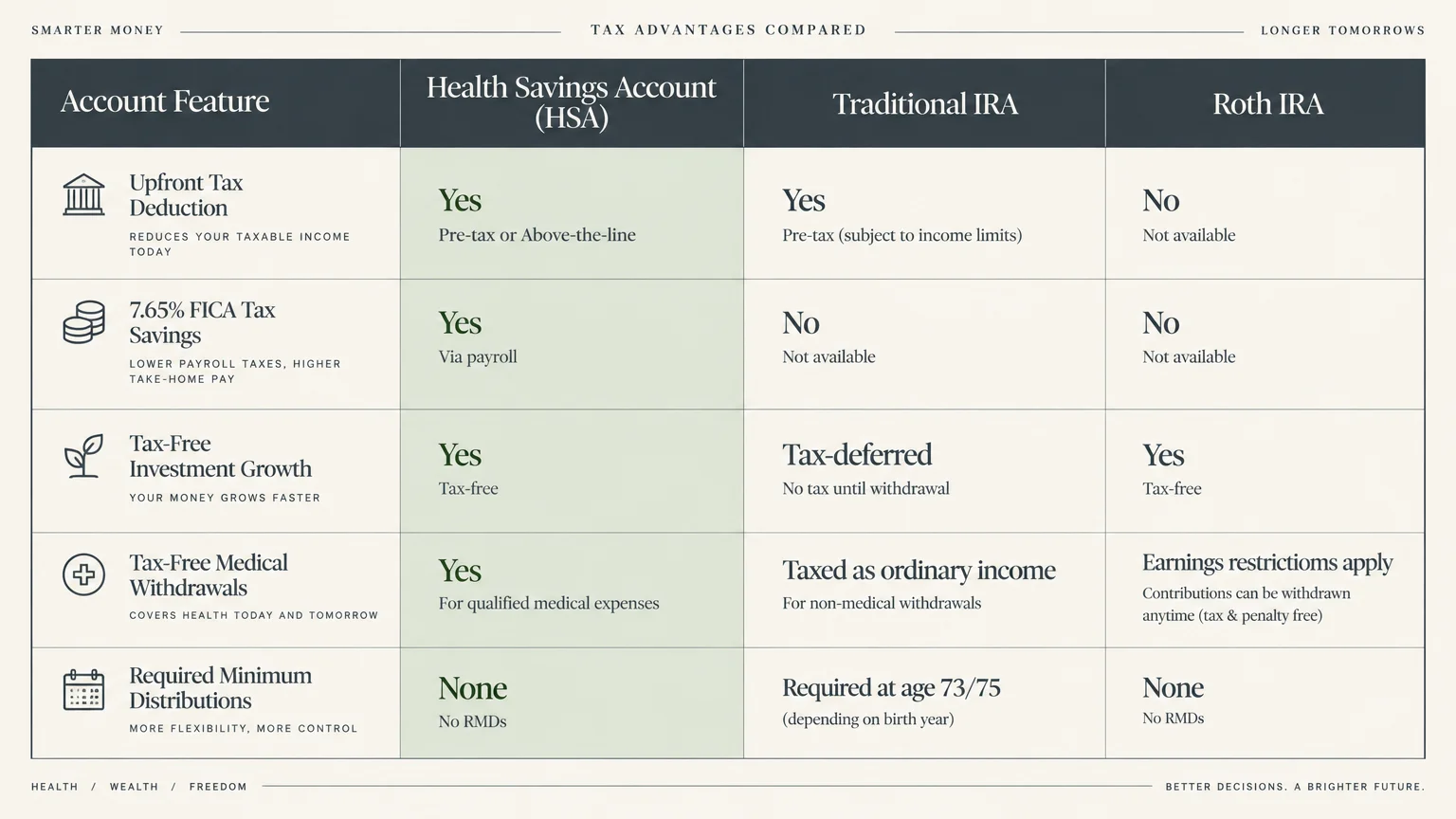
Many pre-retirees prioritize 401(k) accounts or IRAs while ignoring their HSA. Comparing the tax rules side-by-side reveals why prioritizing your HSA can save substantial money.
| Feature | Health Savings Account (HSA) | Traditional 401(k) / IRA | Roth IRA |
|---|---|---|---|
| Contribution Tax Treatment | Pre-tax payroll or tax-deductible | Pre-tax payroll or tax-deductible | After-tax dollars (no deduction) |
| FICA Tax Exemption | Yes (via payroll contributions) | No (FICA taxes still apply) | No (FICA taxes still apply) |
| Growth on Investments | 100% tax-free | Tax-deferred | 100% tax-free |
| Qualified Medical Withdrawals | 100% tax-free | Taxed as ordinary income | Tax-free (after age 59½) |
| Non-Medical Withdrawals (65+) | Taxed as ordinary income | Taxed as ordinary income | Tax-free (after age 59½) |
| Required Minimum Distributions | None during account owner lifetime | Mandatory at age 73 or 75 | None during account owner lifetime |
When you withdraw funds from a Traditional 401(k) to pay medical bills, you pay ordinary income tax on every dollar. That withdrawal also increases your adjusted gross income.
Higher income can trigger taxes on your Social Security benefits and lead to Medicare premium surcharges. HSA distributions do not increase your reported income on your tax return.
“The HSA is the only account in the tax code that allows you to deduct contributions, grow money completely tax-free, and withdraw it without paying a dime in taxes.” — Ed Slott, CPA and Retirement Distribution Specialist

How the HSA Transforms at Age 65
Prior to age 65, withdrawing HSA money for non-medical expenses triggers ordinary income taxes plus a harsh 20% IRS penalty. This steep penalty deters early non-medical spending.
Once you turn 65, the 20% penalty disappears entirely. This pivotal rule change transforms your HSA into an account that functions just like a Traditional IRA for general spending.
If you take money out at age 65 or older for non-medical living costs, you simply pay regular income tax. You face no special penalties or restrictions.
If you use the funds for qualified healthcare expenses, every distribution remains 100% tax-free. Your HSA provides all the upside of an IRA with built-in tax-free protection for medical costs.
Unlike Traditional IRAs and 401(k) plans, HSAs do not enforce Required Minimum Distributions (RMDs). You can let your balance grow untouched indefinitely if you do not need the money.

Using Your HSA for Medicare and Long-Term Care
Many seniors do not realize they can use accumulated HSA funds to pay for healthcare coverage premiums. Once you reach age 65, specific premium payments become qualified medical expenses.
You can pay monthly premiums for Medicare Part B medical insurance and Medicare Part D prescription plans using tax-free HSA withdrawals. You can also pay premiums for Medicare Part C (Medicare Advantage) coverage.
If you must pay a premium for Medicare Part A because you lack 40 quarters of work history, that premium is also HSA-eligible. Review official premium rules on Medicare.gov before submitting claims.
However, the IRS strictly prohibits using HSA dollars to pay premiums for Medicare Supplement Insurance, commonly known as Medigap. Paying Medigap premiums with HSA funds triggers income taxes and potential penalties.
You can also use HSA assets to cover tax-qualified long-term care insurance premiums. The IRS sets maximum annual deductible amounts based on your age under Revenue Procedure 2025-32:
- Age 40 or younger: Up to $500 per year
- Age 41 to 50: Up to $930 per year
- Age 51 to 60: Up to $1,860 per year
- Age 61 to 70: Up to $4,960 per year
- Age 71 and older: Up to $6,200 per year
These generous limits allow older Americans to offset significant insurance costs using money that was never taxed. This strategy preserves other retirement assets for daily living needs.

The Shoebox Strategy for Long-Term Growth
Many people treat their HSA as a routine checking account. They deposit money in January and spend it on copays and prescription drugs in February.
Spending HSA funds immediately limits the account’s wealth-building capacity. You forfeit the second pillar of the triple tax advantage: compounding investment growth over time.
Savvy savers use what financial planners call the “shoebox strategy.” Under this method, you pay current out-of-pocket medical bills using regular cash or checking account funds.
You keep all receipts, explanation of benefits statements, and invoices stored safely in a physical file or secure digital folder. Meanwhile, your invested HSA balance continues compounding tax-free in the financial markets.
The tax code sets no deadline for reimbursing yourself for qualified medical expenses incurred after you opened the account. You can incur an expense at age 55 and reimburse yourself tax-free at age 70.
When you need extra cash in retirement, you simply pull out old receipts and issue tax-free withdrawals from your HSA. You gain immediate liquidity without increasing your taxable income.
Pitfalls to Watch For
While the HSA offers incredible financial benefits, navigating IRS regulations requires careful planning. A single procedural mistake can trigger unwelcome taxes and penalties.
Watch out for these common missteps as you manage your healthcare savings:
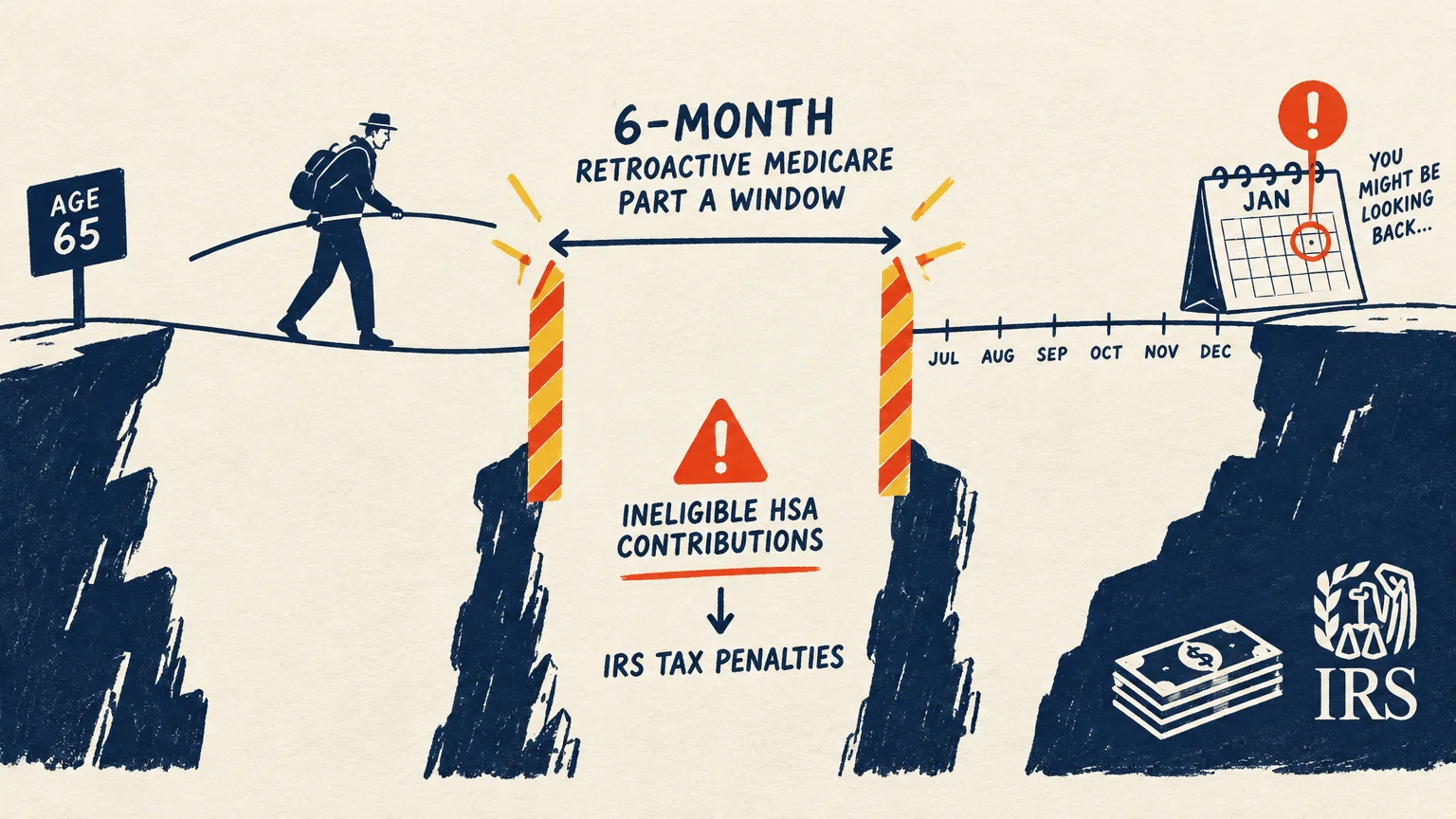
- The 6-Month Retroactive Medicare Trap: When you apply for Medicare Part A or Social Security benefits after age 65, Medicare coverage backdates up to six months. You must stop HSA contributions six months before enrolling to prevent a 6% IRS excess contribution excise tax. Visit the Social Security Administration (SSA) to verify your enrollment timeline.
- Paying Medigap Premiums with HSA Funds: While Part B and Advantage plan premiums are eligible, Medigap premiums are not. Using HSA funds for Medigap coverage turns that distribution into taxable income.
- Combining Spousal Catch-Up Contributions: Spouses aged 55 or older cannot deposit both $1,000 catch-up contributions into a single joint account. Each spouse must maintain their own distinct HSA account to claim their separate catch-up limit.
- Leaving Balances in Cash: Many administrators leave HSA deposits in basic cash accounts yielding minimal interest by default. You must deliberately allocate contributions into diversified investment options to achieve substantial long-term growth.
Being proactive about these rules protects your savings from administrative snags and avoidable tax burdens.

Getting Expert Help
Deciding how to balance HSA contributions with other retirement accounts depends heavily on your overall wealth strategy. Certain milestones benefit from professional guidance:
- Working Past Age 65: If you plan to remain employed past 65 with employer group coverage, consult a benefits specialist. They will help you coordinate your HDHP coverage without triggering retroactive Medicare penalties.
- Managing Retirement Tax Brackets: A certified financial planner can calculate whether paying current medical bills from an HSA or from after-tax savings produces greater tax efficiency. Resources from the Consumer Financial Protection Bureau (CFPB) can help you locate reputable professionals.
- Long-Term Care Policy Structuring: An insurance specialist can verify whether your specific long-term care policy meets IRS qualification standards. This ensures your premium payments remain completely tax-free under age-based caps.
- Inheritance and Estate Planning: Unlike IRAs, HSAs passed to non-spouse beneficiaries lose their tax-exempt status immediately. An estate planner can help you name proper beneficiaries to avoid severe lump-sum tax bills for your heirs. Senior resources from AARP provide valuable educational guidance on asset transfers.
Working with a qualified advisor ensures you extract maximum value from every dollar you save.
Frequently Asked Questions About HSAs and Retirement
Can I contribute to an HSA if I am enrolled in Medicare?
No. The moment your Medicare coverage becomes effective—whether Part A, Part B, Part C, or Part D—you lose eligibility to contribute new funds to an HSA. However, you can keep your existing account and spend the remaining balance tax-free on qualified medical expenses indefinitely.
What happens to my HSA funds if I do not spend them this year?
Unlike Flexible Spending Accounts (FSAs), HSAs never operate under “use-it-or-lose-it” rules. Every dollar remaining in your HSA rolls over automatically from year to year. The money belongs to you permanently, even if you change employers, switch health plans, or retire.
Can I use my HSA funds to pay for my spouse’s medical expenses?
Yes. You can use your HSA funds tax-free to pay for qualified medical expenses incurred by your spouse and any legal tax dependents. This rule applies even if your spouse is enrolled in Medicare or covered under a separate, non-HDHP health insurance policy.
Is there an income limit to contribute to an HSA?
No. Unlike Roth IRAs, HSAs have no income phaseouts or earning caps. High-earning individuals can make the maximum allowable contribution and claim the full tax deduction regardless of adjusted gross income.
What records do I need to keep for qualified HSA withdrawals?
You should retain itemized receipts, doctor bills, and pharmacy statements showing the provider, date of service, description of care, and out-of-pocket cost paid. The IRS does not require receipts when filing taxes, but you must produce them if selected for an audit.
Building Your Healthcare Security
Rising medical costs present a major financial hurdle for seniors, but the HSA triple tax advantage gives you an effective shield. Taking full advantage of tax-deductible deposits, tax-free growth, and penalty-free distributions significantly reduces your retirement stress.
Review your healthcare plan options during your next open enrollment period. If an HDHP fits your ongoing medical needs, open an HSA and begin funding your future healthcare security today.
The information in this guide is meant for educational purposes. Your specific circumstances—including income, benefits, tax situation, and health needs—may require different approaches. When in doubt, consult a licensed financial advisor or tax professional.
Last updated: October 2026. Benefit amounts, tax rules, and program details change annually—verify current figures with official government sources.








Leave a Reply