

Retiring abroad can cut your local tax bill to zero, stretch your pension, and upgrade your lifestyle. Yet moving overseas does not automatically erase what you owe back home.
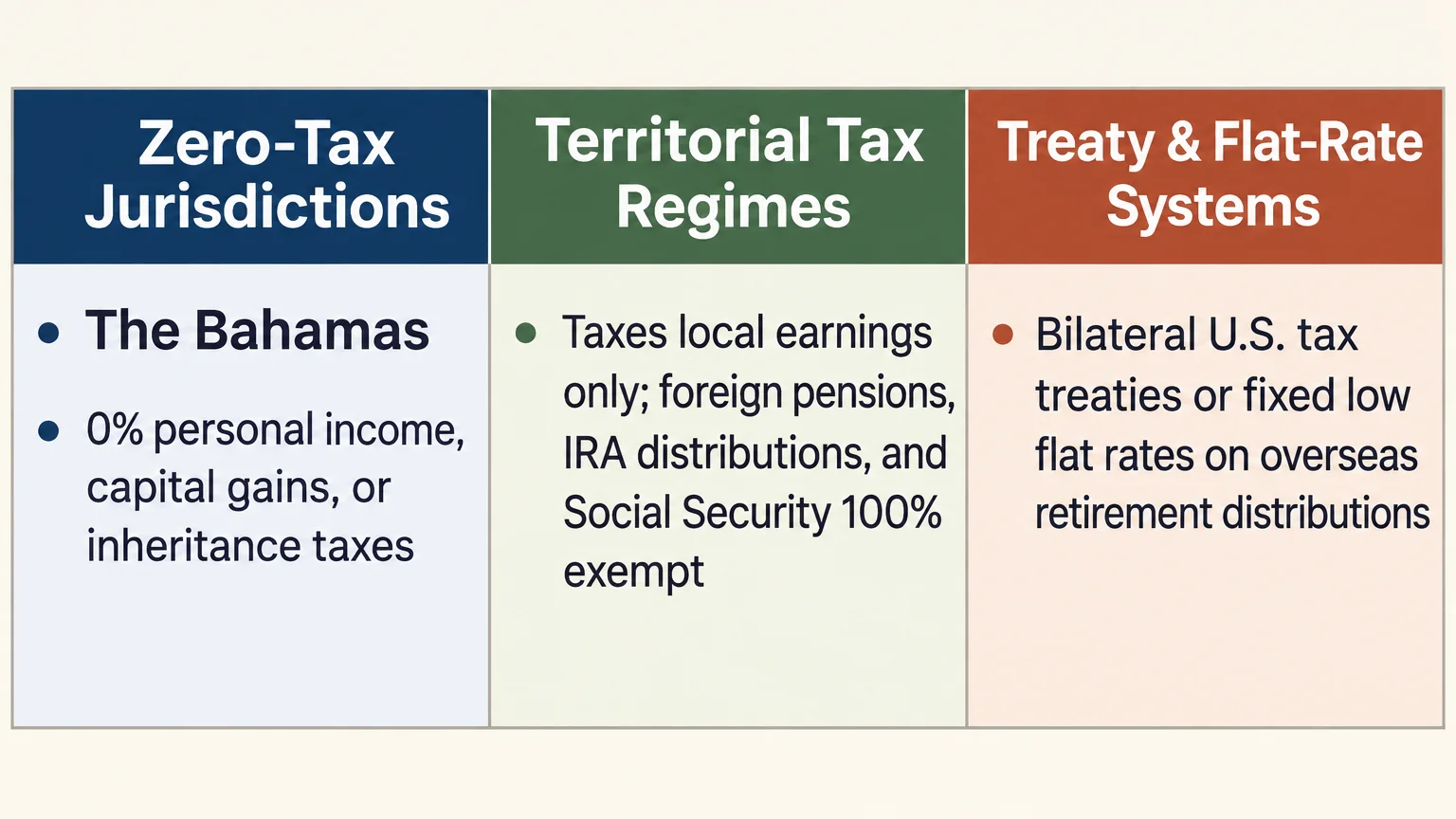
The Bahamas takes our top spot because it levies no personal income, capital gains, or inheritance taxes at all. Nine other tax-friendly destinations also shelter foreign retirement income through territorial rules, flat rates, or U.S. tax treaties.
Before you pack your bags, you need to pair local tax perks with U.S. federal rules, Social Security guidelines, and visa thresholds.
What U.S. Retirees Must Know About Retiring Abroad and Taxes
When you plan an expat retirement, your U.S. tax obligations travel with you. Per IRS Publication 54, the United States taxes citizens and resident aliens on worldwide income regardless of where they live.
You must report global taxable income on Form 1040 under the same general rules as domestic residents. Expats receive an automatic filing extension to June 15, though any tax owed still accrues interest starting April 15.
Many future expats assume the Foreign Earned Income Exclusion shields their nest egg, which is a costly mistake. For tax year 2026, Form 2555 lets qualifying earners exclude up to $132,900 (up from $130,000 in 2025) plus a $39,870 standard housing limit, per Rev. Proc. 2025-32.
However, the IRS specifies that pensions, annuities, Social Security, dividends, capital gains, and rental income do not count as earned income. You cannot use the Foreign Earned Income Exclusion to wipe out retirement distributions.
Fortunately, generous domestic deductions still help lower your U.S. tax bill while living overseas. You can check current filing forms and thresholds directly on the Internal Revenue Service website.
- 2026 standard deduction: For tax year 2026, the baseline deduction is $16,100 for single filers, $32,200 for married couples filing jointly, and $24,150 for heads of household.
- Existing age 65+ add-on: Filers age 65 or older receive an extra $2,050 if unmarried, or $1,650 per qualifying spouse if married.
- Enhanced senior deduction (2025–2028): Under the One, Big, Beautiful Bill Act (IRS Tax Tip 2026-14, Feb. 19, 2026), taxpayers age 65+ get an additional $6,000 deduction per person—or $12,000 jointly if both spouses are 65+—phasing out above $75,000 MAGI ($150,000 joint).
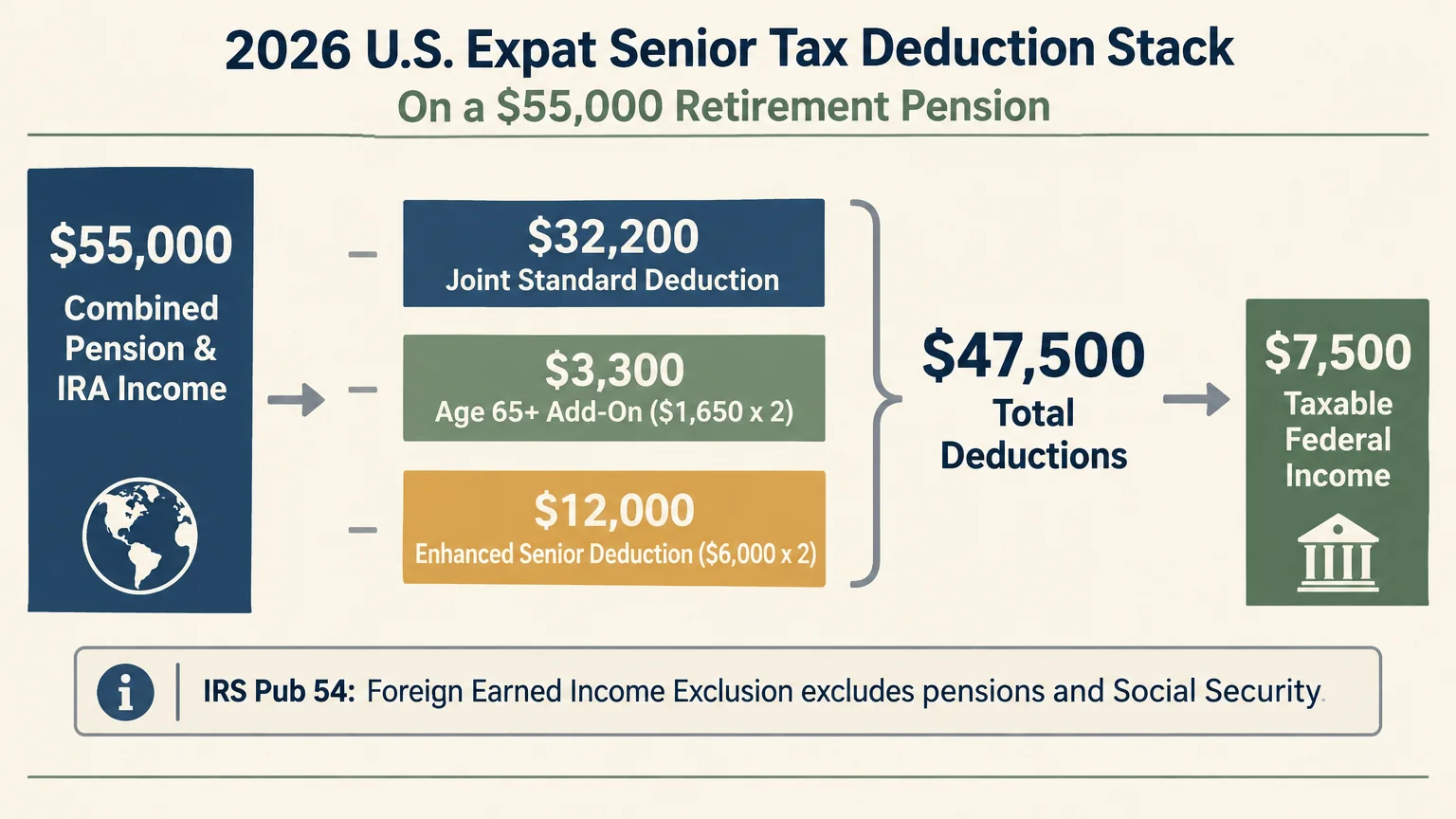
Consider a concrete example for tax year 2026. If you and your spouse are both age 67 and file jointly with $55,000 in combined pension and IRA income, your deductions stack up quickly.
You claim the $32,200 joint standard deduction, $3,300 in standard age 65+ add-ons, and the $12,000 enhanced senior deduction for a total of $47,500. Only $7,500 of that income remains subject to federal brackets, even before foreign tax credits.
Moving money overseas also triggers strict reporting rules that carry steep penalties if ignored. Watch two thresholds closely:
- FBAR (FinCEN Form 114): You must file if your foreign financial accounts exceed $10,000 in aggregate at any point during the year, though U.S. IRAs and 401(k)s are exempt per IRS FBAR instructions.
- FATCA (IRS Form 8938): Expats living abroad must file if specified foreign assets top $200,000 at year-end or $300,000 anytime for single filers, or $400,000 at year-end or $600,000 anytime for joint filers.
Smart expat tax planning focuses on your combined global bill, not just a zero percent local rate. Confirming how U.S. deductions, foreign tax credits, and local residency rules interact saves far more than chasing a headline alone.
How Living Overseas Affects Social Security and Medicare
Collecting retirement checks abroad is far more common than most seniors realize. According to Social Security Administration (SSA) data from December 2024 and the 2025 Annual Statistical Supplement, 711,778 beneficiaries receive payments at foreign addresses.
Broader industry tallies count roughly 760,000 Americans abroad collecting over $7.5 billion annually out of an estimated 3.30 million U.S. citizens living overseas, per the Federal Voting Assistance Program 2024 model. You can verify payment delivery rules for your target country through the Social Security Administration.
The SSA sends retirement, survivor, and disability benefits to more than 150 countries, yet restrictions still exist. U.S. Treasury rules bar payments to Cuba and North Korea, and SSA restricts payments absent exceptions in Azerbaijan, Belarus, Kazakhstan, Kyrgyzstan, Moldova, Tajikistan, Turkmenistan, and Uzbekistan.
Needs-based Supplemental Security Income (SSI) follows stricter residency rules than earned retirement benefits. Your SSI payments stop after you spend 30 consecutive days outside the United States.
Two major rules also help retirees who worked across borders protect their checks. Signed on January 5, 2025, the Social Security Fairness Act repealed the Windfall Elimination Provision, ending benefit cuts for retirees who also receive foreign pensions.
In addition, the United States maintains 30 bilateral Social Security totalization agreements. These pacts prevent dual payroll taxation and coordinate work credits between participating nations.
Healthcare coverage requires equally careful planning before you relocate. Original Medicare generally does not pay for medical care outside the United States, so review your coverage options on Medicare.gov and budget for local or international health insurance.
Side-by-Side Comparison: 10 Tax-Friendly Countries for Retirees
Different tax-friendly countries for retirees cut your tax bill in very different ways. Some charge 0% across the board, while others exempt foreign pensions or apply low flat rates under special retiree regimes.
| Rank | Country | Local Tax on Foreign Pensions | Key Residency Threshold | Watch-Out |
|---|---|---|---|---|
| 1 | The Bahamas | 0% (No personal income tax) | $1,000,000 real estate or Central Bank bond | 10-year investment hold; VAT and import duties |
| 2 | United Arab Emirates | 0% (No personal income tax) | Age 55+: AED 2M property, AED 1M savings, or AED 20,000/mo income | Criteria vary by emirate; private health insurance needed |
| 3 | Panama | 0% (Territorial system) | $1,000/mo lifetime pension ($750/mo + $100,000 property) | Local Panamanian-source income remains taxable |
| 4 | Belize | 0% (QRP exemption) | Age 40+ with $2,000/mo ($24,000/yr) foreign retirement income | Must stay 30 consecutive days annually |
| 5 | Costa Rica | 0% on foreign pensions | $1,000/mo lifetime pension | Mandatory CCSS public health/pension contributions (~10.7% modeled) |
| 6 | Malaysia | 0% on remitted FSI through Dec. 31, 2036 | MM2H fixed deposits from $150,000 to $1,000,000 | 182+ days/yr for tax residency; source tax & local filing required |
| 7 | France | €0 on U.S. pensions & Social Security (Treaty) | Long-stay visitor visa | U.S. income sets marginal rate on any French-source income |
| 8 | Cyprus | 5% flat tax above €5,000/yr | 183-day or 60-day residency rule | GESY health contributions apply; annual election needed |
| 9 | Greece | 7% flat tax for up to 15 tax years | €3,500/mo FIP visa or €250,000–€800,000 Golden Visa | 183+ days/yr on FIP visa; higher Golden Visa caps in prime areas |
| 10 | Italy (Southern Regions) | 7% flat tax for ~10 years total | €31,000/yr passive income (Elective Residence Visa) | Town population cap of 30,000 in 8 southern regions |

The 10 Best Countries to Retire for Lower Taxes
Every destination below offers a legally established way to reduce local taxes on your retirement income as of late 2026. Rules, visa minimums, and filing steps vary widely, so match each option to your exact income mix and budget.
1. The Bahamas: 0% Personal Income, Capital Gains, and Inheritance Tax
The Bahamas earns the No. 1 spot among countries with no income tax because it levies 0% personal income, capital gains, inheritance, and wealth taxes. Instead of taxing your Social Security or IRA withdrawals, the government raises revenue through VAT and import duties.
For American seniors, proximity to Florida makes visiting family and maintaining U.S. medical care straightforward. Local banks and legal systems are familiar, and the Bahamian dollar trades one-to-one with the U.S. dollar.
Securing permanent status requires substantial capital upfront. Per the Bahamas Department of Immigration, the minimum investment for Economic Permanent Residency rose from $750,000 to BSD/USD $1,000,000 effective January 1, 2025.
You must place that $1,000,000 into residential real estate or Central Bank Zero Coupon Bonds and hold the asset for 10 years. Applicants investing $1.5 million or more receive accelerated application review.
2. United Arab Emirates: 0% Personal Income Tax With a 55+ Visa
The United Arab Emirates charges 0% personal income tax, meaning your pensions, dividends, and interest face zero local taxation. Modern hospitals, year-round sunshine, and English-friendly services make cities like Dubai popular for globally minded retirees.
Unlike jurisdictions requiring seven-figure outlays, Dubai offers a dedicated 5-year renewable Retirement Visa specifically for people age 55 and older. Depending on emirate criteria, you can qualify with AED 2 million in property, AED 1 million in savings or a deposit, or AED 20,000 per month (AED 240,000 per year) in income.
Wealthier retirees can also pursue the investment-based 10-year Golden Visa for longer residency certainty. Keep in mind that you will need comprehensive private health insurance and should factor summer heat into your annual travel plans.
3. Panama: 0% Tax on Foreign Pensions Plus Statutory Senior Discounts
Panama runs a territorial tax system, charging 0% local income tax on foreign pensions, Social Security, and overseas investment earnings. Only income generated inside Panama is subject to Panamanian taxation.
Its flagship Pensionado Visa (Executive Decree 320) grants immediate permanent residency if you show a lifetime pension of at least $1,000 per month. If you purchase $100,000 in Panamanian real estate, the pension floor drops to $750 per month (plus $250 per month for each dependent).
Beyond tax savings, the Pensionado program mandates steep everyday discounts for residents. You receive 50% off hotels Monday through Thursday and 25% off restaurants and airline tickets, stretching fixed checks noticeably further.
4. Belize: 0% Local Tax on Foreign Income Under the QRP
Belize offers English as its official language and a straightforward tax exemption for retirees through its Qualified Retirement Program (QRP). Administered by the Belize Tourism Board, the program welcomes applicants age 40 and older.
To qualify, you must document at least $2,000 per month ($24,000 per year) in foreign retirement income from Social Security, pensions, annuities, or savings. Approved members pay 0% Belizean tax on foreign income and can import personal household goods duty-free.
To keep your QRP status active, you simply need to spend at least 30 consecutive days in Belize each year. That low stay requirement makes Belize appealing if you want a warm-weather winter base rather than a full-time move.
5. Costa Rica: 0% Foreign Pension Tax, With a Healthcare Caveat
Costa Rica taxes foreign pensions at 0%, allowing U.S. retirees to keep their Social Security and private pension checks free of local income tax. Its long-standing Pensionado visa requires at least $1,000 per month from a lifetime pension.
Retirees without a traditional lifetime pension can explore the Rentista track ($2,500 monthly income or a $60,000 bank deposit) or the Inversionista option ($150,000 in real estate). Strong biodiversity and well-established expat towns draw thousands of North Americans.
However, you must budget for mandatory contributions to the CCSS public healthcare and pension system once you hold residency. In TaxPilot’s 2026 modeling, those mandatory CCSS assessments create an effective contribution rate of roughly 10.7%, so weigh that cost against private medical savings.
6. Malaysia: 0% Tax on Remitted Foreign Income Extended Through 2036
Malaysia gives retirees long-term tax certainty in Southeast Asia. Under Order P.U.(A) 451/2024 and Budget 2026, Malaysia extended its tax exemption on foreign-sourced income remitted by resident individuals through December 31, 2036.
To claim the exemption, your foreign income must have already been taxed in the source country, and you must declare it on a Malaysian tax return. Tax residency typically requires spending at least 182 days per year in the country.
Long-term stays run through the Malaysia My Second Home (MM2H) visa, which now uses tiered fixed deposits. Required deposits start at $150,000 for the Silver tier and rise to $1,000,000 for the Platinum tier.
7. France: €0 French Tax on U.S. Pensions and Social Security via Treaty
France surprises many retirees because it normally imposes high income taxes, yet the U.S.–France Income Tax Treaty flips the math for Americans. Under Articles 18, 24, and 29, U.S. citizens living in France generally owe €0 in French income tax on U.S.-sourced pensions and Social Security.
That treaty protection covers traditional IRAs, Roth IRAs, 401(k) plans, and Social Security payments when properly reported. You must still file French returns and attach the required treaty forms each year.
One important nuance applies if you also earn money locally in France, such as French rental income. Your U.S. retirement income still counts when calculating the marginal tax bracket applied to that French-source income.
8. Cyprus: 5% Flat Tax on Foreign Pensions Above €5,000
Cyprus pairs Mediterranean island living with one of Europe’s lowest dedicated pension tax rates. Under Income Tax Law 118(I)/2002 as amended, tax residents who qualify under the 183-day or 60-day rule can elect annually to pay a 5% flat tax on foreign pension income exceeding €5,000 per year.
If your foreign pension totals €40,000, the first €5,000 is exempt and the remaining €35,000 is taxed at just 5%—a €1,750 local bill. Newcomers who obtain Non-Domiciled status also avoid Cypriot income tax on dividends and interest.
Remember to account for GESY national healthcare contributions, which apply to residents’ income. You will also need to file an annual tax election to lock in the 5% pension rate instead of standard progressive brackets.
9. Greece: 7% Flat Tax on Foreign Income Anywhere in the Country
Greece lets foreign pensioners transfer their tax residency and pay a flat 7% tax on all foreign-source income for up to 15 tax years. Unlike Italy’s regional program, the Greek 7% regime applies anywhere in the country, including Athens and major islands.
Retirees typically enter Greece through either the Financially Independent Person (FIP) visa or the Golden Visa. The FIP visa requires €3,500 per month in passive income and at least 183 days per year in Greece.
The Golden Visa route instead requires purchasing qualifying real estate. Minimum investments sit at €800,000 in prime zones such as Attica, Thessaloniki, Mykonos, Santorini, and islands over 3,100 residents, €400,000 elsewhere, or €250,000 exclusively for property conversions and restorations.
10. Italy (Southern Regions): 7% Flat Tax Expanded to Larger Towns in 2026
Italy’s 7% flat tax under Article 24-ter of the Italian Tax Code (TUIR) rewards retirees willing to settle in the country’s scenic south. New tax residents receiving a foreign pension—provided they were not tax resident in Italy during the prior 5 years—pay a 7% flat substitute tax on all foreign-sourced income.
That 7% rate covers pensions, dividends, capital gains, and foreign rental income for 9 tax periods after your move year, giving you roughly 10 years total. You gain broader choices now, too: Article 26 of Law No. 34 (March 11, 2026), effective April 7, 2026, raised the qualifying town population cap from 20,000 to 30,000 inhabitants.
Eligible towns span eight southern regions—Sicily, Calabria, Sardinia, Campania, Basilicata, Abruzzo, Molise, and Puglia—plus designated central earthquake zones. Retirees enter on Italy’s Elective Residence Visa, which requires €31,000 per year (~$35,526) in passive income and prohibits working.
Honorable Mentions and New 2026 Retiree Tax Rules
Several smaller nations and newly enacted 2026 laws also deserve a spot on your shortlist if the top 10 do not fit your plans.
- Malta: From basis year 2026 under Malta’s Pensions (Tax Exemption) Rules (S.L. 123.204, MTCA), residents over age 61 receive a full tax exemption on pension income—including foreign and Social Security pensions—up to €37,104 per year (up from €16,636). Separately, the Malta Retirement Programme charges a 15% flat tax on foreign income remitted to Malta with a €7,500 minimum annual tax and a 90-day average annual stay.
- Paraguay and Georgia: Both countries exempt foreign-sourced pensions at 0%. Paraguay sets no income floor for temporary residency, requires a pension certificate or $70,000 investment for permanent residency, and lets residents apply for citizenship after 3 years.
- Uruguay and Turkey (2026 laws): Uruguay’s Law 20.446 (effective January 1, 2026) introduced an 11-year tax holiday option alongside a 12% tax on foreign rentals and capital gains for other residents. Turkey’s Law No. 7582 (Article 20/D, June 2026) exempts foreign income for 20 years for new residents arriving from January 1, 2026, paired with a 1% inheritance tax rate.
- Other 0% income tax jurisdictions: Monaco, the Cayman Islands, Bahrain, Qatar, the Turks and Caicos Islands, and Vanuatu levy no personal income tax. Bahrain’s 10-year Golden Residency retiree route requires a pension of at least BHD 4,000 per month (or BHD 2,000 for former local workers), while Oman plans to introduce a personal income tax starting January 1, 2028, per TaxPilot (Oct. 2026).

Outdated Expat Tax Breaks to Avoid in 2026
Outdated retirement blogs still advertise tax breaks that governments have already repealed or restricted. Crossing these off early prevents expensive surprises during your move.
- Portugal ended NHR pension breaks: Portugal closed its famous Non-Habitual Resident regime in 2024. Its replacement, IFICI (often called NHR 2.0), issued its first approvals on March 31, 2026 and excludes pension income, leaving new retirees facing progressive rates of roughly 13.25% to 48% on foreign pensions (though the D7 visa remains €920/month and Lei Orgânica 1/2026, in force May 19, 2026, set ordinary citizenship timelines at 7 to 10 years).
- Thailand taxes remitted foreign income: Under Revenue Department Order No. Por. 161/2566 (effective January 1, 2024), Thai tax residents staying 180+ days per year pay 0% to 35% progressive tax on foreign income earned from 2024 onward when remitted into Thailand. Pre-2024 savings remain grandfathered under Order Por. 162/2566, while a proposed 2-year remittance exemption for 2026 remains shelved or pending enactment.
- Spain ended its Golden Visa: Spain terminated its property-based Golden Visa on April 3, 2025. Retirees now rely on the Non-Lucrative Visa (€28,800 per year or €2,400 per month in passive income) and face worldwide income taxation plus regional wealth taxes above exemption thresholds.

Common Mistakes to Avoid
Even savvy savers stumble when moving retirement accounts across borders. Watch for four common errors before signing a foreign lease or buying overseas real estate.
- Assuming zero local tax means zero U.S. tax: Moving to The Bahamas or Dubai removes local income taxes, not IRS Form 1040. You still owe federal tax on traditional IRA withdrawals, taxable pensions, and capital gains above your U.S. deductions.
- Overlooking FBAR and FATCA forms: Opening a local bank account to pay utilities or buy property can push your foreign balances past the $10,000 FBAR threshold. Missing FinCEN Form 114 or IRS Form 8938 invites harsh penalties even when no extra tax is owed.
- Leaving Medicare without replacement coverage: Because Original Medicare rarely pays outside the United States, a single hospital stay abroad can wipe out years of tax savings. Secure local public enrollment or private expat health coverage before your departure date.
- Trusting pre-2024 residency guides: Visa floors and tax laws shifted sharply between 2024 and 2026 across Portugal, Spain, Thailand, Italy, and The Bahamas. Verify every residency rule with official embassy or immigration sites before wiring deposits.
Finding the Right Advisor
Cross-border retirement blends U.S. tax law, foreign residency rules, and healthcare planning, making specialized guidance worth the fee. Consider consulting a qualified cross-border CPA, Enrolled Agent, or fiduciary planner in these four scenarios:
- Coordinating tax treaties and foreign credits: If you choose France, Greece, Cyprus, or Italy, an expat tax specialist ensures you file the exact treaty elections and Form 1116 foreign tax credits so you never pay tax twice on the same dollar.
- Timing Roth conversions before you move: A fee-only fiduciary planner can model whether converting traditional IRA funds before establishing foreign tax residency lowers your lifetime bill, since some countries tax Roth distributions differently than the IRS.
- Vetting residency investments and real estate: Before committing $1,000,000 in The Bahamas or €400,000 to €800,000 in Greece, have independent local counsel review title deeds, holding periods, and exit rules.
- Protecting your accounts from fraud: Before transferring large sums overseas, review cross-border banking and consumer safeguards through resources like the Consumer Financial Protection Bureau and retirement planning checklists from AARP.
Frequently Asked Questions
Do I still pay U.S. taxes if I retire to a country with no income tax?
Yes, U.S. citizens and resident aliens must file Form 1040 and report worldwide income even when living in 0% tax jurisdictions like The Bahamas or the UAE. However, your 2026 standard deduction and age 65+ senior deductions still reduce what you owe the IRS.
Can I receive my Social Security check in another country?
Yes, the Social Security Administration pays earned retirement, survivor, and disability benefits in more than 150 countries. You cannot receive payments in Cuba or North Korea, and restrictions apply in eight former Soviet republics, while SSI stops after 30 days outside the U.S.
Does the Foreign Earned Income Exclusion cover my pension or 401(k)?
No, the $132,900 Foreign Earned Income Exclusion for 2026 applies only to wages and self-employment earnings. The IRS excludes pensions, annuities, Social Security, dividends, capital gains, and rental income from Form 2555.
Which European country is best for U.S. retirees trying to save on taxes?
France often yields the lowest tax on U.S. retirement accounts because the U.S.–France tax treaty exempts U.S. pensions, IRAs, Roth IRAs, and Social Security from French income tax. For broader foreign investment income, Cyprus (5%), Greece (7%), and southern Italy (7%) offer low flat rates.

Next Steps for Your Expat Retirement Plan
Start by listing your exact retirement income sources—Social Security, pensions, IRA withdrawals, and dividends—and matching them against two or three countries above. Then test your favorite spot with an extended stay to weigh healthcare access, daily costs, and distance from family.
The information in this guide is meant for educational purposes. Your specific circumstances—including income, benefits, tax situation, and health needs—may require different approaches. When in doubt, consult a licensed financial advisor or tax professional.
Last updated: November 2026. Benefit amounts, tax rules, and program details change annually—verify current figures with official government sources.





Leave a Reply