

Outdated retirement myths cost older Americans thousands of dollars in missed benefits, surprise taxes, and uncovered medical bills. Replacing guesswork with current rules protects your savings and strengthens your monthly cash flow.
From Social Security solvency fears to rigid withdrawal formulas, common retirement misconceptions distort how you plan your later years. These six reality checks pair verified figures with practical steps you can use today.
Review each myth below to spot blind spots in your budget, healthcare coverage, and tax strategy before they drain your nest egg.
Myth 1: Social Security Is Going Bankrupt and Won’t Be There for You
Many workers assume Social Security will run completely out of money before they collect their fair share. That fear drives people to claim benefits prematurely or ignore Social Security in their retirement math.
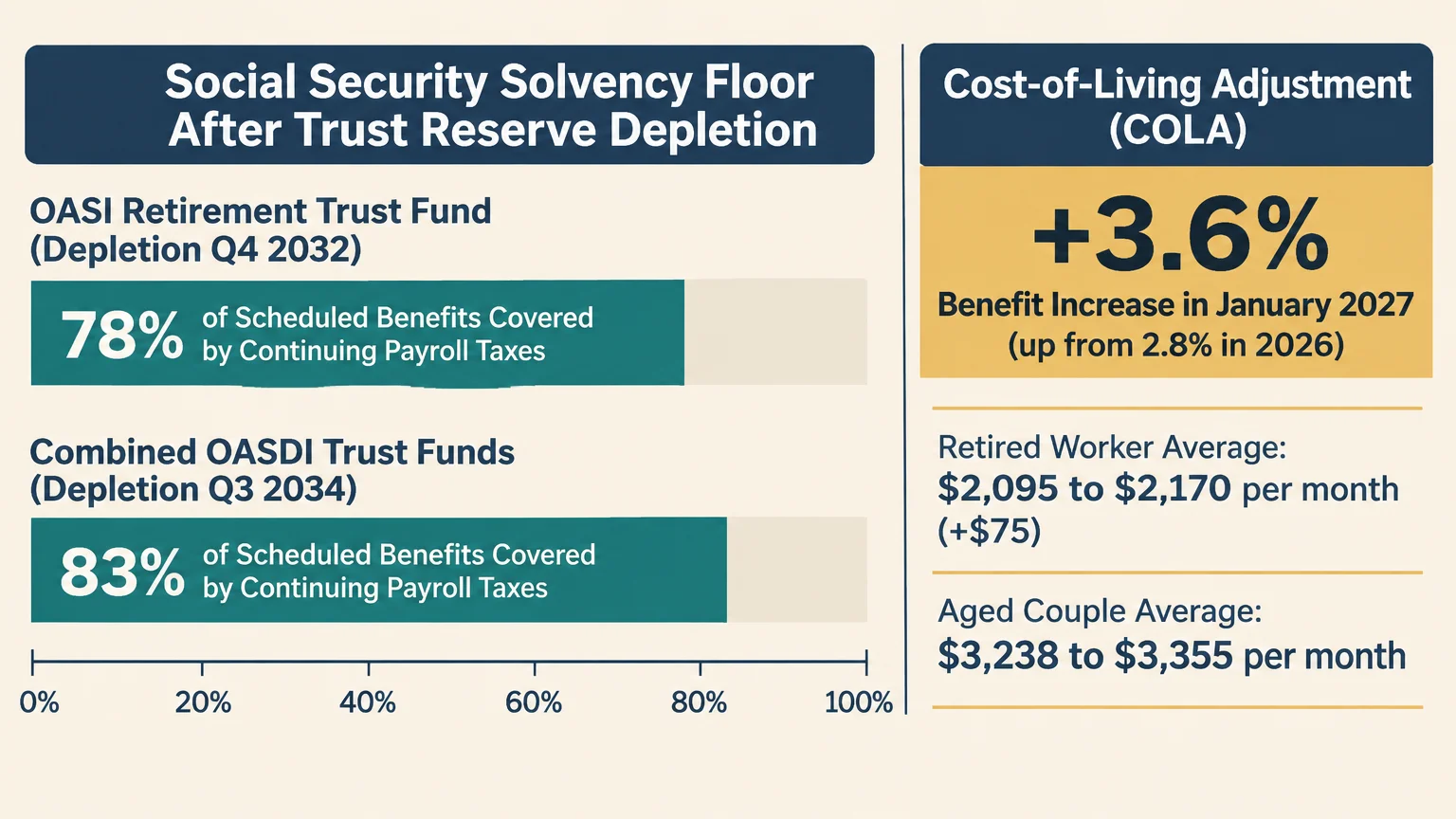
According to the 2026 Social Security Trustees Report released June 9, 2026, the retirement-only Old-Age and Survivors Insurance (OASI) trust fund is projected to deplete its reserves in the fourth quarter of 2032. Even if Congress fails to act by then, ongoing program revenue would still cover 78% of scheduled benefits.
Looking at the combined retirement and disability (OASDI) trust funds, reserves are projected to last until the third quarter of 2034. Continuing payroll tax revenue would still pay 83% of scheduled benefits at that point, declining gradually to 65% by 2100.
In short, your monthly check will not drop to zero. Benefits also continue adjusting for inflation each year.
The Social Security Administration (SSA) announced on October 14, 2026, that Social Security and SSI benefits will rise 3.6% in January 2027, up from 2.8% in 2026. That increase lifts the estimated average monthly benefit for retired workers by about $75, from $2,095 to $2,170.
For an aged couple both receiving benefits, the average combined monthly check rises from $3,238 to $3,355 in 2027. Treating Social Security as a durable income floor—rather than a vanished promise—lets you plan with far greater accuracy.
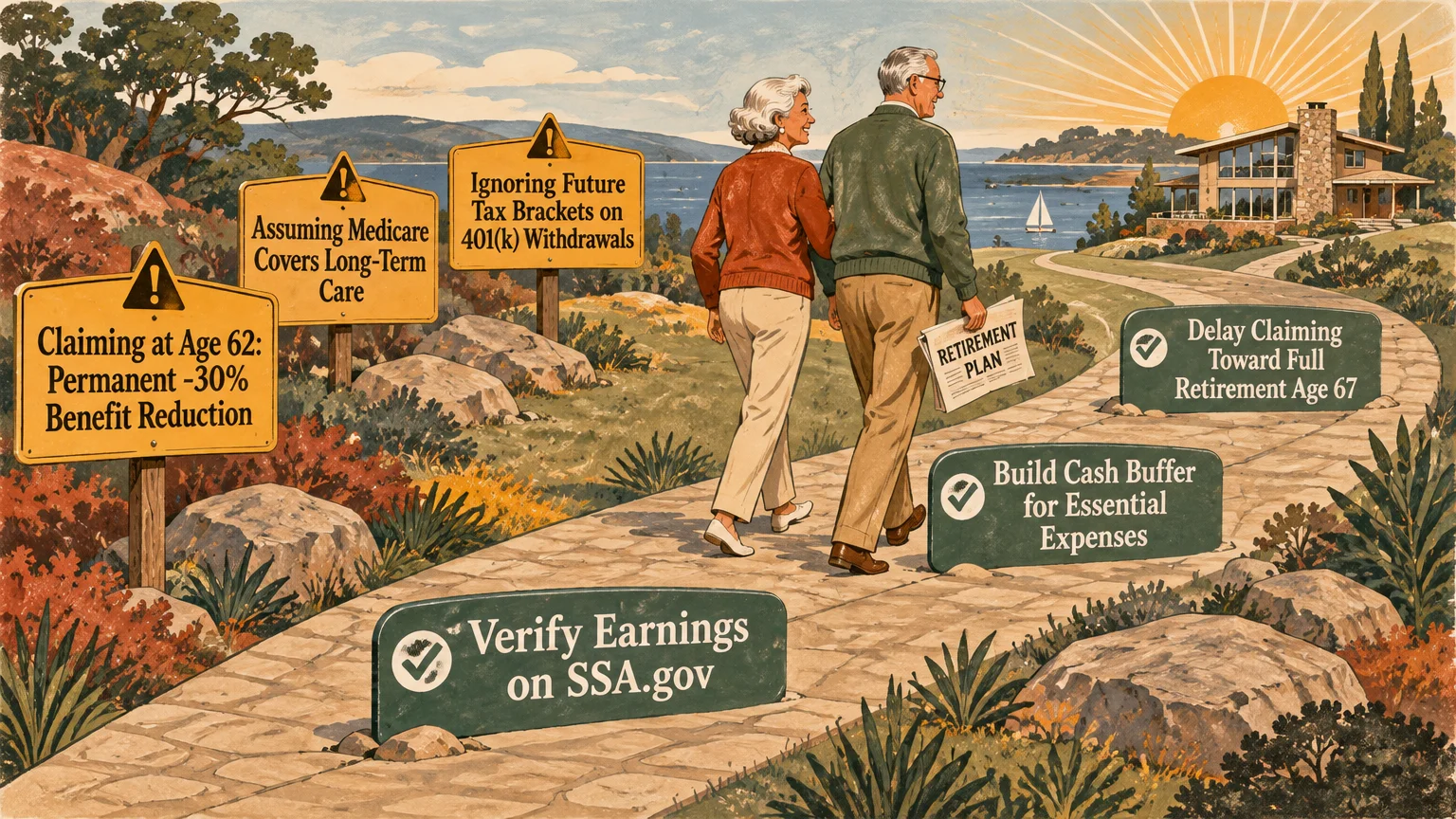
- Verify your personal record: Create a free account at SSA.gov to review your earnings history and confirm no missing wage years reduce your benefit calculation.
- Run a stress test: Calculate whether your essential bills stay covered if future benefits ever face a 17% to 22% adjustment in the early 2030s.
- Build a modest buffer: Use personal savings or part-time income bridges rather than panic-claiming Social Security early out of solvency fears.
Myth 2: Claiming Social Security at 62 Is Always the Smartest Move
Grabbing your Social Security check the moment you turn 62 feels tempting, especially if you want cash in hand immediately. Yet locking in an early start date permanently shrinks one of your strongest inflation-adjusted income streams.
For anyone born in 1960 or later, Full Retirement Age (FRA) is 67 according to the SSA. Claiming at age 62 permanently reduces your monthly benefit by 30% for the rest of your life.
By contrast, waiting past your FRA earns 8% per year in delayed retirement credits—two-thirds of 1% per month—all the way to age 70. For a retiree born in 1960 or later, waiting until 70 boosts your monthly check to 124% of your full retirement amount.
To see how dramatically claiming age changes your income, consider an illustrative retiree whose full benefit at age 67 equals $2,000 per month.
| Claiming Age (Born 1960+) | Share of Full Benefit | Illustrative Monthly Check ($2,000 FRA) | Illustrative Annual Total |
|---|---|---|---|
| Age 62 (Early) | 70% (-30% reduction) | $1,400 | $16,800 |
| Age 67 (Full Retirement Age) | 100% (Full benefit) | $2,000 | $24,000 |
| Age 70 (Maximum Delayed) | 124% (+24% credits) | $2,480 | $29,760 |
Claiming early also creates friction if you continue earning a paycheck. According to the SSA (October 2026), beneficiaries under FRA for the entire year have $1 in benefits withheld for every $2 earned above $24,480 in 2026, rising to $25,560 in 2027.
In the calendar year you reach FRA, $1 is withheld for every $3 earned above $65,160 in 2026—or $67,920 in 2027—for months before your birthday month. Once you hit your FRA month, the earnings limit disappears completely.
Early claiming still makes sense if you face serious health challenges or lack other cash to pay basic living expenses. Otherwise, coordinating claiming ages—especially having the higher-earning spouse delay—can maximize survivor protection and lifetime income.
Myth 3: Medicare Covers All Your Healthcare and Long-Term Care Costs
Turning 65 and enrolling in Medicare brings welcome relief from employer insurance hurdles, yet assuming Medicare pays every medical bill is one of the costliest retirement planning mistakes. Significant premiums, deductibles, and coverage exclusions remain your responsibility.
According to Fidelity Investments’ 25th Annual Retiree Health Care Cost Estimate (July 21, 2026), a 65-year-old retiring in 2026 needs an average of $185,500 in after-tax savings just for healthcare expenses throughout retirement. That figure jumped 7.5% from the prior year.
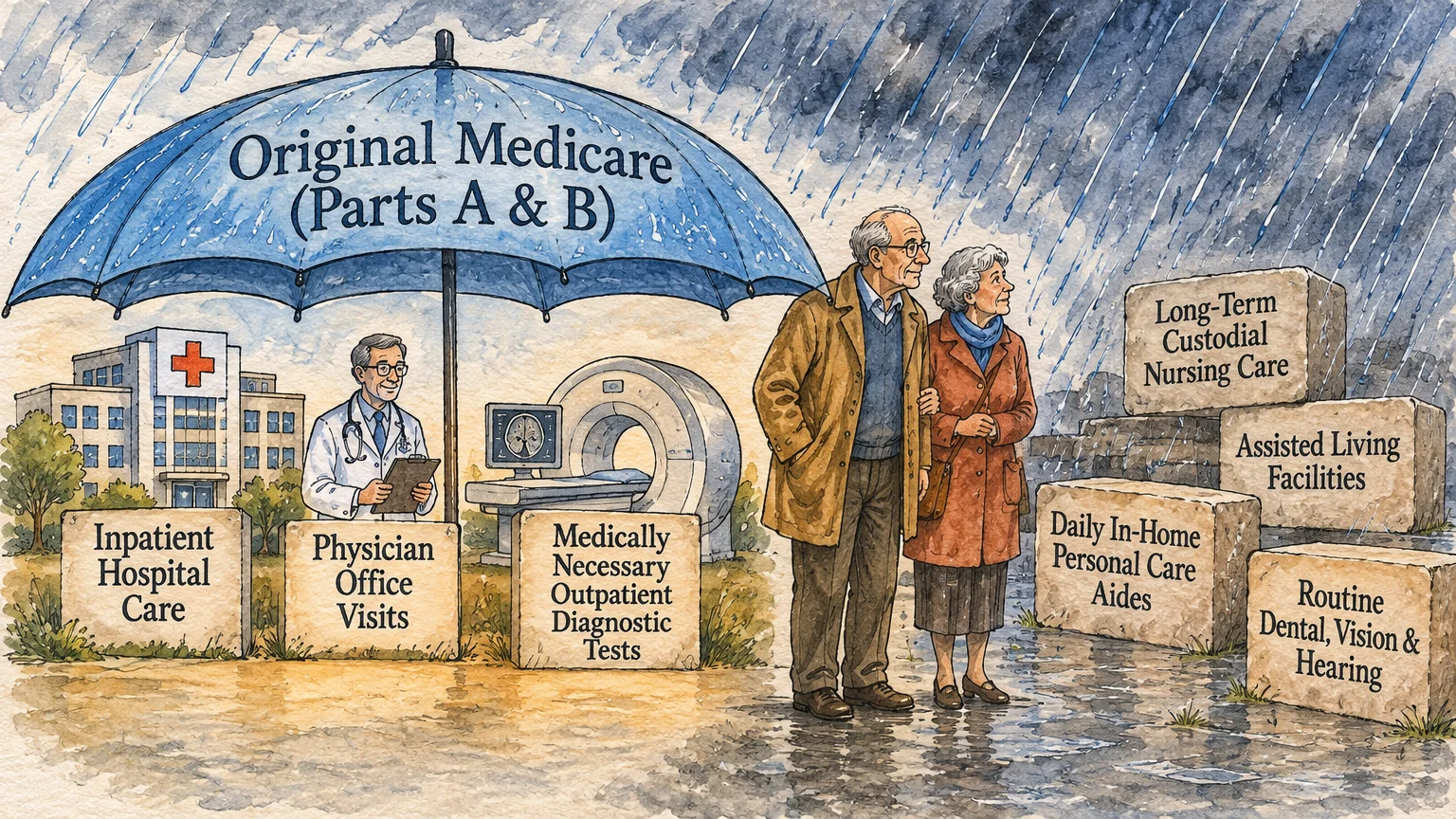
Even more striking, that $185,500 benchmark assumes enrollment in Original Medicare (Parts A and B) plus Part D prescription coverage. It excludes over-the-counter medications, most dental care, and long-term custodial care.
Annual out-of-pocket charges also continue climbing, as confirmed by the Centers for Medicare & Medicaid Services (CMS) on November 17, 2026, and Medicare.gov:
- Part B monthly premium: Rises $6.50 (3.2%) from $202.90 in 2026 to $209.40 in 2027, usually deducted straight from Social Security checks.
- Part B annual deductible: Increases from $283 in 2026 to $292 in 2027.
- Part A hospital deductible: Rises from $1,736 in 2026 to $1,776 in 2027 per benefit period covering days 1 through 60.
- Part A daily coinsurance: Climbs from $434 to $444 per day for hospital days 61 through 90, and from $217 to $222 per day for skilled nursing facility stays on days 21 through 100.
- Part D prescription drug limits: The annual out-of-pocket cap on covered drugs rises from $2,100 in 2026 to $2,400 in 2027, while the maximum allowable deductible rises from $615 to $700.
Long-term care represents an even larger gap that catches boomer retirement budgets off guard. Medicare does not cover non-medical custodial care, such as help with bathing, dressing, or daily supervision.
Data from the U.S. Administration for Community Living (ACL) and the CareScout/Genworth 2025 Cost of Care Survey (released March 2, 2026) show that 7 out of 10 people will require long-term care during their lifetime. National 2025 median annual costs reveal how quickly savings can vanish:
- Nursing home (private room): $129,575 per year ($355 per day).
- Nursing home (semi-private room): $114,975 per year ($315 per day).
- In-home non-medical caregiver: $35 per hour, or $80,080 per year based on 44 hours per week.
- Assisted living community: $74,400 per year ($6,200 per month).
- In-home skilled nursing: $90 per hour ($160 per visit).
Treat routine Medicare cost-sharing and potential long-term care as two separate funding buckets—one covered from monthly cash flow and Medigap or Advantage plans, and the other backed by dedicated savings, insurance, or home equity.
Review your Medicare Part D drug formulary every fall during Open Enrollment so rising deductibles and caps do not catch you off guard. Exploring long-term care options in your late 50s or early 60s also preserves far more choices.
Myth 4: You Can Simply Keep Working Until 70 If Savings Fall Short
Whenever savings fall behind schedule, many workers comfort themselves with a simple backup plan: work until age 70 or never fully retire. Relying on extra working years as your main safety net leaves your finances exposed to factors beyond your control.
According to the EBRI and Greenwald Research 2026 Retirement Confidence Survey (April 2026), 46% of retirees left the workforce earlier than planned, up from 40% in 2025. Only 36% of early retirees stepped away because they could afford to do so.
Instead, the top triggers for early retirement were a health problem or disability (41%) and company changes or downsizing (35%). While 39% of current workers expect to stay on the job until age 70 or never retire, only 10% of retirees actually managed it.
Allianz Life’s 2026 Annual Retirement Study (May 19, 2026) found a nearly identical gap. Exactly 42% of retirees stopped working earlier than expected—compared with just 5% who retired later—citing health issues (30%) and unexpected job loss (21%).
Not surprisingly, 59% of Americans worry they will not be able to retire on their own terms. Figures from the U.S. Bureau of Labor Statistics (BLS) reinforce this reality: only 19.1% of Americans age 65 and older remained in the labor force in 2025, down from 20.2% in 2019.
Keep working if you enjoy your career and stay healthy, but build your baseline plan as if your paycheck could stop at age 62. Boost savings aggressively in your 50s, keep fixed debts low, and maintain a liquid emergency reserve for unexpected job transitions.
Myth 5: Your Taxes Drop Automatically Once You Retire
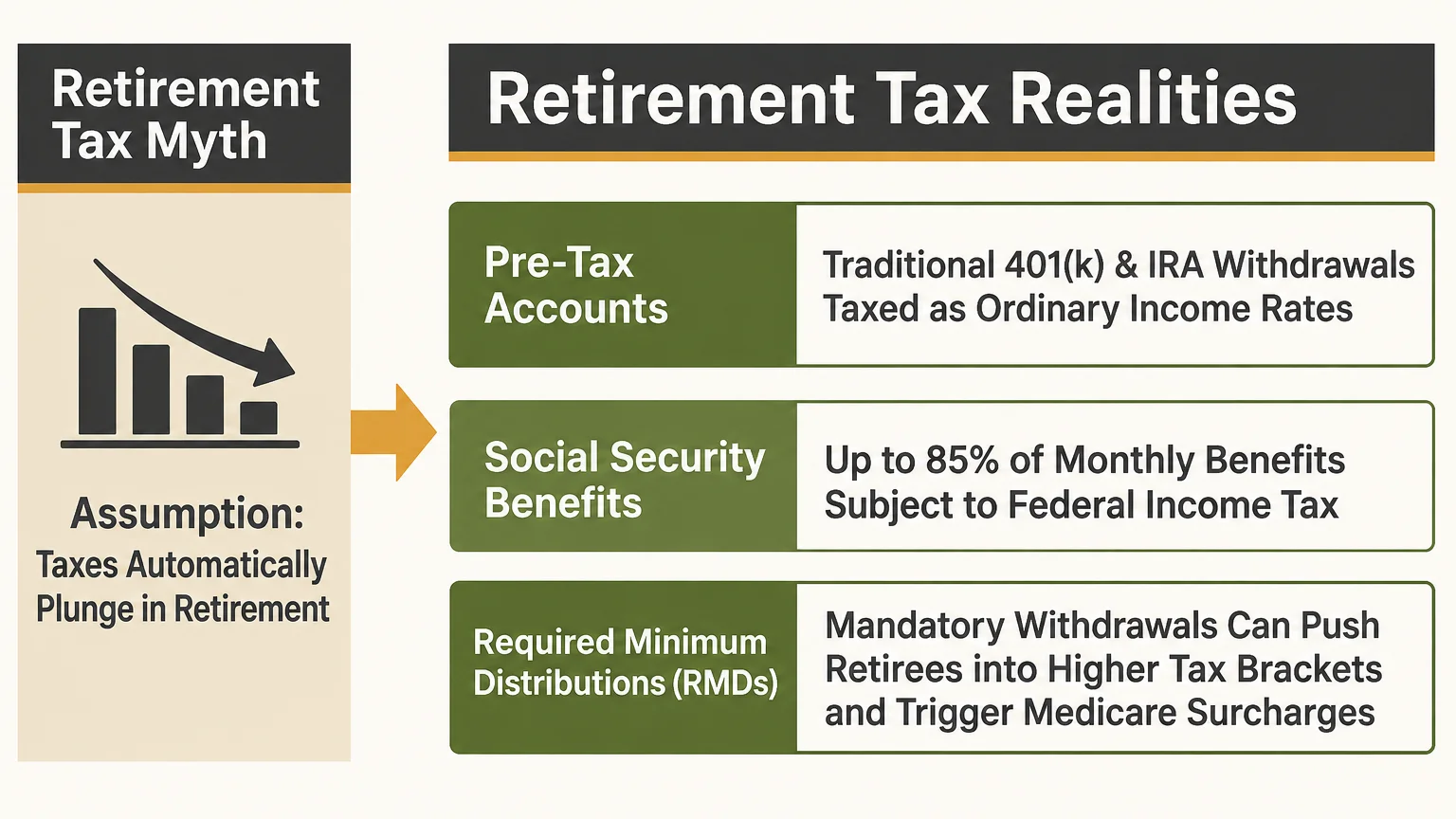
Generations of generic retirement advice promised that leaving the workforce automatically drops you into a lower tax bracket. In reality, overlapping rules for Social Security, Required Minimum Distributions (RMDs), and high-earner catch-up contributions can keep your tax bill stubbornly high.
First, Social Security benefits themselves can trigger federal income taxes based on your provisional income—your adjusted gross income plus nontaxable interest plus half of your Social Security benefits. According to the SSA, up to 50% of benefits become taxable once provisional income exceeds $25,000 for single filers or $32,000 for married couples filing jointly.
Up to 85% of your benefits become taxable above $34,000 (single) or $44,000 (joint). Because Congress never indexed those thresholds for inflation, rising COLAs push more retirees over the line every year.
Second, pre-tax retirement accounts do not stay tax-deferred forever. According to Internal Revenue Service (IRS) rules and the Charles Schwab 2026 RMD Guide, traditional IRAs and pre-tax workplace plans require RMDs starting at age 73.
Your first RMD is due by April 1 of the year after turning 73, and every subsequent RMD is due by December 31. Missing an RMD triggers a steep 25% excise tax on the shortfall, though correcting it promptly and filing IRS Form 5329 can cut the penalty to 10%.
Roth IRAs and designated Roth workplace accounts carry no RMDs during the original owner’s lifetime, making tax diversification vital. Fortunately, older taxpayers also have valuable tax breaks and higher contribution caps available right now:
- Temporary Senior Bonus deduction (2025–2028): Under the One Big Beautiful Bill Act enacted July 4, 2025, taxpayers age 65 and older can claim an extra $6,000 deduction per eligible person ($12,000 for joint filers when both are 65+), whether itemizing or taking the standard deduction.
- Senior Bonus phaseouts: This extra deduction starts phasing out at $75,000 modified adjusted gross income ($150,000 joint), disappears at $175,000 ($250,000 joint), and expires after 2028.
- Workplace 401(k), 403(b), 457, and TSP limits: IRS Notice 2026-66 (IR-2026-136, November 12, 2026) sets the base deferral limit at $24,500 in 2026, rising to $25,500 in 2027.
- Age 50+ catch-up contributions: Workers 50 and older can add $8,000 in 2026 ($32,500 total) and $8,500 in 2027 ($34,000 total).
- Ages 60–63 super catch-up: Where plans allow it under SECURE 2.0, workers ages 60 through 63 can contribute an extra $11,250 in 2026 ($35,750 total) and $11,750 in 2027 ($37,250 total).
- Mandatory Roth catch-up rule: Workers whose prior-year FICA wages topped $150,000 (for 2026 catch-ups) or $155,000 of 2026 wages (for 2027 catch-ups) must direct workplace catch-up contributions into a Roth account rather than pre-tax dollars.
- IRA limits: Traditional and Roth IRA caps stand at $7,500 in both 2026 and 2027, plus a $1,100 catch-up for savers age 50 and older ($8,600 total).
Taking advantage of the temporary $6,000 senior deduction window from 2025 through 2028 can help you execute smart partial Roth conversions before RMDs begin at age 73. Check with a tax preparer each fall so your withdrawals stay within favorable brackets.
Myth 6: The 4% Rule Guarantees Safe Spending While Expenses Plummet
Two popular spending assumptions circulate widely in boomer retirement planning: first, that you can safely withdraw 4% of your portfolio every year plus inflation; second, that your overall living costs will drop sharply as you age. Both rules of thumb require updating.
In its State of Retirement Income report (December 2025 / 2026 outlook), Morningstar tested a 30-year retirement with a 90% probability of success and a 20% to 50% equity mix. Using forward-looking market and inflation assumptions, Morningstar estimated a safe starting withdrawal rate of 3.9% for 2026.
That 3.9% rate is up slightly from 3.7% in 2024 but still below 4.0% in 2023 for fixed, inflation-adjusted withdrawals. If you remain flexible—skipping inflation raises after down market years—you can often start with a slightly higher withdrawal rate.
On a $600,000 portfolio, the difference between 4.0% ($24,000) and 3.9% ($23,400) looks modest in year one. Yet sticking rigidly to inflation increases during market downturns can permanently damage long-term portfolio survival.
Meanwhile, BLS Consumer Expenditure Surveys show that retirement expenses do not simply evaporate. While overall U.S. household spending averaged $81,905 in 2025 (up 4.3% from $78,535 in 2024), households headed by adults ages 65 to 74 averaged $65,354 in 2024.
Households age 75 and older spent $55,834—roughly 15% less overall—but healthcare consumed a growing slice of the pie. Medical spending jumped from 11.8% of total outlays at ages 65–74 to 14.2% at age 75 and older, averaging $7,799 per year (about $650 per month) across all 65+ households in 2024.
Rather than assuming your budget will shrink automatically, separate discretionary spending like travel from rising essentials like healthcare and property upkeep. Flexible withdrawal guardrails protect your principal without forcing painful lifestyle cuts.
Common Mistakes to Avoid
Even thoughtful savers fall into avoidable traps when old retirement myths shape their decisions. Watch out for these four common missteps:
- Taking two RMDs in one tax year: Delaying your first RMD past December 31 until the April 1 deadline after turning 73 forces you to take both your first and second RMD in the same calendar year, potentially bumping you into a higher tax bracket and raising Social Security taxation.
- Ignoring the Medicare Part B and Part D increases: Failing to subtract rising premiums—such as the $209.40 monthly Part B standard rate in 2027—from your projected Social Security check overstates your spendable monthly income.
- Overlooking the Roth catch-up wage threshold: High earners above $150,000 in prior-year FICA wages (for 2026) or $155,000 (for 2027) should confirm their employer plan offers a Roth option so catch-up savings do not stall.
- Assuming healthy years guarantee late retirement: Counting on a full-time paycheck until age 70 without a contingency budget leaves you vulnerable if health issues or layoffs strike in your early 60s.
Finding the Right Advisor
Many retirement decisions interact across taxes, healthcare, and investments, making a second set of qualified eyes worthwhile. Consider working with a fee-only fiduciary planner or tax professional in these specific situations:
- Coordinating spousal Social Security timing: An advisor can model break-even ages, survivor benefits, and bridge withdrawals between ages 62 and 70.
- Managing the 2025–2028 Senior Bonus tax window: A tax specialist can help you weigh Roth conversions against MAGI phaseouts ($75,000 single / $150,000 joint) before the extra $6,000 deduction expires after 2028.
- Planning for potential long-term care: A planner can compare self-funding, hybrid insurance, and Medicaid rules before health changes limit your choices.
- Setting flexible portfolio guardrails: An investment advisor can customize safe withdrawal rules around your exact asset mix rather than relying on a generic 4% rule.
To check credentials and protect yourself from biased sales pitches or financial scams, consult educational tools from the Consumer Financial Protection Bureau (CFPB) before signing any advisory agreement.
Frequently Asked Questions
Will Social Security stop paying benefits in 2032 or 2034?
No. According to the 2026 Social Security Trustees Report, even if Congress takes no action before trust fund reserves deplete—projected for Q4 2032 for OASI alone and Q3 2034 for combined funds—ongoing payroll taxes would still cover 78% to 83% of scheduled benefits.
Do I have to take Required Minimum Distributions from a Roth IRA?
No. Under current IRS rules, Roth IRAs and designated Roth workplace accounts have no RMDs during the original account owner’s lifetime, unlike traditional IRAs and pre-tax 401(k) plans that start RMDs at age 73.
How much should a 65-year-old retiring in 2026 set aside for healthcare?
Fidelity Investments estimates that an average 65-year-old retiring in 2026 needs $185,500 in after-tax savings for Medicare premiums, deductibles, and out-of-pocket medical costs—and that estimate excludes most dental care, over-the-counter medicines, and long-term custodial care.
Is the 4% withdrawal rule still safe for retirement?
Morningstar’s 2026 outlook puts the safe starting withdrawal rate slightly lower at 3.9% for fixed inflation-adjusted withdrawals over 30 years. Using flexible spending rules that pause inflation raises during down markets can support higher initial withdrawals.

Take Your Next Step Toward a Smarter Retirement
Pick one assumption from this list—your Social Security start date, your Medicare out-of-pocket budget, or your RMD tax plan—and update it with current 2026 and 2027 figures this week. One focused adjustment today can protect thousands of dollars over your retirement.
The information in this guide is meant for educational purposes. Your specific circumstances—including income, benefits, tax situation, and health needs—may require different approaches.
When in doubt, consult a licensed financial advisor or tax professional.
Last updated: November 2026. Benefit amounts, tax rules, and program details change annually—verify current figures with official government sources.





Leave a Reply