

Moving to a state with no state income tax sounds like an instant raise for your retirement budget, but calculating your real cost of living requires looking beyond tax returns. While nine states impose zero income tax on your pensions, 401(k) withdrawals, and Social Security, local governments often recoup that revenue through higher property taxes, elevated sales taxes, and reduced municipal services. Moving from a high-tax state like California or New York to a tax-friendly destination like Florida or Texas can save you thousands annually, provided you evaluate the complete financial picture. Understanding how state sales taxes, real estate taxes, and healthcare infrastructure balance against income savings ensures you keep more money in your pocket during retirement.
The Real Truth About Retiring in a No-Tax State
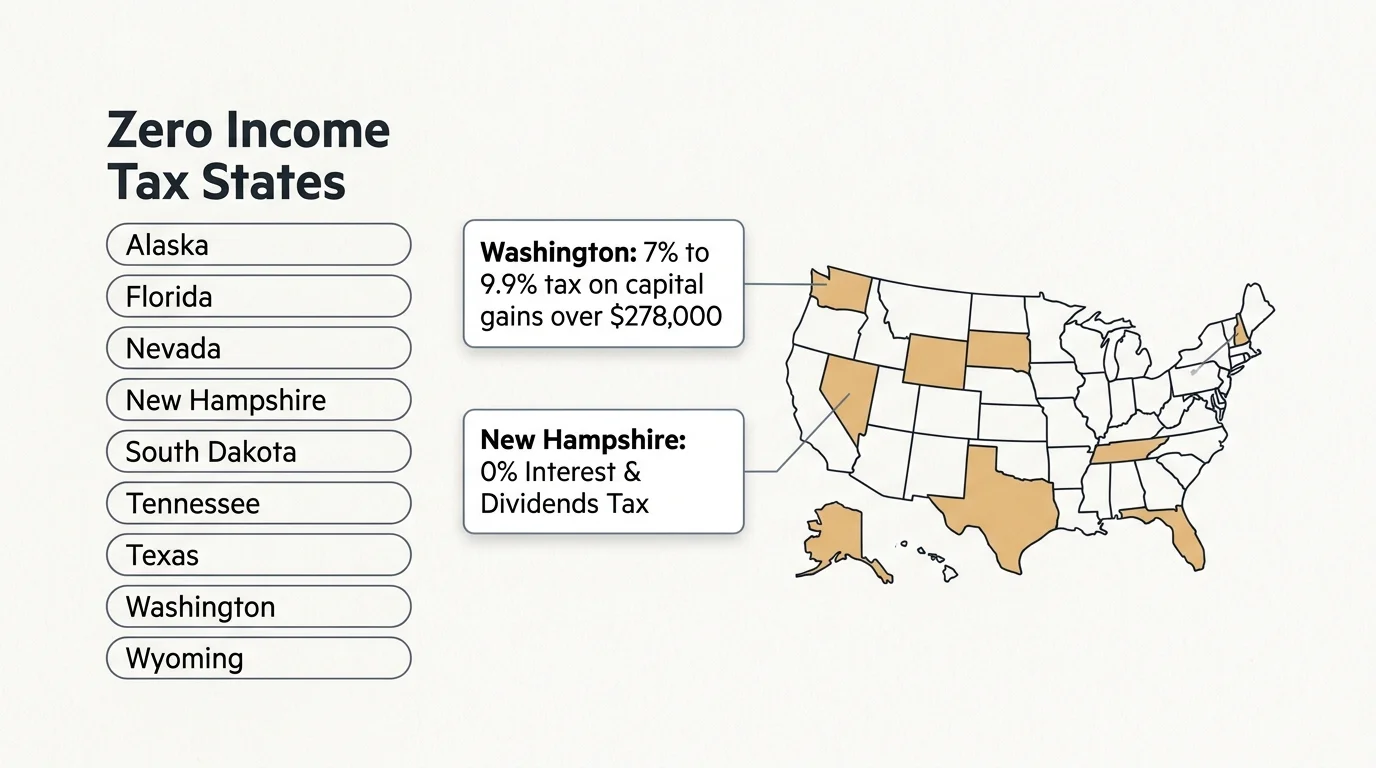
When you start researching retirement tax planning, states without a personal income tax naturally top the wishlist. As of 2026, nine states charge zero state income tax on earned wages and distributions from retirement accounts like traditional 401(k)s and IRAs: Alaska, Florida, Nevada, New Hampshire, South Dakota, Tennessee, Texas, Washington, and Wyoming.
Each of these states finances its budget differently, meaning you must look closely at individual state codes:
- New Hampshire: The state completed its scheduled tax overhaul on January 1, 2025, fully repealing its Interest and Dividends Tax. New Hampshire now charges no personal income tax on investment earnings, making it entirely tax-free on individual income.
- Washington: While Washington levies no income tax on wages, pensions, or retirement account withdrawals, the state imposes a tax of 7% to 9.9% on long-term capital gains exceeding $278,000. High-net-worth retirees selling stocks or taxable investment assets must account for this tax.
- Florida and Texas: Both states maintain zero income tax across all personal earnings, investment returns, and retirement distributions; however, they rely heavily on consumption and property revenue.
Relocating to one of these states protects your pre-tax retirement withdrawals. When you pull money from a traditional IRA or 401(k), the IRS taxes the distribution as ordinary income at the federal level, but state tax authorities in no-income-tax states take nothing. For a retiree withdrawing $60,000 a year from tax-deferred accounts, avoiding a 6% state income tax saves $3,600 every single year.
How High-Tax States Treat Senior Retirement Income
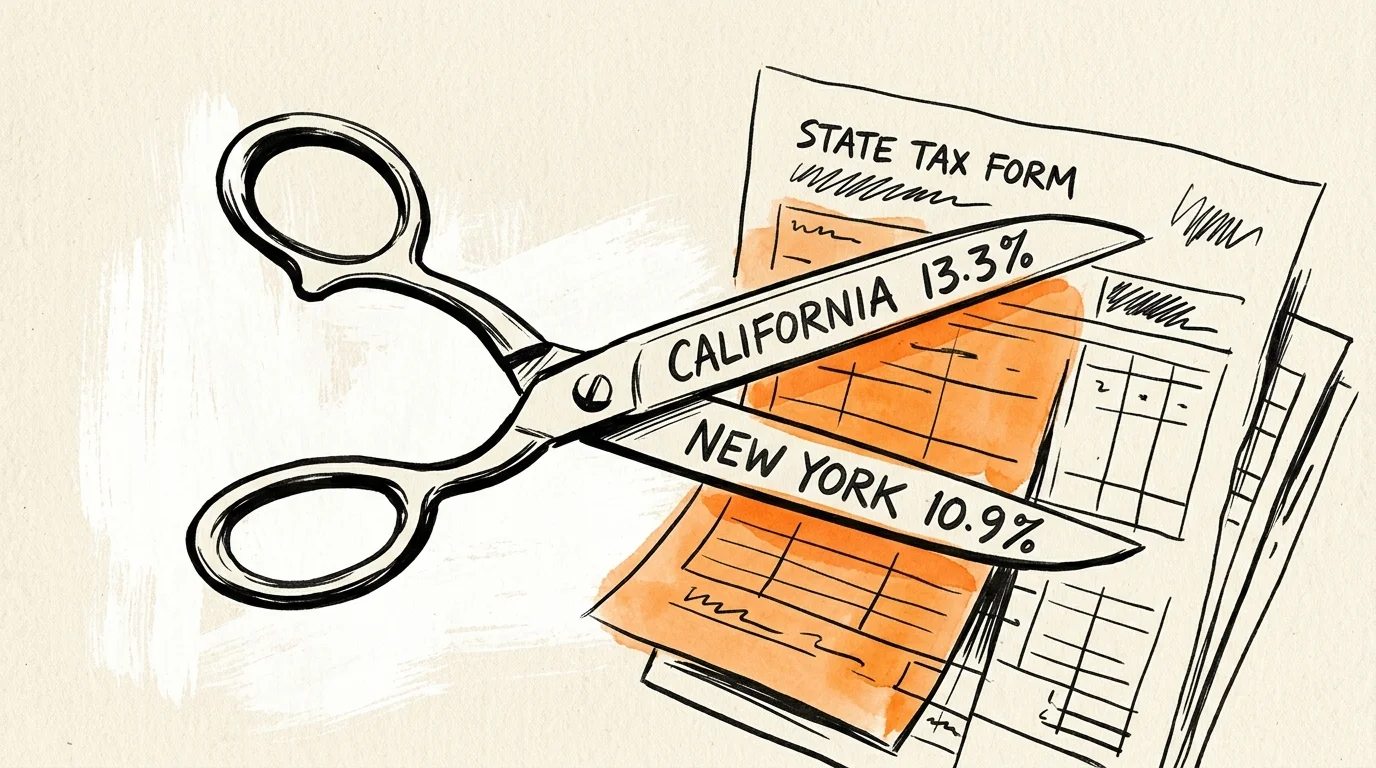
High-tax states carry significant marginal income tax rates that directly reduce your retirement cash flow. Top state income tax brackets highlight the contrast: California reaches up to 13.3%, New York sits at 10.9%, New Jersey reaches 10.75%, and Minnesota peaks at 9.85%. If you live in these jurisdictions, every dollar of taxable retirement income above state thresholds faces these rates.
State treatment of Social Security benefits creates another stark financial distinction. The federal government taxes up to 85% of Social Security benefits depending on your combined income, but state laws vary dramatically. As of 2026, only nine states still tax Social Security benefits to any degree: Colorado, Connecticut, Minnesota, Montana, New Mexico, Rhode Island, Utah, and Vermont. West Virginia officially eliminated its remaining state income tax on Social Security benefits starting in 2026.
Despite these high rates, several traditional high-tax states offer targeted senior exemptions. Many states exempt military pensions, provide public pension deductions, or offer senior property tax freeze programs. Furthermore, under federal tax guidelines updated by the Internal Revenue Service (IRS), seniors age 65 and older qualify for a temporary $6,000 bonus deduction on top of their federal standard deduction through tax year 2028. This temporary federal provision provides substantial relief across all states, regardless of local state tax rates.
The Hidden Offsets: Property Taxes, Sales Taxes, and Cost of Living
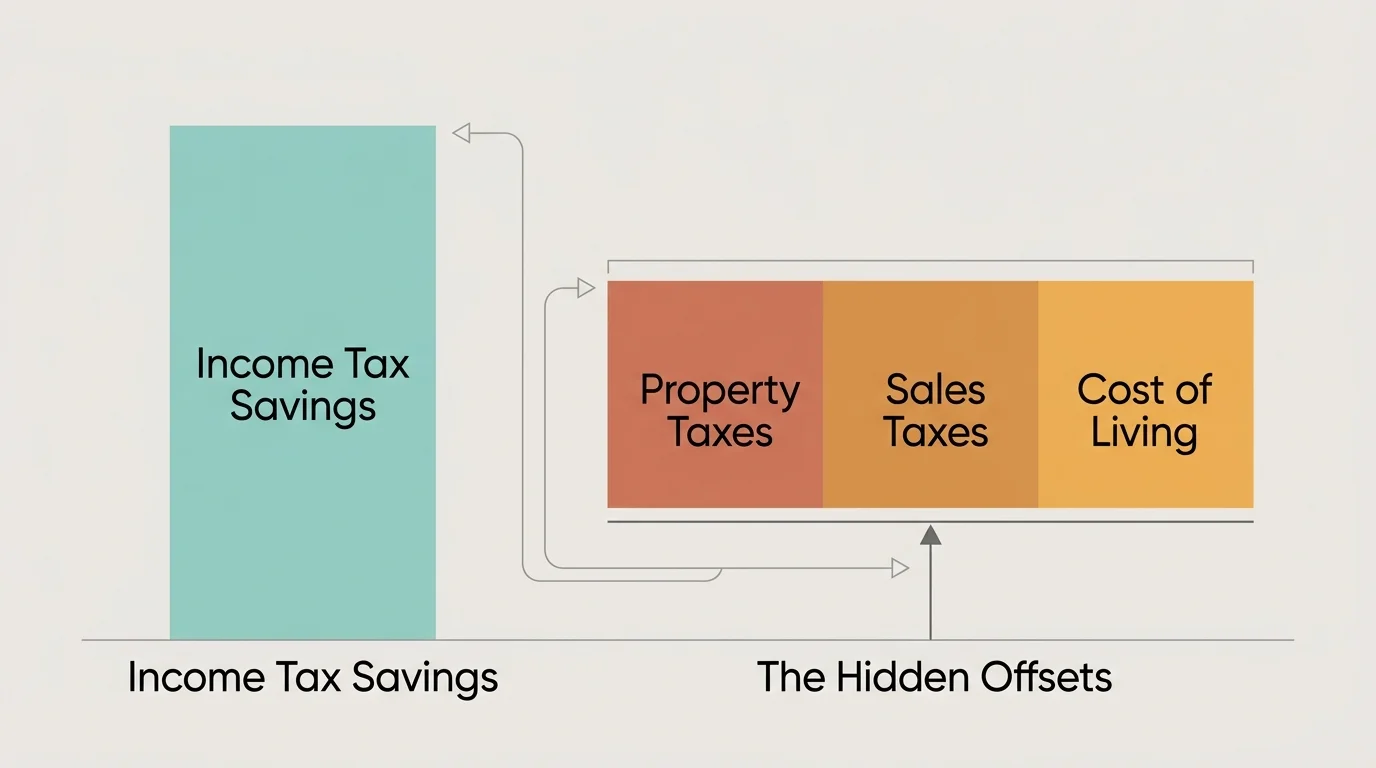
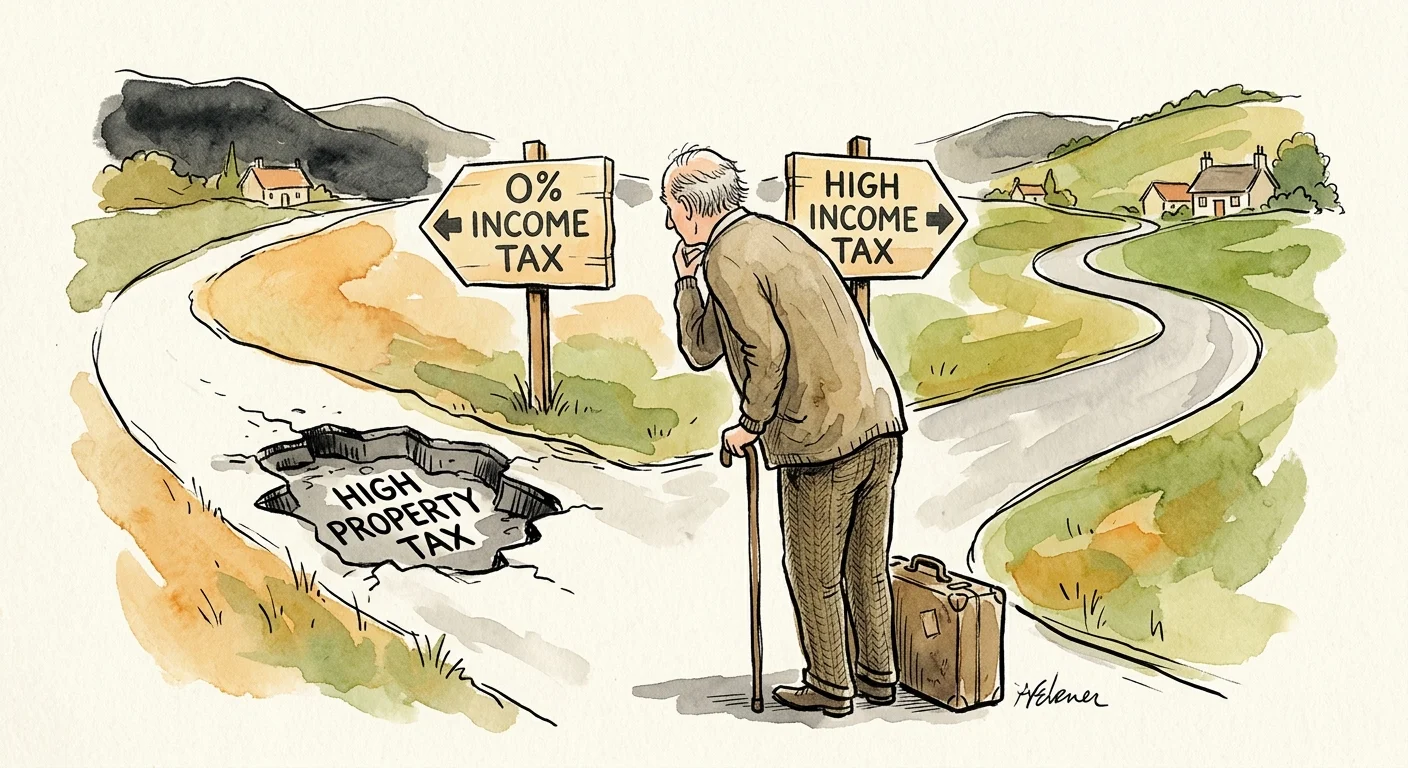
State governments must fund roads, public safety, public schools, and infrastructure. When a state elects not to collect income tax, it shifts the financial responsibility to property taxes, sales taxes, excise fees, and public services. Failing to account for these secondary costs causes significant budget surprises for relocating retirees.
Consider real estate taxes, which represent a permanent ongoing expense whether you mortgage your home or own it outright:
- Texas: Operates without a state income tax, but its effective property tax rate averages 1.36% to 1.50% of assessed home value. On a $400,000 home, annual property taxes often total $5,400 to $6,000 or more.
- New Hampshire: Features an average property tax rate between 1.50% and 2.10%, requiring homeowners on a $400,000 property to pay up to $8,400 annually.
- National Comparison: The national median property tax rate hovers around 0.99%. States like Hawaii, Alabama, and Colorado maintain property tax rates below 0.60%, offsetting their income tax structures.
Sales tax rates present another offset. Washington state carries an average combined state and local sales tax rate of 9.47%, while Texas averages 8.20%. Conversely, states like Delaware, Montana, New Hampshire, and Oregon charge 0% in general state sales tax. Buying a new vehicle, purchasing furniture, or covering daily household goods in a high-sales-tax state quietly chips away at your income tax savings.
Home insurance premiums add another major layer of expense. Coastal states that lack income taxes, particularly Florida, face insurance conditions that drive home coverage costs to double or triple the national average. Premium hikes, coupled with higher auto insurance rates, easily erase thousands in income tax savings.
Side-by-Side Comparison: High-Tax vs. No-Tax States for Retirees
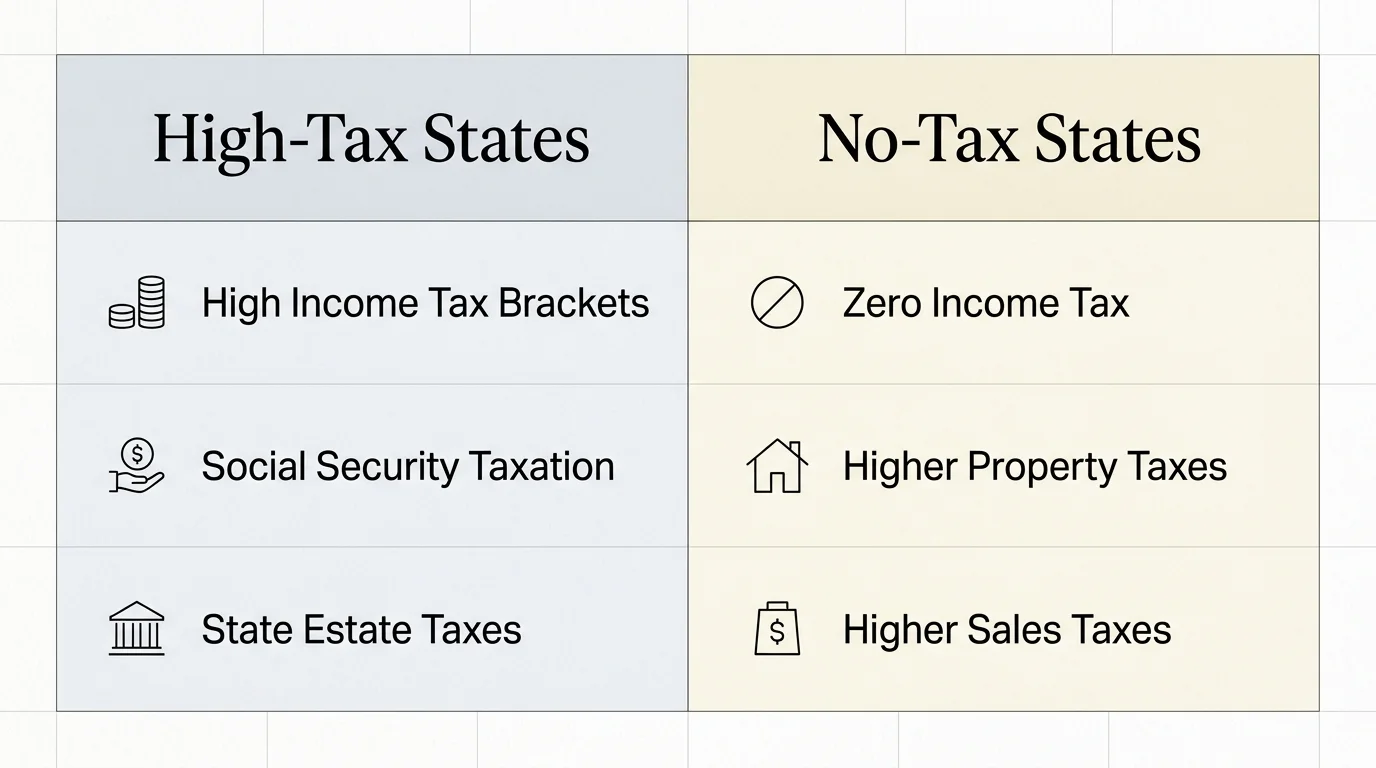
Evaluating state tax structures requires comparing how each revenue stream affects your overall financial stability. The table below details the structural trade-offs between typical high-tax states and popular no-income-tax destinations.
| Tax Category / Feature | High-Tax States (e.g., CA, NY, NJ, MN) | No-Income-Tax States (e.g., FL, TX, NV, NH) |
|---|---|---|
| State Tax on Pensions & 401(k)s | Fully taxed at ordinary income rates (some offer partial senior exclusions). | 0% state tax on all retirement account distributions. |
| Social Security State Tax | Taxed in a small minority of states (e.g., MN, VT); exempt in most others. | 0% state tax on all Social Security income. |
| Average Property Tax Rates | Varies widely; national average ~0.99% (NJ is high, CA capped by Prop 13). | Generally higher than average (TX: ~1.4%, NH: ~1.8%) to replace income revenue. |
| Combined State & Local Sales Tax | Moderate to high (CA ~8.8%, NY ~8.5%). | Often higher to balance budgets (WA ~9.47%, TX ~8.20%). |
| Healthcare & Services Access | Often features broad social safety nets and highly funded municipal systems. | May feature fewer state-funded senior support programs and public services. |

Real-World Example: Calculating Your True Tax Burden
To see how these differences play out, review this concrete numerical comparison. Consider a retired couple, both age 67, living on $85,000 in annual income. Their income consists of $35,000 from Social Security benefits and $50,000 withdrawn from a traditional 401(k). They own a primary residence valued at $400,000 and spend $20,000 annually on taxable retail goods.
Scenario A: Retiring in a High-Income-Tax State (e.g., 5% average effective income tax, 1.0% property tax, 7% sales tax)
- State Income Tax: The state exempts Social Security but taxes 401(k) withdrawals at 5%. On $50,000 of distributions, state income tax equals $2,500.
- Property Tax: At a 1.0% rate on their $400,000 home, annual real estate taxes total $4,000.
- Sales Tax: Spending $20,000 on taxable purchases at 7% generates $1,400 in sales tax.
- Total Direct State/Local Tax Paid: $7,900
Scenario B: Retiring in a No-Income-Tax State (0% income tax, 1.6% property tax, 8.5% sales tax)
- State Income Tax: 0% tax on 401(k) withdrawals and Social Security equals $0.
- Property Tax: At a 1.6% rate on the $400,000 home, annual real estate taxes total $6,400.
- Sales Tax: Spending $20,000 on taxable purchases at 8.5% generates $1,700 in sales tax.
- Total Direct State/Local Tax Paid: $8,100
In this realistic scenario, the couple actually pays $200 more per year in direct state and local taxes in the no-income-tax state. Because their income is modest and property value is relatively high, elevated local real estate and sales taxes completely erase the income tax savings. If this couple held $150,000 in annual retirement account withdrawals, the math would flip heavily in favor of the no-tax state. Calculating your personal tax blueprint is the only way to reveal true savings.
“Never move solely for tax reasons; low-tax states often substitute revenue through real estate taxes, toll roads, and user fees that offset expected income tax savings.” — Suze Orman, Personal Finance Expert
Common Mistakes to Avoid in Retirement Tax Planning
Moving across state lines to optimize your retirement finances involves strict legal and operational rules. Avoiding these frequent missteps protects your money and prevents regulatory scrutiny.
- Failing to establish legal domicile: High-tax states aggressively audit former residents who claim to have moved. Simply buying a condo in Florida or Nevada does not suffice. You must satisfy the statutory residency test (typically showing you spend fewer than 183 days in your former state) and prove that your primary domicile moved by shifting your driver’s license, voter registration, primary banking, medical providers, and legal documents.
- Ignoring health insurance network changes: Healthcare infrastructure varies widely by state and county. Moving to a low-tax state could mean leaving an established doctor network or moving outside the service area of your Medicare Advantage plan. Check regional hospital quality ratings and specialist coverage via Medicare.gov before finalizing a move.
- Overlooking local capital gains and estate taxes: State-level estate and inheritance taxes can surprise surviving spouses and heirs. While the federal estate tax exemption remains elevated, states like Massachusetts, Oregon, and Maryland impose state estate taxes with far lower thresholds.
- Assuming all income sources are exempt: Certain income, such as rental proceeds from real estate located in your former high-tax state, remains fully taxable by that state even after you relocate.

Finding the Right Advisor for Multi-State Relocation
Relocating during retirement involves intersecting real estate, state tax, and estate planning laws. Partnering with a Certified Public Accountant (CPA) or a Certified Financial Planner (CFP) ensures you execute the move without costly tax penalties.
You should seek professional guidance in the following specific scenarios:
- Selling a primary home with massive equity gains: If your principal home appreciated beyond the federal $250,000 ($500,000 for married couples) tax exclusion, timing the sale relative to your change in state residency requires precise structuring.
- Managing multi-state real estate portfolios: Retaining rental property or commercial real estate in a high-tax state while living in a no-tax state requires accurate multi-state tax filings to avoid double taxation.
- Transitioning complex trust documents: Revocable living trusts, durable powers of attorney, and healthcare directives drafted in one state may not align with probate codes in another. A qualified estate planning attorney should review your documents in your new home state.
Frequently Asked Questions
Which states do not tax Social Security retirement benefits?
As of 2026, 41 states plus Washington, D.C. do not tax Social Security benefits. Only nine states retain some form of tax on Social Security income: Colorado, Connecticut, Minnesota, Montana, New Mexico, Rhode Island, Utah, and Vermont. West Virginia completed its full phase-out of Social Security taxation in 2026.
How do states determine if I am a resident for tax purposes?
Most state tax agencies rely on two primary tests: physical presence (the 183-day rule) and legal domicile. Domicile reflects your permanent, primary home where you maintain personal, family, and financial ties. Changing your driver’s license, voter registration, primary bank accounts, and homestead exemption helps establish your new state as your primary domicile.
What happens to my 401(k) or traditional IRA distributions when I move to a no-tax state?
Federal law protects retirees from being taxed by their former state on pension and retirement account distributions. Once you establish true legal residency in a no-tax state, your distributions from traditional IRAs, 401(k) accounts, and 403(b) plans incur zero state income tax.
Does moving to a state without an income tax always save money?
Not always. Higher local real estate taxes, increased combined sales taxes, elevated home insurance premiums, and higher utility charges can eliminate state income tax savings. Evaluating your total expenditure profile determines whether relocating actually reduces your net expenses.
Next Steps for Your Retirement Tax Strategy
Determining whether a high-tax state or a no-tax state best serves your retirement goals requires a full budget audit. Start by itemizing your anticipated income streams, including Social Security, pension payouts, taxable account dividends, and traditional 401(k) or IRA distributions. Next, estimate local real estate taxes, sales taxes, home insurance premiums, and healthcare overhead in candidate cities. Comparing these figures side by side reveals your true cost of living far better than looking at state income tax rates alone.
Before putting a house on the market or packing a moving truck, schedule a consultation with a tax professional to evaluate your transition plan. Running precise projections ensures you keep more of your hard-earned wealth and enjoy a financially secure retirement.
The information in this guide is meant for educational purposes. Your specific circumstances—including income, benefits, tax situation, and health needs—may require different approaches. When in doubt, consult a licensed financial advisor or tax professional.
Last updated: February 2026. Benefit amounts, tax rules, and program details change annually—verify current figures with official government sources.








Leave a Reply