

Retiring from the military unlocks powerful financial advantages that private-sector workers cannot access. Mastering these unique military retirement benefits can save you thousands of dollars each year in taxes and healthcare.
While civilian retirees often watch their savings erode against market swings and inflation, your earned benefits offer unmatched stability. You simply need to know how to deploy them strategically.
From lifetime medical coverage to state tax shelters, veteran retirement planning follows a distinct playbook. Here are seven crucial financial realities every military retiree must navigate.

1. Built-In Inflation Defense: The Power of Military Pension COLA
Military pension differences stand out immediately when you look at how your monthly check responds to inflation. Most private-sector defined-benefit plans pay a flat monthly amount for life without periodic adjustments.
Your military retired pay adjusts annually through Cost-of-Living Adjustments (COLA) tied directly to the Consumer Price Index. These regular increases ensure your basic purchasing power keeps pace with rising living expenses.
For example, military retirees received a 3.2% raise in 2024 and an additional 2.5% boost effective December 2024. Over a twenty-year retirement, that guaranteed compounding effect adds tens of thousands of dollars to your pocket.
Civilian retirees must shoulder this inflation risk themselves by taking stock market risks or purchasing expensive private annuities. You possess a government-guaranteed buffer that civilian retirees simply cannot buy on the open market.

2. Healthcare Superiority: How TRICARE For Life Outperforms Civilian Medigap
Civilian retirees routinely spend hundreds of dollars every month on private supplemental health insurance. When you reach age 65, your healthcare pathway diverges significantly thanks to TRICARE For Life.
TRICARE For Life acts as a robust, premium-free wraparound plan to original Medicare. You pay zero annual enrollment fees to maintain this comprehensive medical coverage.
According to Medicare.gov, the standard Medicare Part B monthly premium is $185.00 in 2025. You must enroll in Part B to unlock TRICARE For Life, but that remains your primary expense.
When you visit doctors who accept Medicare, TRICARE For Life covers virtually all remaining copayments and deductibles. Your out-of-pocket medical expenses for covered care typically drop to zero.
Additionally, TRICARE pharmacy coverage qualifies as creditable drug coverage under federal regulations. You do not need to buy a Medicare Part D plan, sparing you separate drug premiums and late-enrollment penalties.
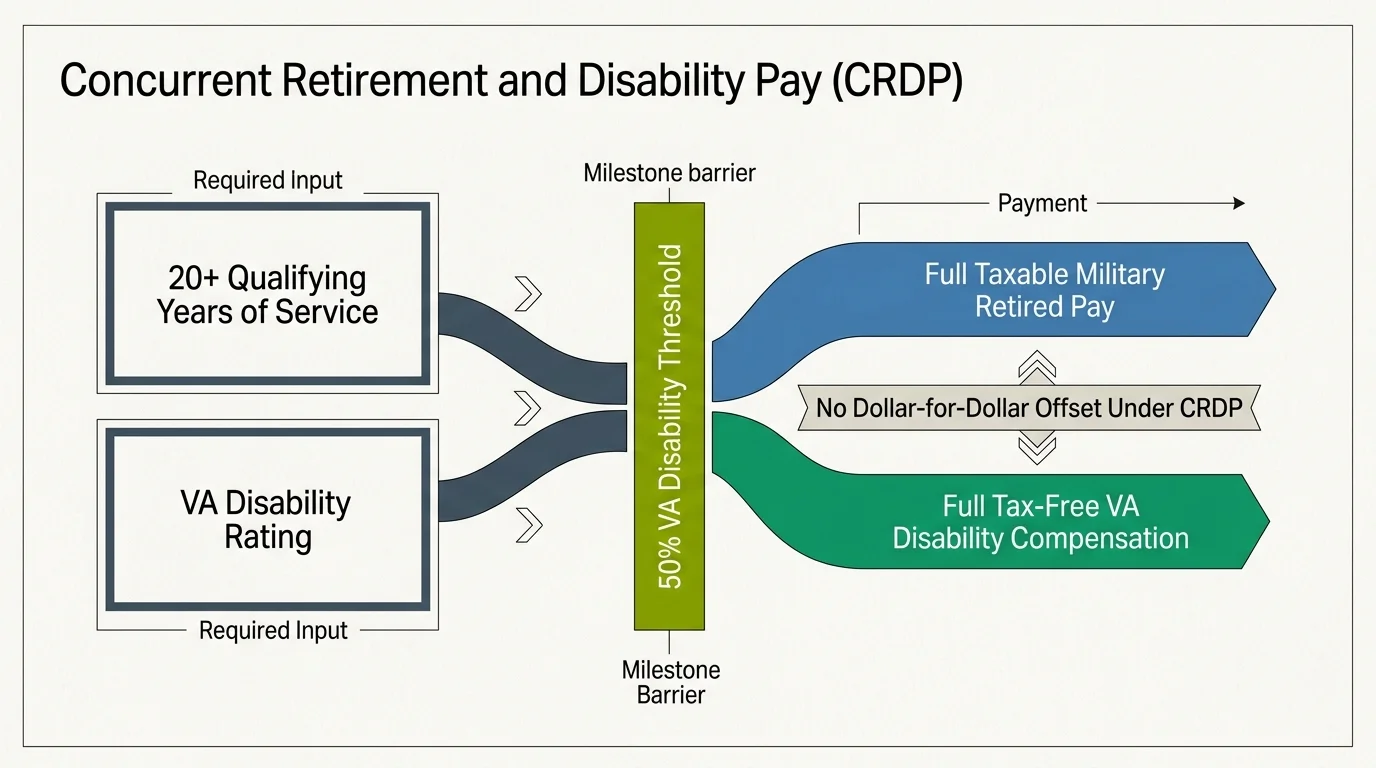
3. The 50% Disability Rule: Unlocking Concurrent Receipt (CRDP)
Civilians rarely balance multiple federal compensation checks, but veterans must master the statutory VA waiver. Federal law originally required a dollar-for-dollar reduction in taxable military pension pay for any tax-free disability pay received.
Fortunately, Concurrent Retirement and Disability Pay (CRDP) eliminates that offset for qualified retirees. You can collect both full payments simultaneously without any financial penalty.
To qualify for CRDP, you must complete at least 20 qualifying years of service and hold a U.S. Department of Veterans Affairs (VA) disability rating of 50% or higher.
Crossing this 50% disability threshold transforms your financial landscape. Because VA disability payments are exempt from federal and state taxes, securing an accurate disability rating significantly boosts your monthly net income.
Financial security in retirement stems from removing unpredictable variables from your monthly cash flow.
“A big part of financial freedom is having your heart and mind free from worry about what-ifs.” — Suze Orman, Personal Finance Author
Guaranteed military benefits provide precisely that peace of mind by insulating you from catastrophic healthcare costs and sudden market downturns.

4. Survivor Benefit Plan Upgrades: The Repeal of the Widow’s Tax
For decades, surviving military spouses endured a painful financial penalty known as the “Widow’s Tax.” Surviving spouses who received VA Dependency and Indemnity Compensation (DIC) lost an equivalent amount from their Survivor Benefit Plan payments.
Congress systematically repealed this deduction, ending the offset entirely on January 1, 2023. Surviving spouses now receive both full benefits concurrently.
An eligible surviving spouse receives 100% of their elected SBP annuity alongside their complete monthly DIC check. The full SBP annuity equals 55% of your chosen base retirement pay.
When structuring your veteran financial planning, you can now purchase SBP coverage confident that outside VA benefits will not reduce your family’s future legacy.

5. State Income Tax Havens for Military Pensions
Most civilian workers face state income taxes on their pension distributions and 401(k) withdrawals. Military retirees, however, enjoy unparalleled state tax advantages depending on where they choose to establish domicile.
More than 37 states completely exempt military retirement pay from state income tax. This total includes nine states with no state income tax and over 28 states that explicitly exempt military pensions.
Several other states offer substantial deductions. For instance, Virginia exempts up to $40,000 of military retired pay, and California enacted targeted partial pension exemptions.
Strategic residency planning can instantly increase your disposable income by thousands of dollars each year. You keep far more of your pension check simply by crossing a state border.

6. Everyday Purchasing Power: Commissaries and Category VI Space-A Travel
Your military retirement benefits include valuable everyday shopping and travel perks that civilians cannot access. These privileges deliver substantial savings directly back to your household budget.
Retirees retain lifelong access to Defense Commissary Agency (DeCA) supermarkets worldwide. Commissaries sell standard consumer goods at wholesale cost plus a modest 5% statutory surcharge.
This pricing model generates an average savings of 20% to 25% compared to civilian grocery chains. Over a full year, feeding a household through the commissary saves thousands of dollars.
Retirees also qualify for Category VI Space-Available (Space-A) passenger travel on military flights. Department of Defense Instruction 4515.13 allows you to board eligible military aircraft worldwide at almost zero cost.

7. Coordinating Benefits With Social Security and TSP
Civilians often depend entirely on private savings and Social Security to fund their retirement. As a military retiree, your pension forms an unbreakable foundation that complements your other retirement assets.
Your military retired pay does not reduce your Social Security benefits in any way. According to the Social Security Administration (SSA), you receive full credit for your military earnings.
You can also utilize the federal Thrift Savings Plan (TSP) to accumulate substantial wealth during your working years. The TSP offers some of the lowest management expense ratios in the investment industry.
The Internal Revenue Service (IRS) requires minimum distributions from traditional TSP accounts once you reach age 73. Balancing these required distributions with your pension prevents sudden spikes in your taxable income.
Disciplined long-term execution remains the key to building generational wealth alongside your pension.
“Do not save what is left after spending, but spend what is left after saving.” — Warren Buffett, Chairman and CEO of Berkshire Hathaway
Investing regular portions of your military pension into growth assets creates a multi-layered financial defense for your family.
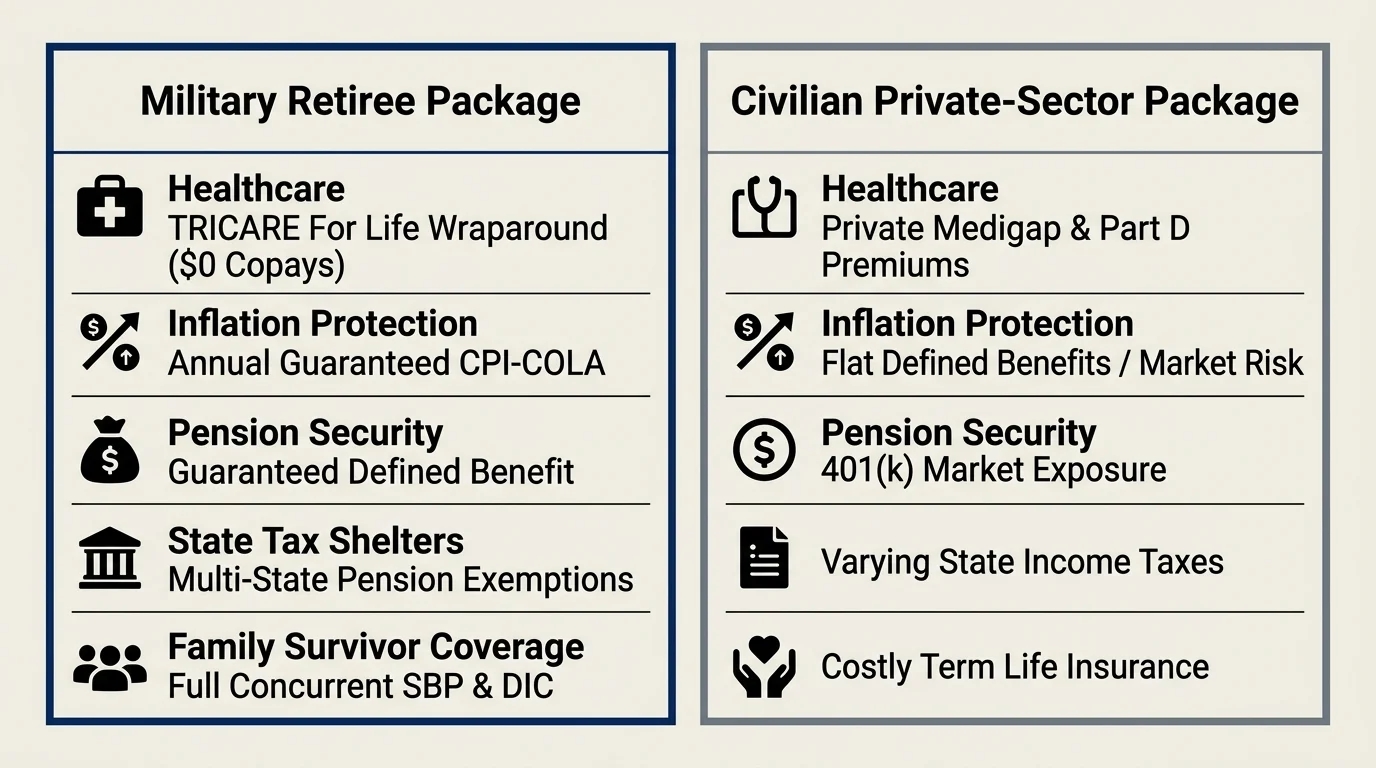
Military Retirement vs. Civilian Retirement: At a Glance
Comparing civilian and military retirement structures side by side reveals distinct structural advantages. Review this comparison to identify which earned benefits provide you the greatest financial leverage.
| Benefit Category | Military Retirees | Civilian Retirees |
|---|---|---|
| Inflation Adjustments | Annual COLA indexed to the CPI-W | Rare on private corporate pensions |
| Age 65 Healthcare | TRICARE For Life ($0 annual enrollment fee) | Commercial Medigap ($150-$300+ monthly) |
| Prescription Coverage | Creditable TRICARE drug plan ($0 Part D premium) | Standalone Medicare Part D plan required |
| Disability Integration | CRDP enables dual receipt at 50%+ VA rating | Private disability often reduces company pension |
| State Tax Burdens | 100% pension exemption in 37+ states | Pensions taxed as ordinary income in most states |
| Retail & Travel Perks | Commissary cost-plus pricing and Space-A travel | Standard commercial retail pricing |

Costly Errors to Sidestep
Even seasoned service members make avoidable errors when transitioning into civilian life. Guarding against these four common mistakes protects your earned benefits and family wealth.
- Missing the Initial Medicare Part B Enrollment Window: Failing to enroll in Part B at age 65 terminates your TRICARE For Life coverage immediately and triggers permanent late-enrollment penalties.
- Neglecting VA Disability Documentation: Failing to claim service-connected ailments leaves taxable military pension dollars on the table instead of converting them into tax-free VA compensation.
- Overlooking State Income Tax Domicile: Maintaining legal residency in a state that fully taxes military pensions can needlessly cost you thousands of dollars annually.
- Assuming the SBP Widow’s Tax Still Applies: Turning down SBP coverage based on outdated advice leaves your spouse without valuable, inflation-protected survivor income.

When DIY Isn’t Enough
While many retirement milestones are easy to manage independently, complex financial decisions warrant expert assistance. Seek qualified professional advice in the following situations.
Consult a specialist if you receive a medical retirement under Chapter 61 rules. Choosing between DoD disability retirement pay and VA compensation requires complex tax calculations that impact your lifelong income.
Work with a fiduciary advisor when planning Roth conversions during low-income gap years before starting Social Security. Strategic conversions permanently shield future growth from federal income tax brackets.
Retain a military-literate attorney if you navigate divorce proceedings. Protecting your pension rights under the Uniformed Services Former Spouses’ Protection Act requires exact legal language.
Coordinate with an accredited claims agent or Veteran Service Officer (VSO) when filing disability appeals through Benefits.gov. Professional representation substantially improves your chances of reaching the 50% CRDP threshold.
Frequently Asked Questions
Does military retirement pay reduce my Social Security benefits?
No, your military retired pay does not offset or reduce your Social Security benefits. You receive both checks in full once you reach your eligible claiming age.
Do I need to buy a standalone Medicare Part D plan?
No, TRICARE For Life pharmacy coverage is considered creditable prescription drug coverage under federal law. You do not need Medicare Part D and will not face late-enrollment penalties for skipping it.
Can I collect both VA disability pay and military retired pay?
Yes, provided you complete 20 years of qualifying service and hold a VA disability rating of 50% or higher. Concurrent Retirement and Disability Pay (CRDP) automatically restores both full payments.
Is military retirement pay subject to state income taxes?
It depends entirely on where you live. More than 37 states completely exempt military retirement pay from state income tax, while others offer generous partial deductions.
Next Steps for Your Retirement
Your military service earned you a retirement package that private-sector workers can only dream of. Take time to audit your healthcare coverage, state tax residency, and disability ratings to maximize every dollar.
The information in this guide is meant for educational purposes. Your specific circumstances—including income, benefits, tax situation, and health needs—may require different approaches.
When in doubt, consult a licensed financial advisor or tax professional.
Last updated: February 2026. Benefit amounts, tax rules, and program details change annually—verify current figures with official government sources.









Leave a Reply