

Relying solely on Social Security leaves many retirees facing severe budget shortfalls when living expenses rise faster than fixed benefits. According to the Social Security Administration (2026), the average monthly benefit check reaches $2,071 after a 2.8% cost-of-living adjustment, replacing only about 41% of pre-retirement earnings for medium earners. To safeguard your standard of living against inflation and healthcare expenses, building multiple streams of cash flow remains essential. Diversifying your retirement income beyond government payments grants you financial independence and stability. Establishing strategic income sources—spanning traditional accounts, dividend portfolios, annuities, and home equity—protects your savings while ensuring reliable monthly cash flow throughout your golden years.
Why Social Security Is Just One Leg of Your Retirement Stool
For decades, financial planners described retirement as a three-legged stool supported by Social Security, private employer pensions, and personal savings. Today, traditional pensions have largely vanished from the private sector, leaving seniors to build their own financial support structures. Depending entirely on government benefits creates severe purchasing power risks over a retirement that could easily last 25 to 30 years.
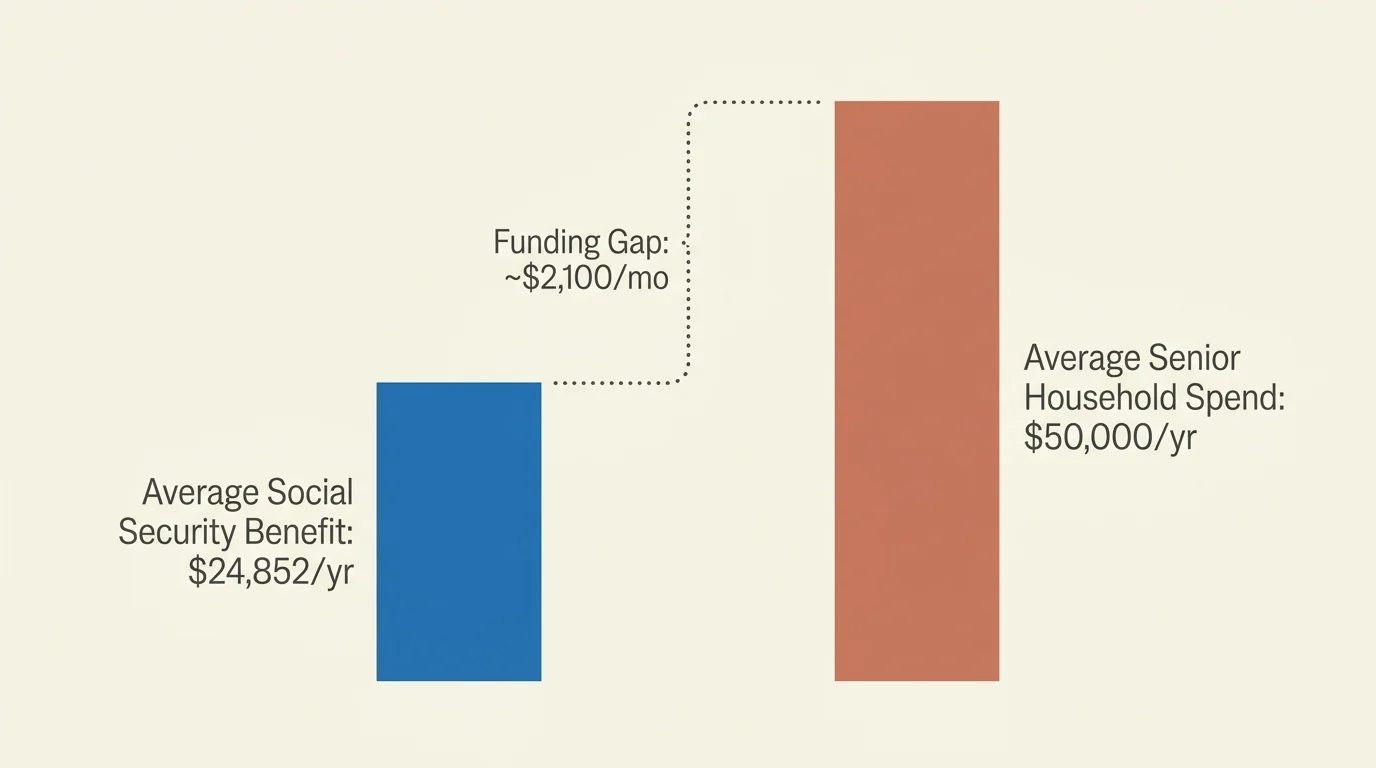
Consider the actual math behind average benefits. A monthly check of $2,071 equates to $24,852 per year. Meanwhile, national survey data from AARP and the Bureau of Labor Statistics indicates that average senior households spend over $50,000 annually on essential expenses like housing, healthcare, utilities, and groceries. That leaves a massive funding gap of roughly $2,100 or more every single month.
Official projections from the Social Security Administration (2026) show that Social Security replaces approximately 41% of career earnings for medium-wage earners ($72,026 per year) and just 33.7% for higher earners ($115,241 per year). Creating multiple, diversified retirement income streams fills this shortfall, lowers your overall tax burden, and shields your household from single-source economic shocks.

8 Powerful Strategies to Diversify Your Retirement Income
1. Traditional Tax-Advantaged Accounts (401k, 403b, and IRAs)
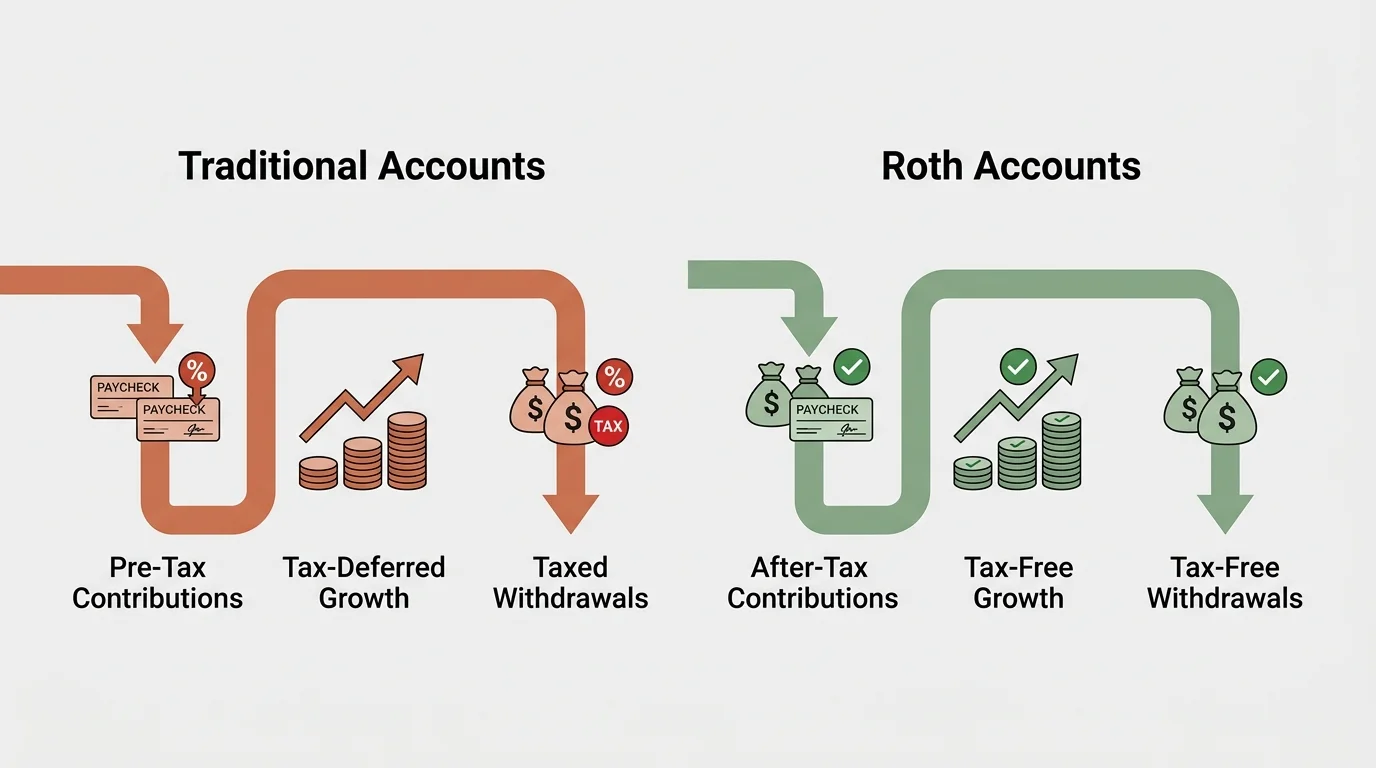
Traditional employer accounts and Individual Retirement Arrangements (IRAs) offer up-front tax deductions while your investments grow tax-deferred. When you take distributions in retirement, the IRS taxes those withdrawals as ordinary income. Managing these withdrawals systematically provides a predictable income foundation.
For 2026, the Internal Revenue Service (IRS) set the base employee deferral limit for workplace plans like 401(k) and 403(b) accounts at $24,500. If you are aged 50 or older, you can add a standard catch-up contribution of $8,000, bringing your total annual limit to $32,500. Furthermore, under SECURE Act 2.0 provisions, workers aged 60 through 63 qualify for an enhanced “super catch-up” limit of $11,250 in 2026, raising total allowable workplace deferrals to $35,750.
For Traditional IRAs, the maximum 2026 annual limit stands at $7,500, plus an inflation-adjusted catch-up limit of $1,100 for individuals aged 50 and older (totaling $8,600). Keep in mind that SECURE Act 2.0 rules dictate when Required Minimum Distributions (RMDs) begin. Account holders born between 1951 and 1959 must begin taking RMDs at age 73, whereas those born in 1960 or later will begin RMDs at age 75 starting in 2033. If you fail to take your complete RMD, the IRS imposes a 25% tax penalty on the missing amount, which drops to 10% if you correct the error within two years.
2. Tax-Free Cash Flow: Roth IRAs and Roth 401(k)s
Unlike traditional tax-deferred vehicles, Roth accounts use after-tax contributions. Qualified distributions—including all investment growth and compound interest—come out 100% tax-free in retirement. Having a bucket of tax-free money lets you make large withdrawals for major purchases, emergency repairs, or medical care without triggering higher income tax brackets.
Roth IRAs do not require minimum distributions during the original account holder’s lifetime, allowing your assets to compound uninterrupted for decades or pass tax-free to your heirs. In 2026, SECURE 2.0 rules mandate that employees earning more than $150,000 in prior-year FICA wages from their current employer must make any workplace catch-up contributions on a Roth (after-tax) basis. Shifting a portion of your wealth into Roth accounts creates exceptional flexibility when balancing tax exposure alongside Social Security earnings.
3. Dividend-Paying Stocks and Income Mutual Funds
Investing in high-quality, dividend-paying equities creates a passive cash flow stream that does not force you to liquidate underlying stock shares. Major, well-capitalized corporations known as “Dividend Aristocrats” have increased their dividend payouts annually for at least 25 consecutive years, offering natural inflation protection.
While equity investments carry market volatility, a portfolio yielding 3% to 4% in annual dividends produces consistent cash deposits into your brokerage account. During your working years, you can reinvest those distributions automatically; once retired, you can direct those payouts straight into your checking account to cover daily living expenses.
4. Guaranteed Lifetime Income via Fixed Annuities
If you miss the guaranteed security of a traditional pension, commercial annuities can provide a reliable cash floor. You transfer a single lump sum or a series of payments to an insurance company in exchange for contractual, guaranteed monthly payouts for life.
A Single Premium Immediate Annuity (SPIA) begins generating cash flow right away. For instance, putting a portion of your savings into a SPIA locks in predictable income that covers fixed baseline expenses like property taxes and Medicare premiums. Fixed-indexed annuities provide downside protection for your principal while tying potential interest earnings to equity benchmarks, offering capital security alongside growth potential.
5. High-Yield Savings, CDs, and Short-Term Treasuries
Maintaining a dedicated cash buffer protects your portfolio from “sequence-of-returns risk”—the danger of being forced to sell stocks at a loss during a severe market decline to pay for routine living costs. Holding two to three years of baseline expenses in cash equivalents ensures you never sell equities in a down market.
Certificates of Deposit (CDs) and U.S. Treasury bills backed by the government offer yield with minimal risk. Establishing a “CD ladder” across 12-month to 60-month terms ensures that a chunk of your principal matures every six or twelve months. This strategy returns cash to you regularly while keeping your yield competitive with current interest rate environments.
6. Real Estate Investments and Home Equity Monetization
Real estate serves as a durable income generator and inflation hedge. Physical rental properties generate monthly cash flow alongside long-term property appreciation, though managing real estate requires landlord responsibilities or property management expenses. Alternatively, Real Estate Investment Trusts (REITs) traded on public exchanges offer high-yield real estate exposure without property maintenance hassles.
Home equity often represents a senior’s single largest asset. Downsizing to a smaller residence releases liquid cash that you can invest in income-producing assets. For seniors aged 62 and older, a Home Equity Conversion Mortgage (HECM)—a federally regulated reverse mortgage insured by the Federal Housing Administration and managed through the U.S. Department of Housing and Urban Development (HUD)—allows you to convert home equity into tax-free monthly tenure payments or an adjusting line of credit without leaving your home.
7. Part-Time Work, Consulting, and Passion Projects
Continuing to work 10 to 15 hours a week in early retirement provides active earned income that significantly reduces the withdrawal strain on your investment portfolio. Consulting in your former profession, coaching, tutoring, or running a small artisan business supplies supplementary cash while keeping you intellectually engaged and socially active.
Be aware of Social Security earning parameters if you choose to work while receiving benefits before reaching your Full Retirement Age (FRA). According to the Social Security Administration, if you earn above annual wage thresholds prior to your FRA, the SSA temporarily holds back $1 in benefits for every $2 earned above the threshold. However, once you reach your FRA, earnings limits vanish entirely, and the SSA recalculates your monthly check upward to account for the withheld funds.
8. Health Savings Accounts (HSAs) as a Secret Retirement Reserve
If you maintain access to a High-Deductible Health Plan (HDHP) prior to enrolling in Medicare, Health Savings Accounts offer unmatched “triple-tax” benefits: contributions lower your taxable income, account growth is completely tax-free, and distributions spent on qualified medical care incur zero taxes.
Once you reach age 65, the IRS removes the 20% penalty for non-medical HSA withdrawals. You can draw money from an HSA for any purpose, paying standard income taxes just like a Traditional IRA. However, if you spend HSA distributions on qualified medical costs—including Medicare Part B premiums, dental care, and vision care—the withdrawals remain entirely tax-free, making the HSA an incredible healthcare income buffer.
Retirement Income Streams Compared
| Income Source | Tax Status | Risk Level | Liquidity | Primary Benefit |
|---|---|---|---|---|
| Traditional 401(k) / IRA | Taxed as Ordinary Income | Moderate to High | High (Subject to RMDs) | Upfront tax savings during working years |
| Roth IRA / Roth 401(k) | 100% Tax-Free | Moderate to High | High (No RMDs) | Tax-free cash flow and flexible withdrawals |
| Dividend Stocks & Funds | Capital Gains Rate / Taxable | Moderate to High | Very High | Growing cash flow with potential capital growth |
| Fixed Annuities | Partially Taxable | Low | Low | Guaranteed lifetime monthly cash flow |
| CDs & Treasuries | Taxable as Interest | Very Low | High (When laddered) | Capital preservation and predictable yields |
| Real Estate / HECM | Varies / Tax-Free Proceeds | Moderate | Low to Moderate | Property appreciation and equity release |
| Part-Time Earnings | Taxed as Ordinary Income | Very Low | Immediate Cash Flow | Protects principal savings from early drawdown |
| Health Savings Account | Tax-Free for Medical | Low to Moderate | High | Triple-tax advantages for medical expenses |

Expert Perspective on Retirement Income Planning
Financial experts emphasize that tax diversification is just as important as asset allocation when designing your retirement distribution structure.
“The real risk in retirement isn’t just market volatility—it’s what tax rates will do to your future income. Tax-free income from Roth accounts gives you absolute certainty in an uncertain tax world.” — Ed Slott, CPA and IRA Expert
Building layered income streams shields your wealth against legislative tax rate increases and sudden economic changes.
“A multi-layered retirement plan protects you against the unexpected. Never put all your financial stability into a single basket, especially when depending on fixed government benefits.” — Suze Orman, Financial Author and Speaker
Costly Errors to Sidestep
Navigating retirement cash flow requires avoiding administrative missteps that trigger steep penalty fees or inflated tax rates. You can protect your wealth by keeping these four common mistakes on your radar:
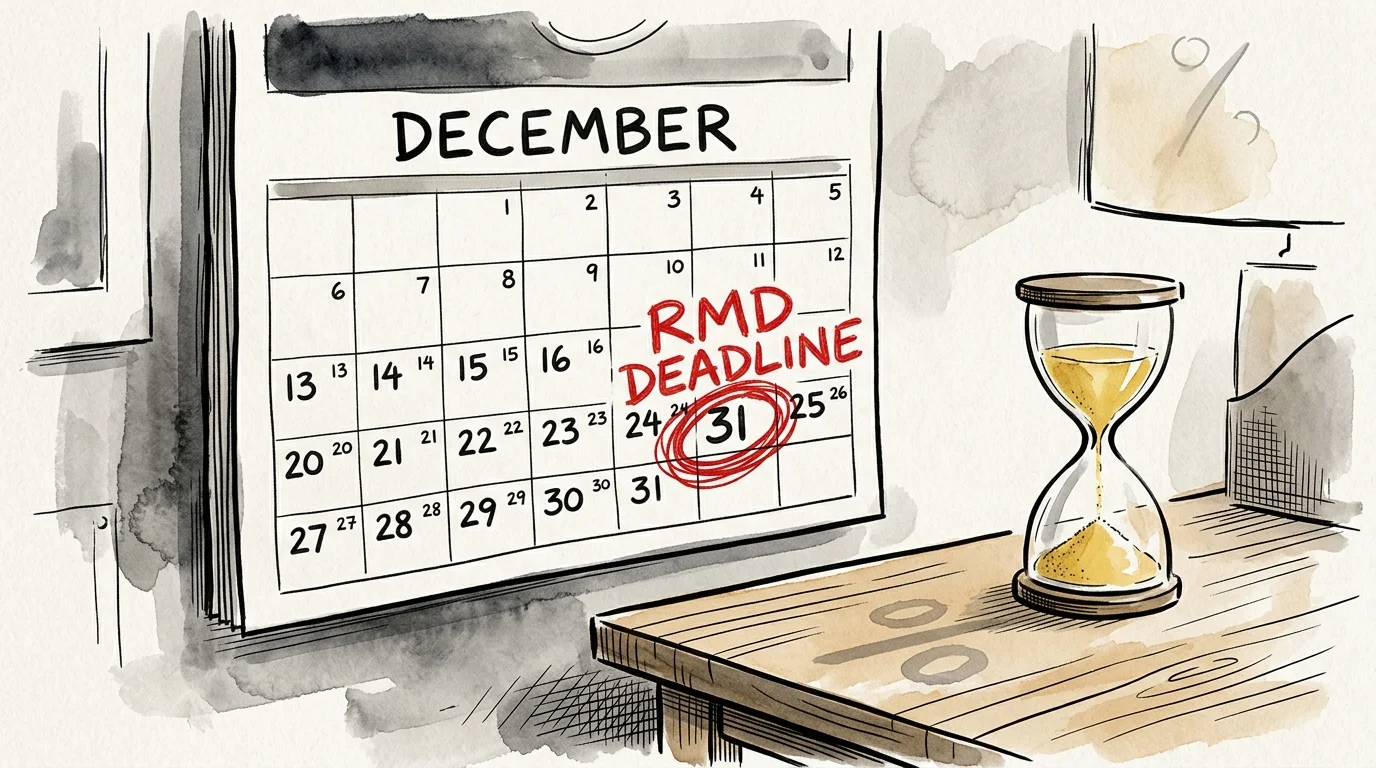
- Ignoring RMD Deadlines and Rules: SECURE 2.0 lowered the non-compliance penalty from 50% to 25% (and down to 10% if corrected within two years), but missing an RMD deadline still extracts an unnecessary toll on your wealth. Track your account balances every December to ensure accurate distributions.
- Over-Allocating to Cash Due to Loss Aversion: Stashing all your savings in low-yielding cash checking accounts feels safe, but inflation erodes your real purchasing power over a multi-decade retirement. Maintain balanced equity exposure to preserve your long-term purchasing power.
- Triggering Medicare IRMAA Surcharges: Income Surges caused by large traditional IRA distributions, property sales, or Roth conversions can push your Modified Adjusted Gross Income (MAGI) over statutory thresholds. This triggers Medicare Income-Related Monthly Adjustment Amount (IRMAA) surcharges, significantly hiking your monthly Medicare Part B and Part D premiums.
- Claiming Social Security Too Early While Working: Exercising your Social Security claim at age 62 while earning substantial working wages subjects your benefit checks to the earnings test reduction, penalizing your immediate monthly receipts.

When DIY Isn’t Enough: 4 Times to Consult a Financial Advisor
While managing your own budget works well during your earning years, converting a nest egg into steady monthly cash flow requires sophisticated tax management and asset allocation. Here are four scenarios where working with a fee-only Certified Financial Planner (CFP) or CPA makes financial sense:
- Managing Complex Multi-Account Distribution Orders: Determining whether to pull funds from taxable brokerage accounts, traditional pre-tax accounts, or Roth reserves requires precise calculation to keep you in the lowest possible tax bracket.
- Executing Multi-Year Roth Conversion Strategies: Systematically converting tax-deferred traditional IRA funds into Roth IRAs before RMD age arrives can save tens of thousands in future taxes, but requires careful execution to avoid triggering Medicare IRMAA surcharges.
- Evaluating Annuity Contracts and Complex Products: Insurance contracts contain complex riders, fee schedules, surrender charges, and payout rules. A fiduciary advisor helps you evaluate whether an annuity truly fits your long-term income goals.
- Navigating Major Life Transitions: Experiencing the loss of a spouse or receiving a sudden lump-sum inheritance requires immediate updates to tax filing strategies, estate distribution plans, and pension rollover options.
Frequently Asked Questions
How much pre-retirement income should I aim to replace?
Financial planners generally suggest replacing 70% to 80% of your pre-retirement earnings to maintain your standard of living. However, rising healthcare costs, travel goals, and inflation may require a higher replacement rate.
What is sequence-of-returns risk and why does it matter?
Sequence-of-returns risk occurs when market downturns happen in the early years of retirement while you withdraw funds. Selling depreciated assets permanently shrinks your portfolio base, making cash reserves and guaranteed income streams critical buffers.
Can I contribute to a Roth IRA if I am fully retired?
You can only make direct contributions to a Roth IRA if you have taxable earned income, such as wages or self-employment earnings. Investment dividends, pensions, and Social Security benefits do not qualify as earned income for IRA contribution limits.
How does dividend income affect my Social Security taxes?
Dividend income increases your Combined Income calculation (Adjusted Gross Income + Non-taxable Interest + half of Social Security benefits). Exceeding statutory income thresholds may cause up to 85% of your Social Security benefits to become taxable.
Taking Action: Your Next Steps
Achieving absolute financial security in retirement comes from taking small, deliberate steps today. Start by auditing your expected fixed costs against your estimated Social Security benefits. Calculate your monthly income deficit, then evaluate which combination of tax-advantaged accounts, dividend investments, liquid cash reserves, or real estate equity can bridge that gap efficiently.
To deepen your strategy, consult tools on Investor.gov or analyze detailed benefits guidelines on official government sites like ConsumerFinancialProtectionBureau. Building a resilient, multi-layered cash flow strategy ensures that you maintain full control over your finances throughout retirement. The information in this guide is meant for educational purposes. Your specific circumstances—including income, benefits, tax situation, and health needs—may require different approaches. When in doubt, consult a licensed financial advisor or tax professional.
Last updated: February 2026. Benefit amounts, tax rules, and program details change annually—verify current figures with official government sources.









Leave a Reply