

Preserving your nest egg requires steady growth and fierce protection against rising everyday costs. Warren Buffett built his legendary reputation by following simple, disciplined money habits that any retiree can adopt.
While Internet rumors claim he wrote a rigid list of rules specifically for seniors, his actual shareholder letters offer far more practical guidance. His core investing principles show you how to outpace inflation without taking reckless risks.
By translating these corporate insights into smart personal strategies, you can safeguard your savings through every phase of retirement.

The Truth About Buffett’s 90/10 Allocation
You may have heard claims that legendary investor Warren Buffett advocates putting 90% of your assets into stocks and 10% into bonds.
In his 2013 shareholder letter, Buffett instructed his wife’s future trustee to place 90% in a low-cost S&P 500 index fund and 10% in short-term government bonds.
However, this directive was designed for an estate with substantial surplus wealth, not for a household drawing regular monthly living expenses.
As Investor.gov points out, holding an aggressive stock portfolio near retirement exposes your nest egg to sequence-of-returns risk.
A steep market downturn in your early retirement years can permanently shrink your savings balance if you must sell shares to pay bills.
Most retirees need a balanced allocation that safeguards cash flow while letting a portion of assets compound steadily.
Protect Your Principal Against Inflation
Buffett famously summarized his investment philosophy in two simple rules: Rule number one is never lose money, and rule number two is never forget rule number one.
For retirees, losing money means more than paper losses on a monthly brokerage statement; it also means losing purchasing power to inflation.
Consumer prices climbed cumulatively by 22.0% over the five years ending in late 2026.
Leaving all your assets in zero-growth accounts guarantees that inflation will slowly erode your living standard.
Rising living expenses demand proactive planning. For example, the Social Security Administration set a 3.6% COLA for 2027, increasing the average retired worker benefit from $2,095 to $2,170 per month.
At the same time, standard Medicare Part B premiums reached $202.90 per month in 2026.
To preserve your real purchasing power, your portfolio must own assets that grow faster than daily price increases.
Sidestep Costly Cash Mistakes
Holding adequate liquidity remains essential for retirees seeking uninterrupted peace of mind.
Buffett retired as Berkshire Hathaway CEO at the end of 2025 and stepped into the Chairman Emeritus role in September 2026, leaving behind an exceptionally strong balance sheet.
In the third quarter of 2026, Berkshire held $356.95 billion net in cash and U.S. Treasury bills to protect operations and seize future opportunities.
Unfortunately, many seniors make severe cash mistakes by parking their emergency reserves in traditional bank savings accounts paying negligible interest.
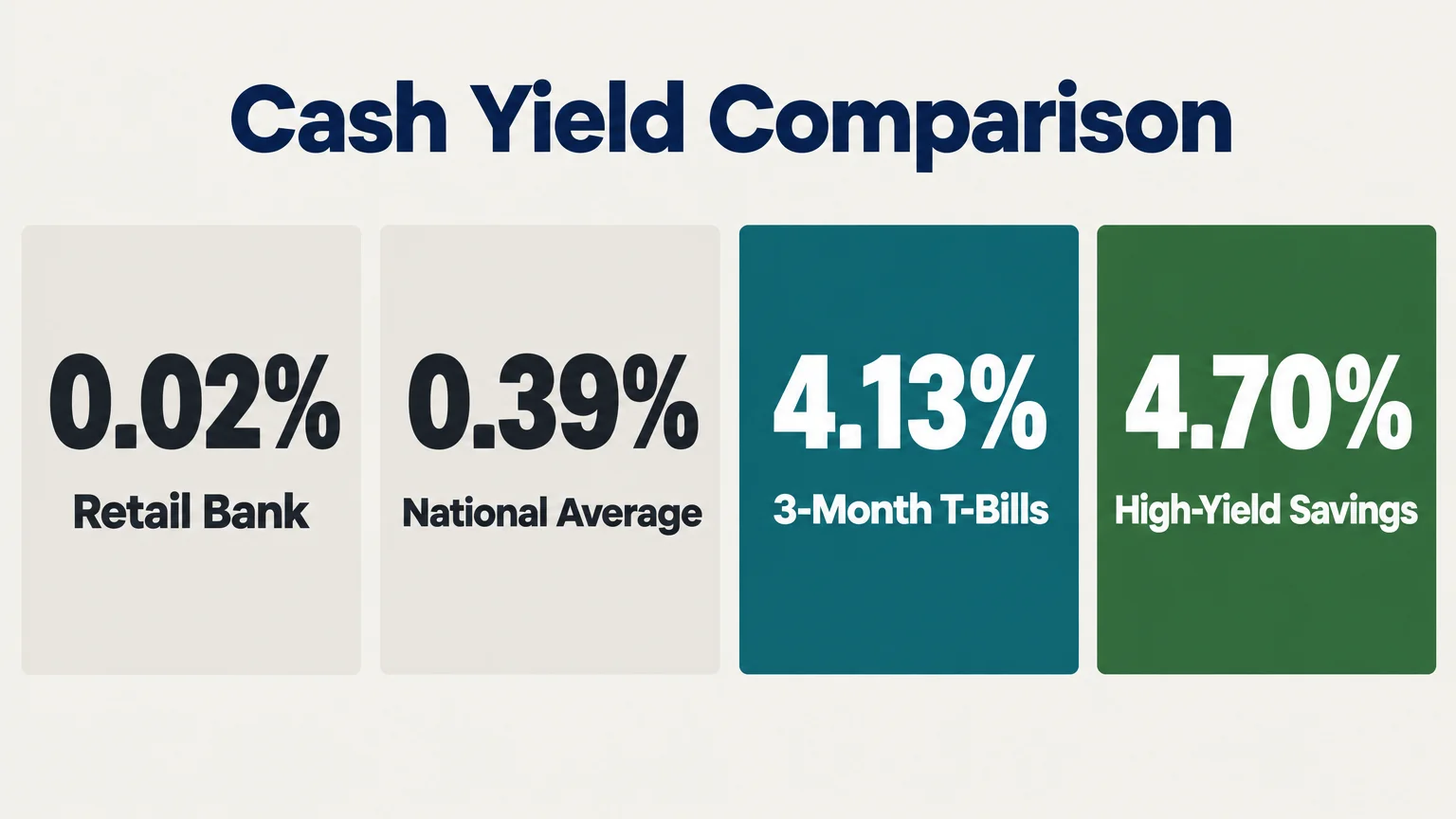
The FDIC national average savings rate sits at only 0.39% APY, while major retail bank branches often pay a meager 0.02%.
In contrast, competitive high-yield savings accounts yield up to 4.70% APY, and three-month Treasury bills offer rates around 4.13%.
Moving idle balances into competitive instruments turns your cash buffer into a reliable monthly income stream.
| Cash Vehicle | Typical Yield | Liquidity & Access | Best Senior Use |
|---|---|---|---|
| Traditional Bank Savings | 0.02% – 0.39% APY | Immediate | Daily checking buffer only |
| High-Yield Savings (HYSA) | Up to 4.70% APY | 1–3 business days | Emergency fund (3–6 months) |
| Short-Term U.S. Treasury Bills | 4.13% – 4.37% yield | Highly liquid secondary market | 1–2 years of planned living expenses |
Keep Investment Fees Rock-Bottom
Investment fees quietly siphon away your capital year after year.
Buffett has repeatedly urged everyday investors to avoid expensive active managers and rely instead on broad, low-cost index funds.
For example, the Vanguard S&P 500 ETF (VOO) charges an expense ratio of just 0.03%, allowing you to keep 99.97% of your gross investment returns.
A 1% advisory fee combined with active fund expenses can consume tens of thousands of dollars over a twenty-year retirement.
“By periodically investing in an index fund, for example, the know-nothing investor can actually outperform most investment professionals.” — Warren Buffett, Chairman Emeritus of Berkshire Hathaway
In addition to low costs, broad index funds provide regular income; the S&P 500 offered a trailing dividend yield of roughly 1.19% in late 2026.
Core Retirement Money Rules for Boomer Investing
Federal Reserve data shows that Baby Boomers hold $28.2 trillion in equities, representing the largest generational market share.
According to Fidelity, Boomers hold an average 401(k) balance of $260,300 and an average IRA balance of $286,700.
Yet Vanguard research reveals that only 40% of Boomers feel confident they can maintain their lifestyle in retirement.
Applying sensible retirement money rules inspired by Buffett helps you manage boomer investing decisions with clarity and discipline:
- Maintain a two-year liquidity bridge: Keep 12 to 24 months of essential expenses in high-yield savings or short-term Treasuries so you never sell stocks during a market dip.
- Stay within your circle of competence: Only invest in companies, funds, and financial instruments whose business models and risks you clearly understand.
- Prioritize steady cash flow over speculation: Seek profitable companies with durable competitive advantages and consistent dividend track records.
- Leverage available senior tax benefits: Claim the temporary $6,000 senior standard deduction under current law to lower taxable income on retirement withdrawals.
These straightforward guidelines help you protect your principal without taking uncomfortable risks.
What Can Go Wrong
Even sound retirement strategies can stumble if emotional impulses take control. Watch out for these four frequent traps:
- Panic-selling during market corrections: Dumping stocks after a decline locks in temporary paper losses and destroys long-term portfolio longevity.
- Missing Required Minimum Distributions (RMDs): Under IRS rules, RMDs begin at age 73. Missing your distribution brings a 25% penalty on the shortfall, though correcting it within two years reduces the penalty to 10%.
- Buying opaque, high-commission financial products: Expensive annuities and structured investments often carry steep surrender fees and limited liquidity. Check credentials and product details through FINRA.
- Hoarding cash in non-yielding accounts: Keeping excessive cash in a basic checking account guarantees that steady inflation erodes your purchasing power.
Avoiding these missteps ensures your assets remain productive and legally compliant throughout retirement.

When to Consult a Professional
Buffett champions independent, low-cost investing, but tax codes and distribution schedules often require professional expertise.
Consider consulting a qualified fee-only financial planner in these four specific situations:
- Structuring multi-account retirement withdrawals: Coordinating distributions across taxable, IRA, and Roth accounts reduces lifetime tax bills.
- Managing Roth conversions before RMDs begin: Shifting pre-tax funds into Roth accounts can prevent future tax bracket spikes and higher Medicare premiums.
- Maximizing the senior tax deduction: For tax years 2025 through 2028, the One, Big, Beautiful Bill Act provides a $6,000 senior deduction ($12,000 for couples) that phases out above $75,000 Modified Adjusted Gross Income ($150,000 joint).
- Updating complex estate directives: Creating trusts and beneficiary designations prevents costly delays for your heirs.
A professional review gives you peace of mind that your financial plan functions smoothly.
Frequently Asked Questions
Did Warren Buffett publish a seven-rule list for retirees?
No official list of seven retirement rules exists from Warren Buffett.
His insights come from decades of Berkshire Hathaway shareholder letters, focusing on low costs, patience, and staying within your circle of competence.
Should retirees adopt Buffett’s 90/10 portfolio strategy?
Most retirees should avoid allocating 90% of their savings to equities.
Buffett designated that mix for his wife’s estate, which will never need to liquidate shares during market declines to cover basic living expenses.
How much cash should you hold in retirement?
While Berkshire Hathaway holds over $300 billion in cash and Treasuries, individual retirees generally need one to two years of living expenses in liquid reserves.
This cash buffer shields you from needing to sell equities when stock prices temporarily drop.
Making Buffett’s Wisdom Work for You
Successful retirement investing does not require complex trading strategies or market timing.
By cutting unnecessary fees, securing competitive yields on cash reserves, and remaining patient, you can safeguard your financial future.
This is educational content based on general financial principles for seniors, and individual results vary based on your situation. Always verify current benefit amounts, tax rules, and program eligibility with official government sources.
Last updated: November 2026. Benefit amounts, tax rules, and program details change annually—verify current figures with official government sources.





Leave a Reply