

You could have thousands of dollars waiting in an old retirement account right now. An October 2026 survey by Empower revealed that roughly 1 in 3 Americans may have lost track of retirement savings from a former employer.
Reclaiming your stranded savings does not require hiring costly commercial search firms. Five free national registries and government tools can help you track down and recover your forgotten accounts today.
The Multi-Trillion-Dollar Pile of Left-Behind Savings
As of July 2025, approximately 31.9 million left-behind 401(k) accounts held an estimated $2.13 trillion in assets, according to research from Capitalize and the Center for Retirement Research. That represents about 25% of all 401(k) plan assets nationwide.
The average balance in a forgotten 401(k) rose to $66,691 in 2025, up from $56,616 just two years earlier. Bureau of Labor Statistics data shows late Baby Boomers held an average of 12.9 jobs between ages 18 and 58, explaining why accounts slip out of sight.
Why Old Retirement Accounts Get Stranded
Corporate acquisitions and company mergers occur constantly across corporate America. When companies merge and change recordkeepers, notice letters can bounce back as undeliverable mail if you moved without updating your address.
Under the SECURE 2.0 Act, employers can forcibly transfer or cash out balances up to $7,000 after December 31, 2023. Under DOL Field Assistance Bulletin 2025-01, active plans can transfer balances of $1,000 or less directly to eligible state unclaimed property divisions.
Method 1: Search the DOL Retirement Savings Lost and Found Database
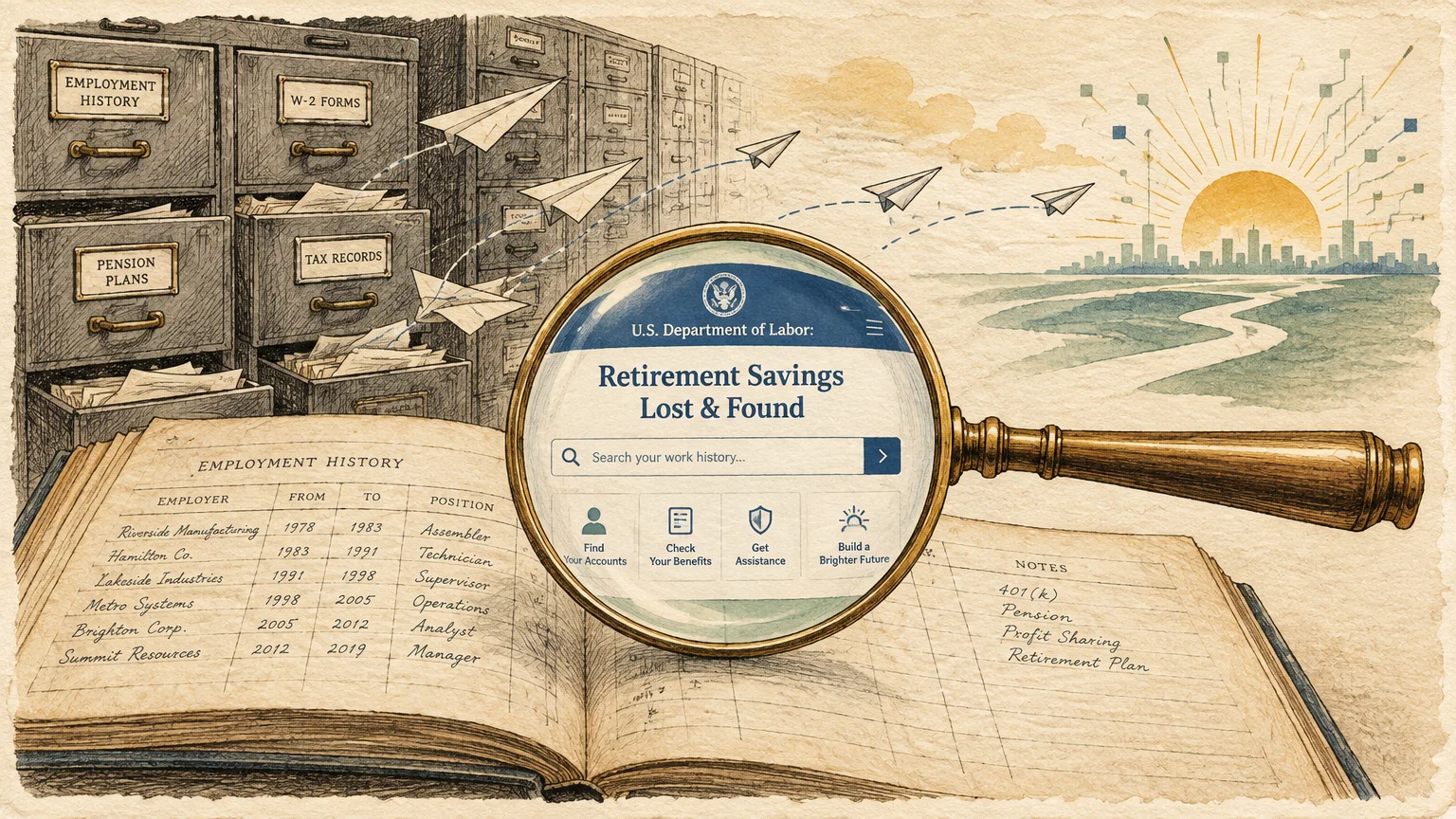
Mandated by the SECURE 2.0 Act of 2022, the Department of Labor established the official Retirement Savings Lost and Found Database at lostandfound.dol.gov. Searchers log in using an identity-verified Login.gov account to look up ERISA-covered private plans.
Because records rely on IRS Form 8955-SSA filings, the system currently displays results primarily for individuals age 65 and older. When it finds a match, it provides plan administrator contact details so you can request rollover paperwork.
Method 2: Check the PBGC Unclaimed Pensions Directory
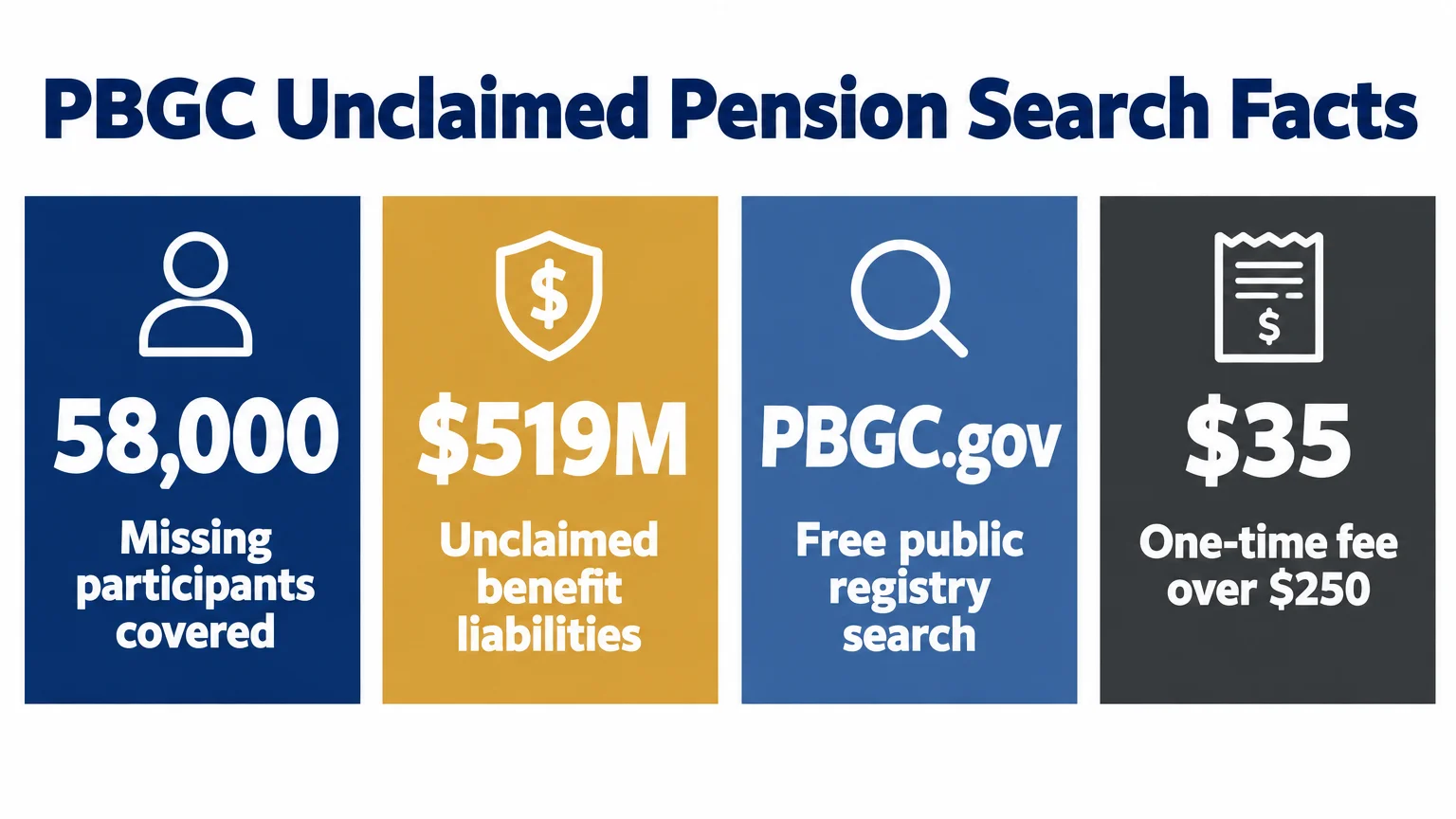
The Pension Benefit Guaranty Corporation (PBGC) protects private defined benefit pension plans and absorbs unclaimed benefits from terminated plans. According to its FY 2025 Annual Report, the Missing Participants Program covered 58,000 participants with $519 million in benefit liabilities.
You can search the registry for free at PBGC.gov using your name, company name, or Social Security number. For defined contribution balances, PBGC charges a one-time $35 administrative fee on transfers exceeding $250, while unclaimed funds accrue interest pegged to the Federal mid-term rate.
Method 3: Locate Terminated Plans via EBSA’s Abandoned Plan Registry
When company owners abandon operations without formal plan termination, employees cannot access their 401(k) balances. The Employee Benefits Security Administration (EBSA) Abandoned Plan Program authorizes custodial financial institutions to wind down orphaned plans and distribute funds.
Search the online database using your former employer’s name, plan name, or city to find the appointed Qualified Termination Administrator (QTA). If you need help, EBSA benefits advisors offer personalized assistance at 1-866-444-3272.
Method 4: Query State Unclaimed Property Registries and MissingMoney.com
When plan distribution checks remain uncashed for several years, state escheatment laws require transferring those funds to state treasuries. NAUPA reported that state unclaimed property programs returned $4.25 billion in financial property to consumers during fiscal year 2025.
Endorsed by NAUPA, MissingMoney.com offers a free multi-state search covering 49 states and the District of Columbia. Always search under current and prior legal names in every state where you lived or worked.
Method 5: Check Voluntary Databases and Prior Plan Custodians
All private employers operating retirement plans must file an annual Form 5500 with the Department of Labor and the Internal Revenue Service. You can search Form 5500 filings for free through EBSA to identify the current plan administrator and employer identification number (EIN).
Old Form W-2 records can also help, as Box 12 codes like “D” or “E” confirm past contributions. Once you identify the custodian—such as Fidelity, Charles Schwab, or Vanguard—contact them directly to search their historical records.
Comparing the Five Recovery Methods
Every recovery method serves a distinct purpose depending on your age, account size, and former employer status.
| Recovery Method | Best For | Account Types Covered | Verification Needed | Cost |
|---|---|---|---|---|
| DOL Lost & Found | Seniors age 65+ with past corporate jobs | Private 401(k)s & defined benefit pensions | Login.gov account & photo ID | Free |
| PBGC Directory | Terminated pensions & closed corporate plans | Defined benefit plans & some 401(k)s | SSN & employment documentation | Free ($35 fee on DC balances over $250) |
| EBSA Abandoned Plan | Companies that went out of business | Orphaned private-sector 401(k) plans | SSN & identity proof for QTA | Free |
| MissingMoney.com | Uncashed distribution checks under $1,000 | Escheated cash & mandatory distributions | State claim form & address proof | Free |
| Form 5500 / Custodians | Investigating active plan mergers and names | All ERISA employer retirement plans | Employer name or EIN | Free |
What to Do Once You Locate Your Lost Savings
Consolidating your savings into a single Traditional IRA or your current employer’s retirement plan simplifies ongoing management. Always request a direct trustee-to-trustee rollover so the funds move without automatic tax withholding.
If you take an indirect rollover check, the custodian must withhold 20% for federal income taxes. You must deposit 100% of the distribution into a new qualified account within 60 days, replacing the 20% from personal savings to avoid tax penalties. Visit Investor.gov for unbiased educational resources on portfolio allocation.
Pitfalls to Watch For
In 2026, retirees must begin taking annual Required Minimum Distributions (RMDs) from pre-tax accounts at age 73, rising to age 75 in 2033 under SECURE 2.0. Roth IRAs and designated Roth 401(k) accounts do not require lifetime distributions.
The IRS assesses an excise penalty of 25% on missed RMDs, though correcting the error within two years can reduce it to 10%. You can file IRS Form 5329 with a written explanation requesting a reasonable-cause waiver. Never pay upfront fees to commercial finder firms when public registries are free.

Getting Expert Help
Complicated circumstances require professional guidance from a Certified Financial Planner (CFP) or CPA. Consider an advisor if your balance involves multiple missed RMDs or a mix of pre-tax and after-tax non-deductible contributions.
Professional assistance is also valuable for inherited accounts subject to 10-year distribution rules. If your former employer underwent Chapter 7 bankruptcy without naming a QTA, a benefits attorney can help file a claim in bankruptcy court.
Frequently Asked Questions
Can my former employer legally keep my 401(k) money if I never claim it?
No, employers cannot legally confiscate your vested retirement contributions or earnings. If an employer cannot locate you, they must transfer your funds to a safe-harbor IRA, the PBGC, or a state unclaimed property fund.
How long does it typically take to recover funds from an abandoned plan?
Active plans typically process direct rollover paperwork within two to four weeks. If your plan entered EBSA’s Abandoned Plan Program or state unclaimed property custody, claims typically require sixty to ninety days.
Will I owe taxes simply for locating and claiming an old retirement account?
Locating and transferring an old account does not trigger taxes if you complete a direct trustee-to-trustee rollover. You will owe ordinary income taxes only if you cash out the balance rather than executing a direct rollover.
What documents do I need to prove ownership of an old account?
You should gather your Social Security card, government photo identification, proof of address, and past W-2 forms or plan statements. If you changed names, have your certified marriage certificate or legal name change decree ready.
Take Control of Your Retirement Assets Today
Your retirement savings represent decades of hard work. Running your information through these free government and national registries takes only a short time and could uncover thousands of dollars.
This article provides general financial education and information only; everyone’s financial situation is unique. For personalized advice tailored to your retirement needs, consider consulting a qualified financial professional such as a CFP or CPA.
Last updated: November 2026. Benefit amounts, tax rules, and program details change annually—verify current figures with official government sources.





Leave a Reply